

Global Smart Water Management Market Size and Forecast – 2026 To 2033
The global smart water management market is expected to grow from USD 19.75 Bn in 2026 to USD 50.34 Bn by 2033, registering a compound annual growth rate (CAGR) of 14.3% from 2026 to 2033. The global smart water management market growth is driven by growing concerns regarding water treatment and security.
On April 21, 2026, legal action was initiated by the U.S. Justice Department toward Washington, D.C., alongside its water and sewer authority, due to an incident involving a pipeline failure. Resulting from this breach, vast quantities of untreated waste entered the Potomac River. Financial sanctions are now being pursued as part of the response. The complaint stems from a massive leak in a 72-inch pipeline, called the Potomac Interceptor. The pipe collapsed on January 19, shooting sewage out of the ground and into the river just north of Washington in Montgomery County, Maryland.
(Source: The Associated Press)
Key Takeaways of the Global Smart Water Management Market
- The solutions segment is expected to account for 58.7% of the global smart water management market share in 2026. As urban areas adopt digital solutions, sensor arrays combined with artificial intelligence analyze water movement. In May 2025, Hyderabad’s water authority introduced an intelligent auditing setup relying on internet-connected flow sensors along with self-regulating valves. Information streams continuously - covering volume, purity, and disinfectant concentration - allowing officials to identify leaks, unauthorized taps, or supply gaps without delay. (Source: Times of India)
- The IoT segment is estimated to capture 41% of the market share in 2026. Connected devices help manage urban water systems by tracking supply, purity, and pipe conditions continuously. Early warnings emerge when irregularities appear, reducing loss through timely responses. During 2026, a nationwide rollout began in Singapore under PUB’s oversight - smart measuring units installed across homes and businesses. One such area, Punggol Northshore, became a testbed for sustainable living concepts developed by the Housing and Development Board (HDB). Infrastructure there adjusts dynamically, using sensor data on electricity demand and garbage levels. Adjustments support smoother operations within housing zones. (Source: GovTech Singapore)
- The industrial segment is projected to hold 43.2% of the smart water management market share in 2026. Beginning with sensor networks, industrial setups now track water flow through automated controls paired with analytical tools. These systems adjust operations to cut waste, refine purification steps, followed by aligning outputs with legal standards. Cost declines emerge alongside smaller ecological footprints due to such integration. During 2024, a shift occurred at Tata Steel’s Ferro Alloys and Minerals Division when it joined forces with FluxGen Sustainable Technologies from Bangalore. The partnership transformed existing pipelines into digitally monitored circuits using remote feedback loops. (Source: Tata Steel)
- North America is expected to dominate the smart water management market in 2026 with a share of 36.2%. In North America, updating outdated water networks has become central to smarter resource handling, and Chicago shows this shift clearly. Worn pipes below streets push utilities toward new tools: sensors spot leaks early; digital meters measure flow more accurately. In August 2025, Verizon collaborated with Chicago’s Center for Neighborhood Technology. The collaboration enabled both officials and residents track and monitor urban flood possibilities. (Source: PhysOrg)
- Asia Pacific is expected to account for 28% share in 2026 and is projected to record the fastest growth over the forecast period. Across the Asia Pacific region, growing pressure on urban water supplies pushes cities like Delhi to adopt new tools. Smart meters appear alongside internet-connected sensors, responding to sharp drops in underground reserves. In November 2025, the Delhi Jal Board (DJB) and IIT Kanpur signed a Memorandum of Understanding to develop India’s first AI-enabled water management system. (Source: IIT Kanpur)
- Municipal Water Supply: Water systems in cities grow smarter when digital tools track usage through connected devices. Owing to problems like leaks show up faster, fixes happen sooner. Real-time data guides how water moves across neighborhoods. Efficiency rises where supplies are stretched thin. Fair delivery becomes possible even as more people arrive.
- Industrial Manufacturing: Water use gets monitored automatically across sectors like steel, power, or chemical production through intelligent control setups. This networking reuses discharged fluids, adjusting how cooling and manufacturing steps function over time. Less fresh supply is needed due to tighter cycles that cut spending on daily tasks. Meeting ecological standards becomes easier when such methods are active within plants.
Segmental Insights
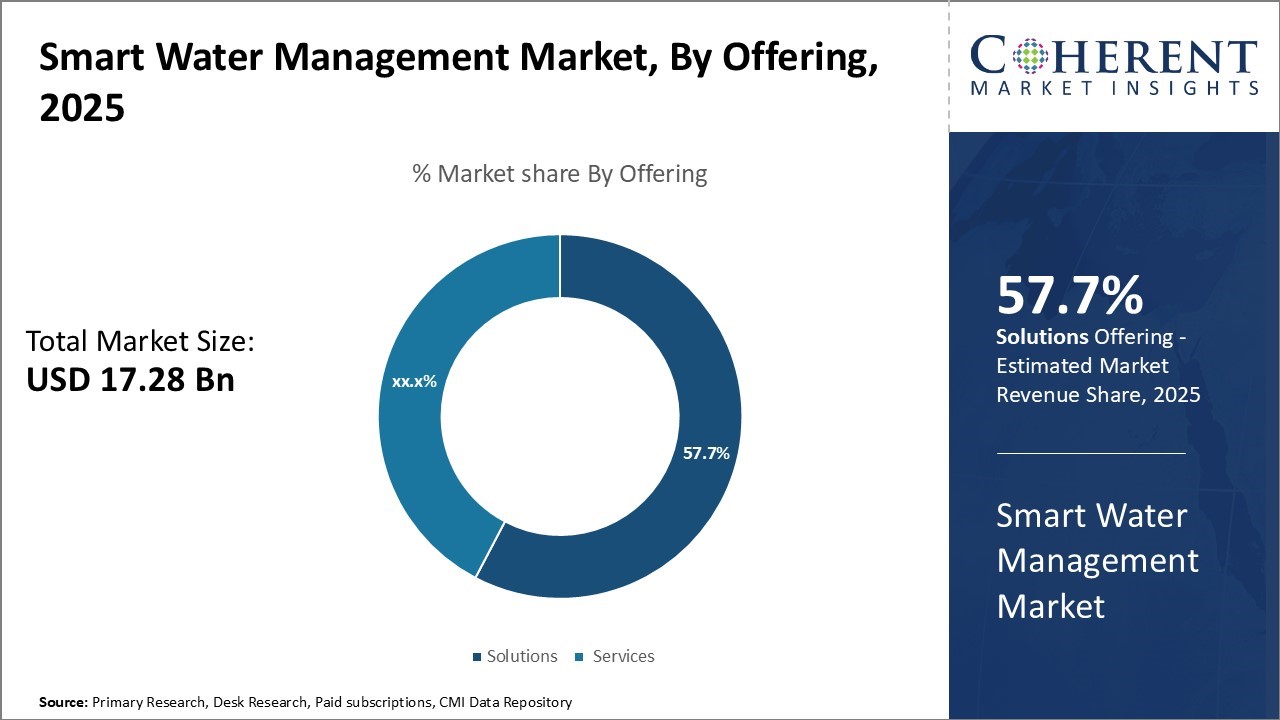
Why Does the Solutions Segment Dominate the Global Smart Water Management Market ?
The solutions segment is expected to account for 58.7% of the global smart water management market share in 2026. As utilities favor full systems over separate parts, solutions dominate the worldwide smart water sector. Where resources are tight, such as in Cape Town, or networks are complex, like in Chicago - digital platforms now link sensors, analytics, and controls into one flow. Issues including leaks, spikes in usage, or disruptions in delivery get found faster, acted on sooner. Entire setups outperform isolated devices, so interest grows not in pieces but in connected frameworks. On April 15, 2026, Chicago had recorded over 9 inches of precipitation this season, making it the city’s second-wettest spring on record, according to the University of Illinois State Water Survey. A flood watch was in effect for several Illinois counties and northwest Indiana as the threat of storms continued. (Source: Chicago Tribune)
Moreover, in December 2025, SUEZ reported that it had registered 7 million meters connected worldwide and over 1,500 customers using its smart water systems and platforms. From leak detection and breakdown prediction to intervention prioritization, AI brings a new level of responsiveness to increasingly demanding networks and strained resources.
(Source: SUEZ)
- Current Industry Events of 2026
- Market Size Estimation
- Regional Breakdown
- Competitive Landscape
- Customer Intelligence
- Segmental Analysis
- Pricing Analysis
- Key Market Drivers, Challenges & Future Trends
- Customized Insights Section
Why is IoT the Most Preferred Technology?
The IoT segment is expected to account for 41% of the global smart water management market share in 2026. Where networks exist, the continuous monitoring of infrastructure such as pipelines, reservoirs, and pump sites becomes silent practice. Human inspections matter less once live information streams take hold. In cities like Barcelona, water providers apply internet-connected pressure tools to locate tiny leaks swiftly across tangled underground layouts. Meanwhile, technology from firms including Xylem Inc. spots abnormal usage shifts almost immediately through automatic analysis. (Source: Tomorrow City)
In addition, the introduction of latest IoT enabled products is driving adoption across the globe. On May 28, 2024, Badger Meter announced the launch of BlueEdge, a unified, connected suite of solutions from Badger Meter that enables confidence in operations for global utility, commercial and industrial water customers.
(Source: Badger Meter)
Industrial Segment Dominates the Global Smart Water Management Market
The industrial segment is expected to account for 43.2% of the global smart water management market share in 2026. Heavy operations like steel production, energy generation, electricity plants, and chemical factories require vast amounts of water. Owing to this demand, oversight becomes essential. Regulatory frameworks, such as Clean Water Act and Water Framework Directive, now enforce strict standards for how efficiently water must be used. In July 2024, as part of its GreenUp strategic plan, Veolia expanded its leading Hubgrade portfolio by launching Hubgrade Water Footprint, an innovative digital solution designed to help industries reduce their water footprint, water-related energy use, and greenhouse gas emissions.
(Source: Veolia)
Currents Events and their Impact
Current Events | Description and its Impact |
Water Management Plan U. K. 2025 to 2026 |
|
Delhi Smart Metering Expansion (2025) |
|
Global Smart Water Management Market Dynamics
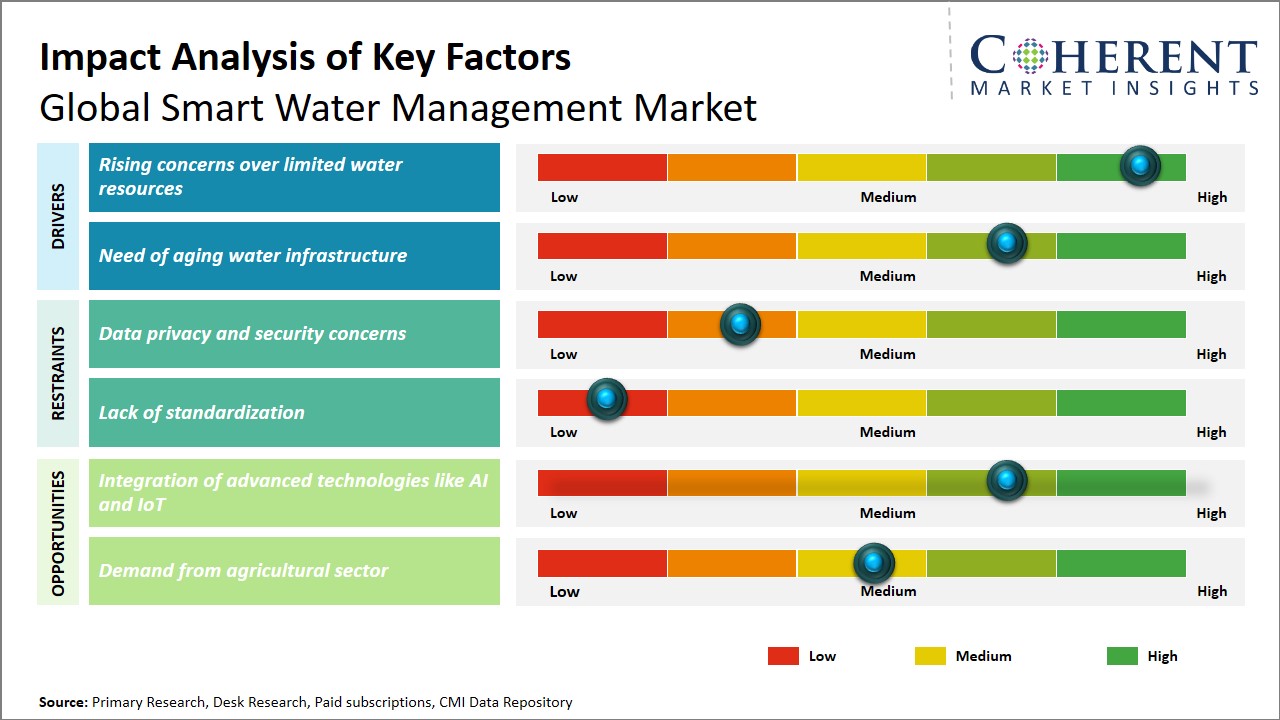
Market Drivers
- Rising concerns over limited water resources
Despite urban expansion, freshwater sources remain fixed worldwide. With populations rising in metropolitan zones, demand intensifies rapidly. Instead of growing, supply holds steady - no gain occurs. Depletion stems not only from excessive withdrawal but also flawed infrastructure, pollution, and altered climate behaviors across regions. Monitoring usage begins to matter more when unseen drips drain resources silently. Fixing weak pipelines becomes part of broader efforts to limit waste where it matters most. Gradually, decision-makers turn toward responsive technologies capable of guiding flow adjustments automatically. These setups assist operations without requiring constant human oversight.
Maintaining outdated frameworks pushes authorities to accept digital upgrades quietly. Efficiency gains emerge slowly under such shifts, often unnoticed at first. In early 2025, a report by The Times of India highlighted efforts in Lucknow where city officials began deploying a modern SCADA setup through the AMRUT initiative. Monitoring operations now occur instantaneously due to upgraded infrastructure. Control over pumping mechanisms operates without manual input, ensuring consistent delivery. Chlorine levels adjust automatically, maintaining safety standards across networks. Oversight happens from one central location, streamlining management tasks. Efficiency gains emerge alongside fewer interruptions in service provision. (Source: Times of India)
- Needs of aging water infrastructure
A majority of water supply networks across cities were set up several decades ago and are in dire need for upgrades to tackle challenges of the modern times. Deteriorating pipelines have been resulting in huge water losses, frequent pipe bursts and disruptions in supply. The infrastructure is also not equipped to deal with the rising demand pressures. Modernizing these aging systems with smart digital solutions are the need of the hour. Advanced technologies enable utilities to better monitor the condition of pipelines, proactively detect faults and schedule predictive maintenance. Sensor networks along the distribution network help locate and mitigate leaks faster. For example, in May 2025, the Times of India highlighted how the Nagpur Municipal Corporation, in collaboration with Orange City Water Pvt. Ltd., deployed Pushcam and Robocam inspection tools for underground pipelines. High-resolution robotic footage helps identify leaks, blockages, and contamination significantly improving repair efficiency and reducing water wastage. (Source: Times of India)
Emerging Trends
- AI + IoT Integration: Now appearing in utility networks, sensor data flows into AI tools that anticipate problems before they grow. Instead of just watching conditions, these setups detect patterns linked to coming pipe failures. Hours ahead, warnings emerge about possible bursts or unusual consumption jumps. With timing improved, repairs align closer to actual need. Less water escapes unnoticed, while system responses shift toward what might happen. Forecasting ability grows stronger as models learn from fresh inputs daily.
- Expansion of smart metering and real-time consumer analytics: One notable development involves the broad installation of intelligent water meters linked to online systems, allowing service providers to observe household and factory usage continuously. Because these tools transmit data automatically, adjustments in billing structures become possible alongside faster responses when flows suggest damage or waste. Unexpected shifts in demand are spotted sooner since information updates without delay through networked infrastructure.
Smart Water Meter Penetration vs Installed Base Gap
Region | Total Installed Water Meter Base | Smart Meter Penetration |
North America | ~120–150 million meters | 25–35% |
Europe | ~170–210 million meters | 35–50% |
Asia Pacific | ~300–400 million meters | 20–30% |
Latin America | ~60–75 million meters | 15–25% |
Middle East & Africa | ~50–70 million meters | 10–20% |
Regional Insights
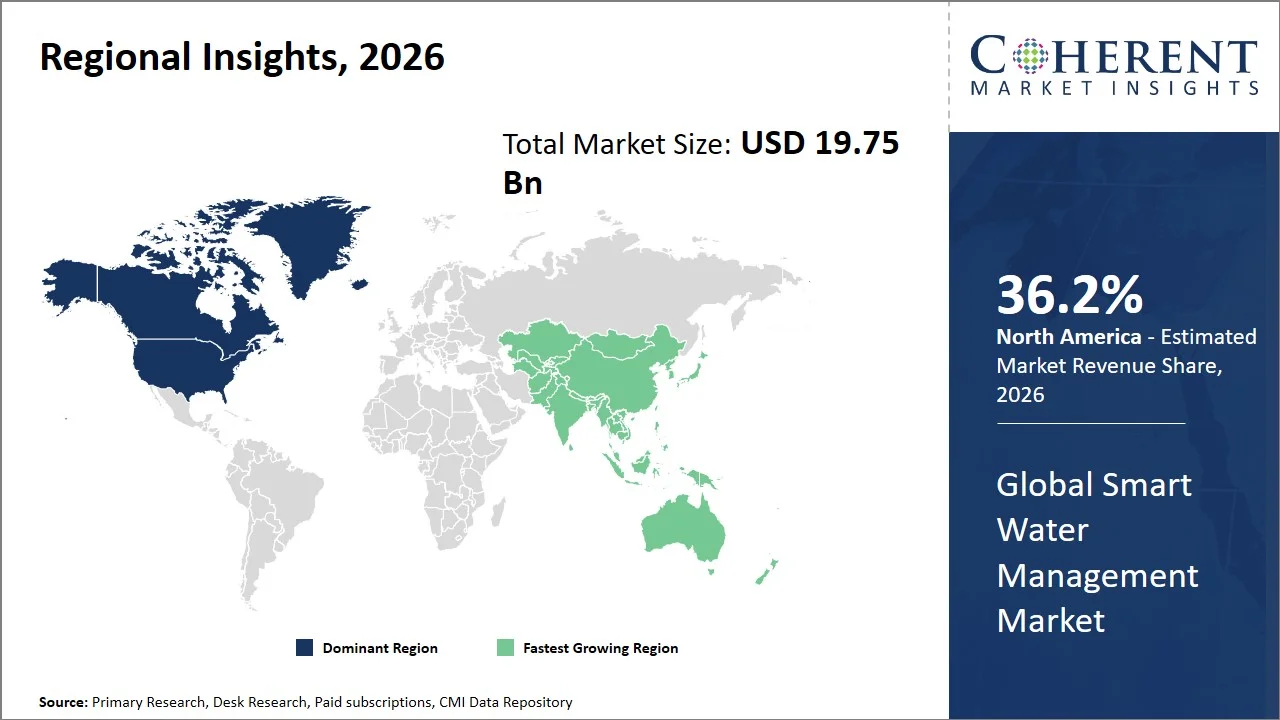
Why is North America a Strong Market for Smart Water Management?
North America is expected to account for a market share of 36.2% in 2026. Across North America, progress in smart water systems stems largely from widespread installation of artificial intelligence powered meters. Because aging pipelines continue to degrade, utility providers turn toward these tools to limit water loss and improve invoice precision. In urban centers throughout both the U.S. and Canada, new metering setups provide continuous usage insights, this enables faster identification of leaks alongside improved handling of supply needs.
In October 2025, Xylem expanded its U.S. footprint through partnerships that blend data with field operations. A recent pilot with Esri helped one utility report USD 70 million in savings and a fourfold reduction in pipeline failures. Grundfos, meanwhile, bolstered its North American presence in August 2025 by acquiring modular treatment firm Newterra, integrating real-time monitoring with energy-efficient purification. (Source: Smart Water Utilities USA)
Why Does Asia Pacific Smart Water Management Market Exhibit High Growth?
Asia Pacific is expected to account for a market share of 28% in 2026 and is expected to register the fastest growth rate over the forecast period. Despite varied terrain, digital sensors now track water movement across parts of Asia Pacific and Oceania with growing precision. Where populations rise fast, nations like China, India, and Singapore install networked devices to monitor supply conditions minute by minute. Instead of waiting for failures, operators receive live updates on pressure shifts, contamination risks, or pipe leaks. Through constant feedback, city planners adjust usage patterns before shortages become critical. Over time, these inputs support better decisions about maintenance, allocation, and system upgrades. With pressures mounting on freshwater access, automated oversight offers one path toward steadier delivery.
In March 2025, the GSMA in partnership with the WASH Innovation Hub at the Administrative Staff College of India, convened the Digital Urban Utilities Forum (DUUF) in response to Bengaluru’s escalating water crisis, bringing together water sector experts, ecosystem enablers and startups, to explore digital innovations for sustainable solutions to the city’s water challenges. The forum’s discussions centered on emerging technology solutions from AI-driven groundwater monitoring and IoT-enabled borewell management to smart metering and water reuse. (Source: GSMA)
Why is U.S. Emerging as a Major Hub in the Smart Water Management Market?
Emerging slowly but steadily, the U.S. now plays a central role in shaping how cities manage water through intelligent technology. Outdated networks once prone to inefficiency are being replaced - sensors and connected devices now track flow with precision, one city at a time. Utilities turn to tools like Xylem’s platforms not out of trend, but necessity: detecting unseen leaks helps conserve what cannot be spared. Regulation acts as a quiet force behind progress; mandates from governing bodies push agencies toward tighter control over waste. Real-time oversight grows more common, where artificial intelligence scans patterns others might overlook. Pressure builds differently across regions like California and Texas; broken pipes and long dry spells reshape priorities without announcement.
Is India the Next Growth Engine for the Smart Water Management Market?
With India stepping into a stronger role within the global smart water sector, national efforts such as the Jal Jeevan Mission introduce digital tools across villages, where internet-connected devices track usage and enhance delivery accuracy. Instead of relying on outdated methods, some regions now rely on continuous data flow from remote monitors installed in pipelines to identify faults early. From Delhi onward to Bengaluru, local authorities respond to shrinking underground reserves through automated sensing technologies that highlight irregular consumption patterns. Rather than waiting for failures, utility providers observe network behavior minute by minute, adjusting responses based on incoming signals. Alongside these shifts, experimental setups involving live feedback from water-quality detectors reshape how city planners approach infrastructure oversight. (Source: Jal Jeevan Mission)
Mexico Smart Water Management Market Analysis and Trends
The smart water management market in Mexico is expanding due to growing water scarcity and aging infrastructure, which are pushing utilities to adopt IoT-based smart meters, sensors, and real-time monitoring systems to better control losses and improve efficiency. For example, municipal water operators in cities like Mexico City are increasingly using digital monitoring tools to detect leaks and track consumption patterns more accurately. This shift is also being supported by smart city initiatives and regulatory efforts aimed at improving water conservation and modernizing water distribution systems. In March 2026, Holcim announced plans to invest USD 20 Million by 2027 to expand its infrastructure and technology for water management. The planned expenditure supports Holcim’s expressed goal of reducing water extraction across all its Mexico operations by up to 33% by 2030. (Source: Mexico News Daily)
Growth within China’s water sector now leans heavily on digital tools, as cities reshape utility functions through modern tech. Instead of traditional methods, sensor grids linked via internet protocols gather constant updates on pressure, volume, and purity levels across pipelines. Artificial intelligence steps in to interpret patterns, while remote dashboards host live views of system performance. Huawei plays a role here - not by building pipes - but by supplying connectivity frameworks that pull sensor outputs into unified command interfaces. In Shenzhen, one outcome takes form as virtual pipe maps that flag leaks almost instantly, adjust supply based on predicted need, and regulate flow without manual input. This shift does not rely on slogans; it reflects an operational pivot - where decisions emerge from streams of analyzed information rather than routine checks. (Source: GWI)
South Africa Smart Water Management Market Analysis and Trends
The smart water management market in South Africa is growing steadily, driven by severe water scarcity, aging infrastructure, and high levels of non-revenue water (around 47%), which are pushing municipalities and industries toward digital solutions like smart meters, IoT monitoring, and leak detection systems. A recent example (2026) is the increasing adoption of data-driven smart metering by municipalities, enabling real-time monitoring, improved billing accuracy, and faster leak detection to reduce water losses and improve efficiency. These developments, alongside industry initiatives such as advanced recycling and closed-loop systems in sectors like bottled water production, highlight a market shift toward technology-enabled, sustainable water management solutions. (Source: Engineering News)
Non-Revenue Water (NRW) Loss Benchmarking By Region
Region | Average NRW (%) | Example |
North America | 15–20% | U.S. utilities lose ~19.5% of treated water mainly due to leakage and pipe deterioration |
Western Europe | 10–25% | Countries like Germany and Netherlands maintain low NRW through advanced monitoring |
South Asia | 25–45% | India and Pakistan show significant unbilled and leakage losses |
Middle East & North Africa (MENA) | 30–55% | NRW worsens stress on already limited freshwater resources |
Pacific Islands | 40–80% | Some islands experience very high technical losses |
How is increased demand from agricultural sector creating new growth opportunities in the global smart water management market?
Growth within the smart water management industry finds strong momentum from farming activities, given agriculture consumes more fresh water than any other domain; dwindling supplies now push a shift toward accurate watering methods. In India, national programs linked to Pradhan Mantri Krishi Sinchayee Yojane promote internet-connected drip solutions, which rely on ground humidity detectors to deliver fluid solely during plant need periods, thus limiting excess while lifting output levels. (Source: PIB)
Just as elsewhere, across vast farms in California, networked sensors and intelligent valves now track ground moisture nonstop. Instead of fixed routines, watering adjusts on its own through live data flows. With such tools, crop growers respond to dry spells more precisely. Efficiency rises when every drop is guided by actual need. As a result, interest grows in digital systems that handle water with finer control. Demand shifts toward technologies capable of field-level adaptation. Outcomes depend less on guesswork, more on measured feedback loops.
Market Players, Key Development, and Competitive Intelligence
Key Developments
- On September 11, 2025, the cities of Mexico City and Monterrey announced a collaboration with Xylem Inc and Amazon to deploy Xylem Vue, an advanced software platform that applies data and analytics to detect leaks, cut water losses and improve residents’ water supply. The projects are estimated to save upwards of 800 million liters of water a year in Mexico City and 560 million liters a year in Monterrey.
- On May 13, 2024, Siemens expanded its software portfolio for the water industry, enabling its customers to optimize their plant operations using artificial intelligence - without the need for technical expertise. These self-service solutions enable users to address the most pressing issues in water and wastewater operations: reducing water loss, preventing pollution from sewers, and ensuring the reliability of treatment assets.
Competitive Landscape
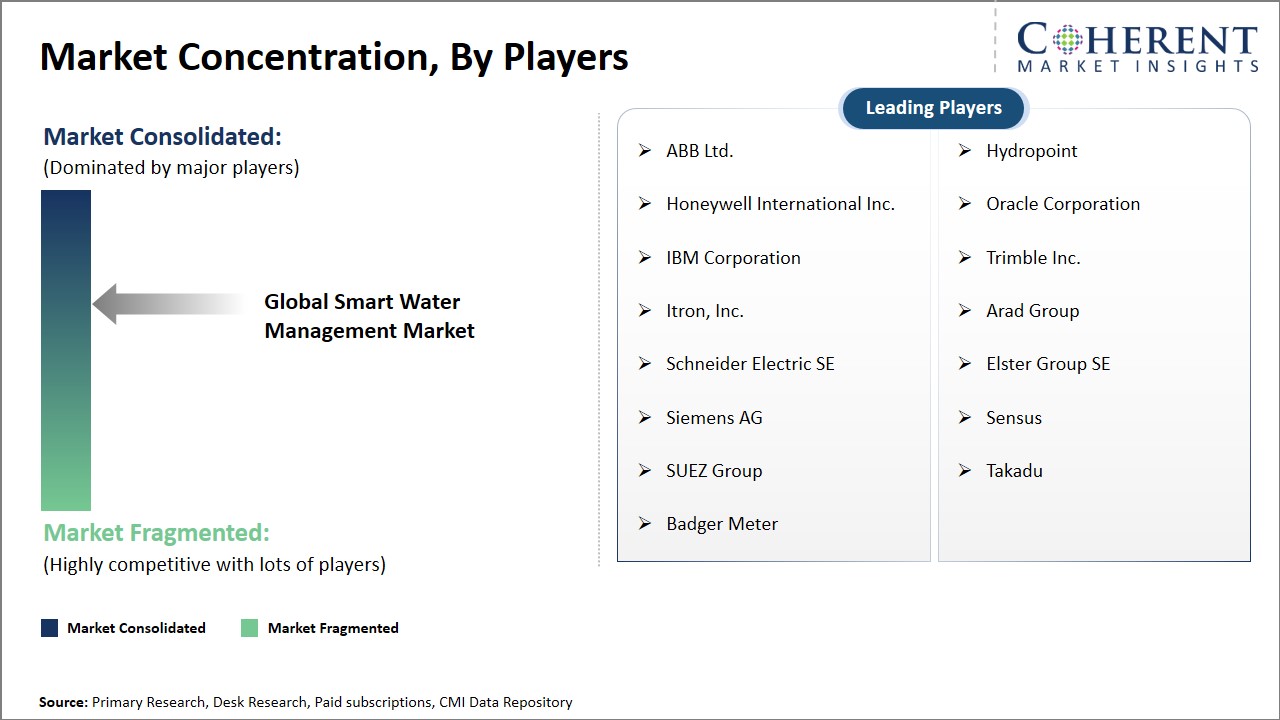
The global smart water management market is characterized by intense competition and a moderately consolidated structure, with major global players such as Xylem Inc., Siemens AG, Itron Inc., Schneider Electric, SUEZ, and Veolia leading the sector through integrated IoT, AI, and smart metering solutions. Offering full-scale digital tools for water oversight marks the main path taken by leading firms, these cover fault prediction, pipeline monitoring, and network efficiency. Their standing grows further via alliances, takeovers, or joint efforts with public supply operators. On another note, local and compact organizations focus sharply on niche advancements like smart sensors, online tracking platforms, or precision watering methods. Such activity feeds a landscape shaped by fresh ideas, yet divided into many small segments.
Market Report Scope
Smart Water Management Market Report Coverage
| Report Coverage | Details | ||
|---|---|---|---|
| Base Year: | 2025 | Market Size in 2026: | USD 19.75 Bn |
| Historical Data for: | 2020 To 2024 | Forecast Period: | 2026 To 2033 |
| Forecast Period 2026 to 2033 CAGR: | 14.3% | 2033 Value Projection: | USD 50.34 Bn |
| Geographies covered: |
| ||
| Segments covered: |
| ||
| Companies covered: | ABB Ltd., Honeywell International Inc., IBM Corporation, Itron, Inc., Schneider Electric SE, Siemens AG, SUEZ Group, Badger Meter, Hydropoint, Oracle Corporation, Trimble Inc., Arad Group, Elster Group SE, Sensus, and Takadu | ||
| Growth Drivers: |
| ||
| Restraints & Challenges: |
| ||
Analyst Opinion (Expert Opinion)
- The smart water management market plays an important role in strengthening global water security, as it addresses challenges such as ageing infrastructure, increasing water scarcity, and growing urban demand. Little by little, water services shift toward digital tools such as IoT, artificial intelligence, and cloud computing, forming smarter networks capable of instant analysis and forward-looking choices. With devices including intelligent meters and sensing arrays becoming standard fixtures, loss prevention improves while operational strength grows under pressure. These components support efficiency not through novelty but consistent function within modern infrastructure.
- Automation in water systems may grow, shaped largely by IoT. Self-adjusting networks could emerge as artificial intelligence becomes common. Advanced analytics might play a central role, shifting how infrastructure responds to demand. What comes next depends on data flow, not manual input. Efficiency gains would stem from continuous monitoring, replacing periodic checks. Systems will adapt, driven by real-time inputs rather than fixed rules. Increasing concerns about water scarcity, climate change, and ageing infrastructure are expected to further accelerate investments in smart metering, leak detection, and predictive maintenance technologies. Over time, utilities and industries are anticipated to transition toward fully integrated digital water systems, where real-time data and automation are central to achieving efficient, sustainable, and resilient water management.
Speak to the analyst
Want personalized insights?
Take the findings above to one of our principal consultants, or have the report rebuilt around the segments, geographies and competitors you actually track.
Market Segmentation
- Offering Insights (Revenue, USD Billion, 2021 - 2033)
- Solutions
- Services
- Technology Insights (Revenue, USD Billion, 2021 - 2033)
- IoT
- Artificial Intelligence and Machine Learning
- Cloud Computing
- Big Data Analytics
- Others
- End User Insights (Revenue, USD Billion, 2021 - 2033)
- Industrial
- Commercial
- Residential
- Regional Insights (Revenue, USD Billion, 2021 - 2033)
- North America
- U.S.
- Canada
- Latin America
- Brazil
- Argentina
- Mexico
- Rest of Latin America
- Europe
- Germany
- U.K.
- Spain
- France
- Italy
- Russia
- Rest of Europe
- Asia Pacific
- China
- India
- Japan
- Australia
- South Korea
- ASEAN
- Rest of Asia Pacific
- Middle East
- GCC Countries
- Israel
- Rest of Middle East
- Africa
- South Africa
- North Africa
- Central Africa
- North America
- Key Players Insights
- ABB Ltd.
- Honeywell International Inc.
- IBM Corporation
- Itron, Inc.
- Schneider Electric SE
- Siemens AG
- SUEZ Group
- Badger Meter
- Hydropoint
- Oracle Corporation
- Trimble Inc.
- Arad Group
- Elster Group SE
- Sensus
- Takadu
Sources
Primary Research Interviews
- Smart water technology solution providers
- Water utility companies and municipal authorities
- IoT and sensor technology manufacturers
- System integrators and software developers
Databases
- Global Water Intelligence Database
- International Water Association (IWA) Database
- World Bank Water Database
- Smart Cities Database
Magazines
- Water & Wastewater International
- Smart Water Magazine
- Water Technology Magazine
- Municipal Water Leader
Journals
- Journal of Water Resources Management
- Water Research Journal
- Smart Cities and IoT Journal
Associations
- International Water Association (IWA)
- Water Environment Federation (WEF)
- American Water Works Association (AWWA)
- Smart Cities Council
Public Domain Sources
- EPA Water Infrastructure Reports
- UN Water Development Reports
- OECD Water Governance Reports
- Government water management policies
Proprietary Elements
- CMI Data Analytics Tool
- Proprietary CMI Existing Repository of information for last 10 years
Get access to 250+ pages report
Every segment, forecast, competitor profile and data table behind the analysis above — available for instant download.
- ESOMAR Member
- ISO 9001:2015 Certified
- D-U-N-S Registered
- GDPR & CCPA Compliant
Missing comfort of reading report in your local language? Find your preferred language:
Transform your Strategy with Exclusive Trending Reports
Frequently Asked Questions
The global smart water management market is expected to stand at USD 19.75 Bn in 2026 and is expected to reach USD 50.34 Bn by 2033.
The CAGR of the global smart water management market is projected to be 14.3% from 2026 to 2033.
Rising concerns over limited water resources and needs of aging water infrastructure are the major factors driving the growth of the global smart water management market.
Data privacy and security concerns and lack of standards are the major factors hampering the growth of the global smart water management market.
In terms of offering, solutions are estimated to dominate the market revenue share in 2026.
As chip nodes shrink, stricter purity requirements increase the need for high-performance filtration systems.
AI helps predict leaks, optimize water distribution, and improve decision-making in utilities.