

Automated Parcel Delivery Terminals Market Analysis & Forecast
Automated Parcel Delivery Terminals Market is estimated to be valued at USD 1,198.9 Mn in 2026 and is expected to reach USD 2,820.6 Mn in 2033, exhibiting a compound annual growth rate (CAGR) of 13.0% from 2026 to 2033.
Key Takeaways
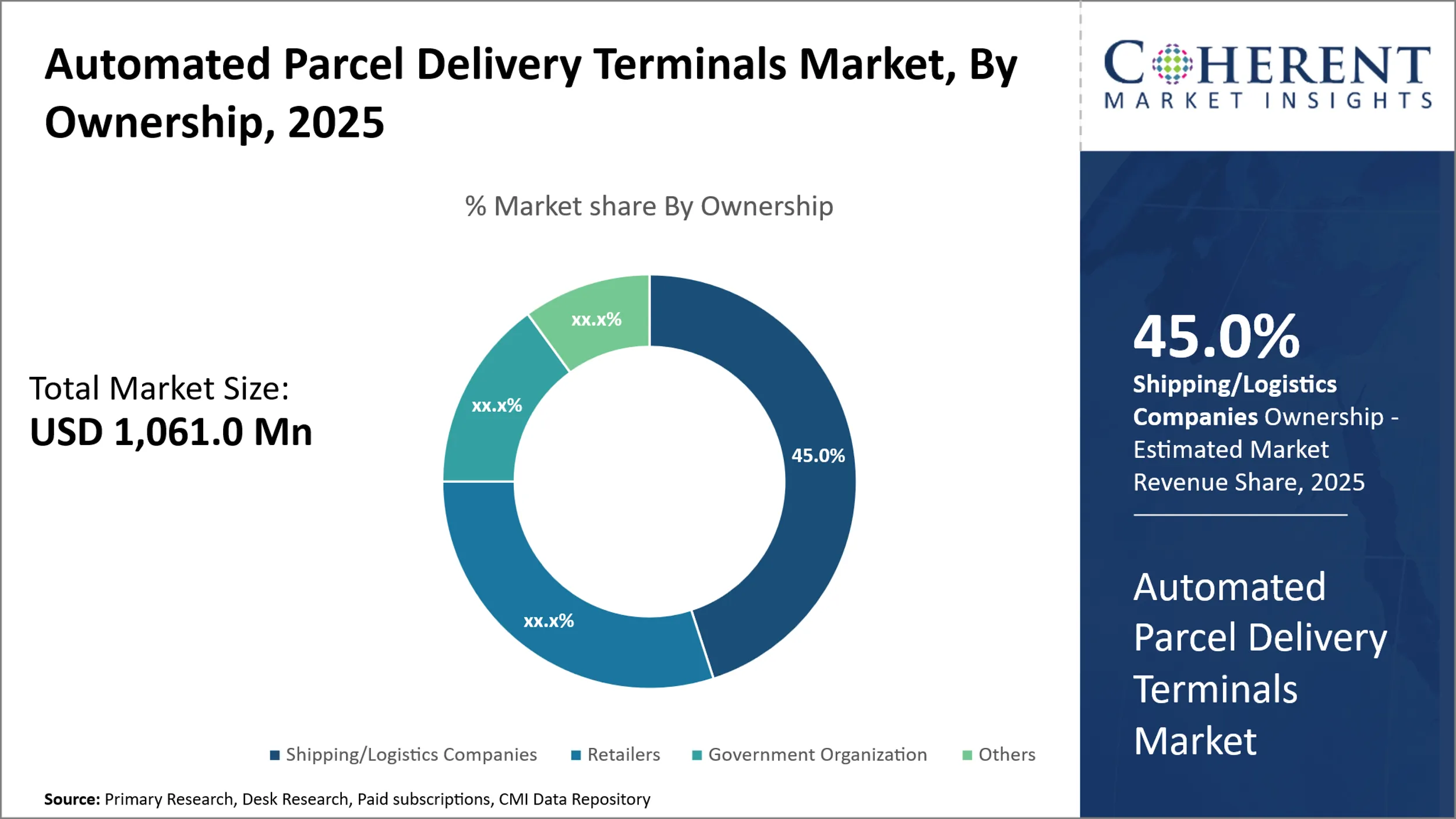
- According to Ownership, The Shipping/Logistics Companies Segment is anticipated to hold major share of 46.0% for the Automated Parcel Delivery Terminals market in 2026.
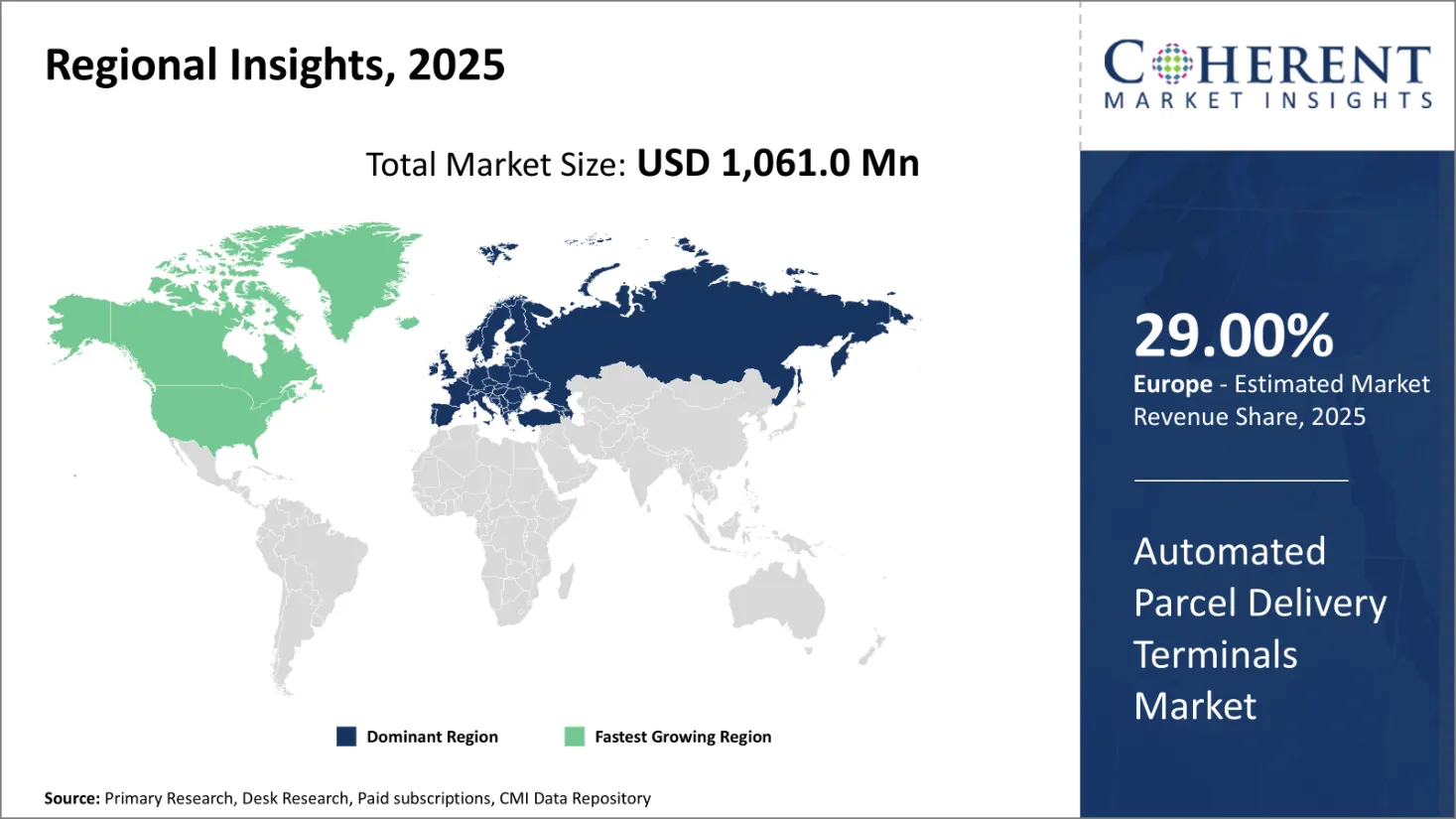
- Europe is considered to be the most dominating region with 29% for Automated Parcel Delivery Terminals market by 2026.
Market Overview
The Automated Parcel Delivery Terminals Market Size has experienced significant growth as a result of the rise in e-commerce and the growing need for easy, contactless delivery options. The Automated Parcel Delivery Terminals Market is a rapidly growing market driven by the increasing demand for efficient and contactless delivery solutions. These terminals, also known as automated lockers or smart lockers, offer a convenient and secure way for consumers to receive their parcels, while enabling businesses to streamline their last-mile delivery operations. The market's growth is fueled by several factors, including the rising e-commerce industry, urbanization, and the need for flexible and convenient delivery options.
Current Events and Its Impact on the Automated Parcel Delivery Terminals Market
Event | Description and Impact |
Massive deployment of parcel lockers in China |
|
Surge in e-commerce and contactless delivery demand |
|
Pricing Analysis
The pricing landscape for automated parcel delivery terminals is shaped by several key factors, including initial capital expenditure, ongoing maintenance, and technological integration. Establishing a network of these terminals requires significant upfront investment for equipment purchase, installation in strategic locations, and integration with logistics and IT infrastructure.
Ongoing costs include regular maintenance, software updates, and security enhancements to ensure operational reliability and user safety. These expenses can present a substantial barrier to entry, particularly for smaller retailers and logistics companies.
- Current Industry Events of 2026
- Market Size Estimation
- Regional Breakdown
- Competitive Landscape
- Customer Intelligence
- Segmental Analysis
- Pricing Analysis
- Key Market Drivers, Challenges & Future Trends
- Customized Insights Section
Role of Emerging Technology
- Emerging technologies are playing a transformative role in the automated parcel delivery terminals market. Innovations in IoT, AI, and mobile applications are enhancing the convenience, security, and efficiency of these terminals.
- For instance, real-time tracking, contactless authentication, and automated sorting powered by AI are streamlining parcel handling and improving the customer experience. The integration of smart lockers with mobile apps allows users to receive notifications, track deliveries, and access parcels securely at any time.
Segmental Insights
Automated Parcel Delivery Terminals Market Insights, By Ownership
In terms of ownership, the shipping/logistics companies segment is expected to contribute largest share of the Automated Parcel Delivery Terminals market trends in 2026. The shipping and logistics companies segment plays a dominant role in the automated parcel delivery terminals market. These companies face significant challenges due to failed delivery attempts, which lead to extra expenses such as repeated delivery trips, increased fuel consumption, and longer delivery times.
Automated parcel delivery terminals address these issues by providing centralized, secure locations for parcel drop-offs and pickups, allowing customers to retrieve their packages conveniently and reducing the need for multiple delivery attempts. This not only improves operational efficiency but also decreases transportation costs and enhances overall service reliability, especially in remote or hard-to-reach areas.
Automated Parcel Delivery Terminals Market Insights, By Deployment Type
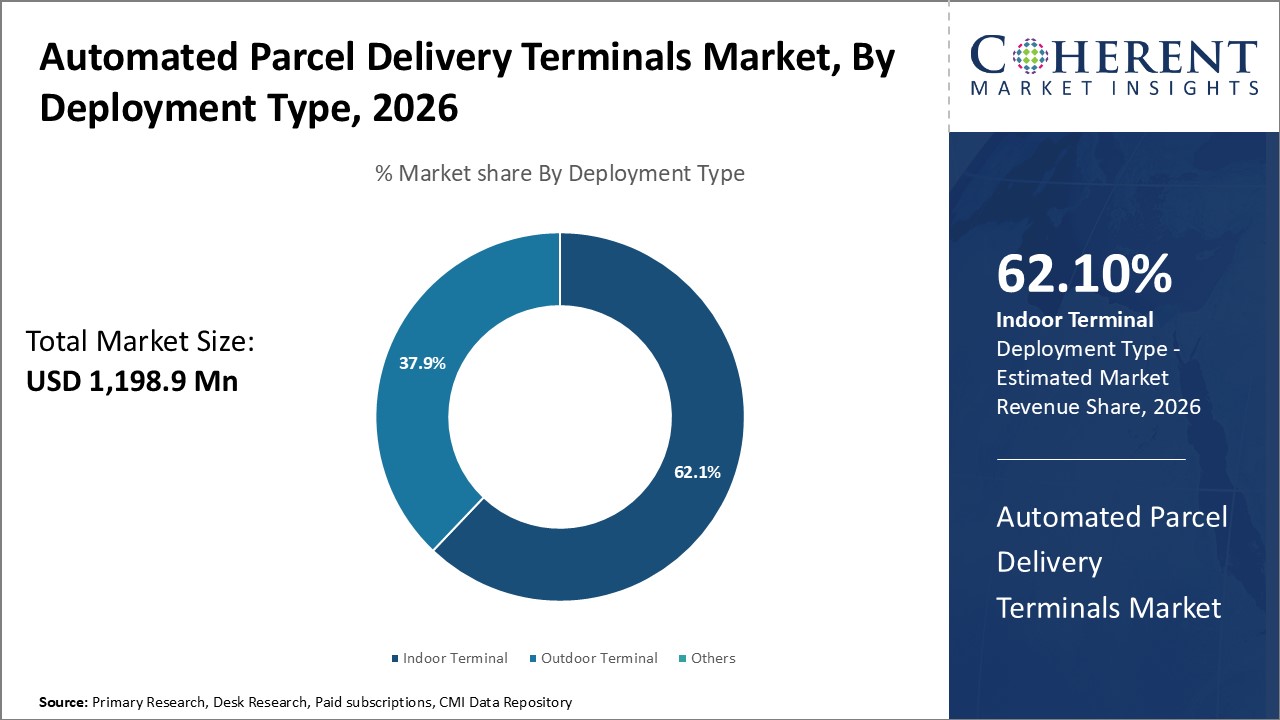
In terms of deployment type, the indoor terminal segment is expected to contribute largest share of the Automated Parcel Delivery Terminals market trends in 2026. Indoor terminals are typically installed within buildings such as shopping malls, residential complexes, offices, and transit hubs. This placement shields them from adverse weather conditions and reduces the risk of theft or vandalism, ensuring parcels remain secure and undamaged.
Regional Insights
Europe Automated Parcel Delivery Terminals Market
Europe has historically been the dominant region as it drives major Automated Parcel Delivery Terminals Market Trends. Indoor terminals represent the largest and fastest-growing segment, reflecting the demand for secure, convenient, and accessible parcel collection points in residential complexes, retail centers, and transport hubs.
Key players in the European market include Smartbox, KEBA AG, Cleveron, Quadient SA, TZ, Bybox, Bell and Howell, and InPost. The market is also witnessing significant investment in AI-enabled delivery systems, advanced tracking technologies, and cloud-based management to enhance operational efficiency and user experience.
North America Automated Parcel Delivery Terminals Market
In the U.S. and Canada, parcel lockers have become an integral part of retail stores, transit hubs, and residential complexes, with companies like Amazon, FedEx, and UPS deploying extensive networks of automated terminals to minimize failed deliveries and optimize delivery operations.
The North America market is also witnessing rapid technological advancements, such as the integration of AI-driven sorting, contactless authentication, and the use of drones for parcel drop-ins, all of which are propelling further market expansion. Additionally, the region’s focus on urbanization and the need to decongest delivery hubs are prompting logistics providers to invest heavily in automated parcel delivery infrastructure, positioning North America as a leading market for these solutions.
Automated Parcel Delivery Terminals Market In Asia Pacific
Japan and South Korea have also seen substantial year-on-year increases in APDT installations, supported by collaborations between logistics firms and local authorities, and the integration of AI-driven scheduling systems to manage high package volumes efficiently. Sustainability is another key driver, with initiatives like Singapore’s Green Plan 2030 encouraging the use of smart lockers to reduce carbon emissions from delivery vehicles.
Automated Parcel Delivery Terminals Market Dominating Countries
U.S Automated Parcel Delivery Terminals Market
The U.S. market benefits from advanced technology integration, including AI-driven sorting, contactless authentication, and drone-assisted parcel drop-ins, which enhance operational efficiency and user convenience. These innovations, combined with a strong focus on customer experience and operational cost reduction, position the U.S. as a key innovator and early adopter in the global market.
India Automated Parcel Delivery Terminals Market
India's automated parcel delivery terminals market is experiencing robust growth, fueled by the country's booming e-commerce sector and increasing urbanization. The surge in online shopping, particularly in metropolitan areas, has created a pressing need for efficient, contactless, and scalable last-mile delivery solutions.
Automated Parcel Delivery Terminals Market In China
China stands out as a dominant player in the automated parcel delivery terminals market, underpinned by its massive e-commerce industry and government support for smart city initiatives. Leading logistics companies, such as Cainiao Network (Alibaba), have deployed vast networks of parcel lockers across the country, with over 100,000 terminals installed to handle the unprecedented surge in parcel volumes.
Market Report Scope
Automated Parcel Delivery Terminals Market Report Coverage
| Report Coverage | Details | ||
|---|---|---|---|
| Base Year: | 2025 | Market Size in 2026: | USD 1,198.9 Mn |
| Historical Data for: | 2020 To 2024 | Forecast Period: | 2026 To 2033 |
| Forecast Period 2026 to 2033 CAGR: | 13.0% | 2033 Value Projection: | USD 2,820.6 Mn |
| Geographies covered: |
| ||
| Segments covered: |
| ||
| Companies covered: | Winnsen Industry Co., Ltd., LL OPTIC (Loginpost), Keba AG, ENGY Company, Cleveron Ltd., ByBox Holdings Ltd., Neopost group, TZ Ltd., Smartbox Ecommerce Solutions Pvt. Ltd., and InPost S.A. | ||
| Growth Drivers: |
| ||
| Restraints & Challenges: |
| ||
Automated Parcel Delivery Terminals Market: Growth Drivers
- Growing Demand for Alternative Delivery Solutions
Global automated parcel delivery terminals market is expected to witness significant growth during the forecast period, due to rising demand for alternative delivery solutions. As e-commerce continues to expand at a rapid pace, so is parcel delivery, putting tremendous pressure on traditional delivery methods.
Automated delivery terminals are an efficient and innovative solution that are strategically placed in congested areas such as shopping malls, airports, and train stations to provide consumers with unprecedented convenience and accessibility, regardless of opening hours or return times. This 24/7 accessibility perfectly meets the needs of busy city dwellers and contributes to overall customer satisfaction.
The integration of cashless payment options via credit/debit cards ensures seamless and secure transactions, and thus, increases the appeal of these automated systems for both logistics service providers and consumers.
For instance, on July 27 2023, Clevon, a global autonomous delivery startup, has introduced a commercial service in Northlake, Texas. The company manufactures self-driving robot carriers and collaborates with PostNet to offer delivery services to customers. After successful testing, the service is now accessible to local residents living near the PostNet office, providing convenient doorstep parcel deliveries. Scheduled between Monday and Friday, deliveries take place from 9 AM to 5 PM within a few miles radius.
- Increasing Cross-border E-commerce Sales
Increasing cross-border e-commerce sales is a major market driver for the global automated parcel delivery terminals market. As online cross-border shopping becomes more popular, consumers are looking for hassle-free and efficient shipping solutions for international purchases.
Automated parcel delivery terminals provides a seamless and convenient way to receive parcels across borders, and thus, eliminates the complex and time-consuming customs clearance processes associated with traditional delivery methods. These terminals offer a secure and contactless method of receiving packages by ensuring a smooth and reliable experience for consumers.
For logistics service providers, the introduction of automated terminals will help to optimize cross-border shipment management, reduce operational complexity, and improve overall efficiency. Rapidly growing trend of cross-border e-commerce has boosted demand for automated home delivery terminals, and thus, driving the expansion and sophistication of this market on a global scale.
For instance, on May 12, 2023, Peachtree Corners Ga. announced its partnership with Smartmile, a delivery services provider. Parcel delivery lockers may become a regular aspect of e-commerce infrastructure, necessitating planning and regulation by cities. To prepare for this potential future, Peachtree Corners, Ga., has partnered with Smartmile, a technology company focused on integrating deliveries for retailers and courier providers.
Smartmile's technology platform can collaborate with any parcel delivery company, regardless of their system design. By connecting with parcel lockers, the technology facilitates alignment between various players, enabling the development of new and customer-centric services locally. Michelle van Weverwijk, head of marketing at Smartmile, emphasized the platform's ability to integrate different systems for improved efficiency.
Automated Parcel Delivery Terminals Market: Trends
The automated parcel delivery terminals market is experiencing rapid growth, fueled primarily by the surge in e-commerce, the need for efficient last-mile delivery, and the increasing preference for contactless and 24/7 accessible solutions.
A major trend is the integration of advanced technologies such as AI-enabled delivery systems, IoT, and mobile applications, which are enhancing tracking, security, and user convenience. The adoption of digital logistics services and hardware-as-a-service models is also rising, allowing businesses to scale their delivery infrastructure cost-effectively.
Automated Parcel Delivery Terminals Market: Opportunities
- Rising Parcel Delivery Points and APMS` Positive Impact on Last-Mile Logistics Sustainability
The expansion of parcel delivery points and the positive impact of automated parcel delivery machines (APMs) on the sustainability of last-mile logistics presents significant opportunities and advancements in the global automated parcel delivery terminal market. Increasing e-commerce is expected to boost demand for efficient last-mile delivery solutions and thus, boosting need for more parcel delivery points in urban and densely populated areas.
Automated parcel delivery terminals offer a promising solution by providing secure and accessible parcel pickup and return points. Integration with APM makes last-mile logistics even more efficient and sustainable, reduces carbon footprint, and minimizes delivery vehicle traffic in congested inner-city areas. The interest in global expansion of automated parcel delivery terminals is on the rise, driven by companies and logistics service providers acknowledging the environmental and operational advantages they offer.
Innovative technologies such as self-driving cars and smart parcel lockers could further transform the market, and offer exciting growth prospects, and thus, position self-delivery terminals as future key players in sustainable urban logistics.
For instance, on February 22, 2023, Clevon, an autonomous delivery company, and ZF Friedrichshafen, a vehicle technology supplier, have joined forces to accelerate the implementation of integrated last-mile delivery services using driverless carriers in urban and on-yard settings. The collaboration involves combining Clevon's autonomous robotic courier technology with ZF's real-time AI-based fleet orchestration platform, Scalar.
Scalar is a software-as-a-service platform that offers real-time fleet orchestration for various types of driverless vehicles, operating in different operational domains, and has already been successfully deployed on public roads under real traffic conditions. This partnership aims to advance the deployment and efficiency of driverless delivery services for enhanced last-mile logistics.
Automated Parcel Delivery Terminals Market: Key Developments
- April 2025, Générale de Manutention Portuaire (GMP) has announced it is expanding its fleet of straddle carriers with 26 new hybrid models, ordered from Kalmar. GMP has also just taken delivery of the first series of 13 units. Delivered to the Terminal de l’Europe in Le Havre on 6 April by Kalmar, these vehicles are contributing to the company’s low-carbon strategy, while improving the flow and safety of goods through its terminals.
- January 2024, InPost has introduced a new parcel locker service at Katowice Airport in Poland that will enable passengers to send prohibited items by post. The parcel locker is in Terminal B at the entrance to the security control area, allowing passengers to remove any prohibited items from their hand luggage before going through security. Previously, these items would have to be disposed of.
- January 2023, Despite Czech rules that currently forbid urban parcel deliveries by unmanned aerial vehicles, Brno-based 3L Robotics expects to launch the country's first landing helipad for drone shipments in 18 months time. The shipment automation terminal startup is spearheading a new drone-ready commercial office development in Brno, together with the property's developer CTP and architects Studio acht.
Analyst Opinion
- The rise in online shopping, coupled with urbanization and the need to decongest delivery networks, is driving logistics providers to invest in automated, 24/7 accessible parcel terminals that streamline the last-mile delivery process.
- The market’s momentum is supported by advancements in technology, such as AI-integrated sorting, contactless authentication, and drone-assisted parcel drop-offs, which further improve operational efficiency and user experience.
- The convenience of automated terminals offering secure, round-the-clock parcel access addresses key challenges like missed deliveries and package theft, making them increasingly attractive to both consumers and businesses.
- As a result, the automated parcel delivery terminals market is expected to see sustained growth, with significant opportunities for innovation and expansion across regions, particularly as e-commerce continues to reshape the logistics landscape.
Speak to the analyst
Want personalized insights?
Take the findings above to one of our principal consultants, or have the report rebuilt around the segments, geographies and competitors you actually track.
Market Segmentation
- Global Automated Parcel Delivery Terminals Market, By Deployment Type (Revenue, USD Mn, 2021 - 2033)
- Indoor Terminal
- Outdoor Terminal
- Global Automated Parcel Delivery Terminals Market, By Ownership (Revenue, USD Mn, 2021 - 2033)
- Retailers
- Shipping/Logistics Companies
- Government Organization
- Others
- Global Automated Parcel Delivery Terminals Market, By Region (Revenue, USD Mn, 2021 - 2033)
- North America
- U.S.
- Canada
- Latin America
- Brazil
- Argentina
- Mexico
- Rest of Latin America
- Europe
- Germany
- U.K.
- Spain
- France
- Italy
- Russia
- Rest of Europe
- Asia Pacific
- China
- India
- Japan
- Australia
- South Korea
- ASEAN
- Rest of Asia Pacific
- Middle East
- GCC Countries
- Israel
- Rest of Middle East
- Africa
- South Africa
- North Africa
- Central Africa
- North America
- Company Profiles
- Winnsen Industry Co., Ltd
- LL OPTIC (Loginpost)
- Keba AG
- ENGY Company
- Cleveron Ltd
- ByBox Holdings Ltd
- Neopost group
- TZ Ltd.
- Smartbox Ecommerce Solutions Pvt. Ltd.
- InPost S.A.
Sources
Primary Research interviews
- Logistics Managers at e-commerce companies (e.g., Flipkart, Amazon)
- Operations Heads at courier and express delivery services (e.g., DHL, Blue Dart, FedEx)
- Product Managers at automated locker manufacturing companies
- Retail Chain Operations Managers (using click-and-collect systems)
- Urban Planning Authorities (for last-mile delivery infrastructure)
Databases
- World Bank Open Data
- OECD iLibrary
- UN Comtrade Database
- IMF eLibrary
- TRAI (for telecom-based IoT integration)
- CMIE Prowess
Magazines
- Parcel and Postal Technology International
- Logistics Insider
- Modern Materials Handling
- Supply Chain Digital
- Smart Cities World
- E-Commerce Times
- Robotics Business Review
- IoT Now
Journals
- International Journal of Logistics Management
- Journal of Business Logistics
- Transportation Research Part E Logistics and Transportation Review
- Journal of Supply Chain Management
- IEEE Internet of Things Journal
- Computers in Industry
Newspapers
- The Economic Times
- The Hindu BusinessLine
- Mint
- Financial Times
- The Wall Street Journal
- The Guardian (Tech/Logistics section)
- South China Morning Post (Tech and Logistics)
Associations
- Universal Postal Union (UPU)
- International Post Corporation (IPC)
- Smart Transportation Alliance (STA)
- European Parcel Locker Association (EPLA)
- International Association of Public Transport (UITP)
- Council of Supply Chain Management Professionals (CSCMP)
Proprietary Elements
- CMI Data Analytics Tool, Proprietary CMI Existing Repository of information for last 8 years
*Definition: Automated parcel delivery terminals, also known as automated lockers or automated parcel lockers, are self-service units that are designed to streamline the process of receiving and returning parcels. These terminals are typically installed in high-traffic locations such as shopping malls, supermarkets, train stations, airports, and other public areas. The main purpose of these terminals is to provide a convenient and safe way for individuals to pick up and drop off packages at any time.
Get access to 250+ pages report
Every segment, forecast, competitor profile and data table behind the analysis above — available for instant download.
- ESOMAR Member
- ISO 9001:2015 Certified
- D-U-N-S Registered
- GDPR & CCPA Compliant
Missing comfort of reading report in your local language? Find your preferred language:
Transform your Strategy with Exclusive Trending Reports
Frequently Asked Questions
The Automated Parcel Delivery Terminals Market size is estimated to be valued at USD 1,198.9 Mn in 2026, and is expected to reach USD 2,820.6 Mn by 2033.
Global automated parcel delivery terminals market is estimated to surpass USD 2,820.6 Mn by 2033.
Major players operating in the market include Winnsen Industry Co., Ltd., LL OPTIC (Loginpost), Keba AG, ENGY Company, Cleveron Ltd., ByBox Holdings Ltd., Neopost group, TZ Ltd., Smartbox Ecommerce Solutions Pvt. Ltd., and InPost S.A.
Among ownership, the shipping/logistic companies segment held the dominant position in the market in 2026, and is expected to retain its dominance throughout the forecast period.
Increasing use of e-commerce is one of the major factors that is expected to drive the market growth over the forecast period.
The CAGR of the global Market is projected to be 13.0% from 2026 to 2033.