

Global Homeland Security Market Size and Share Analysis – (2026-2033)
Homeland Security Market is estimated to be valued at USD 716.59 Bn in 2026 and is expected to reach USD 1070.40 Bn in 2033, exhibiting a compound annual growth rate (CAGR) of 5.9% from 2026 to 2033.
Key Takeaways
- Based on End User, Public sector segment is expected to dominate the global market with 82.8% shares over the forecast period. This is due to the growing adoption of homeland security products and services by government organizations as well as defense department of many countries around the globe.
- North America is poised to hold around 28.95% shares in the global market during the forecast period.
Market Overview
The Homeland Security market has been growing steadily in the recent past due to heightened geopolitical tensions, rising cyber-attacks, and rising demand levels for public security and disaster recovery. Advancements in technology in surveillance systems, threat detection through AI-based, and converged communication platforms are fueling industry growth throughout the forecast period. Greater investment in border protection, protection of infrastructure, and cybersecurity is expected to drive further market growth in both emerging and developed markets.
Current Events and Its Impact on Homeland Security Market
Current Events | Description and its impact |
Deployment of AI-Integrated Surveillance Ecosystems |
|
Development of Autonomous Border Security Platforms |
|
Role of Emerging Technologies
Homeland Security instruments are at the heart of border security, monitoring, and cyber protection.
The Internet of Things is changing the security landscape by integrating sensors, drones, and communications networks into a cohesive and responsive security system. For example, IoT devices can be employed to monitor strategic infrastructure, identify chemical or radiological threats, and facilitate more rapid coordination in crisis situations. Blockchain is also finding its way as a secure method of handling sensitive information, especially for handling identities and secure communication.
Sophisticated biometrics, including iris and fingerprint scanning, are improving access control and minimizing threats of unauthorized intrusion across borders and high-security zones. At the same time, unmanned ground vehicles and UAVs are becoming more common in reconnaissance, surveillance, and in disaster response, posing less risk to human operators.
Cloud computing allows for elastic, secure storage of information and data and real-time information sharing among agencies. All these technologies improve efficiency, precision, and high-stress decision-making.
- Current Industry Events of 2026
- Market Size Estimation
- Regional Breakdown
- Competitive Landscape
- Customer Intelligence
- Segmental Analysis
- Pricing Analysis
- Key Market Drivers, Challenges & Future Trends
- Customized Insights Section
Global Homeland Security Market Drivers
- Rise in government initiatives for protecting nation from civil wars and cross border disputes to drive the market growth
The world is experiencing rise in civil wars and cross-border disputes. Border conflicts are occurring among nations as a result of expansionism, terrorism, possession of natural resources among others. Whereas, civil wars are arising due to territorial disagreement, and political unrests. In order to overcome these conflicts, several governments are taking significant actions for controlling such situations and hence are heavily investing in the homeland security of the country. This in turn is expected to augment growth of the global homeland security market over the forecast period.
In July 2025, the U.S. government passed a major legislative package under the "One Big Beautiful Bill," allocating USD 46.5 billion to enhance homeland and border security infrastructure. A significant portion of this funding is directed toward combating rising cross-border threats linked to drug trafficking, illegal immigration, and foreign surveillance. The bill funds deployment of AI-powered surveillance towers, autonomous drones, and biometric access systems along the U.S.–Mexico border. Companies like Anduril Industries and Palantir Technologies are among the key defense-tech players tapped for system development and integration.
- Increasing cases of trafficking and smuggling across the world to boost the market pace
Among various other reasons, criminal activities are growing all over the world due to trafficking and smuggling. Smuggling and trafficking can include illegal human immigration, human trafficking, and drug smuggling starting the fastest growing anti-social threat worldwide.
This is due to various global factors such as prolonged poverty in nations such as Botswana, Namibia, Mozambique, Paraguay, and Uruguay leading to increasing migration from these countries, and economic crisis among countries such as Afghanistan, Pakistan, and Iraq. These factors are driving the demand for homeland security solutions, which is expected to propel growth of the market in the coming years.
Global Homeland Security Market Opportunities
Growing demand for information security is expected to offer growth opportunities in the global homeland security market during the forecast period. Information security involves protecting user information and data from unauthorized modification, access, destruction, or disruption that can pose threat to the nation.
Governments, hospitals, the military, research and educational institutes, along with public and private organizations among others maintain a large amount of information. This information is stored on the cloud and servers and through electronic media it is transmitted across networks. To maintain security of this data or information demand for information security solutions is increasing all over the world, which in turn is creating growth opportunities for homeland security market.
Increasing technological developments are likely to provide market players with multiple business opportunities during the forecast period. With the launch of novel technologies, the market is projected grow significantly in near the future. The market will be transformed due to advancements in robotics, biotechnology, portable unmanned vehicles, nanotechnology, and cloud computing among others. Adoption of these technologies will create demand for homeland security solutions and services, which in turn will offer various opportunities in the market during the forecast period.
Global Homeland Security Market Trends
- Growing proliferation of social networking and development in Information Technology is a growing trend
The rise in proliferation of social networking and development in information technology are offering numerous benefits in the working and living environments. However, with these advantages can also come problems in different types of cyber exploitation threats. Advancement in cyber security is gathering the knowledge of experts of cyber security from government, academia, and industry in several countries and international borders in order to provide ways and means to sustain and protect the cyber space ecosystems. Thus, this trend is fueling demand for various homeland security solutions, which is expected to boost the market growth.
- Growing focus of market players of reducing the innovation cost is a major trend in the market
Several major market competitors in the global homeland security market are increasing their focus on reducing the cost of innovation of next-generation solutions and technologies such as sensor technology to cater growing consumers of homeland security market demand. There is an increase in investment in R&D by suppliers for offering scalable, efficient technologies that offer real-time instrumentation as well as analytics among networks. This further will boost adoption of homeland security solutions, which is expected to propel growth of the global homeland security market over the forecast period.
Segmental Insights
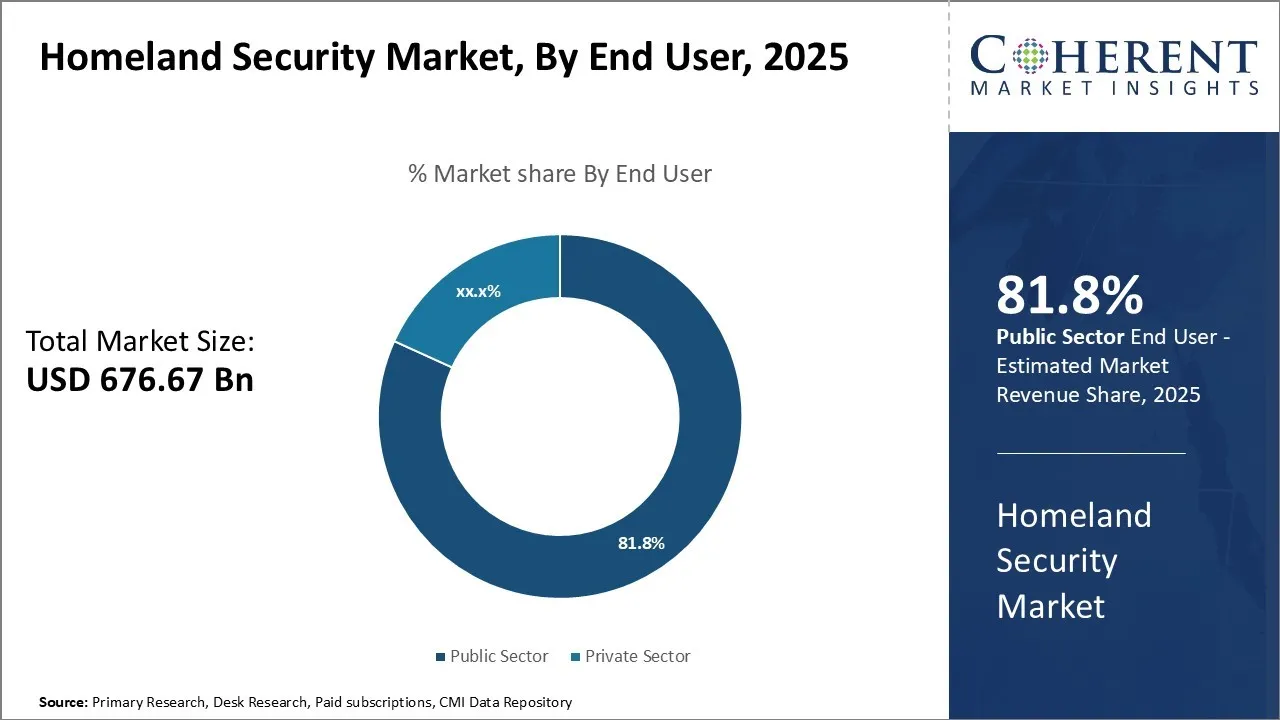
Homeland Security Market Insights, By End User
Public Sector is expected to dominate the global market over the forecast period and this is attributed to the growing adoption of homeland security products and services by government organizations as well as defense department of many countries around the globe.
The services, products, and systems used by the public sector to protect property and public of nation range from surveillance and security systems, marine systems, fighter aircrafts to antivirus software. The growing adoption of these systems is likely to support growth of this segment.
Private Sector segment is also expected to witness significant growth in the near future and this is owing to the growing use of various homeland security products by several private companies, such as use of maritime security services by private shipping companies, and use of security systems for oil & gas pipelines production by oil & gas industry for protection against destruction, thefts, and terrorist attacks.
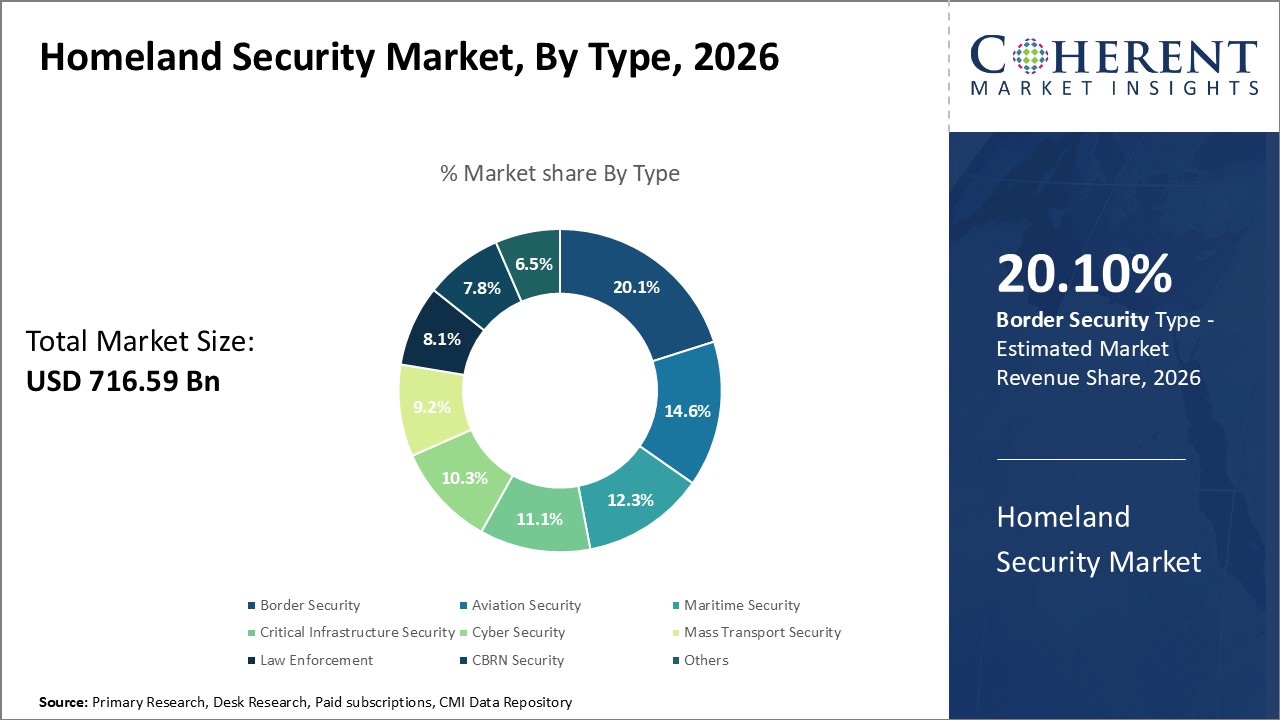
Homeland Security Market Insights, By Type
Based on Type, the market is segmented into Border Security, Aviation Security, Maritime Security, Critical Infrastructure Security, Cyber Security, Mass Transport Security, Law Enforcement, CBRN (Chemical, Biological, Radiological, and Nuclear) Security, Others (First Responders, Counter Terror Intelligence, C3I, and Pipeline Security). Out of which, Border Security is expected to dominate the global market over the forecast period and this is attributed to the growing occurrence of illegal cross-country smuggling of goods that are prohibited in various regions across the globe leading to enhancement of border security.
Aviation Security segment is also expected to witness significant growth in the near future and this is owing to the development of various aviation related cybersecurity programs by global associations for steadily decreasing the risk posed on aviation systems by cyber-attacks. Global associations are collaborating with industry leaders to develop novel programs and solutions. This in turn is expected to support growth of the segment.
Homeland Security Market Insights, By Technology
Based on Technology, the market is segmented into Recognition and Surveillance Systems, AI based Solutions, Security Platforms, and Others. Out of which, Recognition and Surveillance Systems is expected to dominate the global market over the forecast period and this is attributed to the growing demand for recognition and surveillance systems due to advantages such as high accuracy in recognizing weapons/people otherwise difficult to identify.
AI-based Solutions segment is also expected to witness significant growth in the near future and this is owing to the growing adoption of AI-based solutions due to their benefits. For instance, in May 2021, The WCC Group applied artificial intelligence in its border management offering, and became the first one to do so. Thus, such use of AI-based solutions is likely to fuel growth of the market in the coming future.
Regional Insights
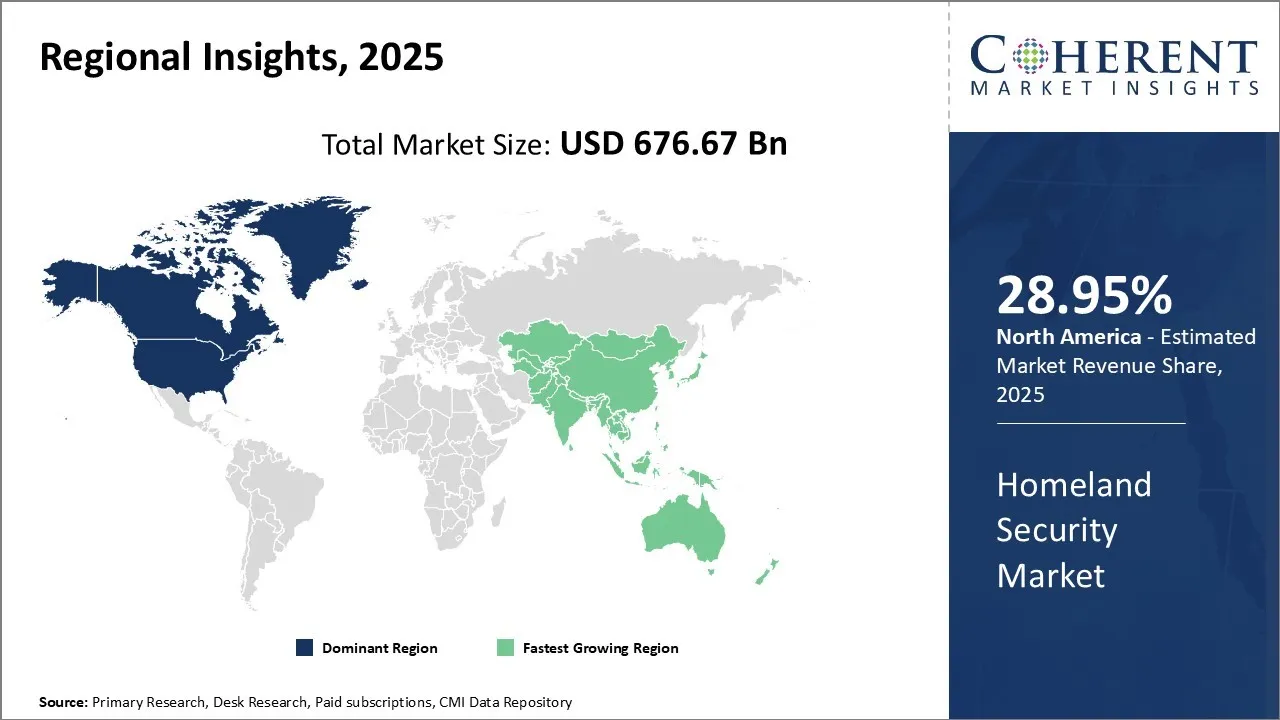
North America Homeland Security Market Analysis and Trends
North America among regions is anticipated to show significant growth in the global homeland security market over the forecast period due to rapid adoption of homeland security related products and services, as a result of multiple military modernization and improvement programs planned in the region.
Moreover, rise in investment to improve national security against various types of threats by the countries in this region is also expected to fuel development of advanced tools in the region. This in turn is likely to drive growth of the market across the region.
Asia Pacific Homeland Security Market Analysis and Trends
Asia Pacific is also projected to augment growth of the global homeland security market during the forecast period. This is due to growing rate of modernization of police forces, rise in yearly budgetary expenditure on homeland security, and increasing terrorist attacks in the region.
The demand for better maritime security is increasing across the region from countries such as Japan, Sri Lanka, India, and Bangladesh. Along with this, initiatives for the public and property safety by governments in the region are also expected to fuel growth of the global homeland security market in Asia Pacific region in the coming future.
Homeland Security Market Dominating Countries
United States Homeland Security Market Analysis and Trend
The U.S. dominates the homeland security market as a result of its huge government spending, robust technical capabilities, and focus on counterterrorism, cybersecurity, and border security. Agencies such as the Department of Homeland Security (DHS) spend money on surveillance, biometric gear, and emergency response systems, and hence the U.S. is a global security technology leader.
China Homeland Security Market Analysis and Trend
China is rapidly developing homeland security capabilities in a heavy investment in surveillance technology, facial recognition, and cyber security. The state also has an interest in domestic stability and border security, which has driven mass deployment of smart city technology as well as AI-enabled monitoring systems. China's development of its domestic market is also supported by a fully mature manufacturing base and developing tech ecosystem.
India Homeland Security Market Analysis and Trend
India is rising as a key participant in the homeland security sector on the strength of growing geopolitical tensions, domestic security issues, and management needs at the borders. It is investing in police modernization, cyber infrastructure upgradation, and installation of advanced surveillance systems, especially along urban and border areas.
United Kingdom Homeland Security Market Analysis and Trend
The UK possesses a robust homeland security system founded on counterterrorism, public safety, and cybersecurity. The UK invests in emergency communication networks, intelligence networks, as well as surveillance powered by AI. Post-Brexit security measures and future threats further solidified the UK's determination to enhance homeland security capacity.
Market Report Scope
Homeland Security Market Report Coverage
| Report Coverage | Details | ||
|---|---|---|---|
| Base Year: | 2025 | Market Size in 2026: | USD 716.59 Bn |
| Historical Data for: | 2020 To 2024 | Forecast Period: | 2026 To 2033 |
| Forecast Period 2026 to 2033 CAGR: | 5.9% | 2033 Value Projection: | USD 1070.40 Bn |
| Geographies covered: |
| ||
| Segments covered: |
| ||
| Companies covered: | L3Harris Technologies, Inc., Elbit Systems Ltd., International Business Machine Corporation, and General Dynamics Corporation | ||
| Growth Drivers: |
| ||
| Restraints & Challenges: |
| ||
Global Homeland Security Market: Key Developments
- In July 2025, the Department of Homeland Security (DHS) launched a new U.S. Immigration and Customs Enforcement (ICE) recruitment campaign calling on Americans to join as federal agents to help remove dangerous criminal undocumented immigrants from U.S. communities.
- In 2025, Anduril Industries extended its network of AI-enabled surveillance towers on the U.S.–Mexico border. The towers detect and classify threats independently and feed data into border enforcement systems, cutting on-site patrols.
- In 2025, Palantir won a large contract from the U.S. Department of Homeland Security to deploy AI-enabled data fusion platforms for real-time threat detection, monitoring of border activity, and coordination of intelligence among federal agencies.
Analyst View
- The homeland security market continues to experience strong growth due to increasing global security threats, geopolitical instability, and the evolving nature of cyber warfare. Terrorist attacks, border incursions, and sophisticated cyber-attacks are compelling governments around the world to invest heavily in their security infrastructure. The integration of emerging technologies such as artificial intelligence, machine learning, and IoT-based surveillance systems is redefining classical security approaches, opening enormous opportunities for technology providers.
- However, the market is faced with considerable hindrances like aggressive regulatory regimes, long buying cycles, and emerging market budgetary constraints. Data privacy and protection concerns are also posing compliance challenges to security solution vendors. Furthermore, the complexity of integrating historical systems with new security technologies is posing installation challenges.
- The market presents great opportunities in the areas of emerging technologies like biometric verification, drone surveillance, and predictive analytics used for threat detection. Smart city initiatives and guarding of sensitive infrastructure are generating new revenue streams for players in the industry. Greater emphasis on cybersecurity resiliency in government organizations is opening up profitable opportunities for niche service providers.
Speak to the analyst
Want personalized insights?
Take the findings above to one of our principal consultants, or have the report rebuilt around the segments, geographies and competitors you actually track.
Market Segmentation
- Global Homeland Security Market, By Type (Revenue, USD Bn, 2021 - 2033)
- Border Security
- Aviation Security
- Maritime Security
- Critical Infrastructure Security
- Cyber Security
- Mass Transport Security
- Law Enforcement
- CBRN (Chemical, Biological, Radiological, and Nuclear) Security
- Others (First Responders, Counter Terror Intelligence, C3I, and Pipeline Security)
- Global Homeland Security Market, By End User (Revenue, USD Bn, 2021 - 2033)
- Public sector
- Private sector
- Global Homeland Security Market, By Technology (Revenue, USD Bn, 2021 - 2033)
- Recognition and Surveillance Systems
- AI based Solutions
- Security Platforms
- Others
- Global Homeland Security Market, By Region (Revenue, USD Bn, 2021 - 2033)
- North America
- U.S.
- Canada
- Latin America
- Brazil
- Argentina
- Mexico
- Rest of Latin America
- Europe
- Germany
- U.K.
- Spain
- France
- Italy
- Russia
- Rest of Europe
- Asia Pacific
- China
- India
- Japan
- Australia
- South Korea
- ASEAN
- Rest of Asia Pacific
- Middle East
- GCC Countries
- Israel
- Rest of Middle East
- Africa
- South Africa
- North Africa
- Central Africa
- North America
- Company Profiles
- L3Harris Technologies, Inc.
- Elbit Systems Ltd.
- International Business Machine Corporation
- General Dynamics Corporation
Sources
Primary Research Interviews
- Government Security Officials and Policy Makers
- Homeland Security Technology Vendors and Manufacturers
- System Integrators and Solution Providers
- End-user Organizations (Airports, Ports, Critical Infrastructure)
- Others
Databases
- Homeland Security Research Corporation Database
- Jane's Intelligence Database
- GlobalData Defense & Security Database
- IHS Markit Aerospace, Defense & Security Database
- Others
Magazines
- Homeland Security Today Magazine
- Security Management Magazine
- Defense & Security Analysis Magazine
- Government Security News Magazine
- Others
Journals
- Journal of Homeland Security and Emergency Management
- International Journal of Critical Infrastructure Protection
- Security Journal
- Others
Newspapers
- Defense News
- Federal Times
- Government Executive
- FCW (Federal Computer Week)
- Others
Associations
- Department of Homeland Security (DHS)
- International Association for Homeland Security Professionals (IAHSP)
- Security Industry Association (SIA)
- American Society for Industrial Security (ASIS International)
- Others
Public Domain Sources
- U.S. Government Accountability Office (GAO) Reports
- Congressional Budget Office Publications
- Federal Emergency Management Agency (FEMA) Publications
- Transportation Security Administration (TSA) Data
- Others
Proprietary Elements
- CMI Data Analytics Tool
- Proprietary CMI Existing Repository of information for last 8 years
*Definition: Homeland Security services are the products and programs that protect people and property from terrorism, natural disasters, and other threats. These services are a combination of public, private, and non-governmental efforts that are coordinated at the federal level to prevent and respond to potential emergencies.
Get access to 250+ pages report
Every segment, forecast, competitor profile and data table behind the analysis above — available for instant download.
- ESOMAR Member
- ISO 9001:2015 Certified
- D-U-N-S Registered
- GDPR & CCPA Compliant
Missing comfort of reading report in your local language? Find your preferred language:
Transform your Strategy with Exclusive Trending Reports
Frequently Asked Questions
The Homeland Security Market size is estimated to be valued at USD 716.59 Bn in 2026, and is expected to reach USD 1070.40 Bn by 2033.
The CAGR of the global Market is projected to be 5.9% from 2026 to 2033.
Rise in government initiatives for protecting nation from civil wars and cross border disputes and increasing cases of trafficking and smuggling are fuelling the market.
The Cyber Security segment is the leading component segment in the market.
High cost of ensuring homeland security and low prioritizing of emergency management action plans are the major factors restraining the market.
Homeland security refers to a nation's efforts to protect its territory, infrastructure, and citizens from threats such as terrorism, cyberattacks, natural disasters, and border violations.
The global homeland security market is valued at over $600 billion as of 2026 and continues to grow due to increasing geopolitical tensions and technology adoption.