

The global fingerprint sensors market is estimated to be valued at US$ 12.82 Bn in 2026 and is expected to reach US$ 28.17 Bn by 2033, exhibiting a compound annual growth rate (CAGR) of 11.9% from 2026 to 2033.
Key Takeaways:
- By Type, The Optical Fingerprint Sensors Segment is projected to account for 53.8% of the fingerprint sensors market share in 2026.
- By Technology, the touch fingerprint sensors segment is expected to dominate the market with a 58% share in 2026.
- By Vertical, the Banking, Financial Services, and Insurance (BFSI) sector is anticipated to contribute 44.6% of the fingerprint sensors market share in 2026.
- By Region, North America is expected to maintain its leading position in the global fingerprint sensors market, capturing a 42.0% share in 2026.
Market Overview:
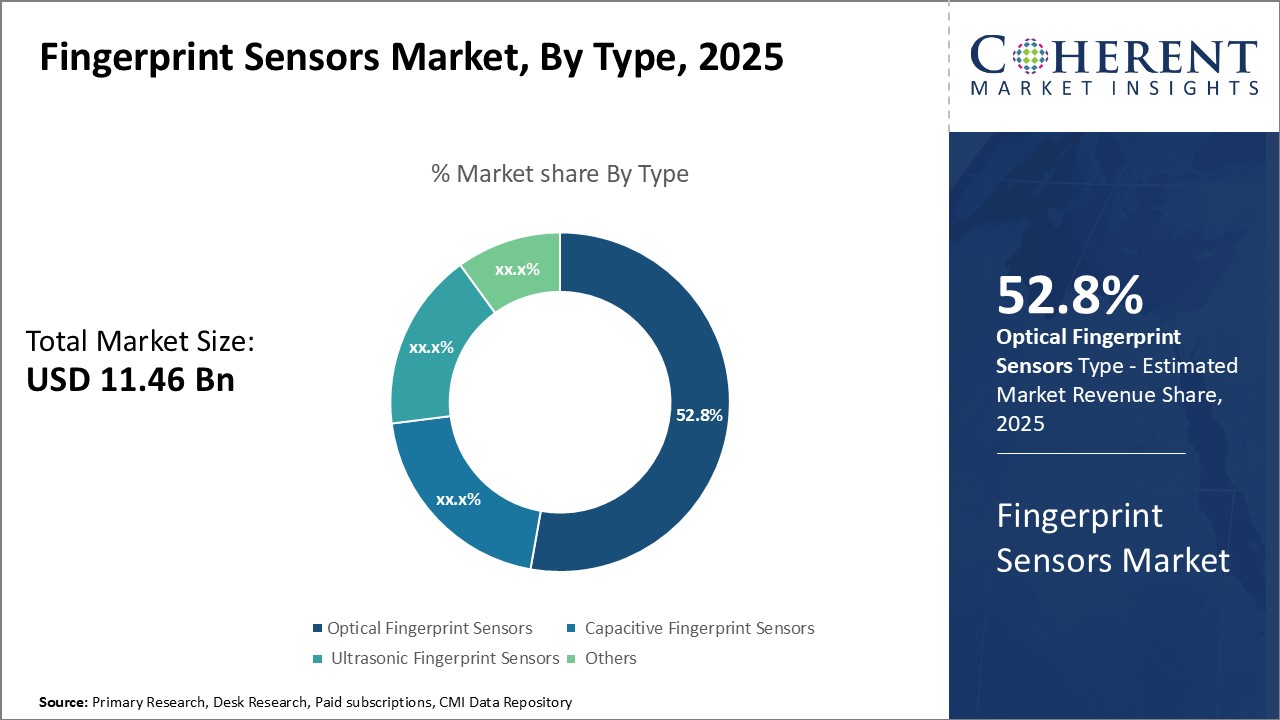
The global fingerprint sensors market is growing rapidly due to rising demand for secure, convenient biometric authentication. Optical fingerprint sensors are expected to dominate with a 52.8% share in 2026, driven by affordability and ease of use. Touch fingerprint sensors will hold 57% market share, fuelled by widespread adoption in connected devices. The BFSI sector leads in usage, accounting for 43.6%. North America will dominate regionally with 42% share, supported by advanced infrastructure and strong regulatory support for biometrics.
Current Events and its Impact on the Fingerprint Sensors Market
Current Event | Description and its impact |
Increased Demand for Contactless and Secure Authentication |
|
Expansion of National ID and e-Governance Programs |
|
Technological Innovations in Fingerprint Sensing |
|
Fingerprint Sensors Market Pricing Analysis
The pricing structure of the global fingerprint sensors market in 2025 is influenced by several factors, including sensor type (optical, capacitive, and ultrasonic), integration level (in-display, side-mounted, rear-mounted), production scale, and end-use application.
Prices remain moderately competitive, especially in the consumer electronics sector, where high volumes drive cost efficiencies. Optical sensors are generally the most cost-effective, while ultrasonic and in-display variants command premium pricing due to enhanced accuracy and integration complexity.
Premium pricing is observed for advanced fingerprint sensor technologies, particularly those with under-display integration, 3D sensing capabilities, and enhanced security features such as hardware encryption. These high-end sensors are commonly adopted in flagship smartphones, biometric payment systems, and automotive applications, where performance and user experience are critical. OEMs and enterprises are willing to invest more in these advanced modules to ensure security, device miniaturization, and seamless user interfaces.
Regional pricing disparities continue, with North America and Western Europe experiencing higher average costs due to strict privacy regulations, advanced hardware requirements, and demand for customized solutions. In contrast, Asia Pacific, led by manufacturing hubs in China, Taiwan, and South Korea, benefits from cost-effective mass production and economies of scale, keeping unit prices lower and supporting broader adoption across mid-range consumer devices.
- Current Industry Events of 2026
- Market Size Estimation
- Regional Breakdown
- Competitive Landscape
- Customer Intelligence
- Segmental Analysis
- Pricing Analysis
- Key Market Drivers, Challenges & Future Trends
- Customized Insights Section
Role of Emerging Technologies in the Fingerprint Sensors Market
Emerging technologies are reshaping the fingerprint sensors market by enhancing security, accuracy, integration, and user experience across applications. Innovations such as artificial intelligence (AI), machine learning (ML), Internet of Things (IoT), edge computing, and advanced biometric algorithms are driving the evolution of fingerprint sensing solutions.
AI and ML are being integrated into fingerprint recognition systems to improve pattern recognition, reduce false positives, and enable adaptive learning for multi-user authentication. These intelligent systems are especially valuable in high-security environments like banking, government, and healthcare, where accuracy and real-time threat detection are critical.
Edge computing is enabling faster fingerprint data processing directly on devices, reducing response time and enhancing data privacy by minimizing cloud dependencies. This is particularly useful in mobile and wearable devices, where low latency and secure authentication are essential.
Additionally, the rise of in-display fingerprint sensors, ultrasonic scanning, and flexible biometric modules is transforming product design in consumer electronics, enabling seamless integration into foldable devices, smart cards, and automotive control panels. Advanced materials and miniaturization are making sensors more durable and energy-efficient, further boosting adoption.
Together, these technologies are not only expanding the scope of fingerprint sensors beyond traditional access control but also reinforcing their role in next-generation authentication, digital identity, and contactless ecosystems.
Fingerprint Sensors Market Trends
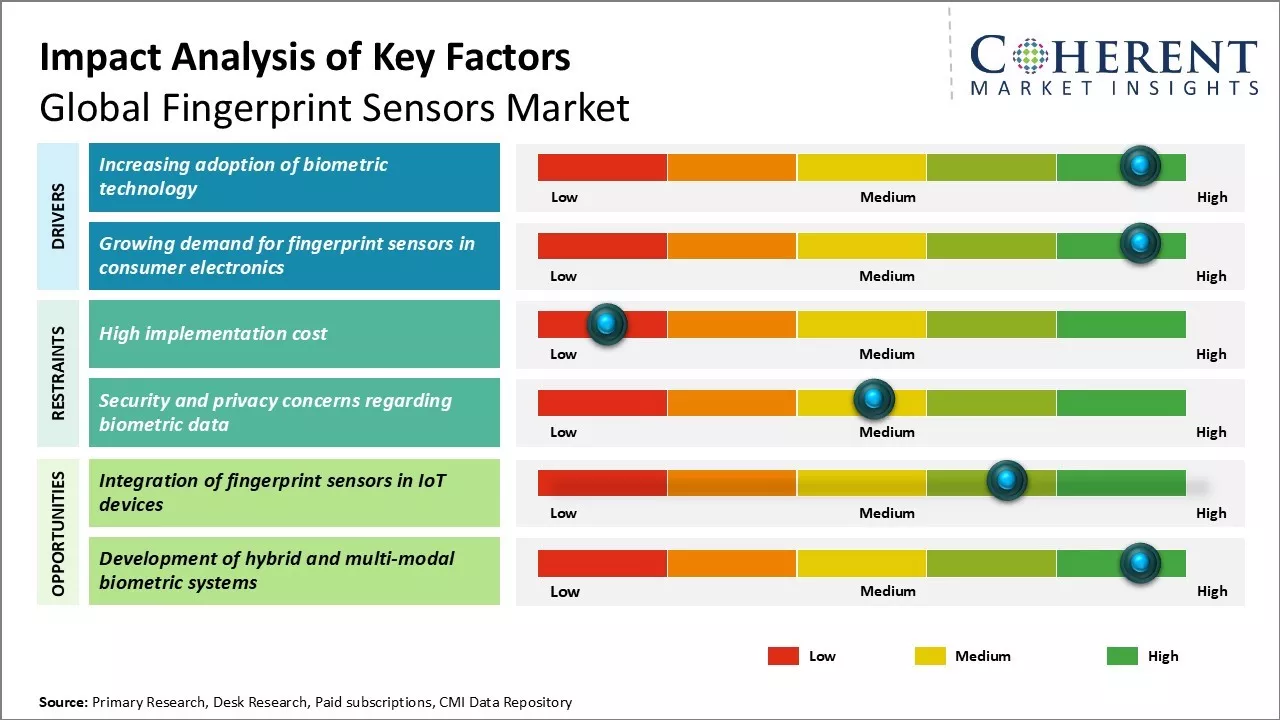
Increasing adoption of biometric technology
The adoption of biometric technology has been rising rapidly in recent times due to increased focus on security and convenience. Biometric authentication provides a hassle-free identification method for users without the need to remember passwords or pins. Fingerprints have emerged as one of the most popular and widely used modalities for biometric identification due to their uniqueness and ease of capture.
Fingerprint sensors have enabled quick and seamless biometrics-based login for millions of smartphone, laptop, and desktop users globally. As people store more sensitive personal and financial information online, there is a growing need for secure authentication methods to protect unauthorized access. Fingerprint biometric provides a much stronger layer of security compared to traditional password or pin-based systems which are prone to hacking.
Major technology companies now include fingerprint sensors as standard features in their flagship devices recognizing the consumer demand for embedded biometric security. In June 2024, The Times of India reported that the Realme GT 6, launching in India on June 20, will feature an in-display fingerprint scanner as part of its flagship specifications. This underscores the continued trend of embedding biometric authentication in mid-to-high-end smartphones.
- Growing demand for fingerprint sensors in consumer electronics
Fingerprint sensors have carved a dominant niche for themselves in the smartphone market and this success is fuelling their integration into various other consumer electronic devices as well. Smartphone makers led the way by bundling front and back mounted fingerprint readers in their flagship phones over the past few years. As biometrics grew popular among consumers to unlock phones, technology entrepreneurs spotted avenues to apply this convenience factor beyond mobiles.
Smart televisions and home appliances now offer fingerprint authentication for secure payment acceptance and parental controls. Wearable’s like smart watches are also fitting fingerprint sensors to avoid passcodes for payments and unlocking companion phone apps. As the PC segment battles increased security risks, laptop and desktop models have commenced including fingerprint biometrics for frictionless login, data protection and access to BIOS settings. Even gaming consoles are experimenting with fingerprint sign-in as a hygienic alternative to controllers.
Opportunities in the fingerprint sensors market
Integration of Fingerprint Sensors in IoT Devices
The increasing integration of fingerprint sensors into various internet of things (IoT) devices and applications presents a lucrative opportunity for the fingerprint sensors market. With the proliferation of connectivity across end-points, there is a rising need for strong yet user-friendly authentication systems to ensure cyber security and access control. Fingerprint biometrics provide a convenient and secure solution owing to their accuracy and scalability.
IoT domains like smart home security systems, wearable’s, smartphones, automotive, banking, and healthcare are opting fingerprint sensors for user identification, device unlocking, and digital payments. This growing dependency on fingerprint verification in IoT ecosystems would spur extensive demand for low-cost, compact sensors with enhanced capabilities.
Mass IoT adoption could further encourage sensor miniaturization and integration into smaller devices. Overall, the convergence of fingerprint biometrics and IoT is expected to play a pivotal role in driving the revenues of fingerprint sensor vendors in the coming years.
Segmental Insights
Fingerprint Sensor Market Insights, By Type
The optical fingerprint sensors segment is projected to account for 53.8% of the fingerprint sensors market share in 2026. This dominance is primarily attributed to the convenience and user-friendliness of optical sensors, which operate by capturing detailed images of fingerprint patterns through a light source and prism system. Their widespread use in consumer electronics, especially smartphones and laptops, continues to drive market growth due to their cost-effectiveness, ease of integration, and reliable performance.
Fingerprint Sensor Market Insights, By Technology
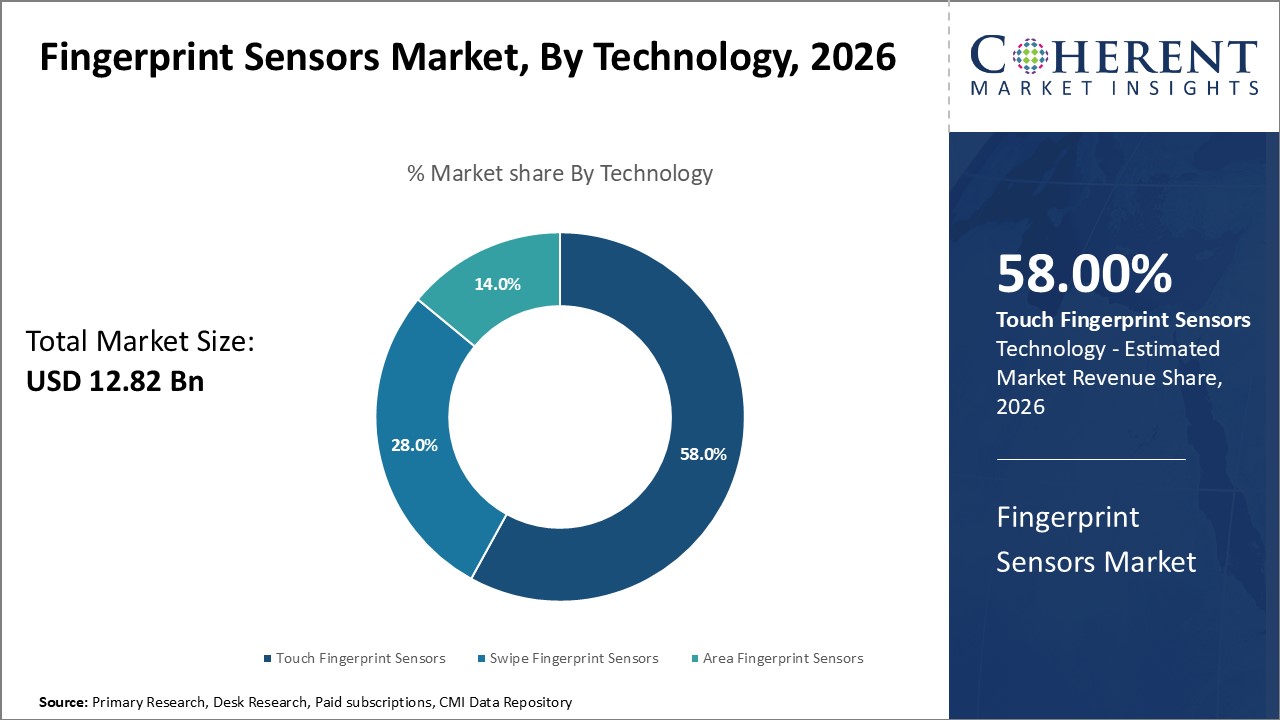
The touch fingerprint sensors segment is expected to dominate the market with a 58.0% share in 2026. The rapid proliferation of internet-connected devices, including smartphones, wearables, and IoT platforms, is fuelling demand for seamless and secure biometric authentication.
Touch-based fingerprint technologies deliver high-speed, accurate identification and offer an intuitive user experience, making them a preferred choice in both personal and enterprise digital ecosystems.
Fingerprint Sensor Market Insights, By Vertical
The Banking, Financial Services, and Insurance (BFSI) sector is anticipated to contribute 44.6% of the fingerprint sensors market share in 2026. This growth is driven by the need for robust identity verification mechanisms amid rising digital fraud and regulatory compliance requirements. The integration of fingerprint sensors into ATMs, mobile banking applications, and fintech platforms enhances both user convenience and transaction security, underscoring the sector’s growing reliance on biometric solutions.
Fingerprint Sensors Market: Regional Insight
North America Fingerprint Sensors Market Analysis and Trends
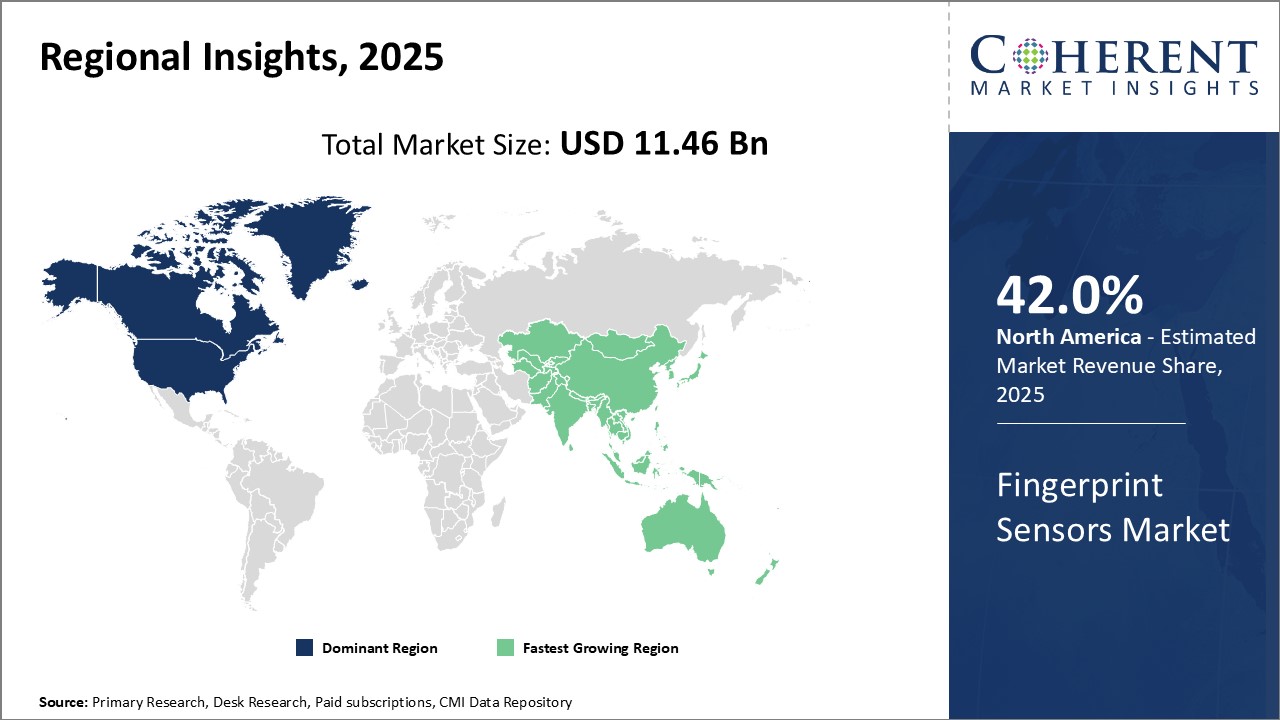
North America is expected to maintain its leading position in the global fingerprint sensors market, capturing a projected 42.0% share in 2026. This dominance is driven by a robust technological infrastructure, early adoption of biometric authentication solutions, and widespread integration of fingerprint sensors across consumer electronics, enterprise systems, and public sector applications.
The region has seen significant investments in cyber security and digital identity management, particularly within the government, healthcare, and BFSI sectors. Regulatory frameworks such as the Biometric Information Privacy Act (BIPA) in the U.S. have spurred demand for secure and privacy-compliant fingerprint solutions. Moreover, the rise of mobile banking, contactless payment platforms, and smart devices is accelerating the deployment of fingerprint sensors across North America.
Continuous innovation from regional tech giants and sensor manufacturers is also strengthening the market, especially in advanced areas such as under-display and ultrasonic fingerprint sensors. With increasing emphasis on data protection and user authentication, North America remains a key driver of global market growth in fingerprint sensing technology.
Distributed Fingerprint sensors market Dominating Countries:
United States, Canada
The United States, Canada, Germany, and China are the leading contributors to the global fingerprint sensors market, reinforcing regional dominance through innovation, regulatory backing, and technological adoption.
The United States leads the market, backed by its advanced technological ecosystem, early integration of biometric systems in government and enterprise security, and strong presence of key fingerprint sensor manufacturers. Regulatory initiatives like the Biometric Information Privacy Act (BIPA) and increasing demand for secure digital identity systems are further driving adoption across sectors such as healthcare, BFSI, and public services.
Market Report Scope
Fingerprint Sensors Market Report Coverage
| Report Coverage | Details | ||
|---|---|---|---|
| Base Year: | 2025 | Market Size in 2026: | USD 12.82 Bn |
| Historical Data for: | 2020 To 2024 | Forecast Period: | 2026 To 2033 |
| Forecast Period 2026 to 2033 CAGR: | 11.9% | 2033 Value Projection: | USD 28.17 Bn |
| Geographies covered: |
| ||
| Segments covered: |
| ||
| Companies covered: | Apple Inc., CrucialTec, Egis Technology Inc., Fingerprint Cards AB, Goodix Technology, IDEX Biometrics, Invixium, M2SYS Technology, NEXT Biometrics, Novatek Microelectronics Corp., Qualcomm Technologies, Inc., Synaptics Incorporated, Touch Biometrix, Vicharak, and VKANSEE | ||
| Growth Drivers: |
| ||
| Restraints & Challenges: |
| ||
Analyst Viewpoint – Fingerprint Sensors Market
- The global fingerprint sensors market is experiencing robust growth, driven by the surging demand for secure, contactless authentication across consumer electronics, financial services, and government applications. Analysts highlight that touch-based fingerprint sensors will continue to dominate, contributing 57.0% of the market share in 2025, owing to the widespread adoption in smartphones, wearable’s, and IoT devices. Their seamless user experience, high accuracy, and integration ease make them the preferred choice for manufacturers and consumers alike.
- Analysts emphasize that emerging technologies such as AI-enhanced biometric algorithms, edge processing, and under-display ultrasonic sensors are significantly advancing fingerprint recognition capabilities. These innovations are enabling real-time authentication with higher precision, improved spoof resistance, and faster processing—particularly important for high-security sectors like BFSI and healthcare. The fusion of AI and fingerprint sensing is also expected to reduce false rejections and support adaptive authentication across multi-user environments.
- North America is forecasted to maintain its leadership in the fingerprint sensors market with a 42.0% share in 2025. Experts attribute this dominance to strong regulatory support, early technology adoption, and high penetration of biometric systems across public and private sectors.
- Asia Pacific is emerging as a fast-growing region, driven by mass smartphone production, fintech expansion, and government-backed digital ID initiatives in countries like China and India. Europe is also witnessing steady growth, fueled by GDPR-compliant biometric deployments and demand for secure enterprise authentication systems.
Fingerprint Sensors Market: Key Development
- In June 2025: At SID Display Week, BOE showcased the automotive industry's first OLED steering wheel featuring an embedded large-area ultrasonic fingerprint sensor.
- In May 2025: Integrated Biometrics launched “GripID MANNIX,” an FBI FAP60-certified full-palm and fingerprint scanner that pairs wirelessly with smartphones and tablets.
- In April 2025, Huawei announced a CNY 2.4 billion project in Changsha to produce TFT-based ultrasonic fingerprint chips, targeting 90 million wafers annually.
- In October, 2024: Goodix unveiled an enhanced ultrasonic fingerprint sensor, which features in the OnePlus 13 flagship for improved fingerprint imaging, robustness against moisture/oil, and faster recognition.
Market Segmentation
- By Type (Revenue, USD Bn, 2021 - 2033)
- Optical Fingerprint Sensors
- Capacitive Fingerprint Sensors
- Ultrasonic Fingerprint Sensors
- Others (Thermal, Piezoelectric, etc.)
- By Technology (Revenue, USD Bn, 2021 - 2033)
- Touch Fingerprint Sensors
- Swipe Fingerprint Sensors
- Area Fingerprint Sensors
- By Vertical (Revenue, USD Bn, 2021 - 2033)
- Consumer Electronics (Smartphones, Laptops, Tablets)
- Banking, Financial Services, and Insurance (BFSI)
- Government and Law Enforcement
- Healthcare
- Automotive
- Others (Industrial, Retail, etc.)
Regional Insights (Revenue, USD Bn, 2021 - 2033)
- North America
- U.S.
- Canada
- Latin America
- Brazil
- Argentina
- Mexico
- Rest of Latin America
- Europe
- Germany
- U.K.
- Spain
- France
- Italy
- Russia
- Rest of Europe
- Asia Pacific
- China
- India
- Japan
- Australia
- South Korea
- ASEAN
- Rest of Asia Pacific
- Middle East
- GCC Countries
- Israel
- Rest of Middle East
- Africa
- South Africa
- North Africa
- Central Africa
- North America
- Key Players Insights
- Apple Inc.
- CrucialTec
- Egis Technology Inc.
- Fingerprint Cards AB
- Goodix Technology
- IDEX Biometrics
- Invixium
- M2SYS Technology
- NEXT Biometrics
- Novatek Microelectronics Corp.
- Qualcomm Technologies, Inc.
- Synaptics Incorporated
- Touch Biometrix
- Vicharak
- VKANSEE
Sources
The Stakeholders Consulted:
- Semiconductor and sensor component manufacturers
- Biometric hardware and software providers
- Consumer electronics OEMs (smartphones, laptops, wearables)
- Automotive and smart vehicle system integrators
- Cybersecurity and digital identity experts
- Government agencies involved in border control, defense, and public safety
- Financial institutions and fintech companies deploying biometric solutions
- Regulatory bodies overseeing data privacy and authentication standards
- Healthcare technology providers integrating biometric access systems
- Smart city planners and IT infrastructure consultants
Databases Opened:
- U.S. Federal Trade Commission (FTC) – Biometric Policy & Privacy Data
- BiometricUpdate.com – Global Biometric Project Tracker
- Ministry of Electronics & Information Technology (India) – Digital Identity & Authentication Reports
- World Bank Open Data – Technology Access and Infrastructure
- International Telecommunication Union (ITU) – ICT Statistics
Magazines & Trade Publications: - Biometric Technology Today
- Sensors Online – Biometric & Optical Sensors
- EE Times – Consumer Electronics & Sensor Trends
- Embedded.com – Secure Hardware & Authentication
- Electronic Design – Components & Systems
- IoT Now – Security & Smart Devices Coverage
- Mobile World Live – Smartphone and Wearable Market Trends
Scientific and Industry Journals:
- IEEE Transactions on Biometrics, Behavior, and Identity Science
- Pattern Recognition Letters
- Journal of Electronic Imaging
- Sensors and Actuators A: Physical
- IEEE Sensors Journal
- Journal of Information Security and Applications
Newspapers & Media Outlets:
- The Wall Street Journal – Tech & Cybersecurity Section
- Bloomberg – Tech and Consumer Electronics Markets
- Reuters – Mobile Devices and Biometric Authentication News
- The Economic Times – Digital India & Biometric Infrastructure
- Business Standard – Technology & Smart Device Trends
Associations and Regulatory Bodies:
- International Biometrics + Identity Association (IBIA)
- Federal Bureau of Investigation (FBI) – Biometric Standards and Specifications
- U.S. National Institute of Standards and Technology (NIST) – Biometric Testing Reports
- European Data Protection Board (EDPB) – Biometric Compliance Guidelines
- Bureau of Indian Standards (BIS) – Fingerprint Device Standards
- International Organization for Standardization (ISO) – ISO/IEC 19794 (Biometrics Standards)
Public Domain Sources:
- U.S. Patent and Trademark Office (USPTO) – Biometric Sensor Filings
- European Commission – Biometric ID and eGovernance Projects
- National Institute of Standards and Technology (NIST) – Biometric Evaluation Dataset
- World Bank – Digital Identification for Development (ID4D)
- OECD – Digital Economy Outlook and Privacy Regulations
- United Nations – E-Government Development Index (EGDI) and Smart City Frameworks
Proprietary Research Elements:
- CMI Data Analytics Tool
- Proprietary CMI Repository of Market Data (covering past 8 years)
- CMI Expert Interviews and Transcripts (focused on biometric authentication, sensor design, consumer electronics trends, and regulatory compliance)
Get access to 250+ pages report
Every segment, forecast, competitor profile and data table behind the analysis above — available for instant download.
- ESOMAR Member
- ISO 9001:2015 Certified
- D-U-N-S Registered
- GDPR & CCPA Compliant
Missing comfort of reading report in your local language? Find your preferred language:
Transform your Strategy with Exclusive Trending Reports
Frequently Asked Questions
The Fingerprint Sensors Market size is estimated to be valued at USD 12.82 Bn in 2026, and is expected to reach USD 28.17 Bn by 2033.
The CAGR of the global Market is projected to be 11.9% from 2026 to 2033.
Increasing adoption of biometric technology and growing demand for fingerprint sensors in consumer electronics are the major factors driving the growth of the global market.
High implementation cost and security and privacy concerns regarding biometric data are the major factors hampering the growth of the global fingerprint sensors industry.
In terms of type, optical fingerprint sensors is estimated to dominate the market revenue share in 2026.
Apple Inc., CrucialTec, Egis Technology Inc., Fingerprint Cards AB, Goodix Technology, IDEX Biometrics, Invixium, M2SYS Technology, NEXT Biometrics, Novatek Microelectronics Corp., Qualcomm Technologies, Inc., Synaptics Incorporated, Touch Biometrix, Vicharak, and VKANSEE are the major players.
North America is expected to lead the global market.