

Biometrics Technology Market Size and Forecast – 2026 to 2033
Biometrics Technology Market is estimated to be valued at USD 79,247.8 Mn in 2026 and is expected to reach USD 2,59,411.6 Mn in 2033, exhibiting a compound annual growth rate (CAGR) of 18.7% from 2026 to 2033.
Key Takeaways
- By Component, Voice holds the largest market share of 34.3% in 2026 owing to the growing demand for secure & convenient authentication.
- By End User, Healthcare acquired the prominent market share of 43.5% in 2026 owing to its rising need for secure patient identification & data protection.
- By Region, Asia Pacific dominates the overall market with an estimated share of 45.5% in 2026 owing to the large-scale government identity / national id programmes.
Market Overview
The biometrics technology market continues to grow rapidly as organizations across banking, healthcare, government, and consumer electronics adopt secure and convenient identification methods. Companies are increasingly using fingerprint, facial, iris, and voice recognition technologies to strengthen security, prevent fraud, and enhance user experience. Advancing digital transformation, government-led identity initiatives, and innovations in AI and sensor technology are driving this expansion, positioning biometrics as an essential element of modern authentication and access control systems worldwide.
Current Events and their Impact on the Biometrics Technology Market
Current Events | Description and its impact |
Geopolitical and Regulatory Developments |
|
Technological Innovations and Advances |
|
Economic and Market Dynamics |
|
Segmental Insights
- Current Industry Events of 2026
- Market Size Estimation
- Regional Breakdown
- Competitive Landscape
- Customer Intelligence
- Segmental Analysis
- Pricing Analysis
- Key Market Drivers, Challenges & Future Trends
- Customized Insights Section
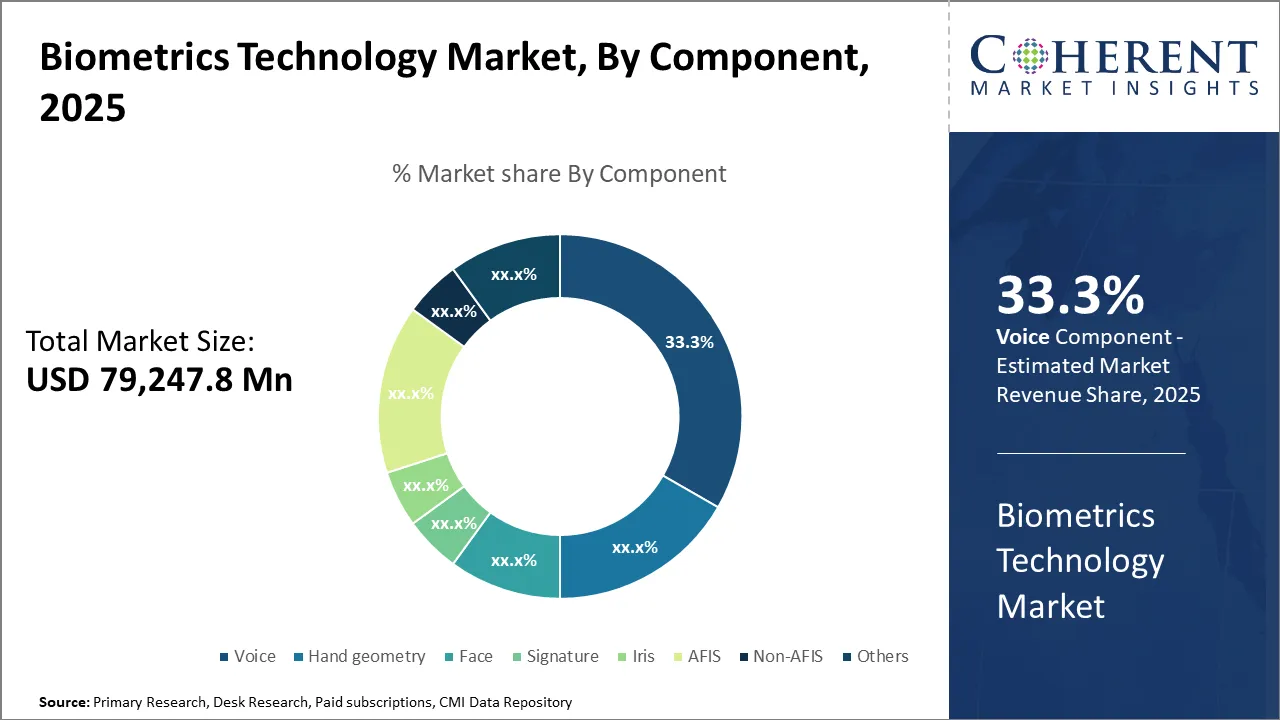
Biometrics Technology Market Insights, By Component: Voice contributes the highest share of the market owing to its expansion of use-cases and deployment contexts.
Voice holds the largest biometrics technology market share of 34.3% in 2026. The voice biometrics technology market is growing as industries seek secure, contactless, and convenient authentication methods. Companies use voice recognition to combat identity fraud, strengthen remote access security, and simplify customer verification in sectors such as banking, telecom, and healthcare. Continuous advancements in AI, speech analytics, and cloud technologies enhance system accuracy and scalability. Moreover, the rapid adoption of voice-enabled devices and digital platforms is driving the widespread integration of voice biometrics into modern authentication processes. For instance, in January 2025, Sonio, a global leader in AI-driven medical technology, has launched Sonio Voice, an advanced voice recognition solution set to transform ultrasound reporting in obstetrics and gynecology (OB-GYN) practices.
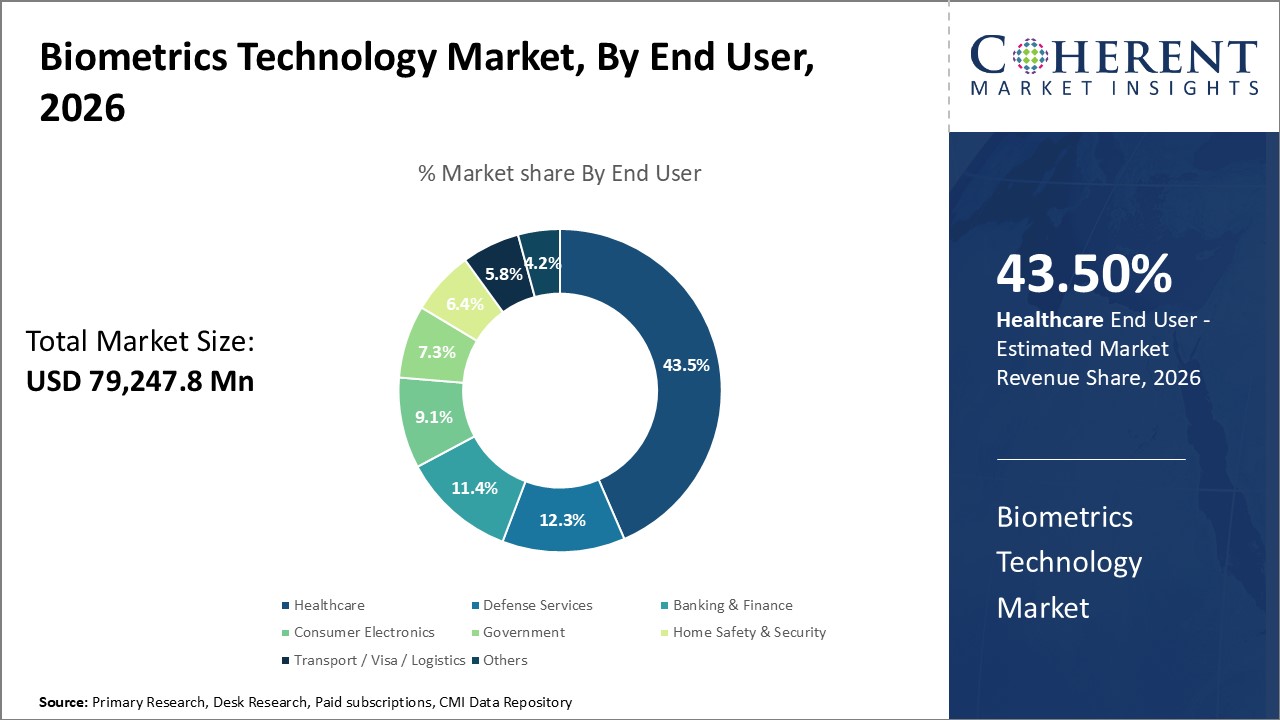
Biometrics Technology Market Insights, By End User: Healthcare contributes the highest share of the market owing to its digitization of healthcare delivery, telehealth & remote monitoring.
Healthcare acquired the prominent market share of 43.5% in 2026. The healthcare biometrics technology market grows as healthcare providers prioritize accurate patient identification, data security, and controlled access to medical records. Hospitals and clinics deploy biometric systems to combat identity fraud, safeguard sensitive information, and improve patient safety. Expanding use of digital health records, telemedicine, and remote monitoring increases the need for dependable authentication. Furthermore, advancements in AI-driven biometric technologies and supportive government policies drive broader adoption of biometrics across global healthcare institutions. For instance, in September 2025, SBI General Insurance has introduced a health tracking feature on its mobile app, significantly advancing health and wellness promotion. The feature leverages biometric technology, allowing users to easily access key health metrics through simple face and fingerprint scans.
Role of AI (Artificial Intelligence) in the Biometrics Technology Market
Artificial Intelligence (AI) actively transforms the biometrics technology market by improving accuracy, speed, and security in facial, fingerprint, iris, and voice recognition. AI-powered algorithms analyze images and voices in real time, perform advanced pattern recognition, and detect liveness, minimizing fraud and false matches. AI also enables systems to learn and adapt over time, maintaining reliable performance in diverse environments. By integrating analytics and multi-modal authentication, AI delivers seamless user experiences and makes biometric systems smarter and more resilient. For instance, in August 2025, Dubai International Airport has unveiled an AI-powered corridor that lets travelers skip passport control in seconds, processing multiple passengers at once—a global first in airport immigration technology.
Regional Insights
Asia Pacific Biometrics Technology Market Trends
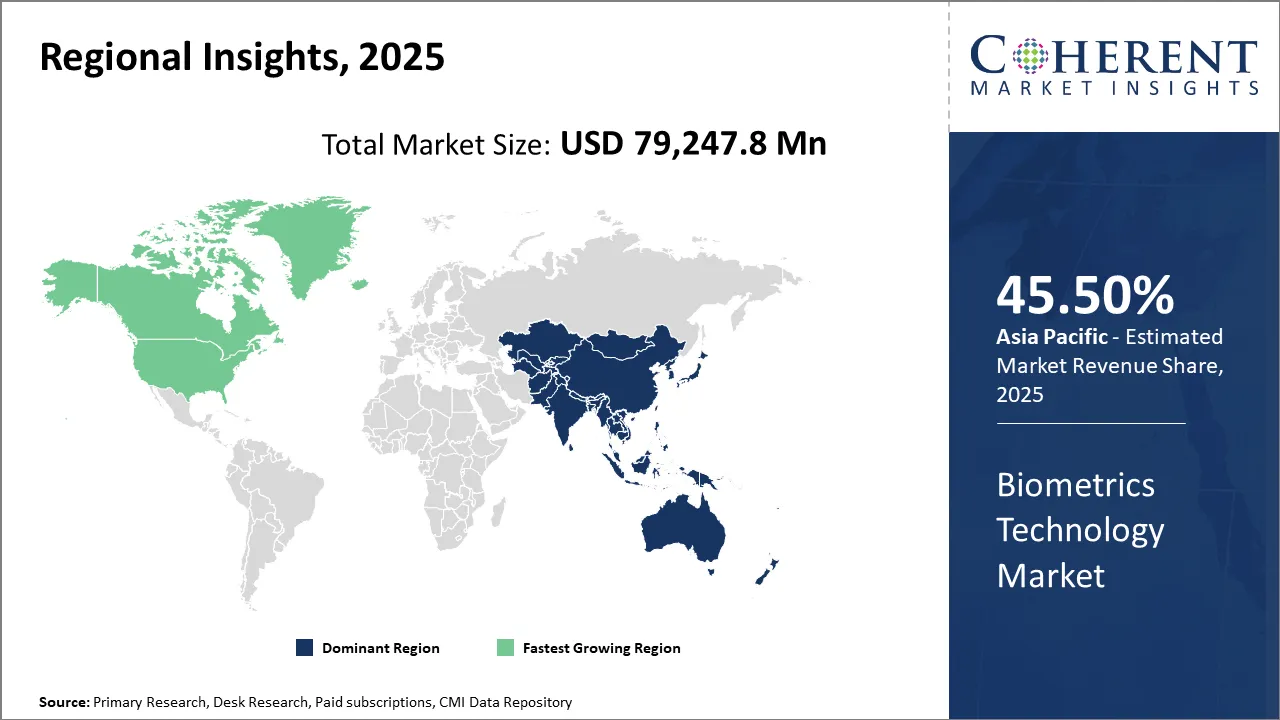
Asia Pacific dominates the overall market with an estimated share of 45.5% in 2026. The Asia Pacific biometrics technology market is expanding as governments and businesses adopt secure authentication systems amid widespread digital transformation. Countries such as China, India, and Japan are integrating biometrics into banking, transportation, and public safety services. Growing smartphone usage, digital payment platforms, and smart city initiatives further drive adoption. Innovations in AI, facial recognition, and contactless technologies actively shape market trends, establishing biometrics as a central component of the region’s digital security infrastructure. For instance, OCBC Bank has become the first in Singapore to introduce Face ID login for its mobile app, allowing retail and business customers with an iPhone X to access the app using a selfie.
North America Biometrics Technology Market Trends
The North American biometrics technology market grows as governments and businesses adopt advanced authentication across healthcare, finance, consumer electronics, and public sectors. Organizations are expanding the use of contactless and multimodal systems in airports, border control, and enterprise access. Companies increasingly deploy AI-powered facial, iris, and voice recognition for seamless user verification. Additionally, the adoption of mobile and cloud-based biometric solutions, strict data protection regulations, and rising demand for fraud prevention and digital identity actively drive market development in the region.
India Biometrics Technology Market Trends
The Indian biometrics technology market is expanding rapidly as the government implements digital‑identity initiatives and businesses respond to growing smartphone use and digital transactions. Organizations in banking, telecom, and public services are increasingly adopting secure authentication methods. Large-scale systems like Aadhaar use fingerprint and facial recognition to manage welfare and financial services, while companies deploy AI-driven and contactless biometric solutions to simplify user verification. These developments are actively transforming identity and access management across the country. For instance, in October 2026, Navi UPI has launched biometric authentication at the Global Fintech Festival 2026, becoming India’s first UPI app to enable fingerprint or face-based payments without a PIN.
United States Biometrics Technology Market Trends
The U.S. biometrics technology market is growing as government agencies and businesses expand secure identity verification across border control, healthcare, and consumer electronics. Organizations actively deploy contactless and multimodal systems combining facial, iris, and fingerprint recognition to improve access and enhance authentication. Companies increasingly rely on mobile and cloud-based biometric solutions, while privacy regulations guide their implementation. At the same time, advancements in artificial intelligence and sensor technologies actively improve the accuracy and reliability of biometric identification systems. For instance, in August 2026, Clear has deployed new biometric eGates at several major US airports, changing how travelers pass through security as the US prepares for a surge of international visitors during major events.
Biometrics Technology Market Trend
Contactless & Hygienic Biometric Systems
Driven by public health concerns and the need for seamless experiences, there is a strong shift toward touch‑free modalities such as facial, iris and voice recognition in places like airports, retail and healthcare. Reports show a surge in deployments of these systems as organizations phase out fingerprint or hand‑print modules. This move positions biometrics as both a hygiene‑safe and convenience‑oriented choice.
Multimodal & Adaptive Authentication
Rather than relying on a single biometric modality, solutions increasingly combine fingerprint, face, iris, voice and behavior to improve accuracy, resist spoofing and serve diverse use‑cases. According to recent analysis, over half of new installs now use two or more modalities. This approach enables systems to adapt across environments (lighting, angles, wearables) and user demographics, enhancing robustness and trust.
Biometrics Technology Market Opportunity
Smart Payments & Biometric Cards
The shift from PINs and passwords to biometric‑enabled payment cards and mobile devices offers a major opportunity. Biometric sensors embedded in cards or wearables can provide secure, fast authentication at checkout and tap‑to‑pay interactions. For instance, one industry note states the addition of biometric sensors to chip‑enabled cards could significantly reduce fraud while using existing payment infrastructure. Vendors capable of delivering low‑cost biometric card modules or mobile authentication solutions stand to capture growth in both developed and emerging markets.
Market Report Scope
Biometrics Technology Market Report Coverage
| Report Coverage | Details | ||
|---|---|---|---|
| Base Year: | 2025 | Market Size in 2026: | USD 79,247.8 Mn |
| Historical Data for: | 2020 To 2024 | Forecast Period: | 2026 To 2033 |
| Forecast Period 2026 to 2033 CAGR: | 18.7% | 2033 Value Projection: | USD 2,59,411.6 Mn |
| Geographies covered: |
| ||
| Segments covered: |
| ||
| Companies covered: | Accu-Time Systems, Inc., Daon, Inc., BIO-Key International, Inc., IrisGuard, Inc., Fujitsu Limited, Lumidigm, Inc., IDTECK, Suprema, Inc., 3M Cogent, Inc., RCG Holdings, Ltd., and NEC Corporation, Massey Ferguson Limited, TAFE, Iseki & Co. Ltd., JCB, and Yanmar Co. | ||
| Growth Drivers: |
| ||
| Restraints & Challenges: |
| ||
Biometrics Technology Market News
- In July 2025, Mastercard and Eastern Bank PLC have launched Bangladesh’s first biometric metal credit card, combining advanced biometric security with a premium metal design for an enhanced user experience.
- In September 2025, The European Union launched its shared Biometric Matching System (sBMS), developed by IDEMIA Public Security and Sopra Steria. The system is operated by eu-LISA, the EU agency managing large-scale security and justice IT systems.
- In November 2024, Airports of Thailand (AOT) has deployed a facial recognition biometric system at six airports, offering passengers a faster, safer, and more convenient experience.
Analyst Opinion (Expert Opinion)
- In my view, the biometrics technology market is at an inflection point where deployment volume is converging with technology maturity, creating both opportunity and substantial risk for those who mis‑read the dynamics. Consider that over 120 countries have rolled out national ID programmes enrolling more than 2 billion citizens.
- The shift towards contactless systems: some reports note that the contactless biometrics segment (face, iris, voice) already accounted for the bulk of new deployments in airports, healthcare and transit. This isn't just a hygiene‑driven fad—it's a structural move, and vendors who continue to rely primarily on traditional fingerprint or hand‑geometry hardware will find themselves squeezed. For example, touch‑free facial recognition in more than 200 cities for surveillance and identity has been documented.
- Another risk is bias and trust erosion. Academic work already shows demographic unevenness in ocular and facial recognition systems across age and gender groups. As you broaden deployment into airports, public transit and big‑ticket government programmes, those weaknesses will become commercial liabilities—especially in regulated jurisdictions. This means the vendors who win will not just have better accuracy but demonstrable fairness, transparent consent models and auditability.
Speak to the analyst
Want personalized insights?
Take the findings above to one of our principal consultants, or have the report rebuilt around the segments, geographies and competitors you actually track.
Market Segmentation
- Global Biometrics Technology Market, By Component (Revenue, USD Mn, 2021 - 2033)
- Face
- Hand geometry
- Voice
- Signature
- Iris
- AFIS
- Non-AFIS
- Others
- Global Biometrics Technology Market, By End User (Revenue, USD Mn, 2021 - 2033)
- Government
- Defense Services
- Banking and Finance
- Consumer Electronics
- Healthcare
- Home Safety and Security
- Transport / Visa / Logistics
- Others (Retail, hospitality, gaming and automobile)
- Global Biometrics Technology Market, By Region (Revenue, USD Mn, 2021 - 2033)
- North America
- U.S.
- Canada
- Europe
- Germany
- U.K.
- France
- Italy
- Spain
- Russia
- Rest of Europe
- Asia Pacific
- China
- India
- Japan
- Australia
- South Korea
- ASEAN
- Rest of Asia Pacific
- Latin America
- Brazil
- Mexico
- Rest of Latin America
- Middle East & Africa
- GCC Countries
- South Africa
- Rest of Middle East and Africa
- North America
- Key Players Insights
- Accu-Time Systems, Inc.
- Daon, Inc.
- BIO-Key International, Inc.
- IrisGuard, Inc.
- Fujitsu Limited
- Lumidigm, Inc.
- IDTECK
- Suprema, Inc.
- 3M Cogent, Inc.
- RCG Holdings, Ltd.
- NEC Corporation.
Sources
Primary Research interviews
- Interviews with biometric technology developers and solution providers
- Discussions with IT security managers implementing biometric systems
- Conversations with end-users in sectors such as banking, healthcare, and government
Databases
- IEEE Xplore Digital Library
- Scopus
- PubMed
- USPTO Patent Database
- World Intellectual Property Organization (WIPO) database
Magazines
- Biometric Technology Today
- Security Magazine
- MIT Technology Review
- Electronic Design
Journals
- IEEE Transactions on Biometrics, Behavior, and Identity Science
- Pattern Recognition Letters
- Journal of Information Security and Applications
- Computers & Security
Newspapers
- The New York Times – Technology section
- The Guardian – Technology
- The Washington Post – Tech & Security news
- Financial Times – Technology
Associations
- International Biometrics + Identity Association (IBIA)
- Biometrics Institute
- Institute of Electrical and Electronics Engineers (IEEE) Biometrics Council
- International Organization for Standardization (ISO) – Biometric standards
Public Domain sources
- Government reports on biometric adoption (e.g., U.S. NIST reports, EU Commission publications)
- Regulatory filings for biometric products
- Whitepapers published by universities and research institutes
- Open-access datasets on biometric technologies
Proprietary Elements
- CMI Data Analytics Tool
- Proprietary CMI Existing Repository of information for last 8 years
Get access to 250+ pages report
Every segment, forecast, competitor profile and data table behind the analysis above — available for instant download.
- ESOMAR Member
- ISO 9001:2015 Certified
- D-U-N-S Registered
- GDPR & CCPA Compliant
Missing comfort of reading report in your local language? Find your preferred language:
Transform your Strategy with Exclusive Trending Reports
Frequently Asked Questions
The Biometrics Technology Market is estimated to be valued at USD 79,247.8 Mn in 2026, and is expected to reach USD 2,59,411.6 Mn by 2033.
The CAGR of the Biometrics Technology Market is projected to be 18.7% from 2026 to 2033.
Rising security across various end use industries such as healthcare, BFSI, is attributing the demand of market services and products.
North America region holds the largest share in the market in 2026.
Key players operating in the are Accu-Time Systems, Inc., Daon, Inc., BIO-Key International, Inc., IrisGuard, Inc., Fujitsu Limited, Lumidigm, Inc., IDTECK, Suprema, Inc., 3M Cogent, Inc., RCG Holdings, Ltd., and NEC Corporation.