

Fintech Industry Market Size and Forecast – 2026 to 2033
The global fintech industry market is estimated to be valued at USD 414.9 Mn in 2026 and is expected to reach USD 808.6 Mn by 2033, exhibiting a compound annual growth rate (CAGR) of 10.0% from 2026 to 2033.
Key Takeaways
- By FinTech Cards, Commercial Cards hold the largest market share of 73.7% in 2026 owing to its digitalisation of business payments & expense processes.
- By Solution, Payment & Fund Transfer expected to hold largest market share of 33.9% in 2026 owing to its digital infrastructure & connectivity.
- By Technology, Application Programming Interface (API) acquired the prominent market share of 39.1% in 2026 owing to the interoperability, modularity & ecosystem connectivity.
- By End User, Enterprise FinTech dominates the overall market share in 2026 owing to the digital transformation & efficiency imperatives of large institutions.
- By Region, North America dominates the overall market with an estimated share of 33.7% in 2026 owing to the advanced technological infrastructure & innovation.
Market Overview
The fintech industry is rapidly transforming the global financial landscape by using digital technologies to provide faster, more convenient, and accessible financial services. It covers payments, digital banking, lending, wealth management, and enterprise solutions, connecting consumers, businesses, and institutions through innovative platforms. Fueled by technological advancements, shifting consumer expectations, supportive regulations, and the growth of embedded finance, fintech is reshaping traditional banking models, expanding financial inclusion, and driving collaboration between startups and established financial institutions, creating a dynamic and competitive ecosystem worldwide.
Current Events and their Impact on the Fintech Industry Market
Current Events | Description and its impact |
Regulatory Shifts in the U.S. and EU |
|
Geopolitical Tensions and Trade Dynamics in Asia-Pacific |
|
Economic Pressures and Funding Environment |
|
Role of AI (Artificial Intelligence) in Fintech Industry
Artificial intelligence plays a transformative role in the fintech industry by enhancing efficiency, accuracy, and customer experience. AI enables automation of key processes such as customer onboarding, risk assessment, fraud detection, and compliance monitoring. Machine learning algorithms analyze vast datasets to identify patterns, predict market trends, and personalize financial services. Chatbots and virtual assistants improve customer support, while AI-powered analytics aid in smarter investment and credit decisions.
In June 2025, Ant International introduced its AI strategy with the launch of Alipay+ GenAI Cockpit, an AI-as-a-Service platform that helps fintech firms and super apps build AI-driven financial services. The platform streamlines workflows across operations such as payments, onboarding, compliance, fraud detection, and dispute resolution.
- Current Industry Events of 2026
- Market Size Estimation
- Regional Breakdown
- Competitive Landscape
- Customer Intelligence
- Segmental Analysis
- Pricing Analysis
- Key Market Drivers, Challenges & Future Trends
- Customized Insights Section
Segmental Insights
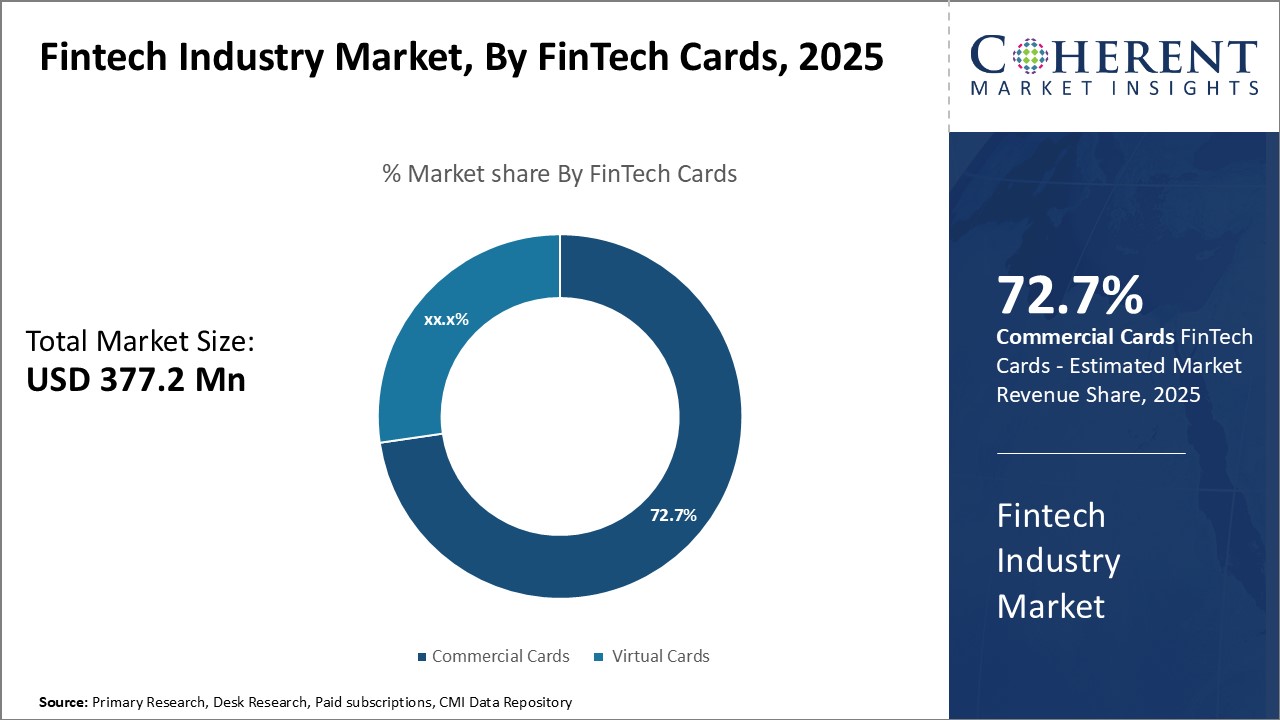
Fintech Industry Market Insights, By FinTech Cards: Commercial Cards contribute the highest share of the market owing to its Technological & product innovation.
Commercial Cards hold the largest market share of 73.7% in 2026. The fintech industry is increasingly adopting commercial cards as businesses pursue efficient, secure, and streamlined payment solutions. These cards simplify expense management, cut administrative workload, and offer real-time insights into corporate spending. Digital transformation, integration with accounting and ERP systems, and the demand for faster, contactless transactions are driving their growth. Advanced data analytics, fraud protection, and rewards programs further boost adoption. Fintech innovations are creating customized card solutions for both SMEs and large enterprises, transforming traditional corporate payment processes. For instance, in April 2024, OakNorth launched a commercial card program for its business banking clients via Marqeta’s card issuing platform, extending the offering to UK SMB customers alongside deposit accounts and automated bill payment tools.
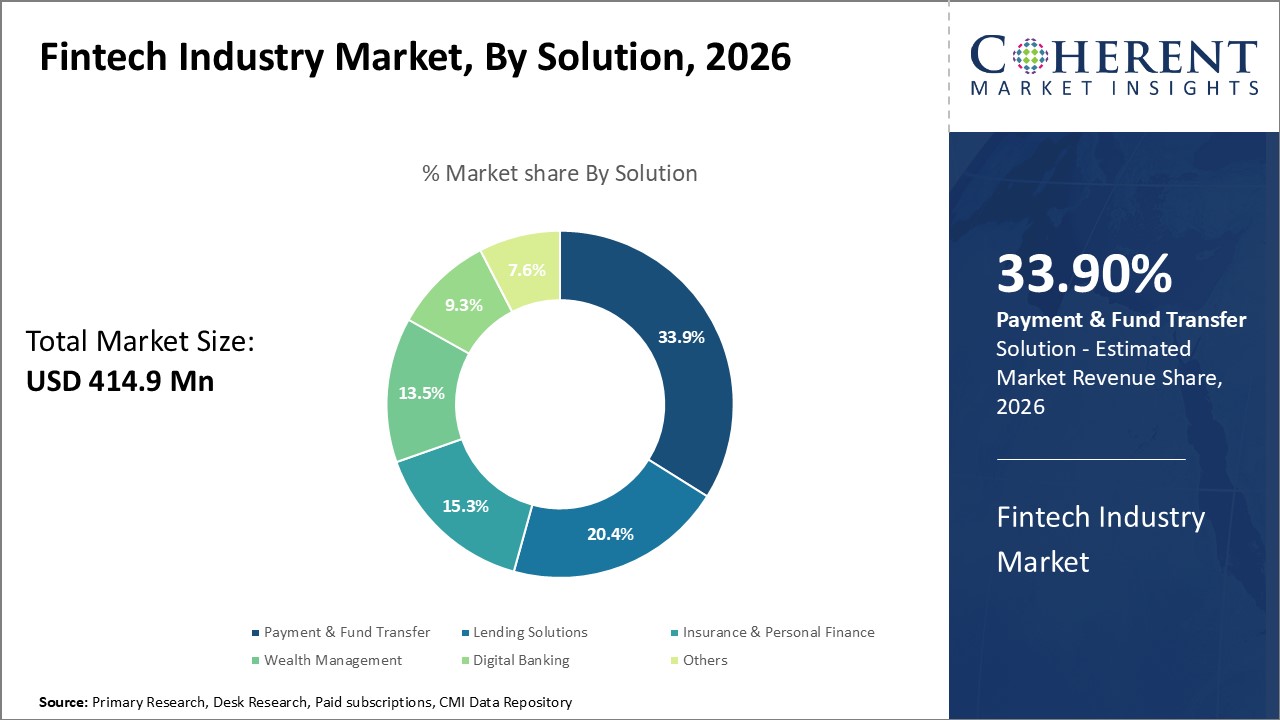
Fintech Industry Market Insights, By Solution: Payment & Fund Transfer contribute the highest share of the market owing to its consumer/business demand shift & use‑cases.
Payment & Fund Transfer expected to hold largest market share of 33.9% in 2026. The fintech industry is driving rapid growth in payment and fund transfer solutions as consumers and businesses seek faster, more secure, and convenient transactions. Widespread adoption of digital wallets, mobile banking, and real-time payment systems is simplifying money movement across accounts and borders. Strong security measures, supportive regulations, and seamless integration with e-commerce and enterprise platforms are further encouraging use. Fintech innovations are facilitating peer-to-peer transfers, cross-border remittances, and automated payment processing, transforming traditional financial transactions and enhancing overall efficiency across the ecosystem. For instance, in March 2025, Unzer, a payment technology provider, introduced "Direct Bank Transfer", an open banking payment method developed in partnership with Mastercard.
Fintech Industry Market Insights, By Technology: Application Programming Interface (API) contribute the highest share of the market owing to its improved customer experience & personalization.
Application Programming Interface (API) acquired the prominent market share of 39.1% in 2026. APIs are accelerating innovation in the fintech industry by connecting financial institutions, fintech platforms, and third-party services seamlessly. Growing demand for faster product development, integration of varied financial services, and real-time data sharing drives their adoption. APIs enhance customer experiences through personalized solutions, open banking, and digital wallets, while boosting operational efficiency, security, and compliance. By enabling flexible, scalable, and interoperable financial ecosystems, APIs are transforming how fintech companies deliver services and collaborate across the industry. For instance, in June 2025, Rizal Commercial Banking Corp. (RCBC) partnered with Hungry Workhorse Consultancy, Inc. to launch an online API marketplace, boosting the digital capabilities of fintech companies.
Fintech Industry Market Insights, By End User: Enterprise FinTech contribute the highest share of the market owing to its regulatory and infrastructure push.
Enterprise fintech is accelerating as businesses and financial institutions modernize operations, boost efficiency, and provide advanced financial solutions. Companies are adopting cloud-based platforms, integrating APIs, and leveraging data analytics to enhance decision-making and manage risk. Growing demand for scalable, automated, and customizable financial tools drives adoption, while supportive regulations and digital transformation initiatives further propel growth. By streamlining processes, enabling embedded finance, and facilitating new business models, enterprise fintech is transforming corporate finance and the way institutions operate. For instance, in October 2025, Attara the commodity hedging fintech launched its Explore Zone, an AI-powered platform that helps commodity traders of all sizes improve financial resilience and manage risk through hedging.
Regional Insights
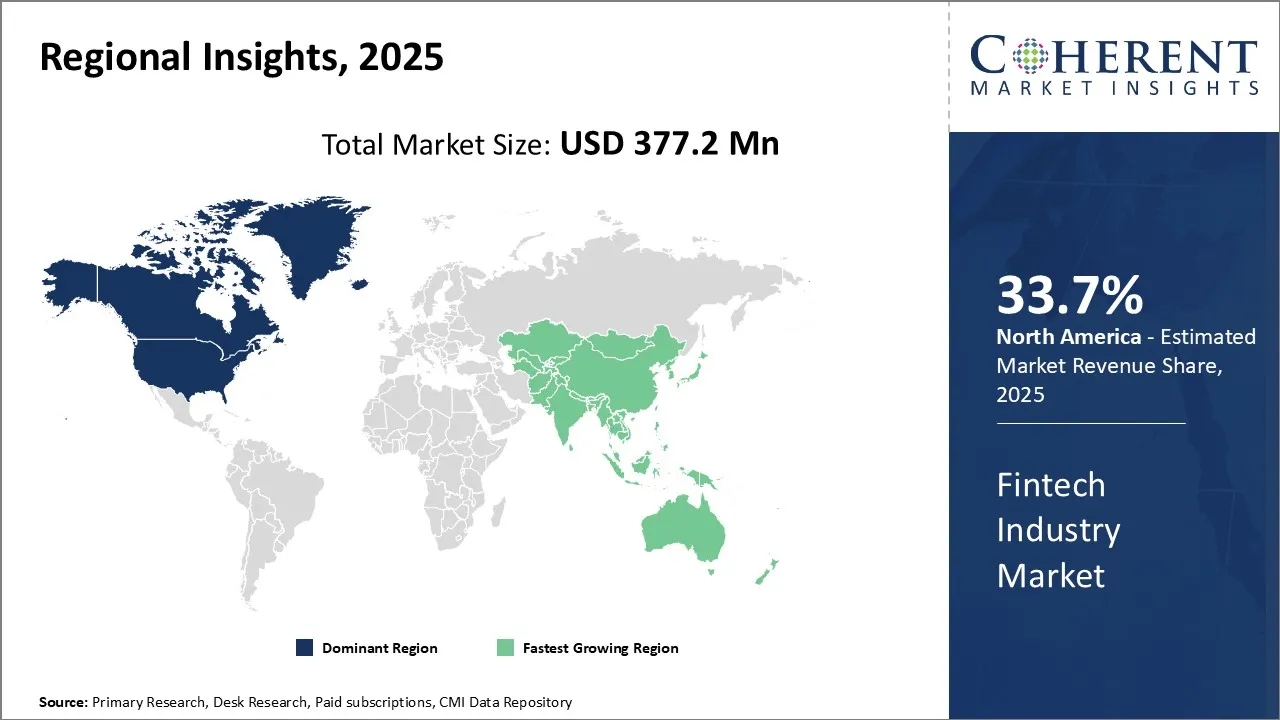
North America Fintech Industry Market Trends
North America dominates the overall market with an estimated share of 33.7% in 2026. The North American fintech market is rapidly evolving as new technologies and regulatory changes transform the industry. Companies are adopting AI-powered automation to improve credit scoring and detect fraud, while embedded finance and Banking-as-a-Service models allow non-financial firms to integrate payments and lending directly into their platforms. Open banking and API ecosystems facilitate seamless data sharing across institutions, and blockchain projects are advancing tokenization and crypto infrastructure. Meanwhile, stronger cybersecurity measures and supportive regulations are enabling growth and innovation in both consumer- and enterprise-focused fintech services. For instance, in September 2026, Scotland launched a "Fintech Gateway" with North America to boost international growth for its fintech sector and attract foreign direct investment.
Asia Pacific Fintech Industry Market Trends
The Asia‑Pacific fintech market growth is rapidly transforming as mobile-first habits, regulatory reforms, and ecosystem convergence drive change. Companies are building super-apps that combine payments, lending, investing, and insurance into single platforms, while governments implement real-time payment systems and digital ID frameworks. Businesses are expanding embedded finance within marketplaces and e-commerce, and cross-border payment networks are growing quickly. At the same time, fintech firms are leveraging AI, blockchain, and open-banking APIs to create innovative solutions in digital wallets, neobanking, and trade finance across the region. For instance, the launch of the India Fintech Foundation (IFF), a self-regulatory body, strengthens governance and promotes innovation in India’s rapidly evolving fintech industry.
United States Fintech Industry Market Trends
The U.S. fintech sector is rapidly transforming as companies adopt digital-first financial services designed for modern consumers. Firms are expanding embedded finance solutions, enabling everyday platforms to offer payments and lending, while APIs and real-time payment networks like FedNow facilitate seamless transactions. Businesses are using AI to improve credit decisions and prevent fraud, and digital wallets, neobanks, and alternative data models are redefining access. Meanwhile, regulators and banks are strengthening cybersecurity and compliance to support this evolving fintech ecosystem. For instance, in March 2026, Prometeo, a leading fintech infrastructure company linking global corporations with financial institutions in Latin America and the U.S., launched Borderless Banking to support B2B financial operations between the two regions.
China Fintech Industry Market Trends
China’s fintech sector is rapidly evolving as digital payments, technological innovation, and regulatory reforms drive transformation across the financial landscape. Leading platforms are extending services beyond payments into lending, wealth management, and insurance, while the government promotes the national digital currency and blockchain infrastructure. Companies are applying AI and big data to enhance credit scoring, prevent fraud, and deliver personalized financial services. At the same time, embedded finance is integrating into e-commerce and everyday apps, making financial services a seamless part of daily life. For instance, in June 2026, China's central bank and the Hong Kong Monetary Authority launched a real-time payment network linking the mainland and Hong Kong, driving a surge in fintech-related stock prices.
Fintech Industry Market Trend
Digital Banking Expansion
Fintech is driving the rapid growth of digital banking, offering fully online services that eliminate the need for traditional branches. Consumers increasingly prefer mobile-first banking for convenience, faster transactions, and 24/7 access. Features such as instant account opening, AI-driven customer support, and personalized financial tools enhance engagement. Digital banks also provide lower fees and innovative products, encouraging competition with traditional banks and accelerating the shift toward fully integrated, tech-driven financial ecosystems.
Embedded Finance & Super-Apps
Embedded finance continues to reshape consumer experiences by integrating payments, lending, insurance, and investment services directly into non-financial platforms like e-commerce or ride-hailing apps. Super-apps consolidate multiple financial and lifestyle services in a single interface, simplifying transactions and increasing engagement. This trend leverages APIs and partnerships to offer seamless, on-demand services, driving convenience and retention while expanding fintech’s reach beyond traditional banking boundaries.
Fintech Industry Market Opportunity
Expanding Digital Payments & Wallets
As consumers and businesses increasingly adopt cashless methods, fintech firms have a strong opportunity to build and scale digital payment solutions—such as mobile wallets, contactless transactions, and peer‑to‑peer transfers. With real‑time payment rails and global e‑commerce growth, fintech providers can address under‑served gaps in convenience, accessibility and cross‑border money movement, thereby replacing traditional payment methods and capturing new transactional volumes.
Market Report Scope
Fintech Industry Market Report Coverage
| Report Coverage | Details | ||
|---|---|---|---|
| Base Year: | 2025 | Market Size in 2026: | USD 414.9 Mn |
| Historical Data for: | 2020 To 2024 | Forecast Period: | 2026 To 2033 |
| Forecast Period 2026 to 2033 CAGR: | 10.0% | 2033 Value Projection: | USD 808.6 Mn |
| Geographies covered: |
| ||
| Segments covered: |
| ||
| Companies covered: | American Express Company, Square, Stripe, PayPal, Capital One, Citigroup Inc., JPMorgan Chase, Mastercard Inc., Visa Inc., Brex, Revolut, and Pivot Payables | ||
| Growth Drivers: |
| ||
| Restraints & Challenges: |
| ||
Fintech Industry Market News
- In May 2025, Willis, a WTW business, launched FinTech Plus, an insurance solution designed to help FinTech firms manage global growth, complexity, and regulatory changes.
- In August 2025, Kira, a global payments infrastructure platform, raised $6.7 million in a seed round led by Blockchange Ventures, Vamos Ventures, Stellar Blockchain, Grit Capital Partners, Credibly Neutral Ventures, Michael Seibel, and Oso Trava. The funding will help Kira rapidly expand fintech services across Latin America, starting in South America.
- In October 2025, JPMorganChase launched the Fintech Forward Programme to support the UK’s fintech industry, expand access to financial services, and drive economic opportunities across the country.
Analyst Opinion (Expert Opinion)
- The narrative of fintech as a “growth at all costs” phenomenon is changing. Evidence shows that reported earnings among listed fintech firms reached 69 % profitability in 2024, up from under 50 % the previous year. This shift matters: it signals maturation of business models, not just user acquisition. Investors and incumbents must recognise that scalability is no longer enough — sustainable margins are now the senior objective.
- In payments, the role of fintech has transitioned from novelty to infrastructure. For instance, the deployment of the FedNow network in the U.S. has expanded to over 1,200 financial‑institutions in short order, underpinning a surge in real‑time payments and shifting expectations of instant settlement. Fintech firms should stop pitching “faster payments” as optional and start framing them as the baseline offering — anyone not building real‑time rails now will fall behind.
- Another key inflection: embedded finance and open banking are now moving past “pilot phase” into broad commercial rollout. Companies such as Plaid already connect more than 10,000 U.S. banks to fintech apps, and one in two Americans have linked bank accounts via its network. The implication: platforms that are not embedded into everyday workflows (commerce, marketplaces, SaaS) will become second‑tier. If you’re a fintech vendor still selling only to end‑users, ask yourself when you will plug into a larger ecosystem.
Speak to the analyst
Want personalized insights?
Take the findings above to one of our principal consultants, or have the report rebuilt around the segments, geographies and competitors you actually track.
Market Segmentation
- FinTech Cards Insights (Revenue, USD, 2021 - 2033)
- Commercial Cards
- Virtual Cards
- Solution Insights (Revenue, USD, 2021 - 2033)
- Payment & Fund Transfer
- Lending Solutions
- Insurance & Personal Finance
- Wealth Management
- Digital Banking
- Others (Remittance Solutions, Crypto Solutions)
- Technology Insights (Revenue, USD, 2021 - 2033)
- Application Programming Interface (API)
- Big Data Analytics
- Artificial Intelligence (AI)
- Blockchain
- Cybersecurity
- End User Insights (Revenue, USD, 2021 - 2033)
- Individual Consumers
- Business FinTech
- Enterprise FinTech
- Regional Insights (Revenue, USD, 2021 - 2033)
- North America
- U.S.
- Canada
- Latin America
- Brazil
- Argentina
- Mexico
- Rest of Latin America
- Europe
- Germany
- U.K.
- Spain
- France
- Italy
- Russia
- Rest of Europe
- Asia Pacific
- China
- India
- Japan
- Australia
- South Korea
- ASEAN
- Rest of Asia Pacific
- Middle East
- GCC Countries
- Israel
- Rest of Middle East
- Africa
- South Africa
- North Africa
- Central Africa
- Key Players Insights
- American Express Company
- Square
- Stripe
- PayPal
- Capital One
- Citigroup Inc.
- JPMorgan Chase
- Mastercard Inc.
- Visa Inc.
- Brex
- Revolut
- Pivot Payables
Sources
Primary Research interviews
- CFOs, CTOs, and Product Heads of leading fintech firms
- Heads of digital banking and payments in major banks
- SME owners and corporate finance managers using fintech solutions
- Fintech startup founders and technology providers
- Regulators and policy makers in the financial technology space
Databases
- World Bank Global Payment Systems Database
- IMF Financial Access Survey (FAS)
- Bank for International Settlements (BIS) Statistics
- Statista – Fintech adoption and usage data
- Open Data from central banks (e.g., Federal Reserve, Reserve Bank of India, PBOC)
Magazines
- FinTech Magazine
- PaymentsSource
- The Banker
- Digital Finance Magazine
- Banking Technology
Journals
- Journal of Financial Technology
- Journal of Payments Strategy & Systems
- Journal of Banking and Finance
- International Journal of Financial Innovation in Banking
- Journal of Digital Banking
Newspapers
- Financial Times
- The Wall Street Journal
- The Economic Times
- Nikkei Asia
- South China Morning Post
Associations
- World FinTech Association (WFA)
- Electronic Transactions Association (ETA)
- FinTech Association of Hong Kong
- National Digital Finance Association (various countries)
- Global Digital Finance (GDF)
Public Domain sources
- Central bank publications and annual reports
- Government fintech policy reports and whitepapers
- Industry statistics from UN, OECD, and IMF
- Publicly available company annual reports and investor presentations
- Open-source fintech research and academic repositories
Proprietary Elements
- CMI Data Analytics Tool
- Proprietary CMI Existing Repository of information for last 8 years
Get access to 250+ pages report
Every segment, forecast, competitor profile and data table behind the analysis above — available for instant download.
- ESOMAR Member
- ISO 9001:2015 Certified
- D-U-N-S Registered
- GDPR & CCPA Compliant
Missing comfort of reading report in your local language? Find your preferred language:
Transform your Strategy with Exclusive Trending Reports
Frequently Asked Questions
The Fintech Industry Market is estimated to be valued at USD 414.9 Mn in 2026, and is expected to reach USD 808.6 Mn by 2033.
The CAGR of the Fintech Industry Market is projected to be 10.0% from 2026 to 2033.
Growing digitalization and cashless transactions and increasing demand for payment security and safety are the major factors driving the growth of global fintech industry market.
Data privacy and security concerns and lack of standard regulations are the major factors hampering the growth of global fintech industry market.
In terms of fintech cards, commercial cards segment, estimated to dominate the market revenue share 2026.
American Express Company, Square, Stripe, PayPal, Capital One, Citigroup Inc., JPMorgan Chase, Mastercard Inc., Visa Inc., Brex, Revolut, and Pivot Payables are the major players.
North America is expected to lead the global fintech industry market in 2026.