

Cryptocurrency Market Size and Trends - 2026 to 2033
The global cryptocurrency market is estimated to be valued at USD 51.85 Bn in 2026 and is expected to reach USD 78.48 Bn by 2033, exhibiting a compound annual growth rate (CAGR) of 6.1% from 2026 to 2033.
Key Takeaways
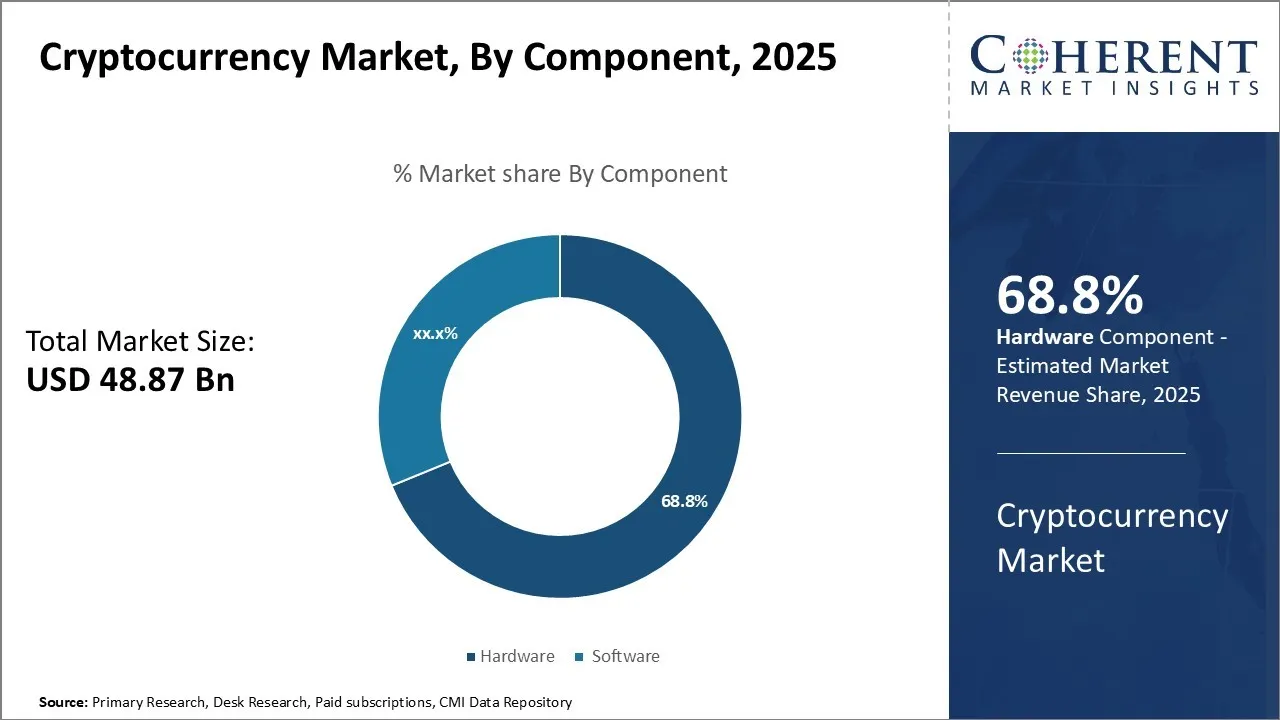
- Based on Component, the Hardware segment is expected to lead the market with 69.8% share in 2026, driven by increasing acceptance and adoption among merchants and consumers.
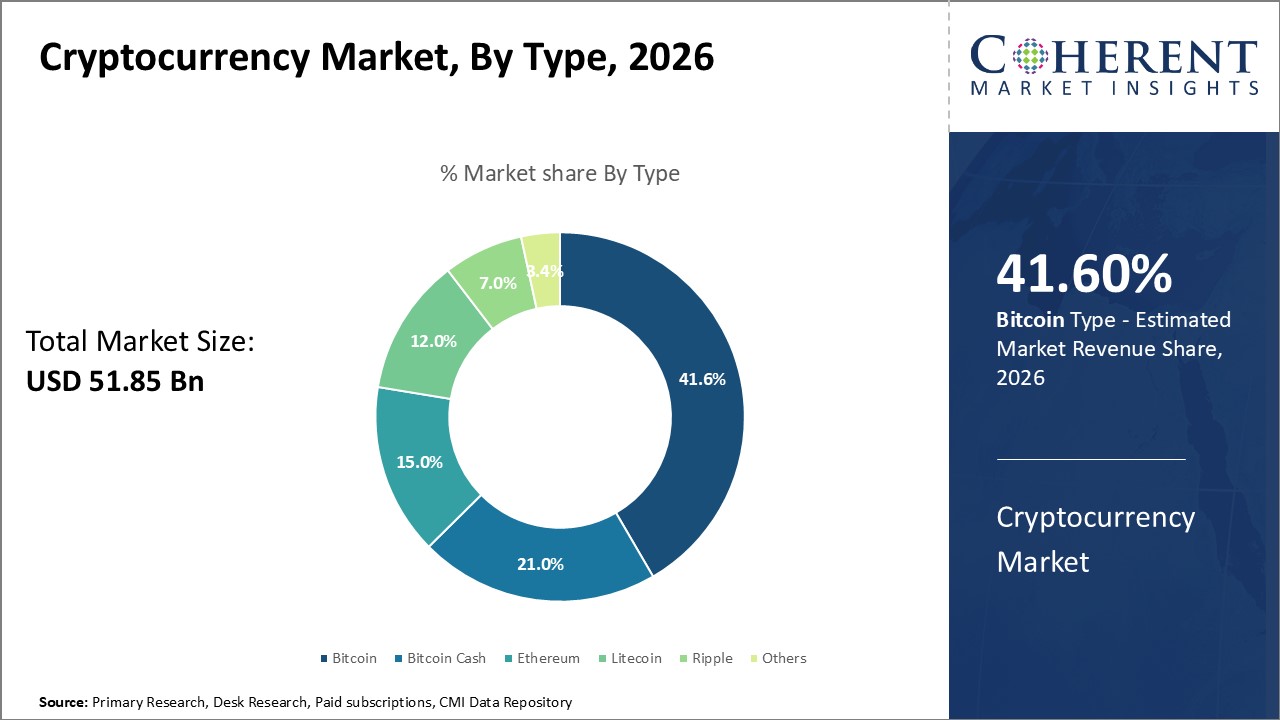
- Based on Type, Bitcoin is expected to hold 41.6% share in 2026, owing to its first-mover advantage, strong brand recognition as 'digital gold,' and established network effects.
- Based on Vertical, the Trading segment is projected to contribute 37.7% share in 2026, driven by the growing use of cryptocurrencies for cross-border transactions.
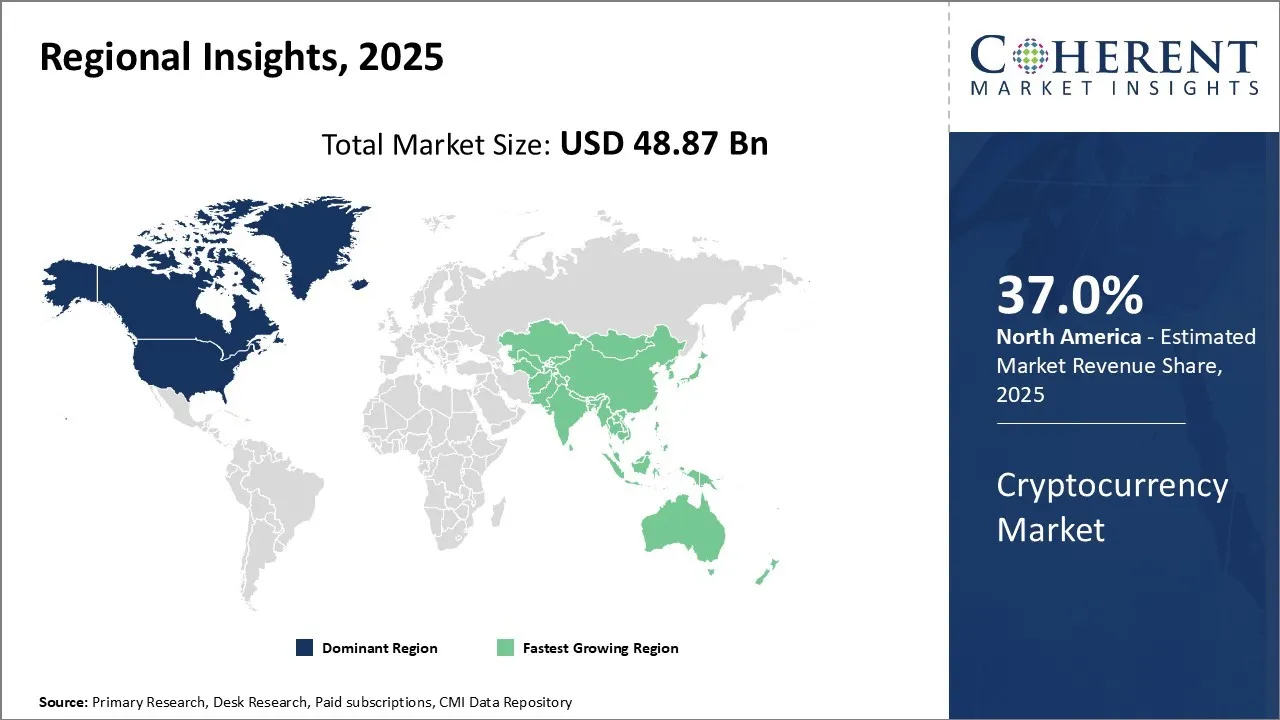
- Based on Region, North America is set to lead the global cryptocurrency market with 37.0% share in 2026. While, Asia Pacific is anticipated to be the fastest growing region.
Market Overview
The cryptocurrency market has been witnessing strong growth over the past few years. With rising adoption of cryptocurrency among both individual and institutional investors, the market is expected to grow multi-fold in the coming years. Various factors like global pandemic, geopolitical tensions, inflation, etc. have accelerated the growth of cryptocurrency as an alternative asset and store of value. Also, growing interest of young population in emerging technologies and ease of access through smartphone apps is supporting the cryptocurrency market growth. Established companies are also entering the market and launching their own cryptos which is providing necessary legitimacy to the asset class.
Current Events and Its Impact on the Cryptocurrency Market
Current Events | Description and its impacts |
U.S. Regulatory Framework Development |
|
Central Bank Digital Currencies (CBDCs) Implementation |
|
Segmental Insights
- Current Industry Events of 2026
- Market Size Estimation
- Regional Breakdown
- Competitive Landscape
- Customer Intelligence
- Segmental Analysis
- Pricing Analysis
- Key Market Drivers, Challenges & Future Trends
- Customized Insights Section
Cryptocurrency Market Insights, By Component: Hardware Dominates Due To Increasing Acceptance And Adoption
Based on the component, hardware is expected to record 69.8% market share by 2026. With the increasing popularity of cryptocurrencies among dealers and consumers alike, there is increasing demand for hardware that can be used for mining, storing, and conducting cryptocurrency transactions. In this regard, specialized hardware for mining cryptocurrencies using high-performance GPUs and ASIC miners helps miners to validate transactions and mine coins. On the other hand, investors use hardware wallets and cold storage solutions that protect their cryptocurrencies from cyber-crimes.
Exchanges and payment services are focusing on strong server technology to handle large transaction volumes in the crypto-market. To cater to this requirement in the hardware industry, companies are getting involved in innovations like GPU mining rigs, ASIC miners, and electronic wallets like Ledger Nano and Trezor. With the rising acceptance rate among traders and users alike for cryptocurrencies, the pace for the requirement of enabling hardware technology is likely to boost the dominance of the hardware market.
For instance, in April 2025, Global crypto exchange BYDFi partnered with Ledger to officially launched a limited edition co‑branded Ledger Nano X hardware wallet at the TOKEN2049 event in Dubai.
Cryptocurrency Market Insights, By Type: Bitcoin Leads Owing To First-Mover Advantage And Strong Network Effects
By type, Bitcoin is predicted to make a significant contribution of 41.6% in the market share by 2026, mainly due to the early mover advantage it possessed with its coin “digital gold.” Founded in 2009, Bitcoin has carved out a niche in the market with its ability to store and transfer value. It remains the most sought-after investment on crypto platforms with significant trading activities.
Bitcoin has a “virtuous cycle,” which increases its dominance as its user and merchant base boosts its position. Even with better features from other cryptocurrencies, it is extremely hard for them to overpowered Bitcoin’s network effects that already span over a decade. Unless major technology failures occur, Bitcoin can dominate the market.
For instance, in December 2025, Ripple acquired the stablecoin platform Rail to expand cross-border payments and reinforce Bitcoin and stablecoin market infrastructure.
Cryptocurrency Market Insights, By Vertical: Trading Segment Expands Due To Cross-Border Use Cases
On the basis of vertical, the trading category is projected to hold a market share of 37.7% by 2026 as a result of the rising need for cryptocurrencies to make international transactions. This is mainly because the cryptocurrencies transaction process involves the potential to be low-cost, seamless, and peer-to-peer across international borders.
The globalization and digitalization of trade networks have picked up the pace in terms of crypto adoption, which has allowed for seamless border-less trading. The main parties using this method, involving trade, import/export, or web marketplaces, are using cryptos to efficiently do their trades across borders. There has also been increased trade investment in this aspect, which has led to foreseen further development in the vertical’s market share.
For instance, in December 2025, SoFi launched the fully reserved stablecoin SoFiUSD to support international payments and remittances, boosting cross-border trading volumes.
Regional Insights
North America Cryptocurrency Market Analysis & Trends
North America continues to dominate the market share in the global cryptocurrencies market, accounting for 37.0% in 2026, primarily due to widespread adoption in financial hubs such as New York and the Silicon Valley. The U.S. houses significant players in the field of cryptocurrencies, including prominent exchanges, trade platforms, digital wallet services, as well as blockchain technology start-ups. The abundant technology infrastructure along with favorable regulations has encouraged innovation in the field of cryptocurrencies, facilitating the creation of innovative digital coins, smart contracts, payment systems, and blockchain solutions.
For instance, in October 2026, Coinbase expanded its institutional crypto custody services in the U.S., providing secure storage and transaction support for digital assets, further strengthening North America’s crypto ecosystem.
Asia Pacific Cryptocurrency Market Analysis & Trends
The Asia Pacific has been experiencing the most rapid acceleration in the adoption of cryptocurrencies, with China, Japan, and South Korea well ahead in the curve. Even with the Chinese government cracking down on the trading of cryptocurrencies and initial coin offerings, the Asia Pacific represents the largest share of the global trading of bitcoins. This can be attributed to the widespread use of the internet and smartphones, and an initial welcoming regulatory environment.
For instance, in November 2026, Binance launched a regional crypto payments initiative in Southeast Asia to facilitate cross-border remittances and merchant adoption, underscoring Asia Pacific’s growing role in the global crypto economy.
Cryptocurrency Market Outlook Country-Wise
U.S. Cryptocurrency Market Trends
The U.S. cryptocurrency market is flourishing in 2026 because of adoption among consumers, favorable regulations, and the presence of exchanges, wallets, and blockchain startups. The presence of strong infrastructure for finance, such as New York and Silicon Valley, has helped development in areas such as cryptocurrencies, smart contracts, payments, and decentralized finance. Institutional investment, with the presence of secure storage solutions and scalable exchanges, is being fueled, thus driving the growth of the U.S. cryptocurrency market.
For instance, in December 2026, Visa announced a pilot program allowing U.S. banks to settle transactions using the USDC stablecoin, enabling faster settlement and improved resilience during off‑hours.
China Cryptocurrency Market Trends
China’s cryptocurrency market is expanding in 2026 despite tightening regulations on the trading of cryptocurrencies and initial coin offerings. High penetration rates of the internet and smartphone usage, as well as strong retail participation, contribute largely to this trend, especially with regard to the trading of bitcoin. Cryptocurrency use through fintech innovations and cross-border money transfer also helps boost the use of cryptocurrencies.
Market Report Scope
Cryptocurrency Market Report Coverage
| Report Coverage | Details | ||
|---|---|---|---|
| Base Year: | 2025 | Market Size in 2026: | USD 51.85 Bn |
| Historical Data for: | 2020 To 2024 | Forecast Period: | 2026 To 2033 |
| Forecast Period 2026 to 2033 CAGR: | 6.1% | 2033 Value Projection: | USD 78.48 Bn |
| Geographies covered: |
| ||
| Segments covered: |
| ||
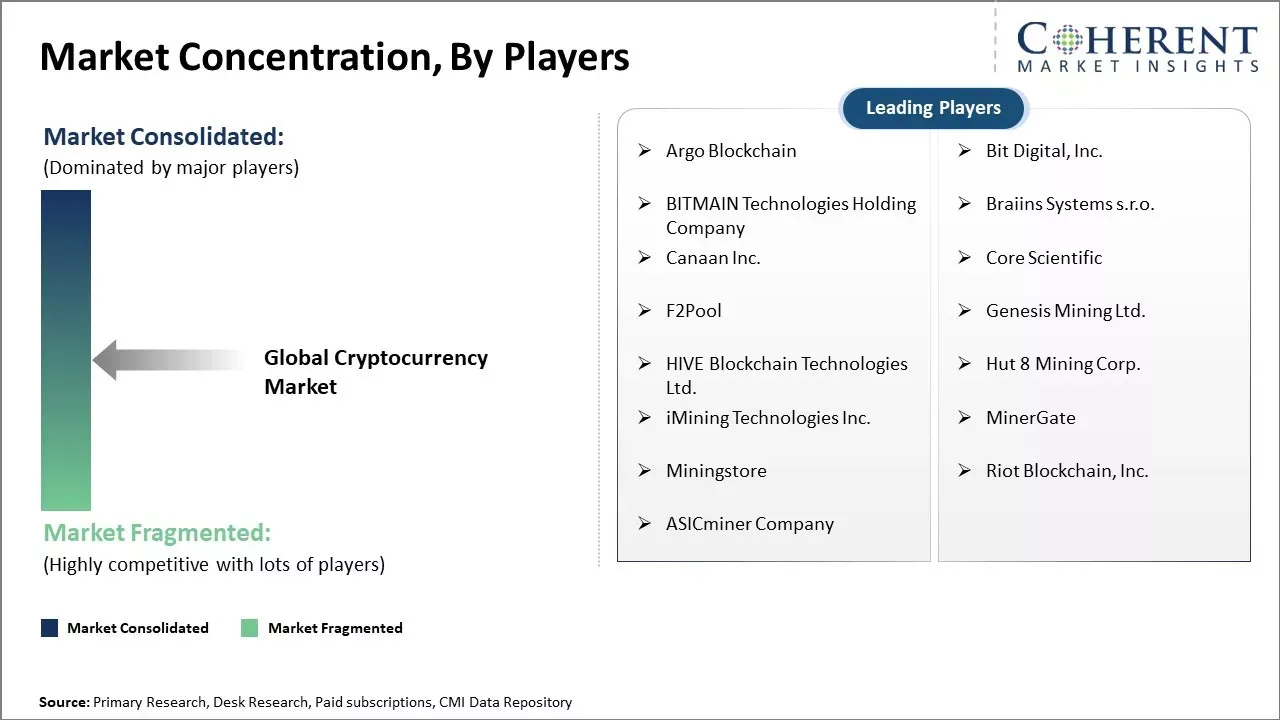
| Companies covered: | Argo Blockchain, Bit Digital, Inc., BITMAIN Technologies Holding Company, Braiins Systems s.r.o., Canaan Inc., Core Scientific, F2Pool, Genesis Mining Ltd., HIVE Blockchain Technologies Ltd., Hut 8 Mining Corp., iMining Technologies Inc., MinerGate, Miningstore, Riot Blockchain, Inc., and ASICminer Company | ||
| Growth Drivers: |
| ||
| Restraints & Challenges: |
| ||
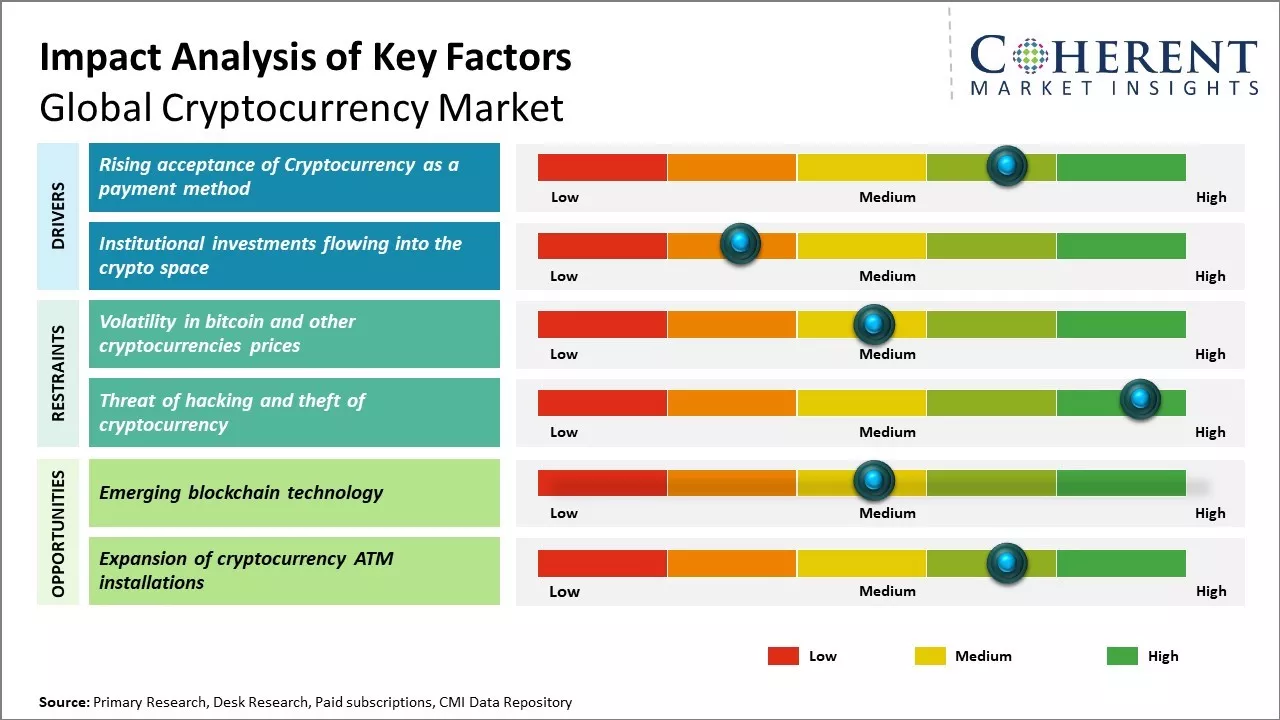
Cryptocurrency Market Driver
Rising acceptance of cryptocurrency as a payment method
With the continuous rise in the value of popular cryptocurrencies like Bitcoin and Ethereum in the past few years, there has been a gradual acceptance of cryptocurrency as a viable payment method across the globe. A growing number of companies are now accepting cryptocurrency payments for goods and services. Large retail chains, travel companies, tech firms, and other businesses have started tapping into this new revenue stream of cryptocurrency users. This acceptance has given confidence to both investors and regular users about the longevity and practical use of digital currencies.
Cryptocurrency payments settle in minutes compared to traditional banking payments. It removes friction from payments by avoiding cross-border transaction barriers and high fees. Young consumers who are technology-savvy have also warmed up to the idea of paying through cryptocurrency apps on their smartphones. Several payment companies are further helping mainstream adoption by introducing services that let customers pay for items at online and physical stores using their crypto balances. With more consumers embracing cryptocurrency for transactions, businesses are realizing the commercial potential that this new payment rail provides. If this trend of acceptance continues to rise across different sectors and geographies, it will surely drive greater interest and demand in the cryptocurrency market.
Market Concentration and Competitive Landscape
Institutional investments flowing into the crypto space
In the past few years, cryptocurrency was considered a fringe asset class dominated by retail investors and technology enthusiasts. Established cryptocurrency exchanges are raising millions from prominent venture capital funds which erstwhile stayed away from this space.
These large institutional investors have brought more sophistication, compliance practices, and additional routes for investors to gain crypto exposure. Activities like bitcoin futures trading, crypto trusts, and funds give easier access for wealth managers to place clients' money. Many traditional finance houses are experimenting with blockchain use cases for trading, clearing, and settlement of assets. With their deep pockets and widespread influence, institutional involvement has added legitimacy to the perception of cryptocurrency as a serious investment asset deserving attention.
Cryptocurrency Industry News
- In December 2025, Hut 8 announced a major USD 7 billion deal with Fluidstack and Anthropic to develop a 245 MW AI data center at its River Bend facility in Louisiana, marking a pivot from pure Bitcoin mining to large‑scale data infrastructure deployment.
- In February, Core Scientific announced its January 2025 production and operations update, reporting 256 self‑mined Bitcoin, a fleet of approx. 161,000 miners with 19.5 EH/s energized hash rate, and ongoing infrastructure deployment across multiple U.S. data centers.
- In December 2025, Riot Platforms announced production and operations updates for November 2025, reporting 428 Bitcoin mined, with a deployed hashrate of 36.6 EH/s and ongoing expansion of large‑scale data center initiatives for Bitcoin mining and high‑performance computing.
Market Segmentation
- Component Insights (Revenue, USD Bn, 2021 - 2033)
- Hardware
- Software
- Type Insights (Revenue, USD Bn, 2021 - 2033)
- Bitcoin
- Bitcoin Cash
- Ethereum
- Litecoin
- Ripple
- Others
- Vertical Insights (Revenue, USD Bn, 2021 - 2033)
- Banking
- Gaming
- Government
- Healthcare
- Retail & E-commerce
- Trading
- Others
- Regional Insights (Revenue, USD Bn, 2021 - 2033)
- North America
- U.S.
- Canada
- Latin America
- Brazil
- Argentina
- Mexico
- Rest of Latin America
- Europe
- Germany
- U.K.
- Spain
- France
- Italy
- Russia
- Rest of Europe
- Asia Pacific
- China
- India
- Japan
- Australia
- South Korea
- ASEAN
- Rest of Asia Pacific
- Middle East & Africa
- GCC Countries
- Israel
- South Africa
- Rest of Middle East & Africa
- Key Players Insights
- Argo Blockchain
- Bit Digital, Inc.
- BITMAIN Technologies Holding Company
- Braiins Systems s.r.o.
- Canaan Inc.
- Core Scientific
- F2Pool
- Genesis Mining Ltd.
- HIVE Blockchain Technologies Ltd.
- Hut 8 Mining Corp.
- iMining Technologies Inc.
- MinerGate
- Miningstore
- Riot Blockchain, Inc.
- ASICminer Company
Sources
Primary Research Interviews from the following stakeholders
Stakeholders
- Interviews with cryptocurrency miners, blockchain developers, crypto exchanges, wallet providers, payment processors, institutional investors, and regulatory advisors across major regional markets.
Specific stakeholders
- CTOs, CIOs, and operations heads at major cryptocurrency mining companies (e.g., Riot Platforms, Hut 8 Mining, HIVE Blockchain, Core Scientific)
- Product and innovation managers at hardware manufacturers (e.g., BITMAIN, Canaan Inc., Braiins Systems)
- Exchange operations and compliance heads at cryptocurrency trading platforms (e.g., Coinbase, Binance, Kraken)
- Security and cold storage specialists at digital asset custodians and wallet providers (e.g., Ledger, Trezor, Fireblocks)
- Procurement and infrastructure officers at blockchain data centers and institutional mining farms
- Blockchain and DeFi strategy leads at financial institutions and fintech companies integrating crypto payments
- Regulatory and policy advisors from government and financial oversight bodies (e.g., SEC, FinCEN, FCA, MAS)
Databases
- CoinMarketCap
- CoinGecko
- Glassnode on-chain data
- Messari crypto data repository
- com statistics
- BitInfoCharts
- CryptoCompare
- IO institutional crypto data
Magazines
- Bitcoin Magazine
- CryptoSlate
- CoinDesk
- The Block
- Decrypt
- Cointelegraph
- Finance Magnates – Crypto Section
- Ledger Insights – Blockchain and Crypto Infrastructure
Journals
- Journal of Blockchain Research
- Ledger – Journal of Cryptography and Blockchain Technology
- International Journal of Digital Currency
- Journal of Financial Technology and Blockchain Applications
- Journal of Cryptocurrency Research
- Journal of Distributed Ledger Technology
Newspapers
- The Wall Street Journal – Crypto & FinTech Section
- Financial Times – Digital Assets Coverage
- The New York Times – Cryptocurrency Reports
- The Guardian – Digital Currency & Blockchain
- Nikkei Asia – Crypto and Blockchain Industry
- Reuters – Cryptocurrency News
- Bloomberg – Digital Assets Section
Associations
- Blockchain Association (U.S.)
- Crypto Valley Association (Switzerland)
- Global Digital Finance (GDF)
- Chamber of Digital Commerce
- Enterprise Ethereum Alliance (EEA)
- International Association for Trusted Blockchain Applications (INATBA)
- Bitcoin Association (Global)
Public Domain Sources
- U.S. Securities and Exchange Commission (SEC) – Cryptocurrency and ICO Filings
- Commodity Futures Trading Commission (CFTC) – Digital Asset Reports
- European Central Bank (ECB) – Crypto & Digital Euro Reports
- Financial Action Task Force (FATF) – Cryptocurrency Guidelines
- Bank of International Settlements (BIS) – Digital Currency Reports
- People's Bank of China (PBoC) – Digital Yuan and Blockchain Reports
- International Monetary Fund (IMF) – Digital Currency and FinTech Reports
- United Nations Conference on Trade and Development (UNCTAD) – Crypto Adoption Reports
Proprietary Elements
- CMI Data Analytics Tool
- Proprietary CMI Existing Repository of information for last 8 years
Definition: The global cryptocurrency market involves the trading and exchange of digital currencies that use cryptography to secure transactions and to control the creation of new units of a particular currency. Some of the major cryptocurrencies being traded globally include Bitcoin, Ethereum, Litecoin, Ripple, and others. This rapidly growing market allows for fast and secure peer-to-peer transactions across borders without any intermediaries. With more businesses, retailers and individuals adopting cryptocurrencies, the global cryptocurrency market has huge potential for further expansion in the coming years.
Get access to 250+ pages report
Every segment, forecast, competitor profile and data table behind the analysis above — available for instant download.
- ESOMAR Member
- ISO 9001:2015 Certified
- D-U-N-S Registered
- GDPR & CCPA Compliant
Missing comfort of reading report in your local language? Find your preferred language:
Transform your Strategy with Exclusive Trending Reports
Frequently Asked Questions
The Cryptocurrency Market is estimated to be valued at USD 51.85 Bn in 2026, and is expected to reach USD 78.48 Bn by 2033.
The CAGR of the Cryptocurrency Market is projected to be 6.1% from 2026 to 2033.
Rising acceptance of cryptocurrency as a payment method and institutional investments flowing into the crypto space are the major factors driving the growth of the global cryptocurrency market.
Volatility in bitcoin and other cryptocurrencies prices and threat of hacking and theft of cryptocurrency are the major factors hampering the growth of the global cryptocurrency market.
In terms of component, hardware is estimated to dominate the market revenue share in 2026.
Argo Blockchain, Bit Digital, Inc., BITMAIN Technologies Holding Company, Braiins Systems s.r.o., Canaan Inc., Core Scientific, F2Pool, Genesis Mining Ltd., HIVE Blockchain Technologies Ltd., Hut 8 Mining Corp., iMining Technologies Inc., MinerGate, Miningstore, Riot Blockchain, Inc., and ASICminer Company are the major players.
North America is expected to lead the global cryptocurrency market in 2026.