

Blockchain Market Size and Forecast — 2026 - 2033
The Global Blockchain Market size is estimated to be valued at USD 12.3 billion in 2026 and is expected to reach USD 48.7 billion by 2033, exhibiting a compound annual growth rate (CAGR) of 22.5% from 2026 to 2033.
Overview
The Blockchain market is experiencing significant growth due to increasing demand for secure, transparent, and decentralized digital transactions across industries. Financial institutions are widely adopting blockchain technology for faster payments, fraud reduction, and efficient cross-border transactions. Rising investments in cryptocurrencies, decentralized finance (DeFi), and smart contracts are further accelerating market expansion. Additionally, growing adoption of blockchain in supply chain management, healthcare, retail, and government applications is improving data transparency and operational efficiency. Supportive government initiatives, advancements in Web3 technologies, and integration with artificial intelligence and IoT are also driving innovation. Increasing concerns regarding data security and cyber threats continue to boost blockchain adoption globally.
Key Takeaways
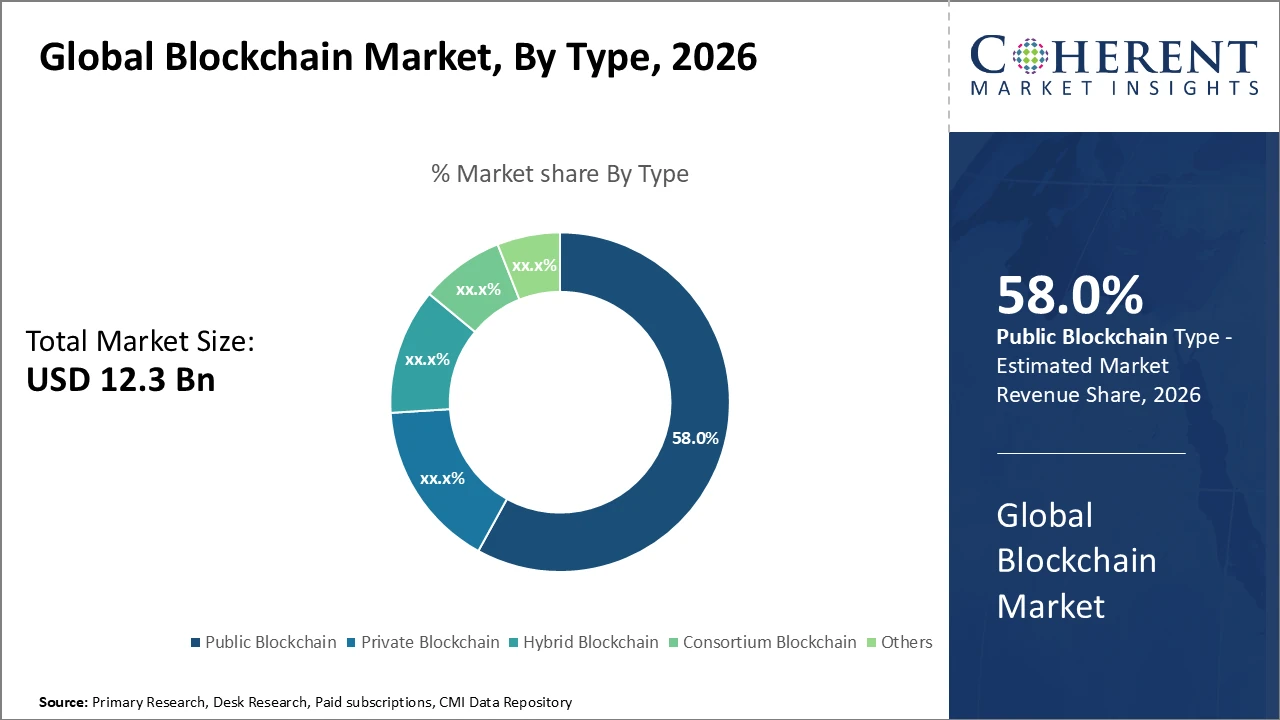
The Public Blockchain segment dominates the market with a 58% share, driven by open-access features suitable for decentralized finance and other applications, while Private and Hybrid Blockchains are rapidly gaining traction for enterprise-specific needs.
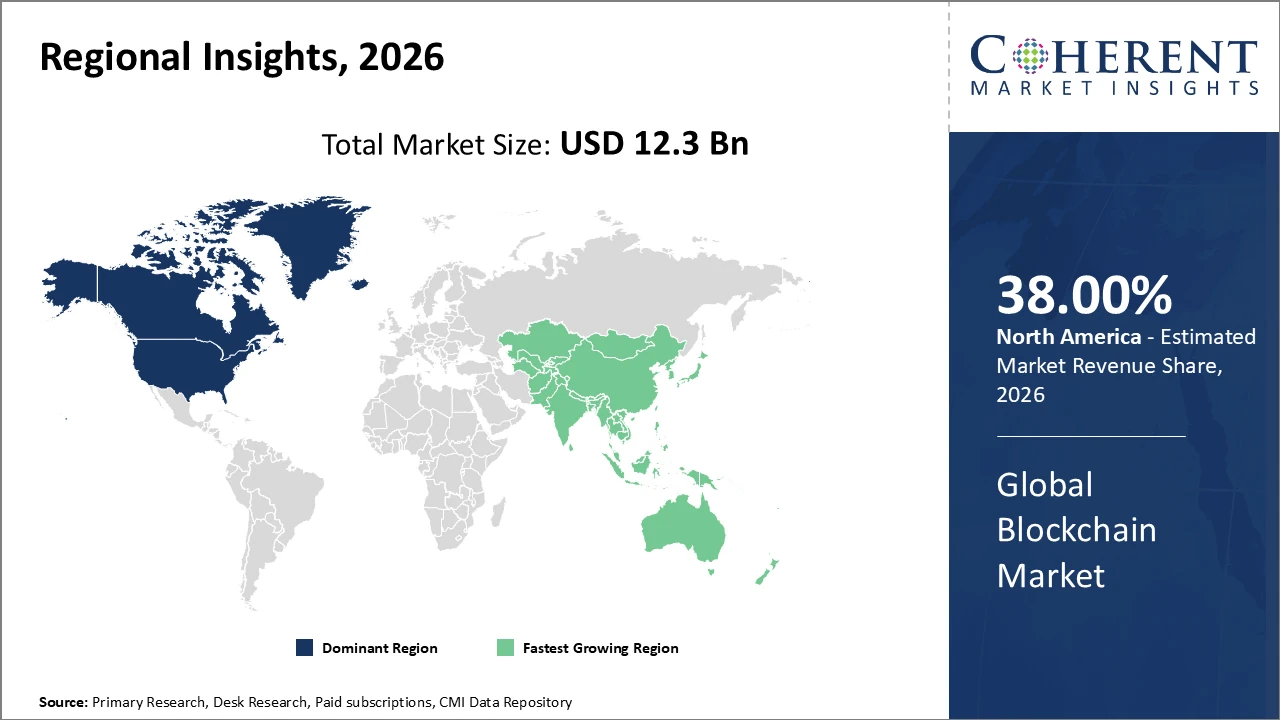
North America remains the largest regional market, supported by robust technology infrastructure and a favorable regulatory environment, accounting for approximately 38% of the global blockchain market.
Asia Pacific is the fastest-growing region, driven by government support in countries like China and India, a rise in blockchain startups, and increased investments, expected to significantly boost regional revenue.
Blockchain Market Segmentation Analysis
Blockchain Market Insights, By Type
Public Blockchain dominates the market share due to its open and transparent network, which drives widespread adoption in decentralized finance and cryptocurrency applications. Private Blockchain is the fastest-growing subsegment, favored by enterprises for enhanced data privacy, security, and streamlined operational workflows. Hybrid Blockchains combine the advantages of public and private networks, enabling secure, scalable deployments suitable for multiple industries. Consortium Blockchain provides restricted access networks, making it ideal for business consortia requiring controlled participation.
Blockchain Market Insights, By Application
Payments and Money Transfer dominates the blockchain market, driven by the rapid growth of decentralized finance and cryptocurrency adoption, alongside innovations in cross-border payment solutions that enhance speed and security. Supply Chain Management is the fastest-growing subsegment, with industries increasingly using blockchain to improve transparency, traceability, and operational efficiency. Healthcare applications focus on secure storage and sharing of patient data, while Government Services adopt blockchain for accurate record management and reducing fraud. Identity Management is expanding quickly due to its importance in digital identity verification and authentication.
Blockchain Market Insights, By Deployment Mode
Cloud-Based deployment mode dominates the blockchain market with a 65% share, fueled by its flexibility, scalability, and cost-efficiency, making it the preferred choice for many organizations. Hybrid deployment mode is the fastest-growing subsegment, offering a combination of on-premise security and cloud scalability, which enables tailored blockchain solutions for diverse business needs. On-Premise deployment continues to serve organizations with strict data control and compliance requirements, maintaining a steady presence in the market.
Blockchain Market Trends
Recent blockchain market trends emphasize scalability, regulatory compliance, and sustainability.
In 2025, hyperscalers like Microsoft and Amazon launched advanced blockchain services to support higher transaction volumes, addressing scalability challenges.
Regulatory frameworks in North America and Europe matured, encouraging greater enterprise adoption of blockchain solutions.
Government support in Asia Pacific accelerated blockchain integration into public services, boosting regional market growth.
Sustainability gained prominence in 2026, with energy-efficient consensus mechanisms like IOHK’s Proof of Stake in Cardano reducing energy consumption by over 70%.
Blockchain Market Insights, By Geography
North America Blockchain Market Analysis and Trends
In North America, the blockchain market is dominated by a mature technology ecosystem, early adoption by financial institutions, and supportive regulatory frameworks that encourage innovation. The region, led by the U.S. and Canada, accounts for approximately 38% of the global market share. Key players, including Microsoft, IBM, and Amazon, are actively driving growth through strategic collaborations, partnerships, and the launch of advanced blockchain services. Strong infrastructure, access to venture capital, and a highly skilled workforce further support development. The integration of blockchain across finance, supply chain, healthcare, and government sectors continues to strengthen North America’s leading position in the global market.
Asia Pacific Blockchain Market Analysis and Trends
Asia Pacific exhibits the fastest growth in the blockchain market, with a projected CAGR exceeding 28%, driven by proactive government-led initiatives in emerging economies. India’s National Blockchain Strategy promotes adoption across sectors such as finance, healthcare, and supply chain, while China’s expansion of its Blockchain Service Network supports enterprise-grade applications. The region benefits from a rapidly growing startup ecosystem and increasing venture capital investments, fostering innovation and accelerating deployment of blockchain solutions. Combined with rising digital infrastructure and supportive regulatory policies, these factors position Asia Pacific for substantial market expansion and long-term growth, establishing it as a key driver in the global blockchain landscape.
Blockchain Market Outlook for Key Countries
USA Blockchain Market Analysis and Trends
The USA’s blockchain market remains a global leader, driven by widespread adoption in financial services and a robust cloud infrastructure. In 2025, major U.S. banks implemented smart contract platforms to streamline cross-border payments, boosting market revenue significantly. Leading technology providers, including Microsoft with Azure Blockchain Service and IBM with its Blockchain platform, continue to play a central role in the ecosystem by offering scalable, enterprise-grade solutions. Additionally, government initiatives exploring blockchain applications for digital identity verification, supply chain transparency, and public record management further support adoption. Strong investment, innovation, and regulatory clarity reinforce the U.S. market’s leadership position globally.
Germany Blockchain Market Analysis and Trends
Germany’s blockchain market is experiencing steady growth, driven by strong government support, advanced digital infrastructure, and a thriving fintech ecosystem. The government’s Blockchain Strategy encourages adoption across finance, supply chain, and public administration, fostering regulatory clarity and innovation. Enterprise applications, particularly in banking and logistics, are expanding rapidly, with organizations leveraging private and hybrid blockchains for secure, efficient operations. Germany also benefits from a growing startup ecosystem focused on blockchain-based solutions, including decentralized finance and digital identity. Trends indicate increasing integration with IoT, AI, and Industry 4.0 initiatives, positioning Germany as a key player in Europe’s blockchain development landscape.
Analyst Opinion
Increasing Enterprise Blockchain Adoption: Enterprises are integrating blockchain to enhance supply chain traceability and secure cross-border payments, driving market growth. In 2025, a global logistics firm reported a 30% reduction in shipment delays after implementing blockchain-enabled traceability platforms.
Expansion of Blockchain-as-a-Service (BaaS): Rising cloud adoption led to a 45% increase in BaaS offerings in 2024, lowering entry barriers and accelerating deployment for SMEs and various industries. Subscription-based pricing models made blockchain solutions more financially accessible, boosting market revenue.
Regulatory Progress and Compliance Frameworks: Clearer regulations in North America and the EU increased enterprise confidence. In 2026, blockchain-based identity verification services grew 60% following regulatory compliance certifications.
Growing Interest in Decentralized Finance (DeFi): DeFi platforms saw transaction volumes rise by over 50% in 2025, reflecting strong user adoption and demand, driven by innovations in smart contracts.
- Current Industry Events of 2026
- Market Size Estimation
- Regional Breakdown
- Competitive Landscape
- Customer Intelligence
- Segmental Analysis
- Pricing Analysis
- Key Market Drivers, Challenges & Future Trends
- Customized Insights Section
Market Scope
| Report Coverage | Details | ||
|---|---|---|---|
| Base Year: | 2025 | Market Size in 2026: | USD 12.3 billion |
| Historical Data for: | 2020 To 2024 | Forecast Period: | 2026 To 2033 |
| Forecast Period 2026 to 2033 CAGR: | 22.5% | 2033 Value Projection: | USD 48.7 billion |
| Geographies covered: |
| ||
| Segments covered: |
| ||
| Companies covered: | IBM Corporation, Microsoft Corporation, Oracle Corporation, SAP SE, Chain, R3 Corda, Amazon Web Services Inc., Ripple Labs Inc., Hyperledger | ||
| Growth Drivers: |
| ||
Blockchain Market Growth Factors
The blockchain market’s rapid growth is largely driven by increasing demand for fraud detection and risk management in financial services, with adoption for banking fraud mitigation rising 40% in 2025. Accelerated digital transformation across healthcare and government sectors has generated significant revenue, as over 50% of government blockchain initiatives in 2024 focused on smart identity management. Enhanced interoperability between legacy IT systems and blockchain platforms boosted hybrid deployment adoption by 30%. Additionally, rising emphasis on data privacy and regulatory compliance in the EU and North America fueled a 28% increase in blockchain applications addressing GDPR and related standards, reinforcing market expansion.
Blockchain Market Development
In May 2026, Shanghai launched a blockchain-based bulk commodity trading services platform to accelerate digital trade infrastructure development in the Yangtze River Delta region and support regional trade expansion.
Key Players
Leading Companies of the Market
IBM Corporation
Microsoft Corporation
Oracle Corporation
SAP SE
Chain
Amazon Web Services, Inc.
R3 Corda
Ripple Labs Inc.
Hyperledger
Several leading companies have strengthened their blockchain capabilities through strategic partnerships and targeted technology investments. For example, IBM Corporation collaborated with major banks to launch blockchain-enabled trade finance platforms, improving transaction transparency and reducing costs by 25%. Likewise, Microsoft’s ongoing enhancements to its Azure Blockchain Service led to a 35% increase in cloud-based blockchain deployments among enterprises by the end of 2025. These initiatives highlight how top players are leveraging innovation, partnerships, and scalable solutions to drive market growth, expand adoption across industries, and solidify their competitive positioning in the rapidly evolving blockchain landscape.
Blockchain Market Future Outlook
The future of the blockchain market is poised for robust growth, driven by increasing demand for secure, transparent, and efficient digital solutions across industries. Advancements in blockchain technology, including scalable networks, interoperability, and energy-efficient consensus mechanisms, are expected to accelerate adoption. Sectors such as finance, healthcare, supply chain, and government are increasingly integrating blockchain for payments, data management, identity verification, and traceability. Emerging trends like decentralized finance, non-fungible tokens, and smart contract platforms are expanding market opportunities. Additionally, supportive regulatory frameworks and growing enterprise investments in blockchain-as-a-service solutions are expected to sustain market momentum over the coming years.
Blockchain Market Historical Analysis
The blockchain market has experienced rapid evolution since the introduction of Bitcoin in 2009, initially focused on cryptocurrency transactions. Between 2010 and 2015, adoption expanded into financial services, with banks exploring blockchain for secure payments and fraud reduction. From 2016 to 2020, enterprise applications emerged across supply chain, healthcare, and government sectors, driven by the need for transparency and traceability. During this period, consortium and private blockchains gained traction alongside public networks. Between 2021 and 2024, investment surged in blockchain-as-a-service platforms and decentralized applications, reflecting increasing enterprise reliance on distributed ledger technology to optimize operations and reduce operational inefficiencies globally.
Sources
Primary Research Interviews:
Blockchain developers, engineers, and product managers from companies creating enterprise blockchain solutions, cryptocurrency platforms, and smart contract systems.
IT managers, fintech specialists, and supply chain executives implementing blockchain solutions within finance, logistics, and healthcare.
Industry experts from firms providing decentralized applications, blockchain-as-a-service platforms, and digital identity solutions.
Magazines:
Blockchain News – Updates on blockchain innovations, enterprise applications, and market trends.
CoinDesk – Insights on cryptocurrency markets, blockchain platforms, and regulatory developments.
Ledger Insights – Case studies and news on blockchain adoption in supply chain, banking, and healthcare.
Journals:
International Journal of Blockchain and Distributed Ledger Technology – Research on blockchain performance, scalability, and security.
Journal of Financial Technology – Studies on blockchain in banking, payments, and digital assets.
IEEE Access – Insights on blockchain protocols, consensus mechanisms, and IoT integration.
Newspapers:
The Wall Street Journal – Company strategies, investments, and mergers in blockchain and fintech sectors.
Financial Times – Global adoption trends, regulations, and market developments in blockchain technology.
Reuters – News on blockchain product launches, partnerships, and technological advancements.
Bloomberg – Corporate performance and market insights in blockchain, cryptocurrency, and enterprise technology sectors.
Associations:
Enterprise Ethereum Alliance (EEA) – Guidelines and standards for blockchain adoption in enterprises.
Hyperledger Foundation – Protocol development, best practices, and collaborative blockchain projects.
Blockchain in Transport Alliance (BiTA) – Standards and recommendations for blockchain in logistics and supply chain management.
Get access to 250+ pages report
Every segment, forecast, competitor profile and data table behind the analysis above — available for instant download.
- ESOMAR Member
- ISO 9001:2015 Certified
- D-U-N-S Registered
- GDPR & CCPA Compliant
Missing comfort of reading report in your local language? Find your preferred language:
Transform your Strategy with Exclusive Trending Reports
Frequently Asked Questions
The dominant players include IBM Corporation, Microsoft Corporation, Oracle Corporation, SAP SE, and Amazon Web Services, Inc., all leading innovation and deployment in enterprise blockchain solutions.
The Blockchain market size is projected to reach USD 48.7 billion by 2033, rising from USD 12.3 billion in 2026, with a CAGR of 22.5%.
Payments and Money Transfers, particularly decentralized finance and payments, shows the largest growth opportunity due to increased adoption for transparency and cost-efficiency.
Market trends indicate a shift toward interoperable networks, sustainability-focused blockchain models, and wider adoption in government and healthcare sectors, driven by regulatory clarity and technological advancements.
The market landscape is competitive, focusing on rapid innovation, partnerships, and scaling solutions, while challenges include regulatory uncertainty in emerging regions and energy consumption concerns.
Strategies revolve around BaaS offerings, strategic collaborations with industry-specific enterprises, focusing on cloud deployments, and compliance-driven implementations to meet evolving industry needs.