

Content Management System Market Size and Trends: 2026-2033
The Global Content Management System Market is estimated to be valued at USD 54,049.9 Mn in 2026 and is expected to reach USD 1,35,247.4 Mn by 2033, exhibiting a compound annual growth rate (CAGR) of 14.0% from 2026 to 2033.
Key Takeaways of the Global Content Management System Market
- Based on Offering, the Solution segment is projected to command a largest share of the content management system market in 2026, as organizations increasingly seek advanced tools to manage, analyze, and optimize digital content.
- Based on Deployment, the Cloud-Based segment is expected to account for 58.5% share of the market in 2026, due to its scalability, cost efficiency, and flexibility.
- Based on Enterprise Size, the Large Enterprises segment is expected to accounted for the highest share of the market in 2026, due to its complex content needs, global operations, and multi-channel strategies.
- Based on Industry Vertical, the Retail and E-commerce segment is projected to hold the greatest share of the market in 2026, due to the need for efficient digital content handling, real-time inventory visibility, and seamless customer engagement.
- Based on Region, North America is expected to lead the global content management system market in 2026 with a 34.2% share. While, Asia Pacific with a 24.6% share is considered as the fastest growing region.
Market Overview
The global content management system market is expected to witness significant growth over the forecast period. With growing digitalization trends across the globe, there is a surge in the demand for advanced and efficient content management systems by businesses to manage an increasing amount of data and content systematically. Content management systems help businesses efficiently handle large volumes of content, provides easy collaboration, and strengthens customer engagement. Managing content across multiple sites doesn't have to mean juggling disconnected systems. Sanity's flexible content platform lets teams structure, reuse, and publish content across every brand, region, or product line from a single unified backend — without the sprawl that typically comes with scaling a CMS. Moreover, features like personalized experience, centralized content storage and control, and multi-channel publishing are also driving the adoption of these systems among organizations. Advancements in technologies such as artificial intelligence, machine learning, and cloud computing are further expected to boost the capabilities of content management systems.
Current Events and their Impact on the Content Management System Market
Current Event | Description and Its Impact |
Data Sovereignty and Cross-Border Data Restrictions |
|
Privacy Regulation Evolution and GDPR Expansion |
|
Role of Artificial Intelligence (AI) in the Content Management System Market
Artificial Intelligence (AI) is transforming the content management system (CMS) market by enhancing automation, personalization, and content governance. AI-powered CMS platforms enable businesses to automatically tag, classify, and organize digital assets, reducing manual effort and improving efficiency. They also leverage natural language processing (NLP) and machine learning to generate insights from unstructured content, improve search accuracy, and deliver highly personalized experiences for end-users.
For instance, in February 2025, Sitecore, a global leader in digital experience software, unveiled over 250 innovative features for its intelligent digital experience platform (DXP) and content management system (CMS), aiming to elevate how marketers build and optimize digital experiences. The enhancements include brand-aware AI, AI copilots, and agentic workflows, delivering personalized, scalable content creation while maintaining brand integrity.
- Current Industry Events of 2026
- Market Size Estimation
- Regional Breakdown
- Competitive Landscape
- Customer Intelligence
- Segmental Analysis
- Pricing Analysis
- Key Market Drivers, Challenges & Future Trends
- Customized Insights Section
Segmental Insights
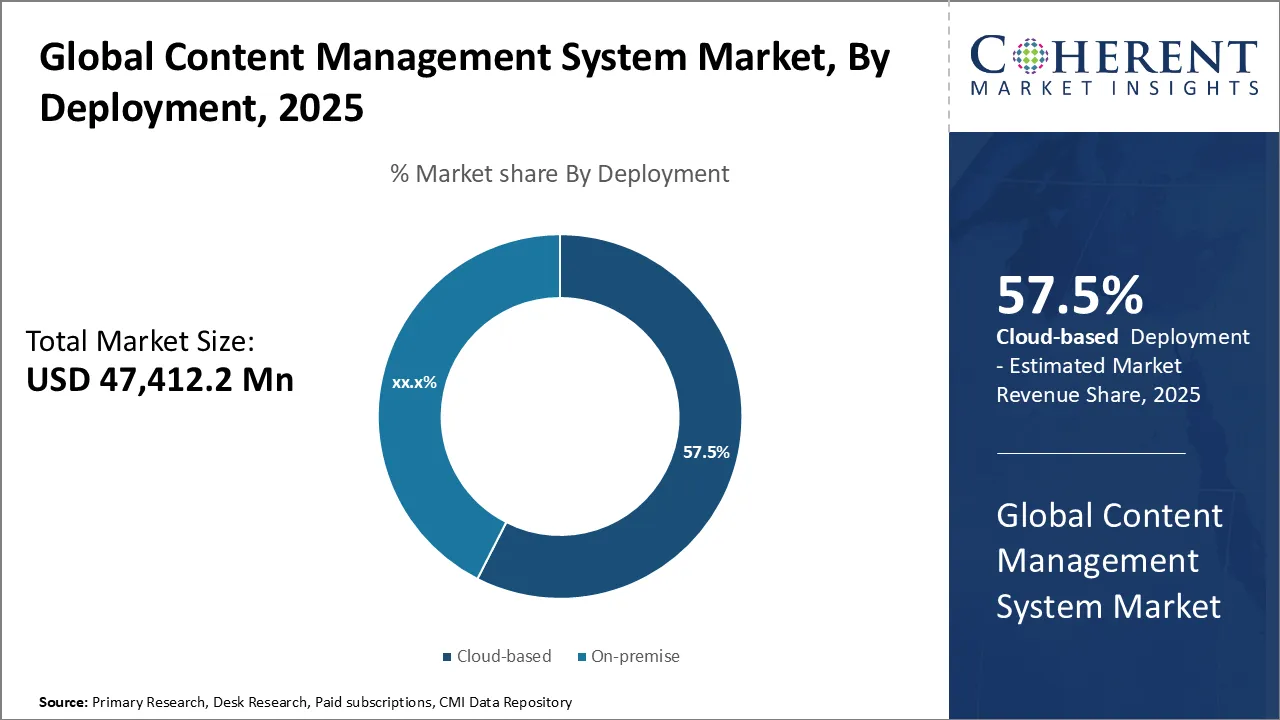
Content Management System Market Insights, By Deployment: Cloud-Based Segment Dominates the Market Driven by Its Scalability, Cost Efficiency, And Flexibility
In terms of deployment, the cloud-based segment is projected to hold 58.5% share of the market in 2026, due to its scalability, cost efficiency, and flexibility. Organizations prefer cloud-based CMS because it eliminates the need for heavy upfront infrastructure investments and reduces maintenance costs. It allows real-time content updates, seamless collaboration across teams, and remote accessibility, which is crucial in today’s digital-first environment.
Moreover, the rise of omnichannel strategies in industries such as retail, media, and BFSI requires CMS platforms that can deliver personalized content across websites, mobile apps, and social media simultaneously, something cloud-based systems excel at. Cloud deployment also supports AI integration, analytics, and automation, enabling businesses to optimize customer experiences. Additionally, the growing need for data security, compliance, and rapid disaster recovery makes cloud-based CMS the preferred choice, especially for global enterprises.
For instance, in June 2025, OpenText rolled out Cloud Editions (CE) 25.3, a significant cloud-native release featuring AI-powered assistants, developer productivity tools, and enhanced cybersecurity capabilities. The key innovations include MyAviator, an AI-driven personal digital worker that enables users to securely search, summarize, and transform documents into formats like podcasts or reports, alongside DevOps Aviator, integrated with GitHub Copilot to streamline documentation, testing, and governance workflows.
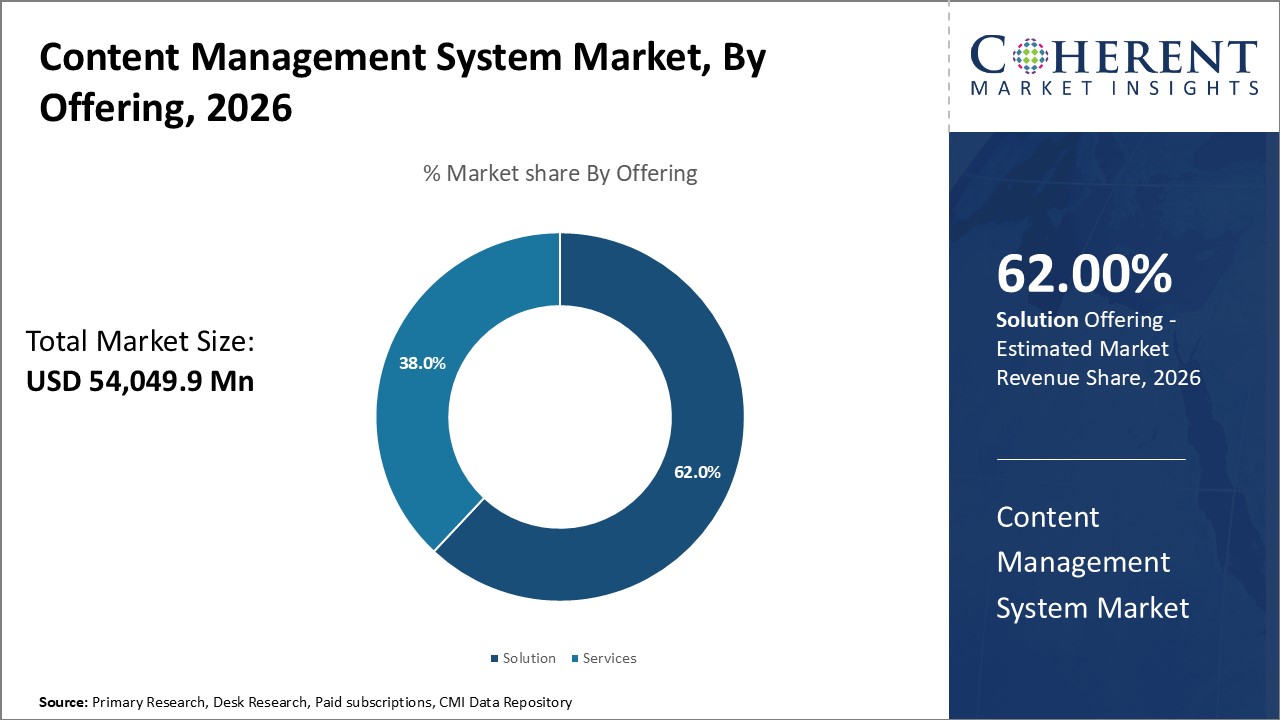
Content Management System Market Insights, By Offering: Solutions Segment Dominates the Market
In terms of offering, the solutions segment is expected to hold the largest share of the market in 2026, as organizations increasingly seek advanced tools to manage, analyze, and optimize digital content.
Web Content Management remains critical for delivering personalized, multilingual, and omnichannel experiences, particularly in retail and media. Content Analytics is gaining traction as businesses look to extract insights from unstructured data to drive customer engagement and strategic decisions. The rising use of rich media has boosted the need for Digital Asset Management (DAM), while AI-powered CMS is transforming the market with automation, intelligent search, and predictive personalization. Collaboration and workflow management solutions are in high demand to support hybrid and remote working models through streamlined document sharing and approvals.
For instance, in June 2025, CERN launched WordPress as its new web content management system (CMS), replacing Drupal following year-long development efforts by its International Relations and IT teams under the Web Governance Board’s oversight. The modern platform aims to shift website ownership from technical coding to streamlined content creation, emphasizing responsiveness and accessibility.
Content Management System Market Insights, By Enterprise Size: Large Enterprise dominates the overall market Due to the Growing Need for Complex Content and Global Operations
In terms of enterprise size, the large enterprise segment holds an estimated highest share of the market in 2026, due to its complex content needs, global operations, and multi-channel strategies. Unlike SMEs, large organizations manage vast amounts of structured and unstructured data, including corporate documents, customer records, digital marketing content, training materials, and compliance-related information. They require CMS platforms that support scalability, security, workflow automation, and integration with ERP, CRM, and cloud services.
For instance, in June 2025, Business Wire India rolled out an enhanced proprietary Content Management System (CMS) to elevate the creation, management, and distribution of press releases and financial disclosures. Built on modern architecture, the CMS streamlines workflows by offering real-time publishing controls, multi-format support (text, infographics, video, and more), and a user-friendly interface optimized for quick client onboarding, which is further enhancing the content management system market revenue.
Content Management System Market Insights, By Industry Vertical: Retail & Warehouse Dominates the Market due to the Demand for Efficient Digital Content Handling, and Real-Time Inventory Visibility
In terms of the industry vertical, retail & warehouse segment is expected to capture the greatest share in 2026, due to the need for efficient digital content handling, real-time inventory visibility, and seamless customer engagement. In retail, CMS platforms are essential for managing product catalogs, promotions, personalized recommendations, digital storefronts, and omnichannel campaigns, ensuring consistent experiences across websites, apps, and physical stores. With the growth of e-commerce and mobile shopping, retailers depend on CMS for scalability, speed, and AI-driven personalization.
For instance, in January 2025, Lenovo unveiled three field-tested retail solutions combining AI and robotics at NRF 2025 in New York City. The Retail Content Management Services enables global deployment of digital content across stores with real-time updates, saving costs and reducing manpower, as evidenced by adoption across over 100 food and beverage outlets.
Regional Insights
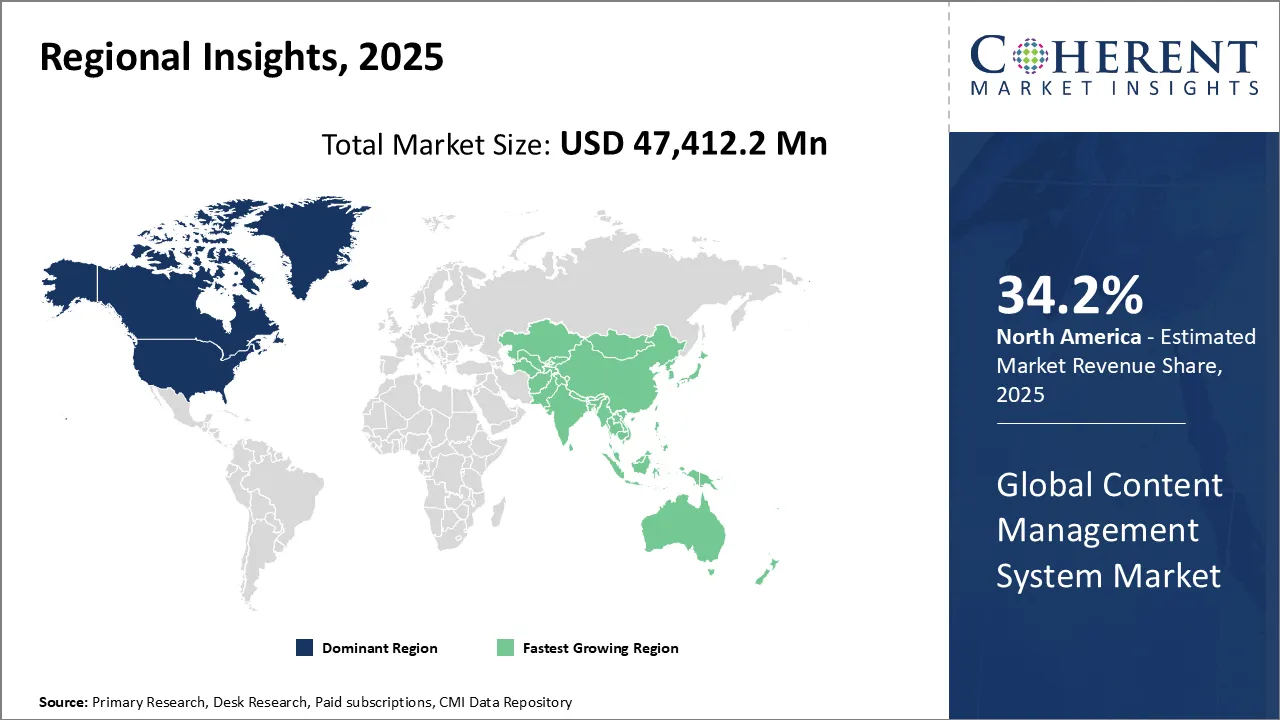
North America Content Management System Market Trends
North America is expected to dominate the content management system market, holding a share of 34.2% in 2026. The region’s lead can be attributed to strong tech ecosystems and focus on digital transformation among organizations. Countries like the U.S. and Canada have a large presence of global CMS vendors and clients utilizing these platforms for web presence, digital marketing, and online commerce needs.
For instance, in June 2026, Boxlight Corporation launched the CL Totem, a sleek freestanding digital signage solution now available across North America. Available in 49" and 55" models, the CL Totem delivers eye-catching video and image display without requiring wall mounting, subscriptions, or complex installations. Powered by the cloud-based CleverLive platform, it enables easy, remote content management and optional multi-zone layouts for social feeds or promotions. Designed for 24/7 operation in high-traffic environments such as retail, hospitality, and campuses.
Asia Pacific Content Management System Market Trends
The Asia Pacific region, holding a share of 24.6%, is expected to exhibit the fastest growth, driven by a growing digital population, rising internet usage, and government initiatives supporting technology adoption. Countries, such as China, India, and South Korea, are emerging as hotspots, with local players innovating while global companies look to tap into new opportunities.
For instance, in March 2026, Cloud-based platform Labrador CMS launched operations in Japan through a strategic partnership with TNL Mediagene, the publisher behind Business Insider Japan, Gizmodo Japan, and 15 other titles. The deal will replace Digiday Japan’s existing WordPress system with Labrador CMS, establishing the first Japanese deployment of the modern, headless CMS tailored for publishers.
Content Management System Market Outlook for Key Countries
U.S. Content Management System Market Trends
The U.S. content management system market, scoring 28.1% share which is highly competitive and is led by global technology giants like Adobe, Oracle, and Microsoft, which cater primarily to large enterprises with advanced enterprise CMS offerings. These companies dominate the market by offering scalable, cloud-based solutions that integrate with analytics, AI, and automation to optimize content management.
Additionally, the market sees strong participation from agencies and small-to-medium businesses (SMBs), which are increasingly adopting cloud-based CMS platforms such as WordPress, Wix, and Squarespace. Local players and specialized providers, such as Sitecore and Acquia, play a crucial role by offering niche solutions for businesses requiring customized or industry-specific content management.
For instance, in April 2026, Kitu Systems, a leading clean-energy solutions provider, unveiled Expedition CMS, its new EV charge content management and operations platform. The launch spotlights a software-as-a-service tool featuring both web and mobile access, tailored for site hosts and drivers alike. Expedition CMS delivers intuitive management of connectivity, site operations, access control, payments, and smart load balancing across diverse charging infrastructure.
China Content Management System Market Trends
The China content management system market is dominated by 11.9% share, due to domestic vendors like Alibaba Cloud, Tencent Cloud, and Kingsoft, which offer localized solutions optimized for Chinese regulatory and business requirements. While global players, such as Adobe and Microsoft, have a presence, strict data regulations and localization preferences give local providers a competitive edge. The government's “Digital China” vision, which focuses on IT infrastructure development and digital transformation across industries, has further accelerated the demand for AI-powered, cloud-based CMS platforms. Companies developing CMS solutions in China must adhere to cybersecurity laws, which has led to the rise of custom-built, China-specific CMS platforms tailored for e-commerce, government portals, and enterprises.
Germany Content Management System Market Trends
The Germany content management system market is holding 6.2% share and is distinguished by a structured buying approach, where enterprises prioritize long-term reliability, security, and compliance with GDPR and data protection regulations. Unlike other markets that are rapidly shifting to cloud-based CMS, German companies exhibit a preference for on-premise solutions, particularly in regulated industries such as finance, healthcare, and government.
Leading domestic CMS providers such as Typo3 and CoreMedia cater to this demand by offering secure, highly customizable platforms designed for enterprise use. German businesses also emphasize personalization and content localization, with a growing interest in AI-driven content recommendations and multilingual CMS solutions. While global players like Adobe and Microsoft are present, local CMS providers gain an advantage by offering tailored integrations with German enterprise software ecosystems, such as SAP. The market's strong focus on structured decision-making and compliance ensures a steady demand for robust, security-focused CMS solutions.
For instance, in November 2024, CoreMedia, a premier Digital Experience Platform provider, unveiled KIO, its new AI-powered assistant for enterprise content management. Positioned as a “powerhouse,” CoreMedia KIO seamlessly integrates AI into workflows, automating metadata generation, image processing, and omnichannel personalization, while maintaining full user control via a conversational interface.
Brazil Content Management System Market Trends
The Content Management Systems (CMS) market in GCC, holding a 3.0% share, is driven by rapid digital transformation programs such as Saudi Vision 2030 and UAE Digital Government Strategy. Organizations across banking, healthcare, retail, and government are adopting CMS to manage bilingual content (Arabic & English), enhance citizen engagement, and support smart city projects. The e-commerce boom fueled by high internet penetration and a young consumer base is further strengthening CMS adoption, particularly for delivering personalized and secure digital experiences.
For instance, in April 2024, RECORD, one of Brazil’s largest broadcasters and the operator behind R7.com, selected Arc XP’s cloud-based content management and digital experience platform to drive its next phase of innovation. The move will support R7.com, its PlayPlus OTT service, and ACLR ad network, enabling the delivery of thousands of new content pieces to nearly 75 million unique monthly visitors.
GCC Countries Content Management System Market Trends
The Brazilian CMS market, accounting for 2.3% share, is witnessing growth due to the rise of e-commerce, fintech, and digital media consumption. Enterprises are deploying CMS to enable localized content, mobile-first strategies, and integration with social commerce platforms. The startup ecosystem and growing shift toward cloud-based CMS solutions are helping SMEs streamline operations and scale faster. Additionally, government emphasis on digital governance and compliance with LGPD (General Data Protection Law) is compelling organizations to adopt secure and regulation-ready CMS platforms.
For instance, in July 2026, the UAE Government Media Office launched its new Media Campaign Planning Guide, a strategic reference for federal communication teams, during the Government Communication Network meeting at Creators HQ. The guide lays out structured methodologies from team formation and visual identity to messaging, channel selection, creative ideation, and campaign evaluation. The event also introduced a Content Management Platform, an integrated digital tool to streamline content development, approval, archiving, and alignment across agencies.
Market Report Scope
Content Management System Market Report Coverage
| Report Coverage | Details | ||
|---|---|---|---|
| Base Year: | 2025 | Market Size in 2026: | USD 54,049.9 Mn |
| Historical Data for: | 2020 To 2024 | Forecast Period: | 2026 To 2033 |
| Forecast Period 2026 to 2033 CAGR: | 14.0% | 2033 Value Projection: | USD 1,35,247.4 Mn |
| Geographies covered: |
| ||
| Segments covered: |
| ||
| Companies covered: | Adobe Inc., Oracle Corporation, OpenText Corporation, Microsoft Corporation, IBM Corporation, Broadcom, Hyland Software, Lexmark International, and Zoho Corporation are the major players. | ||
| Growth Drivers: |
| ||
| Restraints & Challenges: |
| ||
Global Content Management System Market Driver
Increasing reliance on digital marketing
With the growing shift towards digital platforms across industries, marketers have increasingly relied on various digital marketing channels to effectively target their audience and drive website traffic. From search engine optimization to social media marketing to online advertising, digital presence has become integral for businesses of all sizes to increase their visibility, promote new launches and stay relevant. However, managing multiple marketing campaigns across different channels has proved complex for many companies. This is where content management systems have provided an effective solution by allowing marketers to centralize content creation, streamline approval workflows and automate distribution of content to various digital touchpoints from a single platform.
Analyst Opinion (Expert Opinion)
The content management system market is shifting from traditional publishing platforms toward composable, cloud-native, and API-first architectures. While WordPress still powers 43% of global websites (W3Techs, 2025), enterprise buyers are prioritizing value over affordability, leading to the rise of premium platforms like Contentful and Strapi.
The gap between content management system market value and content management system market price is widening. Enterprises increasingly justify higher costs for scalability, personalization, and AI-driven automation. Gartner projects that by 2026, 70% of CMS deployments will embed AI for content tagging, personalization, and predictive insights. E-commerce platforms such as Shopify already demonstrate how AI-powered CMS enhances conversion and customer retention.
However, CMS sprawl and hidden costs remain key concerns. Large-scale deployments often incur integration and security expenses that are 1.5–2x higher than licensing costs, particularly for premium platforms like Adobe Experience Manager. Yet, global firms continue to invest due to governance, scalability, and brand consistency needs.
Speak to the analyst
Want personalized insights?
Take the findings above to one of our principal consultants, or have the report rebuilt around the segments, geographies and competitors you actually track.
Key Developments
- In July 2025, Optimizely launched its new “GEO-Ready” CMS features designed to enhance brand visibility in AI-powered search environments. Optimizely aims to transform sites from passive content warehouses into proactive “visibility engines” optimized for both humans and machines.
- In July 2025, Webflow announced the launch of real-time collaboration capabilities in private beta, enabling multiple team members to work simultaneously on the same web page. The move aims to eliminate bottlenecks and handoffs, allowing designers, developers, and marketers to build, edit, and publish together in real time.
- In March 2025, Adobe launched the Adobe Experience Platform Agent Orchestrator, a unified orchestration layer enabling businesses to build, manage, and coordinate AI agents from Adobe and third-party ecosystems. Ten purpose-built AI agents spanning use cases like audience optimization, website performance, content production, and B2B account qualification are debuting atop this platform to boost personalization and productivity.
Market Segmentation
- Offering Insights (Revenue, USD Mn, 2026 - 2033)
- Solution
- Web Content Management
- Content Analytics
- Digital Asset Management
- AI-Powered CMS
- Collaboration and Workflow Management
- Document Management
- Others (Learning Content Management System (LCMS), etc.)
- Services
- Consulting
- Implementation and Integration
- Support and Maintenance
- Deployment Insights (Revenue, USD Mn, 2026 - 2033)
- Cloud-Based
- On-Premise
- Enterprise Size Insights (Revenue, USD Mn, 2026 - 2033)
- Small and Medium Enterprises (SMEs)
- Large Enterprises
- Industry Vertical Insights (Revenue, USD Mn, 2026 - 2033)
- Banking, financial services, and insurance (BFSI)
- Retail and e-commerce
- Healthcare and life sciences
- Government and public sector
- Manufacturing
- Media and entertainment
- Others (Education, Travel and Hospitality, etc.)
- Regional Insights (Revenue, USD Mn, 2026 - 2033)
- North America
- U.S.
- Canada
- Latin America
- Brazil
- Argentina
- Mexico
- Rest of Latin America
- Europe
- Germany
- U.K.
- Spain
- France
- Italy
- Russia
- Rest of Europe
- Asia Pacific
- China
- India
- Japan
- Australia
- South Korea
- ASEAN
- Rest of Asia Pacific
- Middle East
- GCC Countries
- Israel
- Rest of Middle East
- Africa
- South Africa
- North Africa
- Central Africa
- North America
- Key Players Insights (Revenue, USD Mn, 2021 - 2033)
- Adobe Inc.
- Oracle Corporation
- OpenText Corporation
- Microsoft Corporation
- IBM Corporation
- Broadcom
- Hyland Software
- Lexmark International
- Zoho Corporation
Sources
Primary Research
Interviews from the following stakeholders
Stakeholders
- Discussions with CMS software vendors, cloud service providers, system integrators, IT administrators, enterprise architects, and procurement heads across leading global markets.
Specific Stakeholders
- Chief Digital Officers and IT transformation heads at large enterprises (e.g., Walmart, Amazon, Tata Consultancy Services, Siemens).
- Web and mobile application developers from digital agencies and IT service firms.
- Content managers and marketing automation leads at retail chains, media houses, and publishing firms (e.g., The New York Times, Times Group, BBC).
- CIOs and IT administrators at universities and e-learning platforms (e.g., Harvard, Coursera, Byju’s).
- Digital platform heads at financial services and banking institutions (e.g., HSBC, ICICI Bank, JPMorgan Chase).
- IT infrastructure managers at healthcare providers and hospital groups (e.g., Mayo Clinic, Apollo Hospitals, NHS).
- Cloud engineers and DevOps teams at technology firms (e.g., Microsoft Azure, AWS, Google Cloud).
Databases
- World Trade Organization (WTO) Trade Statistics
- UN Comtrade Database
- Bureau of Economic Analysis (U.S.)
- Eurostat
- Ministry of Electronics and Information Technology (MeitY), India
- China Internet Network Information Center (CNNIC)
- Japan External Trade Organization (JETRO)
- Korea Customs Service Data Portal
- Directorate General of Commercial Intelligence and Statistics (DGCIS), India
Magazines
- CMSWire
- TechTarget – Content Management & Collaboration Section
- InformationWeek
- Computer Weekly – Enterprise Applications
- CIO Review
- Web Designer Magazine
- Hosting Advice
- TechRadar Pro – Software & CMS
Journals
- Journal of Web Engineering
- IEEE Internet Computing
- Journal of Information Technology
- ACM Transactions on Information Systems (TOIS)
- International Journal of Information Management
- Journal of Computer-Mediated Communication
- Journal of Enterprise Information Management
Newspapers
- The Wall Street Journal – Technology
- The Economic Times – IT & Digital Transformation
- Financial Times – Digital Business Reports
- The Hindu Business Line – IT & Services
- Nikkei Asia – Technology & Software Industry
- South China Morning Post – Digital Economy & Internet
- The Guardian – Technology and Media
Associations
- World Wide Web Consortium (W3C)
- Open Source Initiative (OSI)
- Content Management Professionals Association (CM Pros)
- International Association of Software Architects (IASA)
- Internet Society (ISOC)
- Cloud Native Computing Foundation (CNCF)
- Confederation of Indian Industry (CII) – IT & Digital Transformation Council
Public Domain Sources
- Ministry of Electronics and IT (Government of India)
- National Institute of Standards and Technology (NIST), U.S.
- U.S. International Trade Commission (USITC)
- Ministry of Economy, Trade and Industry (METI), Japan
- India Investment Grid – IT & Software Sector
- NITI Aayog – Digital India Reports
- Reserve Bank of India (RBI) – Digital and IT Infrastructure Reports
- EU Single Market Observatory – Digital Platforms and Software
Proprietary Elements
- CMI Data Analytics Tool, and Proprietary CMI Existing Repository of information for last 8 years
Get access to 250+ pages report
Every segment, forecast, competitor profile and data table behind the analysis above — available for instant download.
- ESOMAR Member
- ISO 9001:2015 Certified
- D-U-N-S Registered
- GDPR & CCPA Compliant
Missing comfort of reading report in your local language? Find your preferred language:
Transform your Strategy with Exclusive Trending Reports
Frequently Asked Questions
The global content management system market is estimated to be valued at USD 47,412.2 Mn in 2025 and is expected to reach USD 1,17,546.5 Mn by 2032.
The CAGR of the global content management system market is projected to be 13.8% from 2025 to 2032.
Increasing reliance on digital marketing and growing demand for personalized content delivery are the major factors driving the growth of the global content management system market.
High cost of implementation and maintenance and data security concerns are the major factors hampering the growth of the global content management system market.
In terms of type, the web content management segment is estimated to dominate the market revenue share in 2025.
Adobe Inc., Oracle Corporation, OpenText Corporation, Microsoft Corporation, IBM Corporation, Broadcom, Hyland Software, Lexmark International, and Zoho Corporation are the major players.
North America is expected to lead the global content management system market in 2025, holding a share of 34.2%.