

On-demand Learning Management System Market Size and Share Analysis: (2026-2033)
The On-demand Learning Management System Market size is anticipated to grow at a CAGR of 16.2% with USD 15.1 Bn in 2026 and is expected to reach USD 45.5 Bn in 2033. The primary drivers are largely defined by the rapid shift toward digital, flexible, and self-paced learning across academic institutions and enterprises. Some of the other factors are rising demand for cloud-based LMS platforms, corporate reskilling programs, hybrid education models, mobile learning, and analytics-led training management. The International Telecommunication Union reported that approximately 6 billion people, or 74% of the global population, were using the Internet in 2025. This strengthens the wider adoption of on-demand learning platforms as well as digitally delivered training solutions.
Key Takeaways
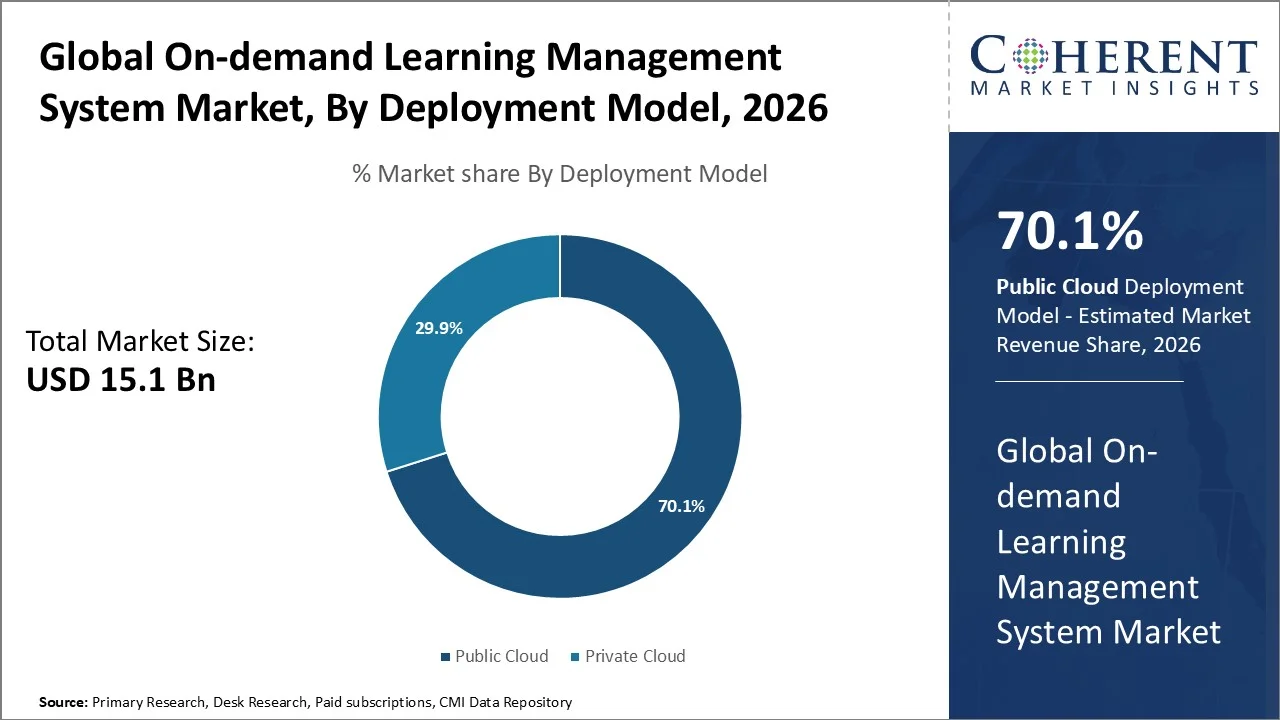
- The public cloud segment is likely to dominate the market with 70.1% in 2026. The segment’s growth is owing to the widespread enterprise adoption, scalability benefits, cost-efficiency, and ease of integration with corporate IT infrastructures. According to OECD adult learning data, participation in learning and training is growing across countries, highlighting increasing demand for digital delivery models supporting cloud
- The distance learning segment is set to lead with 65.2% in 2026. The segment’s growth is owing to the rising preference for flexible, self-paced training, and the adoption of mobile-enabled learning platforms. In the U.S., nearly 9.4 million undergraduates were enrolled in at least one distance education course in fall 2021, thereby showcasing sustained adoption of the remote learning modalities.
- The corporate segment is set to lead with 60.5% in 2026. The segment’s growth is owing to the increased investment in employee development, mandatory compliance training, and the growing digital transformation initiatives in various industries. The OECD Surveys show that on average around 40% of adults across OECD countries participate in education and training annually, thereby indicating continued engagement in workplace learning and upskilling.
- The IT and telecom segment is set to lead with 23.2% in 2026. The segment’s growth is owing to the rapid adoption of cloud-based LMS solutions for remote workforce training, skill development programs, and integration with enterprise resource planning (ERP) systems.
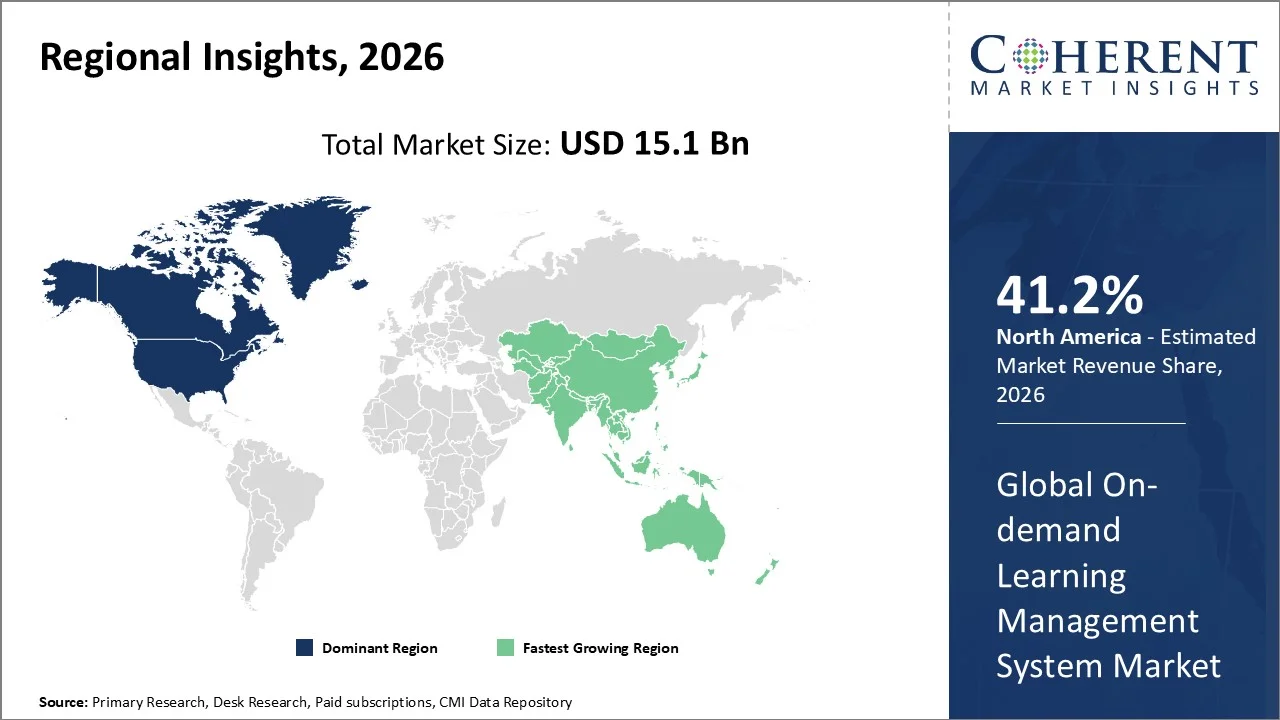
- North America is expected to acquire the prominent share of 41.2% in 2026. The region’s growth is owing to the high digital literacy, strong IT infrastructure, favorable government initiatives supporting e-learning, and growing corporate training budgets.
Segmental Insights
Why is Public Cloud Acquiring the Largest Share?
On the basis of deployment model, the public cloud segment is projected to account for the largest On-demand Learning Management System Market share of 70.1% in 2026. The segment’s growth is owing to the faster deployment, lower upfront infrastructure cost, and the ability to support browser-based, mobile, self-paced, and hybrid training across corporate and academic users.
Public cloud LMS platforms also fit rapid content updates, analytics dashboards, integrations with HRIS/CRM systems, and elastic user scaling during onboarding or compliance-training cycles. In the U.S., NCES/IPEDS reported 4.9 million postsecondary students enrolled exclusively in distance education courses and 5.16 million enrolled in some distance education courses in fall 2022, strengthening demand for cloud-hosted learning delivery.
The data from NCSES/Census ABS also showed that nearly 34.9% of the U.S. educational-services firms used cloud-based computing systems in 2020–2022. In July 2025, Instructure launched Canvas Career, an AI-powered, skills-first LMS beta for workforce and continuing education, supporting public-cloud LMS adoption globally.
- Current Industry Events of 2026
- Market Size Estimation
- Regional Breakdown
- Competitive Landscape
- Customer Intelligence
- Segmental Analysis
- Pricing Analysis
- Key Market Drivers, Challenges & Future Trends
- Customized Insights Section
Distance Learning hold the Largest Market Share
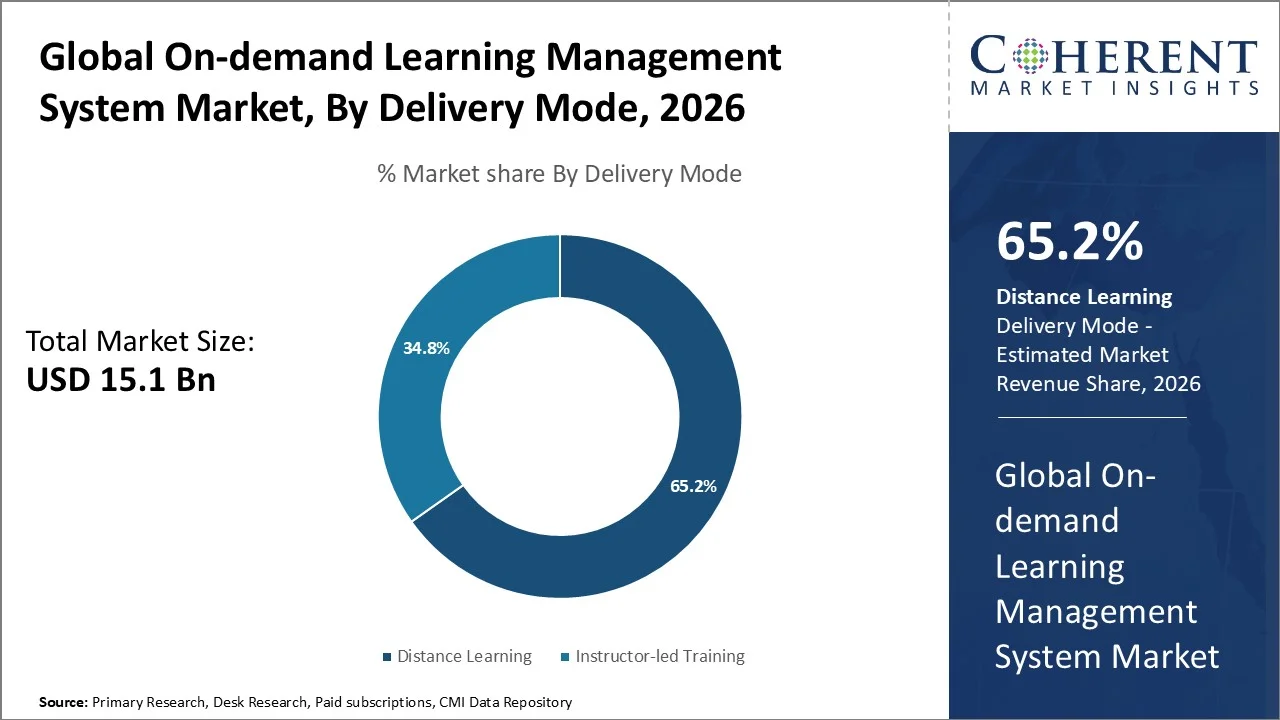
On the basis of delivery mode, the distance learning segment lead with a major 65.20% share in 2026. The segment’s growth is owing to the rising acceptance of self-paced, remote, and credit-bearing digital courses across schools, universities, and working-professional upskilling. In 2024, the NCES reported that nearly 53.8% of the U.S. postsecondary students were enrolled in distance education courses, thereby showing that online delivery has moved into mainstream higher education.
In India, the Ministry of Education reported in March 2026 that SWAYAM had 5.80 crore cumulative enrolments, 52.88 lakh certifications, and over 4,400 unique courses as of January 2026. This strengthens the LMS adoption because the distance learning needs scalable course hosting, assessment, certification, learner tracking, and discussion forums.
A key development was the February 2024 launch of SWAYAM Plus with partners like L&T, Microsoft, and Cisco, adding multilingual content, AI-enabled guidance, credit recognition, and employment-linked courses for distance learners at the global enterprise scale.
Market Drivers
Corporate Upskilling and Hybrid Workforce Training Demand is Transforming the On-demand Learning Management System Market in the US
Corporate upskilling and hybrid work are driving U.S. demand for on-demand learning management systems, as enterprises seek scalable platforms for compliance training, role-based reskilling, AI literacy, and remote onboarding.
According to the US Bureau of Labor Statistics, nearly 22.9% of employed individuals teleworked for pay during the first quarter of 2024. This shows that several employees work in a hybrid setup, which encourages the use of digital as well as self-paced training. The projections also indicate about 1% of employment growth for training and development specialists from 2024 to 2034, thereby highlighting the increasing organizational focus on structured workforce learning.
In August 2025, the US Department of Labor announced up to USD 30 million in Industry-Driven Skills Training Fund grants to states and businesses. This allows for expanded innovative workforce This initiative reinforces LMS adoption by strengthening the flexible course delivery, credential tracking, and reskilling models in remote and in-person employee populations.
Generative AI-based Personalized Learning: A Major Breakthrough in the On-demand Learning Management System Market
The Generative AI-based personalized learning is emerging as a practical breakthrough for the On-demand Learning Management System Market. This is because it connects self-paced course delivery with adaptive recommendations, automated assessments, multilingual learning support, and real-time coaching.
In Fall 2023, the NCES reported that nearly 10.31 million students in the U.S. degree-granting postsecondary institutions took at least one distance education course, thereby representing 54.1% of total enrollment. This large online learner base strengthens the need for LMS platforms which personalize pacing, content, and assessments at scale. The U.S. Department of Education also notes that the artificial intelligence has the capability to improve adaptivity as well as personalization in digital learning tools like lesson creation and material adaptation.
In October 2025, the firm, Absorb Software, introduced the mentoring within Absorb LMS, an AI-driven learning platform. It integrates mentoring, coaching, as well as personalized learning in a unified system, specifically designed to enhance development and engagement in today’s hybrid workplace.
Current Events and Their Impact on the On-demand Learning Management System Market
Current Event | Description and its Impact |
U.S. DOJ ADA Title II Web and Mobile App Accessibility Rule
|
|
EU AI Act Implementation for AI-enabled Education Platforms |
|
On-demand Learning Management System Market Trends
- The rising demand for flexible, self-paced learning is accelerating the adoption of cloud-based on-demand LMS platforms.
- AI-enabled personalization, adaptive content delivery, and automated assessments are improving learner engagement as well as training effectiveness.
- The mobile-first LMS platforms are gaining traction as students and employees prefer anytime, device-based learning access.
- The growth in online education strongly is supporting the LMS demand. In 2025, nearly 34.8% of EU internet users took an online course or used online learning materials, up from 33.4% in 2024. In the U.S., NCES data shows 53.8% of postsecondary students were enrolled in distance education courses in fall 2024.
- The corporate upskilling and government-backed digital learning programs are broadening the LMS adoption. The U.S. BLS projects training and development specialist jobs to grow 11% from 2024–2034, while India’s SWAYAM platform supports free, self-paced, credit-linked courses from Class 9 to postgraduate level, thereby strengthening formal digital learning infrastructure.
Regional Insights
North America Dominates Owing to the Rapid Adoption of Digital Learning Technologies
The North America region accounts for 41.2% of the market share in 2026. The region’s growth is owing to by the rapid adoption of digital learning technologies and the increasing demand for flexible training across industries. Some of the other factors include widespread integration of LMS tools in higher education, corporate workforce development training, and regulatory compliance programs.
In addition, the Fall 2024 IPEDS data reported that about 26.5% of the U.S. higher ed students were enrolled in distance education programs, thereby sustaining the mainstream incorporation of learning management systems. The Government of Canada’s AI Strategy for the Federal Public Service (2025–2027) also puts a greater emphasis on continual professional development, thereby bolstering the demand for scalable, AI
Healthcare is another key growth vertical for the regional market. According to a 2023 MedBridge survey, nearly 82% of healthcare organizations were using LMS to comply with regulatory training requirements. The investor interest is escalating, as seen with AI
Asia Pacific On-demand Learning Management System Market Trends
Asia Pacific is expected to witness strong growth in On-demand Learning Management System Market over the forecast period. The region’s growth is owing to the government-backed digital learning infrastructure, mobile-first course delivery, and rising demand for continuous workforce reskilling across education and enterprises.
In India, the Ministry of Education reported that DIKSHA hosts over 3.74 lakh e-contents, including materials in 126 Indian and 7 foreign languages, 14,819 ISL videos, and 5,135 audiobook chapters, supporting scalable multilingual LMS adoption. In Singapore, SkillsFuture Singapore reported that SkillsFuture Credit claims for online learning subscriptions and courses increased tenfold, from 266 in 2023 to 2,655 in 2024.
As a recent development, SkillsFuture Singapore expanded eligible online learning options in 2024 by adding Udemy Business and Coursera, strengthening demand for cloud LMS platforms that support modular learning, learner tracking, digital credentials, and employer-led upskilling across the region’s schools, universities, public agencies, and corporate training ecosystems.
Digital Education and Corporate Training Solutions is Accelerating the On-demand Learning Management System Market in United States
In the United States on‑demand Learning Management System (LMS) market, digital education and corporate training solutions continue to grow as institutions and organizations adopt LMS platforms to support online and hybrid learning.
According to the U.S. National Center for Education Statistics (NCES), in Fall 2021, 61% of undergraduate students were enrolled in at least one distance education course, illustrating sustained reliance on online learning systems that depend on LMS infrastructure.
A major industry development in 2024 was the completion of KKR & Co’s USD 4.8 billion acquisition of Instructure (Canvas), thereby highlighting substantial investment and confidence in LMS providers.
China On-demand Learning Management System Market Trends
The On-demand Learning Management System Market in China is experiencing substantial growth. The growth is driven by the rising adoption of digital and AI-enabled learning platforms in both education and corporate sectors.
The Ministry of Education’s Smart Education of China initiative integrates school, vocational, higher-education, and workforce training platforms to create a unified digital learning ecosystem. By the end of 2023, 519,000 educational institutions were connected, thereby benefiting 18.8 million teachers and 293 million learners.
In March 2025, the Smart Education of China 2.0 platform was launched, adding AI-driven adaptive learning, personalized course recommendations, digital credentials, and enhanced support for self-paced corporate and academic learning.
Who are the Major Companies in On-demand Learning Management System Industry
Some of the major key players in On-demand Learning Management System Market are Adobe Systems, TalentLMS, DoceboLMS, Litmos, Trivantis, WizIQ, Mindflash, SchoolKeep, Latitude Learning LMS, and SAP.
Key News
- In April 2026, the Football Association of Ireland (FAI) launched a new online learning management system to support coaches and volunteers at all levels. The platform offers mandatory Garda Vetting, Safeguarding, and First Aid modules, followed by Me & My Ball courses to enhance youth football participation.
- In August 2025, the Hispanic Organization of Mortgage Experts (HOME) launched HOME Certified, the first bilingual on-demand learning management system. It trains and certifies loan officers to serve Hispanic and Latino borrowers, who are projected to drive 70% of U.S. homeownership growth over the next two decades.
- In November 2024, CISA launched CISA Learning, a modern learning management system replacing FedVTE. The platform strengthens the on-demand cybersecurity training by giving CISA staff, US veterans, contractors, and federal, state, local, tribal, and territorial partners free, uninterrupted access to critical courses and resources online.
Market Report Scope
On-demand Learning Management System Market Report Coverage
| Report Coverage | Details | ||
|---|---|---|---|
| Base Year: | 2025 | Market Size in 2026: | USD 15.1 Bn |
| Historical Data for: | 2020 To 2024 | Forecast Period: | 2026 To 2033 |
| Forecast Period 2026 to 2033 CAGR: | 16.2% | 2033 Value Projection: | USD 45.5 Bn |
| Geographies covered: |
| ||
| Segments covered: |
| ||
| Companies covered: | Adobe Systems, TalentLMS, DoceboLMS, Litmos, Trivantis, WizIQ, Mindflash, SchoolKeep, Latitude Learning LMS, and SAP. | ||
| Growth Drivers: |
| ||
| Restraints & Challenges: |
| ||
Analyst Opinion
- The On-demand Learning Management System Market is driven by the permanent shift toward flexible learning. In fall 2023, 10.3 million U.S. postsecondary students, or 54.1% of all students, were enrolled in at least one distance education course, showing that online learning has become a mainstream delivery model rather than a temporary trend.
- Corporate learning is another major growth engine for the market. The U.S. Bureau of Labor Statistics projected that the training and development managers are expected to grow 6% from 2024 to 2034, faster than the average for all occupations. It also noted that training is delivered through video, self-guided material, online applications, computers, and handheld devices.
- The skill disruption is also pushing companies toward scalable and on-demand LMS platforms. The World Economic Forum’s 2025 report found that 63% of employers cite skills gaps as a key barrier, while 59 out of every 100 workers may need reskilling or upskilling by 2030. This supports demand for AI-enabled, personalized, and continuous learning platforms.
Speak to the analyst
Want personalized insights?
Take the findings above to one of our principal consultants, or have the report rebuilt around the segments, geographies and competitors you actually track.
Market Segmentation
- By Deployment Model (Revenue, USD Bn, 2021-2033)
- Public Cloud
- Private Cloud
- By Delivery Mode (Revenue, USD Bn, 2021-2033)
- Distance learning
- Instructor-led Training
- By User Type (Revenue, USD Bn, 2021-2033)
- Academic
- Corporate
- By End User (Revenue, USD Bn, 2021-2033)
- Banking, Financial Services, and Insurance
- Healthcare
- Retail
- Government
- Manufacturing
- IT and Telecom
- Consulting
- Others
- By Region (Revenue, USD Bn, 2021-2033)
- North America
- U.S.
- Canada
- Latin America
- Brazil
- Mexico
- Argentina
- Rest of Latin America
- Europe
- Germany
- U.K.
- France
- Italy
- Spain
- Russia
- Rest of Europe
- Asia Pacific
- China
- India
- Japan
- Australia
- South Korea
- ASEAN
- Rest of Asia Pacific
- Middle East
- GCC
- Israel
- Rest of Middle East
- Africa
- South Africa
- Central Africa
- North Africa
- North America
- Key Players
- Adobe Systems
- TalentLMS
- DoceboLMS
- Litmos
- Trivantis
- WizIQ
- Mindflash
- SchoolKeep
- Latitude Learning LMS
- SAP
Sources
Primary Research Interviews
- Corporate L&D Managers
- E-learning Platform Providers
- LMS Solution Integrators
- Educational Technology Consultants
- HR Technology Analysts
- Training & Development Specialists
- Others
Databases
- Bloomberg Terminal
- Thomson Reuters Eikon
- IHS Markit
- Euromonitor International
- Others
Magazines
- Training Magazine
- eLearning Industry Magazine
- Learning Solutions Magazine
- Chief Learning Officer Magazine
- EdTech Magazine
- Others
Journals
- International Journal of Educational Technology in Higher Education
- Journal of Computer Assisted Learning
- Computers & Education
- British Journal of Educational Technology
- Educational Technology Research and Development
- Others
Newspapers
- The Wall Street Journal
- Financial Times
- Forbes
- Reuters
- Bloomberg News
- Others
Associations
- eLearning Guild
- International Society for Technology in Education (ISTE)
- Association for Talent Development (ATD)
- Learning and Performance Institute (LPI)
- European Association for Technology-Enhanced Learning (EATEL)
- Others
Public Domain Sources
- U.S. Department of Education – Office of Educational Technology
- UNESCO Institute for Statistics
- European Commission – Education and Training Directorate
- World Bank Open Data – Education
- OECD Education Statistics
- Others
Proprietary Elements
- CMI Data Analytics Tool
- Proprietary CMI Existing Repository of Information for the Last 10 Years
Get access to 250+ pages report
Every segment, forecast, competitor profile and data table behind the analysis above — available for instant download.
- ESOMAR Member
- ISO 9001:2015 Certified
- D-U-N-S Registered
- GDPR & CCPA Compliant
Missing comfort of reading report in your local language? Find your preferred language:
Transform your Strategy with Exclusive Trending Reports
Frequently Asked Questions
The On-demand Learning Management System Market is expected to reach USD 45.5 Bn in 2033.
Major players operating in the global On-demand Learning Management System Market include Adobe Systems, TalentLMS, DoceboLMS, Litmos, Trivantis, WizIQ, Mindflash, SchoolKeep, Latitude Learning LMS, and SAP.
The high implementation costs, complex system integration with legacy IT systems, and user resistance due to limited digital literacy are the key factors hampering growth of the market.
The global shift toward remote and hybrid work, rising corporate demands for continuous upskilling, and the integration of AI-based personalization and cloud computing to deliver flexible, anytime-anywhere educational experiences is boosting the demand for On-demand Learning Management System.
The On-demand Learning Management System Market is anticipated to grow at a CAGR of 16.2% between 2026 and 2033.
Among regions, North America is expected to account for a largest market share in the global On-demand Learning Management System Market over the forecast period.