

Machine Learning Market Size and Share Analysis - Growth Trends and Forecast (2026 - 2033)
The global machine learning market size is estimated at USD 134.8 Bn in 2026 and is projected to grow at a CAGR of 26.1% during the forecast period, reaching approximately USD 683.4 Bn by 2033. This is mostly due to increasing adoption of artificial intelligence across industries, rising demand for predictive analytics, and growing investments in cloud-based machine learning platforms.
Key Takeaways from the Machine Learning Market Report
- Banking, financial services & insurance (BFSI) is expected to account for the largest market share of 20.8% in 2026 due to rising use of machine learning for fraud detection, credit scoring and risk analytics, algorithmic trading, customer personalization, and AML and compliance automation. For example, Experian's 2026 AI study found that 84% of financial institutions consider AI a high business priority, driving greater use of machine learning for fraud detection, credit decisions, and risk management.
- Cloud-based segment is set to lead the market with a share of 53.1% in 2026 because organizations increasingly prefer scalable ML infrastructure, managed AI services, and lower deployment costs. For example, Flexera's 2025 State of the Cloud Report found that 79% of organizations use or are evaluating cloud AI/ML services, driving demand for cloud-based machine learning platforms.
- North America is projected to dominate the global machine learning industry with a share of 31.80% in 2026, owing to presence of major AI and cloud companies, high enterprise AI spending, and rising adoption of machine learning across BFSI, healthcare, retail, and manufacturing. For example, the U.S. accounted for USD 69.2 Bn (77%) of global AI infrastructure spending in Q4 2025, while 61% of CEOs are actively adopting AI agents, supporting strong machine learning adoption across industries.
- Asia Pacific, registering a CAGR of around 31%, is poised to emerge as the fastest growing market for machine learning, thanks to rapid AI adoption, government initiatives, expanding cloud infrastructure as well as digital transformation across nations like China, India, and Japan.
Machine Learning Market Overview
The global machine learning market is poised to exhibit robust growth during the forecast period. This growth is primarily driven by increasing use of artificial intelligence and machine learning across BFSI, education, energy, healthcare & pharmaceuticals, manufacturing, retail, transport & logistics, and other industries.
Rising demand for predictive analytics and automation, growing availability of big data as well as advancements in cloud computing and high-performance computing infrastructure are also supporting market expansion. In addition, integration of generative AI, natural language processing (NLP), and computer vision technologies into business operations is creating growth opportunities for machine learning market.
Machine learning (ML) is a branch of artificial intelligence (AI) that enables computers to learn from data and improve their performance without being explicitly programmed for every task. By identifying patterns in data, machine learning models can make predictions, classify information, and support decision-making. Rapid growth in data generated across industries, combined with advances in computing power, has significantly improved the accuracy, scalability, and adoption of machine learning solutions.
Increasing advancements in machine learning algorithms, computing power, and AI technologies are improving the accuracy and performance of machine learning systems. Higher accuracy in applications such as image recognition, speech recognition, recommendation systems, and predictive analytics is fueling adoption of machine learning across industries like BFSI, healthcare, retail as well as manufacturing.
Integration of machine learning with robotics is expected to drive growth of machine learning market during the forecast period. Machine learning enables robots to perceive their environment, recognize objects, make decisions, and improve performance through data-driven learning, expanding their use in industrial automation, autonomous mobile robots, drones, and autonomous vehicles.
According to the International Federation of Robotics (IFR), around 542,000 industrial robots were installed worldwide in 2024, more than double the number recorded a decade ago. Annual installations exceeded 500,000 units for the fourth consecutive year, reflecting the growing adoption of intelligent automation that increasingly relies on machine learning technologies.
Growing adoption of machine learning in the healthcare sector is expected to boost machine learning market value. Machine learning enables faster and more accurate disease diagnosis, medical image analysis, clinical decision support, drug discovery, and personalized treatment by analyzing large volumes of healthcare data.
Segmental Insights
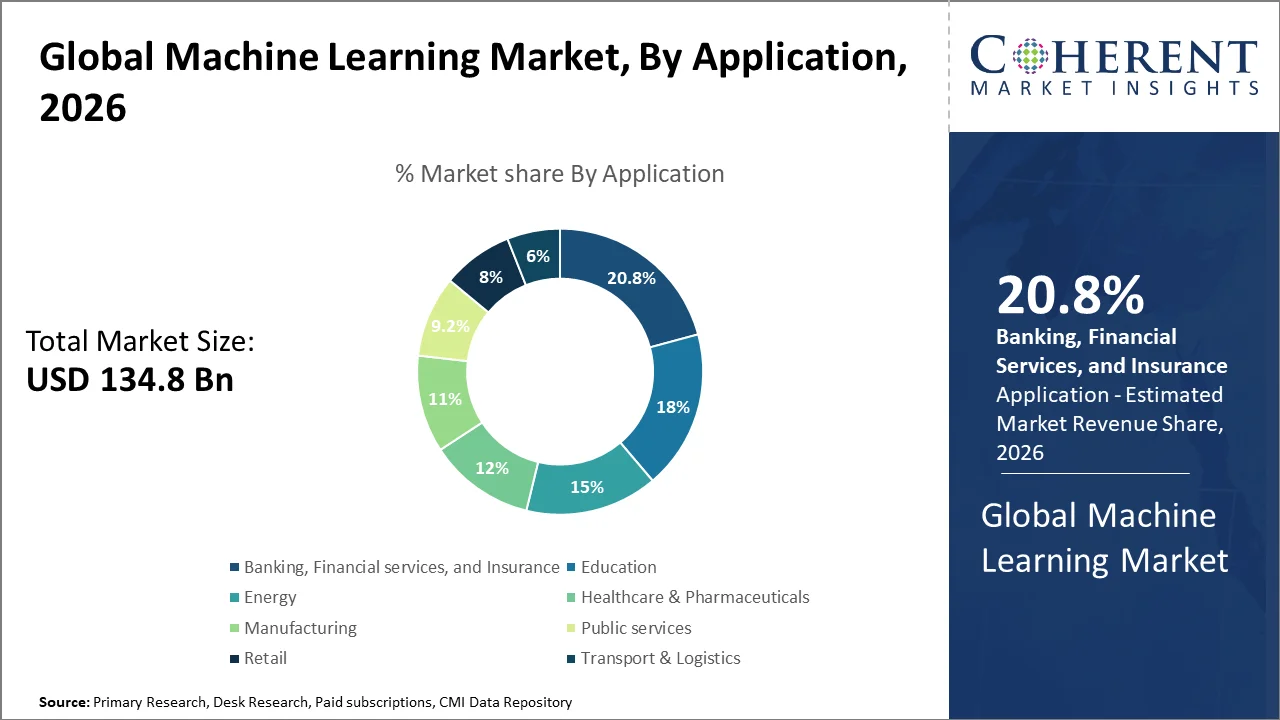
Which Application Accounts for the Largest Global Machine Learning Market Share?
BFSI to Account for Over One-Fifth of Market Revenue in 2026
According to Coherent Market Insights’ machine learning market analysis, banking, financial services & insurance (BFSI) is slated to account for the largest revenue share of 20.8% in 2026. This dominance is attributable to increasing adoption of machine learning for fraud detection, risk assessment, credit scoring, algorithmic trading, customer service automation, and regulatory compliance.
Financial institutions are investing heavily in AI-powered solutions to improve operational efficiency, strengthen security as well as deliver personalized customer experiences. This, in turn, is expected to boost growth of the machine learning market during the assessment period.
For example, according to the Cambridge Centre for Alternative Finance (2026), 81% of surveyed financial services firms have adopted AI at some level. The report also identifies fraud detection (58%), credit risk modelling (54%), and AI-powered customer support (74%) as among the most common AI use cases. This highlights the growing demand for machine learning across the BFSI sector.
- Current Industry Events of 2026
- Market Size Estimation
- Regional Breakdown
- Competitive Landscape
- Customer Intelligence
- Segmental Analysis
- Pricing Analysis
- Key Market Drivers, Challenges & Future Trends
- Customized Insights Section
Why is Cloud Deployment the Preferred Choice?
Scalability and Cost Efficiency Drive Cloud Deployment Demand
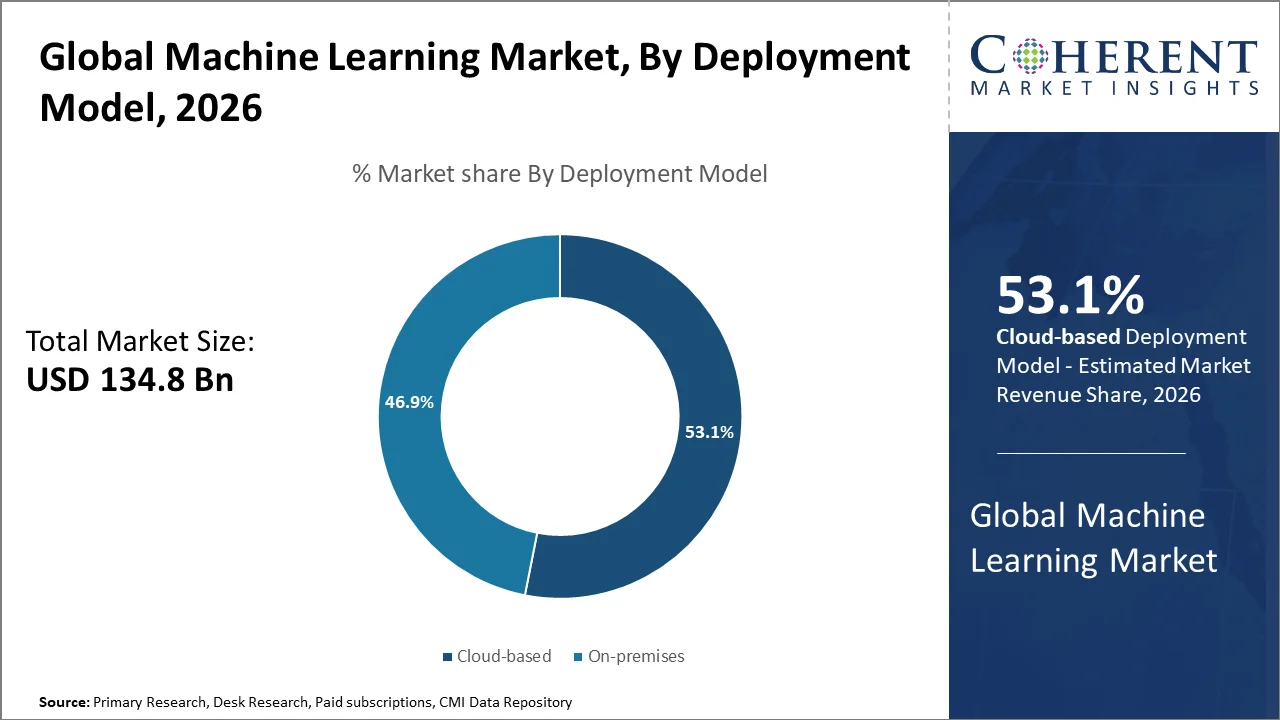
By deployment model, cloud-based segment is anticipated to lead the market during the forecast period, holding a share of 53.1% in 2026. This is mostly due to its ability to provide scalable computing resources, lower infrastructure costs as well as faster deployment of machine learning models.
Cloud platforms allow organizations to access high-performance computing, storage, and AI tools on demand without large upfront investments. In addition, growing adoption of hybrid and multi-cloud strategies, increasing availability of managed AI and machine learning services, and rising demand for real-time data processing are also driving adoption of cloud-based machine learning solutions across industries.
Machine Learning Market Growth Drivers
Growing Adoption of Artificial Intelligence (AI)
Organizations in the contemporary world are increasingly integrating machine learning into business processes to automate tasks, improve decision-making as well as enhance customer experiences. Rising enterprise investment in AI is accelerating ML adoption, driving the growth of the machine learning market.
Machine Learning Market Opportunities
Increasing Adoption Across Industries
Expanding adoption across industries is expected to create lucrative growth opportunities for the machine learning market during the forthcoming period. Industries like healthcare, banking, retail, manufacturing, automotive, and telecommunications are increasingly using machine learning for predictive analytics, fraud detection, recommendation engines, quality control as well as predictive maintenance. This growing adoption is expected to drive demand for machine learning solutions and support market growth.
Machine Learning Market Trends
Rise of Generative AI and Foundation Models
Rapid adoption of generative AI technologies is a key trend driving the machine learning market. Organizations are increasingly investing in machine learning platforms, foundation models as well as AI infrastructure to develop and deploy generative AI applications for content creation, coding, customer service, drug discovery, and business automation. This trend is increasing demand for advanced ML algorithms, cloud-based AI services, GPUs as well as MLOps solutions.
Current Events and Their Impact on the Machine Learning Market
Current Event | Description and its Impact |
OECD Reports Rapid Growth of AI Adoption in Government (2026) |
|
Governments Strengthen AI Policies and Standards (2026) |
|
Regional Insights
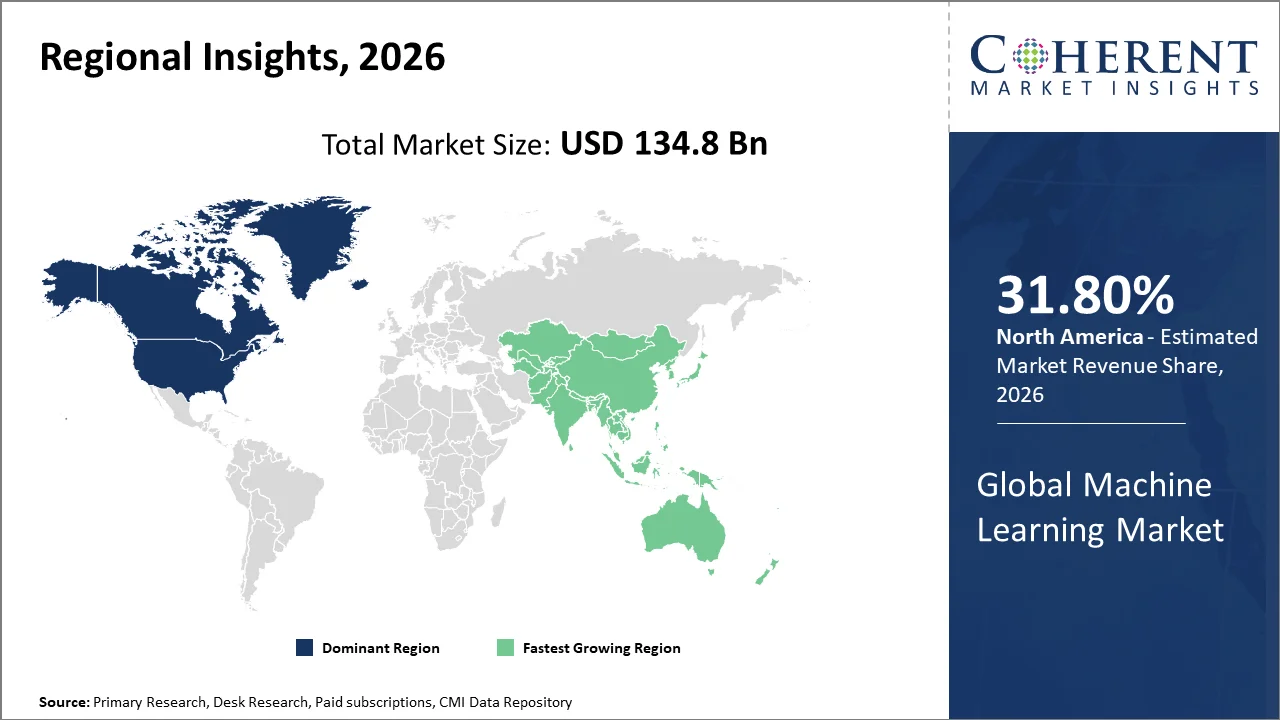
North America Remains at the Machine Learning Market Growth
North America is expected to retain its dominance over the global machine learning market, accounting for a share of 31.80% in 2026. This is attributable to high AI adoption across industries, strong cloud infrastructure, increasing investment in AI research and development as well as the presence of leading technology companies.
Rising investment in AI is playing a key role in boosting North America machine learning market growth. According to the Stanford Institute for Human-Centered Artificial Intelligence AI Index Report 2025, U.S. private AI investment reached USD 109.1 billion in 2024, nearly 12 times higher than China. This continued investment is accelerating the development and deployment of machine learning solutions across industries.
Asia Pacific Emerges as the Fastest-Growing Machine Learning Market
Asia Pacific machine learning market is projected to register the highest CAGR of 31% during the forecast period. This is mostly due to rapid digital transformation, increasing government support for AI, expanding cloud adoption, rising enterprise use of machine learning, and growing investments in AI technologies across China, India, Japan, and South Korea.
Rising AI investment is helping accelerate machine learning adoption across Asia Pacific. According to the Stanford Institute for Human-Centered Artificial Intelligence AI Index Report 2026, India attracted USD 4.09 billion in private AI investment in 2025, making it one of the leading AI investment destinations in Asia. This increasing investment is supporting the development and adoption of machine learning solutions across industries.
Machine Learning Market Outlook – Country-wise
U.S. Machine Learning Market Trends
The United States is projected to remain a leading market for machine learning solutions during the assessment period. This is mainly due to strong presence of leading AI and cloud technology companies, high investments in AI research and development, rapid adoption of generative AI across industries, and increasing integration of machine learning into healthcare, finance, retail, and defense applications.
China Machine Learning Market Forecast
China’s machine learning market is anticipated to grow rapidly during the assessment period. This is attributable to strong government support for AI development, expanding smart manufacturing initiatives, increasing deployment of AI-powered surveillance and automation systems, rapid digital transformation across industries, and rising investments in intelligent transportation and smart city projects.
Who are the Major Companies in the Machine Learning Market?
Some of the major players in machine learning market are Microsoft Corporation, SAP SE, Sas Institute Inc., Amazon Web Services, Inc., Bigml, Inc., Google Inc., Fair Isaac Corporation, Hewlett Packard Enterprise Development LP, and Intel Corporation.
Key Strategies Adopted by Industry Players
Leading machine learning companies are adopting various organic and inorganic strategies to boost their revenue as well as gain a competitive edge in the industry. These include new product launches, increasing investments in R&D, acquisitions, partnerships, collaborations, mergers, and distribution agreements.
- In June 2026, Intel announced new AI innovations at COMPUTEX 2026 in Taipei, Taiwan. The company introduced new AI hardware and infrastructure technologies to support enterprise AI and data center workloads.
- In January 2026, SAP released new versions of the SAP HANA Cloud Predictive Analysis Library and Automated Predictive Library. The update added several new embedded machine learning and AI functions to improve predictive analytics.
- In November 2025, Google introduced Nested Learning, a new machine learning approach. The new method is designed to improve how AI models learn and solve complex tasks.
- In February 2024, Microsoft partnered with Mistral AI to accelerate AI innovation. The partnership brought Mistral Large to Microsoft Azure as the model's first cloud platform.
Market Report Scope
Machine Learning Market Report Coverage
| Report Coverage | Details | ||
|---|---|---|---|
| Base Year: | 2025 | Market Size in 2026: | USD 134.8 Bn |
| Historical Data for: | 2020 To 2024 | Forecast Period: | 2026 To 2033 |
| Forecast Period 2026 to 2033 CAGR: | 26.1% | 2033 Value Projection: | USD 683.4 Bn |
| Geographies covered: |
| ||
| Segments covered: |
| ||
| Companies covered: | Microsoft Corporation, SAP SE, Sas Institute Inc., Amazon Web Services, Inc., Bigml, Inc., Google Inc., Fair Isaac Corporation, Hewlett Packard Enterprise Development Lp, and Intel Corporation | ||
| Growth Drivers: |
| ||
| Restraints & Challenges: |
| ||
Analyst Opinion (Expert Opinion)
- Machine learning is becoming a key technology for businesses. Companies are using it to automate tasks, improve decisions, and increase productivity across industries such as healthcare, finance, retail, and manufacturing.
- AI adoption is growing rapidly. According to the Stanford AI Index 2025, 78% of organizations used AI in at least one business function in 2024, up from 55% in 2023. This is increasing demand for machine learning software, platforms as well as skilled professionals.
- With improvement in cloud computing technology, improved AI chips, and availability of big data sets, machine learning is becoming fast, accurate, and convenient for implementation by all kinds of organizations. Hence, the future outlook for the machine learning market seems very bright.
Speak to the analyst
Want personalized insights?
Take the findings above to one of our principal consultants, or have the report rebuilt around the segments, geographies and competitors you actually track.
Market Segmentation
- By Application
- Banking, Financial services, and Insurance
- Education
- Energy
- Healthcare & Pharmaceuticals
- Manufacturing
- Public services
- Retail
- Transport & Logistics
- By Deployment Model
- On-premises
- Cloud-based
- By Region Insights ( Revenue, USD Bn, 2021 - 2033)
- North America
- U.S.
- Canada
- Latin America
- Brazil
- Argentina
- Mexico
- Rest of Latin America
- Europe
- Germany
- U.K.
- Spain
- France
- Italy
- Russia
- Rest of Europe
- Asia Pacific
- China
- India
- Japan
- Australia
- South Korea
- ASEAN
- Rest of Asia Pacific
- Middle East
- GCC Countries
- Israel
- Rest of Middle East
- Africa
- South Africa
- North Africa
- Central Africa
Sources
Primary Research interviews
- Industry experts, AI & machine learning solution providers, cloud service providers, technology executives, data scientists, software developers, system integrators, research institutions, and end-use industry professionals
Databases
- World Bank
- International Monetary Fund (IMF)
- United Nations (UN) Data
- OECD Data
- Eurostat
- U.S. Census Bureau
- National Institute of Standards and Technology (NIST)
- Data.gov
- European Data Portal
- Statista (for general statistics)
Magazines
- MIT Technology Review
- AI Magazine
- IEEE Spectrum
- CIO Magazine
- InformationWeek
- Analytics Insight
Journals
- Journal of Machine Learning Research (JMLR)
- IEEE Transactions on Pattern Analysis and Machine Intelligence (TPAMI)
- Nature Machine Intelligence
- Machine Learning (Springer)
- Artificial Intelligence Journal
- Expert Systems with Applications
Newspapers
- The Wall Street Journal
- Financial Times
- The New York Times
- The Economic Times
- The Hindu Business Line
- Nikkei Asia
Associations
- Association for Computing Machinery (ACM)
- Institute of Electrical and Electronics Engineers (IEEE)
- Association for the Advancement of Artificial Intelligence (AAAI)
- Linux Foundation AI & Data
- ML Commons
Public Domain sources:
- National Institute of Standards and Technology (NIST)
- U.S. Bureau of Labor Statistics (BLS)
- U.S. Census Bureau, European Commission
- Organisation for Economic Co-operation and Development (OECD)
- World Bank
- International Monetary Fund (IMF)
- United Nations
- U.S. Patent and Trademark Office (USPTO)
- European Patent Office (EPO)
Proprietary Elements
- CMI Data Analytics Tool
- Proprietary CMI Existing Repository of information for last 10 years.
Get access to 250+ pages report
Every segment, forecast, competitor profile and data table behind the analysis above — available for instant download.
- ESOMAR Member
- ISO 9001:2015 Certified
- D-U-N-S Registered
- GDPR & CCPA Compliant
Missing comfort of reading report in your local language? Find your preferred language:
Transform your Strategy with Exclusive Trending Reports
Frequently Asked Questions
The machine learning market includes software, hardware, and services that enable computers to learn from data and make predictions without explicit programming.
The global market is estimated to be valued at USD 134.8 Bn in 2026.
The global Machine Learning Market value is expected to reach USD 683.4 Bn by 2033.
The global market is poised to exhibit a CAGR of 26.1% from 2026 to 2033.
Major growth factors include increasing adoption of artificial intelligence (AI) across industries, growing availability of big data, rising investments in AI and cloud computing, advancements in computing hardware such as GPUs and TPUs, expanding use of machine learning in healthcare, finance, retail, and manufacturing, and increasing demand for automation, predictive analytics, and personalized customer experiences.
BFSI is expected to account for the largest market share of 20.8% in 2026
North America is projected to lead the market with a share of 31.80% in 2026.