

Global Cloud Computing Market Size and Forecast – 2026 To 2033
The global cloud computing market is expected to grow from USD 1,175 Bn in 2026 to USD 3,255 Bn by 2033, registering a compound annual growth rate (CAGR) of 16% from 2026 to 2033. The global cloud computing market is driven by rapid adoption of agentic AI and generative AI. On May 27, 2026, Snowflake announced that it has signed a multi-year strategic collaboration agreement (SCA) with Amazon Web Services (AWS) to accelerate enterprise agentic AI adoption to help joint customers worldwide build and deploy AI faster and more securely. As part of the expanded collaboration, Snowflake is making a USD 6 billion multi-year infrastructure commitment to AWS, its largest to date, reflecting the accelerating enterprise demand for AI and data workloads running on AWS. (Source: Snowflake)
Key Takeaways of the Global Cloud Computing Market
- The Software as a Service (SaaS) segment is expected to account for 47.0 % of the global cloud computing market share in 2026. Growing use of big data analytics is a major factor driving the growth of the segment. On June 1, 2026, Snowflake and Anthropic announced at Snowflake Summit 26, a significant momentum in their strategic partnership. Enterprises are increasingly adopting Anthropic Claude in Snowflake Cortex AI, Snowflake’s suite of AI products, driven by growing demand for governed, production-ready AI. (Source: Snowflake)
- The public cloud segment is estimated to capture 53.0 % of the market share in 2026. Increasing development of green and sustainable cloud infrastructure is a primary factor driving the growth of the public cloud segment. On September 18, 2025, Microsoft announced that its newest AI-focused data centers, including the Fairwater campus in Wisconsin, U.S., utilize advanced closed-loop liquid cooling systems that dramatically reduce water consumption compared with traditional facilities. (Source: Microsoft)
- The application development and testing segment is estimated to capture 39.0 % of the market share in 2026. Rising adoption of hybrid and multi-cloud strategies for application development is a key factor for the segmental growth. On December 8, 2025, AWS and Google Cloud announced a jointly engineered multicloud networking solution that uses both AWS Interconnect multicloud and Google Cloud’s Cross-Cloud Interconnect. (Source: Amazon)
- North America is expected to dominate the cloud computing market in 2026 with a market share of 39.0 %. Increasing government cloud modernization projects in North America is driving the growth of the regional market. On August 7, 2025, the U.S. General Services Administration (GSA) announced an innovative OneGov agreement with Amazon Web Services (AWS) to provide up to USD 1 billion in savings for cloud adoption, modernization, and training for federal agencies through December 31, 2028. (Source: General Services Administration)
- Asia Pacific is expected to account for 26.0 % share in 2026 and is projected to record the fastest growth over the forecast period. A steady increase in cloud security and compliance services in Asia Pacific is driving the growth of the cloud computing market in the region. On March 12, 2025, Palo Alto Networks deepened its commitment to the Asia Pacific region by integrating Prisma Access Browser into its existing infrastructure in strategic locations like Australia, India, Indonesia, Japan, and Singapore, with plans to expand to other countries within the region. (Source: Palo Alto Networks)
- Rise of Multi-cloud and Hybrid Cloud Strategies: Enterprises are moving away from single provider to multi-cloud (many public cloud providers) and hybrid cloud platforms. This promotes flexibility, lowers vendor lock-in and increases resilience. Now major platforms like Amazon Web Services, Microsoft Azure and Google Cloud are investing extensively in interoperability capabilities to facilitate this shift.
- Rapid Growth of Edge Computing Integration: Increasing numbers of IoT devices, autonomous systems and real-time applications are coming online and computing is moving to the point where the data is. Instead of sending all the data to centralized cloud servers, the processing is happening at local edge nodes, which reduces latency and bandwidth utilization, crucial for use cases such as smart cities, industrial automation and connected automobiles.
Segmental Insights
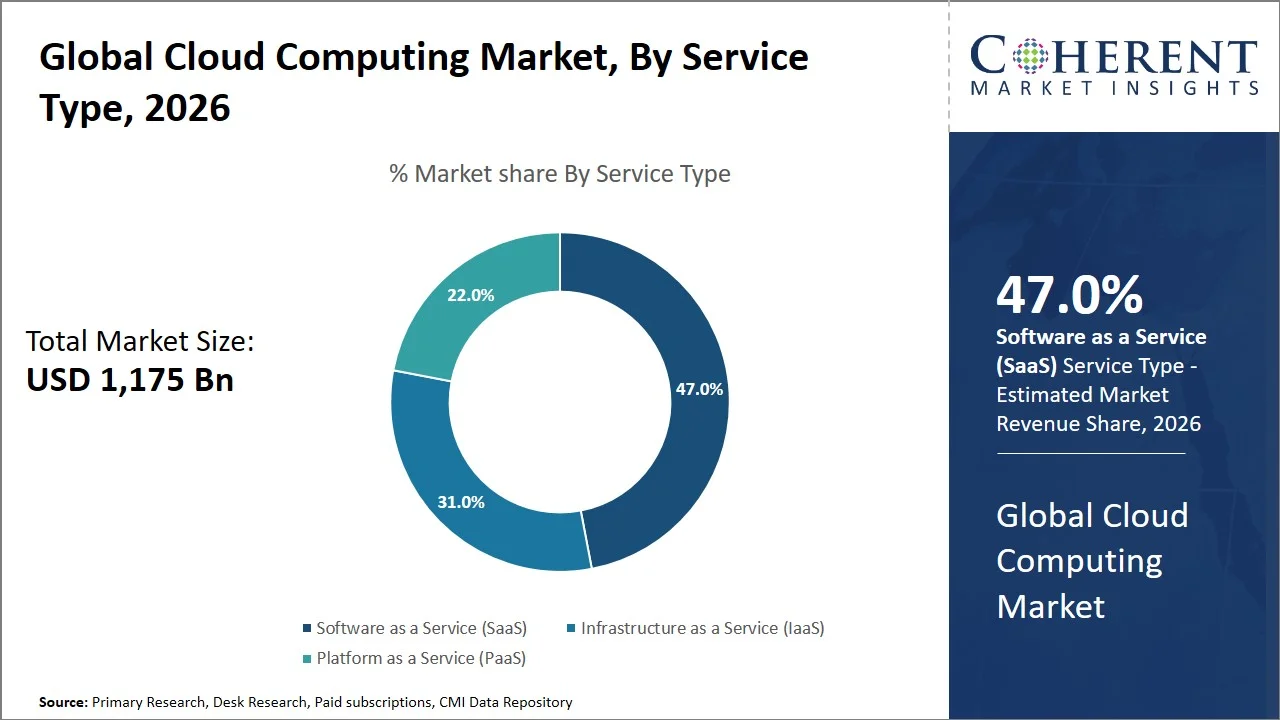
Why Does Software as a Service (SaaS) Dominate the Global Cloud Computing Market?
The Software as a Service (SaaS) segment is expected to account for 47.0% of the global cloud computing market share in 2026. SaaS eliminates the requirement for enterprises to install, maintain or upgrade software on local systems. Instead, applications are distributed via the internet on a subscription basis, meaning firms may start utilizing them virtually immediately with little expenditure. This makes SaaS very attractive to small and medium businesses, as well as large corporations aiming to decrease IT infrastructure and maintenance expenses and scale fast.
On September 3, 2025, ServiceNow engaged into a significant OneGov agreement with the U.S. The General Services Administration (GSA) will supply AI-powered workflow tools through a user-friendly SaaS license model. The program was expressly created to help government agencies update their operations without the need to deploy and manage sophisticated on-premise software infrastructure, which is more evidence of the increasing desire for subscription-based SaaS solutions. (Source: Service Now)
- Current Industry Events of 2026
- Market Size Estimation
- Regional Breakdown
- Competitive Landscape
- Customer Intelligence
- Segmental Analysis
- Pricing Analysis
- Key Market Drivers, Challenges & Future Trends
- Customized Insights Section
Why is Public Cloud the Most Preferred Deployment Type?
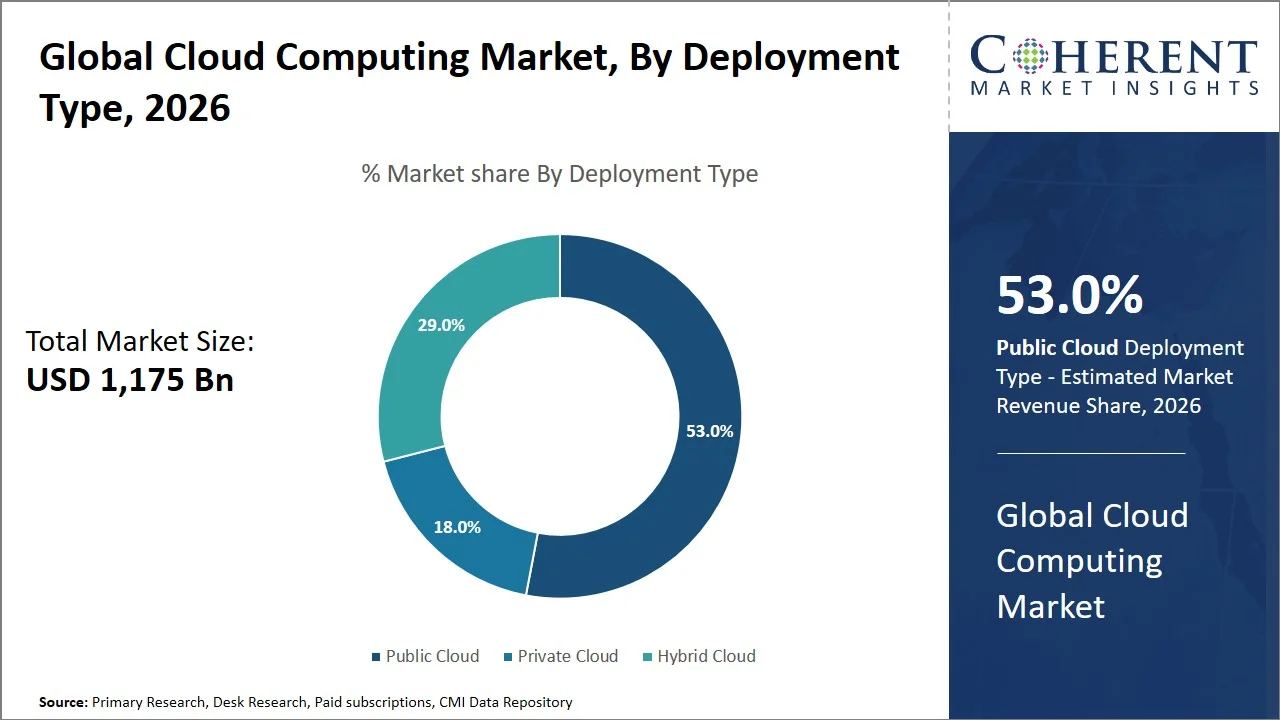
The public cloud segment is expected to account for 53.0% of the global cloud computing market share in 2026. High scalability at cheap upfront cost is one of the most important reasons for the popularity of public cloud. Organizations now have access to near limitless computing capabilities from providers such as Amazon Web Services, Microsoft Azure and Google Cloud without having to invest in physical infrastructure. The pay-as-you-go pricing model offers organizations the flexibility to scale resources up or down instantaneously based on demand which makes it very cost-efficient and flexible as opposed to private or on-premise solutions.
On June 4, 2026, Pinterest deepened its long-term partnership with Amazon Web Services with a USD 4 billion cloud services arrangement till 2031. The company said it can get the scalable computing power it needs for AI-powered visual search and content discovery from AWS infrastructure and custom AI chips without the need to build its own large-scale infrastructure, citing the cost-efficiency of the public cloud model. (Source: Amazon)
Application Development and Testing Dominates the Global Cloud Computing Market
The application development and testing segment is expected to account for 39.0% of the global cloud computing market share in 2026. One of the main drivers for application development and testing being the leading use of cloud computing is the ability to quickly construct on demand scalable development environments. Amazon Web Services, Microsoft Azure, Google Cloud) enable developers to spin up and tear down testing environments in an instant without the need to buy or configure real hardware. This greatly decreases development cycles, accelerates software releases and enables continuous integration and continuous deployment (CI/CD) procedures, making the cloud perfect for agile development workflows.
On June 2, 2026, Microsoft launched Project Solara, a chip-to-cloud platform for developers to build and deploy AI-powered enterprise apps on Azure-hosted services. With centralized application logic and testing environments in the cloud, developers can rapidly prototype, validate, and distribute new software experiences without the burden of managing sophisticated on-premise development infrastructure. (Source: Microsoft)
Currents Events and their Impact
Current Events | Description and its Impact |
EU Digital Markets Act (DMA) – European Union |
|
EU Digital Services Act (DSA) – European Union |
|
(Source: European Commission, European Commission)
Cloud Computing Market Dynamics
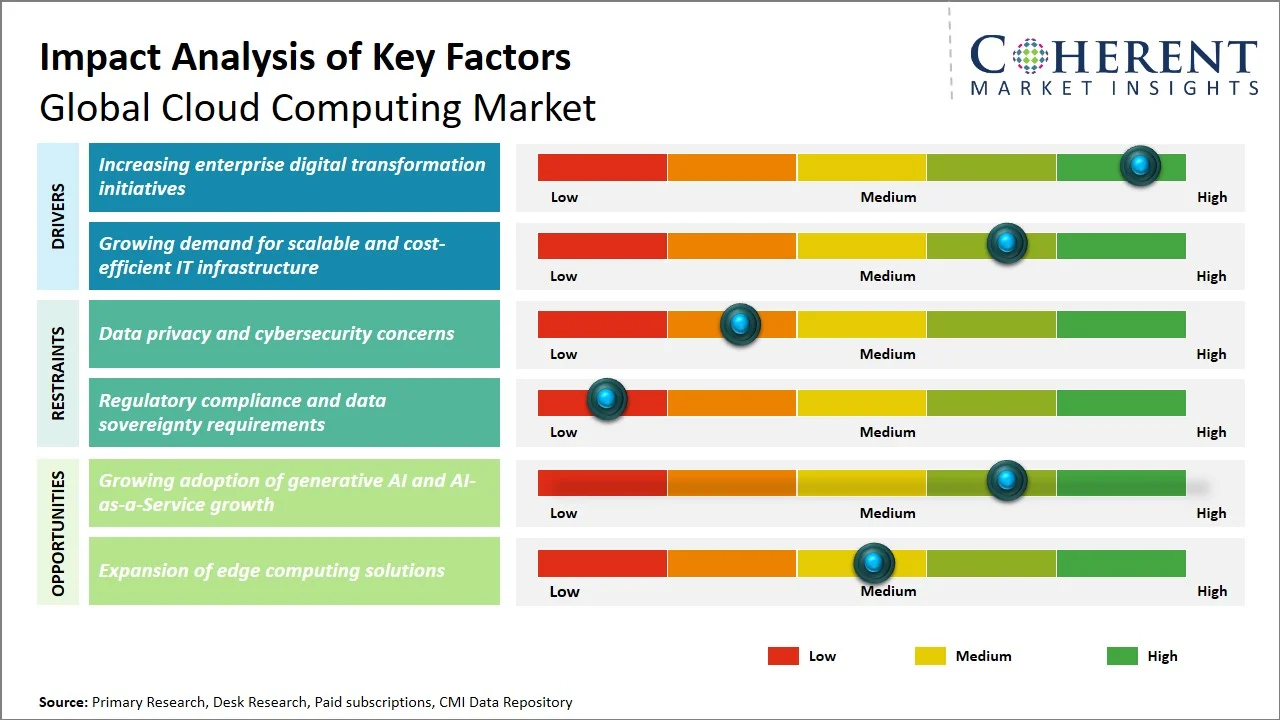
Market Drivers
Increasing enterprise digital transformation initiatives
Growing enterprise digital transformation projects is a major factor driving worldwide cloud computing usage as enterprises across industries are increasingly updating their operations utilizing digital technology. To boost productivity, agility and customer experience, businesses are moving from traditional IT infrastructure to cloud-based platforms. This transformation involves the use of technologies like cloud computing, artificial intelligence, data analytics, and automation to expedite processes and facilitate real-time decision-making. As businesses strive to stay ahead in the fast-moving digital economy, cloud services are critical to fueling scalable, adaptable and innovation-driven business models.
On June 4, 2026, IBM and Google Cloud announced the launch of a new Google Cloud Practice, designed to help organizations more quickly scale AI into production and modernize core systems. The new practice combines IBM’s deep industry expertise and IBM Consulting Advantage, the company’s AI-powered platform that helps IBM teams design, build and deploy AI solutions faster using agents and industry workflows, now with Google Cloud’s Gemini Enterprise Agent Platform, cybersecurity and data capabilities. (Source: IBM)
Growing demand for scalable and cost-efficient IT infrastructure
The increase in demand for scalable and cost-effective IT infrastructure is one of the major factors driving the growth of the cloud computing market globally. Organizations are seeking ways to control increasing data volumes and fluctuating workloads without investing heavily in physical hardware. The cloud platforms allow companies to immediately scale computing resources up and down to meet demand, providing the best possible performance without the cost of over provisioning. This pay-as-you-go model drastically cuts capital investment and converts IT expenditure into a much more predictable operating expense structure. This, in turn, allows businesses to improve cost efficiency, increase operational flexibility and devote more time to core company innovation rather than infrastructure maintenance.
On October 22, 2025, Applied Digital announced that it has entered into a lease agreement with a U.S.-based Investment Grade Hyperscaler at its state-of-the-art, purpose-built Polaris Forge 2 Campus. This lease represents approximately USD 5 billion in total contracted revenue over an estimated 15-year lease term and covers 200 megawatts (MW) of critical IT load purpose-built to support the Hyperscaler’s artificial intelligence (AI) and high-performance compute (HPC) infrastructure. (Source: Applied Digital)
Emerging Trends
- AI-Driven Cloud Services and AI-as-a-Service Expansion: Cloud providers are incorporating artificial intelligence and machine learning into their platforms at an unprecedented level. That includes ready-made APIs, generative AI models and automated analytics services. As the backbone for scaling AI workloads, especially for large models that demand huge amounts of computational resources and specialized hardware like GPUs and TPUs, cloud infrastructure is emerging.
- Increased Focus on Cloud Security and Zero Trust Architecture: With cyber threats becoming more complex, enterprises are embracing Zero Trust security models, where no user or device is trusted by default. Cloud providers are investing big dollars on encryption, identity management and continuous monitoring. Security is no longer an add-on, but a basic aspect of cloud architecture, driven by regulatory compliance and growing data privacy concerns.
Global Cloud Computing Market - Cloud Workload Migration
Cloud workload migration refers to the process of moving applications, data, and IT workloads from on-premise data centers or legacy systems to cloud environments (public, private, or hybrid cloud). It is a core driver of the global cloud computing market because enterprises are shifting workloads to improve scalability, cost efficiency, AI readiness, and operational agility, while also adopting hybrid and multi-cloud strategies for flexibility.
- Workload shift trend
- Over 50%+ of enterprise workloads now run in public cloud environments
- Hybrid cloud remains the dominant deployment model
- Migration pattern
- Lift-and-shift remains the leading strategy
- Refactoring/cloud-native redesign is growing rapidly
- Enterprise adoption scale
- 94% of organizations already use cloud services, making migration an ongoing continuous process rather than a one-time shift
Regional Insights
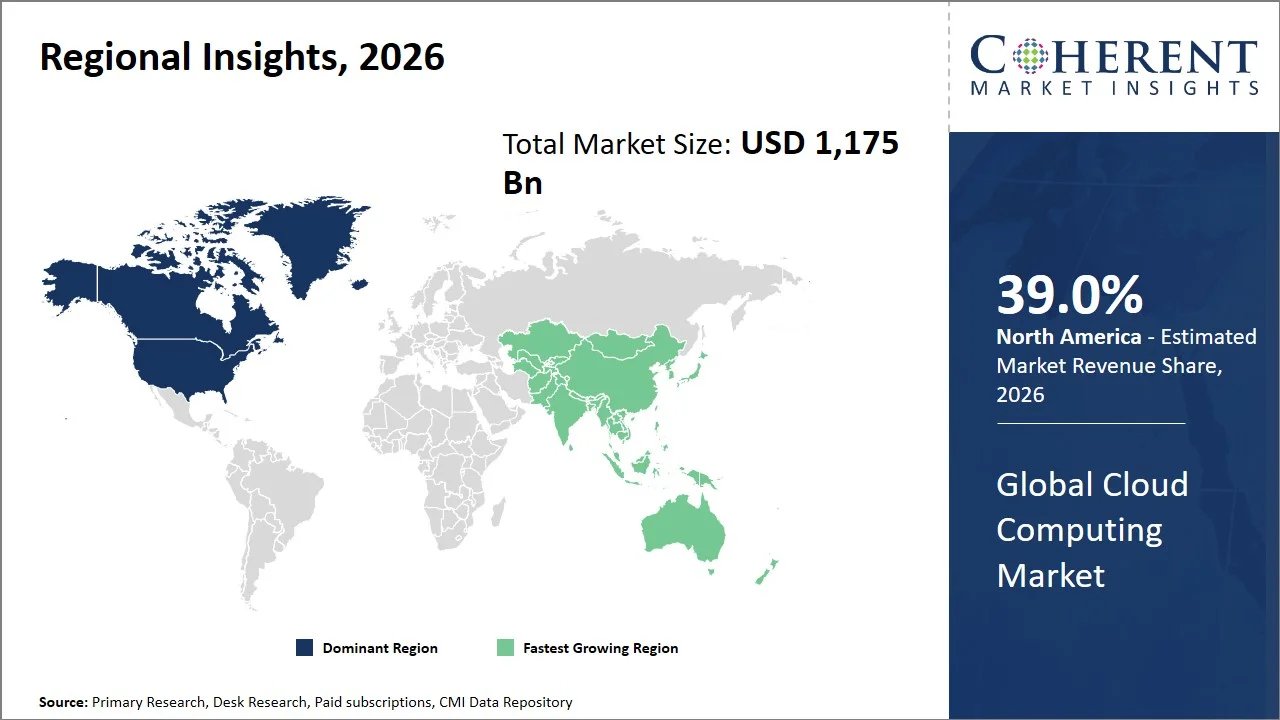
Why is North America a Strong Market for Cloud Computing?
North America is expected to account for a market share of 39.0% in 2026. North America continues to be the most developed cloud computing industry with hyperscalers such as Amazon Web Services, Microsoft Azure and Google Cloud maintaining large multi-region infrastructures throughout the U.S. and Canada. The U.S. government is also accelerating this adoption with frameworks like FedRAMP and defense-oriented cloud environments like AWS GovCloud to help federal agencies use the cloud securely. Regional domination is further reinforced by strong enterprise demand from banking (JPMorgan Chase), streaming (Netflix on AWS) and SaaS enterprises.
Moreover, North America is witnessing an increase in government cloud modernization initiatives. For instance, on November 24, 2025, Amazon announced an investment of up to US$ 50 billion to expand AI and supercomputing capabilities for Amazon Web Services (AWS) U.S. government customers. This investment, set to break ground in 2026, will add nearly 1.3 gigawatts of AI and supercomputing capacity across AWS Top Secret, AWS Secret, and AWS GovCloud (US) regions by building data centers with advanced compute and networking technologies. (Source: Amazon)
Why Does the Asia Pacific Cloud Computing Market Exhibit High Growth?
Asia Pacific is projected to account for 26.0% of the global cloud computing market and is expected to register the fastest growth. The Asia Pacific cloud computing market is quite competitive with fast-growing global firms as well as regional competitors like Alibaba Cloud, Tencent Cloud and Huawei Cloud driving growth. Countries such as Singapore, India and Indonesia are seeing massive data center investments, driven by development in the digital economy and government-backed digitization programmes. For example, cross-border e-commerce platforms such as Lazada are backed by Alibaba Cloud’s extended availability zones in Southeast Asia.
In addition, rapid development in cloud security services in the region is further aiding the growth of the Asia Pacific cloud computing market. On October 17, 2025, Alibaba Cloud enhanced its offering of security and compliance products, including Anti-DDoS services, Web Application Firewall (WAF), encryption and auditing tools to assist organizations comply with regional cybersecurity standards. (Source: Alibaba Cloud)
Global Cloud Computing Market Outlook for Key Countries
Why is the U.S. Emerging as a Major Hub in the Cloud Computing Market?
The U.S. cloud computing market is the global innovation hub, with hyperscalers such as AWS, Azure and Google Cloud leading the way and powering workloads for organizations like NASA, Airbnb and Spotify. The Department of Defense's Joint Warfighting Cloud Capability (JWCC) contract, for example, is an example of federal efforts to further integrate the enterprise and government cloud. SaaS ecosystems in Silicon Valley also depend significantly on cloud-native development to speed up product rollout.
Is China the Next Growth Engine for the Cloud Computing Market?
The cloud computing market in China is dominated by domestic companies such as Alibaba Cloud, Huawei Cloud and Tencent Cloud, who operate under strong data sovereignty and cybersecurity restrictions. The government’s “New Infrastructure” program encourages the large-scale development of cloud and AI data centers within national borders. For example, Alibaba Cloud hosts important Chinese platforms such as Taobao and Alipay and adheres to local data storage requirements.
Germany Cloud Computing Market Analysis and Trends
The Germany cloud computing market is heavily influenced by EU legislation like GDPR and sovereignty-focused initiatives such as Gaia-X, which is striving to build a secure European cloud ecosystem. Deutsche Telekom’s T-Systems and SAP’s cloud services have “sovereign cloud” offerings for industries including automotive (BMW, Volkswagen) The focus is on data protection, industrial cloud applications and control of EU-based infrastructure.
India Cloud Computing Market Analysis and Trends
Aadhaar-based services, UPI payments and the Digital Personal Data Protection Act (DPDP Act, 2023), are powering the growth of India’s cloud computing market. Global companies like AWS, Azure and Google Cloud are investing extensively in Indian regions and local players like Jio Platforms and Tata Communications are supporting localized cloud and telecom-integrated services. Top Indian companies like Flipkart and Zomato handle huge real-time transaction volumes using cloud-native designs.
South Korea Cloud Computing Market Analysis and Trends
The South Korean government’s Digital New Deal is helping telecom-led providers as KT Cloud and Naver Cloud to develop the cloud computing market. Other companies, including Samsung and LG, are also progressively deploying cloud infrastructure for AI-enabled manufacturing and semiconductor design workflows. The government is pushing for cloud use in public services, including smart city initiatives in Seoul and Busan.
Global Cloud Computing Market - Cloud Workload Volume
Metric / Dimension | 2025 Value | 2026 Outlook |
Workloads still on-premises | ~28% | ~20–23% declining |
Public cloud workload share | ~51% of workloads | ~55–60% projected |
AI/ML workloads in cloud compute | ~30% of total cloud compute | ~40–50% projected |
Containerized workloads (Kubernetes-based) | ~55% of applications | ~65%+ expected |
Serverless / event-driven workloads | ~35% growth in 2025 | ~45%+ growth trend |
Edge + distributed workloads | ~15% of total cloud workloads | ~25% expected |
How is the Growing Adoption of Generative AI and AI-as-a-Service Creating New Growth Opportunities in the Cloud Computing Market?
The cloud computing market is seeing huge new growth potential as generative AI and AI-as-a-Service are increasingly used, and there is a rapidly growing demand for high-performance, scalable computing infrastructure. Developing sophisticated AI models requires huge amounts of processing power, specialized hardware such as graphics processing units (GPUs) and tensor processing units (TPUs), and vast amounts of data storage, most of which is provided by cloud computing services such as Amazon Web Services, Microsoft Azure and Google Cloud. Cloud companies are increasingly delivering pre-trained generative AI models, APIs and managed machine learning services that enable enterprises to access AI capabilities without having to create expensive in-house infrastructure. This trend is pushing more cloud usage in industries including health, finance, e-commerce and media, and opening up new monetization avenues such as hosting AI models, inference services, and AI development platforms.
On April 20, 2026, Amazon and Anthropic expanded their collaboration with a commitment from Anthropic to spend more than USD 100 billion over the next 10 years on AWS technologies. This encompasses current and future generations of Trainium (Amazon’s custom silicon) and tens of millions of Graviton cores (Amazon’s widely-adopted CPU chip) to provide superior price performance. (Source: Amazon)
Global Cloud Computing Market - Cloud Cost Optimization Savings
Cost Optimization Lever | Typical Savings Range | 2025–2026 Benchmark Data |
Overall cloud waste reduction (FinOps adoption) | 20% – 35% savings | Mature FinOps programs reduce waste by ~30–35% on average |
Idle / unused resource cleanup (VMs, storage, IPs) | 10% – 25% savings | ~32% of cloud spend is wasted globally |
Rightsizing workloads (compute optimization) | 15% – 40% savings | Rightsizing and optimization can yield up to ~25% efficiency gains |
Reserved Instances / Savings Plans / CUDs | 20% – 72% savings (vs on-demand) | Effective Savings Rate (ESR) reaches ~38% in large organizations |
Spot / Preemptible instances usage | 50% – 90% savings | Widely used for batch + AI workloads (FinOps trend 2025) |
Multi-cloud / workload shifting optimization | 10% – 30% savings | Multi-cloud execution can reduce query cost up to ~56% in research scenarios |
Market Players, Key Development, and Competitive Intelligence
Key Developments
- On June 23, 2025, Salesforce announced Agentforce, a major upgrade to its digital labor platform that gives companies the visibility and control to scale AI agents without compromise. With a new Command Center for complete observability, built-in support for Model Context Protocol (MCP) for plug-and-play interoperability, and over 100 new prebuilt industry actions to speed time to value, Agentforce 3 helps companies scale what works, fix what does not, and unlock the full potential of agentic AI.
- On May 12, 2025, Alibaba Cloud announced its strategic partnerships with LuLu Financial Holdings and Ant Digital Technologies during the Dubai Fintech Summit 2025. These collaborations underscore Alibaba Cloud’s ongoing commitments to supporting the region’s digital transformation by equipping businesses with effective tools and robust infrastructure to thrive in an AI-powered world.
Competitive Landscape
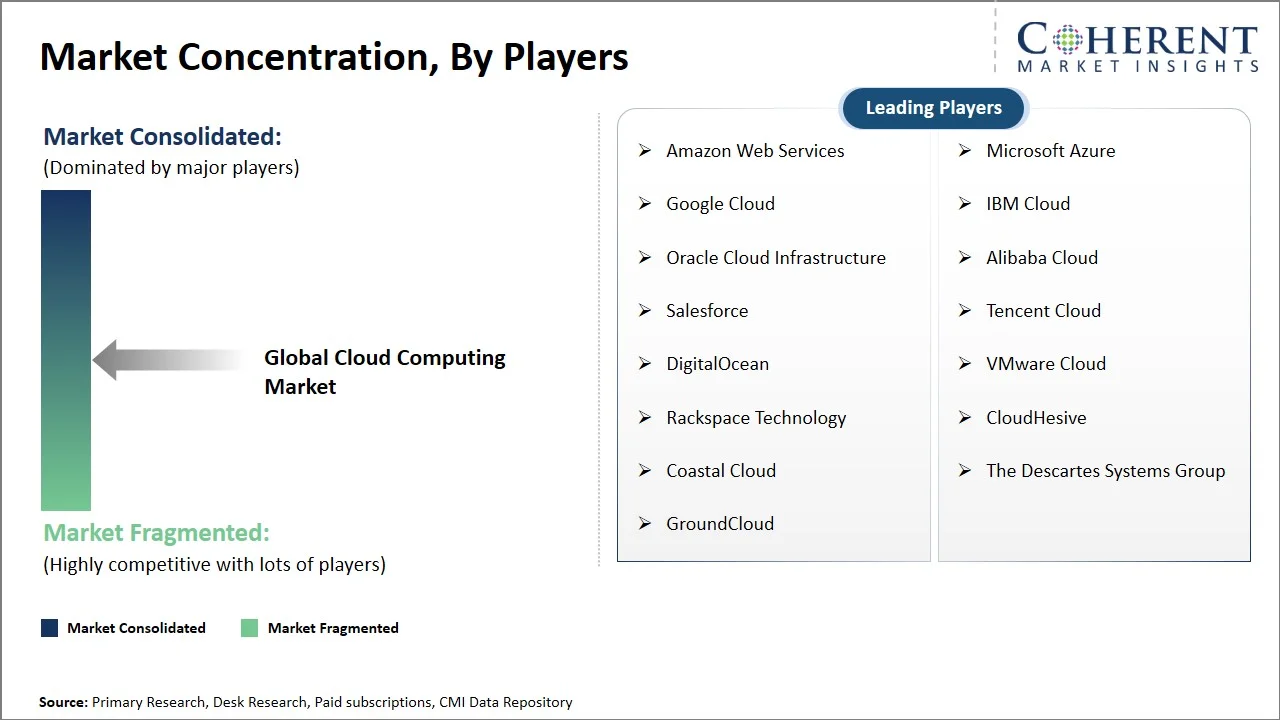
The global cloud computing market is highly consolidated, with a few hyperscale providers dominating the market. Amazon Web Services, Microsoft Azure, and Google Cloud are consistently at the top and command a substantial share of global infrastructure capacity and enterprise workloads. Other big tech companies like Alibaba Cloud, IBM Cloud and Oracle Cloud are also formidable competitors, with differentiated strategies focused on vertical cloud solutions, hybrid cloud capabilities and tight integration with enterprise software ecosystems. The intense rivalry is further fueled by ongoing price optimization tactics, rapid growth of global data center networks and aggressive investment in artificial intelligence and machine learning capabilities. Developer ecosystems are becoming an increasingly important part of a company’s market positioning, as are long-term business contracts and the ability to deliver seamless multi-cloud interoperability across regions and industries.
Market Report Scope
Cloud Computing Market Report Coverage
| Report Coverage | Details | ||
|---|---|---|---|
| Base Year: | 2025 | Market Size in 2026: | USD 1,175 Bn |
| Historical Data for: | 2020 To 2024 | Forecast Period: | 2026 To 2033 |
| Forecast Period 2026 to 2033 CAGR: | 16% | 2033 Value Projection: | USD 3,255 Bn |
| Geographies covered: |
| ||
| Segments covered: |
| ||
| Companies covered: | Amazon Web Services, Microsoft Azure, Google Cloud, IBM Cloud, Oracle Cloud Infrastructure, Alibaba Cloud, Salesforce, Tencent Cloud, DigitalOcean, VMware Cloud, Rackspace Technology, CloudHesive, Coastal Cloud, The Descartes Systems Group, and GroundCloud | ||
| Growth Drivers: |
| ||
| Restraints & Challenges: |
| ||
Analyst Opinion (Expert Opinion)
- The cloud computing industry is being substantially supported by the growing digital transformation activities in enterprises, especially as companies move to cloud-native architectures and AI-driven operations. The increased usage of generative AI, data analytics, and automation technologies is being cited as a key driver of continuous cloud demand, with these workloads needing scalable, high-performance computer infrastructure. At the same time, critical issues like data sovereignty, cyber security threats, regulatory compliance requirements, and vendor lock-in concerns are being pointed out as variables that may affect enterprise cloud adoption strategies and deployment decisions. The relevance of hybrid and multi-cloud methods is also evident as firms seek more flexibility, resiliency and cost optimization in their IT infrastructures.
- The global cloud computing market is expected to see strong long-term growth as a result of ongoing growth in generative AI applications, greater reliance on edge computing for real-time processing, and the widespread adoption of hybrid and multi-cloud architectures across enterprises of all sizes. Significant investments in hyperscale data center infrastructure, high-performance computing systems and AI-optimized cloud platforms will be made in major regions such as North America, Asia Pacific and Europe. The market penetration is expected to grow further with the evolution of industry-specific cloud solutions built for industries such as healthcare, banking, manufacturing and retail, creating new revenue streams for providers. Furthermore, new developments in automation, serverless computing and sovereign cloud models are anticipated to transform how enterprises architect and operate digital infrastructure in the future years.
Speak to the analyst
Want personalized insights?
Take the findings above to one of our principal consultants, or have the report rebuilt around the segments, geographies and competitors you actually track.
Market Segmentation
- Service Type Insights (Revenue, USD Billion, 2021 - 2033)
- Software as a Service (SaaS)
- Infrastructure as a Service (IaaS)
- Platform as a Service (PaaS)
- Deployment Type Insights (Revenue, USD Billion, 2021 - 2033)
- Public Cloud
- Private Cloud
- Hybrid Cloud
- Workload Type Insights (Revenue, USD Billion, 2021 - 2033)
- Application Development and Testing
- Data Storage and Backup
- Resource Management
- Orchestration Services
- End User Insights (Revenue, USD Billion, 2021 - 2033)
- BFSI
- IT and Telecom
- Healthcare
- Manufacturing
- Retail and Consumer Goods
- Government and Public Sector
- Media and Entertainment
- Energy and Utilities
- Regional Insights (Revenue, USD Billion, 2021 - 2033)
- North America
- U.S.
- Canada
- Latin America
- Brazil
- Argentina
- Mexico
- Rest of Latin America
- Europe
- Germany
- U.K.
- Spain
- France
- Italy
- Russia
- Rest of Europe
- Asia Pacific
- China
- India
- Japan
- Australia
- South Korea
- ASEAN
- Rest of Asia Pacific
- Middle East
- GCC Countries
- Israel
- Rest of Middle East
- Africa
- South Africa
- North Africa
- Central Africa
- North America
- Key Players Insights
- Amazon Web Services
- Microsoft Azure
- Google Cloud
- IBM Cloud
- Oracle Cloud Infrastructure
- Alibaba Cloud
- Salesforce
- Tencent Cloud
- DigitalOcean
- VMware Cloud
- Rackspace Technology
- CloudHesive
- Coastal Cloud
- The Descartes Systems Group
- GroundCloud
Sources
Primary Research Interviews
- Cloud Service Providers (CSPs) and Platform Vendors
- Enterprise IT Decision Makers and CIOs
- Cloud Infrastructure Partners and System Integrators
- Cloud Security and Compliance Specialists
Magazines
- Cloud Computing Magazine
- CIO Magazine
- InformationWeek
- Enterprise Cloud News
Journals
- IEEE Transactions on Cloud Computing
- Journal of Cloud Computing: Advances, Systems and Applications
- International Journal of Cloud Applications and Computing
Associations
- Cloud Security Alliance (CSA)
- Cloud Industry Forum (CIF)
- Open Cloud Computing Interface (OCCI)
- Cloud Computing Association
Public Domain Sources
- U.S. Department of Commerce Cloud Computing Reports
- European Commission Digital Single Market Studies
- NIST Cloud Computing Standards
- OECD Digital Economy Outlook
Proprietary Elements
- CMI Data Analytics Tool
- Proprietary CMI Existing Repository of information for last 10 years
Get access to 250+ pages report
Every segment, forecast, competitor profile and data table behind the analysis above — available for instant download.
- ESOMAR Member
- ISO 9001:2015 Certified
- D-U-N-S Registered
- GDPR & CCPA Compliant
Missing comfort of reading report in your local language? Find your preferred language:
Transform your Strategy with Exclusive Trending Reports
Frequently Asked Questions
The global cloud computing market is expected to stand at USD 1,175 Bn in 2026 and is expected to reach USD 3,255 Bn by 2033.
The CAGR of the global cloud computing market is projected to be 16% from 2026 to 2033.
In terms of service type, the Software as a Service (SaaS) segment is estimated to dominate the market revenue share in 2026.
IaaS provides virtualized computing resources like servers and storage over the internet.
Multi-cloud strategy involves using services from multiple cloud providers to avoid dependency on a single vendor.
Data privacy and cybersecurity concerns and regulatory compliance and data sovereignty requirements are the major factors hampering the growth of the global cloud computing market.
Increasing enterprise digital transformation initiatives and growing demand for scalable and cost-efficient IT infrastructure are the major factors driving the growth of the global cloud computing market.