

Ship-to-Shore Cranes Market Size and Forecast
The Ship-to-Shore Cranes Market is estimated to be valued at USD 6.71 Bn in 2026 and is expected to reach USD 9.26 Bn by 2033, exhibiting a compound annual growth rate (CAGR) of 4.7% from 2026 to 2033.
Key Takeaways
- By Lifting Capacity, the Panamax STS Cranes segment is estimated to hold the highest share of 55.8% in 2026, owing to the increasing development of supporting infrastructure.
- By Outreach, the >60 meters segment is estimated to hold the highest share of 27.8% in 2026, owing to the versatility offered through extendable boom lengths.
- By Power Supply, the Diesel segment is estimated to hold the highest share of 64.8% in 2026, owing to significantly lower energy costs compared to electric alternatives.
- By Region, Asia-Pacific acquires the prominent market share of 55.6% in 2026 as the rise of automation and digital technologies.
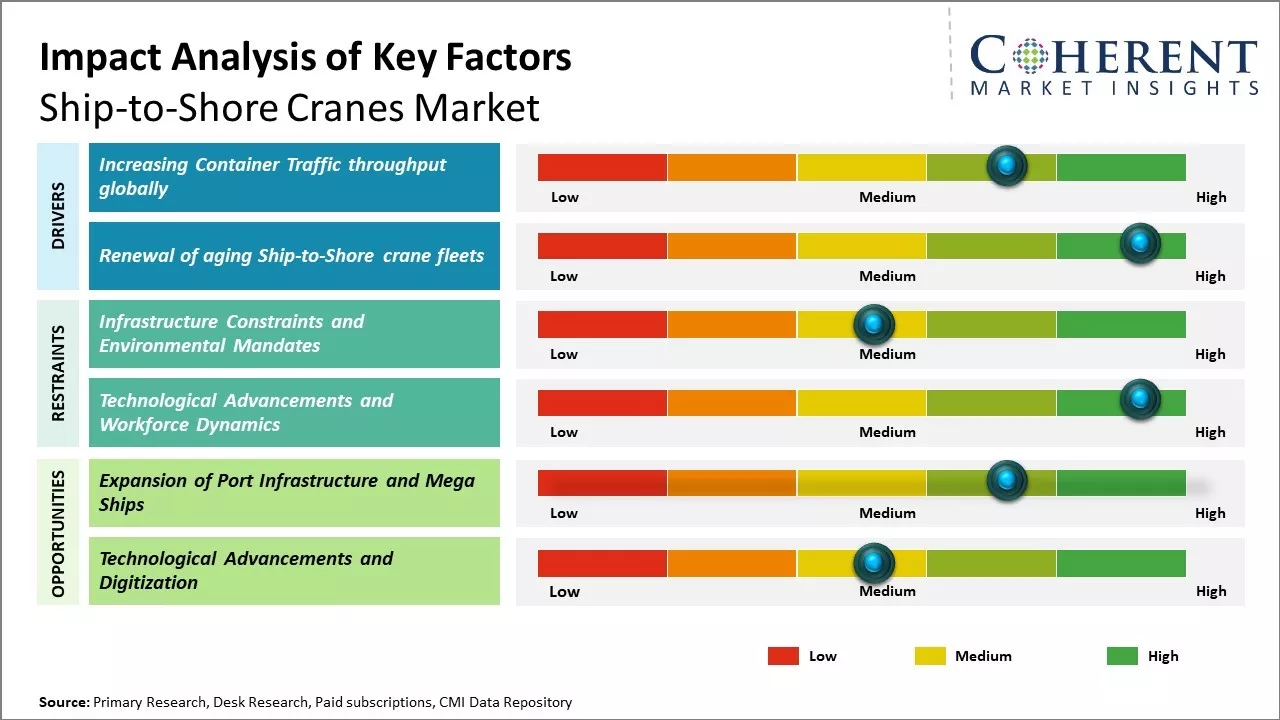
Market Overview
Ship-to-shore cranes are essential for handling cargo at ports efficiently and their widespread use is driving revenues in this market. Growing marine trade activities and capacity expansion of ports to handle increasing cargo volumes will further aid the growth of this market during the forecast period. The market is witnessing a rising demand for technologically advanced ship-to-shore cranes that improve operational efficiency. The adoption of automation, digitization, and remote monitoring solutions in cranes enables higher productivity and reduces maintenance downtime. Manufacturers are extensively investing in R&D to develop autonomous and electric cranes. Such trends towards smart ports are creating new revenue opportunities for ship-to-shore crane providers in the coming years.
Current Events and their Impact on the Ship-to-Shore Cranes Market
Current Events | Description and its impact |
Geopolitical Tensions |
|
Labor & Automation Shifts |
|
Infrastructure Expansion |
|
End user Feedback and Unmet Needs in the Ship-to-Shore Cranes Market
- Integration with Terminal Operating Systems (TOS): Many port operators report persistent challenges in integrating new STS cranes with existing Terminal Operating Systems. Lack of standardized protocols and vendor-specific APIs create inefficiencies in real-time data synchronization, limiting automation potential and forcing costly workarounds for operational compatibility.
- High Downtime Due to Maintenance Complexities: End-users often face long downtimes due to maintenance complexities, especially in older or hybrid STS cranes. Limited availability of spare parts, complex subsystems, and reliance on OEMs for critical servicing delays operations and increases total cost of ownership.
- Limited Retrofit Options for Sustainability: Operators express the need for more robust retrofit solutions to upgrade existing diesel cranes with energy-efficient or hybrid modules. Current retrofit offerings are often expensive, complex, or non-scalable hindering progress toward emission reduction and sustainability goals, particularly at mid-sized terminals.
- Current Industry Events of 2026
- Market Size Estimation
- Regional Breakdown
- Competitive Landscape
- Customer Intelligence
- Segmental Analysis
- Pricing Analysis
- Key Market Drivers, Challenges & Future Trends
- Customized Insights Section
Pricing Analysis of Ship-to-Shore Cranes
STS cranes generally cost anywhere between USD 6 million and over USD 20 million per unit. Panamax cranes, which are smaller and used for ships passing through the original Panama Canal dimensions, are typically priced between USD 6 million and USD 9 million. Post-Panamax cranes, which support medium-sized container ships, usually cost in the range of USD 8 million to USD 12 million. Super Post-Panamax cranes, which handle very large ships, often fall between USD 12 million and USD 15 million. The most advanced cranes Ultra-Large STS cranes designed for ultra-large container vessels can exceed USD 20 million depending on configuration and technology integration.
Segmental Insights
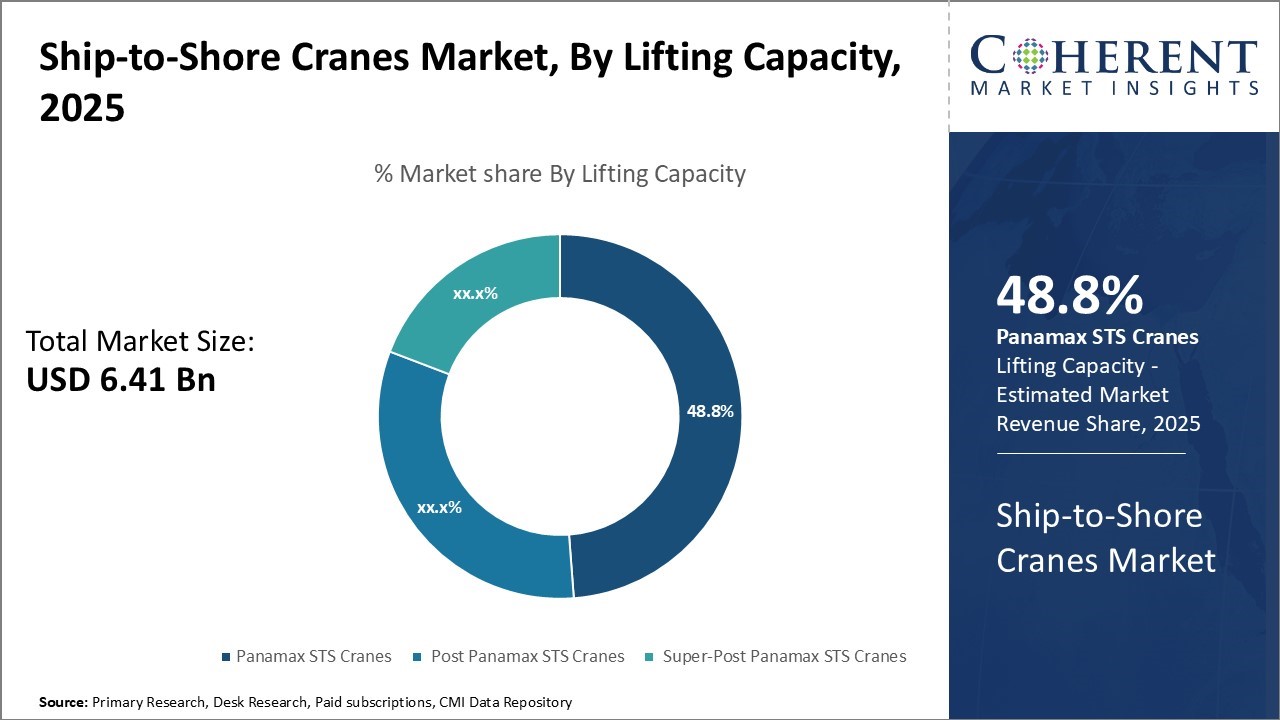
Ship-to-Shore Cranes Market Insights, By Lifting Capacity
Panamax STS Cranes contribute the highest share of the market owing to its expansion of panamax vessel fleet
The Panamax STS Cranes segment is estimated to hold the highest share of 55.8% in 2026. Panamax cranes are designed to serve mid-sized cargo vessels that can pass through the original Panama Canal locks. As global trade volumes continue rising, many countries are investing heavily in expanding and modernizing port facilities to accommodate larger ship traffic. This involves deepening shipping containers, increasing quay lengths, and installing new gantry rails and yard spaces. Panamax cranes play a vital role in efficiently unloading vessel cargo at such ports. Their lifting capacities ranging from 30-50 tons suit the load requirements of bulk and container ships plying international routes. For instance, in November 2022, DP World installed two Super Post Panamax STS cranes at its terminal in Lirquén, Chile. Powered by renewable energy, the new cranes will enhance the company’s operational efficiency, reduce its carbon footprint by 11%, and boost port productivity by 30%. This is further accelerating the ship to shore cranes market demand.
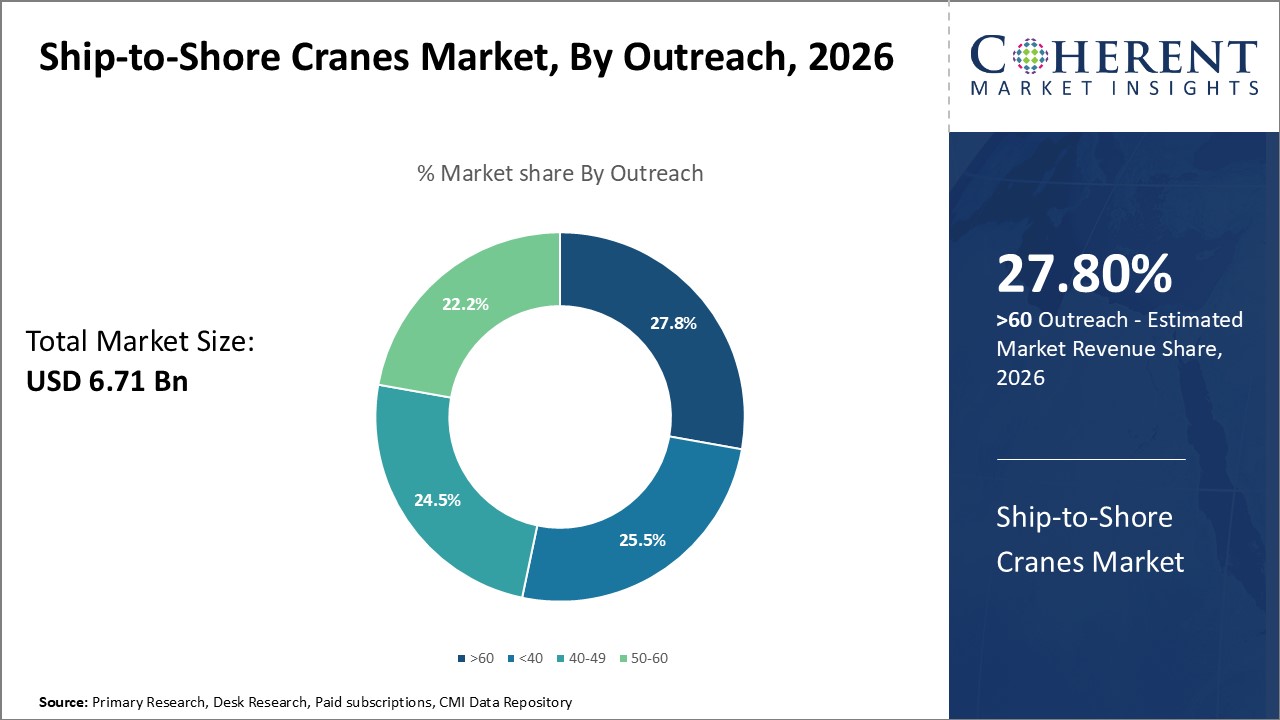
Ship-to-Shore Cranes Market Insights, By Outreach
>60 meters contribute the highest share of the market owing to its infrastructure investment in deep-water ports
The >60 meters segment is estimated to hold the highest share of 27.8% in 2026. Advanced STS cranes with extendable booms exceeding 60 meters provide port operators maximum flexibility to serve a wide range of vessel sizes calling at a terminal. The extendable design allows cranes to match their outreach according to vessel types, ranging from small feeders to very large container ships. It enables ports to minimize infrastructure duplication and costs associated with procuring and maintaining multiple fixed-length cranes. The extendable feature also facilitates efficient yard operations as a single crane can service multiple berths. Leading global suppliers have pioneered hydraulic extendable boom technologies that extend outreach by up to 30% without compromising on lifting capacities. This has boosted popularity of extra-long reach STS cranes optimizing versatility at ports. For instance, Liebherr Container Cranes has delivered a ship-to-shore (STS) container crane to Terminales Maritimas Del Sureste S.A. (TMS) at the Port of Alicante, Spain. The crane features a single lift spreader with a 46.9-meter outreach, a 15.24-meter span, a 36-meter lift height, and a safe working load (SWL) of 50 tons.
Ship-to-Shore Cranes Market Insights, By Power Supply
Diesel contributes the highest share of the market owing to its reliability & proven performance
The Diesel segment is estimated to hold the highest share of 64.8% in 2026. Diesel remains a widely preferred power option for STS cranes operating at ports globally. Powering gantry cranes directly using diesel generators eliminates infrastructure needs for extensive cabling networks to supply electricity from an offsite substation. It provides ports energy security without dependencies on grid power supply. Moreover, diesel fuel remains relatively inexpensive vis-à-vis electricity tariffs in several global trade hubs. Given the capital-intensive nature and long lifecycles of STS cranes, low energy operating costs assume greater significance. Diesel engines also offer fuel efficiency and require less maintenance than gas turbines. For instance, in July 2024, Paradip Port carried out its first ship-to-ship transfer of special grade diesel oil at the North Oil Jetty within the Harbour area, transferring the cargo from MV Orkim Fortitude to the empty tanker MV Torm Republican. The port completed this operation as part of the company’s efforts to cut transportation costs while exploring new avenues for operational expansion. This is further accelerating the ship to shore cranes market growth.
Regional Insights
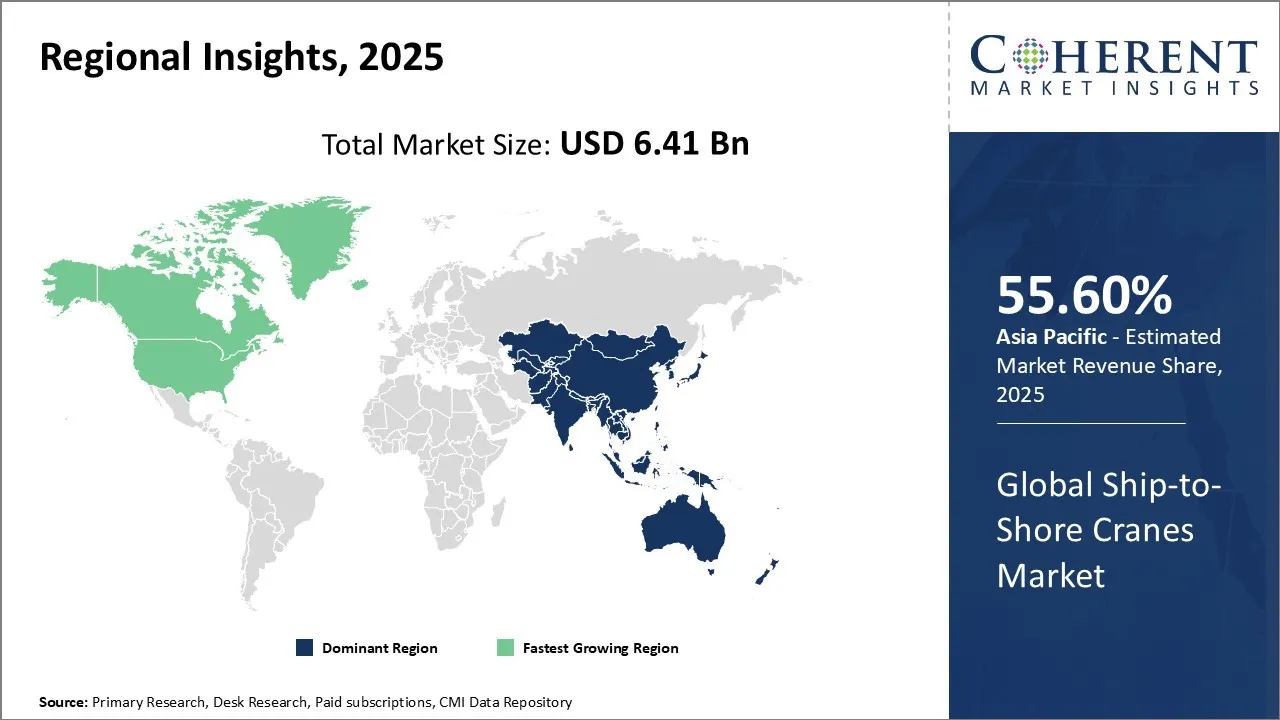
Asia-Pacific Ship-to-Shore Cranes Market Trends
The Asia-Pacific STS crane market dominates the overall market, with a share of 55.6%. Governments are actively investing in smart-port initiatives and infrastructure, driving the adoption of automated and electric STS cranes. Ports are integrating advanced technologies—such as digital twins, IoT, remote operation, and AI analytics—to boost safety, energy efficiency, and throughput. Sustainability regulations further accelerate the shift toward eco-friendly crane solutions across the region. For instance, during the 15th Singapore Maritime Week, the Maritime and Port Authority of Singapore (MPA) has opened the country’s first Maritime Drone Estate (MDE). Located near the anchorages and Marina South Pier, the MDE provides an ideal setting for testing and advancing drone technology for maritime applications such as remote ship inspections and shore-to-ship transfers.
North America Ship-to-Shore Cranes Market Trends
Environmental regulations are driving North American ports to accelerate the shift toward electric and hybrid STS cranes. Ports along the East and West Coasts are actively replacing diesel-powered machines to meet stricter sustainability targets, reduce emissions, and limit noise pollution. At the same time, terminals are equipping STS cranes with IoT sensors, AI analytics, and remote-control features to enhance real-time monitoring, predictive maintenance, and operational oversight—ultimately improving crane uptime and overall terminal efficiency.
In August 2024, Stafford Crane Group manufactured ship-to-shore (STS) container cranes in the United States.
United States Ship-to-Shore Cranes Market Trends
U.S. ports are actively transitioning from diesel to electric and hybrid STS cranes to meet stringent environmental and noise regulations. These eco-friendly alternatives enhance energy efficiency, reduce emissions, and support national sustainability goals and community health. To increase productivity and capacity, port operators are advocating for automation, including semi-automated STS cranes. However, labor unions like the ILA have enforced restrictions, mandating extra staffing per automated unit. Ongoing labor negotiations continue to influence the pace and extent of automation adoption in the U.S. For instance, three massive, brand-new cranes—now the tallest in North America—have become part of the Port of Oakland's skyline in California, USA. Crews constructed each crane over several weeks and completed the third one last week. This is further proliferating the ship to shore cranes market share.
Europe Ship-to-Shore Cranes Market Trends
Major European ports, especially Rotterdam and Hamburg, are rapidly deploying automated STS cranes integrated with digital twins, IoT sensors, and AI analytics. These technologies enhance precision, enable predictive maintenance, and improve terminal synchronization, resulting in higher throughput and reduced manual intervention. To meet strict carbon and noise pollution standards, European ports are swiftly replacing diesel STS cranes with electric and hybrid models. Germany leads this transition through its eco-port initiatives, adopting eco-lifts and energy recovery systems. For instance, the Port of Greenock has introduced its new £25 million ship-to-shore cranes, marking a significant investment aimed at enhancing the facility's productivity. This is further accelerating the ship to shore cranes market revenue.
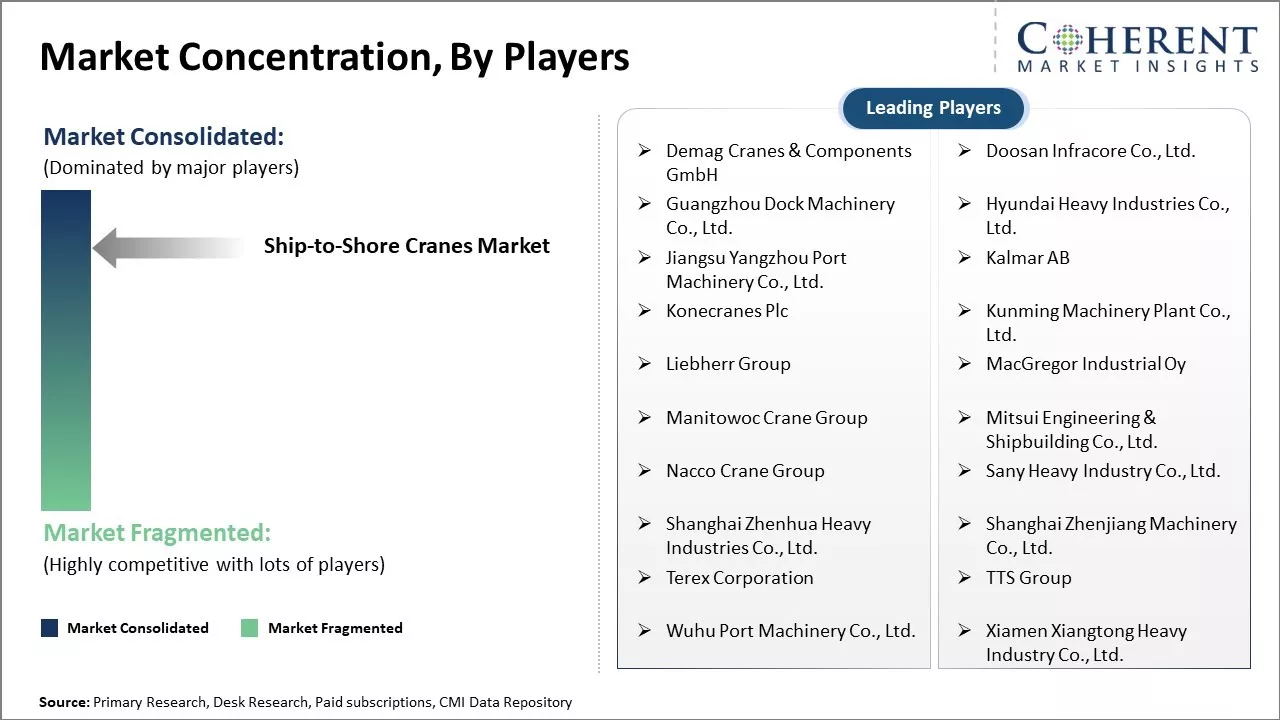
Market Concentration and Competitive Landscape
Ship-to-Shore Cranes Market Industry News
- In April 2025, the Port Elizabeth Container Terminal invested ZAR240 million ($12.7 million) to acquire a new ship-to-shore crane and strengthen its operations. This upgrade aims to enhance the terminal’s ability to handle larger vessels and improve container management for the automotive and agricultural sectors.
- In February 2025, the Rijeka Gateway terminal received the final two ship-to-shore (STS) cranes today, completing the terminal’s core equipment setup. Rijeka Gateway's management stated that the overall project has now reached approximately 75% completion.
- In March 2025, Asian Terminals Inc. (ATI) received two advanced ship-to-shore (STS) cranes, increasing the capacity of its flagship terminal, Manila South Harbor (MSH). With this addition, MSH now operates a fleet of 11 STS cranes, along with hybrid and conventional rubber-tired gantries and other cargo-handling equipment to “make trade flow faster, safer, and smarter,” ATI stated.
Market Report Scope
Ship-to-Shore Cranes Market Report Coverage
| Report Coverage | Details | ||
|---|---|---|---|
| Base Year: | 2025 | Market Size in 2026: | USD 6.71 Bn |
| Historical Data for: | 2020 To 2024 | Forecast Period: | 2026 To 2033 |
| Forecast Period 2026 to 2033 CAGR: | 4.7% | 2033 Value Projection: | USD 9.26 Bn |
| Geographies covered: |
| ||
| Segments covered: |
| ||
| Companies covered: | Demag Cranes & Components GmbH, Doosan Infracore Co., Ltd., Guangzhou Dock Machinery Co., Ltd., Hyundai Heavy Industries Co., Ltd., Jiangsu Yangzhou Port Machinery Co., Ltd., Kalmar AB, Konecranes Plc, Kunming Machinery Plant Co., Ltd., Liebherr Group, MacGregor Industrial Oy, Manitowoc Crane Group, Mitsui Engineering & Shipbuilding Co., Ltd., Nacco Crane Group, Sany Heavy Industry Co., Ltd., Shanghai Zhenhua Heavy Industries Co., Ltd., Shanghai Zhenjiang Machinery Co., Ltd., Terex Corporation, TTS Group, Wuhu Port Machinery Co., Ltd., and Xiamen Xiangtong Heavy Industry Co., Ltd. | ||
| Growth Drivers: |
| ||
| Restraints & Challenges: |
| ||
Ship-to-Shore Cranes Market Trend
Transition to Electrification and Hybrid Power
Ports around the world are rapidly replacing diesel-powered STS cranes with electric and hybrid models to comply with stricter environmental regulations and reduce operating costs. This shift is driven by government incentives, rising carbon emission penalties, and growing public demand for greener port operations. To align with long-term sustainability goals, ports are enhancing energy efficiency and reducing noise pollution by adopting electric cranes. Leading ports in Asia, North America, and Europe are actively investing in grid-connected systems and advanced energy recovery technologies.
Surge in Automation and Smart Crane Technologies
The adoption of automation in STS cranes is accelerating as ports seek to enhance safety, throughput, and operational efficiency. Automated cranes equipped with AI analytics, IoT sensors, and digital twins allow for real-time monitoring, collision avoidance, and predictive maintenance. Major terminals like Rotterdam and Shanghai now operate semi- and fully-automated STS units, reducing labor reliance and turnaround times. These advancements are critical in addressing labor shortages and improving container handling consistency.
Ship-to-Shore Cranes Market Opportunity
Expansion of Port Infrastructure and Mega Ships
The advent of mega ships necessitates the deployment of larger and more advanced ship-to-shore cranes. Simultaneously, investments in port infrastructure to accommodate these vessels open up significant opportunities for crane manufacturers and service providers. As ports strive to enhance their capacity and efficiency to handle growing trade volumes, the demand for state-of-the-art cranes capable of efficiently unloading cargo from these massive vessels continues to rise.
Analyst Opinion (Expert Opinion)
- The Ship-to-Shore Cranes market stands at a technological inflection point where operational intelligence, not brute capacity, is emerging as the primary differentiator. Ports that still view STS cranes merely as high-lift machinery are underestimating the strategic value they now deliver in automated port ecosystems.
- With regulations such as California’s At-Berth Rule and the EU’s Fit for 55 legislation tightening emissions control, ports have no choice but to phase out diesel-powered cranes. Case in point—Port of Los Angeles has already deployed over 30 electric STS units and cut crane-related GHG emissions by 70%. Meanwhile, the Port of Hamburg’s hybrid STS crane fleet has achieved a 30% energy efficiency gain using regenerative drives.
- However, electrification alone doesn’t guarantee competitiveness. Smart automation is the real game changer. The Port of Rotterdam’s use of fully automated STS cranes has enabled a staggering 95% vessel turnaround accuracy rate, supported by AI-driven crane scheduling and digital twin modeling. In contrast, semi-automated terminals still face 15–20% higher labor downtime, particularly in ports with union-imposed staffing mandates like in the U.S.
- The market’s most overlooked risk is its integration gap. Many crane deployments still fail to fully interface with Terminal Operating Systems (TOS) or yard automation layers, leading to disjointed operations. Over 40% of North American terminals, for instance, cite TOS-to-crane integration as a persistent bottleneck, as per recent interviews conducted with port engineering heads. Until vendors offer truly open, modular integration architectures, crane intelligence will remain trapped in silos.
- Furthermore, manufacturers must shift away from a one-size-fits-all model. Emerging markets, particularly in Africa and Southeast Asia, don’t need ultra-high spec STS cranes they need scalable, modular systems with hybrid retrofit options to meet power constraints and budget realities.
Speak to the analyst
Want personalized insights?
Take the findings above to one of our principal consultants, or have the report rebuilt around the segments, geographies and competitors you actually track.
Market Segmentation
- Lifting Capacity Insights (Revenue, USD Bn, 2021 - 2033)
- Panamax STS Cranes
- Post Panamax STS Cranes
- Super-Post Panamax STS Cranes
- Outreach Insights (Revenue, USD Bn, 2021 - 2033)
- <40
- 40-49
- 50-60
- >60
- Power Supply Insights (Revenue, USD Bn, 2021 - 2033)
- Diesel
- Electric
- Hybrid
- Regional Insights (Revenue, USD Bn, 2021 - 2033)
- North America
- U.S.
- Canada
- Latin America
- Brazil
- Argentina
- Mexico
- Rest of Latin America
- Europe
- Germany
- U.K.
- Spain
- France
- Italy
- Russia
- Rest of Europe
- Asia Pacific
- China
- India
- Japan
- Australia
- South Korea
- ASEAN
- Rest of Asia Pacific
- Middle East & Africa
- South Africa
- GCC Countries
- Israel
- Rest of Middle East & Africa
- Key Players Insights
- Demag Cranes & Components GmbH
- Doosan Infracore Co., Ltd.
- Guangzhou Dock Machinery Co., Ltd.
- Hyundai Heavy Industries Co., Ltd.
- Jiangsu Yangzhou Port Machinery Co., Ltd.
- Kalmar AB
- Konecranes Plc
- Kunming Machinery Plant Co., Ltd.
- Liebherr Group
- MacGregor Industrial Oy
- Manitowoc Crane Group
- Mitsui Engineering & Shipbuilding Co., Ltd.
- Nacco Crane Group
- Sany Heavy Industry Co., Ltd.
- Shanghai Zhenhua Heavy Industries Co., Ltd.
- Shanghai Zhenjiang Machinery Co., Ltd.
- Terex Corporation
- TTS Group
- Wuhu Port Machinery Co., Ltd.
- Xiamen Xiangtong Heavy Industry Co., Ltd.
Sources
Primary Research interviews
- Port authority officials from key terminals (e.g., Port of Rotterdam, Port of Los Angeles, Port of Singapore)
- Crane procurement managers and maritime engineers
- Automation and terminal operations specialists
- STS crane OEM technical leads and service managers
- Marine electrical systems integrators
Databases
- IEEE Xplore Digital Library
- ScienceDirect (Elsevier)
- Eurostat Port Statistics
- World Bank Logistics Performance Index
- UNCTADstat (United Nations Conference on Trade and Development)
Magazines
- Port Technology International
- World Cargo News
- The Maritime Executive
- Container Management Magazine
- Marine Log
Journals’
- Journal of Maritime Research
- International Journal of Maritime Engineering
- Transportation Research Part E Logistics and Transportation Review
- Journal of Automation in Construction
- Ocean Engineering
Newspapers
- Financial Times (Shipping & Transport section)
- The Wall Street Journal (Global Trade and Infrastructure sections)
- Nikkei Asia (Ports and Maritime Infrastructure)
- The Economic Times (Logistics & Ports coverage)
- The Guardian (Sustainability and Ports)
Associations
- International Association of Ports and Harbors (IAPH)
- Port Equipment Manufacturers Association (PEMA)
- International Maritime Organization (IMO)
- American Association of Port Authorities (AAPA)
- European Sea Ports Organisation (ESPO)
Public Domain sources
- IMO environmental compliance reports
- U.S. Department of Transportation – Maritime Administration (MARAD) publications
- EU TEN-T and Green Port initiatives
- Port authority websites and procurement tenders
- Manufacturer white papers (e.g., Konecranes, Liebherr, ZPMC)
- Panama and Suez Canal Authority infrastructure updates
Proprietary Elements
- CMI Data Analytics Tool, and Proprietary CMI Existing Repository of information for last 8 years
Get access to 250+ pages report
Every segment, forecast, competitor profile and data table behind the analysis above — available for instant download.
- ESOMAR Member
- ISO 9001:2015 Certified
- D-U-N-S Registered
- GDPR & CCPA Compliant
Missing comfort of reading report in your local language? Find your preferred language:
Transform your Strategy with Exclusive Trending Reports
Frequently Asked Questions
The Ship-to-Shore Cranes Market is estimated to be valued at USD 6.71 Bn in 2026, and is expected to reach USD 9.26 Bn by 2033.
The CAGR of the Ship-to-Shore Cranes Market is projected to be 4.7% from 2026 to 2033.
Increasing container traffic throughput globally and renewal of aging ship-to-shore crane fleets are the major factor driving the growth of ship-to-shore cranes market.
Infrastructure constraints and environmental mandates and technological advancements and workforce dynamics are the major factor hampering the growth of ship-to-shore cranes market.
In terms of Lifting Capacity, Panamax STS Cranes is estimated to dominate the market revenue share 2026.
Demag Cranes & Components GmbH, Doosan Infracore Co., Ltd., Guangzhou Dock Machinery Co., Ltd., Hyundai Heavy Industries Co., Ltd., Jiangsu Yangzhou Port Machinery Co., Ltd., Kalmar AB, Konecranes Plc, Kunming Machinery Plant Co., Ltd., Liebherr Group, MacGregor Industrial Oy, Manitowoc Crane Group, Mitsui Engineering & Shipbuilding Co., Ltd., Nacco Crane Group, Sany Heavy Industry Co., Ltd., Shanghai Zhenhua Heavy Industries Co., Ltd., Shanghai Zhenjiang Machinery Co., Ltd., Terex Corporation, TTS Group, Wuhu Port Machinery Co., Ltd., and Xiamen Xiangtong Heavy Industry Co., Ltd. are the major players.
Asia Pacific is expected to lead the ship-to-shore cranes market.