

U.S. Emergency Management Services Market Size and Share Analysis - Growth Trends and Forecasts (2026 - 2033)
The U. S. Emergency Management Services Market was valued at USD 43.3 Bn in 2026 and is projected reach USD 63.4 Bn by 2033, registering a CAGR of 5.6% during the forecast period. The market expansion is driven by increasing investments in disaster preparedness infrastructure and the rising frequency of natural disasters across the United States.
Key Takeaways
- Based On End Use Industry, the Federal Government Segment Dominated the market in 2025, driven by higher federal funding for disaster response programs and national emergency preparedness initiatives.
Market Overview
The U. S. Emergency Management Service Market incorporates several solutions that help an organization prepare for, respond to and recover from disasters and emergencies. These services range from disaster preparedness planning & coordination to providing support in developing procedural documentation for use during response operations. Th increased use of artificial intelligence (AI) based analytics, geographic information system (GIS) mapping, real-time communication platforms and cloud-based incident management system is improving efficiency in responding to emergencies.
Current Events and their Impacts
Current Event | Description and its Impact |
Intensifying Climate Change and the Rise in Natural disasters |
|
Strengthening Federal and State Emergency Management Regulations |
|
Technology Advancement |
|
Pandemic-Driven Preparedness and Response Improvements |
|
How is AI impacting the surge in the U. S. Emergency Management Service Market?
AI is improving the effectiveness and response time of emergency management services across America. With powerful analytic capabilities, AI is providing agencies with data to help predict impending disasters in real time at the point of risk or to allocate resources or respond during a disaster. AI applications, such as predictive models, automated alerts, and intelligent data analysis, help build situational awareness for decision support. As a result, the adoption of AI-frameworks by both government and private sector organizations has increased significantly over the last few years as they seek ways to improve disaster preparedness and response strategies.
In February 2026, IFS launched IFS Nexus Black Resolve for Utilities, an AI-powered disaster response platform for energy and water providers. It enhances emergency response and daily operations by providing real-time crew visibility, automated communication, and improved coordination. The platform helps utilities address workforce shortages and aging infrastructure while reducing restoration times and allowing staff to focus on strategic decisions.
- Current Industry Events of 2026
- Market Size Estimation
- Regional Breakdown
- Competitive Landscape
- Customer Intelligence
- Segmental Analysis
- Pricing Analysis
- Key Market Drivers, Challenges & Future Trends
- Customized Insights Section
Segmental Insights
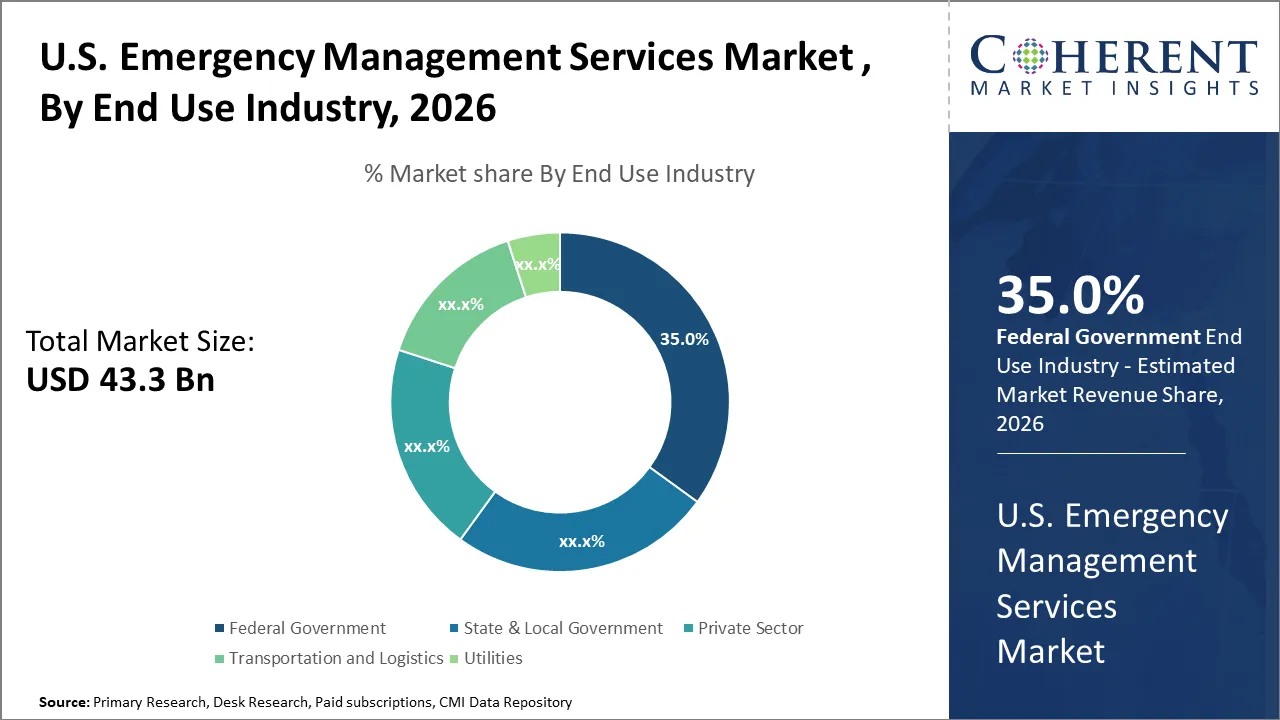
U.S. Emergency Management Service Market Insights, By End Use Industry - Federal Government segment Dominates the Market
The Federal Government has the largest share of the market, as they are predominant in national level of preparedness for, providing fund for, and coordinating with state and local governments who respond to disasters. As an example of the size and scope of federal agencies such as FEMA (Federal Emergency Management Agency), FEMA leads federally coordinated disaster operations and makes large investments in disaster management infrastructure to train and equip state and local governmental authorities for disaster response. For Example, FEMA deployed extensive emergency response teams and federal disaster relief funds during the 2023 Maui wildfires to support evacuation, recovery and rebuilding efforts.
Market Report Scope
U.S. Emergency Management Services Market Report Coverage
| Report Coverage | Details | ||
|---|---|---|---|
| Base Year: | 2025 | Market Size in 2026: | USD 43.3 Bn |
| Historical Data for: | 2020 To 2024 | Forecast Period: | 2026 To 2033 |
| Forecast Period 2026 to 2033 CAGR: | 5.6% | 2033 Value Projection: | USD 63.4 Bn |
| Geographies covered: |
| ||
| Segments covered: |
| ||
| Companies covered: | IBM Corporation, Motorola Solutions Inc., Honeywell International Inc., Lockheed Martin Corporation, Esri Inc., Hexagon AB, Everbridge Inc. | ||
| Growth Drivers: |
| ||
| Restraints & Challenges: |
| ||
Market Dynamics
U.S. Emergency Management Service Market Driver
Increasing Frequency of Natural Disasters and Climate-Related Emergencies
As the frequency of hurricanes, wildfires, flooding and extreme weather events increases throughout the United States, there is an uptick in the number of organizations developing systems for disaster preparedness and response. Government agencies and emergency response organizations continue to develop emergency management systems to minimize economic damage and protect the safety of the public. Consequently, there has been a significant increase in the number of investments made in advanced emergency management services.
Growing Government Investments in Disaster Preparedness and Public Safety Infrastructure
Federal and state government are investing more funds into disaster preparedness programs and the infrastructure used for emergency response and management. These funds are being used for developing communication systems for use in emergencies, training programs for responders and technology for managing disaster risk. As a result of these investments, the use of emergency management services continues to grow across municipalities, healthcare facilities and critical infrastructure industries.
U.S. Emergency Management Service Market Opportunity
Expansion of Smart Disaster Management Technologies
The increasing use of smart technology is creating a major opportunity within the U. S. Emergency Services Market, as new innovations like the internet of things (IoT) sensors, real-time monitoring systems, and AI analytics allow for improved disaster detection and response times by emergency management agencies.
Using smart infrastructure technology, emergency managers are able to monitor the environment and any potential hazards that may be present and send real-time notifications to emergency management organizations. This type of technology enhances situational awareness and allows for faster decision making in an emergency.
Analyst Opinion (Expert Opinion)
- Analysts from FEMA have indicated that the spending on federal disaster assistance as well as preparedness activities is expected to continue to rise due to the increased number of climate change-related disasters occurring throughout the country, as a result, the long-term market for advanced technology solutions for emergency management services and response infrastructure is anticipated to be strong.
- Experts from NOAA have stated that the continued rise in the number of billion-dollar weather disasters that occur throughout the United States is resulting in increased investments into early warning systems, analysis of risks, and coordinated planning for emergency responses between agencies.
Speak to the analyst
Want personalized insights?
Take the findings above to one of our principal consultants, or have the report rebuilt around the segments, geographies and competitors you actually track.
U.S. Emergency Management Service Market News
- In December 2025, the Federal Emergency Management Agency (FEMA) awarded USD 250 million in preparedness funding to states hosting the 2026 FIFA World Cup to strengthen emergency response and public safety infrastructure.
Market Segmentation
- By End User
- Federal Government
- State and Local Government
- Private Sector
- Transportation and Logistics
- Key Players
- IBM Corporation
- Motorola Solutions Inc.
- Honeywell International Inc.
- Lockheed Martin Corporation
- Esri Inc.
- Hexagon AB
- Everbridge Inc.
Sources
Primary Research Interviews
- Emergency management directors, disaster response coordinators, public safety officials, homeland security professionals, healthcare emergency preparedness officers, fire and rescue department officials, emergency communication specialists, municipal disaster planning authorities, and industry technology vendors.
Databases
- Federal Emergency Management Agency Disaster Declarations Database
- National Oceanic and Atmospheric Administration Disaster and Weather Events Database
- Centers for Disease Control and Prevention Emergency Preparedness and Response Data
- U.S. Department of Homeland Security Open Data Portal
- U.S. Bureau of Labor Statistics Employment and Occupational Data
- National Fire Incident Reporting System.
Magazines
- Emergency Management Magazine
- Homeland Security Today
- Firehouse Magazine
- Government Technology Magazine
Journals’
- International Journal of Disaster Risk Reduction
- Journal of Emergency Management
- Disaster Prevention and Management
- Journal of Homeland Security and Emergency Management.
Newspapers
- The New York Times
- The Washington Post
- USA Today
- The Wall Street Journal.
Associations
- International Association of Emergency Managers
- National Emergency Management Association
- National Fire Protection Association
- International Association of Fire Chiefs
- American Public Health Association
Public Domain Sources
- Federal Emergency Management Agency
- U.S. Department of Homeland Security
- Government Accountability Office reports
- Congressional Research Service publications
- National Institute of Standards and Technology
- Ready.gov resources.
Proprietary Elements
- CMI Data Analytics Tool
- Proprietary CMI Existing Repository of information for last 8 years
Get access to 250+ pages report
Every segment, forecast, competitor profile and data table behind the analysis above — available for instant download.
- ESOMAR Member
- ISO 9001:2015 Certified
- D-U-N-S Registered
- GDPR & CCPA Compliant
Missing comfort of reading report in your local language? Find your preferred language:
Transform your Strategy with Exclusive Trending Reports
Frequently Asked Questions
Emergency Management Services include disaster preparedness, response coordination, risk assessment, recovery planning and crisis communication solutions used to manage natural disasters, public health emergencies and infrastructure disruptions.
Key factors include increasing natural disasters, government investments in disaster preparedness, adoption of advanced emergency management technologies and growing demand for resilient infrastructure systems.
IBM Corporation, Motorola Solutions Inc., Honeywell International Inc., Lockheed Martin Corporation, Esri Inc., Hexagon AB, Everbridge Inc.
Major Companies include: IBM Corporation, Motorola Solutions Inc., Honeywell International Inc., Lockheed Martin Corporation, Esri Inc., Hexagon AB, Everbridge Inc.
High implementation costs, interoperability issues between agencies, limited funding for smaller jurisdictions, and workforce shortages are key factors hampering the growth of the U.S. Emergency Management Services market.