

Data Governance Market Size and Trends
The data governance market is estimated to be valued at USD 5.70 Bn in 2026 and is expected to reach USD 20.56 Bn by 2033, growing at a compound annual growth rate (CAGR) of 20.1% from 2026 to 2033.
Key Takeaways
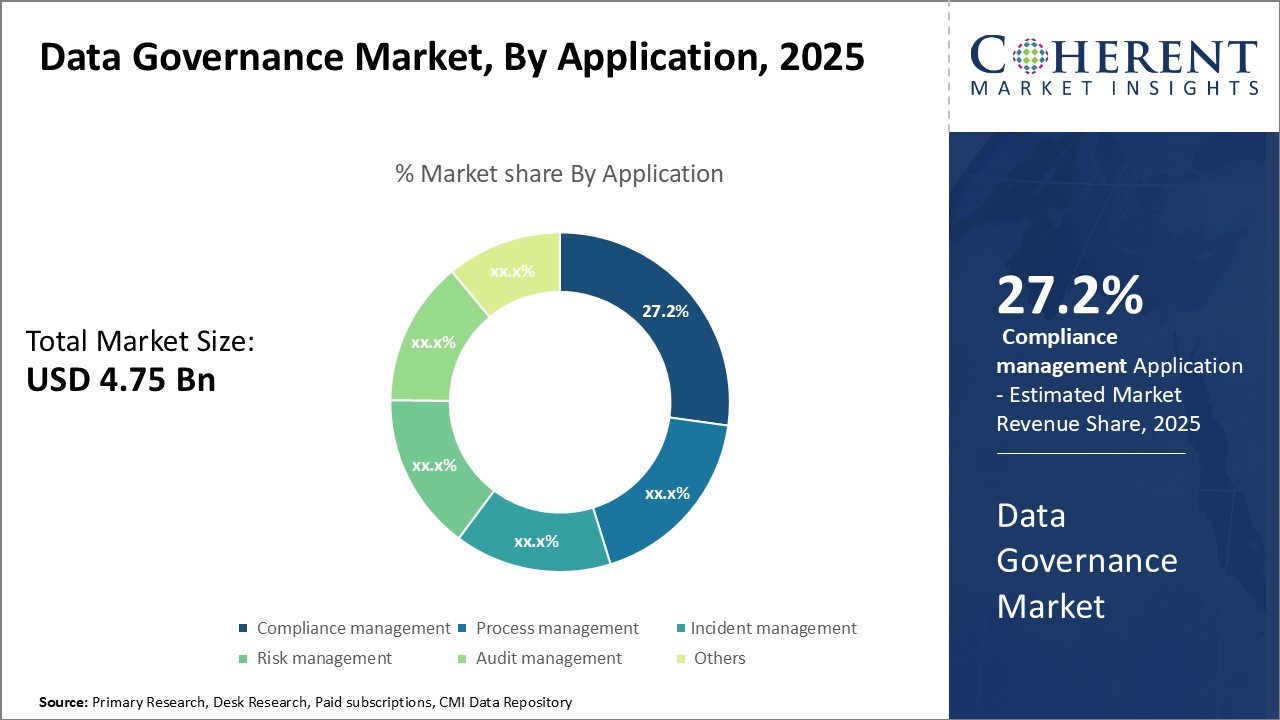
- Based on Application, the Compliance Management segment is accounted the leading position with the share of 28.2% in the market in 2026, driven by stringent data privacy and security regulations.
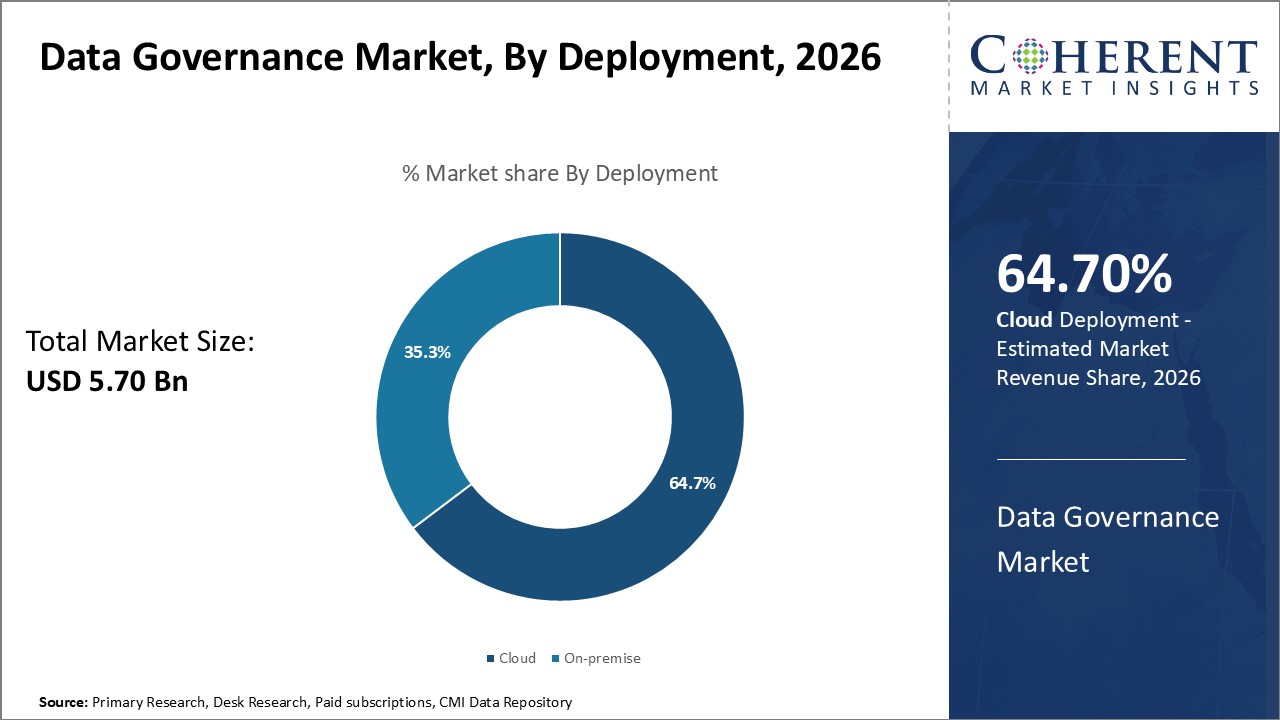
- Based on Deployment, the Cloud segment is expected to lead the global data governance market with a 64.7% share in 2026, reflecting its benefits around scalability, affordability and accessibility.
- Based on Organization Size, the Large-Scale business is projected to dominate the market with a 75.68% share in 2026, attributed to its complex data ecosystems.
- Based on Industry Vertical, the Banking, Financial Services, and Insurance (BFSI) segment is anticipated to hold the highest shares in the marker in 2026, owing to the highly regulated environment.
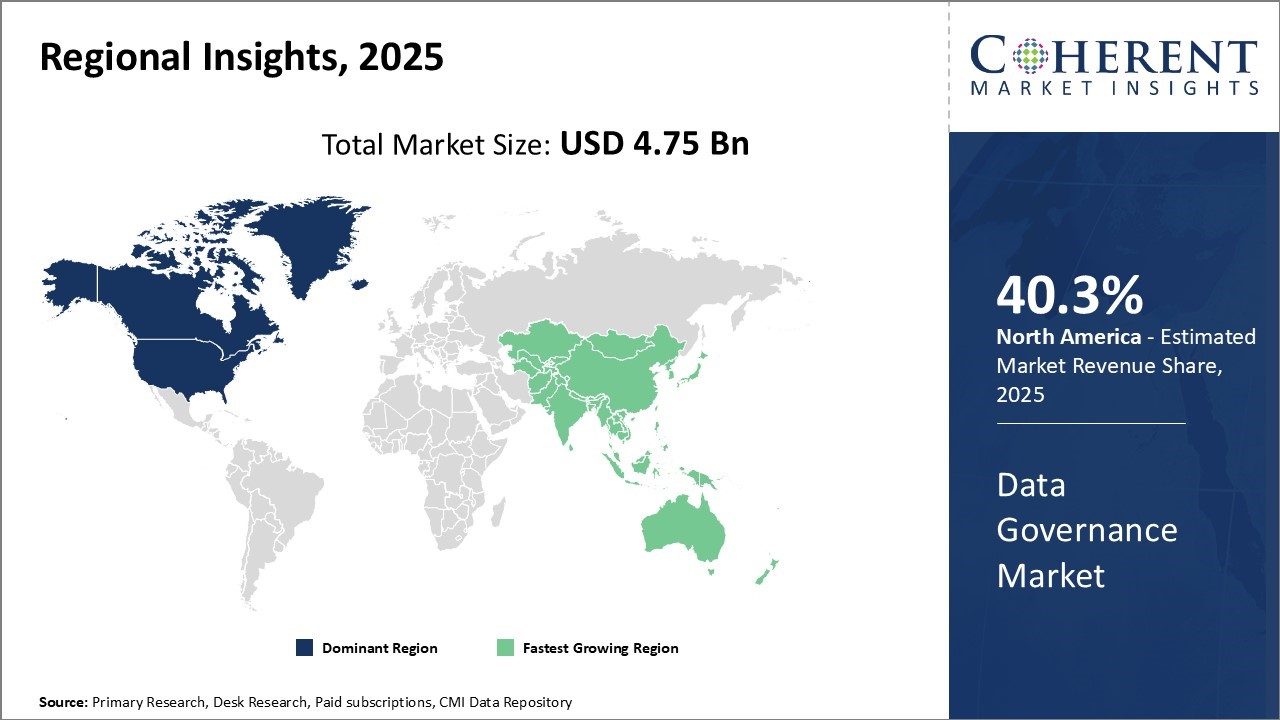
- Based on Region, North America is expected to lead the market, holding a share of 40. 3% in 2026, attributed to the presence of major technology companies. While, Asia Pacific is anticipated to be the fastest growing region with a market share of 24.28% in 2026, driven by rapid digitalization.
Market Overview
The global governance market demand is primarily driven by the organizations across industries, as they are recognizing the importance of data governance to derive meaningful insights from their growing volumes of data, while also ensuring regulatory compliance and strengthening customer trust.
With data becoming a crucial corporate asset and competitive differentiator, the need to institutionalize processes to manage and oversee data more effectively is driving increased investments in data governance solutions. Additionally, developments, such as cloud computing, big data analytics and rising consumer digitalization, are further propelling the data governance market growth. With many large enterprises still in the early stages of formalizing their data governance practices, the demand looks set to continue its upward trajectory over the coming years.
Current Events and their Impacts on Data Governance Market
Current Events | Description and its Impact |
Major Regulatory Expansions in Key Regions |
|
Cybersecurity Pressures Intensifying |
|
Role on Artificial intelligence (AI) in Data Governance Market
The integration of artificial intelligence into data governance is rapidly transforming the industry by providing innovative solutions and insights. It has enhanced the data quality, security and compliance though automation and real-time monitoring. The key impact that AI offers to data governance is leading to improved decision making, operational efficiency and competitive advantages.
In July 2025, Governata, Saudi Arabia's first enterprise data management platform, officially launched with an AI-driven solution aimed at helping local organizations meet the kingdom’s data compliance requirements while utilizing artificial intelligence to enhance decision-making.
- Current Industry Events of 2026
- Market Size Estimation
- Regional Breakdown
- Competitive Landscape
- Customer Intelligence
- Segmental Analysis
- Pricing Analysis
- Key Market Drivers, Challenges & Future Trends
- Customized Insights Section
Segmental Insights
Data Governance Market Insights, By Application: The regulatory compliance factor drives the demand for compliance management solutions
In terms of application, compliance management segment is expected to contribute the highest share of 28.2% in 2026, owing to stringent data privacy and security regulations. As data governance becomes increasingly important, organizations are under tremendous pressure to comply with regulations such as GDPR, CCPA, LGPD and HIPAA. Non-compliance can result in huge financial penalties. Compliance management solutions help organizations systematically address compliance requirements across various jurisdictions. They provide capabilities for policy management, data classification, access governance and auditing. This helps ensure sensitive data is handled according to compliance policies and legal statutes.
Compliance needs are becoming more complex as regulations evolve. For example, GDPR introduced additional requirements around data subject rights and breach notifications. LGPD expanded the scope of personal data. Compliance solutions allow organizations to future-proof their programs and centrally manage compliance obligations. The solutions also automate routine tasks like access reviews, reducing the manual effort needed. This drives cost efficiencies. Organizations leverage compliance management for governance initiatives as well. The solutions integrate governance capabilities for controls, policies and procedures. This promotes an integrated approach to data governance and compliance.
In April 2025, AuditBoard, the leading global platform for connected risk, transforming audit, risk, and compliance, launched RegComply, a powerful new solution for regulatory compliance management to health organizations stay on top of changing regulations and manage their compliance programs with integrated risk insights. The new solution includes new AI capabilities from AuditBoard and is powered by regulatory change and obligations data from CUBE RegPlatform™, a leading global regulatory intelligence solution provider.
Data Governance Market Insights, By Deployment: Deploying data governance in the cloud boosts scalability and affordability
In terms of deployment, cloud segment is expected to contribute the highest share of 64.7% in 2026, owing to benefits around scalability, affordability, and accessibility. Managing governance programs can impose heavy infrastructure demands. But cloud-based solutions provide elastic capacity and pay-as-you-go pricing models. This addresses the fluctuating resource needs of governance initiatives. It allows organizations to scale solutions up or down as requirements change. Cloud deployment removes the need for upfront capital expenditure on hardware and infrastructure. This lowers the costs for organizations, especially smaller firms with limited IT budgets.
In May 2025, Aderant, the leading global business management software provider for law firms introduced four new cloud-based technology solutions, Cloud Accounts Receivable (AR), Cloud General Ledger (GL), Stridyn Analytics, and askMADDI. These new AI powered application delivers a more unified, modern and personalized user experience, enabling firm accounting and finance teams to better coordinate, access real-time data, improve decision making and drive efficiency.
Data Governance Market Insights, By Organization Size: Streamlining governance for large enterprises with diversified data ecosystems
In terms of organization size, large-scale business is expected to contribute the highest share of 75.68% in 2026, owing to their complex data ecosystems. Large enterprises manage voluminous and diverse data across multiple business units, functions, and geographical locations. They face unique governance challenges around visibility, access controls and policy enforcement at scale. Traditional decentralized approaches are inefficient for enterprises with thousands of data sources. Centralized platforms provide the functionality needed to rationalize governance across the large enterprise.
In May 2025, SimpleMDG, the no-code master data governance solution built on SAP Business Technology Platform (BTP), collaborated with CBS (Corporate Business Solutions), a trusted SAP consultancy known for its deep expertise in enterprise data management and SAP transformation to empower SAP customers across APAC with AI-driven master data management that plans on launching. This partnership with address to market demands for rapid time-to-value, enabling GROW with SAP and RISE with SAP customers, from midsize organizations to large enterprises.
Regional Insights
North America Data Governance Market Analysis and Trends
North America has established itself as the dominant region in the global data governance market and is expected to hold the largest share of 40.3% in 2026. The presence of major technology companies and large corporations dealing with voluminous data sets has propelled investments in robust data governance practices. Strict privacy regulations such as GDPR and CCPA have further compelled organizations to formalize their database management processes and establish protocols for data access, usage and security.
In May 2026, the Standards Council of Canada (SCC) and Statistics Canada launched the AI and Data Governance (AIDG) Standardization Hub—an online platform providing centralized resources to support education and exploration in standardization, with a focus on improving data governance and promoting the safe, ethical, and effective use of AI. Such innovations are propelling the data governance market revenue.
Asia Pacific Data Governance Market Analysis and Trends
The Asia Pacific region is poised to be the fastest growing market for data governance and is expected to fastest growing region with CAGR of 24.28% in 2026. Rapid digitization of processes across industries coupled with rising internet and smartphone penetration has led to explosive data generation in the region. Countries like India, China, Japan, Australia, and South Korea present a huge market opportunity due to their sizable populations and growing focus on leveraging analytics for strategic business decisions. In addition, Asia Pacific sees large influx of data gathered from international trade and commerce. This has prompted regulatory authorities to implement governance frameworks for ensuring data security, privacy, and quality across borders. Leading consulting firms have established delivery centers in the region to provide customized data governance services and solutions catering to local business needs.
In May 2026, Privy by IDfy launched Privy Data Compass—a data governance module that helps enterprises identify, classify, and assess personal data across their systems in India. It enables better risk management, secure data disposal, and clear accountability throughout the data lifecycle.
Data Governance Market Outlook Country-wise
The United States Data Governance Market Trends
The U.S. market for data governance is characterized by increasing concerns towards data breaches, cyber threats and privacy issues, which contributing is increasing adoption of robust data governance solutions to safeguard sensitive information and protect customer privacy. In 2024, the United States experienced around 3,158 data breaches which impacted over 1.35 billion individuals. This is further adding to the data governance market share.
Canada Data Governance Market Trends
The Canada data governance market is expected to continue its growth trajectory, supported by increasing adoption of predictive and prescriptive analytics across various industries. Implementation of such analytics helps in enhancing decision-making process and operational efficiency. For instance, in December 2024, the government of Canada has embarked on USD 134 million CAD agreement with analytics and AI leaders SAS to modernize its data and artificial intelligence infrastructure across 26 federal departments and agencies. This will be performed under the Enterprise Licensing Agreement (ELA).
China Data Governance Market Trends
China continues to lead the Asia Pacific region in the data governance market, driven by the integration of advanced technology such as AI and machine learning. For instance, in 2023, China inaugurated the NDA (National Data Administration), a dedicated bureau focused on data-centric economic development and market regulation. It’s mainly focuses on unifying industry data standards, facilitating cross-industry data share, and streamlining data regulation. Later in 2024, China launched ‘Data Element X’, this promotes high-level data application, focusing on quality data supply, circulation analytics and security.
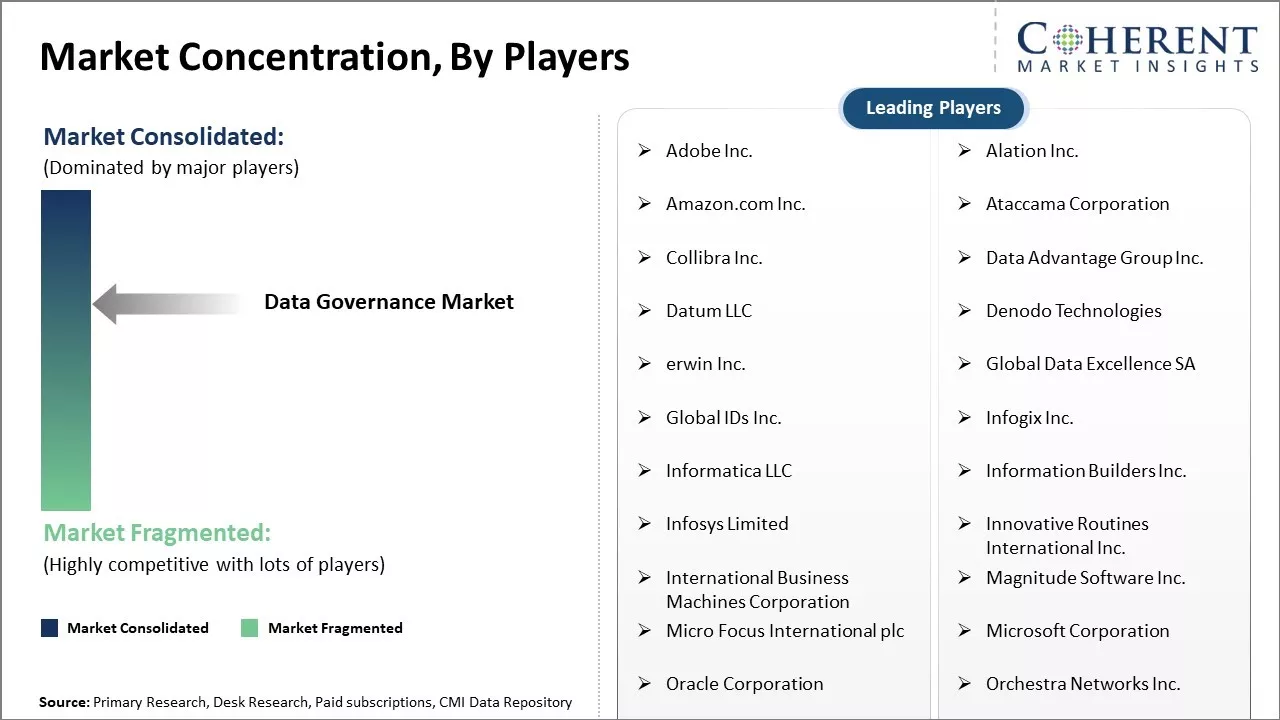
Market Concentration and Competitive Landscape
Key Developments
- In May 2025, First Rate, a leading provider of financial technology solutions, has launched a cutting-edge Alts Data management solution. This launched is designed to revolutionize how wealth management firms handle alternative investment data. This provides a fully operational platform that helps firms efficiently management, analyze, and gain insights from their alternative investment portfolios.
- In May 2025, Hitachi Vantara launched a Virtual Storage Platform 360, a unified management software solution designed to help customers simplify data infrastructure management operations, improve decision-making and delivery of data services. The VSP 350 address obstacle of managing sprawling data environment by integrating data management tools across enterprise storage to monitor key performance indicators.
- In May 2025, Informatica launched a groundbreaking suite of autonomous AI tool, which is designed to transform enterprise data management, Central of this launched is the CLAIRE® Agents and the AI Agent Engineering service, both integrated into Informatica's Intelligent Data Management Cloud (IDMC) platform.
- In January 2024, Databricks introduced Data Intelligence Platform for Communications, catering to network service providers and telecommunication carriers. This platform integrates data governance, data sharing, and data management with generative AI and Machine Learning (ML) tools.
Market Report Scope
Data Governance Market Report Coverage
| Report Coverage | Details | ||
|---|---|---|---|
| Base Year: | 2025 | Market Size in 2026: | USD 5.70 Bn |
| Historical Data for: | 2020 To 2024 | Forecast Period: | 2026 To 2033 |
| Forecast Period 2026 to 2033 CAGR: | 20.1% | 2033 Value Projection: | USD 20.56 Bn |
| Geographies covered: |
| ||
| Segments covered: |
| ||
| Companies covered: | Adobe Inc., Alation Inc., Amazon.com Inc., Ataccama Corporation, Collibra Inc., Data Advantage Group Inc., Datum LLC, Denodo Technologies, erwin Inc., Global Data Excellence SA, Global IDs Inc., Infogix Inc., Informatica LLC, Information Builders Inc., Infosys Limited, Innovative Routines International Inc., International Business Machines Corporation, Magnitude Software Inc., Micro Focus International plc, Microsoft Corporation, Oracle Corporation, Orchestra Networks Inc., Reltio Inc., SAP SE, SAS Institute Inc., Symantec Corporation, Syncsort Incorporated, Talend Inc., TIBCO Software Inc., TopQuadrant Inc., and Varonis Systems Inc. | ||
| Growth Drivers: |
| ||
| Restraints & Challenges: |
| ||
Data Governance Market Driver
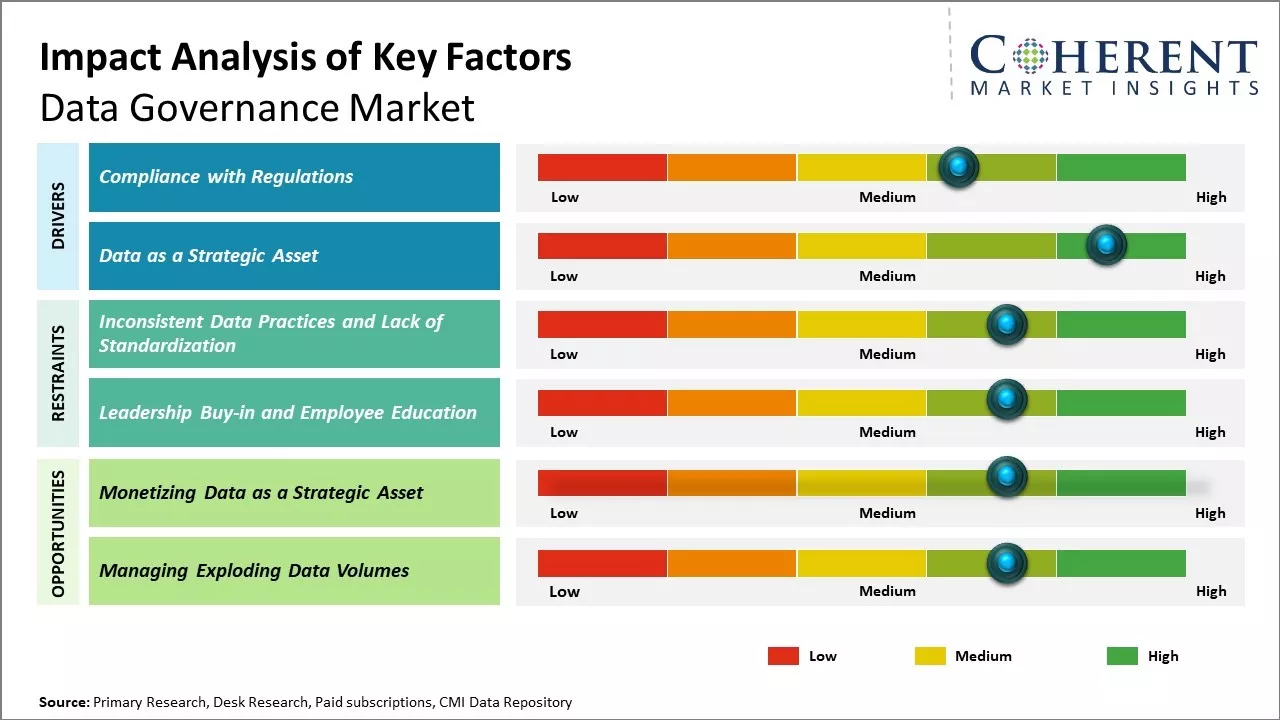
- Compliance with Regulations
With increasing data regulations, many organizations are now compelled to establish stronger data governance practices. Regulations such as General Data Protection Regulation in EU and Central Consumer Protection Authority in California have tightened the rules around how personal data of customers should be collected, used, and shared. Non-compliance to these regulations can attract hefty fines. For example, GDPR allows fines of up to US$ 22 million or 4% of the annual global turnover for breaching entities. Similarly, CCPA allows fines of up to US$ 7,500 for each violation.
As data privacy regulations around the world are getting severer, businesses need to ensure legitimate data processing activities and secure customer consent for appropriate data usage. This requires mapping all data flows, assessing data protection impact rigorously and appointing data protection officers. Organizations have to be transparent about personal data collection and usage. Manual processes are ineffective for these tasks and leave room for human errors. A strong data governance framework with the right tools is required to systematically manage the requirements of various regulations and avoid fines or breach of customer trust. Many firms are turning to data governance solutions to automate compliance-related workflows and audit trails for demonstrably lawful data processing activities. Vendors are also positioning their products as being designed specifically for supporting compliance needs of GDPR, CCPA, and other such regulations.
For instance, in January 2025, the Ministry of Electronics and Information Technology (MeitY) released the much-awaited draft of the Digital Personal Data Protection Rules, 2025 (Rules) for public consultation.
Data Governance Market Opportunities
- Monetizing Data as a Strategic Asset
The opportunities in the data governance market forecast lie in organizations recognizing data as a valuable institutional asset now. As data volumes grow exponentially, the need to institutionalize processes around data collection, storage, usage, and deletion will rise exponentially. This presents a massive opportunity for data governance solution and service providers to assist organizations across industries in the market.
In May 2025, Datavault Ai Inc. a leader in Ai-driven data valuation and monetization, has partnered with high-performance computing innovator Kova. Together they launched a secure, tokenized data vending solution at IBM Think 2025. This solution is designed to facilitate real-time, encrypted data transactions without moving raw data, thereby reducing cyber risks and ensuring compliance with strict data governance standards.
Analyst Opinion (Expert Opinion)
- In the current digital landscape, data governance has transitioned from a back-office compliance function to a front-line strategic enabler. As artificial intelligence (AI), advanced analytics, and regulatory complexity converge, data governance is no longer optional—it is foundational to any enterprise’s ability to innovate responsibly and operate competitively.
- The acceleration of AI adoption, particularly with the rise of foundation models and generative AI, has created unprecedented demand for high-quality, governed data. According to IDC, 73% of enterprises deploying AI in production cite data quality, lineage, and control as the primary barriers to scale. This signals a clear inflection point: AI maturity is directly correlated with governance maturity.
- Traditional governance frameworks—centered around static policies, manual audits, and post-hoc data cataloging—are proving insufficient. Organizations are now moving toward active data governance, which emphasizes dynamic policy enforcement, real-time lineage tracking, and contextual data access. Platforms like Collibra, Alation, and Informatica are rapidly evolving in this direction, embedding governance directly into data workflows and cloud-native environments.
- Data regulations have become increasingly stringent and extraterritorial. Rather than stifling innovation, however, regulatory frameworks are acting as catalysts for modernizing enterprise data strategies. The European Union’s GDPR, Saudi Arabia’s Personal Data Protection Law (PDPL), and India’s Digital Personal Data Protection Act (DPDP Act) are driving significant investment in governance infrastructure.
- A recent example is the July 2025 launch of Governata, Saudi Arabia’s first enterprise-grade data management platform, designed specifically to help local organizations comply with national data regulations while enabling AI adoption. This move reflects a broader regional trend: embedding regulatory compliance directly into technology platforms, rather than treating it as an external constraint.
- Governance is increasingly viewed as a means of achieving data sovereignty, particularly in jurisdictions focused on national AI strategies and digital autonomy. In this context, organizations with proactive governance capabilities are better positioned to operationalize compliance as a competitive differentiator.
- The governance model is shifting from reactive oversight—where tools audit past behavior—to proactive enablement, where governance policies are automatically enforced at the point of data consumption. Modern data governance demands automation, embedded controls, and interoperability with cloud data warehouses, data lakes, and AI platforms.
- For instance, Snowflake’s Unified Governance Layer and Databricks’ Unity Catalog reflect a clear industry move toward governance capabilities that are natively integrated into data platforms. These developments indicate that governance is becoming inseparable from core data infrastructure, not just an adjacent function.
Speak to the analyst
Want personalized insights?
Take the findings above to one of our principal consultants, or have the report rebuilt around the segments, geographies and competitors you actually track.
Market Segmentation
- Application Insights (Revenue, USD Bn, 2021 - 2033)
- Incident management
- Process management
- Compliance management
- Risk management
- Audit management
- Others
- Deployment Insights (Revenue, USD Bn, 2021 - 2033)
- Cloud
- On-premise
- Organization Size Insights (Revenue, USD Bn, 2021 - 2033)
- Large-scale Business
- Small- and Medium-scale Business
- Industry Vertical Insights
- Banking, Financial Services, and Insurance (BFSI)
- Government and defense
- Retail and consumer goods
- Telecommunications and IT
- Construction and engineering
- Others
- Regional Insights
- North America
- U.S.
- Canada
- Latin America
- Brazil
- Argentina
- Mexico
- Rest of Latin America
- Europe
- Germany
- U.K.
- Spain
- France
- Italy
- Russia
- Rest of Europe
- Asia Pacific
- China
- India
- Japan
- Australia
- South Korea
- ASEAN
- Rest of Asia Pacific
- Middle East & Africa
- GCC Countries
- South Africa
- Israel
- Rest of Middle East & Africa
- North America
- Key Players Insights
- Adobe Inc.
- Alation Inc.
- Amazon.com Inc.
- Ataccama Corporation
- Collibra Inc.
- Data Advantage Group Inc.
- Datum LLC
- Denodo Technologies
- erwin Inc.
- Global Data Excellence SA
- Global IDs Inc.
- Infogix Inc.
- Informatica LLC
- Information Builders Inc.
- Infosys Limited
- Innovative Routines International Inc.
- International Business Machines Corporation
- Magnitude Software Inc.
- Micro Focus International plc
- Microsoft Corporation
- Oracle Corporation
- Orchestra Networks Inc.
- Reltio Inc.
- SAP SE
- SAS Institute Inc.
- Symantec Corporation
- Syncsort Incorporated
- Talend Inc.
- TIBCO Software Inc.
- TopQuadrant Inc.
- Varonis Systems Inc.
Sources
Primary Research Interviews from the following stakeholders
Stakeholders
- Interviews with CIOs, data stewards, compliance officers, IT security managers, enterprise architects, and digital transformation leads across major industry verticals and global regions.
Specific Stakeholders
- Chief Data Officers at financial institutions
- Data governance leads at healthcare providers and networks
- IT governance managers at government agencies and public sector enterprises
- Information security heads at telecom and cloud service providers
- Data architects and compliance managers in pharma and life sciences firms
- Enterprise data analysts and system integrators working with ERP and MDM systems
- Cloud platform strategists and storage solution leads at large tech infrastructure providers
Databases
- OECD Data Governance Indicators
- United Nations E-Government Development Database
- World Bank Open Data Portal – Digital Governance & Infrastructure
- Eurostat – ICT Usage and e-Government Statistics
- Reserve Bank of India (RBI) – IT Governance Reports
- U.S. National Center for Science and Engineering Statistics (NCSES)
- Statistics Canada – Digital Technology and Use Surveys
- Ministry of Electronics and IT (MeitY), India – Data Protection and Governance Reports
Magazines
- CIO Magazine
- Data Management Insight
- InformationWeek
- Data Governance Insider
- TechTarget – Data Management Section
- Data Centre Review
- Government Technology Magazine
- IT Pro – Data & Analytics Section
Journals
- Journal of Data and Information Quality (ACM)
- Government Information Quarterly (Elsevier)
- Journal of Information Privacy and Security
- Journal of Information Systems (American Accounting Association)
- Data & Knowledge Engineering
- Journal of Enterprise Information Management
Newspapers
- The Wall Street Journal – Cybersecurity & Data Section
- Financial Times – Tech & Compliance Features
- The Hindu Business Line – Data and Privacy Reports
- The Economic Times – Digital Transformation & Governance Coverage
- South China Morning Post – Tech & Governance Policy Updates
- Nikkei Asia – Data Economy and Regulation Updates
Associations
- Data Management Association (DAMA International)
- International Association of Privacy Professionals (IAPP)
- Open Data Institute (ODI)
- IEEE Standards Association – Data Governance Working Groups
- ISACA – Data Governance and IT Audit Chapters
- Centre for Data Ethics and Innovation (UK)
- Cloud Security Alliance (CSA)
Public Domain Sources
- Ministry of Electronics and IT (MeitY), India – Data Governance Framework
- European Data Protection Supervisor (EDPS)
- National Institute of Standards and Technology (NIST), U.S. – Data Governance Frameworks
- U.S. Federal CIO Council – Data Strategy Reports
- EU Digital Single Market Reports – Data Governance Initiatives
- Office of the Australian Information Commissioner (OAIC) – Data Regulation Guidelines
- Digital India Programme – Data Empowerment and Protection Architecture (DEPA)
Proprietary Elements
- CMI Data Analytics Tool, and Proprietary CMI Existing Repository of information for last 8 years
*Definition: The data governance market involves solutions that help organizations establish effective data governance programs to manage their data as a valuable asset. This ensures data quality, usability, security, and privacy across various functions and systems. Products in this market provide tools for data classification, cataloguing, policy management, data lineage visualization, reporting, and analytics to help organizations derive more value from their data while adhering to compliance requirements.
Get access to 250+ pages report
Every segment, forecast, competitor profile and data table behind the analysis above — available for instant download.
- ESOMAR Member
- ISO 9001:2015 Certified
- D-U-N-S Registered
- GDPR & CCPA Compliant
Missing comfort of reading report in your local language? Find your preferred language:
Transform your Strategy with Exclusive Trending Reports
Frequently Asked Questions
The Data Governance Market is estimated to be valued at USD 5.70 Bn in 2026, and is expected to reach USD 20.56 Bn by 2033.
The CAGR of the Data Governance Market is projected to be 20.1% from 2026 to 2033.
Compliance with regulations and data as a strategic asset are the major factors driving the growth of the data governance market.
Inconsistent data practices and lack of standardization and leadership buy-in and employee education are the major factors hampering the growth of the data governance market.
In terms of application, compliance management is estimated to dominate the market revenue share in 2026.
Adobe Inc., Alation Inc., Amazon.com Inc., Ataccama Corporation, Collibra Inc., Data Advantage Group Inc., Datum LLC, Denodo Technologies, erwin Inc., Global Data Excellence SA, Global IDs Inc., Infogix Inc., Informatica LLC, Information Builders Inc., Infosys Limited, Innovative Routines International Inc., International Business Machines Corporation, Magnitude Software Inc., Micro Focus International plc, Microsoft Corporation, Oracle Corporation, Orchestra Networks Inc., Reltio Inc., SAP SE, SAS Institute Inc., Symantec Corporation, Syncsort Incorporated, Talend Inc., TIBCO Software Inc., TopQuadrant Inc., and Varonis Systems Inc. are the major players.
North America is expected to lead the data governance market in 2026.