

Data Catalog Market Size and Forecast – 2026 to 2033
The Global Data Catalog Market is estimated to be valued at USD 3.01 Bn in 2026 and is expected to reach USD 12.04 Bn by 2033, exhibiting a compound annual growth rate (CAGR) of 21.9% from 2026 to 2033.
Key Takeaways
- By Component, Solution holds the largest market share of 61.1% in 2026 owing to its regulatory compliance and data governance.
- By Deployment, Cloud-based expected to hold largest market share of 58.7% in 2026 owing to the scalability and flexibility.
- By End User, Retail and E-commerce acquired the prominent market share of 45.6% in 2026 owing to the data-driven personalization and customer experience.
- By Region, North America dominates the overall market with an estimated share of 35.8% in 2026 owing to the advanced IT infrastructure and cloud adoption.
Market Overview
Organizations are rapidly expanding the Data Catalog Market as they prioritize efficient data management and governance. The need for better data discovery, regulatory compliance, and enhanced analytics drives them to use data catalogs to centralize metadata, improve data accessibility, and ensure data quality. By integrating AI and cloud technologies, industries such as healthcare, finance, retail, and manufacturing increasingly adopt these solutions. This growth highlights how businesses worldwide embrace data-driven decision-making in their digital transformation efforts.
Current Events and their Impact on the Data Catalog Market
Current Events | Description and its impact |
Geopolitical and Regulatory Developments |
|
Technological Advancements and Innovation |
|
Economic and Industry Dynamics |
|
Role of AI (Artificial Intelligence) in Data Catalog Market
AI is transforming the data catalog industry by enhancing data discovery, governance, and user engagement. It enables intelligent search, automated metadata tagging, and natural language interaction, making it easier for users to find and understand data. AI-powered tools can identify data relationships, suggest relevant datasets, and ensure data quality through anomaly detection. By streamlining catalog maintenance and surfacing insights proactively, AI reduces manual effort and increases the catalog’s value across the organization.
In March 2025, data.world launched the public beta of Archie Chat, an AI-powered assistant that simplifies how users interact with their enterprise data catalog. By enabling natural language conversations, Archie Chat accelerates data discovery, improves catalog adoption, and helps users quickly find the answers they need.
- Current Industry Events of 2026
- Market Size Estimation
- Regional Breakdown
- Competitive Landscape
- Customer Intelligence
- Segmental Analysis
- Pricing Analysis
- Key Market Drivers, Challenges & Future Trends
- Customized Insights Section
Segmental Insights
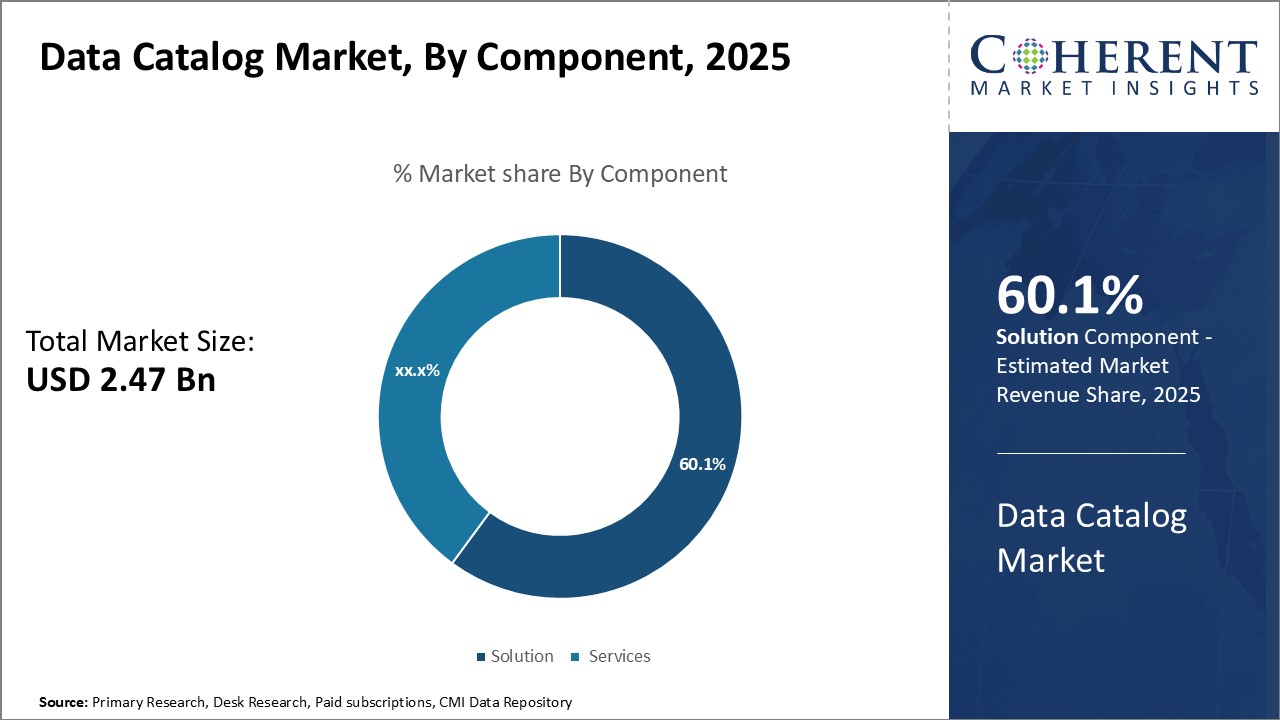
Data Catalog Market Insights, by Component: Solution contributes the highest share of the market owing to its adoption of cloud services and self-service analytics.
Solution holds the largest data catalog market share of 61.1% in 2026. Solution providers are building advanced solutions that use AI, machine learning, and natural language processing to make it easier for both internal teams and external partners to search, access, and analyze massive data sets. The ability to use AI and ML for enhanced data profiling and governance is making data catalog solutions much more popular. These solutions also have important features like security and access controls, metadata management, and self-service capability that make data assets easier to find and use. This feature is especially important in regulated fields that deal with private customer data, which speeds up the adoption of these solutions.
For instance, in October 2025, Commvault introduced Clumio for Apache Iceberg on AWS, a solution that strengthens the cyber resilience of AI and analytics data lakehouses by providing Iceberg-aware, air-gapped backup capabilities.
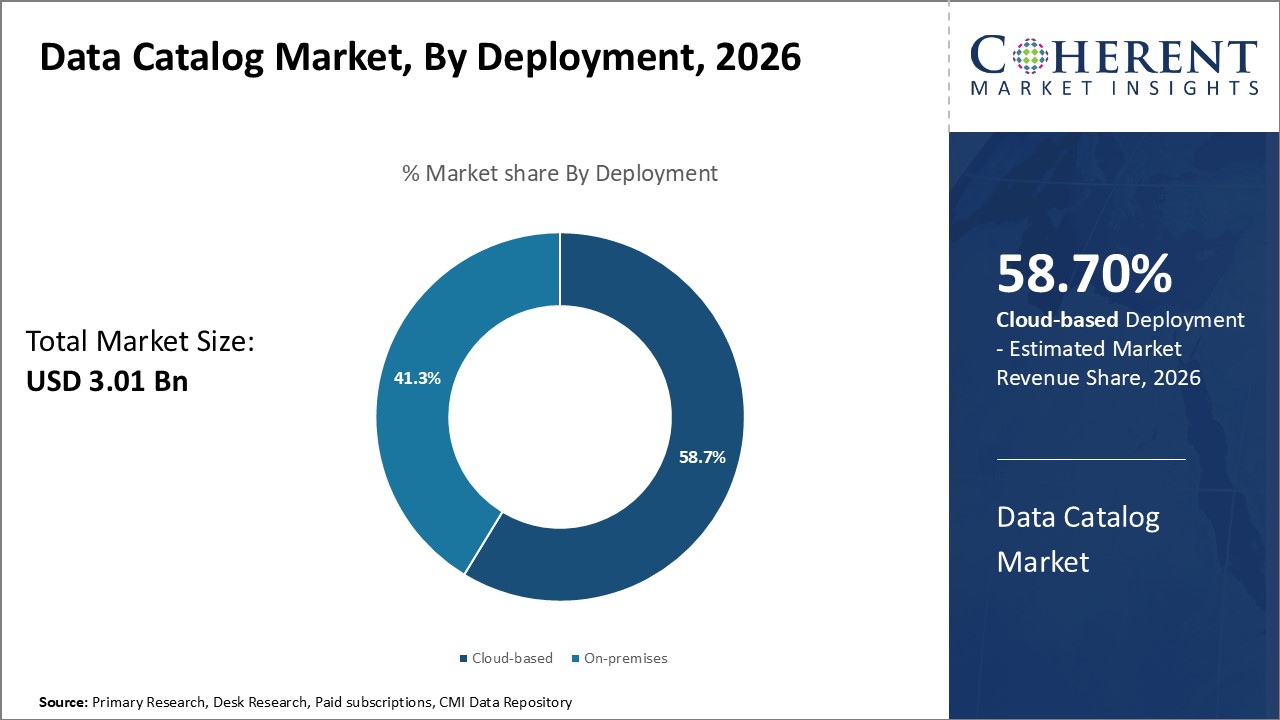
Data Catalog Market Insights, by Deployment: Cloud-based contribute the highest share of the market owing to its enhanced collaboration and accessibility.
Cloud-based expected to hold largest market share of 58.7% in 2026. You may quickly change the size of cloud data catalog services to meet changing business needs without having to modify your actual IT infrastructure. Also, giving employees access to cloud platforms from anywhere and at any time makes them more productive and able to work together. Vendors may take care of security, maintenance, and regular upgrades in the cloud, which makes it easier for users to manage their systems. Because of these features, more people favor cloud-based data catalog tools over on-premises ones. This is because businesses want solutions that are cost-effective, scalable, and easy to maintain to keep up with their changing data management needs.
For instance, in May 2025, Informatica introduced Agentic AI, expanding its AI-powered cloud data management platform with CLAIRE Agents and AI Agent Engineering to connect, govern, and manage AI agents at scale while enabling enterprise-wide access to trusted data.
Data Catalog Market Insights, by End User: Retail and E-commerce contribute the highest share of the market owing to its omnichannel retailing and data consistency.
Retail and E-commerce acquired the prominent market share of 45.6% in 2026. Through digital transactions, social media interactions, and IoT-enabled devices, retail verticals collect a lot of customer data. At the same time, BFSI has to follow tight rules when it comes to handling very private financial details. It's hard for traditional databases and data warehouses to keep up with such rapid expansion of data. These fields need a way to organize and manage chaotic, unstructured data pools by classifying, tagging, and managing data assets. This makes it easier to search for, find, and use analytics to make personalized suggestions, find fraud, reduce churn, and reach many other business goals.
For instance, in September 2025, Informatica has introduced Agentic AI, expanding its AI-powered cloud data management platform with CLAIRE Agents and AI Agent Engineering to connect, govern, and manage AI agents at scale while enabling enterprise-wide access to trusted data.
Regional Insights
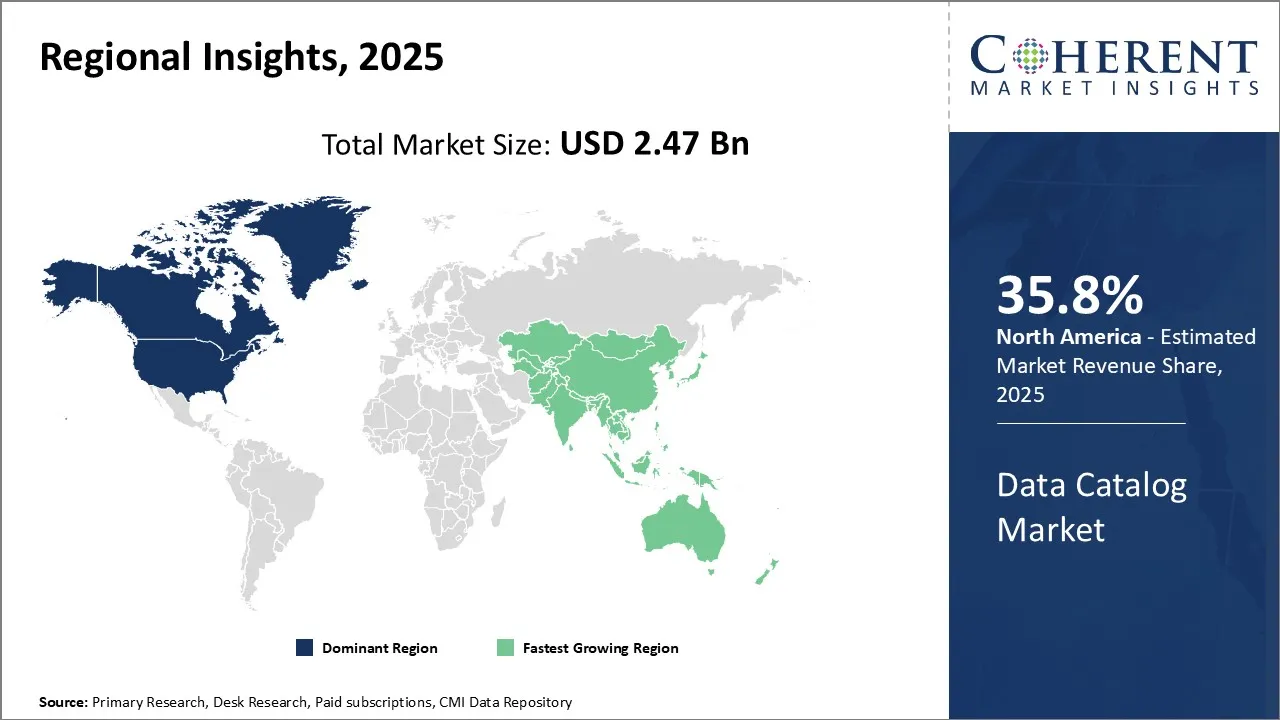
North America Data Catalog Market Trends
North America dominates the overall market with an estimated share of 35.8% in 2026. The Data Catalog Market in North America is being shaped by big expenditures in modern IT infrastructure and the rising use of cloud computing. As privacy laws change, businesses pay more attention to following the rules and managing their data. By adding AI and machine learning, they improve the features of data catalogs, making it easier to maintain metadata and access data. Digital transformation projects are driving demand in many areas, such as healthcare, banking, and retail. As more applications that use a lot of data emerge, the requirement for better data structure and governance grows as well. This makes North America the market leader.
For instance, Sangsin Brake America launched a new North American online catalog to help customers easily search and identify its brake product offerings for light, heavy-duty, and commercial vehicles.
Asia Pacific Data Catalog Market Trends
The Asia Pacific Data Catalog Market is changing quickly because more people are using digital technology and more cloud infrastructure is being built. To meet the growing demands of regulators, businesses in China, India, and Japan put data governance and compliance at the top of their lists. More money is going into AI and machine learning, which makes data catalogs work better. For example, they can now automatically tag metadata and maintain data quality. The rise in the e-commerce and manufacturing industries also increases the need for good data management, which makes Asia Pacific a fast-growing and dynamic market.
United States Data Catalog Market Trends
Businesses in the United States are the main drivers of the Data Catalog Market because they focus on innovation and using new technology. To meet strict privacy rules, they put a lot of effort into making data more open and well-managed. Companies improve metadata management by using AI-powered solutions, which makes it easier to find and use data. Fast cloud migration makes it possible to have data catalog solutions that can grow and change with your needs. Also, industries like healthcare, banking, and retail are driving market growth by becoming more reliant on data-driven tactics, making the U.S. a leader in the industry.
For instance, Informatica has integrated Axon Data Governance with its Data Quality, Enterprise Data Catalog, and Secure@Source solutions to help business and IT teams collaborate and implement AI-powered, trusted data governance.
Canada Data Catalog Market Trends
Organizations in Canada are slowly moving the Data Catalog Market forward by putting more attention on data protection and following the rules. They use data catalog solutions to make data easier to see and manage, especially in industries that are heavily regulated, including finance and healthcare. More firms are using cloud technologies, which makes it easier for them to share and access data. Companies also put money into AI and automation to make metadata maintenance easier and keep data quality high. These things work together to make Canada a developing market for data management solutions that are safe and work well.
For instance, in March 2026, CARFAX Canada has launched its new Service Suite, an all-in-one customer engagement solution designed to help Canadian dealerships and service shops boost service revenue and build long-term customer loyalty.
End-user Feedback and Unmet Needs in the Data Catalog Market
- Complexity in Usability: Users often find data catalog interfaces unintuitive, requiring extensive training. Simplified navigation and enhanced user experience are in high demand, allowing business users and data scientists to locate, understand, and trust data quickly without technical barriers.
- Inadequate Metadata Quality: End-users frequently report inconsistent or outdated metadata, which undermines data trustworthiness. There is a need for automated, continuous metadata enrichment and validation to maintain data relevance and accuracy across diverse, evolving datasets.
- Limited Collaboration Features: Collaboration among data teams is hindered by the lack of integrated communication and annotation tools. Users seek platforms that enable seamless sharing of insights, feedback, and data lineage discussions within the catalog environment to improve collective data governance.
Data Catalog Market Trend
Data Governance Embedded Within Catalogs
Modern data catalogs are integrating governance frameworks directly into their workflows. This trend focuses on embedding compliance controls, data privacy rules, and audit trails within the catalog, enabling organizations to maintain regulatory adherence effortlessly. By aligning governance with discovery, companies ensure data quality and security without sacrificing accessibility, making governance a seamless, real-time process rather than a separate, burdensome task.
Data Catalog Market Opportunity
Addressing Data Compliance Complexity
With increasing data regulations worldwide, companies seek tools that simplify compliance management. Data catalogs can seize the opportunity to offer integrated regulatory tracking, automated policy enforcement, and audit-ready reporting features. By embedding compliance within the catalog’s core, businesses can proactively manage data privacy and governance challenges, reduce risk and operational overhead while maintain seamless data accessibility.
Market Report Scope
Data Catalog Market Report Coverage
| Report Coverage | Details | ||
|---|---|---|---|
| Base Year: | 2025 | Market Size in 2026: | USD 3.01 Bn |
| Historical Data for: | 2020 To 2024 | Forecast Period: | 2026 To 2033 |
| Forecast Period 2026 to 2033 CAGR: | 21.9% | 2033 Value Projection: | USD 12.04 Bn |
| Geographies covered: |
| ||
| Segments covered: |
| ||
| Companies covered: | Alation, Alteryx, Amazon Web Services (AWS), Collibra, Cloudera, Datawatch Corporation, Google LLC, IBM Corporation, Informatica, Microsoft Corporation, Oracle Corporation, TIBCO Software, Waterline Data, Zaloni, and Exasol | ||
| Growth Drivers: |
| ||
| Restraints & Challenges: |
| ||
Data Catalog Market News
- In March 2025, Matia, the unified DataOps platform, announced the general availability of its enhanced Data Catalog at Snowflake Summit 2025. This launch marks a key milestone in the platform’s evolution, allowing teams to manage metadata, track lineage, and govern data through a single interface.
- In March 2025, world has launched the public beta of Archie Chat, its AI-powered catalog assistant designed to transform how users interact with their enterprise data catalog.
- In March 2025, Alation Inc., the data intelligence company, has launched its Agentic Platform, reinventing the data catalog for the AI era by using agents to automate and streamline data discovery, governance, and compliance management.
- In September 2025, Rivvit has released its data catalog module, offering financial and investment firms clear data lineage documentation and visibility into enterprise data flows.
Analyst Opinion (Expert Opinion)
- The data catalog market is at a pivotal inflection point, transitioning from a niche tool primarily used by data engineers to a strategic enabler of enterprise-wide data democratization. However, many vendors still fall short in delivering genuinely intuitive user experiences. According to recent Gartner surveys, over 60% of organizations cite poor usability as a key barrier to broader catalog adoption, underscoring the urgent need for catalogs that serve business users, not just technical teams.
- Moreover, the explosion of hybrid and multi-cloud environments complicates metadata synchronization. Providers lagging behind in supporting diverse data ecosystems risk becoming obsolete. Snowflake’s recent investment in its native data marketplace and cataloging capabilities is a testament to the market’s recognition that unified visibility across cloud silos is paramount for efficient governance and analytics.
- From a governance perspective, regulatory pressures around data privacy (GDPR, CCPA) demand catalogs embed compliance features, but many solutions still treat governance as an afterthought rather than a built-in capability. Forward-thinking vendors are integrating audit trails and automated policy enforcement directly into their catalogs, enabling organizations to shift from reactive compliance to proactive data stewardship.
- Apart from this, the integration of data catalogs into the broader DataOps ecosystem remains nascent but is poised to become a competitive differentiator. Vendors that enable real-time lineage tracking, pipeline monitoring, and seamless connectivity with orchestration tools will empower enterprises to move beyond data discovery toward continuous data quality assurance—critical for scaling AI/ML initiatives.
Speak to the analyst
Want personalized insights?
Take the findings above to one of our principal consultants, or have the report rebuilt around the segments, geographies and competitors you actually track.
Market Segmentation
- Component Insights (Revenue, US$ Bn, 2021 - 2033)
- Solution
- Services
- Deployment Insights (Revenue, US$ Bn, 2021 - 2033)
- Cloud-based
- On-premises
- End User Industry Insights (Revenue, US$ Bn, 2021 - 2033)
- BFSI
- Retail and E-commerce
- Healthcare
- Manufacturing
- Others
- Regional Insights (Revenue, US$ Bn, 2021 - 2033)
- North America
- U.S.
- Canada
- Latin America
- Brazil
- Argentina
- Mexico
- Rest of Latin America
- Europe
- Germany
- U.K.
- Spain
- France
- Italy
- Russia
- Rest of Europe
- Asia Pacific
- China
- India
- Japan
- Australia
- South Korea
- ASEAN
- Rest of Asia Pacific
- Middle East & Africa
- GCC Countries
- Israel
- South Africa
- Rest of Middle East & Africa
- Key Players Insights
- Alation
- Alteryx
- Amazon Web Services (AWS)
- Collibra
- Cloudera
- Datawatch Corporation
- Google LLC
- IBM Corporation
- Informatica
- Microsoft Corporation
- Oracle Corporation
- TIBCO Software
- Waterline Data
- Zaloni
- Exasol
Sources
Primary Research interviews
- Data engineers and architects from leading enterprises
- Chief Data Officers (CDOs) across various industries
- Product managers of data catalog solutions
- Data governance and compliance officers
Databases
- IEEE Xplore Digital Library
- PubMed Central (for data management-related studies)
- ArXiv (for AI and metadata automation research)
- Open Data repositories from cloud providers (AWS, Azure, Google Cloud)
Magazines
- Data Management Review
- InformationWeek
- TechTarget’s Search Data Management
- Data Economy
Journals
- Journal of Data and Information Quality (JDIQ)
- ACM Transactions on Database Systems
- International Journal of Information Management
- Data & Knowledge Engineering
Newspapers
- The Wall Street Journal (Technology section)
- Financial Times (Technology & Innovation section)
- The New York Times (Technology section)
- The Guardian (Technology)
Associations
- Data Management Association (DAMA) International
- The Open Group (Data Management and Analytics Forum)
- Association for Computing Machinery (ACM)
- International Data Management Association
Public Domain sources
- U.S. Government open data portals
- Industry whitepapers from cloud platforms (e.g., Google Cloud’s whitepapers)
- Regulatory publications from GDPR and CCPA official websites
- Technical blogs and case studies from open-source data catalog projects
Proprietary Elements
- CMI Data Analytics Tool, and Proprietary CMI Existing Repository of information for last 8 years
Get access to 250+ pages report
Every segment, forecast, competitor profile and data table behind the analysis above — available for instant download.
- ESOMAR Member
- ISO 9001:2015 Certified
- D-U-N-S Registered
- GDPR & CCPA Compliant
Missing comfort of reading report in your local language? Find your preferred language:
Transform your Strategy with Exclusive Trending Reports
Frequently Asked Questions
The Data Catalog Market is estimated to be valued at USD 3.01 Bn in 2026, and is expected to reach USD 12.04 Bn by 2033.
The CAGR of the Data Catalog Market is projected to be 21.9% from 2026 to 2033.
Rising demand for data discovery and governance and rise of self-service analytics are the major factors driving the growth of the global data catalog market.
Complex implementation and data privacy and security concerns are the major factors hampering the growth of the global data catalog market.
In terms of Component, the Solution segment is estimated to dominate the market in 2026.
Alation, Alteryx, Amazon Web Services (AWS), Collibra, Cloudera, Datawatch Corporation, Google LLC, IBM Corporation, Informatica, Microsoft Corporation, Oracle Corporation, TIBCO Software, Waterline Data, Zaloni, and Exasol are the major players.
North America is expected to lead the global data catalog market.