

Artificial Intelligence-Based Security Market Size and Share Analysis- Growth Trends and Forecasts (2026-2033)
The Artificial Intelligence-Based Security Market size is anticipated to grow at a CAGR of 17% with USD 36.2 Bn in 2026 and is expected to reach USD 93.4 Bn in 2033. The primary drivers are largely defined by the rising burden of cyberattacks, data breaches, phishing threats, and ransomware incidents. Some of the other factors are increasing cloud adoption, growing use of connected devices, higher deployment of AI-based threat detection tools, and greater need for real-time security monitoring. The FBI reported 859,532 internet crime complaints and losses exceeding USD 16 billion in 2024, thereby supporting the demand for artificial intelligence-based security solutions.
Key Takeaways
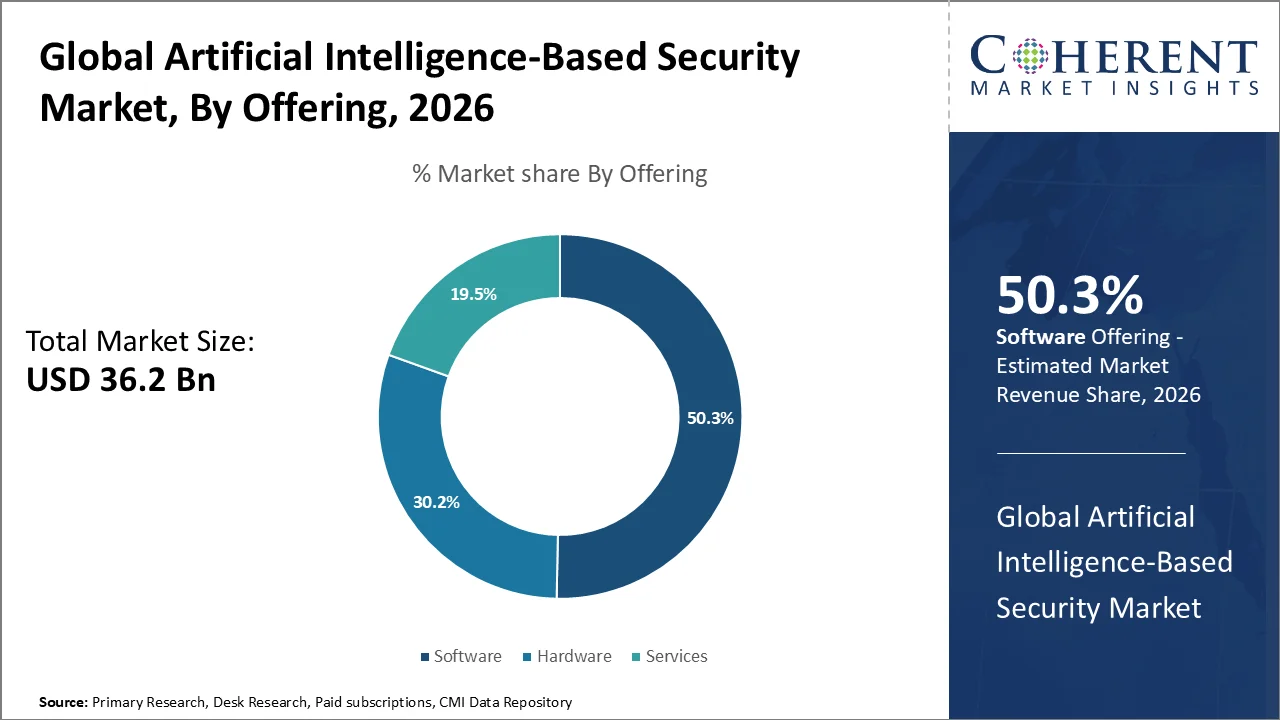
- The software segment is likely to dominate the market with 50.3% in 2026. The segment’s growth is owing to the expanding federal use of AI and automated software capabilities for cybersecurity analytics and threat identification. The number of documented AI use cases in federal agencies nearly doubled from 571 in 2023 to 1,110 in 2024, thereby reflecting broader AI software deployment in government cybersecurity systems.
- The cloud segment is set to lead with 60.5% in 2026. The segment’s growth is owing to the increasing federal reliance on authorized cloud services and strengthened programs like FedRAMP. Cloud authorization usage grew by 60% across agencies in recent years, thereby supporting the secure cloud deployments which integrate AI‑enhanced defenses.
- The network security segment is set to lead with 36.8% in 2026. The segment’s growth is owing to the rising cybersecurity incidents targeting networks. The federal agencies reported over 32,000 information security incidents in FY 2023, thereby underscoring the need for AI‑driven network protection as well as real‑time monitoring.
- On the basis of security solutions, the Identity & Access Management (IAM) segment is set to lead with 25% in 2026. The segment’s growth is owing to the renewed national focus on robust identity controls along with risk management.
- The machine learning segment is set to lead with 45.2% in 2026. The segment’s growth is owing to the increasing adoption of AI technologies across federal agencies.
- The BFSI segment is set to lead with 26.5% in 2026. The segment’s growth is owing to its critical role in national infrastructure resilience strategies. U.S. federal cybersecurity assessments designate financial systems as priority sectors for strengthening defenses against evolving digital threats.
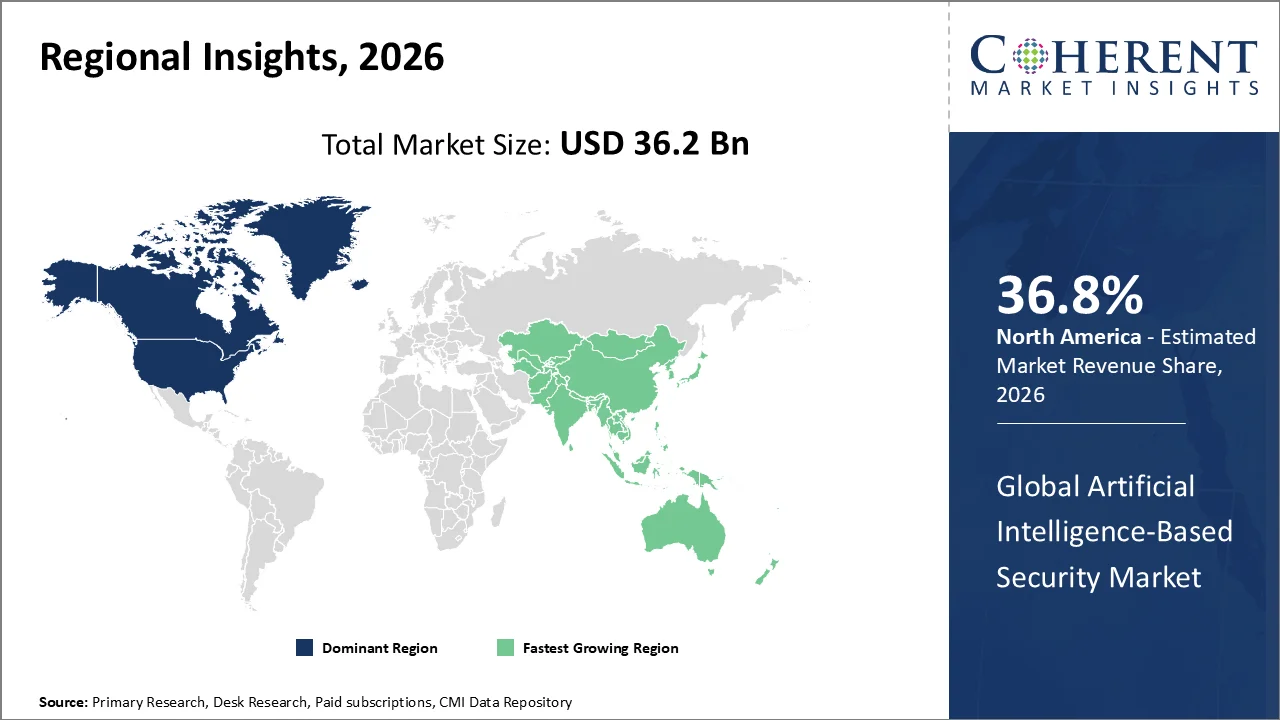
- North America is expected to acquire the prominent share of 36.8% in 2026. The region’s growth is owing to the comprehensive national cybersecurity strategy frameworks and U.S. federal initiatives to mitigate rising cyber risks. These efforts focus on AI and new technologies in high-risk areas, which experienced more than 30,000 IT security incidents in FY 2022.
Segmental Insights
Why is Software Acquiring the Largest Share?
On the basis of offering, the software segment is projected to account for the largest Artificial Intelligence-Based Security Market share of 50.3% in 2026. The segment’s growth is owing to its central role in automating threat detection, anomaly monitoring, vulnerability prioritization, identity analytics, and incident response across cloud, endpoint, and network environments.
Only 24% of organizations have fully integrated AI into cybersecurity, even as AI-powered attacks are expected to become a leading threat, highlighting a strong growth opportunity for advanced AI-based security software. Stanford University also notes that the U.S. AI security and private investment reached around USD 285.9 billion globally.
In May 2026, IBM expanded its AI-powered security portfolio, teaming up with Anthropic through Project Glasswing to protect critical software infrastructure and remediate vulnerabilities in open-source as well as enterprise systems. The initiative combines AI-driven threat detection, exposure assessment, and proactive software hardening to defend clients against advanced AI-enabled attacks.
- Current Industry Events of 2026
- Market Size Estimation
- Regional Breakdown
- Competitive Landscape
- Customer Intelligence
- Segmental Analysis
- Pricing Analysis
- Key Market Drivers, Challenges & Future Trends
- Customized Insights Section
Network Security hold the Largest Market Share
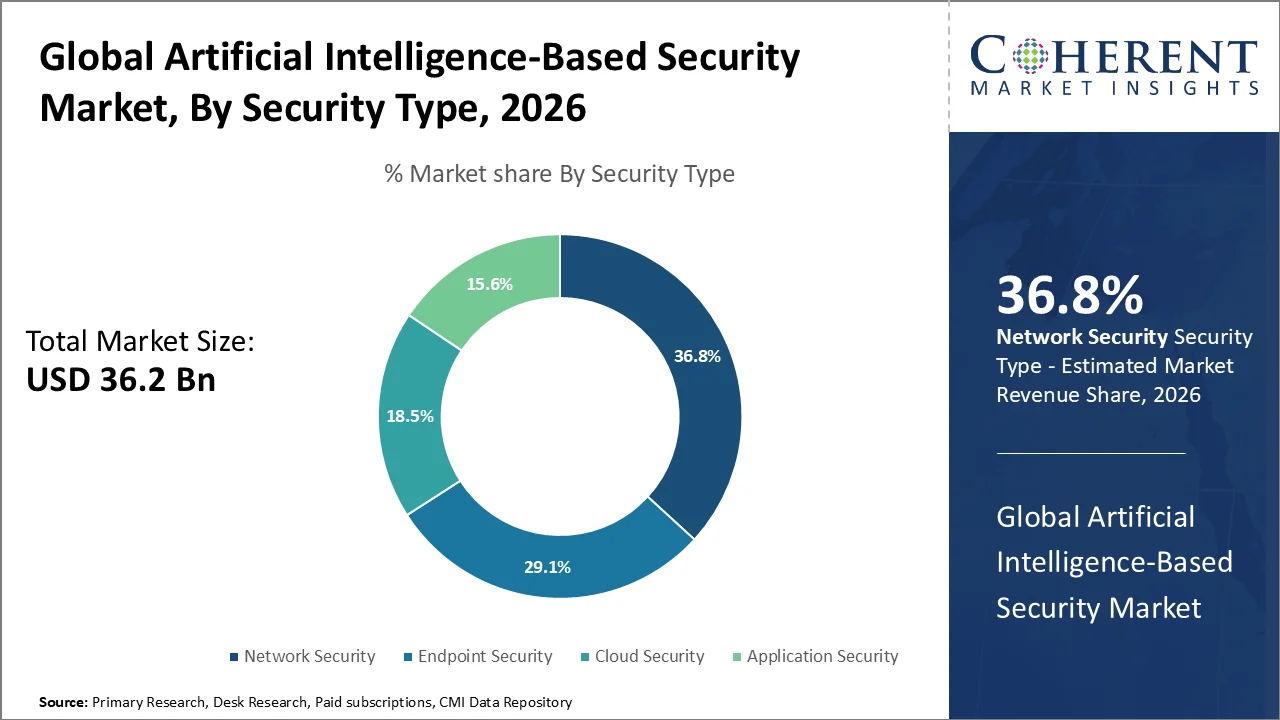
On the basis of security type, the network security segment lead with a major 36.8% share in 2026. The segment’s growth is owing to the increasing cybercrime incidents, the rise of hybrid and remote work models, accelerated cloud adoption, and heightened exposure to ransomware, phishing, and AI-enabled attacks.
The FBI Internet Crime Complaint Center received over 1 million cybercrime complaints in 2025, with reported losses nearing USD 21 billion, highlighting the need for stronger intrusion prevention, firewall, zero-trust access, network detection, and response tools.
In May 2026, the U.S. Department of Commerce’s CAISI signed agreements with Google DeepMind, Microsoft, and xAI to support cutting edge AI model evaluation. These initiatives are expected to strengthen the AI security and also propel the adoption of advanced network security solutions.
Market Drivers
Federal Cybersecurity Modernization and Critical Infrastructure Protection is Transforming the Artificial Intelligence-Based Security Market in the US
The federal cybersecurity modernization and critical infrastructure protection are reshaping the U.S. Artificial Intelligence-Based Security Market. The agencies are moving from rule-based monitoring to AI-enabled detection, identity analytics, automated response, as well as OT threat intelligence.
The need is also supported by the official risk data. The GAO reported 32,211 federal information security incidents in fiscal year 2023, thereby keeping cybersecurity on the federal high-risk agenda. The federal AI adoption is also speeding up. The GAO found reported generative AI use cases across selected agencies increased from 32 in 2023 to 282 in 2024. This creates a stronger demand for secure AI governance, model monitoring, data protection, and the AI-assisted cyber operations.
In January 2025, CISA, JCDC, government agencies, and industry partners published the AI Cybersecurity Collaboration Playbook to coordinate response, share AI security risks, and improve resilience across critical infrastructure. This is pushing vendors toward explainable, compliant, infrastructure-ready AI security platforms for federal along with the regulated enterprise buyers.
AI Powered Autonomous Threat Detection and Response: A Major Breakthrough in the Artificial Intelligence-Based Security Market
AI-powered autonomous threat detection and response is becoming a major breakthrough in the Artificial Intelligence-Based Security Market. The organizations need faster protection against increasingly complex cyberattacks. The AI-enabled cybersecurity platforms use machine learning, behavioral analytics, and automated response workflows to detect unusual network activity, identify breaches, and contain threats with limited human involvement.
These systems have the ability to identify network breaches 108 days faster than traditional manual approaches, thereby helping the enterprises in minimizing response delays and lowering incident impact. The faster detection and containment can also generate average cost savings of around USD 1.8 million per incident for affected organizations.
The government-backed innovation is also strengthening this market shift. In August 2024, DARPA and ARPA-H launched the Artificial Intelligence Cyber Challenge, a multi-year program with USD 29.5 million in prize funding. The initiative encourages teams to build autonomous cyber reasoning systems which use large language models to find, diagnose, and patch critical infrastructure vulnerabilities without direct human supervision.
Current Events and Their Impact
Current Event | Description and its Impact |
EU AI Act Full Applicability from August 2026
|
|
U.S. Federal Push for AI Innovation and Cybersecurity Collaboration
|
|
Artificial Intelligence-Based Security Market Trends
- Rising cyberattacks, phishing, ransomware, and data breaches are increasing enterprise demand for AI-led threat detection and response tools. The FBI’s 2025 Internet Crime Report recorded 1,008,597 total complaints, with AIthereby highlighting the growing risks requiring advanced security solutions.
- AI-based identity and access management adoption is expanding. This is because the organizations are strengthening user verification, anomaly detection, and zero-trust security models.
- Machine learning-enabled network security gains traction, thereby helping the security teams detect unusual traffic patterns and prevent advanced cyber intrusions faster.
- Cloud security software adoption is accelerating as enterprises shift workloads to hybrid and multi-cloud environments, thereby increasing demand for automated risk monitoring.
- Growing government focus on secure AI systems is supporting the wider adoption of AI-based cybersecurity solutions. The CISA’s AI roadmap highlights the use of AI to enhance cybersecurity, protect AI systems from cyber threats, and reduce malicious AI use across critical infrastructure.
- Rising financial losses from cybercrime are pushing organizations toward predictive security tools. In 2024, the FBI reported phishing/spoofing, extortion, and personal data breaches as the top cybercrime complaints. Also, the cryptocurrency-related investment fraud losses exceeded USD 6.5 billion.
- AI governance and risk management frameworks are becoming important market enablers. NIST’s AI Risk Management Framework supports safer design, development, use, and evaluation of AI systems, improving buyer confidence in AI-based security platforms.
Regional Insights
North America Dominates Owing to the Strong Cybersecurity Infrastructure and Rising AI-Led Threat Detection Adoption
The North America region accounts for 36.8% of the market share in 2026. The region’s growth is owing to a strong federal cybersecurity framework, rising enterprise investment in AI-powered threat monitoring, and growing demand for automated risk detection across government, defense, BFSI, healthcare, and critical infrastructure sectors.
According to the FBI’s 2025 Internet Crime Report, over 2,100 ransomware incidents targeted critical infrastructure, thereby underscoring the urgent need for advanced AI security solutions. In response, the federal initiatives have intensified. In May 2026, the NIST Cybersecurity and Privacy Program published its FY2025 Annual Report (SP 800‑238), highlighting expanded AI and cybersecurity research focused on automated threat detection, risk management, and secure system design.
In April 2026, Apiiro launched a command-line interface (CLI) to integrate AI-native security directly into software development workflows, enabling real-time security checks as AI agents generate and modify code. This approach shifts security from reactive post-code review to proactive, automated enforcement.
Asia Pacific Artificial Intelligence-Based Security Market Trends
Asia Pacific is expected to witness strong growth in Artificial Intelligence-Based Security Market over the forecast period. The region’s growth is owing to the rising AI enabled cyberattacks, expanding digital public infrastructure, cloud migration, and stronger cyber resilience programs across India, Singapore, Australia, Japan, and South Korea.
Singapore’s Cyber Security Agency reported that infected infrastructure increased 67% to 117,300 systems in 2024, indicating demand for automated threat intelligence, anomaly detection, and malware-response tools. Australia’s ASD received over 36,700 calls to its Cyber Security Hotline and responded to more than 1,100 cybersecurity incidents in FY2023–24, strengthening enterprise adoption of AI-led monitoring and incident response platforms.
In August 2023, Sangfor Technologies launched its Cyber Guardian MDR services in the Asia Pacific, thereby expanding its managed detection and response capabilities beyond Malaysia. The platform leverages AI-driven threat detection, continual monitoring, and expert incident response to deliver timely, accurate, and cost-effective cybersecurity protection for organizations.
Increasing Investment and Strategic Initiatives is Accelerating the Artificial Intelligence-Based Security Market in United States
The United States Artificial Intelligence-Based Security Market is experiencing growth. This is owing to the increasing investment in AI research, heightened cybersecurity requirements, and incorporation of AI-powered threat detection in various sectors.
According to the U.S. National Science Foundation, over USD 700 million is invested annually in AI research and infrastructure supporting secure AI technologies
In March 2026, Accenture launched Cyber.AI, powered by Anthropic’s Claude, to enable AI-driven, continuous cybersecurity operations and faster threat response. The platform combines Accenture’s proprietary agents with Claude to protect, monitor, and govern autonomous AI agents in real time.
China Artificial Intelligence-Based Security Market Trends
China’s Artificial Intelligence-Based Security Market is driven by a rising adoption of AI-powered surveillance, threat detection, and cybersecurity solutions across enterprises and public infrastructure. According to official industry data, China registered 103 AI-based security product launches in Q1 2026, spanning intelligent cameras, AI threat detection models, and secure IoT platforms.
In June 2025, Huawei launched HiSec Endpoint, a 3-in-1 AI-driven security solution combining EDR, NAC, and ZTNA, certified by The Tolly Group for superior protection. The platform uses AI-powered static and dynamic behavior detection to achieve a 96.7% malware detection rate and 100% ransomware detection, outperforming industry benchmarks.
Who are the Major Companies in Artificial Intelligence-Based Security Industry
Some of the major key players in Artificial Intelligence-Based Security Market are Nvidia Corporation, Intel Corporation, Xilinx Inc., Samsung Electronics Co., Ltd., Micron Technology, IBM Corporation, Cylance Inc., Threatmetrix, Securonix, Inc., Amazon, Sift Science, Acalvio Technologies, and Skycure Inc.
Key News
- In May 2026, AITX’s RAD launched SCANNA, a software solution that integrates existing IP cameras and NVRs into its AI-driven RADSoC platform, enabling intelligent monitoring, incident management, and operationally responsive security. The system leverages AI workflows via SARA to transform passive video systems into active, AI-powered security assets without new hardware investments.
- In April 2026, Mallory launched an AI-native threat intelligence platform that monitors global adversary activity, contextualizes threats against an organization’s assets, and delivers prioritized, evidence-based guidance for proactive cybersecurity action. The platform integrates with existing security tools and supports automated, AI-speed decision-making to protect enterprises from AI-enabled attacks.
Market Report Scope
Artificial Intelligence-Based Security Market Report Coverage
| Report Coverage | Details | ||
|---|---|---|---|
| Base Year: | 2025 | Market Size in 2026: | USD 36.2 Bn |
| Historical Data for: | 2020 To 2024 | Forecast Period: | 2026 To 2033 |
| Forecast Period 2026 to 2033 CAGR: | 17% | 2033 Value Projection: | USD 93.4 Bn |
| Geographies covered: |
| ||
| Segments covered: |
| ||
| Companies covered: | Nvidia Corporation, Intel Corporation, Xilinx Inc., Samsung Electronics Co., Ltd., Micron Technology, IBM Corporation, Cylance Inc., Threatmetrix, Securonix, Inc., Amazon, Sift Science, Acalvio Technologies, and Skycure Inc. | ||
| Growth Drivers: |
| ||
| Restraints & Challenges: |
| ||
Analyst Opinion
- AI-based security is driven by real operational need. Around 67% of organizations worldwide are already using AI capabilities for cybersecurity, especially for anomaly detection, malware identification, and automated incident response. This means the market is not only growing because of technology trends but it is growing because security teams need faster and smarter threat detection.
- AI is becoming one of the most important tools inside modern Security Operations Centers. The estimates show that 99% of SOCs use AI, 97% of IT and security professionals use AI to streamline tasks, and 90% see strong value in improving detection accuracy and minimizing alert fatigue. This shows that AI is already part of daily security operations, not just a future investment area.
- However, the secure governance is still behind AI adoption. The industry data shows that nearly 13% of organizations reported breaches involving AI models or applications, while 63% do not have formal AI governance policies. This gap is creating stronger demand for AI-based security solutions, as enterprises need better controls, safer deployment, and stronger risk mitigation across digital environments.
Speak to the analyst
Want personalized insights?
Take the findings above to one of our principal consultants, or have the report rebuilt around the segments, geographies and competitors you actually track.
Market Segmentation
- By Offering (Revenue, USD Bn, 2021-2033)
- Hardware
- Software
- Services
- By Deployment Type (Revenue, USD Bn, 2021-2033)
- Cloud
- On-Premise
- By Security Type (Revenue, USD Bn, 2021-2033)
- Network Security
- Endpoint Security
- Application Security
- Cloud Security
- By Security Solutions (Revenue, USD Bn, 2021-2033)
- Identity and Access Management (IAM)
- Risk and Compliance Management
- Encryption
- Data Loss Prevention (DLP)
- Unified Threat Management (UTM)
- Antivirus/Antimalware
- Intrusion Detection/Prevention System (IDS/IPS)
- Others
- By Technology (Revenue, USD Bn, 2021-2033)
- Machine Learning
- Context Awareness Computing
- Natural Language Processing
- By Vertical (Revenue, USD Bn, 2021-2033)
- Government & Defense
- BFSI
- Enterprise
- Infrastructure
- Automotive & Transportation
- Healthcare
- Retail
- Manufacturing
- Others
- Global Artificial Intelligence-Based Security Market, By Region (Revenue, USD Bn, 2021-2033)
- North America
- U.S.
- Canada
- Latin America
- Brazil
- Mexico
- Argentina
- Rest of Latin America
- Europe
- Germany
- U.K.
- France
- Italy
- Spain
- Russia
- Rest of Europe
- Asia Pacific
- China
- India
- Japan
- Australia
- South Korea
- ASEAN
- Rest of Asia Pacific
- Middle East
- GCC
- Israel
- Rest of Middle East
- Africa
- South Africa
- Central Africa
- North Africa
- North America
- Key Players
- Nvidia Corporation
- Intel Corporation
- Xilinx Inc.
- Samsung Electronics Co., Ltd.
- Micron Technology
- IBM Corporation
- Cylance Inc.
- Threatmetrix
- Securonix, Inc.
- Amazon
- Sift Science
- Acalvio Technologies
- Skycure Inc.
Sources
Primary Research Interviews
- AI-Based Security Solution Providers
- Identity and Access Management (IAM) Vendors
- Risk and Compliance Management Consultants
- Cloud Security and Data Protection Experts
- Cybersecurity Analysts and Ethical Hackers
- IT Infrastructure and Network Security Managers
- Industrial Security Technology Consultants
- Government & Defense Cybersecurity Officials
- Others
Databases
- Bloomberg Terminal
- Thomson Reuters Eikon
- IQVIA (for cybersecurity analytics overlaps)
- Definitive Healthcare (for AI in critical infrastructure security)
- Clarivate Analytics
- Others
Magazines
- Cybersecurity Magazine
- SecurityWeek
- SC Magazine
- Dark Reading
- CIO Magazine – Security Section
- Others
Journals
- IEEE Transactions on Information Forensics and Security
- Journal of Cybersecurity (Oxford University Press)
- Computers & Security (Elsevier)
- International Journal of Information Security
- ACM Transactions on Privacy and Security
- Others
Newspapers
- Financial Times
- The Wall Street Journal
- Reuters
- Bloomberg News
- The New York Times – Technology/Security Section
- Others
Associations
- Information Systems Security Association (ISSA)
- International Information System Security Certification Consortium (ISC)²
- National Institute of Standards and Technology (NIST) Cybersecurity Forum
- Cloud Security Alliance (CSA)
- European Union Agency for Cybersecurity (ENISA)
- Others
Public Domain Sources
- U.S. Department of Homeland Security – Cybersecurity & Infrastructure Security Agency (CISA)
- National Institute of Standards and Technology (NIST) – Cybersecurity Framework
- European Commission – Digital Strategy / Cybersecurity
- World Bank Open Data – ICT Security Reports
- OECD Digital Security and Trust Data
- Others
Proprietary Elements
- CMI Data Analytics Tool
- Proprietary CMI Existing Repository of Intelligence for the Last 10 Years
Get access to 250+ pages report
Every segment, forecast, competitor profile and data table behind the analysis above — available for instant download.
- ESOMAR Member
- ISO 9001:2015 Certified
- D-U-N-S Registered
- GDPR & CCPA Compliant
Missing comfort of reading report in your local language? Find your preferred language:
Transform your Strategy with Exclusive Trending Reports
Frequently Asked Questions
The Artificial Intelligence-Based Security Market is expected to reach USD 93.4 Billion in 2033.
The scarcity of skilled professionals, data privacy and regulatory compliance issues, and evolving adversarial AI threats are the key factors hampering growth of the market.
The escalating sophistication of AI-powered cyberattacks, the explosion of connected devices, and a severe shortage of skilled cybersecurity professionals is boosting the demand for Artificial Intelligence-Based Security solutions.
The Artificial Intelligence-Based Security Market is anticipated to grow at a CAGR of 17% between 2026 and 2033.
Among regions, North America is expected to account for a largest market share in the global Artificial Intelligence-Based Security Market over the forecast period.
They provide real-time threat detection, predictive analytics, automated response, and reduced human intervention, enhancing overall organizational security posture.
The market encompasses software, hardware, and service solutions that leverage artificial intelligence (AI) to detect, prevent, and respond to cyber threats across enterprises, government, and other sectors.