

Music Streaming Market Size and Forecast – 2026 to 2033
Global Music Streaming Market is estimated to be valued at USD 58.70 Bn in 2026 and is expected to reach USD 205.51 Bn by 2033, growing at a compound annual growth rate (CAGR) of 19.6% from 2026 to 2033.
Key Takeaways
- By Service, On-demand Streaming is expected to contribute the highest market share of 52.8% in 2026.
- By Content, Audio is expected to contribute the highest market share of 52.9% in 2026.
- By End User, Individual user segment is expected to contribute the highest market share of 58.4% in 2026.
- By Region, North America is a leading market with a projected growth of 48.2% market share in 2026.
Market Overview
The music streaming market is expected to witness significant growth during the forecast period. Factors such as growing adoption of smartphones and smart gadgets, increasing internet penetration across the globe, and changing consumer preference towards streaming music online rather than owning physical copies are expected to drive the growth of the market. Additionally, ongoing technological advancements in streaming services allowing users to access music on the go through their mobile apps along with feature enhancements like improved audio quality, personalized playlists, and offline listening are further propelling the demand for music streaming. Major players in the market are focusing on expanding their music libraries and constantly updating their catalogs to provide users with access to a large volume and variety of songs in different genres and languages.
Current Events and Its Impacts on the Music Streaming Market
Current Events | Description and its impact |
Geopolitical and Regulatory Developments |
|
Technological Innovations and Adoption |
|
Competitive Landscape and Industry Consolidation |
|
Role of AI in Music Streaming
Artificial intelligence plays a central role in the music streaming industry by enhancing discovery, personalization, and content management. AI algorithms analyze listening behavior to deliver highly personalized playlists, recommendations, and radio stations, improving user engagement and retention. It also supports dynamic pricing, targeted advertising, and audience insights for artists and labels. Increasingly, AI is used for content moderation, copyright protection, and detection of AI-generated music to ensure transparency and fair attribution.
In June 2025, Deezer launched the world’s first AI tagging system for music streaming, identifying albums that contain fully AI-generated tracks. The platform also unveiled an AI music detection tool, reporting that about 18% of daily uploads—over 20,000 tracks—are entirely AI generated.
- Current Industry Events of 2026
- Market Size Estimation
- Regional Breakdown
- Competitive Landscape
- Customer Intelligence
- Segmental Analysis
- Pricing Analysis
- Key Market Drivers, Challenges & Future Trends
- Customized Insights Section
Segmental Insights
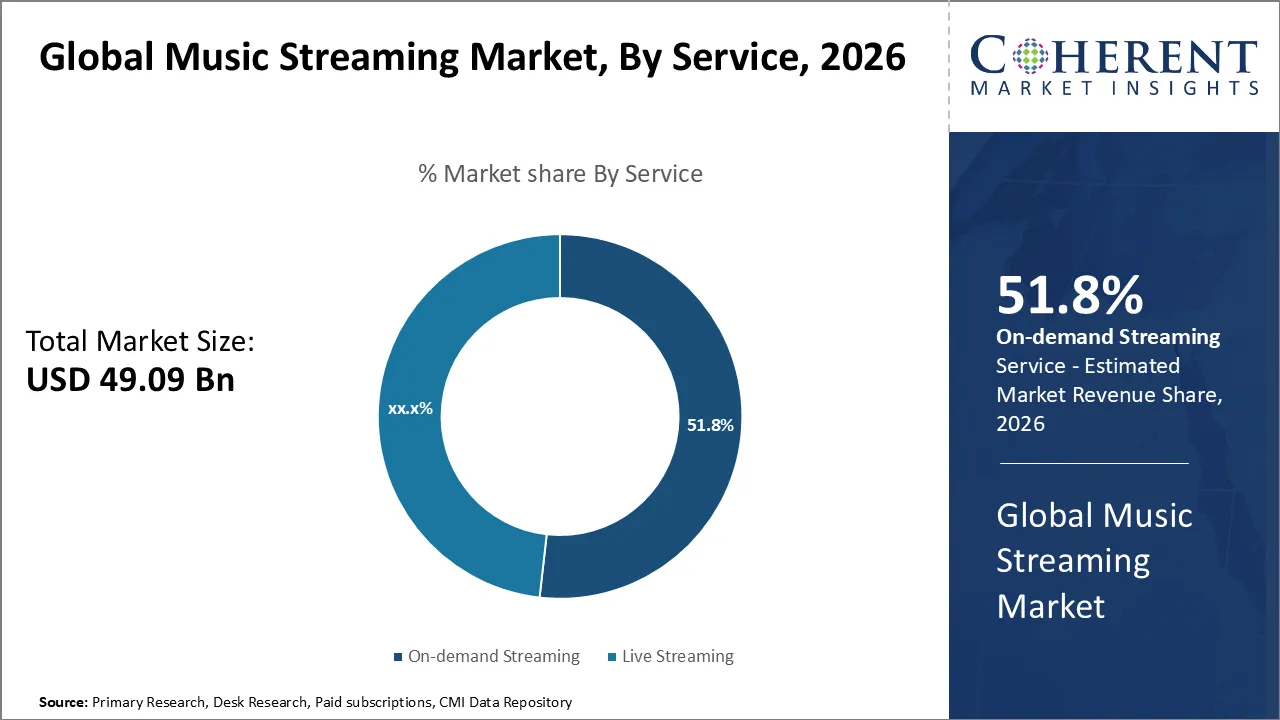
Music Streaming Market, Insights By, Service: Convenience and accessibility drive the dominance of On-demand streaming
By Service, On-demand Streaming is expected to contribute the highest market share of 52.8% in 2026. owning to its convenience and accessibility. On-demand streaming allows users to choose the music they want to listen to at their own will and convenience without any scheduling limitations. They can create personalized playlists and listen to any song or genre of their choice from a vast catalog at anytime from anywhere via their smart devices. For instance, Amazon launched a new on-demand music streaming service, offering "tens of millions" of tracks from both major and independent labels.
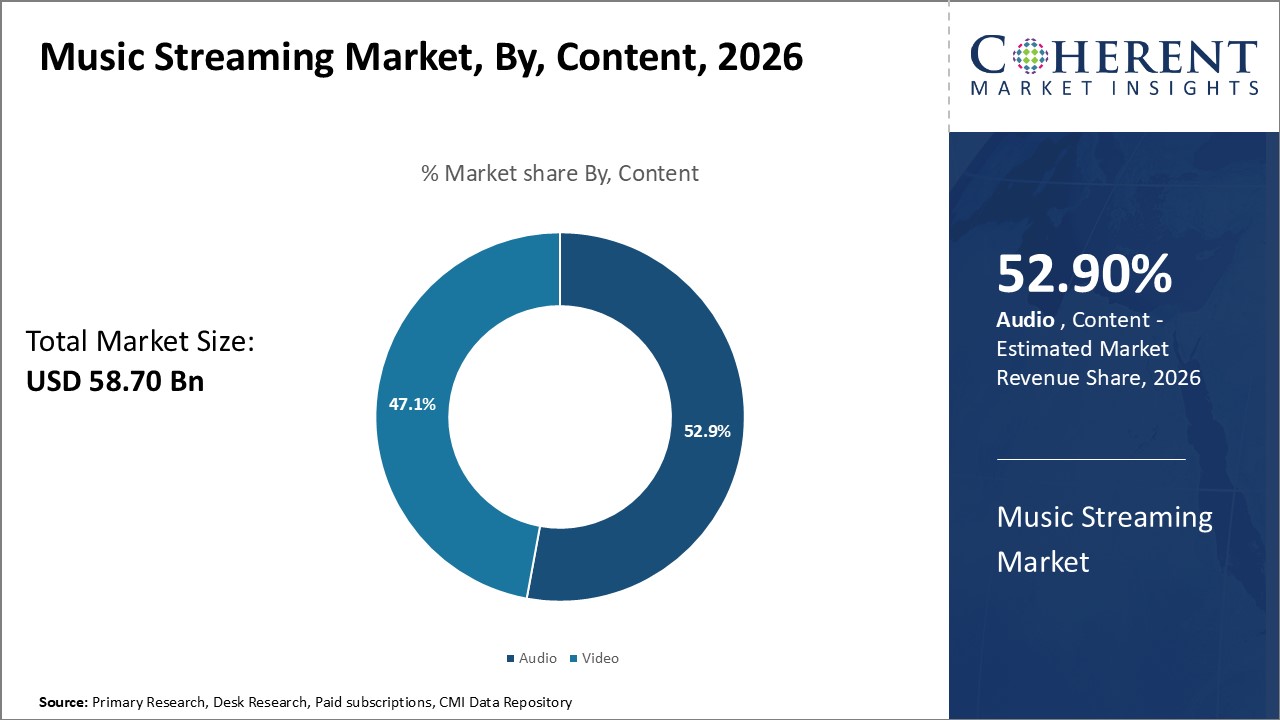
Music Streaming Market, Insights By, Content: Audio Content Drives Higher Engagement on Music Streaming Platforms
By Content, Audio is expected to contribute the highest market share of 52.9% in 2026 mainly due to higher levels of engagement it drives on music streaming platforms. While the market for music videos is growing, audio content in the form of songs continue to be the primary reason users turn to music streaming services. Several research surveys indicate that the users spend more time passively listening to music playlists or genres of their choice rather than watching music videos. For instance, in October 2026, Immersive audio streaming platform AuroMasters launched in India, aiming to address two common issues in music streaming: low audio quality for users and limited revenue for artists.
Individual Users are the Major Adopters of Music Streaming Driven by Personalization
By End-user, Individual user segment is expected to contribute the highest market share of 57.4% in 2026 owing to their need for personalized music experiences. Music streaming being a very personal activity, individual users have warmed up to its ability to cater playlists and recommendations according to their unique tastes. With more music discovery and curation tools available, individuals can shape highly customized music experiences as per their changing moods and interests. For instance, in September 2025, Mongolia’s Sonsy launched as the country’s first world-class music streaming service, offering Individual, Duo, and Family subscriptions, a freemium model, and offline mode, with Tuned Global powering backend streaming, security, licensing, and analytics.
Regional Insights
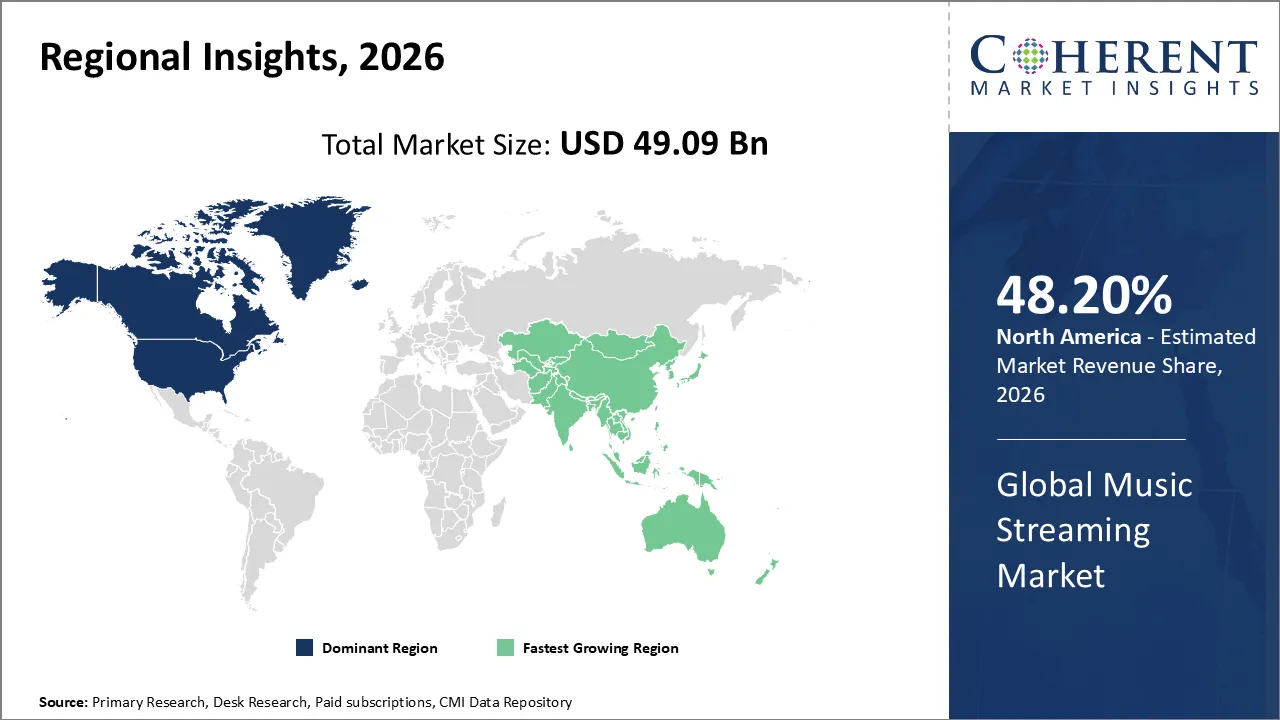
North America Music Streaming Market Trends
North America is a leading market for music streaming and is expected to account for 48.20% market share in 2026. The growth can be attributed to factors such as high smartphone and internet penetration, availability of diverse music content from major labels, and presence of global streaming platforms. Countries like the U.S. and Canada have seen widespread adoption of streaming among both young and older demographic segments. For instance, in December 2026, Spotify launched music videos for Premium subscribers across the U.S. and Canada, stepping up its challenge to YouTube’s dominance in visual music content.
Asia Pacific Music Streaming Market Trends
Asia Pacific music streaming market is a fast-growing market and is expected to account for 33.9% market share in 2026. The growth is mainly attributed to the increasing digitalization and increase in young population with rising disposable incomes across developing countries. Lower data rates and availability of low-cost plans have boosted streaming uptake. Local players have also contributed to the market expansion. For instance, Music streaming service Spotify has launched and begun rolling out its services in India, proceeding despite its ongoing legal battle with Warner Music over music rights in the country.
United States Music Streaming Market Trends
The way music is being consumed in the United States is rapidly changing due to evolving streaming trends. Listeners are switching from owning music to renting access via streaming subscriptions. This change favors on-demand, ad-supported platforms like Spotify that allow users to instantly listen to tens of millions of songs from any device with an internet connection. As consumers cut cable cords and listen to music on smartphones everywhere they go, the immediacy and convenience of streaming has transformed music into an "on-tap" rather than "on-the-shelf" experience. For instance, in August 2026, Apple Music launched a new tool that lets users import playlists from other streaming platforms like Spotify. After beta testing in Australia and New Zealand, it is now available in the U.S., U.K., Brazil, Canada, France, Germany, and Mexico.
China Music Streaming Market Trends
The evolving music streaming preferences and habits of younger generations of music listeners in China are likely to heavily influence music streaming trends in 2024. Younger Chinese between the ages of 16-30 currently make up the largest proportion of music streamers in the country. This demographic tends to favor interactive music experiences like playlists, livestreaming, and social features more so than older generations. As this younger cohort continues gaining purchasing power and dominance in the overall music market in coming years, music streaming platforms will need to devote more resources towards developing engaging social and live streaming features to captivate this audience. For instance, TikTok’s parent company ByteDance is reportedly planning to launch the music streaming service ‘Feile’ in China, building on its experience developing and launching Resso.
End-User Feedback and Unmet Needs in the Music Streaming Market
- Content Discovery Challenges: Users often struggle to find new or relevant music easily. Standard recommendations can feel repetitive. They want smarter, personalized discovery that reflects evolving tastes, moods, and niche genres. Better curation, contextual suggestions, and fresh recommendations could enhance engagement and satisfaction.
- Audio Quality Expectations: Many listeners want clearer, richer sound without paying high subscription fees. Casual users feel limited by standard quality, especially on high-end headphones or wireless speakers. Flexible, accessible premium sound options with simple toggles would address this unmet need for a better listening experience.
- Playlist Personalization Needs: Users appreciate playlists but want more control and adaptability. They seek dynamic mixes that understand context — workout, study, commute — and update intelligently. Current static lists feel outdated quickly. Enhanced personalization tools that respond to behavior and feedback are in demand.
Music Streaming Market Trend
Personalization and Intelligent Recommendations
Music platforms are focusing heavily on personalization. Users expect playlists and recommendations that reflect their mood, activity, and evolving tastes. Algorithms are becoming more context-aware, using listening patterns, time of day, and even location signals to suggest relevant content. Curated playlists by mood, genre, and niche interests are increasingly popular. This trend enhances user engagement and makes discovery feel more effortless and enjoyable.
Integration with Everyday Tech Ecosystems
Streaming services are expanding beyond apps into smart devices like speakers, wearables, cars, and home assistants. Seamless connectivity allows users to access music wherever they are — at home, in the car, or during workouts. Voice controls, smart suggestions, and cross-device continuity are becoming standard features. This integration makes music a more natural part of daily life and encourages continuous engagement across contexts.
Music Streaming Market Opportunity
Expansion into Emerging and Underserved Markets
Many regions still have untapped demand for affordable, localized music streaming. Services that offer regional languages, culturally relevant content, and easy onboarding for first-time digital users can capture these markets. Localization extends beyond catalog — it includes payment options, marketing, and UX tailored to local behaviours. Innovations in low-bandwidth modes and lightweight apps also create opportunities to serve users with limited connectivity.
Market Report Scope
Music Streaming Market Report Coverage
| Report Coverage | Details | ||
|---|---|---|---|
| Base Year: | 2025 | Market Size in 2026: | USD 58.70 Bn |
| Historical Data for: | 2020 To 2024 | Forecast Period: | 2026 To 2033 |
| Forecast Period 2026 to 2033 CAGR: | 19.6% | 2033 Value Projection: | USD 205.51 Bn |
| Geographies covered: |
| ||
| Segments covered: |
| ||
| Companies covered: | Spotify AB, Apple, Inc., Amazon.com, Inc., Google LLC, Deezer SA, Pandora Media, Inc., Tencent Music Entertainment Group, Tidal, SoundCloud Global Limited & Co. KG, iHeartMedia, Inc. | ||
| Growth Drivers: |
| ||
| Restraints & Challenges: |
| ||
Music Streaming Market News
- In August 2025, the new streaming platform LFG.TV aims to give DJs more visibility beyond gaming streams and viral TikTok dances. Launching over Labor Day Weekend, it promises 24/7 livestreaming dedicated to dance music culture without the usual platform issues.
Analyst Opinion (Expert Opinion)
- The music streaming market in 2025 is not merely expanding — it is reshaping the industry’s economic and cultural architecture with profound implications for platforms, artists, and listeners alike. Streaming now commands the majority of recorded music revenue globally, with services like Spotify holding roughly a third of all subscribers and platforms such as YouTube Music, Apple Music, Amazon Music and Tencent collectively dominating listenership. Spotify’s lead is not just in scale but in engagement: average daily listening approaches nearly two hours per user, underscoring entrenched consumer reliance on on-demand access over traditional formats.
- This scale has yielded unmistakable structural shifts — recorded music revenues have risen for a tenth consecutive year, primarily driven by subscription growth, even as physical formats decline and vinyl grows only modestly. However, these aggregate numbers mask growing friction within the ecosystem. Artists and rights holders increasingly critique compensation models; industry payouts are often a fraction of perceived value, fueling debate on equitable royalty frameworks and transparency initiatives by niche platforms.
- On the product side, the competitive dynamic is evolving beyond scale toward experience differentiation. Leading services are deploying advanced personalization features — such as Spotify’s enhanced genre-controlled Discover Weekly playlists — to counter recommendation fatigue and sustain listening diversity. Meanwhile, platform strategies increasingly intersect with broader entertainment vectors (e.g., video integration, social sharing), reflecting a strategic pivot from pure music delivery to immersive, multi-format engagement.
Speak to the analyst
Want personalized insights?
Take the findings above to one of our principal consultants, or have the report rebuilt around the segments, geographies and competitors you actually track.
Market Segmentation
- Service Insights (Revenue, USD Bn, 2026 - 2033)
- On-demand Streaming
- Live Streaming
- Content Insights (Revenue, USD Bn, 2026 - 2033)
- Audio
- Video
- End-user Insights (Revenue, USD Bn, 2026 - 2033)
- Individual
- Commercial
- Regional Insights (Revenue, USD Bn, 2026 - 2033)
- North America
- U.S.
- Canada
- Latin America
- Brazil
- Argentina
- Mexico
- Rest of Latin America
- Europe
- Germany
- U.K.
- Spain
- France
- Italy
- Russia
- Rest of Europe
- Asia Pacific
- China
- India
- Japan
- Australia
- South Korea
- ASEAN
- Rest of Asia Pacific
- Middle East
- GCC Countries
- Israel
- Rest of Middle East
- Africa
- South Africa
- North Africa
- Central Africa
- Key Players Insights (Revenue, USD Bn, 2021 - 2033)
- Spotify AB
- Apple, Inc.
- com, Inc.
- Google LLC
- Deezer SA
- Pandora Media, Inc.
- Tencent Music Entertainment Group
- Tidal
- SoundCloud Global Limited & Co. KG
- iHeartMedia, Inc.
Sources
Primary Research interviews
- Senior executives from music streaming platforms
- Independent and major-label artists
- Music producers and distributors
- Digital rights management specialists
- Advertising and brand partnership managers
- Technology vendors supporting streaming infrastructure
Databases
- International Federation of the Phonographic Industry (IFPI) data releases
- World Intellectual Property Organization (WIPO) statistics
- U.S. Copyright Office databases
- Eurostat digital economy datasets
- National telecom and media regulatory databases
Magazines
- Billboard
- Rolling Stone
- Music Business Worldwide
- Variety
- Wired
- Sound On Sound
Journals
- Journal of the Music & Entertainment Industry Educators Association
- International Journal of Music Business Research
- Journal of Media Economics
- New Media & Society
- Information, Communication & Society
Newspapers
- The New York Times
- The Guardian
- Financial Times
- The Wall Street Journal
- The Washington Post
Associations
- International Federation of the Phonographic Industry (IFPI)
- Recording Industry Association of America (RIAA)
- British Phonographic Industry (BPI)
- European Music Council
- Music Publishers Association
Public Domain sources
- Government cultural and media reports
- National statistics offices
- Regulatory filings and policy documents
- Public earnings transcripts of listed streaming platforms
- Open-access academic publications
Proprietary Elements
- CMI Data Analytics Tool
- Proprietary CMI Existing Repository of information for last 8 years
Get access to 250+ pages report
Every segment, forecast, competitor profile and data table behind the analysis above — available for instant download.
- ESOMAR Member
- ISO 9001:2015 Certified
- D-U-N-S Registered
- GDPR & CCPA Compliant
Missing comfort of reading report in your local language? Find your preferred language:
Transform your Strategy with Exclusive Trending Reports
Frequently Asked Questions
The Music Streaming Market is estimated to be valued at USD 47.06 Bn in 2026, and is expected to reach USD 143.89 Bn by 2033.
The CAGR of the Music Streaming Market is projected to be 19.6% from 2026 to 2033.
Subscription-based business model and large music catalog availability are the major factors driving the growth of Music Streaming Market.
Lack of internet connectivity and platform dependency are the major factors hampering the growth of Music Streaming Market.
In terms of Service, On-demand Streaming is estimated to dominate the market revenue share in 2026.
Spotify AB, Apple, Inc., Amazon.com, Inc., Google LLC, Deezer SA, Pandora Media, Inc., Tencent Music Entertainment Group, Tidal, SoundCloud Global Limited & Co. KG, iHeartMedia, Inc. are the major players.
North America is expected to lead the Music Streaming Market in 2026.