

Electric Motor Market Size and Trends
The electric motor market is estimated to be valued at USD 155.40 Bn in 2026 and is expected to reach USD 257.82 Bn by 2033, growing at a compound annual growth rate (CAGR) of 7.5% from 2026 to 2033.
Key Takeaways
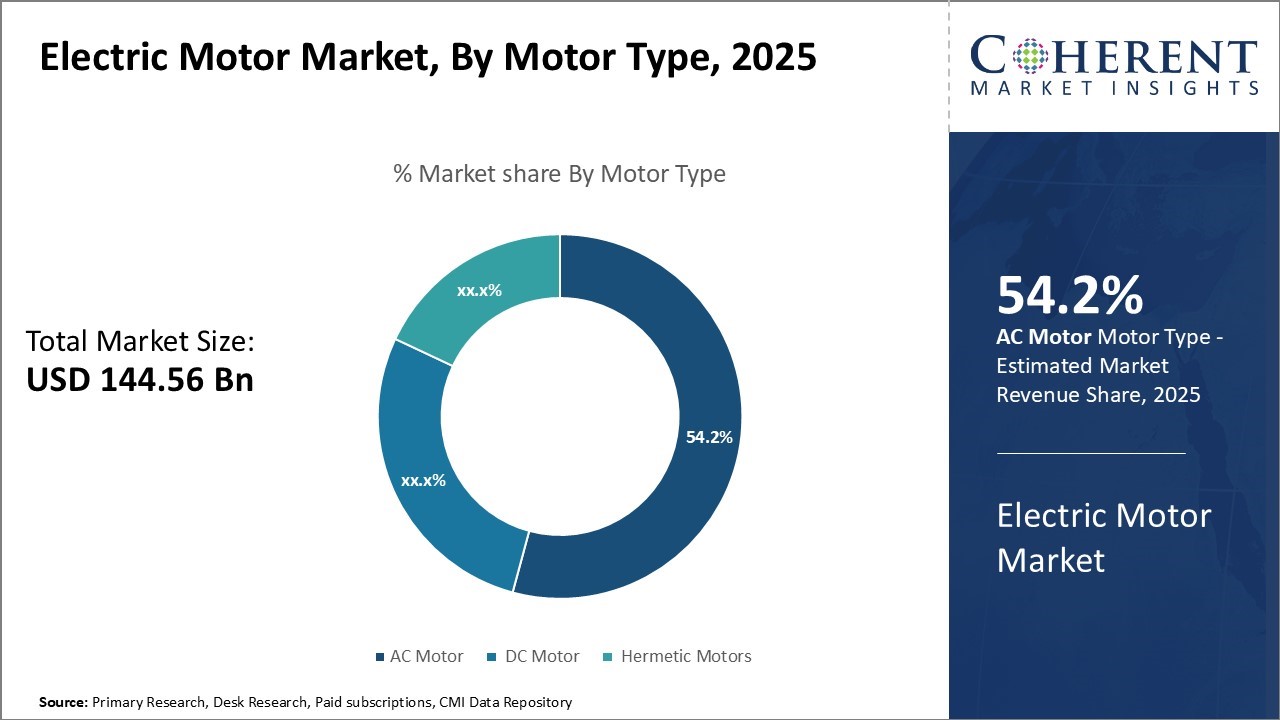
- Based on Motor Type, the AC motor segment is expected to lead the market with a 55.2% share in 2026, due to its superior efficiency and versatility compared to other motor types.
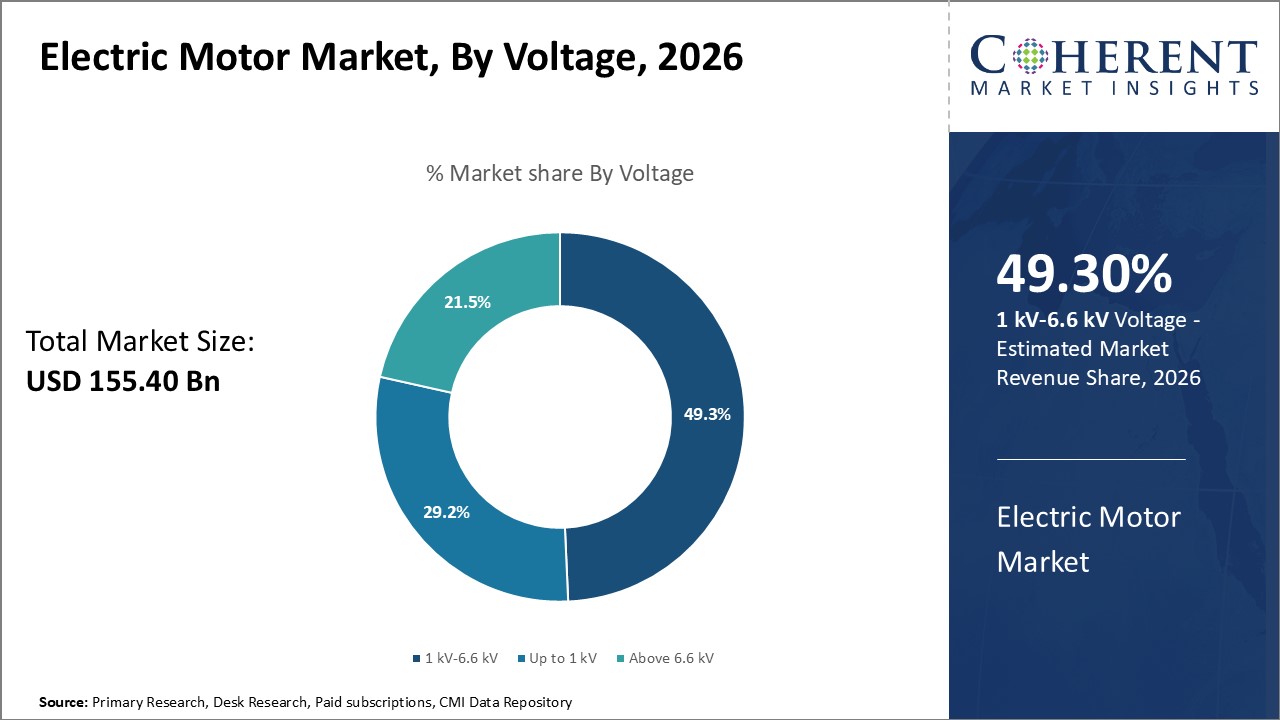
- Based on Voltage, the 1 kV-6.6kV segment is expected to dominate at 49.3% share in 2026, asit caters to a wide range of industrial applications that maximize motor efficiency within this voltage band.
- Based on End User, the Transportation segment remains the dominate segment with an estimated 34.1% share in 2026, due to the motors being extensively used as the logistics backbone.
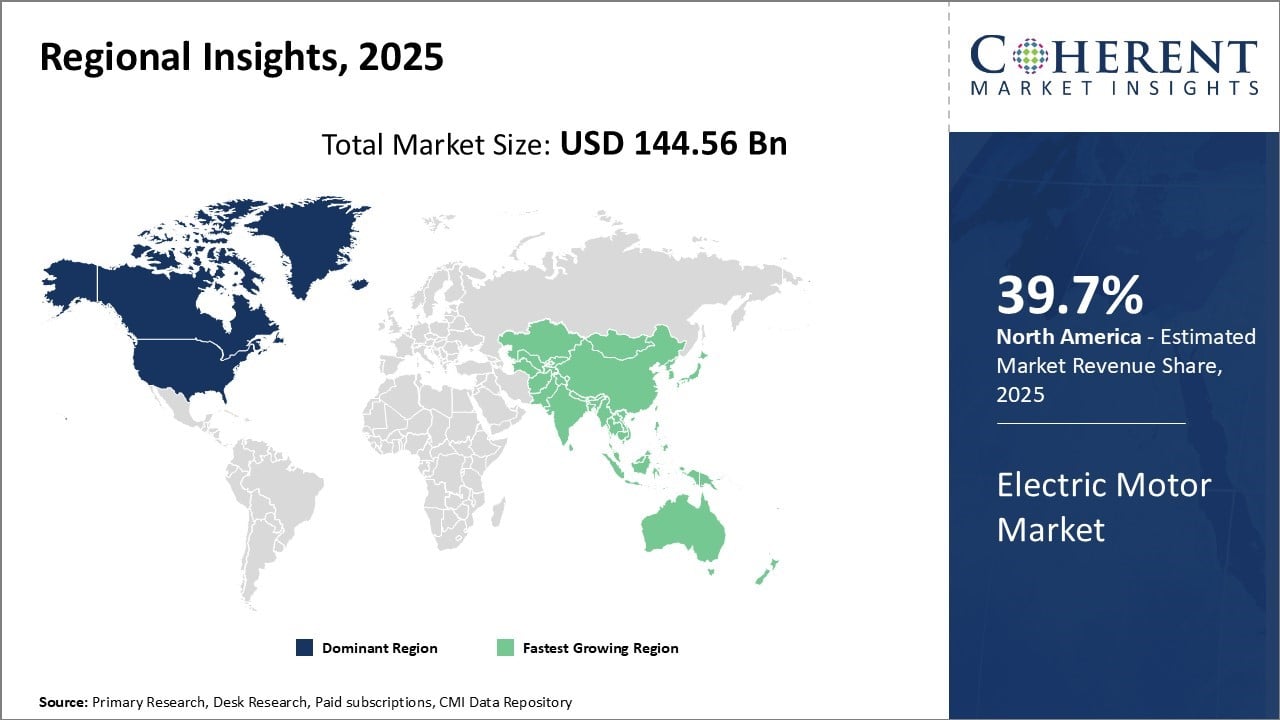
- Based on Region, North America is expected to lead the market, holding a share of 39. 7% in 2026. While, Asia Pacific is anticipated to be the fastest growing region during the forecast period in the electric motor market.
Market Overview
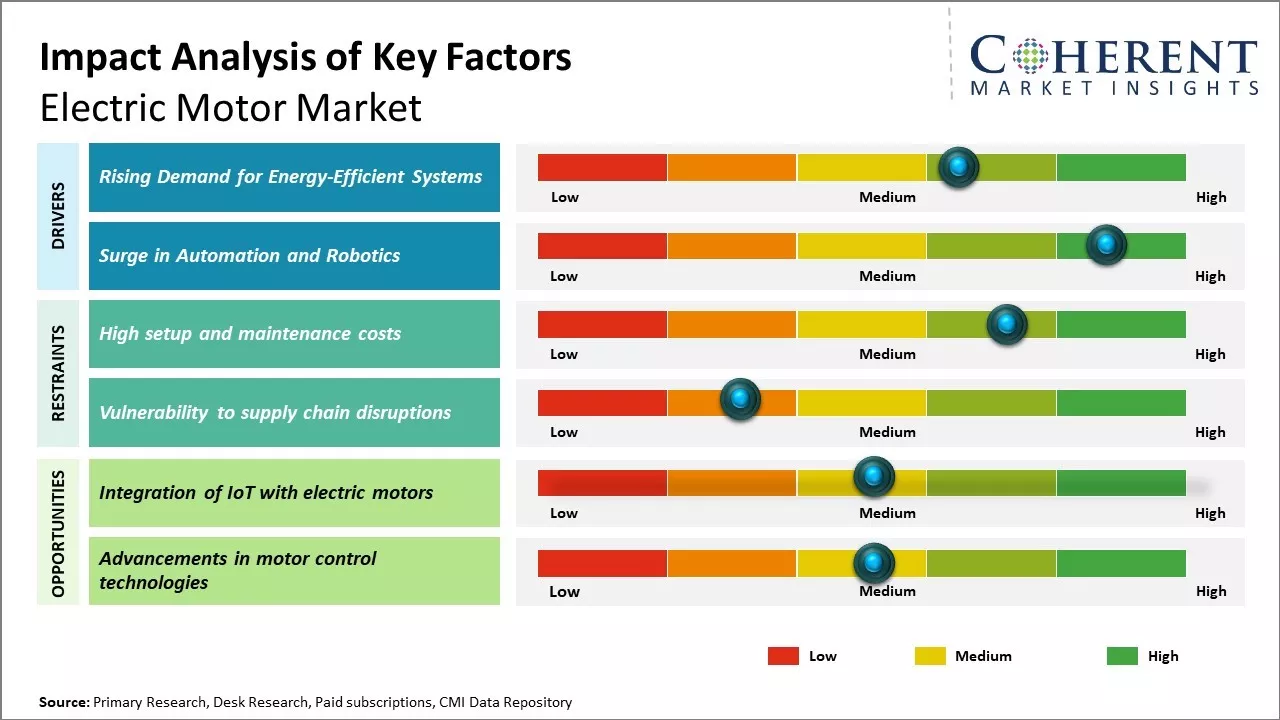
The electric motor market is witnessing positive trends driven by stringent emission norms and rising demand for energy-efficient systems. With greater acceptability of electric vehicles and strong government initiatives towards renewable energy, electric motor market demand from automotive and energy industries is growing steadily. Manufacturers are focusing on the development of smart motors integrated with Internet of Things (IoT) and cloud connectivity to optimize performance. Adoption of permanent magnet motors is increasing due to their high torque to weight ratio. Overall, the electric motor market is expected to flourish over the long-term owing to rapid industrialization and manufacturing automation worldwide.
Current Events and their Impact on the Electric Motor Market
Current Event | Description and its Impact |
Technology Transition to Magnet-Free Motor Architectures |
|
Regional EV Market Dynamics and Policy Shifts |
|
Key Manufacturers in Electric Motor Market
- ABB Ltd. (Sweden–Switzerland)
ABB, a global leader in electrification and automation, posted $32.9 billion in revenues for 2024, with its Motion (electric motor) division contributing around $6.7 billion. Motors are part of a broader portfolio spanning drives, robotics, and power systems. In India, ABB’s low-voltage motor business has enabled over 500 GWh of annual energy savings across industries, a level comparable to powering an entire Indian state. The company’s motion division supports industrial automation, HVAC, smart manufacturing, and data centers, with growing investments in sustainable motor and energy solutions, such as renewable backups for AI-fueled facilities.
- Nidec Corporation (Japan)
Nidec is a global powerhouse in small precision motors, automotive traction motors, and industrial drives. In the first nine months of FY2024, Nidec reported net sales of ¥1.945 trillion (approx. US $13 billion), up 11.5% year-on-year, with operating profit rising 5%. The company is scaling its Gen‑3 EV traction motors and expanding its automotive product lines under a strategic vision targeting ¥4 trillion in sales by FY2025, primarily across precision, automotive, and industrial divisions. While competition in the Chinese EV market has pressured margins, Nidec continues focusing on high-efficiency, brushless DC motors and modular electric axle systems (E-Axle) for global electric vehicles.
- WEG S.A. (Brazil)
WEG, one of the world’s largest motor manufacturers operating in over 140 countries, recently posted a 25.5% year-on-year revenue increase to 10.08 billion reais (~$285 million net profit) in Q1 2025, though advisory notes warned of macroeconomic uncertainty and tariff pressures. In 2024, WEG expanded by acquiring Regal Rexnord’s motor business—adding global manufacturing capacity across the U.S., Mexico, China, India, Italy, the Netherlands, and Canada, and generating over $542 million in operating revenue from that acquisition alone. WEG’s portfolio includes low- and high-voltage motors, special-purpose motors, and drives for industries such as oil & gas, renewables, mining, and power.
- Current Industry Events of 2026
- Market Size Estimation
- Regional Breakdown
- Competitive Landscape
- Customer Intelligence
- Segmental Analysis
- Pricing Analysis
- Key Market Drivers, Challenges & Future Trends
- Customized Insights Section
Segmental Insights
Electric Motor Market Insights, By Motor Type - Superior Efficiency and Versatility Drives AC Motor Dominance
In terms of motor type, AC motor contributes the highest share of the market owing 55.2% in 2026 due to its superior efficiency and versatility compared to other motor types. AC motors can efficiently utilize electric power at all speeds, thereby consuming less energy than alternatives. They maintain steady torque at varying speeds, making them suitable for a wide range of industrial applications requiring flexibility of operation. AC motors also produce less vibrations and noise than DC motors. The consistency of their torque output even during fluctuations in supply voltages further enhances their reliability. Their ability to start and stop smoothly without risk of overshooting also makes AC motors safer to use around humans in many commercial and residential applications. Their brushless design eliminates the need for periodic brush replacement, lowering maintenance costs over the motor's lifetime.
In December 2024, Danfoss Power Solutions launched its latest Editron ED3 onboard charger and ePTO, enabling AC charging up to 44 kW for heavy-duty off‑highway and truck applications. The compact, liquid‑cooled three‑in‑one device combines AC and DC ePTO functionality with a high‑power onboard charger that halves typical charging time compared to 22 kW systems. This is further propelling the electric motor market demand.
Electric Motor Market Insights, By Voltage - Wide Application Range Captures Peak Demand in 1 kV-6.6 kV Voltage Segment
In terms of voltage, the 1 kV-6.6 kV segment contributes the highest share of 49.3% in 2026 of the electric motor market due to catering to a wide range of industrial applications that maximize motor efficiency within this voltage band. Motors in the 1-6.6 kV range can effectively handle medium to heavy loads in industries like oil and gas, mining, power generation, and chemical processing without oversizing. They support a variety of common industrial equipment from pumps and fans to conveyers and material handling systems. The voltage headroom allows variable speed control for flexibility while keeping harmonic distortions lower than lower voltage alternatives. Further, recent grid connections in emerging economies have standardized in this medium voltage range, concentrating demand. As industrial automation proliferates and process plant capacities expand globally, optimal load matching within this voltage spectrum ensures maximum energy efficiency to be derived. Thereby, 1 kV-6.6 kV motors have dominated applications that span across sectors, capturing the highest electric motor market share.
In April 2025, Bharat Heavy Electricals Limited (BHEL) developed India’s first-ever 1,600 kW, 6.6 kV, 2‑pole, flameproof high‑tension (HT) motor, marking a major technological milestone. This state‑of‑the‑art motor is designed for applications in hazardous, high‑risk industrial environments where intrinsic safety and high-power output are critical. Featuring robust flameproof construction, the motor ensures safe and efficient operations under challenging conditions.
Electric Motor Market Insights, By End Use - Logistics Backbone Spurs Transportation Sector Demand
In terms of end user, the transportation sector leads the electric motor market owing 49.3% in 2026 due to the motors being extensively used as the logistics backbone. Motors find ubiquitous applications powering diverse transportation vehicles and equipment ranging from rolling stock and aircraft to industrial vehicles, automobiles and ships. In automobiles alone, over 40 motors are installed today to operate components from window lifts to climate control systems. Motors also energize various auxiliary functions across aircraft, metros, trams and freight trains. In the logistics industry, they are vital to material handling systems sustaining efficient movement of cargo. With transportation being a driver of globalization, motors have become indispensable to modern logistics operations. As international trade grows along with the rise of e-commerce, transportation networks are expanding concertedly. This widespread reliance on electric motors throughout diverse modes has elevated the transportation sector’s prominence as the largest end user segment.
In July 2025, Orbis Electric introduced its cutting‑edge HaloDrive, an axial‑flux in‑wheel motor-generator targeted at the commercial electric vehicle sector. Designed to integrate directly into the wheel hub, HaloDrive significantly reduces vehicle weight and boosts driving range by up to 20%. The motor offers up to 97% efficiency, simplified integration, and cost advantages over traditional EV drive systems.
Regional Insights
North America Electric Motor Market Analysis & Trends
North America has been the dominant region in the global electric motor market owing 39.7% in 2026. The presence of leading motor manufacturers such as ABB, Siemens, and General Electric has firmly established the motor supply chain in the region. Additionally, the well-developed industrial sector utilizing a plethora of motor-driven equipment has contributed to North America commanding the largest market share. Stringent energy efficiency standards implemented by organizations like the Consortium for Energy Efficiency have also pushed the adoption of premium efficiency motors.
With factories closer to the major end-user industries, companies in North America have lower transportation costs and faster turnaround times. This enables just-in-time manufacturing and supply. The regional presence also allows these firms to customize offerings as per client requirements better than overseas competitors. Local manufacturing also means they face fewer trade barriers and do not have currency risk exposure. Together, these factors have enabled North American electric motor providers to defend their market leadership.
For instance, in July 2026, Best Electric Machine (BEM), a Massachusetts-based innovator in electric motor systems, launched an early-access program for its groundbreaking SYNCHRO‑SYM™ motor-generator system. This pioneering architecture eliminates rare-earth permanent magnets and doubles nominal power density while halving losses, copper usage, and costs. The symmetric, dual-active stator–rotor topology enables up to 8× peak torque, achieving unmatched efficiency and affordability.
Asia Pacific Electric Motor Market Analysis & Trends
On the other hand, Asia Pacific has emerged as the fastest growing regional market. The burgeoning industrial and manufacturing activity in countries like China and India is the primary driver of this growth. Both nations are witnessing expansions and new plants across industries like construction, pharmaceuticals, automotive, etc. This is translating to massive demand for industrial motors. SEA nations are also industrializing rapidly to become global export hubs, augmenting regional requirements.
For instance, in June 2026, ABB introduced its latest innovation, the AMXE Marine Motor, a compact, high‑power electric propulsion system built for small‑ to mid‑sized electric and hybrid vessels. Engineered to endure harsh seawater environments and strong currents, the motor delivers ABB’s highest power density while occupying minimal space. Its water‑cooled design eliminates external ventilation, reducing noise and vibration for smoother onboard operations.
Electric Motor Market Outlook Country-Wise
China Electric Motor Market Trends
China leads the global Electric Motor Market Demand due to its dominance in EV manufacturing and industrial production. The rapid adoption of electric vehicles by brands like BYD and NIO, supported by government subsidies and the NEV policy, has fueled strong demand for efficient motors. Beyond EVs, China’s focus on robotics, wind energy, and smart appliances further boosts motor usage. With a mature manufacturing base and top exporters like Harbin Electric, China is both a major consumer and global supplier of electric motors, driving innovation and scale across industries.
In February 2026, BorgWarner secured a major electric motor contract with a leading Chinese OEM, further expanding its footprint in China’s burgeoning new energy vehicle (NEV) market. The motor features a platform-based design compatible across BEV and hybrid models, and uses its ultra‑short hairpin welding process to reduce size and improve packaging efficiency, further enhancing the electric motor market revenue.
The U.S. Electric Motor Market Trends
The United States is a key driver of the electric motor market demand, fueled by rapid electrification in transportation and industry. Major automakers like Tesla and GM are scaling EV production, while electric motors are increasingly used in HVAC systems and smart factories for improved energy efficiency. Government support, including U.S. Department of Energy programs, promotes motor efficiency and innovation. Together, these factors position the U.S. as a leading market for electric motor demand.
In July 2026, Best Electric Machine (BEM), a U.S. innovator in variable‑speed electric motor‑generator systems, launched an early‑access program for its latest patented technology, ahead of schedule. The system promises heightened efficiency and performance for industrial and energy applications.
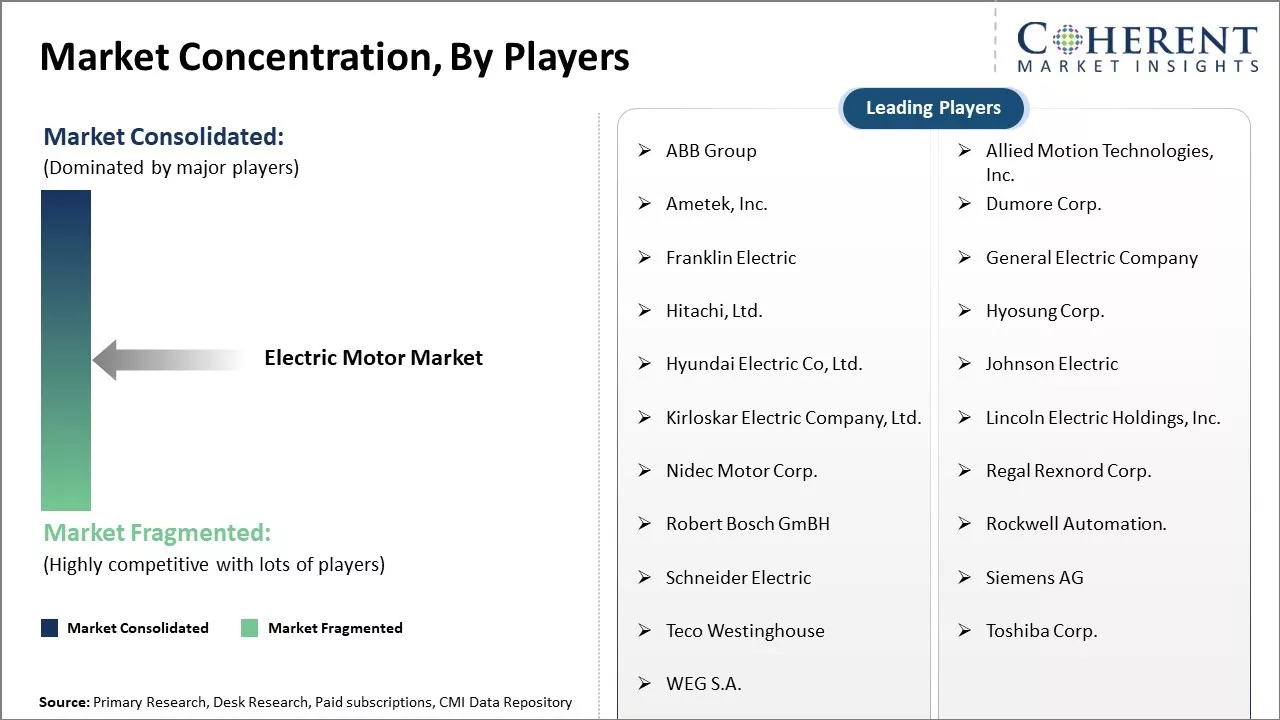
Market Concentration and Competitive Landscape
Electric Motor Industry News
- In July 2025, Conifer, a Silicon Valley–based startup founded by veterans of Lucid Motors and Apple’s Project Titan, unveiled its first electric motor that entirely avoids rare earth elements by using abundant ferrite (iron‑based) magnets. Leveraging a compact axial‑flux (disc‑shaped) design and proprietary stator technology, the motor delivers higher efficiency and power density while occupying half the size of comparable models.
- In May 2025, Chennai‑based private space startup Agnikul Cosmos successfully test‑fired India’s first electric motor‑driven semi‑cryogenic rocket engine. The engine uses liquid oxygen and refined kerosene, with an electric motor powering its pumps, enabling highly precise throttle control across thrust levels. Many pump subsystems were 3D‑printed and assembled at Rocket Factory‑1, Agnikul’s AS9100D‑certified facility within IIT Madras Research Park.
- In April 2025, Ahmedabad‑based Matter Motor launched the Aera 5000+, India’s first geared electric motorcycle. The bike features a 4‑speed manual gearbox with clutch, paired with an 11.5 kW liquid‑cooled motor, allowing a top speed of around 105 km/h and a 0–40 km/h sprint in approximately 2.8 seconds.
- In July 2023, General Electric Vernova's Solar & Storage Solutions teamed up with Fortune Electric is a leading company specializing in electrical engineering and manufacturing. to create Battery Energy Storage Solutions (BESS) in Taiwan. The aim is to utilize electric motors within the storage system to regulate energy flow, manage battery charging and discharging, and ensure seamless integration of stored energy.
Market Report Scope
Electric Motor Market Report Coverage
| Report Coverage | Details | ||
|---|---|---|---|
| Base Year: | 2025 | Market Size in 2026: | USD 155.40 Bn |
| Historical Data for: | 2020 To 2024 | Forecast Period: | 2026 To 2033 |
| Forecast Period 2026 to 2033 CAGR: | 7.5% | 2033 Value Projection: | USD 257.82 Bn |
| Geographies covered: |
| ||
| Segments covered: |
| ||
| Companies covered: | ABB Group, Allied Motion Technologies, Inc., Ametek, Inc., Dumore Corp., Franklin Electric, General Electric Company, Hitachi, Ltd., Hyosung Corp., Hyundai Electric Co, Ltd., Johnson Electric, Kirloskar Electric Company, Ltd., Lincoln Electric Holdings, Inc., Nidec Motor Corp., Regal Rexnord Corp., Robert Bosch GmBH, Rockwell Automation., Schneider Electric, Siemens AG, Teco Westinghouse, Toshiba Corp., and WEG S.A. | ||
| Growth Drivers: |
| ||
| Restraints & Challenges: |
| ||
Electric Motor Market Driver
- Rising Demand for Energy-efficient Systems
With growing environmental conservation concerns worldwide, there is an increasing push towards replacing old mechanical drive systems with more energy efficient electric motor driven systems. Electric motors provide higher levels of efficiency compared to systems driven by combustion engines. They can optimize energy usage and cut greenhouse gas emissions significantly. Many industries are actively seeking ways to reduce their carbon footprint and lower operating costs. Electric motors address both these needs very well. Switching to motor-driven equipment allows reducing electricity wastage and fuel consumption. They cause less wear and tear too since their operation involves fewer moving parts compared to other technologies. The payback period for investing in electric motor systems has become very attractive considering long term energy savings. To meet international climate targets, governments are also offering various subsidies and tax rebates to industries adopting green technologies. This is motivating more companies to replace their fossil-fuel guzzling machinery with electric alternatives. The trend is especially strong in commercial sectors like Heat Ventilation and Air Conditioning (HVAC), packaging, material handling, and machine tools where efficiency gains can be substantial. Overall, the economic and environmental benefits of electric motorization are boosting its adoption across multiple industrial verticals.
For instance, ABB has launched an energy‑efficient propulsion package for electric buses, featuring the AMXE250 motor paired with the HES580 inverter, the first three‑level inverter introduced to the electric bus market.
Analyst Opinion (Expert Opinion)
The electric motor market in 2025 is no longer characterized by incremental innovation; it has rapidly evolved into a cornerstone of industrial competitiveness and decarbonization strategy.
In industrial settings, adoption of IE4 and IE5 class motors is accelerating, particularly in HVAC, manufacturing, and water treatment sectors. Simultaneously, original equipment manufacturers (OEMs) in the automotive industry are increasingly deploying axial flux and permanent magnet synchronous motors (PMSMs) to enhance torque density and thermal efficiency. Mercedes-Benz’s integration of axial flux motors within its AMG.EA platform exemplifies this shift, enabling notable space and weight reductions that contribute to improved packaging efficiency and thermal management.
Equally significant is the integration of motor control with real-time diagnostics enabled through IoT platforms. Leading firms such as Schneider Electric, Siemens, and ABB are advancing intelligent motor control centers (iMCCs) that seamlessly interface with edge computing environments. ABB’s Ability Smart Sensor-equipped motors, for instance, have demonstrated the potential to reduce downtime by up to 70% and extend operational lifespan by 30%, according to deployment results in the textile and process industries.
In the sub-1kW segment, a growing cost-performance asymmetry is reshaping market dynamics. The robotics, drone, and consumer appliance sectors are witnessing a surge in demand for compact, efficient motors. While large manufacturers have traditionally focused on high-power applications, companies from China and South Korea are capturing market share with low-cost, reliable brushless DC (BLDC) motors. This shift is disrupting global supply chains, particularly for Western OEMs that rely heavily on Asian-sourced components.
Regulatory developments are no longer passive compliance mechanisms; they now actively shape product design and innovation priorities. Frameworks such as the European Union’s Ecodesign Regulation 2019/1781 and India’s BEE Star Rating system have emerged as critical levers influencing R&D and procurement criteria. These policies often outpace commercial readiness and pose significant challenges for mid-tier manufacturers that struggle to meet concurrent requirements for energy efficiency and digital integration.
Speak to the analyst
Want personalized insights?
Take the findings above to one of our principal consultants, or have the report rebuilt around the segments, geographies and competitors you actually track.
Market Segmentation
- Motor Type Insights (Revenue, USD Bn, 2026 - 2033)
- AC Motor
- DC Motor
- Hermetic Motors
- Voltage Insights (Revenue, USD Bn, 2026 - 2033)
- Up to 1 kV
- 1 kV-6.6 kV
- Above 6.6 kV
- End User Insights (Revenue, USD Bn, 2026 - 2033)
- Industrial
- Commercial
- Residential
- Agriculture
- Transportation
- Regional Insights (Revenue, USD Bn, 2026 - 2033)
- North America
- U.S.
- Canada
- Latin America
- Brazil
- Argentina
- Mexico
- Rest of Latin America
- Europe
- Germany
- U.K.
- France
- Italy
- Russia
- Rest of Europe
- Asia Pacific
- China
- India
- Japan
- Australia
- South Korea
- ASEAN
- Rest of Asia Pacific
- Middle East & Africa
- GCC Countries
- South Africa
- Rest of Middle East & Africa
- North America
- Key Players
- ABB Group
- Allied Motion Technologies, Inc.
- Ametek, Inc.
- Dumore Corp.
- Franklin Electric
- General Electric Company
- Hitachi, Ltd.
- Hyosung Corp.
- Hyundai Electric Co, Ltd.
- Johnson Electric
- Kirloskar Electric Company, Ltd.
- Lincoln Electric Holdings, Inc.
- Nidec Motor Corp.
- Regal Rexnord Corp.
- Robert Bosch GmBH
- Rockwell Automation
- Schneider Electric
- Siemens AG
- Teco Westinghouse
- Toshiba Corp.
- WEG S.A.
Sources
Primary Research Interviews from the following stakeholders
Stakeholders
- Interviews with electric motor manufacturers, component suppliers, OEM engineers, plant managers, maintenance heads, automation system integrators, procurement leads, and utility operators across global industrial, automotive, and energy sectors.
Specific Stakeholders
- EV powertrain engineers at automotive OEMs
- Electrical and maintenance engineers at manufacturing plants
- Design engineers and R&D heads at HVAC system manufacturers and appliance brands
- Operations heads in renewable energy projects
- Facilities and MEP consultants involved in building automation and industrial electrification
- Procurement leads at railways and metro authorities
- Automation engineers and robotics integrators using precision motors for industrial motion control
Databases
- World Bank Energy Use Statistics
- UN Comtrade Database – HS Codes 8501, 8503
- International Energy Agency (IEA) Data & Statistics Portal
- Eurostat – Industrial Equipment & Motor Usage Data
- China Customs Statistics – Electric Motor Exports & Imports
- U.S. Census Bureau – International Trade Data for Electric Motors
- Directorate General of Commercial Intelligence and Statistics (DGCIS), India
- National Bureau of Statistics of China
- Korea Electric Power Corporation (KEPCO) Data Portals
Magazines
- Automation World
- Plant Engineering Magazine
- Motion Control & Automation
- Electric & Hybrid Vehicle Technology International
- Power Transmission Engineering
- Motor Magazine
- Energy & Power Magazine
- Design World – Motion Control Section
Journals
- IEEE Transactions on Industrial Electronics
- IEEE Transactions on Energy Conversion
- IEEE Transactions on Transportation Electrification
- Journal of Electrical Engineering & Technology
- International Journal of Electric and Hybrid Vehicles (IJEHV)
- Journal of Energy Engineering
- Mechanical Systems and Signal Processing (Elsevier)
Newspapers
- The Economic Times – Energy & Auto Components
- Business Standard – Engineering & Infrastructure
- Nikkei Asia – Manufacturing & EV Supply Chain
- South China Morning Post – Green Energy & Export Trends
- The Wall Street Journal – Global Supply Chain and Auto Industry
- The Hindu Business Line – EV and Industrial Automation
Associations
- National Electrical Manufacturers Association (NEMA)
- International Electrotechnical Commission (IEC)
- International Energy Agency – Electric Motor Systems Efficiency Program (EMSA)
- European Committee of Manufacturers of Electrical Machines and Power Electronics (CEMEP)
- Electrical Apparatus Service Association (EASA)
- Indian Electrical & Electronics Manufacturers’ Association (IEEMA)
- China Electrical Equipment Industrial Association (CEEIA)
Public Domain Sources
- Ministry of Power, Government of India
- Department of Heavy Industry – Electrical Machinery Report
- U.S. Department of Energy – Motor System Market Assessment
- National Institute of Standards and Technology (NIST)
- Energy Efficiency Services Limited (EESL) – Motor Replacement Initiatives
- Ministry of Economy, Trade and Industry (METI), Japan
- Eurostat – Energy Efficiency Reports for Motor Systems
- India Energy Dashboard – NITI Aayog
- European Commission – EcoDesign & Motor Efficiency Directives
Proprietary Elements
- CMI Data Analytics Tool, and Proprietary CMI Existing Repository of information for last 8 years
*Definition: The electric motor market involves companies that manufacture electric motors in various power ranges and designs. Electric motors are used across industries to convert electrical energy into mechanical energy and power various machines and equipment. The market includes companies producing AC and DC motors used in industrial machinery, vehicles, home appliances, HVAC equipment, and other applications. Key players in the electric motor market offer motors optimized for different applications with advanced technologies for higher efficiency, precision and durability.
Get access to 250+ pages report
Every segment, forecast, competitor profile and data table behind the analysis above — available for instant download.
- ESOMAR Member
- ISO 9001:2015 Certified
- D-U-N-S Registered
- GDPR & CCPA Compliant
Missing comfort of reading report in your local language? Find your preferred language:
Transform your Strategy with Exclusive Trending Reports
Frequently Asked Questions
The Electric Motor Market is estimated to be valued at USD 155.40 Bn in 2026, and is expected to reach USD 257.82 Bn by 2033.
The CAGR of the Electric Motor Market is projected to be 7.5% from 2026 to 2033.
Rising demand for energy-efficient systems and surge in automation and robotics are the major factors driving the growth of the electric motor market.
High setup and maintenance costs and vulnerability to supply chain disruptions are the major factors hampering the growth of the electric motor market.
In terms of motor type, AC motor is estimated to dominate the market revenue share in 2026.
ABB Group, Allied Motion Technologies, Inc., Ametek, Inc., Dumore Corp., Franklin Electric, General Electric Company, Hitachi, Ltd., Hyosung Corp., Hyundai Electric Co, Ltd., Johnson Electric, Kirloskar Electric Company, Ltd., Lincoln Electric Holdings, Inc., Nidec Motor Corp., Regal Rexnord Corp., Robert Bosch GmBH, Rockwell Automation., Schneider Electric, Siemens AG, Teco Westinghouse, Toshiba Corp., and WEG S.A. are the major players.
North America is expected to lead the electric motor market in 2026.