

Asia Teleshopping Market Size and Share Analysis- Growth Trends and Forecasts (2026-2033)
The Asia Teleshopping Market size is anticipated to grow at a CAGR of 8.1%, with USD 79.84 Bn in 2026, and is expected to reach USD 137.91 Bn by 2033. The primary growth drivers are largely defined by the rising penetration of television and digital shopping channels, increasing adoption of smartphones and internet-enabled commerce, growing consumer preference for convenient home-based purchasing, expansion of direct-to-consumer retail models, and wider integration of live-streaming and interactive shopping platforms. India’s TV audience is projected to reach 1 Bn by 2029, supported by rising incomes and expanding internet penetration.
Key Takeaways
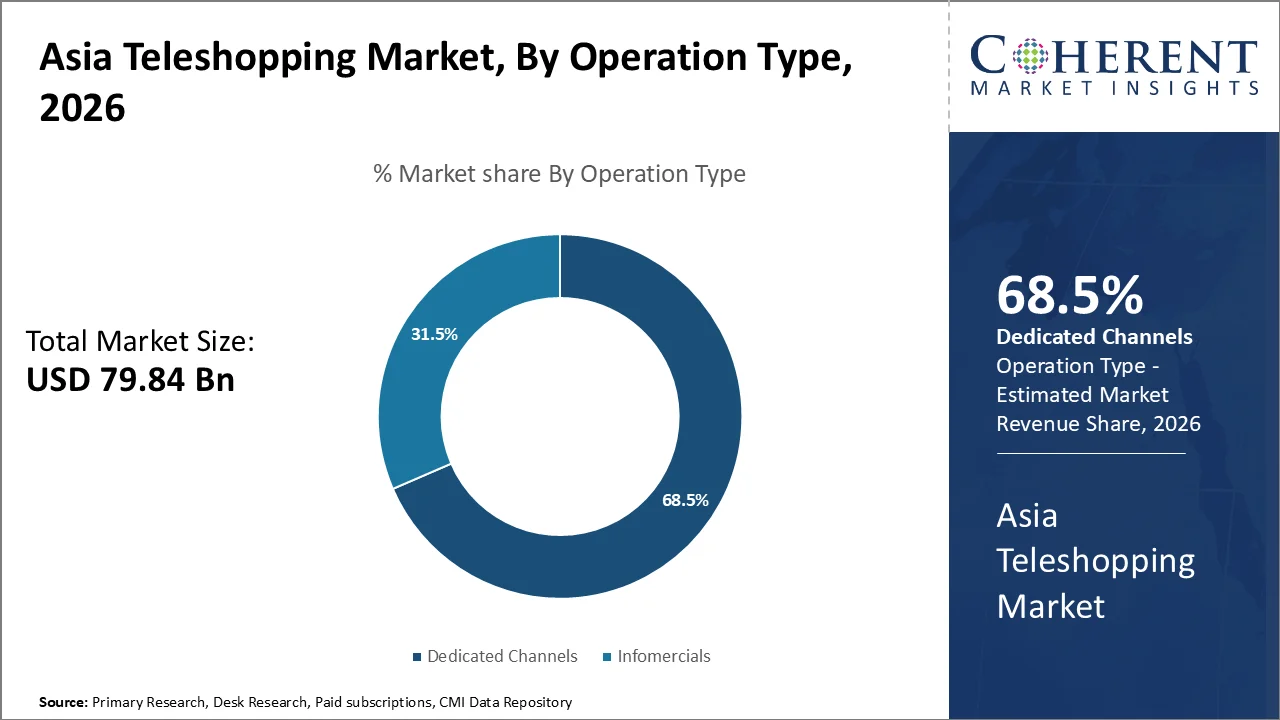
- The dedicated channels segment is likely to dominate the market with 68.5% in 2026. The segment’s growth is owing to 24/7 broadcasting, repeated product demonstrations, wider household reach, and increasing integration of television selling with livestream and video-commerce formats. CJ OnStyle reported 80 million cumulative mobile live-commerce visitors in 2025, while mobile-live commerce grew 66% year-on-year. Its mobile platform also carried approximately 20,000 brands and operated 54 live-content IPs, reflecting the transition of traditional dedicated teleshopping channels toward integrated TV-mobile commerce models.
- The consumer electronics segment is set to lead the product type category with 33.8% in 2026. The segment’s growth is owing to the suitability of electronics for live demonstrations, feature comparisons, bundled offers, frequent product launches, and relatively high transaction values. According to China government data released on January 21, 2026, retail sales of home appliances reached nearly CNY 1.17 trillion in 2025, while communication-device sales approached CNY 1.01 trillion.
- The cash on delivery segment is expected to account for the highest share of 35.5% in 2026 for the payment method segment. The segment’s growth is attributed to consumers’ preference for payment after receipt of product, increased confidence of first-time buyers, low payment friction and continued usage across rural and semi-urban markets. While UPI and other digital payment mechanisms have expanded rapidly, the Shiprocket–KPMG Bharat 2.0 report published in 2025 found that around 105 million consumers in India continue to prefer cash on delivery, particularly across rural and semi-urban locations.
Market Drivers
Rapid Expansion of Online Retail is Strengthening the Asia Teleshopping Market
The Asia Teleshopping Market is benefiting from the continued growth of online retail and remote buying channels. As consumers become more comfortable with non-store retail, traditional teleshopping companies are adding television programming with online ordering, mobile applications and digital commerce platforms.
According to the National Bureau of Statistics of China, China’s online retail sales reached RMB 15.97 trillion in 2025, increasing 8.6% year-on-year. Online retail sales of physical goods reached RMB 13.09 trillion, increasing 5.2% and accounting for 26.1% of total retail sales of consumer goods.
Current Events and Their Impact on the Asia Teleshopping Market
Current Event | Description and its Impact |
China Implements New Live-Streaming E-Commerce Supervision Measures (February 1, 2026) |
|
India Operationalizes Digital Personal Data Protection Rules (November 14, 2025) |
|
- Current Industry Events of 2026
- Market Size Estimation
- Regional Breakdown
- Competitive Landscape
- Customer Intelligence
- Segmental Analysis
- Pricing Analysis
- Key Market Drivers, Challenges & Future Trends
- Customized Insights Section
Segmental Insights
Why are Dedicated Channels Acquiring the Largest Share?
On the basis of operation type, the dedicated channels segment is projected to account for the largest Asia Teleshopping Market share of 68.5% in 2026. The segment’s growth is owing to continuous programming, repeated product demonstrations, established household reach, presenter-led selling, and increasing integration of conventional television channels with mobile and digital ordering platforms.
QVC's Japanese operation generated approximately USD 825 million in revenue in 2025. QVC International, including Japan, Germany, the U.K., and other markets, generated USD 2.36 billion in 2025 revenue.
Why is Consumer Electronics Acquiring the Largest Share?
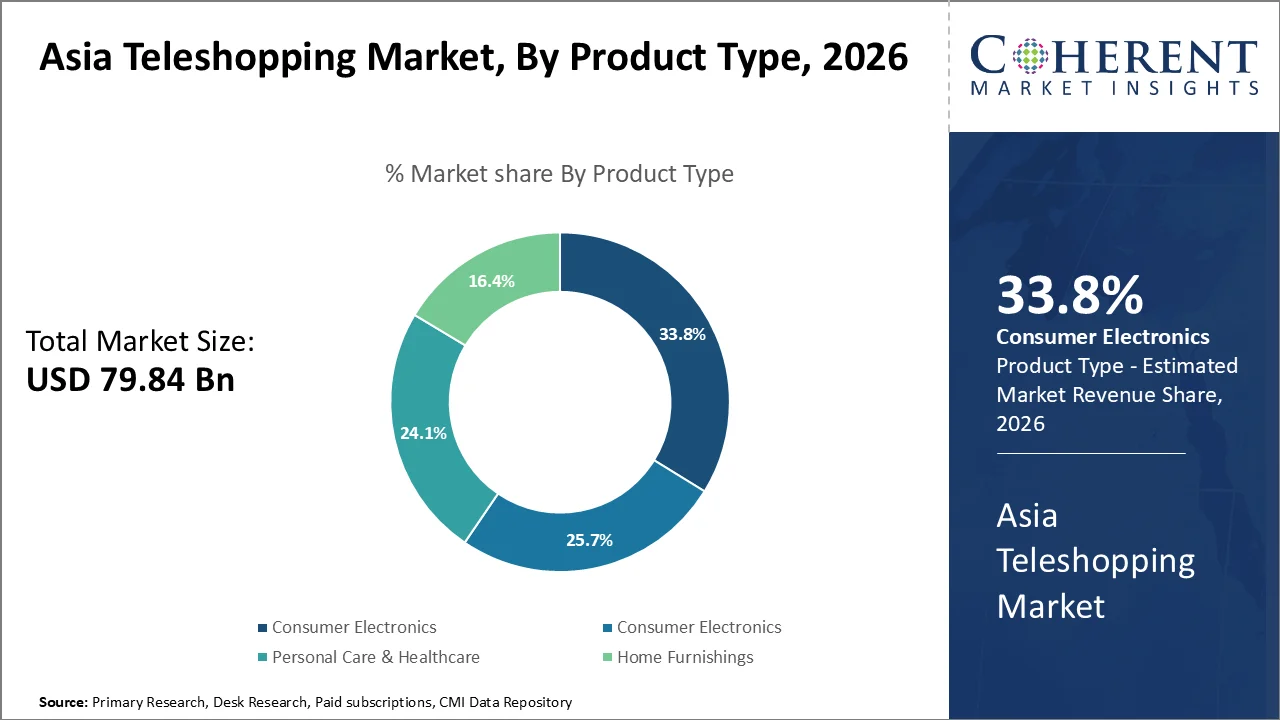
On the basis of product type, the consumer electronics segment is projected to hold the largest Asia Teleshopping Market share of 33.8% in 2026. The segment’s growth is owing to strong suitability for live demonstrations, product comparisons, limited-period discounts, bundled offers, installment promotions, and relatively high average selling prices.
According to Japan’s Ministry of Economy, Trade and Industry (METI), online sales of domestic electrical appliances, AV equipment, PCs, and peripherals reached JPY 2.7443 trillion in 2024. The category recorded an e-commerce penetration rate of 43.03%, one of the highest rates among Japan’s physical-goods categories, demonstrating strong consumer acceptance of remotely purchased electronics.
In April 2026, Amazon India launched a dedicated AI Store for consumer electronics, covering AI-enabled smartphones, laptops, televisions, tablets, wearables, air conditioners, refrigerators, and washing machines.
Why is Cash on Delivery Holding the Largest Market Share?
On the basis of payment method, the cash on delivery segment is projected to account for the largest Asia Teleshopping Market share of 35.5% in 2026. The segment’s growth is owing to payment convenience at product receipt, greater confidence among consumers reluctant to prepay, continued cash usage in emerging Asian markets, and suitability for telephone- and television-originated orders.
The Worldpay Global Payments Report 2026 highlights that Southeast Asian countries continue to record some of the highest cash-on-delivery adoption rates globally. COD maintains double-digit shares of online payments in Indonesia, the Philippines, Taiwan, Thailand, and Vietnam, indicating continued relevance despite rapid expansion of wallets and account-to-account payments.
In June 2026, Sepoy & Co. implemented Cashfree Payments’ One Click Checkout with a redesigned COD mechanism for its Indian D2C operations. Instead of eliminating COD, the company retained the payment option and introduced a INR 90 COD charge collected at delivery to improve order quality.
Asia Teleshopping Market Trends
- The rising convergence of linear television, connected TV, and digital commerce is transforming conventional teleshopping into an omnichannel retail model. TRAI published a consultation paper in April 2026, citing around 193 million television households in India in 2025, including conventional and connected-TV households. TRAI’s own data puts the connected-TV households at around 102 million and linear-TV households at 105 million. That indicates a fast-growing opportunity for teleshopping firms to marry broadcast reach with interactive digital purchasing.
- The scale of traditional television broadcasting continues alongside digital platforms and this is supporting a hybrid rather than purely digital evolution of teleshopping. In November 2025, the Government of India reported that television reached nearly 900 million viewers across 230 million households, showing that television still offers significant mass-market reach even as shopping transactions increasingly move to mobile and online platforms.
- The increasing use of interactive and shoppable video is leading teleshopping companies to shift from one-way TV broadcasts to real-time engagement, demonstrations, polls and instant buying. In March 2025, the Infocomm Media Development Authority of Singapore announced that an interactive live-commerce implementation achieved a 95% completion rate for live videos between 30 and 60 minutes, generating up to 20 shopping clicks per second during live streams.
Large Digital Commerce Base and Omnichannel Ecosystem are Strengthening the China Teleshopping Market
China is expected to dominate the Asia Teleshopping Market with an estimated share of 42.5% in 2026. The country’s leading position is attributed to its huge digital consumer base, extensive logistics infrastructure, widespread mobile commerce and quick integration of livestreaming with traditional home-shopping and video-selling models. Coherent Market Insights states that China is expected to have the largest market share in the Asia Pacific home-shopping market in 2026.
According to the China Internet Network Information Center data as reported by the Chinese government in February 2026, China’s internet users also reached 1.125 billion by the end of 2025, and the internet penetration rate was 80.1%. Such a connected population is a huge audience for television-to-mobile, livestream and interactive home-shopping formats.
Expanding Digital Retail and Regional-Language Home Shopping are Accelerating the India Teleshopping Market
India is expected to hold an estimated 10.5% share of the Asia Teleshopping Market in 2026. Growth is supported by improving last mile logistics and sustained demand for home delivered products across Tier II and Tier III cities, rising digital adoption, regional-language television commerce, and increasing e-retail participation.
Who are the Major Companies in Asia Teleshopping Industry
Some of the major key players in Asia Teleshopping Market are ShopChannel, China Shopping Network, Network18 (HomeShop18), Shop CJ, Naaptol, Zee Media Corporation Ltd., Telebrands Corp.
Key News
- In February 2026, Jupiter Shop Channel and Insight Edge announced the deployment of an AI-based program-scheduling optimization system. The system entered full-scale operation in December 2025 and uses AI to generate programming schedules designed to maximize sales and new-customer acquisition while managing complex broadcasting requirements.
- In August 2026, Zee Media reported that its network had expanded to 36 digital properties, 16 TV news channels, 14 news apps, and three digital news channels across 12 languages.
Market Report Scope
Asia Teleshopping Market Report Coverage
| Report Coverage | Details | ||
|---|---|---|---|
| Base Year: | 2025 | Market Size in 2026: | USD 79.84 Bn |
| Historical Data for: | 2020 To 2024 | Forecast Period: | 2026 To 2033 |
| Forecast Period 2026 to 2033 CAGR: | 8.1% | 2033 Value Projection: | USD 137.91 Bn |
| Segments covered: |
| ||
| Companies covered: | ShopChannel, China Shopping Network, Network18 (HomeShop18), Shop CJ, Naaptol, Zee Media Corporation Ltd., Telebrands Corp. | ||
| Growth Drivers: |
| ||
| Restraints & Challenges: |
| ||
Analyst Opinion
- The Asia Teleshopping Market is increasingly evolving from traditional television-led selling toward an integrated TV-and-digital commerce model. Established home-shopping operators continue to retain substantial television reach while building mobile and online customer touchpoints. As of March 2025, the TV channel’s reach was around 32.1 million television households in Japan, according to Jupiter Shop Channel, and the website and app drew around 159-million-page views per month and 3.2 million monthly unique users.
- Significant growth in online retailing across mature Asian markets is opening up a favorable environment for teleshopping companies to expand beyond traditional broadcasting. Sales at major online retailers rose 11.8% on-year in 2025, compared with a mere 0.4% growth for offline retailers, according to South Korea's Ministry of Trade, Industry and Resources.
- Dedicated television shopping is expected to remain an important customer-acquisition and product-demonstration channel, although the market is moving toward a hybrid operating structure. QVC Japan currently reaches approximately 29 million households, illustrating the continuing scale of dedicated television-shopping distribution in one of Asia's mature markets.
Speak to the analyst
Want personalized insights?
Take the findings above to one of our principal consultants, or have the report rebuilt around the segments, geographies and competitors you actually track.
Market Segmentation
- By Operation Type (Revenue, USD Bn, 2021-2033)
- Dedicated Channels
- Infomercials
- By Product Type (Revenue, USD Bn, 2021-2033)
- Consumer Electronics
- Apparel & Accessories
- Personal Care & Healthcare
- Home Furnishings
- By Payment Method (Revenue, USD Bn, 2021-2033)
- Cash on Delivery
- Net Banking
- Mobile Wallet
- Debit/Credit Card
Sources
Primary Research Interviews
- Teleshopping and home-shopping channel operators
- Television commerce and live-commerce executives
- E-commerce and omnichannel retail platform managers
- Consumer electronics and home-appliance brand managers
- Media buying and television advertising professionals
- Logistics, fulfillment, and last-mile delivery service providers
- Digital payment, cash-on-delivery, and payment gateway executives
- Broadcasting, consumer protection, and e-commerce regulatory experts
- Retail distributors and product sourcing managers
- Consumers using television, livestream, and remote shopping platforms
Databases
- World Bank
- International Telecommunication Union (ITU)
- United Nations Conference on Trade and Development (UNCTAD)
- International Monetary Fund (IMF)
- OECD Digital Economy Database
- National Bureau of Statistics of China
- Japan Ministry of Economy, Trade and Industry (METI)
- Telecom Regulatory Authority of India (TRAI)
- Reserve Bank of India (RBI)
- National Payments Corporation of India (NPCI)
- Korea Communications Commission (KCC)
- Infocomm Media Development Authority (IMDA), Singapore
Magazines
- Retail Asia
- Inside Retail Asia
- Campaign Asia
- Digital Commerce 360
- Retail4Growth
- Indian Retailer
- Television Asia Plus
- BroadcastPro Asia
Journals
- Electronic Commerce Research and Applications
- Journal of Retailing and Consumer Services
- International Journal of Retail & Distribution Management
- Journal of Interactive Marketing
- Telecommunications Policy
- Journal of Business Research
- Asia Pacific Journal of Marketing and Logistics
- International Journal of Consumer Studies
Newspapers
- The Economic Times
- Business Standard
- Nikkei Asia
- The Straits Times
- South China Morning Post
- The Korea Herald
- The Japan Times
- The Hindu BusinessLine
Associations
- Asia-Pacific Broadcasting Union (ABU)
- GSMA
- Cellular Operators Association of India (COAI)
- Internet and Mobile Association of India (IAMAI)
- Retailers Association of India (RAI)
- Korea Online Shopping Association
- Japan Direct Marketing Association (JADMA)
- Asia Pacific Retailers Association / regional retail industry bodies
- National broadcasting and television industry associations across key Asian countries
Public Domain Sources
- Government e-commerce and retail statistics
- Television household, broadcasting reach, and channel distribution data
- Digital payment and cash-on-delivery transaction statistics
- Consumer protection and advertising regulations
- Live-commerce and social-commerce policy publications
- Telecom, broadband, smartphone, and internet penetration statistics
- Stock exchange filings and corporate disclosures
- Publicly available consumer behavior and online shopping surveys
Proprietary Elements
- CMI Data Analytics Tool
- Proprietary CMI Existing Repository of Information for the Last 10 Years
Get access to 250+ pages report
Every segment, forecast, competitor profile and data table behind the analysis above — available for instant download.
- ESOMAR Member
- ISO 9001:2015 Certified
- D-U-N-S Registered
- GDPR & CCPA Compliant
Missing comfort of reading report in your local language? Find your preferred language:
Transform your Strategy with Exclusive Trending Reports
Frequently Asked Questions
The Asia Teleshopping Market is expected to reach USD 137.91 Bn by 2033, increasing from USD 79.84 Bn in 2026.
Major players operating in the Asia Teleshopping Market include ShopChannel, China Shopping Network, Network18 (HomeShop18), Shop CJ, Naaptol, Zee Media Corporation Ltd., and Telebrands Corp.
The high customer acquisition and advertising costs and rising competition from e-commerce and social commerce platforms are the key factors hampering growth of the Asia Teleshopping Market.
The increasing adoption of dedicated television and home-shopping channels, growing penetration of smartphones and internet-enabled commerce, rising preference for convenient home-based purchasing, and integration of livestreaming and interactive shopping platforms are driving market growth.
The Asia Teleshopping Market is anticipated to grow at a CAGR of 8.1% between 2026 and 2033.
China is projected to dominate the Asia Teleshopping Market, with an estimated 42.5% market share in 2026, supported by its large digital consumer base, developed logistics infrastructure, widespread mobile commerce adoption, and expanding livestream shopping ecosystem.
Teleshopping is a remote retail model involving the promotion and sale of products through television and home-shopping channels, increasingly integrated with mobile applications, websites, livestreaming, and other digital ordering platforms.