

Online Retail Market Size and Share Analysis - Growth Trends and Forecast (2026 - 2033)
The global online retail market size is expected to reach approximately USD 10,636 Bn in 2026 and is projected to grow at a compound annual growth rate (CAGR) of 18.0% during the forecast period (2026-2033), totaling USD 34,000 Bn by 2033. This can be attributed to rapid expansion of e-commerce, increasing internet and smartphone penetration, and growing preference for convenient, contactless, and time-efficient shopping experiences.
Key Takeaways from the Online Retail Market Report
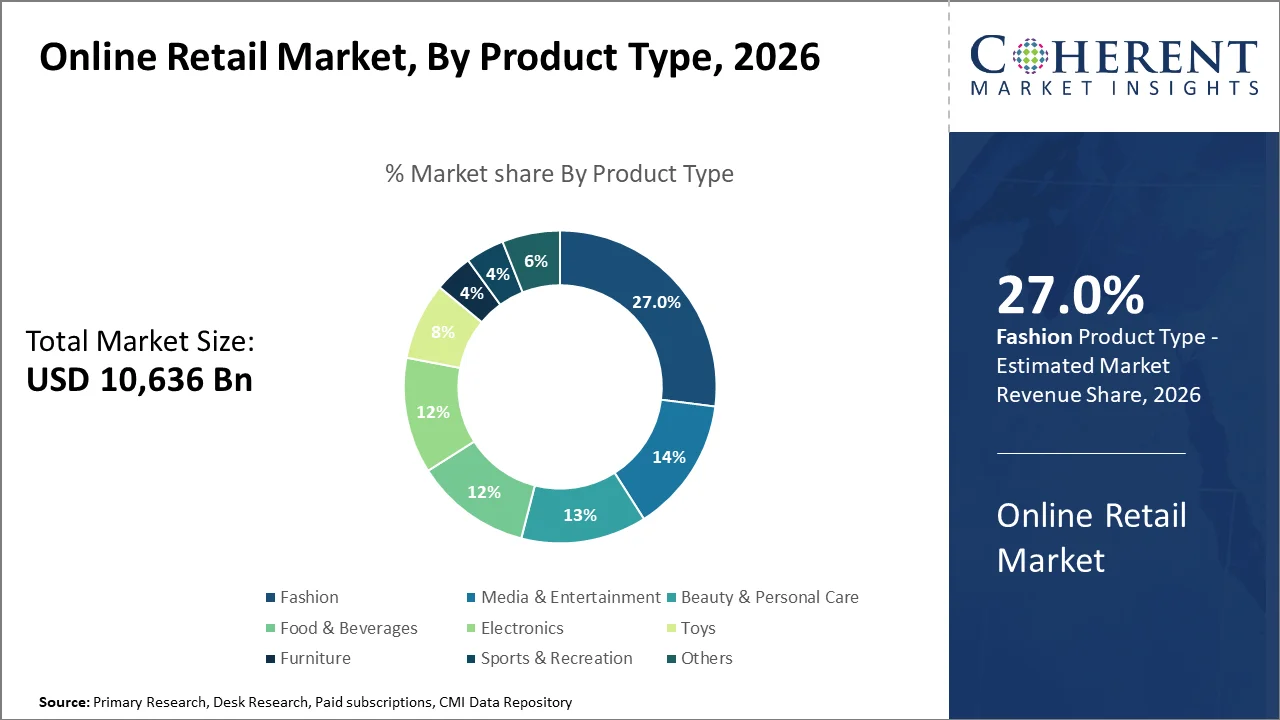
- Fashion segment is expected to lead the market with a share of 27% in 2026 due to strong consumer demand for apparel, rapidly changing trends, and wide availability of styles across online platforms. For instance, OECD e-commerce consumer data shows that 64% of online shoppers in the EU purchased clothing, footwear, and sporting goods, making it the most frequently purchased product category.
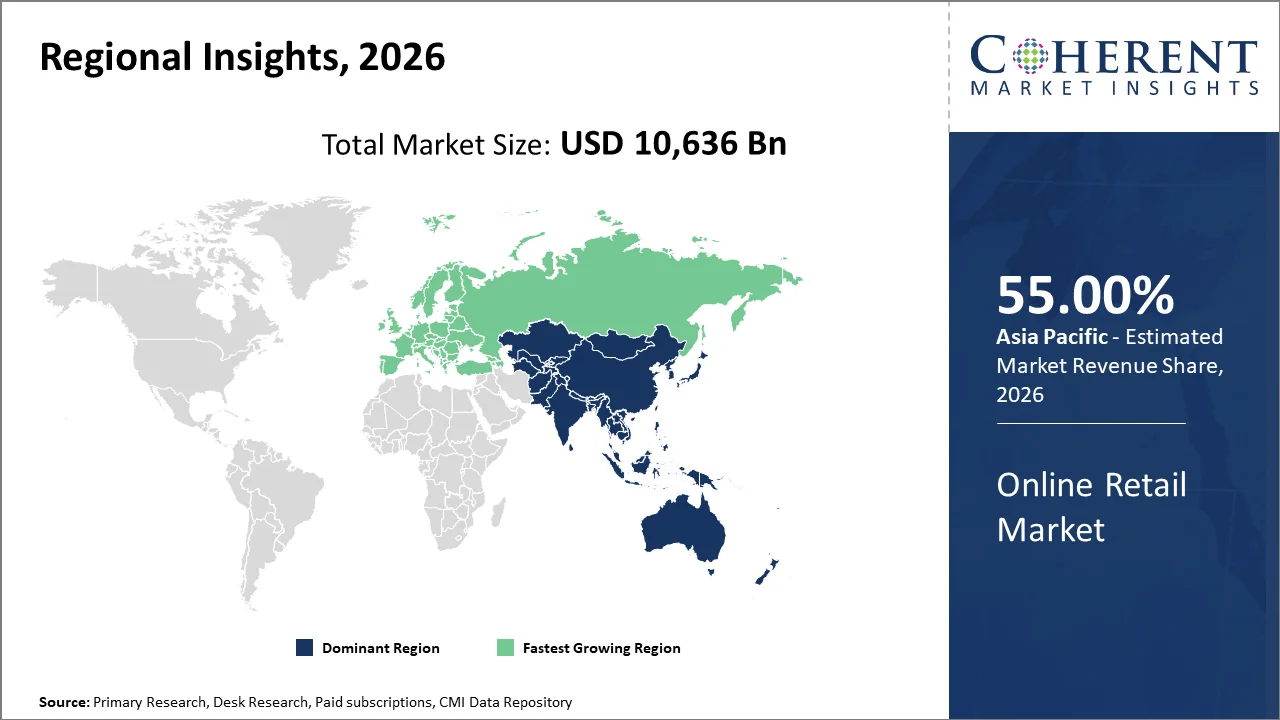
- Asia Pacific is set to dominate the global online retail industry with a share of 55% in 2026, owing to rapid digital adoption, expanding internet user base, increasing smartphone penetration, and strong presence of major e-commerce markets like China and India. For example,
- Europe, capturing a share of 22% in 2026, is anticipated to remain the second-largest market for online retail during the forecast period, thanks to high internet penetration, strong digital infrastructure, and well-established e-commerce platforms across nations like the UK, Germany, and France.
Online Retail Market Overview
The global online retail market is expected to register strong growth during the forecast period. This is mostly due to increasing internet and smartphone penetration, growing consumer preference for convenient shopping, wider availability of digital payment options, and continuous improvements in logistics and delivery services that make online purchasing faster and more reliable.
Online retail is gaining popularity in both developed and developing countries due to its wide selection of branded products available on a single platform, attractive discounts, and convenient home delivery services. According to various e-commerce industry reports, global online retail has shown steady growth over the past decade, thanks to increasing internet penetration and expansion of digital payment systems worldwide.
Expansion of digital payment systems is fostering growth of online retail market. Rise of secure digital payment methods, such as UPI, mobile wallets, and credit/debit card systems, has built trust in online transactions and reduced reliance on cash. Similarly, growth of e-commerce platforms is supporting market expansion. Global and regional platforms have made product discovery and purchasing seamless.
Personalized shopping experience is expected to positively impact online retail market growth during the forthcoming period. AI-powered recommendation systems and data analytics help online platforms understand customer preferences and show relevant products. This makes shopping easier as well as increases user engagement and improves the chances of purchase.
Social media and digital marketing influence is also boosting the market. Social commerce and influencer marketing on platforms like Instagram, Facebook, and TikTok strongly impact buying decisions, especially among younger consumers. These platforms help brands reach a wider audience and encourage quick purchase behavior.
Segmental Insights
Which Product Type Dominates the Online Retail Market?
Fashion Segment to Hold the Largest Market Share
According to Coherent Market Insights’ latest online retail market analysis, fashion segment is set to lead the market with a share of 27% in 2026. This can be attributed to rising consumer demand for apparel and accessories, driven by frequent purchase cycles and rapidly changing fashion trends.
Rise of fast fashion brands, aggressive digital marketing strategies, and influencer-led promotion on social media platforms are significantly boosting online sales in this category. In addition, improved user experience through mobile shopping apps, easy return policies, and personalized recommendations have made fashion one of the most convenient and preferred segments for online shoppers.
On the other hand, electronics segment is projected to register the highest CAGR during the forecast period, capturing a market share of 24% in 2026. This is mostly due to increasing adoption of smartphones, laptops, gaming devices, and smart home technologies.
- Current Industry Events of 2026
- Market Size Estimation
- Regional Breakdown
- Competitive Landscape
- Customer Intelligence
- Segmental Analysis
- Pricing Analysis
- Key Market Drivers, Challenges & Future Trends
- Customized Insights Section
Online Retail Market Growth Drivers
Rapid Smartphone and Internet Penetration
Increasing adoption of smartphones and rising internet penetration are providing a strong impetus to the growth of the online retail market. According to This rapid increase in smartphone usage and internet connectivity is expected to create a highly conducive environment for the expansion of the online retail industry during the forthcoming period.
Online Retail Market Opportunities
Improved Logistics and Last-Mile Delivery
Increasing advancements in logistics infrastructure and last-mile delivery networks are creating lucrative growth opportunities for online retail market. Efficient supply chains are making online retail more reliable and customer-friendly. Similarly, expansion of same-day and next-day delivery services in many regions is enhancing consumer satisfaction and driving repeat purchases. In addition, the growing network of warehouses and fulfillment centers, along with improved tracking systems and simplified return processes, is strengthening operational efficiency and encouraging wider adoption of online retail platforms.
Online Retail Market Trends
Rise of AI-Driven Agentic Commerce
AI assistants are being used by many shoppers to do the comparison of prices and place an order for goods. These AI tools have created a shopping interface for online shopping. Additionally, it helps in creating a cart that is not bound by any platform.
For example, in January 2026, AI concierge allows users to shop through conversation as an alternative to the traditional search bar. Similarly, in May 2025, Shopify launched an AI tool that builds complete online stores from keywords.
Current Events and Their Impact on the Online Retail Market
Current Event | Description and its Impact |
Record growth in ultra-fast delivery (Amazon & Walmart, 2025–2026) |
|
Rise in AI-powered online shopping scams (global, 2025–2026) |
|
Regional Insights
Asia Pacific Remains at the Epicenter of Online Retail Ma
Asia Pacific is expected to retain its dominance over the global online retail market with a 55% share in 2026. This can be attributed to increasing adoption of smartphones, expanding middle-class populations, and rapid digital payment adoption, especially in nations like China, India, and Japan.
Rise of mobile-first and social commerce ecosystems, such as Alibaba’s live commerce model and India’s UPI-based instant payments system, are boosting Asia Pacific online retail market growth. China alone accounts for the majority of regional sales, while India is among the fastest-growing e-commerce markets globally with a double-digit CAGR expected through 2030.
Europe Remains a Prominent Market for Online Retailers
Europe is expected to account for 22% of the global online retail market share in 2026. This is mostly due to high internet penetration, strong consumer trust, and well-developed cross-border e-commerce systems. Rise of omnichannel retail models and increasing demand for sustainable and second-hand (“recommerce”) shopping are also supporting expansion of Europe online retail market.
Convenience and time efficiency play a key role in fueling demand for online retail across Europe. Consumers in the region increasingly prefer online shopping because it eliminates the need to visit physical stores. Features such as doorstep delivery, easy returns, and 24/7 availability significantly enhance convenience.
Online Retail Market Outlook – Country-wise
U.S. Online Retail Market Trends
The U.S. is expected to remain a leading market for online retail during the assessment period. This is due to increasing consumer spending power, advanced logistics infrastructure, and rising adoption of digital shopping platforms. Rapid expansion of omnichannel retail, AI-driven personalization, and same-day delivery services led by players are also supporting market expansion.
Shift toward mobile commerce and subscription-based shopping models is a key growth-shaping trend in the U.S. mobile retail market. Growth is also supported by innovations like Amazon’s AI shopping assistants and Walmart’s expanded automated fulfillment centers, improving delivery speed and customer experience.
China Online Retail Market Forecast
China’s online retail industry is poised to exhibit robust growth throughout the forecast period. This is attributable to presence of a highly digital consumer base, strong mobile payment ecosystems such as Alipay and WeChat Pay, and large-scale adoption of live-stream and social commerce models.
Expansion of platform ecosystems like Alibaba, JD.com, and Pinduoduo, which integrate AI-based recommendations, ultra-fast delivery, and rural e-commerce penetration, is boosting Asia Pacific online retail market. For instance, China’s online retail sales reached nearly ¥16 trillion in 2025, with livestream commerce playing an important role in supporting continued e-commerce growth.
Leading China-based online retailers are gradually expanding their regional footprint to boost their sales as well as gain a competitive edge in the market. For example, Chinese e-commerce company JD.com recently launched its Joybuy online marketplace in Europe. The rollout covered Germany, France, the UK, Belgium, the Netherlands, and Luxembourg.
Who are the Major Companies in the Online Retail Market?
Some of the major players in Online Retail Market are Amazon Inc., Alibaba Group, eBay Inc., Otto GmbH & Co KG, JD.com Inc., Groupon Inc., Shopify Inc., Flipkart, Rakuten Inc., and Zalando S.E.
Key Strategies Adopted by Industry Players
Top online retail companies are adopting various strategies to expand their regional presence as well as boost their sales growth. These include new product launches, mergers, acquisitions, partnerships, facility expansions, and distribution agreements.
Recent Developments in the Online Retail Market
- In May 2026, Amazon launched its “Amazon Now” service offering around 30-minute delivery in select cities. The service includes groceries and other everyday essentials such as household and personal care items.
- In February 2026, Rakuten Ichiba partnered with Google to enable shopping through YouTube videos using the YouTube Shopping affiliate program. Users can view products from Rakuten Ichiba in videos and buy them directly from the platform.
- In February 2025, Otto Group introduced new use cases for generative AI in e-commerce. These tools are designed to improve customer experience as well as make operations more efficient and support long-term business growth across its subsidiaries.
- In November 2024, Amazon launched Amazon Haul, a low-cost shopping section within its app in the U.S. The service offers a selection of products priced at $20 or less.
Market Report Scope
Online Retail Market Report Coverage
| Report Coverage | Details | ||
|---|---|---|---|
| Base Year: | 2025 | Market Size in 2026: | USD 10,636 Bn |
| Historical Data for: | 2020 To 2024 | Forecast Period: | 2026 To 2033 |
| Forecast Period 2026 to 2033 CAGR: | 18% | 2033 Value Projection: | USD 34,000 Bn |
| Geographies covered: |
| ||
| Segments covered: |
| ||
| Companies covered: | Amazon Inc., Alibaba Group, eBay Inc., Otto GmbH & Co KG, JD.com Inc., Groupon Inc., Shopify Inc., Flipkart, Rakuten Inc., and Zalando S.E. | ||
| Growth Drivers: |
| ||
| Restraints & Challenges: |
| ||
Analyst Opinion (Expert Opinion)
- AI is becoming a core layer in online retail, with platforms like Amazon and Google integrating AI-powered search, recommendation, and shopping assistants that help users discover, compare, and evaluate products more efficiently, shifting shopping from manual search to guided decision-making.
- Social platforms are increasingly acting as retail channels, with TikTok, Instagram, and YouTube expanding “shop directly from content” models, reducing dependence on standalone e-commerce websites.
- Fast delivery remains a key competitive driver, with retailers expanding same-day and next-day delivery networks as many consumers increasingly prioritize convenience and speed, especially for time-sensitive purchases.
Speak to the analyst
Want personalized insights?
Take the findings above to one of our principal consultants, or have the report rebuilt around the segments, geographies and competitors you actually track.
Market Segmentation
- By Product Type Insights ( Revenue, US$ Bn, 2021 - 2033)
- Fashion
- Media & Entertainment
- Beauty & Personal Care
- Furniture
- Food & Beverages
- Sports & Recreation
- Electronics
- Toys
- Others
- By Region Insights ( Revenue, US$ Bn, 2021 - 2033)
- North America
- U.S.
- Canada
- Latin America
- Brazil
- Argentina
- Mexico
- Rest of Latin America
- Europe
- Germany
- U.K.
- Spain
- France
- Italy
- Russia
- Rest of Europe
- Asia Pacific
- China
- India
- Japan
- Australia
- South Korea
- ASEAN
- Rest of Asia Pacific
- Middle East & Africa
- GCC Countries
- Israel
- Rest of Middle East & Africa
- North America
Sources
Primary Research interviews
- Interviews with industry stakeholders such as online retail platform operators, e-commerce sellers, logistics providers, payment solution providers, digital marketing professionals, and retail consumers across key regions
Databases
- Government trade databases
- National statistics portals
- International trade and commerce databases
- Import-export databases
- Company annual reports
- Stock exchange filings
- E-commerce transaction datasets
Magazines
- Retail and e-commerce focused trade magazines, business and technology magazines covering digital commerce trends, logistics, payments, and consumer behavior insights.
Journals
- Peer-reviewed journals in e-commerce, digital business, retail management, supply chain management, information systems, and consumer behavior studies
Newspapers
- Leading national and international newspapers covering business, economy, technology, and retail sector developments, including digital transformation and online shopping trends
Associations
- E-commerce industry associations
- Retail trade associations
- Digital commerce councils
- Logistics and supply chain associations
- Payment industry associations
- Chamber of commerce publications
Public Domain sources
- Government publications
- Regulatory authority reports
- Census and economic survey data
- Central bank publications
- WTO and UN trade statistics
- Publicly available corporate disclosures
Proprietary Elements
- CMI Data Analytics Tool
- Proprietary CMI Existing Repository of information for last 10 years
Get access to 250+ pages report
Every segment, forecast, competitor profile and data table behind the analysis above — available for instant download.
- ESOMAR Member
- ISO 9001:2015 Certified
- D-U-N-S Registered
- GDPR & CCPA Compliant
Missing comfort of reading report in your local language? Find your preferred language:
Transform your Strategy with Exclusive Trending Reports
Frequently Asked Questions
The global market is estimated to be valued at USD 10,636 Bn in 2026.
The global Online Retail Market value is expected to reach USD 34,000 Bn by 2033.
The global market is poised to exhibit a CAGR of 18% from 2026 to 2033.
Major growth factors include rising internet and smartphone penetration and expansion of e-commerce platforms.
Fashion segment is set to dominate the market with a share of 27% in 2026.
Some major companies in the Online Retail Market include Amazon Inc., Alibaba Group, eBay Inc., Otto GmbH & Co KG, JD.com Inc., Groupon Inc., Shopify Inc., Flipkart, Rakuten Inc., and Zalando S.E.
North America is expected to lead the market with a share of 55% in 2026.