

Data Center Colocation Market Size and Trends
The Global Data Center Colocation Market is estimated to be valued at USD 104.56 Bn in 2026 and is expected to reach USD 241.46 Bn by 2033, exhibiting a compound annual growth rate (CAGR) of 12.7% from 2026 to 2033.
Key Takeaways
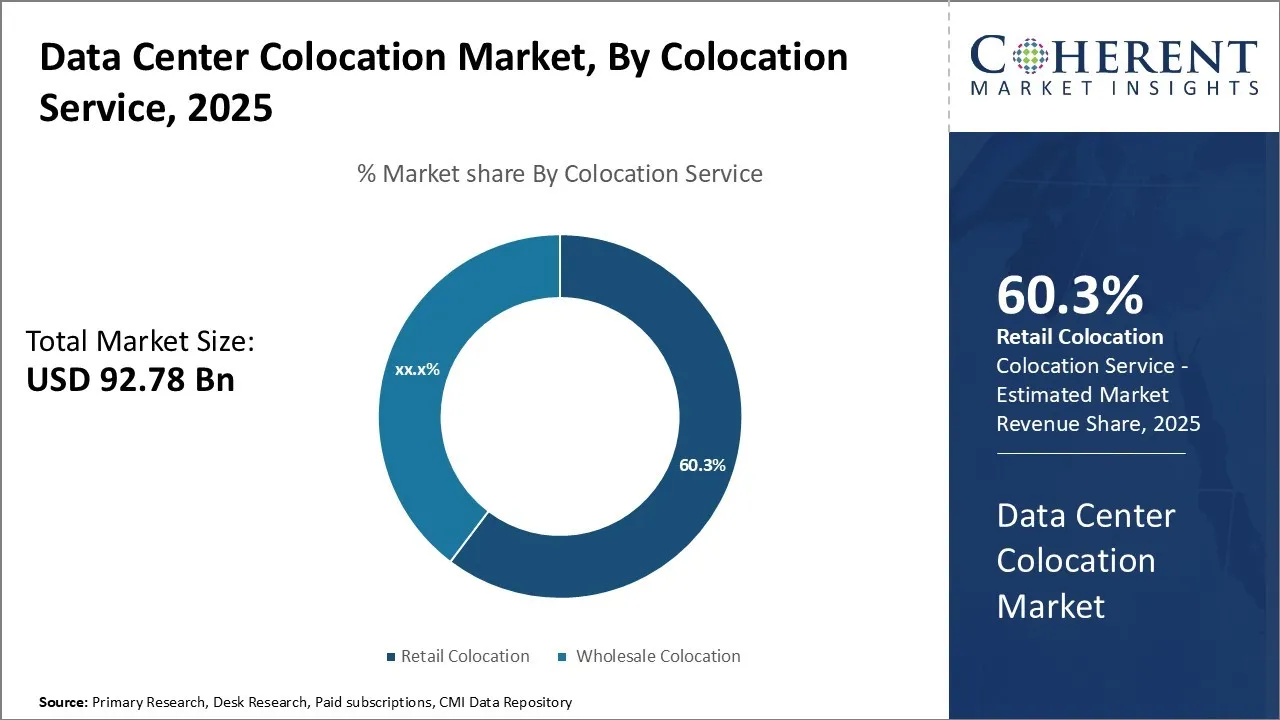
- Based on Colocations Service, the Retail Colocation segment is projected to account for 61.3% share of the global data center colocation market in 2026, due to its convenience and scalability.
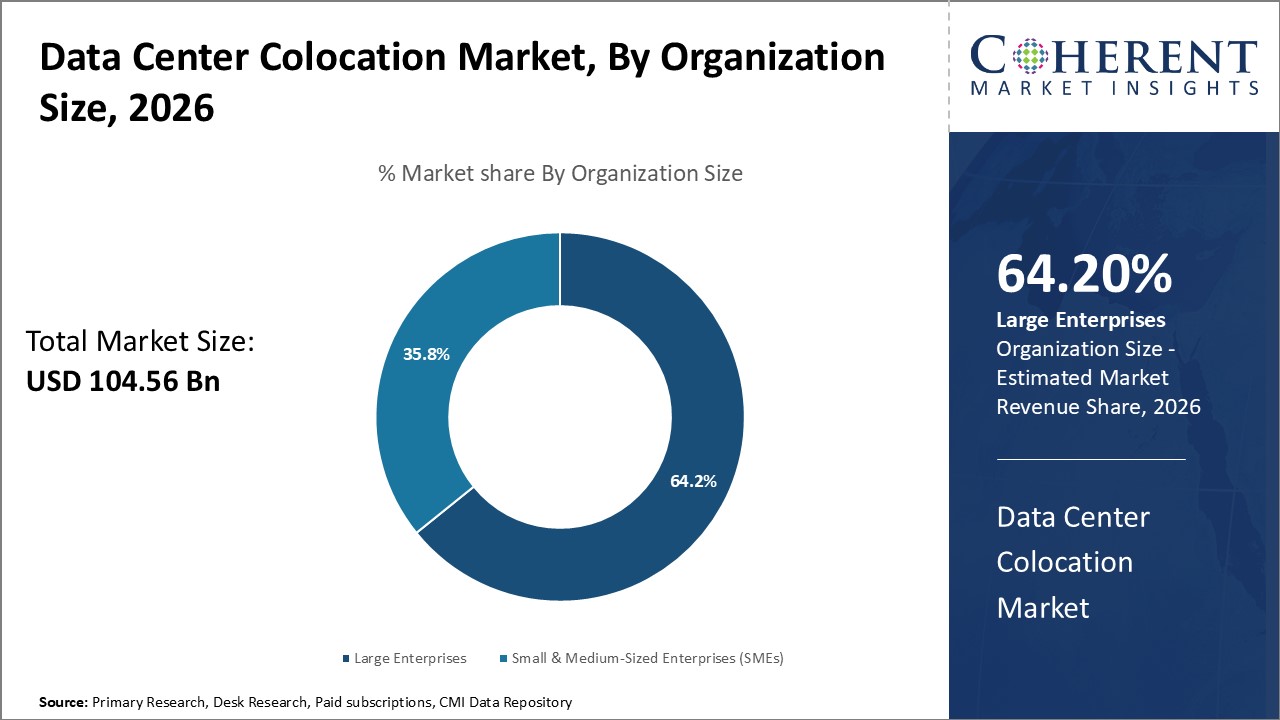
- Based on Organization Size, the Large Enterprise segment is expected to account for 64.2% share of the global data center colocation market in 2026, owing to critical IT infrastructure requirements.
- Based on Vertical, the IT and Telecom segment is expected to lead the global data center colocation market with a 36.4% share in 2026, owing to the dynamic needs of the industry.
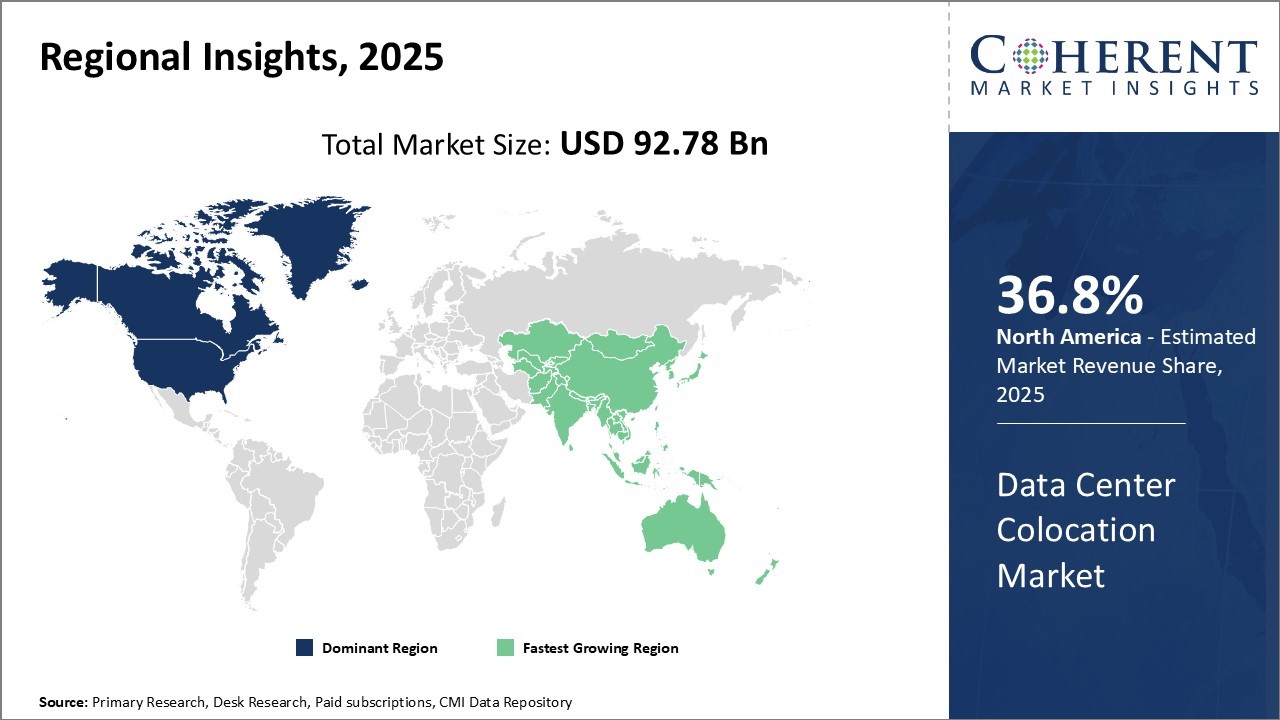
- Based on Region, North America is expected to lead the market, holding a share of 36. 8% in 2026. While, Asia Pacific is anticipated to be the fastest growing region during the forecast period in the data center colocation market.
Market Overview
The data center colocation market is growing rapidly due to rising digital transformation, cloud adoption, and increasing data volumes. Businesses are shifting to colocation to avoid the high costs of building and maintaining in-house data centers while ensuring security, scalability, and uptime.
Key drivers of data center colocation market demand include growth in IoT, AI, and edge computing, which require low-latency data processing. SMEs and large enterprises alike benefit from shared infrastructure, especially in sectors like finance, healthcare, and e-commerce. While North America leads, Asia Pacific is the fastest-growing region, driven by digital expansion in countries like India and China.
Current Events and their Impact on the Data Center Colocation Market
Current Event | Description and its Impact |
European Regulatory Crackdown on Data Center Emissions |
|
Global Grid Infrastructure Constraints and Power Shortages |
|
Artificial Intelligence (AI) And Automation in Data Center Colocation Facilities
AI and automation are transforming data center colocation facilities by enhancing operational efficiency, energy management, and security. AI-powered tools are used to monitor temperature, power usage, and equipment performance in real time, helping predict failures before they occur and reducing downtime. Automation allows routine tasks such as server provisioning, network configuration, and load balancing to be completed with minimal human intervention, improving response times and reducing labor costs.
In colocation environments, AI also optimizes energy consumption through intelligent cooling systems and dynamic power allocation, which is crucial for maintaining sustainability. For example, Google and Equinix have adopted AI-driven energy management systems that significantly lower PUE (Power Usage Effectiveness) levels.
Moreover, AI enhances security with biometric access, facial recognition, and anomaly detection in network traffic. These innovations are enabling colocation providers to deliver smarter, greener, and more resilient infrastructure to meet growing customer demands.
In April 2025, ST Telemedia Global Data Centres (India) launched a ₹450 crore AI‑ready data centre campus in New Town, Kolkata, set to operationalise in Q2 2025. Spread across 5.59 acres, the state‑of‑the‑art facility features high‑density rack configurations, advanced cooling systems, including future‑ready liquid cooling and a modular, scalable infrastructure capable of supporting up to 25 MW of IT load.
- Current Industry Events of 2026
- Market Size Estimation
- Regional Breakdown
- Competitive Landscape
- Customer Intelligence
- Segmental Analysis
- Pricing Analysis
- Key Market Drivers, Challenges & Future Trends
- Customized Insights Section
Segmental Insights
Data Center Colocation Market Insights, By Colocation Service: Convenience and Scalability Drive Retail Colocation Adoption
In terms of colocation service, the retail colocation segment is projected to hold a 61.3% share of the data center colocation market in 2026 due to its convenience and scalability. It enables businesses to quickly deploy IT infrastructure in secure, pre-equipped facilities without the burden of building their own data centers. With flexible, pay-as-you-grow models, enterprises can scale resources as needed which is ideal for those undergoing digital transformation. Retail colocation also offers enhanced reliability, security, and 24/7 support, making it especially attractive for dynamic or fast-growing industries.
In November 2023, Equinix unveiled its second IBX® data center in Seoul, designated SL4, in Q1 2024. Located within its hyperscale xScale® facility SL2x in Goyang‑si, Gyeonggi‑do, the site will offer approximately 550 cabinets in its first phase, along with an AI‑ready power, cooling and connectivity infrastructure. SL4 will be interconnected via low‑latency dark fibre to Equinix’s existing Seoul IBX, SL1, enhancing access to cloud providers, AI ecosystems and internet exchanges such as KINX and Sejong Telecom.
Data Center Colocation Market Insights, By Organization Size: Large Enterprises Drive the Take-up of Wholesale Colocation
In terms of organization size, the large enterprises segment is expected to hold 64.2% share of the market in 2026 owing to critical IT infrastructure requirements. Wholesale colocation is the preferred option for large enterprises with substantial IT resources as it provides them dedicated space, power and cooling within the data center facility. This allows them to install and manage all their servers and networking equipment independently while leveraging the security, connectivity and support of the colocation provider.
Large enterprises require mission critical systems that demand higher levels of customization, control and security which wholesale colocation aptly addresses. They can deploy resources according to their predetermined specifications and ensure round-the-clock access and management of their dedicated data hall or suite. Wholesale colocation also enables large enterprises to avoid vendor lock-ins by easily switching out infrastructure from one provider to another. The significant IT budgets and demands of bandwidth-intensive applications have made wholesale colocation highly suitable for the deployment and management challenges of large enterprises.
In July 2025, Energy Capital Partners (ECP) and KKR launched a USD 4 billion hyperscale data‑centre campus in Bosque County, Texas, marking the first investment under their strategic $50 billion AI infrastructure partnership. The multi‑phase site will deliver 144 MW of IT capacity across 700,000 sq ft in its opening stage, with expansion potential already built in.
Data Center Colocation Market Insights, By Vertical: Scalability and Cloud Affinity Drives IT and Telecom Adoption
In terms of vertical, IT and telecom segment is expected to hold 36.4% share owing to the dynamic needs of the industry in 2026. As leading digital services providers, IT and telecom companies require scalable data center infrastructure that can easily scale up or down based on fluctuating traffic and demand levels. Retail and wholesale colocation addresses this need perfectly by offering flexible and elastic compute and storage capacities on demand. Colocating their infrastructure also enables IT and telecom providers to leverage location-specific advantages to improve connectivity for their clients. Colocating also helps these companies optimize resource utilization of their on-premise infrastructure while tapping cloud-based innovations. Overall, the scalability and cloud affinity of colocation models have made it increasingly attractive for the dynamic IT and telecom industry vertical.
In June 2025, STL (Sterlite Technologies Ltd), a global leader in optical and digital solutions launched a next‑generation Data Centre portfolio tailored to the unique needs of AI-driven infrastructure. The new offerings span high-performance fibre and copper cabling, pre‑terminated multi‑fibre systems with LC/MPO connectors, and the STL Celesta high‑density IBR technology, enabling agility, scalability and sustainability for hyperscalers, colocation players, enterprises and telecom providers. Such development are proliferating the data center colocation market revenue.
Regional Insights
North America Data Center Colocation Market Analysis & Trends
North America dominates the global data center colocation market with an estimated 36.8% market share in 2026. The U.S. accounts for the major share due to strong presence of major tech giants such as Google, AWS, IBM, Microsoft, and others who have established their data centers across various U.S. states. The growth in the region can be attributed to rapid digitization and increasing reliance on cloud-based solutions among enterprises of all sizes. Moreover, aggressive retail colocation strategies by major data center operators like Equinix, Digital Realty, and others have further boosted the demand in North America over the years.
For instance, in July 2026, EnCap Investments LP launched Quantica Infrastructure, a Houston‑based venture delivering shovel‑ready, AI‑ and hyperscale‑ready site infrastructure across North America. The platform integrates renewable energy, traditional grid power, and robust fiber connectivity into master‑planned real estate, reducing deployment risk and accelerating data centre delivery for hyperscale and AI operators.
Asia Pacific Data Center Colocation Market Analysis & Trends
Asia Pacific region is experiencing the fastest growing in the global data center colocation market share. Asia Pacific is growing rapidly due to a rising digital economy, expanding internet user base, and increasing cloud adoption in countries like India, China, and Indonesia. Businesses are turning to colocation to support scalable infrastructure and meet government data localization rules without building their own data centers. Smart city projects and real-time applications in cities like Singapore and Tokyo are also driving edge colocation demand. Global players like Equinix, NTT, and ST Telemedia are investing heavily in the region.
In March 2026, NTT DATA India committed to invest USD 500 million over the next 12–18 months to strengthen its AI platforms, expand data‑centre capacity and deliver sovereign cloud solutions for financial clients. The firm plans to add approximately 210 MW of IT capacity across new campuses in Kolkata, Bengaluru and Navi Mumbai.
Data Center Colocation Market Outlook Country-Wise
The U.S. Data Center Colocation Market Trends
The United States leads the global data center colocation market due to its vast number of hyperscale and enterprise data centers and strong demand from sectors like cloud computing, AI, fintech, and streaming. Key regions such as Northern Virginia, Silicon Valley, Dallas, and Chicago serve as major colocation hubs thanks to rich connectivity and robust infrastructure.
Major players like Equinix, Digital Realty, and CyrusOne are expanding their U.S. footprints to meet growing enterprise and hyperscale needs. With high-performance demands and scalable infrastructure requirements, the U.S. remains the core driver of global data center colocation market demand.
In March 2026, Nebius Group, the Amsterdam‑based AI infrastructure provider announced plans to build a 300 MW data centre in Vineland, New Jersey, in collaboration with DataOne. The facility will be constructed using Nebius’s in‑house design, with the first 100 MW phase slated to go live by summer 2026, delivered in just 20 weeks. Customer demand may trigger further expansion toward the full 300 MW capacity.
In parallel, Nebius is launching a 10 MW colocation deployment in Keflavik, Iceland, powered entirely by geothermal energy and expected to be fully operational by the end of Q1 2026.
China Data Center Colocation Market Trends
China is a key growth driver in the global data center colocation market demand, supported by its government-backed data infrastructure initiatives. Demand is fueled by smart city projects, e-commerce growth, and the rollout of the digital yuan, all of which require scalable and secure data storage.
Major players like China Telecom and GDS Holdings are rapidly expanding colocation facilities in regions like Beijing and Shanghai to support cloud providers, fintech, and AI companies. China's data localization laws and need for high-performance computing make colocation critical, positioning the country as a dominant and growing force in the global market.
For instance, China’s largest financial exchange announced the launch of a new colocation data centre, marking a significant expansion of its technology infrastructure. The facility offers ultra‑low latency connectivity to the exchange’s trading platforms and is designed to support high-frequency trading and large-scale data operations. Strategically located near major market hubs, the data centre provides premier access to trading firms and financial institutions.
Market Concentration and Competitive Landscape
Data Center Colocation Industry News
- In July 2025, Google announced to invest $6 billion in its first major data centre in India, building a 1-gigawatt (GW) facility in Visakhapatnam, Andhra Pradesh. The project includes $2 billion earmarked for renewable energy capacity to power the site sustainably.
- In March 2025, Vertiv launched a new global portfolio of overhead prefabricated infrastructure designed to streamline and accelerate data‑center deployment worldwide. The turnkey offering integrates power, cooling, and structural support systems into prefabricated modules that install above IT racks, significantly reducing on‑site construction time. Tailored to support modern workloads from enterprise to AI deployments, the solution delivers high‑density liquid cooling, modular scalability, and rapid deployment flexibility, whether as retrofits or greenfield builds.
- In August 2023, Digital Realty, a global provider of cloud- and carrier-neutral data center, colocation, and interconnection solutions, introduced high-density colocation services across its PlatformDIGITAL global data center platform. This offering, available in 28 markets across North America, EMEA, and Asia Pacific, supports workloads of up to 70 kilowatts per rack and utilizes innovative Air-Assisted Liquid Cooling (AALC) technologies.
- In March 2023, Web Werks – Iron Mountain Data Centers (IMDC) officially launched its first data center in Bengaluru. Located in the Whitefield district, the 80,000 sq ft BLR‑1 facility is a Tier III design capable of supporting up to 4 MW of IT load, reinforcing IMDC’s southern India footprint.
Market Report Scope
Data Center Colocation Market Report Coverage
| Report Coverage | Details | ||
|---|---|---|---|
| Base Year: | 2025 | Market Size in 2026: | USD 104.56 Bn |
| Historical Data for: | 2020 To 2024 | Forecast Period: | 2026 To 2033 |
| Forecast Period 2026 to 2033 CAGR: | 12.7% | 2033 Value Projection: | USD 241.46 Bn |
| Geographies covered: |
| ||
| Segments covered: |
| ||
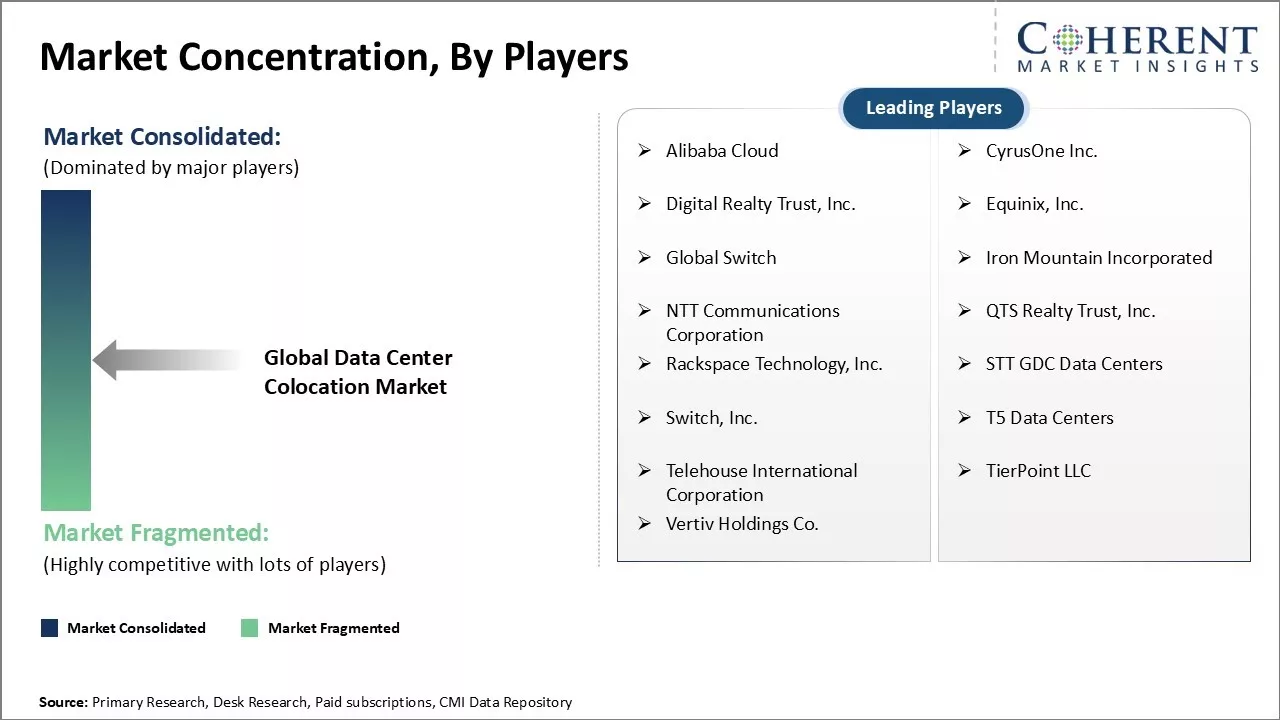
| Companies covered: | Alibaba Cloud, CyrusOne Inc., Digital Realty Trust, Inc., Equinix, Inc., Global Switch, Iron Mountain Incorporated, NTT Communications Corporation, QTS Realty Trust, Inc., Rackspace Technology, Inc., STT GDC Data Centers, Switch, Inc., T5 Data Centers, Telehouse International Corporation, TierPoint LLC, and Vertiv Holdings Co. | ||
| Growth Drivers: |
| ||
| Restraints & Challenges: |
| ||
Data Center Colocation Market Driver
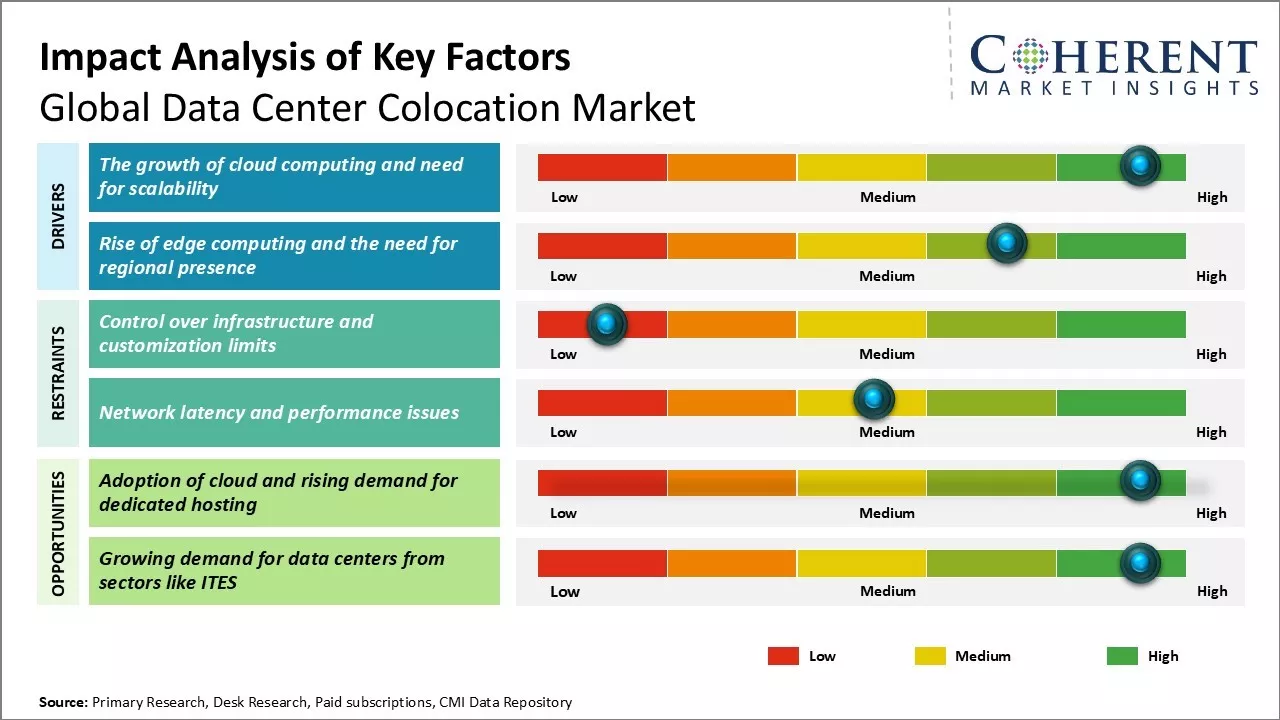
- The growth of cloud computing and need for scalability
The rise of cloud computing has transformed how businesses operate and consume IT services. Rather than building and managing costly in-house data centers, cloud providers increasingly turn to data center colocation to lease space, power, and cooling infrastructure. This model allows them to scale operations quickly and cost-effectively as customer demand grows.
Colocation offers cloud firms flexible, pay-as-you-grow leasing and seamless connectivity between global facilities, helping avoid location lock-ins and enabling faster deployment. By outsourcing infrastructure, providers can focus on innovation and client experience rather than facility management. This shift has played a major role in accelerating digital transformation and expanding data center colocation market share globally.
For instance, in May 2025, Sify Technologies unveiled a pay‑per‑use colocation pricing model across its three NVIDIA‑certified, AI‑ready hyperscale data center campuses in India. The new hourly billing option covers hosting, power, cooling, and infrastructure, enabling enterprise clients to access the full stack without long‑term commitments.
- Rise of edge computing and the need for regional presence
Edge computing is rapidly transforming the IT landscape as more applications demand ultra-low latency. By processing data close to its source, edge computing enables millisecond-level response times, this is ideal for autonomous vehicles, AR/VR, telemedicine, and smart manufacturing. To support this, major cloud and internet firms are deploying regional edge nodes in third-party data centers, telecom towers, and retail locations.
Colocation facilities are essential to this shift, offering proximity to end users and carrier-neutral connectivity. Instead of building new infrastructure, companies leverage existing fiber and interconnection ecosystems at colocation sites. Flexible leasing and modular deployments further ease entry into edge computing. As a result, data center colocation market growth is accelerating, fueled by rising demand for scalable, distributed infrastructure critical to next-gen low-latency applications.
For instance, in July 2025, India’s NES Data has launched its new edge and modular data centres, marking a strategic expansion into Tier‑II and underserved cities across India. This infrastructure‑as‑a‑service provider will deploy containerized and prefabricated facilities, designed for scalable, low‑latency AI-first workloads. These modular sites offer sustainable, plug‑and‑play growth, aligning with India’s push for a more decentralized, efficient digital infrastructure.
Data Center Colocation Market Opportunities
- Emerging Markets: Unlocking Growth Through Rapid Digitalization
Emerging economies, particularly in Southeast Asia, Africa, and Latin America, are witnessing a surge in data consumption, mobile internet usage, and digital transformation initiatives. This trend is creating significant demand for localized data center colocation services, as enterprises, cloud providers, and governments seek scalable and cost-effective IT infrastructure without the need for in-house data centers.
For example, in February 2024, Equinix, one of the world’s leading colocation providers announced a $390 million investment to expand its data center footprint across Africa and Southeast Asia, including a major expansion in Johannesburg, South Africa, and Jakarta, Indonesia. These markets were identified due to their booming e-commerce sectors, growing cloud adoption, and digital-first government policies. Such initiatives are adding to the data center colocation market demand.
Analyst Opinion (Expert Opinion)
The data center colocation market value is at an inflection point, shifting from being a cost-driven infrastructure choice to a critical enabler of edge computing, AI scalability, and enterprise resilience. Its evolution is no longer just about rack space and power but about strategic proximity to digital demand and latency-sensitive workloads.
Traditionally, colocation players emphasized central hubs, Ashburn, London, Frankfurt, Singapore but this centrality model is being systematically deconstructed. Emerging nodes like Portland, Hyderabad, and Warsaw are gaining traction. In India, for instance, colocation demand in Tier 2 cities has risen by over 32% in the past year alone, driven by regional OTT caching, fintech operations, and public cloud expansion. This decentralization reflects a demand-driven recalibration rather than oversupply.
Operators are also shifting from being mere infrastructure landlords to integrated digital partners. A compelling example is Equinix’s xScale facilities tailored for hyperscalers, blending colocation with private interconnection ecosystems. Similarly, Digital Realty's ServiceFabric and NTT’s multi-cloud interconnect platforms underscore a growing preference for colocations that offer embedded software-defined interconnectivity, low-latency access to clouds, and AI/ML workloads.
Energy strategy is another defining axis. Colocation providers are not merely adopting renewables for compliance; they’re restructuring power procurement and cooling to support dense AI clusters. Liquid cooling infrastructure, once confined to supercomputing, is now entering colocation design mandates. In the U.S., more than 41% of new colocation builds in 2025 include partial or full liquid cooling capacity, particularly to accommodate NVIDIA H100 GPU clusters and similar AI accelerators. Providers that fail to optimize power usage effectiveness (PUE) below 1.3 may simply be left out of the AI data stack buildouts.
Speak to the analyst
Want personalized insights?
Take the findings above to one of our principal consultants, or have the report rebuilt around the segments, geographies and competitors you actually track.
Market Segmentation
- Colocation Service Insights (Revenue, USD Bn, 2021 - 2033)
- Retail Colocation
- Wholesale Colocation
- Organization Size Insights (Revenue, USD Bn, 2026 - 2033)
- Small and Medium-Sized Enterprises (SMEs)
- Large Enterprises
- Vertical Insights (Revenue, USD Bn, 2026 - 2033)
- BFSI (Banking, Financial Services, and Insurance)
- IT and Telecom
- Healthcare
- Government
- Manufacturing
- Others (including Retail, Education, Media, and Entertainment)
- Regional Insights (Revenue, USD Bn, 2026 - 2033)
- North America
- U.S.
- Canada
- Latin America
- Brazil
- Argentina
- Mexico
- Rest of Latin America
- Europe
- Germany
- U.K.
- Spain
- France
- Italy
- Russia
- Rest of Europe
- Asia Pacific
- China
- India
- Japan
- Australia
- South Korea
- ASEAN
- Rest of Asia Pacific
- Middle East & Africa
- GCC Countries
- Israel
- South Africa
- Rest of Middle East & Africa
- North America
- Key Players Insights
- Alibaba Cloud
- CyrusOne Inc.
- Digital Realty Trust, Inc.
- Equinix, Inc.
- Global Switch
- Iron Mountain Incorporated
- NTT Communications Corporation
- QTS Realty Trust, Inc.
- Rackspace Technology, Inc.
- STT GDC Data Centers
- Switch, Inc.
- T5 Data Centers
- Telehouse International Corporation
- TierPoint LLC
- Vertiv Holdings Co.
Sources
Primary Research Interviews from the following stakeholders
Stakeholders
- Interviews with data center operators, enterprise IT heads, colocation service providers, facility managers, energy consultants, cloud architects, and procurement officers across Tier I, II, and III markets.
Specific Stakeholders
- Data center infrastructure leads at telecom providers
- Cloud and infrastructure heads at hyperscale users
- CIOs and IT directors at banks and financial institutions
- IT and operations managers at healthcare networks and pharma companies
- Heads of real estate and infrastructure at large enterprises
- Facility and power management consultants in industrial parks and IT clusters
- Product engineers and systems architects at rack/server, HVAC, and power backup equipment OEMs
Databases
- International Energy Agency (IEA) – Data Center Energy Reports
- UN Comtrade Database
- Bureau of Economic Analysis (U.S.)
- Eurostat – ICT Sector Statistics
- India’s Ministry of Electronics and Information Technology (MeitY)
- China Customs Statistics
- Korea Data Center Council – Import/Export Logs
- Japan External Trade Organization (JETRO)
- Directorate General of Commercial Intelligence and Statistics (DGCIS), India
- Uptime Institute Global Data Center Survey
Magazines
- Data Center Frontier
- Mission Critical Magazine
- Data Centre Magazine
- Capacity Media
- TechRadar Pro – Data Infrastructure Section
- Light Reading – Data Center Connectivity
- Enterprise Networking Planet
- Power Engineering International (Data Center Power Trends)
Journals
- IEEE Transactions on Cloud Computing
- Energy and Buildings (Elsevier)
- ACM Journal on Emerging Technologies in Computing Systems
- Journal of Network and Systems Management
- Future Generation Computer Systems
- Journal of Cloud Computing Advances, Systems and Applications
Newspapers
- The Wall Street Journal – Technology & Data Centers
- The Economic Times – Infrastructure & Cloud Tech
- Financial Times – Data Economy
- Nikkei Asia – Enterprise Tech & Infrastructure
- The Hindu Business Line – Data Centers and Power Policy
- South China Morning Post – Asia Data Infrastructure Reports
Associations
- Uptime Institute
- Green Grid Association
- Open Compute Project Foundation
- European Data Centre Association (EUDCA)
- Data Center Dynamics (DCD) Community
- Cloud Native Computing Foundation (CNCF)
- Internet Infrastructure Coalition (i2Coalition)
- Confederation of Indian Industry (CII) – Digital Infrastructure Cell
Public Domain Sources
- Ministry of Power (India) – Energy Use in Data Centers
- Ministry of Electronics and IT (MeitY), India
- National Renewable Energy Laboratory (NREL), U.S.
- Ministry of Economy, Trade and Industry (METI), Japan
- Reserve Bank of India – ICT and Infrastructure Sector Reports
- EU Digital Strategy Portal – Data Infrastructure Reports
- NITI Aayog – Infrastructure Outlook Reports
- U.S. Energy Information Administration (EIA) – Data Center Power Statistics
- Government of Singapore – Smart Nation Data Centre Standards
Proprietary Elements
- CMI Data Analytics Tool, and Proprietary CMI Existing Repository of information for last 8 years
*Definition: The global data center colocation market involves hosting of servers, storage and networking equipment of an organization in a third-party data center. Colocation provides dedicated, shared or virtual space that businesses can occupy within a data center facility which house advanced security systems, redundant power and network connectivity infrastructure. Companies lease this shared infrastructure from colocation providers which eliminates the capital expenditure required to build their own data center infrastructure. Colocation services offer scalable options for businesses to expand their IT infrastructure with their data located off-premise managed by colocation specialists.
Get access to 250+ pages report
Every segment, forecast, competitor profile and data table behind the analysis above — available for instant download.
- ESOMAR Member
- ISO 9001:2015 Certified
- D-U-N-S Registered
- GDPR & CCPA Compliant
Missing comfort of reading report in your local language? Find your preferred language:
Transform your Strategy with Exclusive Trending Reports
Frequently Asked Questions
The Data Center Colocation Market is estimated to be valued at USD 104.56 Bn in 2026, and is expected to reach USD 241.46 Bn by 2033.
The CAGR of the Data Center Colocation Market is projected to be 12.7% from 2026 to 2033.
The growth of cloud computing and need for scalability and rise of edge computing and the need for regional presence are the major factors driving the growth of global data center colocation market.
Control over infrastructure and customization limits and network latency and performance issues are the major factors hampering the growth of global data center colocation market.
In terms of colocation service, the retail colocation segment, estimated to dominate the market revenue share in 2026.
Alibaba Cloud, CyrusOne Inc., Digital Realty Trust, Inc., Equinix, Inc., Global Switch, Iron Mountain Incorporated, NTT Communications Corporation, QTS Realty Trust, Inc., Rackspace Technology, Inc., STT GDC Data Centers, Switch, Inc., T5 Data Centers, Telehouse International Corporation, TierPoint LLC, and Vertiv Holdings Co. are the major players.
North America is expected to lead the global data center colocation market in 2026.