

Water Trading Market Size and Forecast – (2026 - 2033)
The Water Trading Market is estimated to be valued at USD 25.56 Bn in 2026 and is expected to reach USD 54.20 Bn by 2033, exhibiting a compound annual growth rate (CAGR) of 13.34% from 2026 to 2033.
Key Takeaways
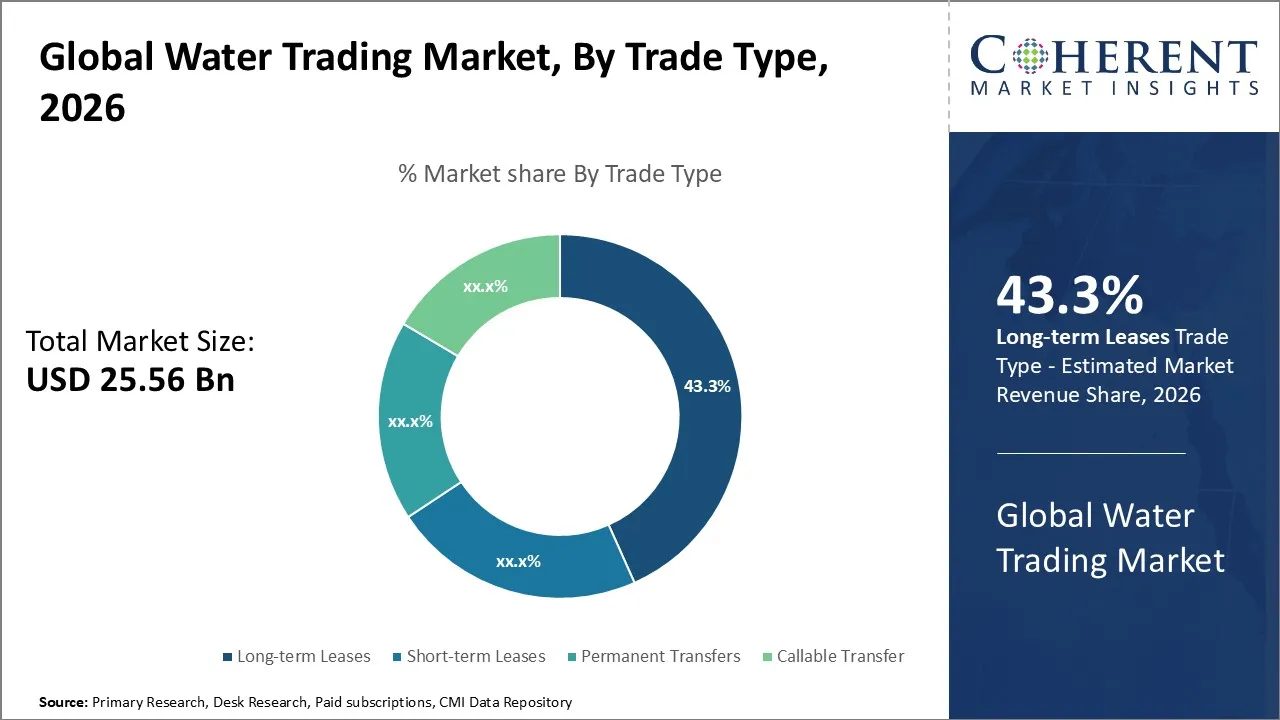
- By Trade Type, Long-term leases hold the largest market share of 43.3% in 2026 owing to its need for stable, predictable water supply.
- By End Use, Agricultural expected to hold the largest market share of 34.4% in 2026 owing to the crop choice and profitability.
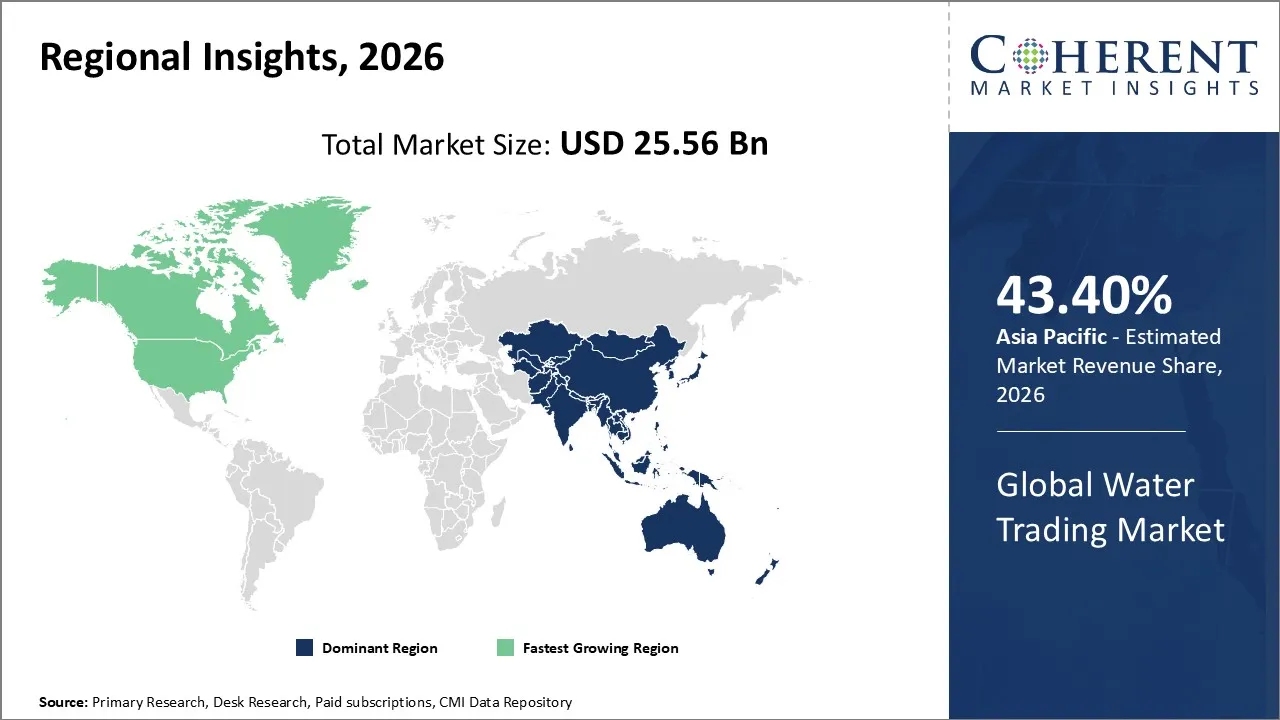
- By Region, Asia Pacific dominates the overall market with an estimated share of 43.4% in 2026 owing to the water scarcity and resource stress.
Market Overview
The global water trading market is expanding quickly as water scarcity, population growth, and the demand for sustainable water management intensify. It allows agriculture, industry, and municipal users to allocate water resources efficiently, manage risks, and generate revenue. Mature markets in Australia and emerging initiatives across Asia‑Pacific demonstrate strong regulatory support, technological adoption, and robust market infrastructure. Governments and digital platforms actively enhance transparency, encouraging greater market participation and the development of long‑term trading strategies.
Current Events and Its Impact on the Water Trading Market
Current Events | Description and its impact |
Climate Change and Environmental Policies |
|
Technological Innovations and Market Platforms |
|
Economic and Financial Market Dynamics |
|
Segmental Insights
- Current Industry Events of 2026
- Market Size Estimation
- Regional Breakdown
- Competitive Landscape
- Customer Intelligence
- Segmental Analysis
- Pricing Analysis
- Key Market Drivers, Challenges & Future Trends
- Customized Insights Section
Water Trading Market Insights, By Trade Type - Long-term leases contribute the highest share of the market owing to its risk management & reliability characteristics
Long-term leases hold the largest market share of 43.3% in 2026. In the water trading market, users pursue long-term leases to ensure stable and predictable water access, particularly in agriculture, industry, and municipal sectors experiencing variable supply. Water scarcity, climate uncertainty, and economic pressures drive them to secure resources over multiple years. Clear regulations, enforceable water rights, and developed market infrastructure minimize transaction risks, while high-reliability entitlements and strategic planning for crops or industrial operations make extended leases appealing. Together, these factors encourage long-term commitments and strengthen financial stability.
Water Trading Market Insights, By End Use - Agricultural contribute the highest share of the market owing to its efficiency and technology adoption
Agricultural expected to hold the largest market share of 34.4% in 2026. Farmers actively participate in the water trading market to manage water scarcity and secure reliable irrigation for their crops. They use trading to hedge against seasonal variability, optimize water usage, and earn extra income by selling surplus allocations. The profitability of high-value crops, implementation of water-efficient technologies, and access to clear legal frameworks encourage their involvement. Transparent markets, improved infrastructure, and favorable pricing allow farmers to make strategic decisions, enhance returns, and maintain stable operations despite uncertain water availability.
Regional Insights
Asia Pacific Water Trading Market Trends
Asia Pacific dominates the overall market with an estimated share of 43.40% in 2026. The Asia Pacific water trading market is rapidly expanding as rising water scarcity, urbanization, and growing industrial and agricultural demands push users to engage in trading. Governments across the region are actively strengthening regulations and investing in infrastructure to enable efficient water allocation. Users are adopting technological solutions, including digital monitoring and trading platforms, to enhance transparency and streamline transactions. Climate variability and resource stress drive stakeholders to secure reliable water sources, while pilot programs and regional initiatives actively promote wider participation and sustainable long-term management.
North America Water Trading Market Trends
Stakeholders in North America are actively shaping the water trading market in response to rising water scarcity, regulatory reforms, and competition among agricultural, industrial, and municipal users. Regions like the western U.S. are developing mature water rights markets, backed by clear legal frameworks and strong infrastructure that ensure secure trading. Users are leveraging advanced technologies, such as real-time monitoring and digital trading platforms, to enhance allocation efficiency and transparency. Drought conditions, resource management policies, and economic incentives drive both short- and long-term trades, supporting strategic planning and sustainable water use.
India Water Trading Market Trends
India is gradually developing its water trading market as agricultural demand, industrial growth, and urban expansion put increasing pressure on limited water resources. Farmers and businesses are actively participating in informal and pilot trading programs to manage seasonal variability and optimize water use. The government is implementing initiatives and evolving policies to formalize water rights and improve allocation efficiency. Stakeholders are adopting technologies like digital monitoring and metering systems to enhance transparency, while climate variability and regional water stress drive them to pursue short- and long-term trading for sustainable water management.
United States Water Trading Market Trends
Agricultural, industrial, and municipal users in the United States are driving the expansion of the water trading market as they seek reliable supplies amid growing scarcity and climate variability. Western states are leading with well-established water rights systems that allow secure trading and long-term planning. Stakeholders are adopting digital platforms and real-time monitoring to enhance transparency, efficiency, and allocation accuracy. Policy reforms and water management programs actively promote short- and long-term trades, while drought pressures and economic incentives encourage strategic use and sustainable resource distribution across sectors.
End-user Feedback and Unmet Needs in the Water Trading Market
- Reliability and Predictability: End-users often highlight the need for more predictable water supply, as allocations can fluctuate seasonally or during droughts. Farmers and industries seek mechanisms that guarantee long-term access, enabling better planning and investment. Current short-term trades sometimes fail to provide the security required for high-value crops or industrial operations.
- Transparency and Market Information: Users frequently report difficulties accessing accurate pricing, availability, and trade history. Limited transparency hinders informed decision-making, increases risk, and discourages participation, especially among smaller farmers and municipal users. Enhanced digital platforms and real-time data could bridge gaps, improving trust and encouraging wider market engagement.
- Regulatory Clarity and Legal Support: Unclear or inconsistent water rights and trading regulations remain a major concern. End-users face legal ambiguities regarding ownership, lease enforcement, and transfer approvals. Streamlined policies, enforceable contracts, and standardized trading frameworks are needed to reduce disputes and foster confidence in both short- and long-term transactions.
Water Trading Market Trend
Growing Demand Driven by Scarcity
Water scarcity and increasing competition among agriculture, industry, and municipalities are fueling the growth of water trading markets globally. Users are increasingly turning to trade as a flexible tool to secure reliable water supplies amid climate variability. Seasonal shortages and regional imbalances are encouraging both short- and long-term transactions. The trend reflects a shift toward market-based water allocation, where scarcity incentivizes efficient use, resource optimization, and strategic planning across diverse sectors.
Technological Adoption and Digital Platforms
The market is increasingly adopting digital solutions to enhance transparency, monitoring, and trading efficiency. Platforms offering real-time water data, allocation tracking, and automated trade facilitation are becoming more common. IoT-enabled sensors, remote monitoring, and predictive analytics allow users to make informed decisions, reduce risks, and optimize allocation. Technology adoption supports both small-scale and institutional users, making water trading faster, more reliable, and accessible while addressing operational inefficiencies in existing supply and distribution networks.
Water Trading Market Opportunity
Digital Transformation and Smart Trading Platforms
Advanced technologies, including IoT sensors, AI-based allocation tools, and blockchain-enabled trading platforms, offer opportunities to enhance transparency, efficiency, and trust in water markets. Digital transformation enables real-time monitoring of water flows, predictive allocation planning, and streamlined transactions. Companies developing innovative software or hardware solutions can target both mature and emerging markets, reducing transaction costs, increasing user confidence, and enabling smaller farmers and industrial users to participate effectively in structured water trading systems.
Market Report Scope
Water Trading Market Report Coverage
| Report Coverage | Details | ||
|---|---|---|---|
| Base Year: | 2025 | Market Size in 2026: | USD 25.56 Bn |
| Historical Data for: | 2020 To 2024 | Forecast Period: | 2026 To 2033 |
| Forecast Period 2026 to 2033 CAGR: | 13.34% | 2033 Value Projection: | USD 54.20 Bn |
| Geographies covered: |
| ||
| Segments covered: |
| ||
| Companies covered: | Severn Trent, Murray Irrigation, Integra Water Services, Aqua America, California Water, Thames Water, Yorkshire Water, Anglian Water, and South Staffs Water | ||
| Growth Drivers: |
| ||
| Restraints & Challenges: |
| ||
Water Trading Market News
- In June 2025, DMCC—an international hub for trade, commerce, and innovation—entered into a strategic Memorandum of Understanding with AQUA-INDEX, a global leader in water commodities trading. The partnership supports AQUA-INDEX’s initiative to launch the world’s first digital token backed directly by freshwater assets, with the objective of redefining how water is valued, traded, and managed globally.
Analyst Opinion (Expert Opinion)
- The water trading market has reached a critical inflection point where empirical performance and theoretical promise diverge sharply, revealing structural strengths alongside systemic risks that demand rigorous governance.
- In Australia’s Murray–Darling Basin, water allocation trading accounted for up to 84% of available surface water allocation in some years, demonstrating that market mechanisms can dominate resource distribution even when availability is high, though most of this activity is seasonal rather than transformational. This level of liquidity, while impressive, also underscores how deeply markets have been integrated into regional water management rather than merely serving as ancillary instruments.
- Yet caution is necessary. Experiences in California and Chile highlight profound equity and concentration risks: smaller farmers in the Central Valley struggle to compete with agribusiness for scarce water allocations, and in drought conditions, wealthier users often secure disproportionate shares, exacerbating vulnerability for less‑resourced populations. These patterns reflect not just localized inequities but structural vulnerabilities inherent in commoditizing a basic necessity.
- The value of entitlements in Australia’s southern Basin alone is estimated near tens of billions, driven by both entitlement and allocation trading, which signals strong investor and user engagement but also raises questions about speculation and asset concentration. Moreover, volatility in markets such as California’s spot price indices, which have surged dramatically during prolonged droughts, illustrates how scarcity can amplify financial pressures on water users and distort allocation toward speculative holding rather than productive use.
- A fundamental tension persists between economic efficiency and social/environmental justice: water markets can allocate resources to higher‑value uses and enhance efficiency, but without robust oversight, they risk privileging those with capital and legal sophistication, marginalizing vulnerable communities, and undermining ecological sustainability. Effective markets must therefore be underpinned by strong regulatory frameworks, transparent data systems, and protective measures for third‑party and environmental interests, rather than relying solely on price signals to resolve allocation challenges.
Speak to the analyst
Want personalized insights?
Take the findings above to one of our principal consultants, or have the report rebuilt around the segments, geographies and competitors you actually track.
Market Segmentation
- Global Water Trading Market, By Trade Type
- Long-term Leases
- Short-term Leases
- Permanent Transfers
- Callable Transfer
- Global Water Trading Market, By End-use
- Agricultural
- Industrial
- Residential
- Global Water Trading Market, By Regional Insights
- North America
- U.S.
- Canada
- Latin America
- Brazil
- Argentina
- Mexico
- Rest of Latin America
- Europe
- Germany
- U.K.
- Spain
- France
- Italy
- Russia
- Rest of Europe
- Asia Pacific
- China
- India
- Japan
- Australia
- South Korea
- ASEAN
- Rest of Asia Pacific
- Middle East
- GCC Countries
- Israel
- Rest of Middle East
- Africa
- South Africa
- North Africa
- Central Africa
- North America
- Key Players Insights
- Severn Trent
- Murray Irrigation
- Integra Water Services
- Aqua America
- California Water
- Thames Water
- Yorkshire Water
- Anglian Water
- South Staffs Water
Sources
Primary Research interviews
- Interviews with water utility managers and operators
- Discussions with water trading platform operators
- Insights from policymakers in water resource management
- Conversations with agricultural water users and industry stakeholders
Databases
- World Bank Open Data (Water Resources)
- FAO AQUASTAT Database
- UN Water Data Portal
- OECD Water Statistics
Magazines
- WaterWorld
- Global Water Intelligence (non-consulting content)
- Environmental Finance
- Water & Wastewater International
Journals
- Water Resources Research
- Journal of Hydrology
- Water Policy
- Journal of Environmental Management
Newspapers
- The Guardian – Environment Section
- The New York Times – Climate & Water Coverage
- Financial Times – Water & Utilities Reporting
- Reuters – Water Market News
Associations
- International Water Association (IWA)
- American Water Works Association (AWWA)
- World Water Council (WWC)
- Water Environment Federation (WEF)
Public Domain sources
- Government water resource reports (e.g., USGS, Environment Agency UK, Bureau of Reclamation)
- National statistics offices’ water consumption and allocation data
- UN reports on water security and trading initiatives
- FAO reports on irrigation and water management
Proprietary Elements
- CMI Data Analytics Tool
- Proprietary CMI Existing Repository of information for last 8 years
Get access to 250+ pages report
Every segment, forecast, competitor profile and data table behind the analysis above — available for instant download.
- ESOMAR Member
- ISO 9001:2015 Certified
- D-U-N-S Registered
- GDPR & CCPA Compliant
Missing comfort of reading report in your local language? Find your preferred language:
Transform your Strategy with Exclusive Trending Reports
Frequently Asked Questions
The Water Trading Market is estimated to be valued at USD 25.56 Bn in 2026 and is expected to reach USD 54.20 Bn by 2033.
The CAGR of the Water Trading Market is projected to be 13.34% from 2026 to 2033.
Water trading improves allocation efficiency, reduces waste, and provides economic incentives for conservation.
Challenges include regulatory complexity, lack of transparency, high transaction costs, infrastructure limitations, and potential inequities.
Digital platforms, real-time monitoring, IoT sensors, and data analytics improve transparency, facilitate efficient trades, and reduce transaction costs.