

Social Business Intelligence Market Analysis and Forecasts (2026-2033)
The Social Business Intelligence Market is anticipated to grow at a CAGR of 6.2% with USD 28,440.1 Mn in 2026 and is expected to reach USD 42,370.2 Mn in 2033. The social business intelligence market is driven by rising use of social media analytics to understand customer behavior, strengthen decision-making, and improve competitive positioning. The social business intelligence market is driven by expanding enterprise use of digital engagement and analytics tools. Eurostat’s January 2026 data reported 63.57% of EU enterprises used social media in 2025, 52.74% used paid cloud services, and 39.85% performed data analytics internally or via external providers. Demand is further supported by customer insight needs, while wider adoption remains constrained by data governance complexity, privacy obligations, and rising cybersecurity exposure across digital ecosystems.
Key Takeaways
- Cloud-based is expected to account the largest share of 68.0% in 2026, driven by the because it scales faster, lowers upfront infrastructure burden, and supports real-time social data analytics; this is reinforced by 2026 forecast that worldwide IT spending will reach US$6.15 trillion and sovereign cloud IaaS spending will hit US$80 billion, up 35.6% year over year. For instance, in 2026, Microsoft Marketplace added an AI-powered social media analytics platform built on Microsoft Azure in March 2026, while AWS published cloud-native guidance for near real-time social media insights, showing that vendors are launching SBI workflows primarily on cloud environments.
- Based on size of enterprise, large enterprise will dominate with 60.0% in 2026, supported by the manage broader customer bases, multiple brands, and higher volumes of social data, making advanced monitoring and analytics more valuable. Eurostat’s January 2026 release shows 89.09% of large EU enterprises used social media, 84.67% used paid cloud services, and 69.24% used BI software in 2025, far above smaller firms. Source: European Union
- IT and Telecommunication hold the dominant share of 22.0% in 2026 owing to operators and digital platforms handle massive, real-time customer interactions, making sentiment tracking, service monitoring, and churn prevention mission-critical. Supporting this, TRAI reported 1,028.61 million internet subscribers and 1,258.77 million wireless subscribers in India by December 2025, while ITU estimated 6.0 billion people online globally in 2025, sustaining huge social-data volumes for this vertical in 2026. Source: ITU; The Indian Telecom Services Performance Indicators
- North America is expected to acquire the dominant share of 41.0% in 2026, as the region combines a very large digital business base, deep social-media penetration, and faster enterprise adoption of analytics-led decision-making. In the U.S., internet publishing, broadcasting, and web-search portal revenue reached US$338.7 billion in 2022, while 78% of Canadian internet users were regular social-media users; additionally, the U.S. recorded 491,941 business applications in March 2026, sustaining strong demand for social listening, customer analytics, and brand-monitoring tools.
Segmental Insights
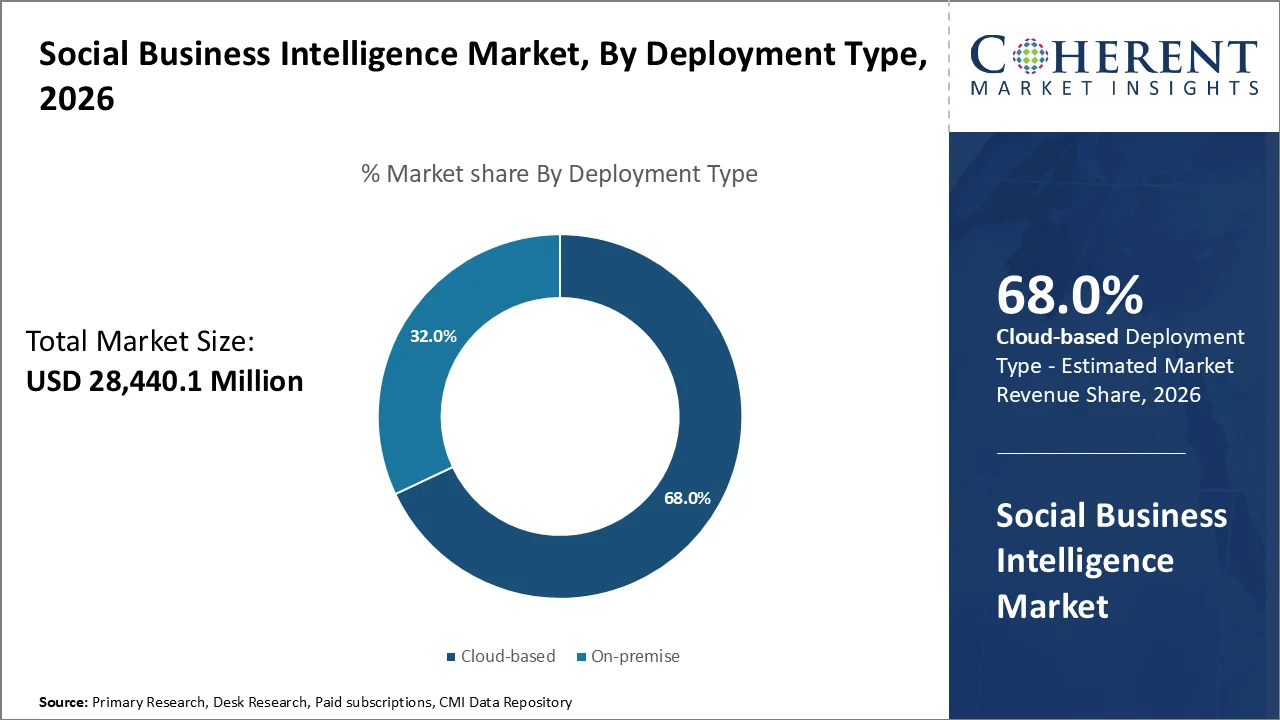
Why is Cloud-based Acquiring the Largest Market Share?
Cloud-based is projected to account for the largest share of cognitive systems spending in 2026, representing approximately 68% of the total volume. because it offers easier scalability, faster deployment, lower upfront infrastructure costs, and stronger support for real-time analytics across large volumes of social data. Its appeal is reinforced by broader enterprise digitization: For instance, in January 2026, Eurostat’s data show 52.74% of EU enterprises used paid cloud services in 2025, while 39.85% performed data analytics, supporting continued preference for cloud-enabled intelligence platforms. Furthermore, in 2025, according to Eurostat, statistical office of the European Union, 84.67% of large enterprises in the EU adopted paid cloud computing services in 2025, highlighting why cloud-based deployment leads in social business intelligence, as larger organizations rely more heavily on scalable, real-time, and analytics-focused platforms.
- Current Industry Events of 2026
- Market Size Estimation
- Regional Breakdown
- Competitive Landscape
- Customer Intelligence
- Segmental Analysis
- Pricing Analysis
- Key Market Drivers, Challenges & Future Trends
- Customized Insights Section
Large Enterprise holds the Largest Market Share
Based on size of enterprise, large enterprise dominates the market, accounting for a significant 60.0% share in 2026, as they manage higher volumes of customer interactions, multi-brand portfolios, and cross-regional digital campaigns, which makes continuous social listening, sentiment tracking, and competitive benchmarking more necessary. The latest government-backed data also supports stronger technology readiness among bigger firms: the U.S. Federal Reserve, citing Census-based business surveys, said about 18% of U.S. firms had adopted AI by year-end 2025, while Statistics Canada reported that businesses with 100+ employees were more likely to plan AI use (20.5%) than mid-sized or smaller firms, and 48.0% of those larger businesses planning AI adoption intended to use it for data analytics. In 2026, Microsoft highlighted Fabric as a converged enterprise data platform for unified operational and analytical data, and IBM announced 11 FedRAMP-authorized AI and automation software solutions, including watsonx, reinforcing enterprise-scale adoption.
Which Vertical segment dominates the market?
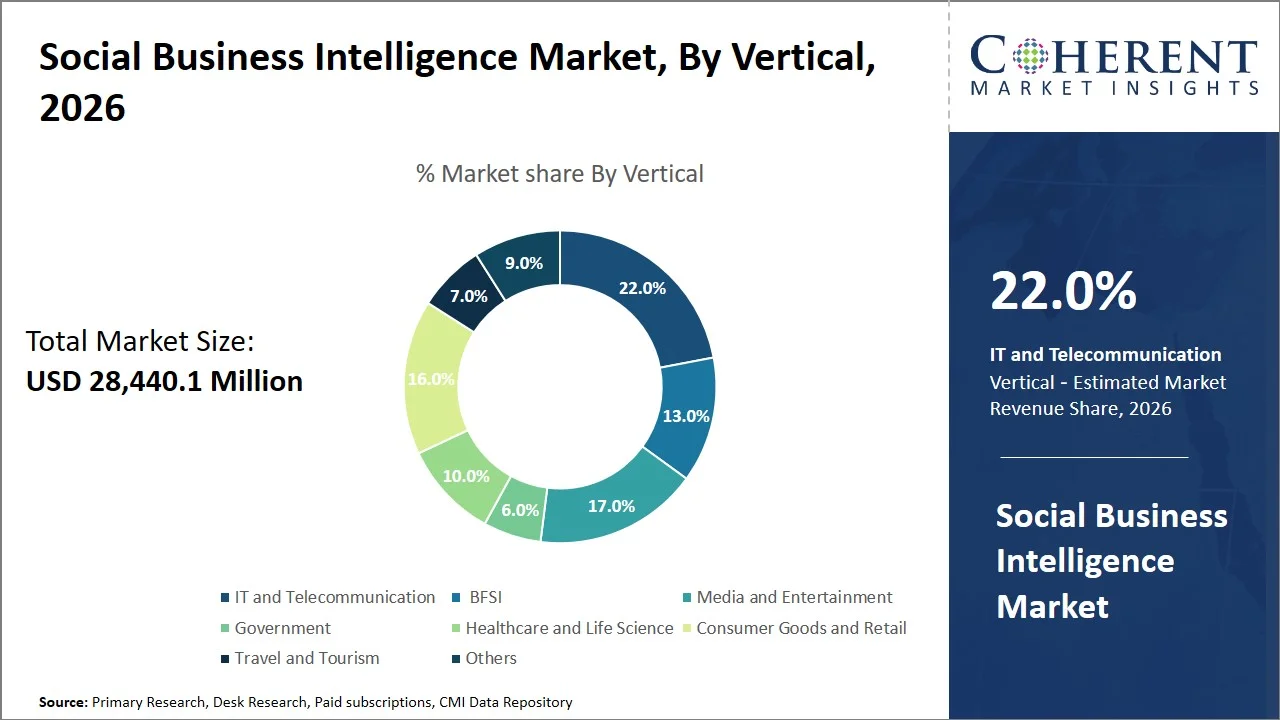
IT and Telecommunication account for the largest share of 22.0% in 2026 due to these companies manage very large volumes of real-time customer interactions across social media, apps, websites, and service channels. They rely heavily on social intelligence tools to track customer sentiment, detect service issues quickly, measure brand perception, support churn prevention, optimize campaigns, and respond faster to market shifts. High digital maturity, strong cloud adoption, and continuous demand for data-driven customer experience management also make this vertical the largest user of social business intelligence solutions. For instance, in February 2026, according to the data published by the Telecom Regulatory Authority of India reported India had 1,273.31 million wireless subscribers, while ITU estimated 6.0 billion people were using the Internet globally in 2025. This scale of connected users creates a very high volume of real-time digital conversations, service interactions, and customer sentiment data, which makes social business intelligence tools especially critical for IT and telecom companies to monitor brand perception, track service quality, and improve customer engagement.
Source: Telecom Regulatory Authority of India; ITU
Market Driver
Increasing Use of Social Media Boosting the Demand for Big Data
Increasing use of social media has increased the demand for big data and driven the growth of the social business intelligence market size in the near future. The increasing use of social media is boosting demand for big data tools because a larger online population creates massive volumes of fast, unstructured customer data that companies need to capture, process, and translate into decisions on sentiment, campaigns, service quality, and competitive positioning. For instance, in official 2025–2026 evidence: the ITU estimated 6 billion people, or 74% of the world’s population, were online in 2025, up from 5.8 billion in 2024, expanding the digital conversation pool. In January 2026, Eurostat, government agency report releases further showed that 63.57% of EU enterprises used social media in 2025, 39.85% performed data analytics, 17.62% analyzed customer data, 11.44% analyzed social media data, and 52.74% used paid cloud services all of which directly support higher demand for scalable big data and social business intelligence solutions. A clear 2026 market instance is Microsoft Marketplace’s March 5, 2026 launch of an AI-powered social media analytics platform on Azure, Eurostat showing that vendors are actively expanding cloud-native tools to manage this data growth.
Growing Adoption and Cloud-Based Technologies and Software as a Service
Growing adoption of cloud-based technologies and Software-as-a-Service is accelerating the social business intelligence market because cloud deployment lowers upfront IT cost, speeds integration of social, CRM, and web data, and enables real-time dashboards across distributed teams. For instance, the U.S. Census Bureau, a federal agency recorded 491,941 business applications in March 2026, expanding the base of firms needing subscription analytics tools, while Statistics Canada says more than 31 million Canadians are active on social media, enlarging the data universe for cloud-based listening platforms. Furthermore, in 2026, Microsoft, technology company, highlighted Fabric capabilities for real-time analytics and alerting, and IBM announced 11 FedRAMP-authorized software solutions, including watsonx, reinforcing enterprise trust in scalable SaaS and hybrid-cloud intelligence platforms.
Rising investment in AI-native network infrastructure and intelligent telecom operations is transforming the Social Business Intelligence Market
Rising investment in AI-native network infrastructure and intelligent telecom operations is strengthening the Social Business Intelligence Market by enabling faster data collection, real-time customer signal processing, and more scalable analytics across digital touchpoints.
For instance, in April 2026, according to the data published by the Telecom Regulatory Authority of India (TRAI) it has been reported that India’s wireless subscriber base reached 1,273.31 million in February 2026. This matters because a larger connected user base generates more calls, messages, app activity, and digital interactions, creating richer telecom and customer data streams that social business intelligence platforms can analyze for sentiment, engagement, and behavior patterns. Furthermore, in March 2026, the FCC proposed reducing regulatory barriers so service providers could accelerate network and service modernization. This supports social business intelligence indirectly by helping telecom operators upgrade infrastructure faster, improve digital service quality, and build more responsive systems that generate usable operational and customer-experience data.
Moreover, At MWC 2026, Nokia highlighted partnerships advancing AI-RAN and the path toward AI-native 6G. This shows telecom networks are becoming more intelligent and software-driven, allowing operators to optimize traffic, automate decisions, and create real-time data environments that strengthen analytics-led business intelligence use cases. In addition, Ericsson’s MWC 2026 focus on autonomous networks reflects the growing use of AI and automation in telecom operations. These intelligent networks improve efficiency, resiliency, and service quality, while also producing continuous operational insights that enterprises can combine with customer and social data for stronger business intelligence.
Current Events and Their Impact
Current Event | Description and its Impact |
Incorporation of Advanced Technology |
|
EU AI Act moving toward full applicability in 2026 |
|
CDC released guidance on Generative AI use in public health |
|
Social Business Intelligence Market Trends
- Real-time, high-volume digital interaction environments are influencing the social business intelligence market growth over the forecast period. The growth of connected users and telecom-scale interaction volumes is increasing the need for real-time monitoring of sentiment, complaints, brand mentions, and service issues. According to the data published by the Telecom Regulatory Authority of India (TRAI) reported that India had 1,257.29 million wireless mobile subscribers and 1,321.31 million total telephone subscriptions at the end of February 2026. In December 2025, TRAI data also showed 1,028.61 million internet subscribers and 1,258.77 million wireless subscribers in India by December 2025. This kind of interaction density supports rising demand for SBI tools across telecom, digital services, and other customer-facing sectors.
- Enterprises are increasingly turning social data into formal business analytics is driving the market growth A key trend is the shift from using social media mainly for marketing to using it as a structured decision-input for customer insight, performance tracking, and competitive intelligence. For instance, in 2025, Eurostat reported that 63.57% of EU enterprises used social media, 33.02% performed data analytics internally, 17.62% analyzed customer data, and 11.44% analyzed social media data. Among large enterprises, 78.84% performed data analytics and 69.24% used BI software, showing that SBI is increasingly part of mainstream enterprise intelligence stacks.
- Governance, security, and auditability are becoming embedded product features which driven the market significantly. Another major trend is that social business intelligence platforms are being designed with stronger governance, traceability, and security controls, because enterprises want AI-enabled insight generation without losing compliance discipline. For instance, in January 2026, ENISA’s 2025 Threat Landscape, analyzed 4,875 cybersecurity incidents from 1 July 2024 to 30 June 2025. A 2026 company example is Microsoft Marketplace’s AI-Powered Enterprise Reporting with Immutable Audit Trails, which connects reports to cryptographically verifiable source data, showing how analytics tools are being built with stronger audit and evidence layers.
- Cloud-based deployment is expanding strongly across enterprises and influencing the social business intelligence market expansion. Cloud deployment is gaining traction because it offers easier scalability, faster implementation, and better handling of high-volume social data. For instance, in January 2026, Eurostat’s data reported 52.74% of EU enterprises used paid cloud services in 2025, while adoption reached 84.67% among large enterprises. For instance, in 2026, Microsoft Marketplace’s Conversational BI launch built on Microsoft Fabric and Azure AI Foundry, reflecting the shift toward cloud-enabled intelligence platforms.
Regional Insights
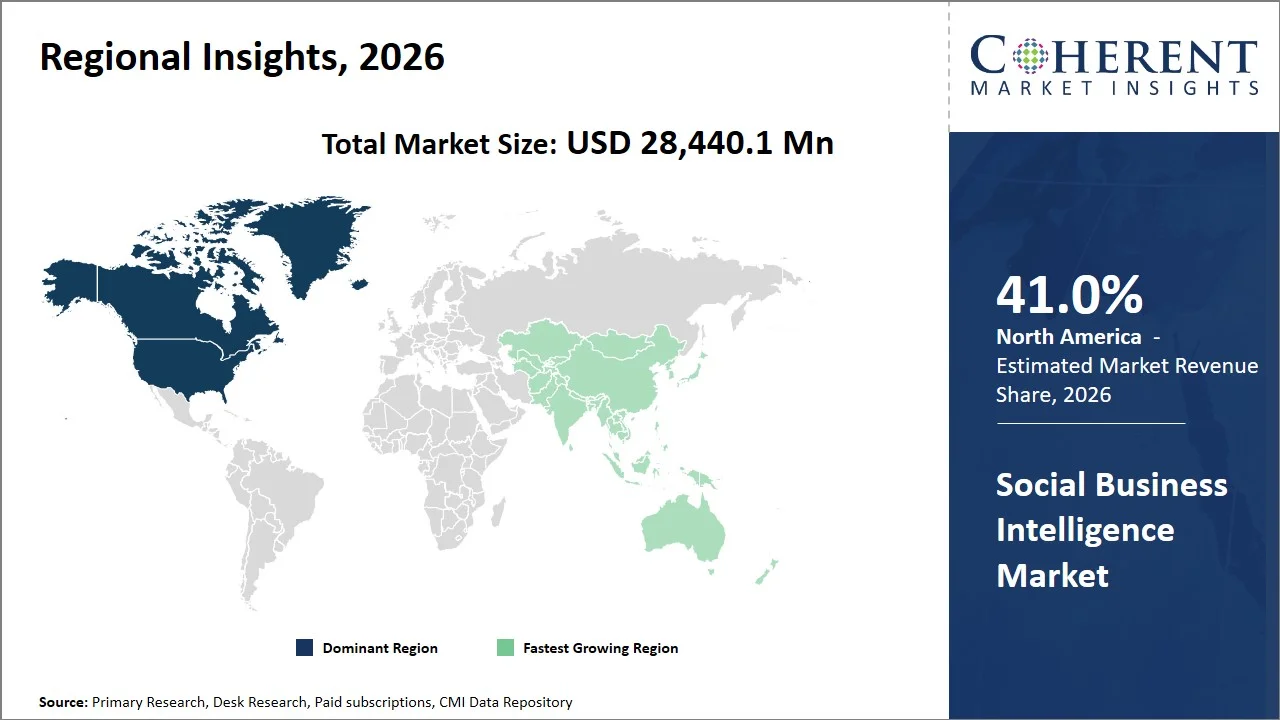
North America dominates owing to robust digital infrastructure
North America account 41% market share in 2026, due to its advanced digital infrastructure, strong enterprise cloud adoption, and concentration of major analytics and platform providers. In the U.S., the Federal Communications Commission (FCC) continued broadband modernization actions in 2026 to reduce infrastructure barriers, supporting faster, data-rich digital environments. Company activity also reinforces this position: in March 2026, Microsoft added new AI and analytics offers to its marketplace, while Amazon stated AWS’s AI revenue run rate exceeded US$15 billion in Q1 2026, reflecting strong enterprise investment in cloud-based intelligence ecosystems. Furthermore,
High internet penetration in North America drives the social business intelligence market by generating vast volumes of online interactions, social media activity, and consumer data, increasing demand for real-time analytics and insight tools. According to International Telecommunication Union, 92% of individuals in North America were using the Internet in 2025, one of the highest globally. This creates a massive volume of digital interactions and social data, directly supporting demand for social business intelligence tools.
Source: FCC; Microsoft; Amazon; ITU
Asia Pacific Social Business Intelligence Market Trends
The Asia-Pacific region is poised to be as the fastest-growing region through 2026-2033, because it combines a rapidly expanding digital population, rising social media usage, accelerating cloud and data-centre investment, and active enterprise AI adoption. ITU reported 77% internet use in Asia-Pacific in 2025, while India alone had 806 million internet users and 491 million social media user identities at the start of 2025. OECD also noted US$2.7 billion in approved data-centre and cloud investments in Thailand in early 2025, highlighting the region’s strengthening digital infrastructure.
Strong Broadband and Cloud Infrastructure is Accelerating the Social Business Intelligence Market Demand in United States
The U.S. social business intelligence market dominates North America social business intelligence market which is driven by its advanced digital infrastructure, high enterprise cloud adoption, and strong policy support for faster, data-rich connectivity. In 2026, the FCC stated that its network modernization actions would help providers shift resources toward modern communications networks, while NTIA notes the Infrastructure Investment and Jobs Act includes US$65 billion to expand reliable high-speed internet access in the U.S., strengthening the environment for real-time social data analytics and intelligence platforms.
China Social Business Intelligence Market Trends
China has become the biggest player in the Asia Pacific social business intelligence market because it has the region’s largest internet population, a very large base of digitally active consumers, and strong government support for AI-led commercialization. Official figures show China had 1.125 billion internet users by the end of 2025 with 80.1% internet penetration, while the country’s online retail sales reached 15.97 trillion yuan in 2025, generating enormous volumes of consumer and social data. In 2026, the government also said it would further expand the “AI Plus” initiative and encourage large-scale commercial application of AI in key sectors. These factors strengthen demand for social listening, sentiment tracking, customer analytics, and real-time business intelligence platforms, making China the dominant country in the regional market.
State Council of China; National Bureau of Statistics of China
Who are the Major Companies in Social Business Intelligence Market
Some of the major key players in Social Business Intelligence Market are IBM Corporation, TIBCO Software, Inc., SAP SE, Logi Analytics Inc., Tableaue Software, Inc., MicroStrategy, Inc., QlikTechnologies, Inc., Alteryx, Inc., and Microsoft Corporation.
Key News
- On February 18, 2026, Sprout Social, Inc., a social intelligence powering company that announced new AI capabilities and a broader Reddit partnership, including subreddit engagement and more precise listening-data filters. This matters because Reddit is becoming more important for discovery, opinion formation, and community-led brand conversations, so stronger Reddit analytics expands the scope of social business intelligence beyond mainstream social networks. Source: Sprout Social, Inc.
- On April 1, 2026, IBM said 11 software solutions, including watsonx offerings, had FedRAMP authorization. This is important because it raises the bar for security, governance, and enterprise-grade deployment factors that increasingly influence social intelligence buying decisions, especially in regulated industries and the public sector. Source: Reuters
- On April 20, 2026, Adobe announced CX Enterprise Coworker, along with Brand Intelligence and Engagement Intelligence, to help organizations orchestrate customer experience using AI and connected enterprise data. This is highly relevant to social business intelligence because it pushes the market toward platforms that combine social signals, customer data, and automated decisioning rather than offering stand-alone social monitoring.
Market Report Scope
Social Business Intelligence Market Report Coverage
| Report Coverage | Details | ||
|---|---|---|---|
| Base Year: | 2025 | Market Size in 2026: | USD 28,440.1 Mn |
| Historical Data for: | 2020 To 2024 | Forecast Period: | 2026 To 2033 |
| Forecast Period 2026 to 2033 CAGR: | 6.2% | 2033 Value Projection: | USD 42,370.2 Mn |
| Geographies covered: |
| ||
| Segments covered: |
| ||
| Companies covered: | IBM Corporation, TIBCO Software, Inc., SAP SE, Logi Analytics Inc., Tableaue Software, Inc., MicroStrategy, Inc., QlikTechnologies, Inc., Alteryx, Inc., and Microsoft Corporation. | ||
Analyst Opinion
- The social business intelligence market is moving beyond campaign tracking and becoming a core decision-support layer for enterprises that need real-time visibility into brand sentiment, customer intent, competitive moves, and emerging risks. This shift is being reinforced by broader enterprise AI adoption: the U.S. Federal Reserve noted that about 18% of U.S. firms had adopted AI by the end of 2025, while Statistics Canada reported that 12.2% of Canadian businesses used AI to produce goods or deliver services in the 12 months preceding the second quarter of 2025. The direction of travel is clear—organizations are building data-driven operating models, and social intelligence is increasingly part of that stack because it converts unstructured digital conversations into actionable business insight.
- Cloud-based analytics and SaaS delivery are strengthening market adoption because buyers increasingly want unified, scalable, and faster-to-deploy intelligence environments instead of fragmented monitoring tools. In March 2026, Microsoft stated that its converged Fabric platform is designed to unify transactional, operational, and analytical data in one architecture, while Microsoft’s March 2026 Fabric updates also emphasized enhancements for working with real-time data. For the social business intelligence market, this matters because enterprise users now expect social listening outputs to connect directly with BI dashboards, AI models, workflows, and real-time alerting systems, making cloud-native and integrated platforms more commercially attractive than standalone solutions.
- Governance, enterprise-grade security, and platform reliability are now as important as analytical capability in vendor selection, especially as social data becomes more deeply integrated into broader AI and decision-making systems. For instance, in April 2026, International Business Machines Corporation (IBM) announced that 11 AI and automation software solutions, including products from the watsonx portfolio, received FedRAMP authorization. That development signals that enterprise and regulated-sector buyers are prioritizing secure, governed AI environments rather than experimental point tools. From an analyst perspective, this will favor vendors that combine social listening, sentiment analysis, and predictive intelligence with strong compliance, auditability, explainability, and workflow integration, because the market is shifting toward enterprise-standard intelligence infrastructure rather than marketing-only software.
- Regional adoption patterns indicate that while North America remains dominant, emerging markets are rapidly catching up due to increasing digital penetration and government-led digital transformation initiatives. Countries in Asia Pacific are strengthening digital infrastructure and data capabilities, which is expected to drive future demand for social intelligence solutions across both public and private sectors.
Speak to the analyst
Want personalized insights?
Take the findings above to one of our principal consultants, or have the report rebuilt around the segments, geographies and competitors you actually track.
Market Segmentation
- By Deployment Types
- On-premise
- Cloud-based
- By Size of Enterprise
- Small Enterprise
- Medium Enterprise
- Large Enterprise
- By Verticals
- BFSI
- Healthcare and Life Science
- Consumer Goods and Retail
- Travel and Tourism
- IT and Telecommunication
- Media and Entertainment
- Government
- Others
- Global Social Business Intelligence Market, By Region
- North America
- U.S.
- Canada
- Latin America
- Brazil
- Mexico
- Argentina
- Rest of Latin America
- Europe
- Germany
- U.K.
- France
- Italy
- Spain
- Russia
- Rest of Europe
- Asia Pacific
- China
- India
- Japan
- Australia
- South Korea
- ASEAN
- Rest of Asia Pacific
- Middle East
- GCC
- Israel
- Rest of Middle East
- Africa
- South Africa
- Central Africa
- North Africa
- North America
- Company Profiles
- IBM Corporation
- TIBCO Software, Inc.
- SAP SE,
- Logi Analytics Inc.
- Tableaue Software, Inc.
- MicroStrategy, Inc.
- QlikTechnologies, Inc.
- Alteryx, Inc.
- Microsoft Corporation
Sources
Primary Research Interviews
- Interviews with marketing leaders and brand managers to understand adoption drivers, campaign tracking needs, and the role of social business intelligence in decision-making.
- Insights from analytics vendors, AI developers, and SaaS providers on sentiment analysis, predictive analytics, automation, and platform integration.
- Discussions with analysts and consultants to assess market trends, competition, deployment models, and use cases across industries.
- Conversations with enterprise and public-sector decision-makers to evaluate investment factors, implementation barriers, data governance, and privacy concerns.
Databases
- OECD ICT Access and Usage by Businesses Database
- Eurostat Digital Economy and Society Statistics Database
- U.S. Census Bureau Digital Economy Data
- DataReportal Global Digital Reports Database
- Statista Digital Consumer and Social Media Intelligence Database
Magazines
- MIT Technology Review (AI, analytics, and platform intelligence coverage)
- IEEE Spectrum (AI, data systems, and enterprise analytics section)
- MarTech
- Adweek (social media, digital intelligence, and consumer engagement coverage)
- Campaign Asia / Campaign US (social analytics and brand intelligence trends)
Journals
- Information Systems Research
- Journal of Interactive Marketing
- International Journal of Information Management
- Journal of Business Research
- Decision Support Systems
Newspapers
- Reuters Technology News
- The New York Times (Technology and Business section)
- The Guardian (Technology and Digital Media section)
- Financial Times (Technology, Data, and Media section)
- The Wall Street Journal (Technology and CIO section)
Associations
- American Marketing Association (AMA)
- Interactive Advertising Bureau (IAB)
- Data & Marketing Association (DMA)
- Association for the Advancement of Artificial Intelligence (AAAI)
- Institute of Electrical and Electronics Engineers (IEEE)
Public Domain Sources
- Company annual reports and investor presentations of listed analytics, SaaS, CRM, and social media intelligence companie
- Official press releases and product announcements from social listening, AI, and enterprise analytics vendor
- OECD reports on digital adoption, data usage, and ICT by enterprises
- European Commission documents on digital strategy, platform regulation, and data governance
- U.S. Census Bureau, NIST, and other government publications on digital economy, AI adoption, and business technology use
Proprietary Elements
- CMI Data Analytics Tool, Proprietary CMI Existing Repository of information for last 10 years
Get access to 250+ pages report
Every segment, forecast, competitor profile and data table behind the analysis above — available for instant download.
- ESOMAR Member
- ISO 9001:2015 Certified
- D-U-N-S Registered
- GDPR & CCPA Compliant
Missing comfort of reading report in your local language? Find your preferred language:
Transform your Strategy with Exclusive Trending Reports
Frequently Asked Questions
The Social Business Intelligence Market is expected to reach USD 42,370.2 Million in 2033.
Complexity associated with mapping data and data governance integrity while cloud adoption and challenges associated with security are the major factors hampering the growth of the social business intelligence market.
Increasing use of social media boosting the demand for big data and growing adoption of cloud-based technologies and software-as-a-service are the key factors driving the growth of the social business intelligence market.
The Social Business Intelligence Market is anticipated to grow at a CAGR of 6.2% between 2026 and 2033.
Among regions, North America is expected to account for a largest market share in the global Social Business Intelligence Market over the forecast period.
Social Business Intelligence refers to the use of social media, online conversations, customer interactions, and digital engagement data to generate actionable business insights. It helps organizations understand customer sentiment, market trends, brand perception, and competitive activity in real time.
Key adopters include retail and e-commerce, BFSI, healthcare, IT and telecom, media and entertainment, travel and hospitality, and consumer goods. These industries rely heavily on consumer engagement, online branding, and sentiment-driven decisions.