

Context Aware Computing Market Size and Trends
The global context-aware computing market is estimated to be valued at USD 76.66 Bn in 2026 and is expected to reach USD 141.05 Bn by 2033, exhibiting a compound annual growth rate (CAGR) of 9.1% from 2026 to 2033.
Key Takeaways
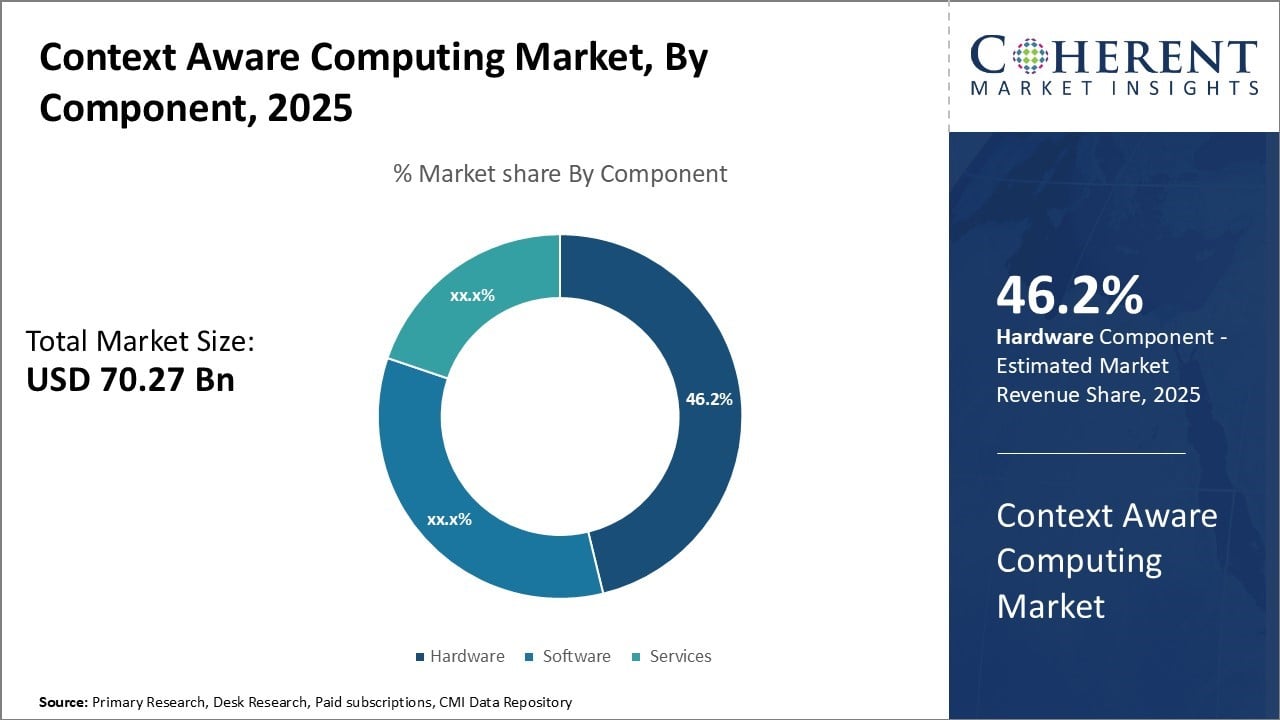
- Based on Components, the Hardware segment is expected to contribute 47.2% of the estimated market share in 2026, owing to enabling core functionalities of context-aware applications and systems.
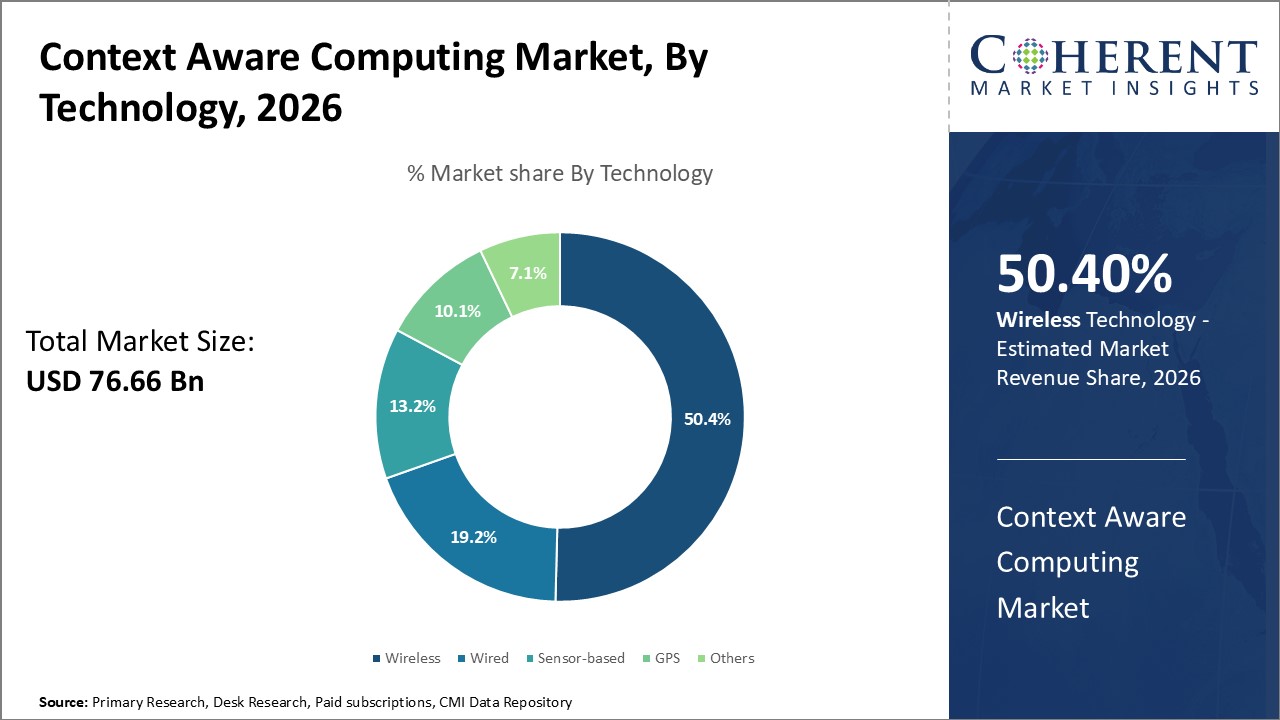
- Based on Technology, the Wireless segment is expected to contribute 50.4% share of the market in 2026, owing to the convenience and mobility provided.
- Based on End user, the Enterprises segment is expected to contribute 62.2% estimated share of the market in 2026, owing to their need for operational optimization through contextual insights.
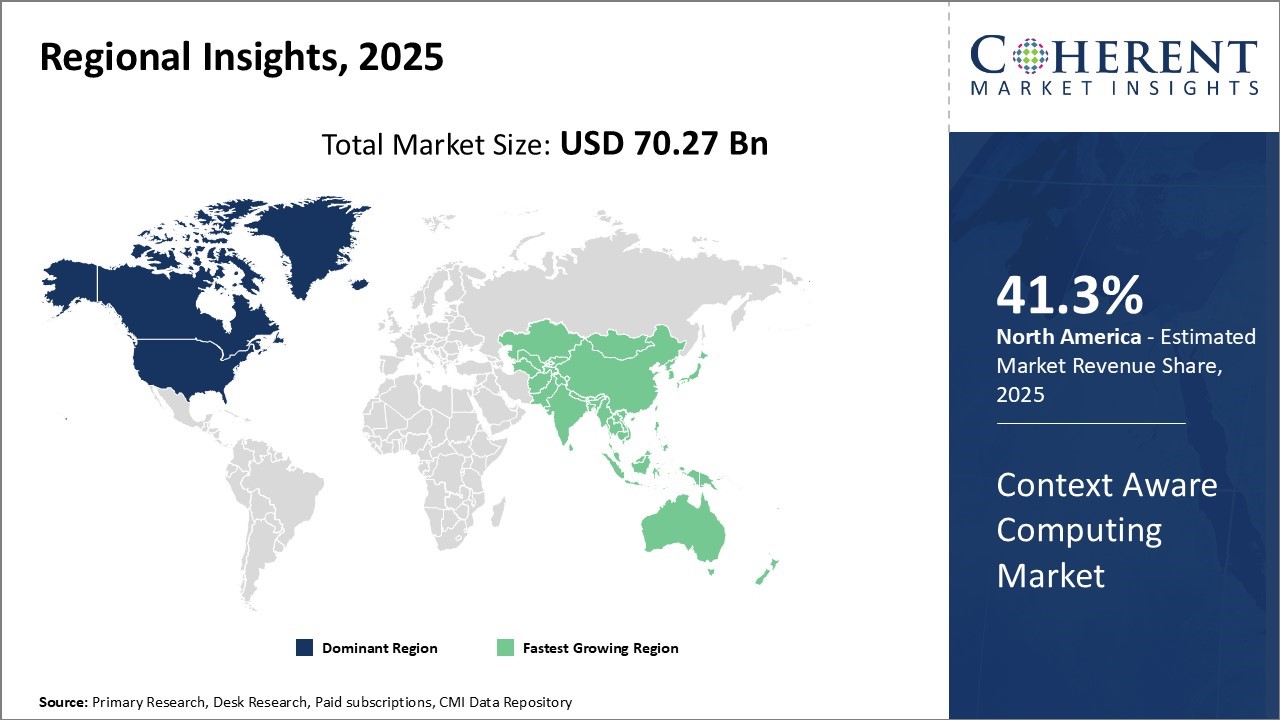
- Based on Region, North America is dominating the regional market for context-aware computing globally. The region is expected to hold 41.3% of the market share in 2026, owing to a strong presence of technology giants and start-ups focusing on artificial intelligence and the internet of things
Market Overview
The increasing adoption of cloud-based technologies and the integration of artificial intelligence into applications are providing growth opportunities to the context-aware computing market. Context-aware computing solutions aim to understand user behaviors and their surrounding environment to provide personalized and relevant experiences. These solutions are being increasingly adopted across various industries like healthcare, transportation, and manufacturing, among others.
Role of Artificial Intelligence (AI) in Context-Aware Computing
Artificial Intelligence (AI) plays a pivotal role in advancing context-aware computing by enabling systems to perceive, interpret, and respond to real-time environmental and user data. AI enhances the ability of devices to make intelligent decisions based on context, such as location, activity, speech, and sensor inputs, leading to more personalized, efficient, and adaptive user experiences.
For instance, in March 2025, Synaptics expanded its Astra AI-native platform with the SR-Series adaptive microcontroller units (MCUs). These MCUs are designed for scalable, multimodal Edge AI, supporting three performance tiers—100 GOPS high-performance, efficiency, and ultra-low-power always-on. This enables context-aware computing across diverse power levels, bringing intelligence closer to the edge and supporting a broad range of applications.
End-User Feedback and Unmet Needs in the Context-Aware Computing Market
- Interoperability and Integration: Many users report challenges in integrating context-aware capabilities with existing systems and platforms, particularly in legacy environments. There is a need for more standardized interfaces and protocols to support seamless data exchange across diverse ecosystems.
- Privacy and Data Security: As context-aware systems often rely on continuous data collection, end users express concerns over data privacy, secure processing, and regulatory compliance. There is a strong demand for edge AI solutions that minimize data transmission and support secure, on-device inference.
- Power Efficiency and Always-On Capability: For applications such as wearables and remote sensors, users seek ultra-low-power solutions with always-on capabilities that do not compromise performance or responsiveness.
- Accuracy and Adaptability: Users also expect higher accuracy in context interpretation and improved adaptability to diverse and dynamic conditions. Current solutions often struggle in complex, multi-modal contexts where environmental signals can be inconsistent or ambiguous.
- Current Industry Events of 2026
- Market Size Estimation
- Regional Breakdown
- Competitive Landscape
- Customer Intelligence
- Segmental Analysis
- Pricing Analysis
- Key Market Drivers, Challenges & Future Trends
- Customized Insights Section
Current Events and Their Impacts on Context-Aware Computing Market
Current Events | Description and its impact |
Technological Advancements: Edge Computing Expansion |
|
Economic Policy: Data Regulation Reforms |
|
Segmental Insights
Context-Aware Computing Market Insights, By Component
Hardware Dominates the Overall Market Due to Enabling Core Functionalities
In terms of components, the hardware segment is expected to contribute 47.2% of the estimated market share in 2026, owing to enabling core functionalities of context-aware applications and systems. Context-aware hardware plays a vital role in seamlessly integrating various software and context signals to provide personalized computing experiences to users. Context-aware hardware devices are equipped with various sensors that can detect a wide range of contextual data, such as location, environmental conditions, user activities, and preferences. Devices such as smartphones, smart watches, IoT appliances, etc., are installed with hardware components like GPS receivers, proximity sensors, accelerometers, gyroscopes, etc. that help in continuous context monitoring.
Advancements in hardware miniaturization have allowed more sensors to be embedded in smaller devices. This has significantly expanded the applicable scope of context-aware systems. Powerful yet compact sensors in hardware can now effortlessly detect superfine contextual cues around users. Hardware components also ensure reliability and quality in context data collection, which is crucial for context-aware applications to function optimally. Devices with robust and high-performance hardware sensors provide accurate and continuous context streams. This strengthens the core capabilities of context-aware solutions.
Context-Aware Computing Market Insights, By Technology
Wireless Segment Dominates Due to Convenience and Mobility
In terms of technology, the wireless segment is expected to contribute 50.4% share of the market in 2026, owing to the convenience and mobility provided. Wireless connectivity allows context-aware systems to operate seamlessly across devices and networks without any physical restrictions. It helps remove infrastructure barriers for context sharing and leveraging between endpoints. Wireless technology frees users from being physically tethered to networks for accessing context-aware services. Context can now effortlessly be captured, analyzed, and shared over the air.
The proliferation of personal mobile devices with integrated wireless capabilities like Bluetooth, WiFi, LTE/5G, etc., has been a key driver. As of 2024, over 1.5 billion 5G smartphones had been in use worldwide. Nearly all modern smartphones and tablets are wirelessly enabled, which has paved the way for an exploding mobile context ecosystem. Context generated via these ubiquitous personal nodes can now effortlessly be accessed from any internet-connected device. This has transformed contexts into digital assets that seamlessly flow across endpoints. The anytime, anywhere access afforded by wireless networks has made context-aware systems highly participatory and experience-centric, further propelling the context-aware computing market revenue.
Context-Aware Computing Market Insights, By End User
Enterprises Dominate Due to Operational Optimization Needs
In terms of end user, the enterprises segment is expected to contribute 62.2% estimated share of the market in 2026, owing to their needs for operational optimization through contextual insights. Context-aware systems offer enterprises capabilities to glean actionable strategic and tactical intelligence from operational data streams. Enterprises across domains are leveraging context to drive efficiency, enhance productivity, reduce costs, improve customer experiences, and gain competitive differentiation.
Context helps optimize business processes, resource allocation, and decision making by offering a comprehensive adaptive view of multi-dimensional enterprise parameters. Enterprises can streamline workflows, match skills/resources to tasks, detect irregularities, and proactively mitigate issues by contextualizing business activity data. Context-aware technologies also help boost employee productivity and job satisfaction. They optimize workplace environments, enable paperless engagement, and automate routine tasks.
Regional Insights
North America Context-Aware Computing Market Trends
North America has established itself as the dominant regional market for context-aware computing globally. The region is expected to hold 41.3% of the market share in 2026. With countries like the U.S. and Canada having a strong presence of technology giants and startups focusing on artificial intelligence and the internet of things, the North American context-aware computing market has seen widespread commercial adoption of context-aware technologies at an early stage.
U.S. Context-Aware Computing Market Trends
Major technology companies based in the U.S., such as Google, Microsoft, and IBM, have invested heavily in the research and development of context-aware platforms and services. This has enabled businesses to leverage context-aware solutions for applications across various sectors, including retail, healthcare, transportation, and industrial automation. The large technology industry in the region is also actively involved in exporting context-aware systems and solutions globally. For instance, in February 2026, Microsoft unveiled the next-gen Phi small language models, Phi-4 multimodal, and Phi-4 mini.
Canada Context-Aware Computing Market Trends
Canada follows the U.S. closely. The growth of the context-aware computing market in Canada is attributed to the rise of smart city initiatives, an increase in investments for Research & Development, and a focus on digital healthcare monitoring.
Asia Pacific Context-Aware Computing Market Trends
The Asia Pacific region has emerged as the fastest-growing regional market for context-aware computing worldwide. Countries like China, Japan, South Korea, and India are witnessing a massive boom in their digital economies focused on AI-enabled technologies.
China Context-Aware Computing Market Trends
China is the largest market for context-aware computing in the Asia Pacific region. There is a growing demand for context-aware computing tools from major industries in China, including e-commerce, manufacturing, banking, and government. Additionally, the government has introduced initiatives to promote innovation and startups developing applications of emerging technologies like contextual computing. For instance, the "Made in China 2026" policy aims to transform China into a high-tech manufacturing powerhouse with a focus on factory automation using industrial IoT and smart manufacturing solutions. Such policies are propelling the context-aware computing market share.
India Context-Aware Computing Market Trends
India is the second-largest market after China. Similar to the “Make in China”, the "Digital India" program in India encourages tech startups to build AI and IoT-based solutions catering to various sectors of the economy. The strong government support, along with increasing technology adoption across industries, makes Asia Pacific an extremely lucrative market for providers of context-aware computing platforms and services.
Market Report Scope
Context Aware Computing Market Report Coverage
| Report Coverage | Details | ||
|---|---|---|---|
| Base Year: | 2025 | Market Size in 2026: | USD 76.66 Bn |
| Historical Data for: | 2020 To 2024 | Forecast Period: | 2026 To 2033 |
| Forecast Period 2026 to 2033 CAGR: | 9.1% | 2033 Value Projection: | USD 141.05 Bn |
| Geographies covered: |
| ||
| Segments covered: |
| ||
| Companies covered: | Apple Inc., Cisco Systems, Inc., Google LLC, IBM Corporation, Intel Corporation, Microsoft Corporation, NVIDIA Corporation, Oracle Corporation, Qualcomm Incorporated, Samsung Electronics Co., Ltd., SAP SE, Siemens AG, Sony Corporation, Texas Instruments Incorporated, and TIBCO Software Inc. | ||
| Growth Drivers: |
| ||
| Restraints & Challenges: |
| ||
Context-Aware Computing Market Trends
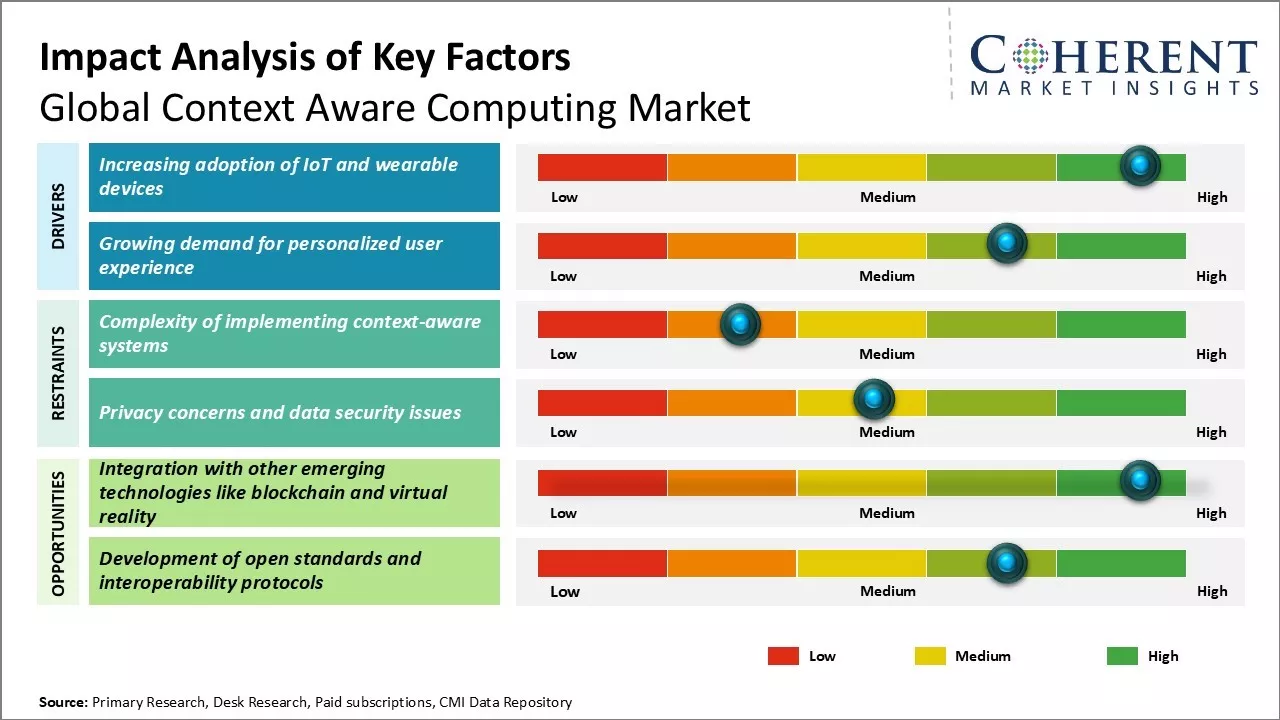
Increasing adoption of IoT and wearable devices
The world is shifting towards a more connected future with the proliferation of internet-enabled devices across various industries. Smart home appliances, connected vehicles, industrial IoT devices, and others. At the core of this transformation lies the technology of the Internet of Things. IoT allows both humans and machines to communicate over the internet and sense various real-world inputs to take intelligent actions. IoT is enabling efficiency gains, cost reductions, and new revenue streams for businesses across sectors. Meanwhile, consumer adoption of connected devices is also rising rapidly, driven by their enhanced functionality and convenience offered.
Wearable devices, in particular, have emerged as one of the fastest-growing segments of the consumer IoT devices. Devices such as smart watches, fitness trackers, and augmented reality headsets are gaining widespread popularity among users looking for real-time insights and assistance on the go. In July 2025, Huawei officially introduced the latest generation of its fitness-focused smartwatches in India with the launch of the HUAWEI WATCH FIT 4 and HUAWEI WATCH FIT 4 Pro. Their lightweight, portable nature, combined with health and lifestyle-focused applications, is resonating well with users. This has prompted major technology players to invest heavily in developing enhanced wearable products with more intuitive and context-aware interfaces. The rising installed base of wearables is expected to be a key enabler for context-aware computing technologies. As these devices gain an understanding of user behavior patterns and the surrounding environment, they can offer highly customized and adaptive experiences. This is further accelerating the context-aware computing market demand.
Context-Aware Computing Market Opportunities
Growing demand for personalized user experience
Digital users have higher expectations of personalization, convenience, and immediacy from their technology interactions. They want their devices, applications, and online services to be tailored exactly as per their individual preferences, needs, and current context. Delivering such highly customized experiences requires understanding user behavior at a deeper level across multiple touchpoints over time. This is where context-aware systems can help, with their ability to capture signals from user activity and environment and make real-time inferences. As users demand more personalization across more aspects of their digital lives, adoption of context-aware techniques is growing among businesses.
A major factor driving this trend is the millennial generation, which now forms a significant part of the consumer landscape. Millennials have adopted digital technologies fully in their lives and expect very seamless and personalized services. Right from their leisure activities like music, videos, to essential services like finance, everything is shifting to digital mediums. Keeping users engaged on various touchpoints now requires a deeper understanding of their aspirations, relationships, and contexts. Context-aware recommendation engines can piece together disparate user data points to offer hyper-personalized suggestions.
Besides consumer-facing industries, even sectors like healthcare and education are exploring the use of context-aware systems. For instance, to enhance remote monitoring of patients by getting situational awareness from their daily living habits and environments. Or helping create more immersive learning experiences for students by adapting content based on their comprehension strengths, location, and time availability, which is further propelling the context-aware computing market share.
Integration with other emerging technologies like blockchain and virtual reality
The area of context-aware computing provides ample opportunities for market growth if integrated effectively with other emerging technologies. Combining context-aware capabilities with blockchain can facilitate novel decentralized context-sharing applications with transparent transactions. For example, context from IoT devices in the supply chain can be recorded on blockchain to enable traceability. Immersive Virtual Reality (VR) and Augmented Reality (AR) systems can greatly benefit from context awareness to deliver location-specific, adaptive, and personalized interactions. Context integration can help VR/AR provide richer, safer, and more engaging experiences. Awareness of user context can assist in automatically configuring VR/AR settings. Also, incorporation of VR/AR context back into the user’s real environment has the potential to spur the development of innovative spatial applications. Such convergence of context-aware computing with blockchain, VR, and AR is expected to open up new revenue streams and help stakeholders capitalize on the evolving technology landscape.
Key Developments
- In June 2025, Hyland unveiled its new agentic document processing solution in Ohio. It is a part of the Content Innovation Cloud. It is powered by generative AI, which allows understanding of meaning, reasoning, and taking actions.
- In March 2025, Synaptics rolled out its SR-Series adaptive microcontroller units as part of the Astra™ AI-Native platform. It is specifically designed for multimodal context-aware computing.
- In December 2022, T-Mobile, a leading wireless carrier, announced a collaboration with Cisco to launch the world's largest, highly scalable, and distributed nationwide cloud-native converged core gateway. This advancement elevates T-Mobile’s 5G standalone core, enhancing performance by over 10% in speed and latency.
- In November 2022, Tata Consultancy Services (TCS), a leading global IT services and consulting firm, partnered with Amazon Web Services (AWS) to launch a quantum computing lab on the Amazon platform. The collaboration helps customers explore and co-create innovative quantum computing use cases to tackle business challenges that surpass the capabilities of traditional technologies.
- In April 2022, IBM, a global leader in technology and consulting, unveiled the IBM z16, its next-generation system featuring an integrated on-chip artificial intelligence (AI) accelerator for latency-optimized inference. This advanced system is designed to enable clients to analyze real-time transactions at scale, including credit card, healthcare, and financial transactions.
- In March 2022, Oracle Cloud Infrastructure (OCI), a leading provider of cloud solutions, introduced a range of new services and capabilities to enhance customer flexibility. OCI expanded its portfolio with 11 additional computing, networking, and storage services, enabling customers to execute workloads more swiftly and securely while reducing costs.
Analyst Viewpoint
- Major technological advancements in artificial intelligence, machine learning, and IoT are enabling devices and applications to gather more contextual data and understanding of user behavior and environment. This will drive the need for context-aware systems that can dynamically adapt and respond based on real-time contextual inputs. North America will continue dominating the market given the huge investments by technology giants in this space. However, Asia Pacific is expected to emerge as the fastest-growing region, supported by expanding mobile and IoT adoption in major countries like China and India.
- Context-aware computing can help address key issues across different industries by enhancing personalization, automation, resource optimization, and productivity. Context awareness will allow applications to be more predictive, proactive, and helpful for users. Revolutionary new technologies like augmented reality, virtual reality, and ambient computing will fuel further growth opportunities. Privacy and security challenges need to be addressed carefully to ensure user trust and confidence in these adaptive systems. Overall context context-aware computing has the potential to revolutionize how people and devices interact with each other in the connected world.
- Standardization efforts are required to facilitate seamless integration and data sharing between heterogeneous context-aware solutions. High development costs and a lack of awareness may limit adoption in the short term.
Market Segmentation
- Component Insights (Revenue, USD Bn, 2021 - 2033)
- Hardware
- Software
- Services
- Technology Insights (Revenue, USD Bn, 2021 - 2033)
- Wireless
- Wired
- Sensor-based
- GPS
- Others (RFID, Bluetooth, Wi-Fi, etc.)
- End User Insights (Revenue, USD Bn, 2021 - 2033)
- Enterprises
- Individuals
- Government
- Regional Insights (Revenue, USD Bn, 2021 - 2033)
- North America
- U.S.
- Canada
- Latin America
- Brazil
- Argentina
- Mexico
- Rest of Latin America
- Europe
- Germany
- U.K.
- Spain
- France
- Italy
- Russia
- Rest of Europe
- Asia Pacific
- China
- India
- Japan
- Australia
- South Korea
- ASEAN
- Rest of Asia Pacific
- Middle East
- GCC Countries
- Israel
- Rest of Middle East
- Africa
- South Africa
- North Africa
- Central Africa
- North America
- Key Players Insights
- Apple Inc.
- Cisco Systems, Inc.
- Google LLC
- IBM Corporation
- Intel Corporation
- Microsoft Corporation
- NVIDIA Corporation
- Oracle Corporation
- Qualcomm Incorporated
- Samsung Electronics Co., Ltd.
- SAP SE
- Siemens AG
- Sony Corporation
- Texas Instruments Incorporated
- TIBCO Software Inc.
Sources
Primary Research Interviews
- In-depth interviews with industry experts, solution providers, software developers, and end-users across sectors such as retail, healthcare, automotive, and smart infrastructure.
Databases
- World Bank Data
- UN Comtrade Database
- OECD Data
- International Telecommunication Union (ITU) Database
Magazines
- Wired
- MIT Technology Review
- IoT Now Magazine
- TechRepublic
- Computerworld
Journals
- IEEE Internet of Things Journal
- Journal of Ambient Intelligence and Smart Environments
- International Journal of Human-Computer Studies
- ACM Transactions on Interactive Intelligent Systems
- Sensors (MDPI)
Newspaper
- The Economic Times – Tech Section
- The Wall Street Journal – Technology
- Financial Times
- The Hindu Business Line – IT & Telecom
- Business Standard
Associations
- IEEE (Institute of Electrical and Electronics Engineers)
- ACM (Association for Computing Machinery)
- IoT M2M Council
- World Economic Forum – Future of Computing Initiatives
- International Telecommunication Union (ITU)
Public Domain Sources
- White papers from government technology initiatives
- Press releases from major tech conferences (CES, MWC, etc.)
- Reports from NIST (National Institute of Standards and Technology)
- European Commission Digital Strategy Publications
- Publicly available product literature and corporate websites
*Definition: The global context-aware computing market involves technologies and devices that can detect environmental changes and adapt accordingly to provide customized experiences based on contextual information like location, nearby people and devices, and behaviors over time. Context-aware capabilities allow systems to intelligently determine the context of real-world situations and environments to provide location-based services and dynamically optimize computing resources based on user needs.
Get access to 250+ pages report
Every segment, forecast, competitor profile and data table behind the analysis above — available for instant download.
- ESOMAR Member
- ISO 9001:2015 Certified
- D-U-N-S Registered
- GDPR & CCPA Compliant
Missing comfort of reading report in your local language? Find your preferred language:
Transform your Strategy with Exclusive Trending Reports
Frequently Asked Questions
The Context Aware Computing Market is estimated to be valued at USD 76.66 Bn in 2026, and is expected to reach USD 141.05 Bn by 2033.
The CAGR of the Context-Aware Computing Market is projected to be 9.1% from 2026 to 2033.
Increasing adoption of IoT and wearable devices and growing demand for personalized user experience are the major factors driving the growth of the global context-aware computing market.
The complexity of implementing context-aware systems and privacy concerns and data security issues are the major factors hampering the growth of the global context aware computing market.
In terms of components, the hardware segment is estimated to dominate the market revenue share in 2026.
Apple Inc., Cisco Systems, Inc., Google LLC, IBM Corporation, Intel Corporation, Microsoft Corporation, NVIDIA Corporation, Oracle Corporation, Qualcomm Incorporated, Samsung Electronics Co., Ltd., SAP SE, Siemens AG, Sony Corporation, Texas Instruments Incorporated, and TIBCO Software Inc. are the major players.
North America is expected to lead the global context-aware computing market in 2026.