

Cloud Services Market Size and Trends: (2026-2033)
The cloud services market is estimated to be valued at USD 762.55 Bn in 2026 and is expected to reach USD 1,707.13 Bn in 2033, exhibiting a compound annual growth rate (CAGR) of 12.2% from 2026 to 2033.
Key Takeaways
- Based on Service Model, the SaaS segment is expected to lead the market with the largest 54% share in 2026, due to widespread adoption of subscription-based business applications and enterprise software solutions.
- Based on Deployment Model, the Public Cloud segment is projected to account for the largest 75% share of the market in 2026, owing to scalability, cost efficiency, and ease of deployment.
- Based on Enterprise Size, the Large Enterprises segment is expected to hold the largest 60% share of the market in 2026, as enterprises increasingly migrate critical workloads and infrastructure to the cloud.
- Based on Industry Vertical, the IT & Telecommunications segment is projected to lead the market 30% share in 2026, due to high cloud adoption for software, infrastructure, and digital transformation initiatives.
- Based on Region, North America is set to lead the cloud service market with 39% share in 2026. While, Asia Pacific is anticipated to be the fastest growing region.
Market Overview
The increasing use of cloud computing across businesses and SMEs is propelling fast growth within the global cloud services market. Cloud services like SaaS, IaaS, PaaS, and BPaaS are increasingly being utilized by businesses to increase flexibility and minimize IT infrastructure costs and complexity. Cloud service vendors are developing innovative solutions with advanced technologies like AI-based platforms, hybrid solutions, and managed security solutions to fulfill increasing needs in businesses. Rapid digital transformation in industries such as IT & telecommunication, BFSI, healthcare, and retail, along with an increase in global data center infrastructure, is boosting growth within this market at present.
Current Events and Its Impacts on the Cloud Service Market
Current Events | and its impact |
US-China Technology Trade Relations and Sanctions |
|
Artificial Intelligence and Generative AI Integration |
|
Role of AI in Cloud Services Market
The cloud services industry is reshaping the world of tech and businesses in the year 2026 by providing scalable, intelligent, and secure platforms that are able to address the needs of the businesses with regard to the changing demands of industries and enterprises.
In the cloud services market, cloud solutions describe services such as SaaS, PaaS, IaaS, BPaaS, and managed security services that help firms optimize IT infrastructure, improve efficiency, and implement their digital transformation strategies. Such technological platforms have received widespread adoption across sectors such as BFSI, healthcare, IT & Telecommunications, Retail, and Manufacturing because they can enable analytics, collaboration, and automation across platforms. For instance, SaaS-based platforms with AI can assist businesses in deriving valuable information from big data while making an informed business decision with ease, while the hybrid solution helps businesses seamlessly integrate the deployment of public and private cloud platforms.
With the ever-growing penetration of the flexibility, economics, and rapid deployment of cloud services in the enterprise IT spending, innovation in the cloud is now a necessity rather than a choice. It helps to close the divide between technology and business, making the cloud platform not just an infrastructure but a tool in the digital enterprise lifecycle.
For instance, in November 2025, Huawei Cloud announced new AI-powered cloud solutions and reported doubling revenue in Brazil, reflecting strong regional adoption and enterprise digital transformation.
- Current Industry Events of 2026
- Market Size Estimation
- Regional Breakdown
- Competitive Landscape
- Customer Intelligence
- Segmental Analysis
- Pricing Analysis
- Key Market Drivers, Challenges & Future Trends
- Customized Insights Section
Segmental Insights
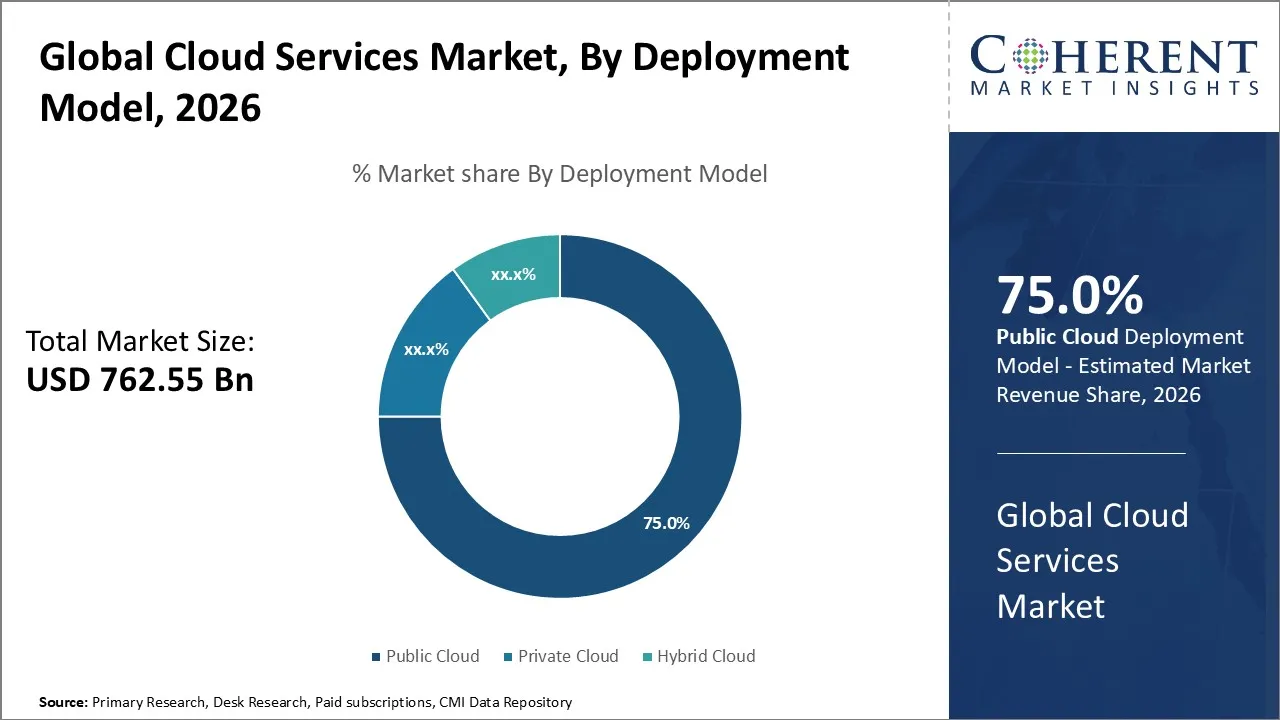
Cloud Services Market Insights, By Deployment Model – Public Cloud leads due to scalability and cost efficiency
In terms of deployment model, the Public Cloud segment is projected to account for the largest 75% share in 2026. Public cloud platforms provide organizations with scalable infrastructure, lower operational costs, and the flexibility to deploy applications quickly without investing in on-premises hardware. Enterprises are increasingly using public cloud services for big data analytics, AI/ML workloads, and disaster recovery, which has strengthened their market position.
For instance, in December 2025, Amazon Web Services (AWS) and Google Cloud announced a new multicloud networking solution designed to simplify connectivity between their public cloud platforms.
Cloud Services Market Insights, By Service Model – SaaS dominates due to widespread adoption of subscription-based solutions
On the basis of service model, the SaaS segment is projected to account for the largest share of 54% in 2026 due to the increasing trend of subscription-based business apps and enterprise solutions. This is due to several benefits offered by SaaS solutions to businesses such as cost reduction, fast implementation processes, and easy access to software from any location across the world. As a result, many businesses are using SaaS solutions to perform collaboration, productivity, CRM, and HR-related tasks due to its prominent position in the global market.
For instance, in April 2025, Google Workspace introduced new AI features in its SaaS suite to enhance real-time collaboration and workflow automation for enterprises, further strengthening the appeal of SaaS-based solutions.
Cloud Services Market Insights, By Enterprise Size – Large Enterprises drive cloud adoption
In terms of enterprise size, the Large Enterprises segment is estimated to hold the largest 60% share of the market in 2026, this is mainly due to large corporations gradually moving production workloads to cloud services. Large-scale organizations find public, hybrid clouds more advantageous due to security features.
For instance, in November 2025, Huawei Cloud expanded its AI and cloud services in Brazil, targeting large enterprises and supporting digital transformation initiatives across BFSI, healthcare, and manufacturing sectors.
Cloud Services Market Insights, By Industry Vertical – IT & Telecommunications leads cloud adoption
Based on industry vertical, the IT & Telecommunications segment is expected to lead the market, comprising 30% of the total market share by 2026, owing to widespread adoption in the area of cloud infrastructure, software development platforms, digital transformation, and other such applications. The IT & Telecommunication industry uses the services offered by the cloud, such as AI, networking, analytics, and CX.
For instance, in November 2025, SAP launched its EU AI Cloud integrating OpenAI, Cohere, and Mistral AI, offering enterprise-focused cloud applications that improve IT operations and accelerate digital transformation for IT and telecom organizations.
Regional Insights
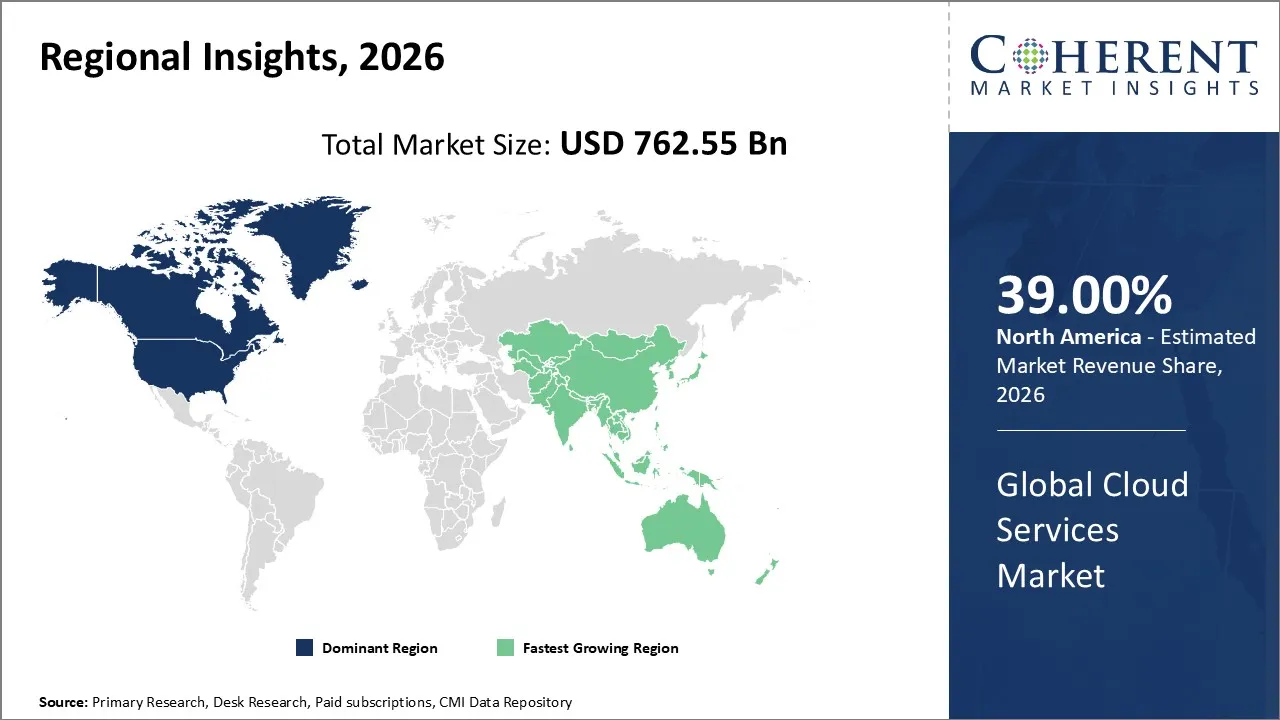
North America Cloud Services Market Analysis & Trends
North America will lead the overall cloud services market in the year 2026, with a projected market share of 39%. Some of the key drivers for this growth include early adoption of innovative cloud technology, significant presence of prominent cloud service offerings such as Microsoft Azure, AWS, and Google Cloud, and substantial investment by enterprises in digital transformation services in the BFSI, healthcare, technology, and telecom sectors.
For instance, in December 2025, AWS and Google Cloud launched a joint multicloud networking service to enhance connectivity and interoperability for enterprises in North America, enabling scalable and secure cloud deployments.
Asia Pacific Cloud Services Market Analysis & Trends
The Asia Pacific region is anticipated to be the fastest-growing market due to rising cloud adoption, growing IT infrastructure investments, increasing digital transformation initiatives by enterprises, and supportive government policies in countries like China, India, Japan, and Australia. Cloud market players and new entrants have been able to offer localized and economical services that address the individual needs of small, medium, and large business entities.
For instance, in November 2025, Huawei Cloud expanded its AI and cloud services in Brazil and Asia Pacific, targeting large enterprises and supporting digital transformation initiatives across multiple sectors, reflecting strong regional demand.
Cloud Services Market Outlook for Key Countries
Is the U.S. cloud services market powering growth through major cloud deals and enterprise investment?
The U.S. cloud services market remains a global leader, driven by strong enterprise adoption, advanced cloud infrastructure, and innovations from major providers like AWS, Microsoft Azure, and Google Cloud. Cloud adoption for enterprises continues to rise with its applications in digital transformation and AI adoption in sectors such BFSI, healthcare, and IT.
For instance, in December 2025, Amazon Web Services (AWS) and Google Cloud introduced a jointly developed multicloud networking service to meet rising demand for reliable enterprise connectivity between major public cloud platforms.
Is China’s cloud services market accelerating with AI-focused adoption and local provider growth?
The Chinese cloud market is expanding at a faster rate due to increasing demands from businesses to adopt AI-integrated cloud solutions. Chinese companies such as Alibaba Cloud, Huawei Cloud, and Tencent Cloud are investing heavily in their cloud solutions. Companies in China are developing innovative solutions to meet their demands as well as making AI integration a prime factor in cloud solutions to differentiate themselves from global companies in the Chinese cloud market.
For instance, in October 2025, IDC released its China public cloud services tracking report, showing that Alibaba Cloud’s share in the country’s IaaS market climbed to about 26.8%, marking consecutive quarterly growth.
Market Report Scope
Cloud Services Market Report Coverage
| Report Coverage | Details | ||
|---|---|---|---|
| Base Year: | 2025 | Market Size in 2026: | USD 762.55 Bn |
| Historical Data for: | 2020 To 2024 | Forecast Period: | 2025 To 2032 |
| Forecast Period 2026 to 2033 CAGR: | 12.2% | 2033 Value Projection: | USD 1,707.13 Bn |
| Geographies covered: |
| ||
| Segments covered: |
| ||
| Companies covered: | Alibaba Group Holding Limited, Amazon Web Services, Inc., Cisco Systems, Inc., Dell, Technologies Inc., Google Llc , Hewlett Packard Enterprise Development Lp, International Business Machines Corporation, Microsoft Corporation, Oracle Corporation, And Rackspace Hosting, Inc. | ||
| Growth Drivers: |
| ||
| Restraints & Challenges: |
| ||
Cloud Services Market Drivers
Increase in demand for cloud services
In opting for cloud computing, the service provides economic savings by way of cost cutting and a reduction in capital expenditures. In putting up an investment in physical IT resources, cloud computing services reduce costs and hence minimize capital expenditure. Proper deployment of private, public, hybrid, or community cloud services can be a very reliable resource for cutting overall operating expenses.
A survey conducted by Booz Allen Hamilton describes that the deployment of cloud computing services saves up to 50 to 60% of the total cost of ownership. Another survey conducted by the CIO magazine determines the belief of the company executives regarding the deployment of cloud computing services with respect to cost cutting. According to the survey 88% of the respondents pointed towards the cost cutting benefits. With the introduction of cloud-computing services the performances of the businesses in many sectors have tremendously increased over years. The following factors contribute in elevating business performance.
- Reduced costs and proper alignment of expenditures with business needs
- Strategies and rollouts of new services to customer needs
- Increased business resilience with the facility of disaster recovery services
Cloud computing services provide an excellent return on investment, which automatically increase the business agility. According to a survey conducted by FCW (The business federal technology) 44% of the companies believe that they get quick return on investment by using cloud-computing services.
Increase in adoption of cloud in SMEs
The last few decades have seen a tremendous rise in the number of entrepreneurs along with their small and medium organizations. Due to advantages offered such as cost cutting and business flexibility cloud computing services are in great demand, proving to be a boon for the start-up business. The needs of cloud computing services are rising due to growth in such small and medium enterprises.
According to a survey conducted by Microsoft Corporation, it was observed that the small medium businesses contributed to nearly 76% in the any country’s economy. Another fact that was discovered is that 79% of entrepreneurs believed that technology could make work more enjoyable. Most of the IT enterprises in the SMB’s need the advanced technology of cloud computing services to flourish their businesses and leave their footprints in various geographies.
Cloud computing service provides several functional advantages and is also an active part of overall growth in the cloud service market. The functional advantages provided by cloud computing service are there are no upgrade and instillation requirements now in the service, operational use of IT staff and shared resources now in the service. The elimination of any requirement to do regular upgrades and installations is beneficial to customers as it is now taken care of by vendors only.
Use of cloud computing services decreases the burden of the IT personnel to retain the IT infrastructure, thus making it possible for the personnel to work on other projects with increased utilization of the IT personnel. Additionally, the resources are well distributed to be used by each person involved in the cloud.
Analyst Opinion (Expert Opinion)
- The cloud service market is currently undergoing a transformation as organizations are shifting from merely cloud I.T. infrastructure to intelligent and AI-infused integrated cloud platforms. According to recent studies, over 70% of businesses in the United States are shifting toward a multicloud strategy in an effort to not only provide redundancy but to optimize SaaS, PaaS, as well as IaaS performance as well.
- The adoption patterns also highlight that hybrid and multicloud technologies lead the strategic plans, as firms are unwilling to be dependent on any single vendor. Case studies from the Japanese market indicate that it is the large-scale manufacturing firms that have embraced hybrid clouds as they require the integration of their ERPs with analytics and AI. Those vendors who do not provide flexible technologies that are AI-enabled and interoperable would find themselves losing their enterprise customers as these firms demand agility and scalability.
- The innovation leader is still in North America, but the Asia Pacific region is closing the gap as a result of the digital transformation movement and the expansion of local cloud providers like Huawei and Tencent.
Speak to the analyst
Want personalized insights?
Take the findings above to one of our principal consultants, or have the report rebuilt around the segments, geographies and competitors you actually track.
Cloud Services Industry News
- In September 2025, Alibaba Cloud announced its latest full‑stack AI innovations and infrastructure upgrades, including next‑generation large language models (e.g., Qwen3‑Max) and expanded cloud infrastructure, during the Apsara Conference 2025.
- In December 2025, AWS announced a series of cloud service upgrades, such as new AI agents, frontier Nova models, AWS AI Factories, S3 Vectors storage for AI workloads, and expanded Amazon Bedrock capabilities, all aimed at helping developers and enterprises build, deploy, and scale AI applications in the cloud.
- In November 2025, Microsoft announced the introduction of new cloud and AI services in the Indonesia Central region, aimed at enabling local organizations to build and deploy AI‑powered applications using Azure infrastructure.
Market Segmentation
- Service Model Insights (Revenue, USD Bn, 2026 - 2033)
- IaaS
- PaaS
- SaaS
- BPaaS
- Management and Security Services
- Deployment Type Insights (Revenue, USD Bn, 2026 - 2033)
- Public Cloud
- Private Cloud
- Hybrid Cloud
- Enterprise Size Insights (Revenue, USD Bn, 2026 - 2033)
- SMEs
- Large Enterprises
- Industry Vertical Insights (Revenue, USD Bn, 2026 - 2033)
- BFSI
- IT & Telecommunications
- Government
- Retail
- Healthcare
- Energy & Utilities
- Media & Entertainment
- Manufacturing
- Others
- Regional Insights (Revenue, USD Bn, 2026 - 2033)
- North America
- U.S.
- Canada
- Latin America
- Brazil
- Argentina
- Mexico
- Rest of Latin America
- Europe
- Germany
- U.K.
- Spain
- France
- Italy
- Russia
- Rest of Europe
- Asia Pacific
- China
- India
- Japan
- Australia
- South Korea
- ASEAN
- Rest of Asia Pacific
- Middle East & Africa
- GCC Countries
- Israel
- Rest of Middle East & Africa
- North America
- Key Players Insights
- Alibaba Group Holding Limited
- Amazon Web Services, Inc.
- Cisco Systems, Inc.
- Dell, Technologies Inc.
- Google Llc
- Hewlett Packard Enterprise Development Lp
- International Business Machines Corporation
- Microsoft Corporation
- Oracle Corporation
- Rackspace Hosting, Inc.
Sources
Primary Research Interviews
- Cloud Service Providers (Alibaba Cloud, AWS, Microsoft Azure, Google Cloud, Oracle Cloud, etc.)
- IT Infrastructure & Cloud Solutions Managers
- Enterprise IT Heads & CIOs
- Cloud Architects & DevOps Engineers
- IT Consultants & System Integrators
- Cybersecurity & Cloud Compliance Specialists
- Others
Databases
- Bloomberg Terminal
- Thomson Reuters Eikon
- S&P Global Market Intelligence
- Statista
- PitchBook
- Others
Magazines
- Cloud Computing Magazine
- InfoWorld
- Network World
- Enterprise Cloud News
- Data Center Knowledge
- Others
Journals
- Journal of Cloud Computing
- International Journal of Cloud Computing & Services Science
- Journal of Information Technology
- Journal of Enterprise Architecture
- Others
Newspapers
- Financial Times
- The Wall Street Journal
- Reuters
- Bloomberg News
- TechCrunch
- Others
Associations
- Cloud Security Alliance (CSA)
- OpenStack Foundation
- The Linux Foundation (Cloud & AI Projects)
- National Institute of Standards and Technology (NIST) – Cloud Computing Programs
- Others
Public Domain Sources
- Official Company Press Releases (Microsoft, AWS, Alibaba Cloud, Oracle, Google, etc.)
- Government Reports on IT & Cloud Adoption
- Regulatory & Compliance Guidelines (e.g., GDPR, CCPA, FedRAMP)
- Industry Whitepapers from Publicly Accessible Sources
- Others
Proprietary Elements
- CMI Data Analytics Tool
- Proprietary CMI Existing Repository of Information for the Last 8 Years
*Definition: A Cloud service refers to any service or application that is delivered over the internet, leveraging cloud computing technology. Instead of running on local servers or devices, these services are hosted on remote servers in data centers operated by cloud service providers.
Get access to 250+ pages report
Every segment, forecast, competitor profile and data table behind the analysis above — available for instant download.
- ESOMAR Member
- ISO 9001:2015 Certified
- D-U-N-S Registered
- GDPR & CCPA Compliant
Missing comfort of reading report in your local language? Find your preferred language:
Transform your Strategy with Exclusive Trending Reports
Frequently Asked Questions
The cloud services market is estimated to be valued at USD 762.55 Bn in 2026, and is expected to reach USD 1,707.13 Bn by 2033.
The global cloud services market is estimated to reach USD 1,207.5 Bn by 2033
Some of the key players in the market are Alibaba Group Holding Limited, Amazon Web Services, Inc., Cisco Systems, Inc., Dell, Technologies Inc., Google Llc, Hewlett Packard Enterprise Development Lp, International Business Machines Corporation, Microsoft Corporation, Oracle Corporation, And Rackspace Hosting, Inc.
The public cloud segment holds the largest market share among the in 2026.
The CAGR of the Cloud Services Market is projected to be 12.2% from 2026 to 2033.