

Security Robot Market Analysis & Forecast: 2026-2033
Security Robot Market is estimated to be valued at USD 19.18 Bn in 2026 and is expected to reach USD 45.31 Bn in 2033, exhibiting a compound annual growth rate (CAGR) of 13.1% from 2026 to 2033.
Key Takeaways
- By Type, the Unmanned Aerial Vehicle (UAV) segment is projected to dominate the global Security Robot Market in 2026, accounting for a commanding 89.1% share in terms of value.
- By Region, North America is expected to lead the global Security Robot Market in 2026, capturing an estimated 38.2% market share.
Market Overview
Increased spending on defense, geopolitical instability, and the growing threat of terrorism is just a few of the reasons why the global security robot market is growing. A crucial contributing factor is the increase in government spending on military robotics R&D. A case in point is the Autonomous Technology Strategic Roadmap, which in the year 2024 the U.S. Department of Defense Robotics Research Office funded with more than $1.7 billion, highlighting the shift towards autonomous systems.
Current Events and Its Impact on the Security Robot Market
Event | Description and Impact |
Geopolitical Tensions and Defense Spending Increases |
|
Artificial Intelligence and Autonomous Technology Breakthroughs |
|
Cybersecurity Threats and Data Protection Regulations |
|
Pricing Analysis
The global security robot market features a broad pricing spectrum, reflecting diverse technologies, functionalities, and end-user requirements. Entry-level models start around $15,000, while advanced enterprise-grade platforms can exceed $500,000. Pricing tiers generally fall into four segments:
- Entry-Level: $15,000–$50,000 — Basic patrol and surveillance robots with limited autonomy.
- Mid-Range: $50,000–$150,000 — Robots equipped with improved AI, sensor suites, and longer operational capabilities.
- Premium: $150,000–$350,000 — Advanced autonomous units featuring high-level AI, rugged design, and multi-sensor integration.
- Enterprise/Military Grade: $350,000+ — Specialized robots for critical infrastructure and defense, often including weapons detection and encrypted communications.
Key brands illustrate this spread: Knightscope’s K7 rough-terrain robot commands $350,000–$400,000, while Cobalt Robotics offers subscription models around $3,500–$6,500 per month for indoor security. SMP Robotics’ perimeter patrol units range from $120,000 to $320,000 depending on configuration.
Emerging players, such as Otsaw Digital, price premium outdoor robots between $200,000 and $280,000, whereas more task-specific robots like 5G Robotics’ DOGO are priced affordably at $30,000–$45,000.
Overall, pricing is influenced by autonomy level, sensor technology, operational environment, and service models, including lease versus outright purchase.
- Current Industry Events of 2026
- Market Size Estimation
- Regional Breakdown
- Competitive Landscape
- Customer Intelligence
- Segmental Analysis
- Pricing Analysis
- Key Market Drivers, Challenges & Future Trends
- Customized Insights Section
Role of Advanced Technologies
The integration of AI in the security robot market is revolutionizing safety systems worldwide. Security robots outfitted with computer-based intelligence now perform real-time threat detection and behavioral analysis with remarkable accuracy. AI-powered models enable continuous learning, reducing false alarms and enhancing genuine threat identification.
Advancements in computer vision allow simultaneous facial recognition, license plate reading, and object identification, vastly improving situational awareness beyond traditional systems. This progress marks a significant security robots advancement in the field of safety systems by enabling autonomous decision-making and adaptive patrol patterns.
Enhanced sensor fusion, combining LiDAR, thermal imaging, radar, and acoustic sensors, provides 360-degree environmental monitoring, even under challenging conditions like darkness or adverse weather. Autonomous navigation breakthroughs, including SLAM and intelligent path planning, allow robots to dynamically map and patrol complex environments without human intervention.
The extension of the security robots capabilities continues with 5G connectivity and IoT integration, enabling seamless communication with broader security networks and remote command centers. Together, these advanced technologies are transforming security robots from supplementary tools into integral components of modern safety infrastructure, delivering continuous, reliable, and proactive protection.
Segmental Insights
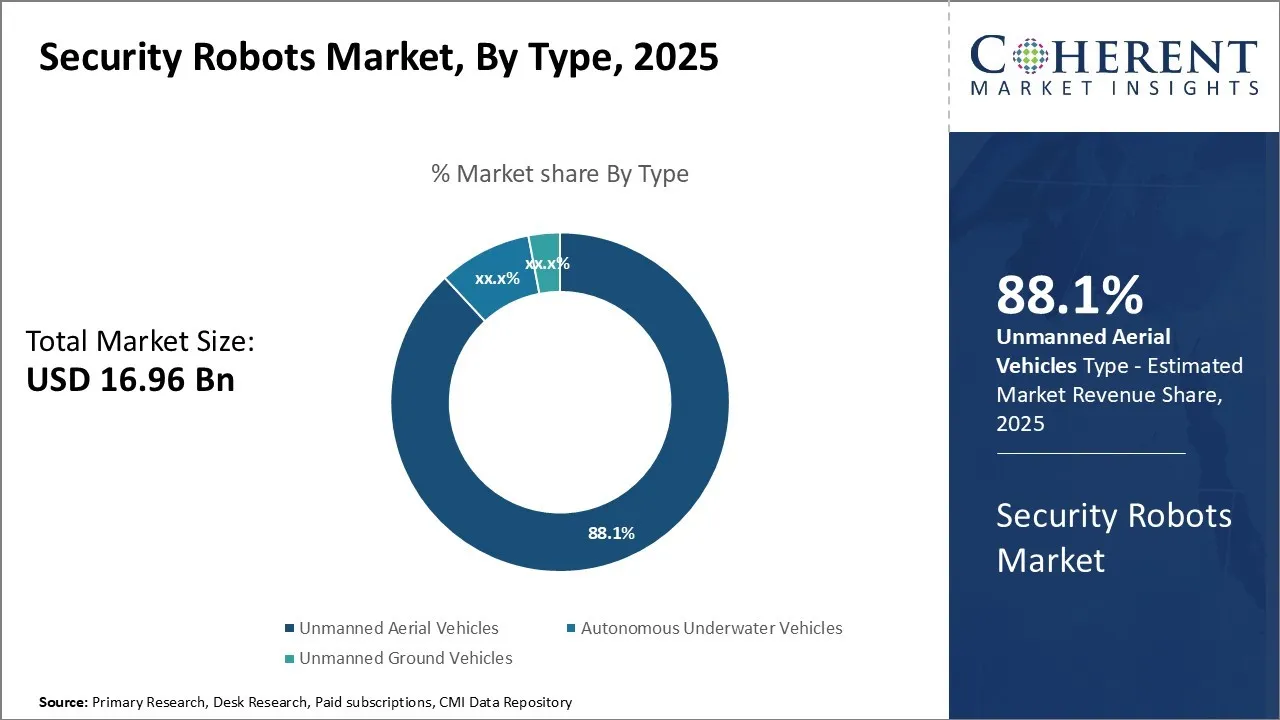
Global Security Robot Market Insights, By Type
In terms of type of robot, the Unmanned Aerial Vehicle (UAV) segment is expected to dominate the global market by 2026, accounting for a commanding 89.1% share in terms of value. This dominance is primarily driven by increased focus among market players on innovation and product development tailored to a broad range of applications including urban development, agriculture, and forest surveys. UAVs operate without the need for an onboard human pilot, offering operational efficiency and remote functionality.
The Unmanned Ground Vehicle (UGV) segment is also projected to witness substantial growth, driven by increasing demand across regions like Europe and North America. UGVs are autonomous or remotely operated robots that remain in contact with the ground and can perform tasks without onboard human intervention. Their applications range from logistics to combat support in military settings.
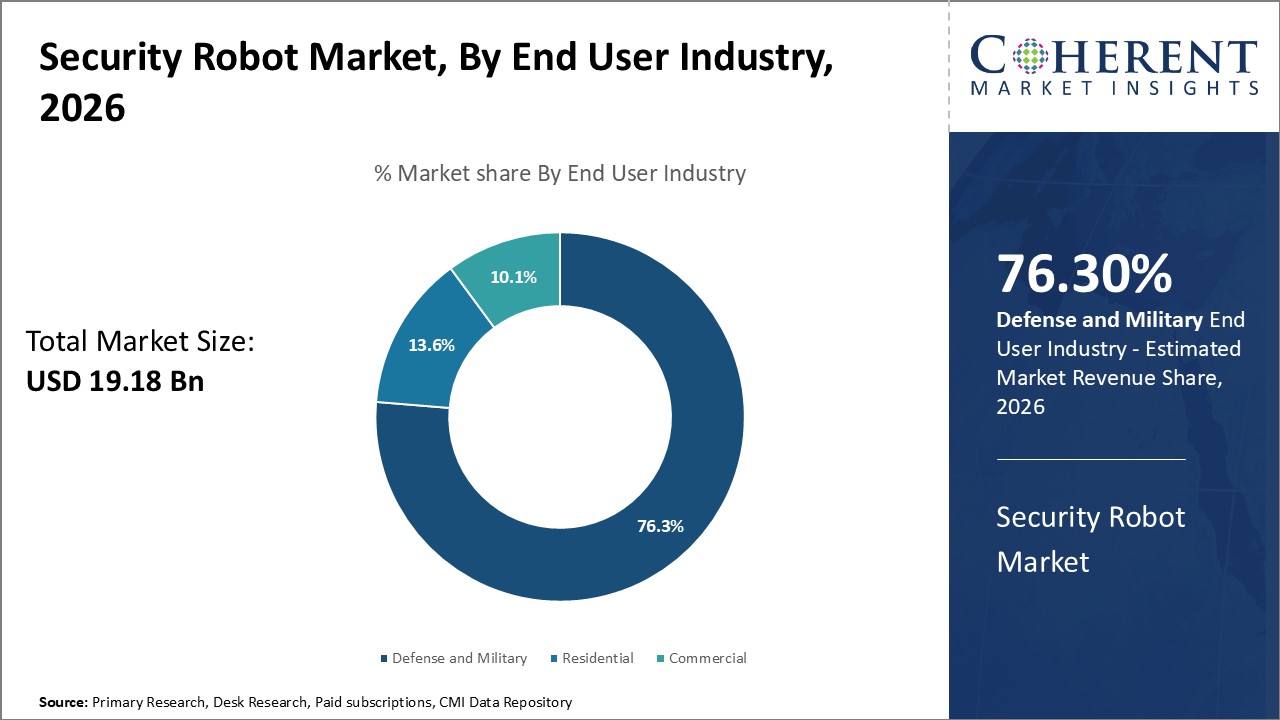
Global Security Robot Market Insights, By End User Industry
By end user industry, the Defense and Military segment is anticipated to lead the market over the forecast period. This is attributed to rising global defense expenditures and the rapid adoption of cutting-edge technologies.
Security robots are increasingly utilized for surveillance, reconnaissance, and combat support roles on the battlefield, as governments invest in automation to enhance operational readiness. The strategic need for advanced, unmanned systems is fueling sustained demand from defense forces worldwide, positioning this segment for robust growth.
The Residential segment is also expected to register notable expansion, supported by the growing trend toward smart home security solutions. With rising crime rates and a heightened focus on personal safety, consumers are turning to security robots for real-time monitoring and threat detection. These systems are increasingly integrated with IoT and AI technologies, making them a critical component of modern residential security infrastructures.
Global Security Robot Market Insights, By Application
In terms of application, the Spying segment is set to dominate the global security robot market throughout the forecast period. This growth is driven by increasing technological innovation and the strategic defense requirements of developed nations.
Security robots are frequently deployed for surveillance missions in hostile or inaccessible environments, especially by military and intelligence agencies. Their role in discreet intelligence gathering and battlefield reconnaissance continues to gain traction, bolstering demand for this segment.
The Patrolling segment is also poised for strong growth, underpinned by innovations that enhance robot autonomy and energy efficiency. Emerging designs, such as solar-powered patrolling robots capable of continuous video monitoring without external power, are gaining attention.
Regional Insights
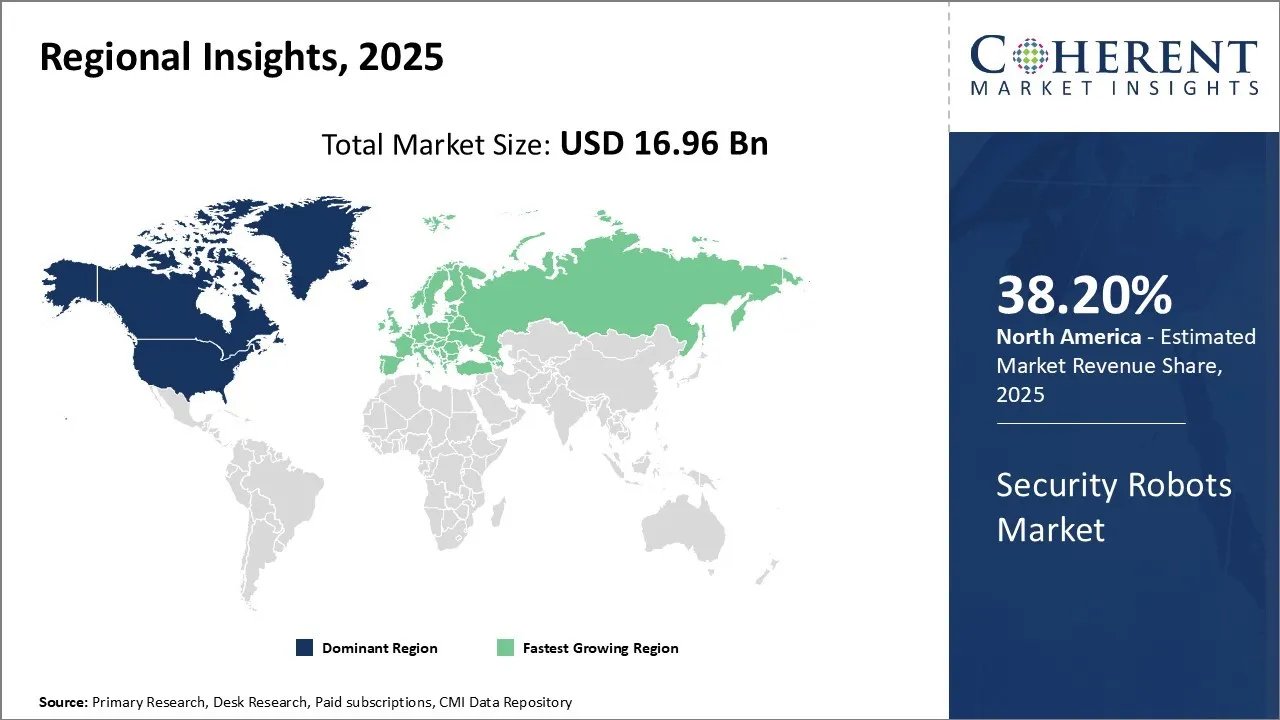
North America Security Robot Market Analysis and Trends
North America is projected to capture a substantial 38.20% share of the global security robot market by 2026, driven by the increasing deployment of unmanned and autonomous solutions across law enforcement, defense, and public safety sectors.
The United States plays a pivotal role in this growth, as rising incidents of mass shootings, school violence, and public unrest have led to a surge in demand for advanced surveillance and threat-detection systems. Autonomous ground robots and aerial drones are increasingly used for patrolling, reconnaissance, and emergency response.
Government agencies are investing heavily in robotics and artificial intelligence to enhance national security. Additionally, Canada is advancing its defense and public safety infrastructure by supporting R&D and commercialization of robotics technologies. Overall, North America's mature defense ecosystem, high technology adoption rate, and strong funding pipeline position it as a leader in the security robot space.
Asia Pacific Security Robot Market Analysis and Trends
Asia Pacific is expected to register the fastest growth in the global security robot market through 2026, fueled by heightened geopolitical tensions, internal conflicts, and the rapid modernization of military capabilities. The region’s demand is concentrated in countries such as China, India, Japan, and South Korea, all of which are prioritizing the integration of robotic systems into their defense and homeland security frameworks.
These nations are actively developing AI-powered autonomous platforms to address border security, urban monitoring, and high-risk operations. The combination of robust manufacturing bases, government support, and growing awareness of security threats makes Asia Pacific a highly attractive market for domestic and international robot manufacturers.
Europe Security Robot Market Analysis and Trends
Europe continues to be a significant regional market for security robots, supported by established defense industries and rising concerns over terrorism and public safety. Nations like Germany, France, and the United Kingdom are deploying robotic surveillance systems in urban areas, transportation hubs, and sensitive government facilities.
European Union initiatives encouraging smart city infrastructure and cross-border security collaboration are boosting demand for AI-powered autonomous systems. Vendors in the region face strong regulatory frameworks related to privacy, ethics, and safety, which influence product development and deployment strategies.
Dominating Countries in the Security Robot Market
United States Security Robot Market Analysis and Trends
The United States leads the global security robot market with strong investments in defense automation, public safety, and law enforcement technologies. Unmanned aerial vehicles (UAVs), ground robots, and AI-integrated surveillance systems are widely deployed across airports, border checkpoints, and public venues.
Key government programs and defense contractors are actively advancing next-generation robotics for applications in military reconnaissance, bomb disposal, and school security. The country’s extensive R&D ecosystem and access to venture capital further bolster innovation and commercialization.
China Security Robot Market Analysis and Trends
China is a dominant force in the Asia Pacific security robot market, driven by large-scale investments in military robotics, surveillance infrastructure, and AI technologies. The government’s push for technological self-reliance and smart city development has accelerated adoption of unmanned patrol vehicles and drone surveillance across public and private sectors. China's strong industrial base and policy support make it a hub for both development and export of security robots.
India Security Robot Market Analysis and Trends
India is emerging as a fast-growing market, propelled by internal security challenges, border tensions, and increasing incidents of domestic terrorism. Security robots are being deployed in railway stations, airports, government buildings, and educational institutions. The “Make in India” initiative is encouraging domestic manufacturing of defense and surveillance robots, while public-private partnerships are fostering innovation in AI and robotics.
Market Report Scope
Security Robot Market Report Coverage
| Report Coverage | Details | ||
|---|---|---|---|
| Base Year: | 2025 | Market Size in 2026: | USD 19.18 Bn |
| Historical Data for: | 2020 To 2024 | Forecast Period: | 2026 To 2033 |
| Forecast Period 2026 to 2033 CAGR: | 13.1% | 2033 Value Projection: | USD 45.31 Bn |
| Geographies covered: |
| ||
| Segments covered: |
| ||
| Companies covered: | Recon Robotics Inc., Lockheed Martin Corporation, RoboTex Inc., Northrop Grumman Corporation, QinetiQ, Thales SA, Kongsberg Gruppen, BAE Systems PLC, FLIR Systems Inc., Elbit Systems Limited, Boston Dynamics Inc., Leonardo SpA, SMP Robotics, AeroVironment Inc., DJI, and Knight Scope | ||
| Growth Drivers: |
| ||
| Restraints & Challenges: |
| ||
Global Security Robot Market Drivers
- Rise in use of robots in surveillance and security applications to drive the market growth
The use of smart security robotics helps in tracking people and assets, patrol physical areas, record data, and in other applications. These robots can pinpoint problems that could be not easy for humans to detect. Moreover, these robots can operate 24/7. Security robots can move around for monitoring security-sensitive locations, can consist significant sensors including thermal, infrared, LiDAR, and ultrasonic.
The use of these robots is increasing to assist human security personnel as they take over some monotonous, manual labor such as patrols. Thus, growing use of robots in surveillance and security applications is expected to fuel growth of the market during the forecast period.
- Increasing concerns regarding safety to augment market growth
The crime rates are increasing all over the world, due to which safety concerns are increasing. This in turn is creating strong demand for security robots.
Several private and public institutions around the world are finding cost-effective ways for deterring crime and protecting property and people. From neutralizing threats in real-time to capturing data for forensic investigation, autonomous systems are effective in detection and discouragement of vandals, trespassing, break-ins, and theft. Thus, demand for security robots is increasing with increasing safety concerns around the world. This factor is expected to boost growth of the global security robot market during the forecast period.
Global Security Robot Market Opportunities
Growing popularity of security robotics due to their benefits will bring multiple opportunities in the global security robot market during the forecast period. The autonomous security robotics continues advance as it is still in its early stage. Current smart security robots are capable of tracking assets and people, recording data, and patrolling physical regions among others.
This technology can pinpoint all the issues that are hard for humans to detect. Moreover, these robots can work non-stop without requiring breaks. Thus, such benefits of security robotics are driving their popularity, due to which the market is likely to see ample opportunities.
Emergence of AI technology to create business opportunities in the global security robot market during the forecast period. Artificial Intelligence (AI) field is showing rapid growth with potential significant use for national security. With increasing technological development, AI technologies are increasingly becoming advanced.
The U.S. for instance along with other nations are focused on development of AI applications for various military functions. Thus, emerging AI technology is likely to bring various lucrative opportunities in the global security robot market during the forecast period.
Global Security Robot Market Trends
- Growing inventions in the robotics space is a major trend in the market
The rate of innovations in the robotics field is rapidly increasing, which in turn is likely to support the market growth. For instance, The Afghan all-girls robotics team developed a pair of robots for identifying and neutralizing land mines.
These robots can be utilized as security robots in areas that require to identify land mines. Several other innovations are being carried out in this field, which is likely to boost demand for security robots in multiple fields. This trend is likely to continue in the market over the coming years.
- Rise in applications in de-mining is a growing trend in the market
The use of security robots in de-mining applications is increasing for ensuring complete safety of personnel. As per the Russian Defense Ministry reports, in December 2020, Russian sappers used the Uran-6 multifunctional robotic system for demining the region around Stepankert Airport. Due to the robotic complex, the productivity in the cleanup of the region from explosive objects increased. Thus, this trend is expected to drive growth of the global security robot market during the forecast period.
Analyst Viewpoint
- The security robot market is experiencing strong growth propelled by rising security threats, a shortage of security personnel, and swift advancements in AI and sensor technologies. Across industries, organizations are turning to autonomous security robots to boost surveillance efficiency while lowering the high costs linked to human guards. Cutting-edge capabilities like facial recognition, thermal imaging, and real-time data analytics have enhanced threat detection precision, increasing the appeal of these systems to end-users.
- Despite this positive momentum, the market faces challenges including high upfront costs, concerns over workforce displacement, and regulatory hurdles related to autonomous surveillance operations. Privacy issues and stringent data protection laws also complicate adoption, particularly in regions with strict compliance requirements.
- Opportunities abound with the rise of cloud-based security solutions, growing demand for perimeter defense in critical infrastructure, and expanding use cases in retail and healthcare. Additionally, the advent of collaborative robots designed to assist rather than replace human security staff opens new avenues for market growth.
- Regionally, North America leads the market due to its advanced technology adoption, significant defense expenditures, and strong robotics manufacturing base. Meanwhile, the Asia-Pacific region is the fastest-growing market, fueled by rapid industrial expansion, increasing security budgets in countries like China and Japan, and rising interest from enterprises looking for efficient and cost-effective automated surveillance.
Global Security Robot Market: Key Developments
- In December 2024, Knightscope Inc., a U.S.-based developer of autonomous security robots, announced the launch of its next-generation K7 model. This advanced four-wheel security robot features upgraded AI-based anomaly detection and enhanced terrain navigation capabilities for wide-area patrolling.
- In June 2025, SMP Robotics, a pioneer in outdoor autonomous mobile robots, introduced a solar-powered security robot designed for remote infrastructure surveillance. The new model integrates thermal imaging, GPS tracking, and AI-powered object recognition.
- In April 2025, Cobalt Robotics, a leading provider of indoor robotic security solutions, unveiled a cloud-based AI dashboard that allows real-time monitoring and analytics from its autonomous patrol units deployed across corporate facilities.
- In February 2025, Boston Dynamics, a global leader in advanced robotics, announced the integration of facial recognition and multi-environment patrolling capabilities into its Spot robot platform, enabling usage in both commercial and defense settings.
- In December 2024, Hyundai Robotics, a division of Hyundai Motor Group, introduced a quadruped security robot equipped with high-resolution LiDAR and adaptive path-planning, aimed at industrial perimeter surveillance.
Market Segmentation
- Global Security Robot Market, By Type of Robot (Revenue, USD Bn, 2021 - 2033)
- Unmanned Aerial Vehicle
- Unmanned Ground Vehicle
- Autonomous Underwater Vehicle
- Global Security Robot Market, By End User Industry (Revenue, USD Bn, 2021 - 2033)
- Defense and Military
- Residential
- Commercial
- Global Security Robot Market, By Application (Revenue, USD Bn, 2021 - 2033)
- Spying
- Explosive Detection
- Patrolling
- Rescue Operation
- Other Types of Applications
- Global Security Robot Market, By Geography (Revenue, USD Bn, 2021 - 2033)
- North America
- U.S.
- Canada
- Latin America
- Brazil
- Argentina
- Mexico
- Rest of Latin America
- Europe
- Germany
- U.K.
- Spain
- France
- Italy
- Russia
- Rest of Europe
- Asia Pacific
- China
- India
- Japan
- Australia
- South Korea
- ASEAN
- Rest of Asia Pacific
- Middle East
- GCC Countries
- Israel
- Rest of Middle East
- Africa
- South Africa
- North Africa
- Central Africa
- Company Profiles
- Lockheed Martin Corporation
- Northrop Grumman Corporation
- Thales SA
- BAE Systems PLC
- Elbit Systems Limited
- Leonardo SpA
- AeroVironment Inc.
- Knight Scope
- DJI
- SMP Robotics
- Boston Dynamics Inc.
- FLIR Systems Inc.
- Kongsberg Gruppen
- QinetiQ
- RoboTex Inc.
- Recon Robotics Inc.
Sources
Primary Research Interviews
- Security Robot Manufacturers
- Technology Integrators and System Providers
- End-user Organizations (Corporate Security, Healthcare, Retail)
- Security Service Providers
- Others
Databases
- International Federation of Robotics (IFR) Database
- Security Industry Association (SIA) Market Database
- IEEE Xplore Digital Library
- Grand View Research Industry Database
- Others
Magazines
- Security Magazine
- Robotics Business Review
- IEEE Robotics & Automation Magazine
- Physical Security International
- Others
Journals
- Journal of Field Robotics
- International Journal of Advanced Robotic Systems
- Robotics and Autonomous Systems
- Others
Newspapers
- The Wall Street Journal
- Financial Times
- Reuters Technology News
- TechCrunch
- Bloomberg Technology
- Others
Associations
- International Federation of Robotics (IFR)
- Security Industry Association (SIA)
- Robotic Industries Association (RIA)
- Association for Unmanned Vehicle Systems International (AUVSI)
- Others
Public Domain Sources
- U.S. Patent and Trademark Office (USPTO)
- European Patent Office (EPO)
- Company Annual Reports and SEC Filings
- Government Security Technology Reports
- Others
Proprietary Elements
- CMI Data Analytics Tool
- Proprietary CMI Existing Repository of information for last 8 years
Definition: A Security Robot is a robotic device that performs security tasks such as reporting, monitoring, investigating, and detecting intruders. It is used to increase the degree of safety and security in commercial establishments like malls, schools or campuses, or multi-building medical complexes.
Get access to 250+ pages report
Every segment, forecast, competitor profile and data table behind the analysis above — available for instant download.
- ESOMAR Member
- ISO 9001:2015 Certified
- D-U-N-S Registered
- GDPR & CCPA Compliant
Missing comfort of reading report in your local language? Find your preferred language:
Transform your Strategy with Exclusive Trending Reports
Frequently Asked Questions
The Security Robot Market size is estimated to be valued at USD 19.18 Bn in 2026, and is expected to reach USD 45.31 Bn by 2033.
The CAGR of the global Market is projected to be 13.1% from 2026 to 2033.
Rise in use of robots in surveillance and security applications and increasing concerns regarding safety are fuelling the growth of market.
The unmanned aerial vehicles segment is the leading type segment in the market.
Growing privacy and intrusion concerns and lack of reliability of this technology are the major factors restraining growth of the market.
Recon Robotics Inc., Lockheed Martin Corporation, RoboTex Inc., Northrop Grumman Corporation, QinetiQ, Thales SA, Kongsberg Gruppen, BAE Systems PLC, FLIR Systems Inc., Elbit Systems Limited, Boston Dynamics Inc., Leonardo SpA, SMP Robotics, AeroVironment Inc., DJI, and Knight Scope.
Security robots are autonomous or semi-autonomous machines equipped with sensors, cameras, and AI software to perform surveillance, patrolling, threat detection, and access control in locations like airports, malls, warehouses, and data centers.