

Space Ground Station Equipment Market Analysis & Forecast: 2026-2033
Space Ground Station Equipment Market is estimated to be valued at USD 11,739.5 Mn in 2026 and is expected to reach USD 20,686.9 Mn in 2033, exhibiting a compound annual growth rate (CAGR) of 8.4% from 2026 to 2033.
Key Takeaways
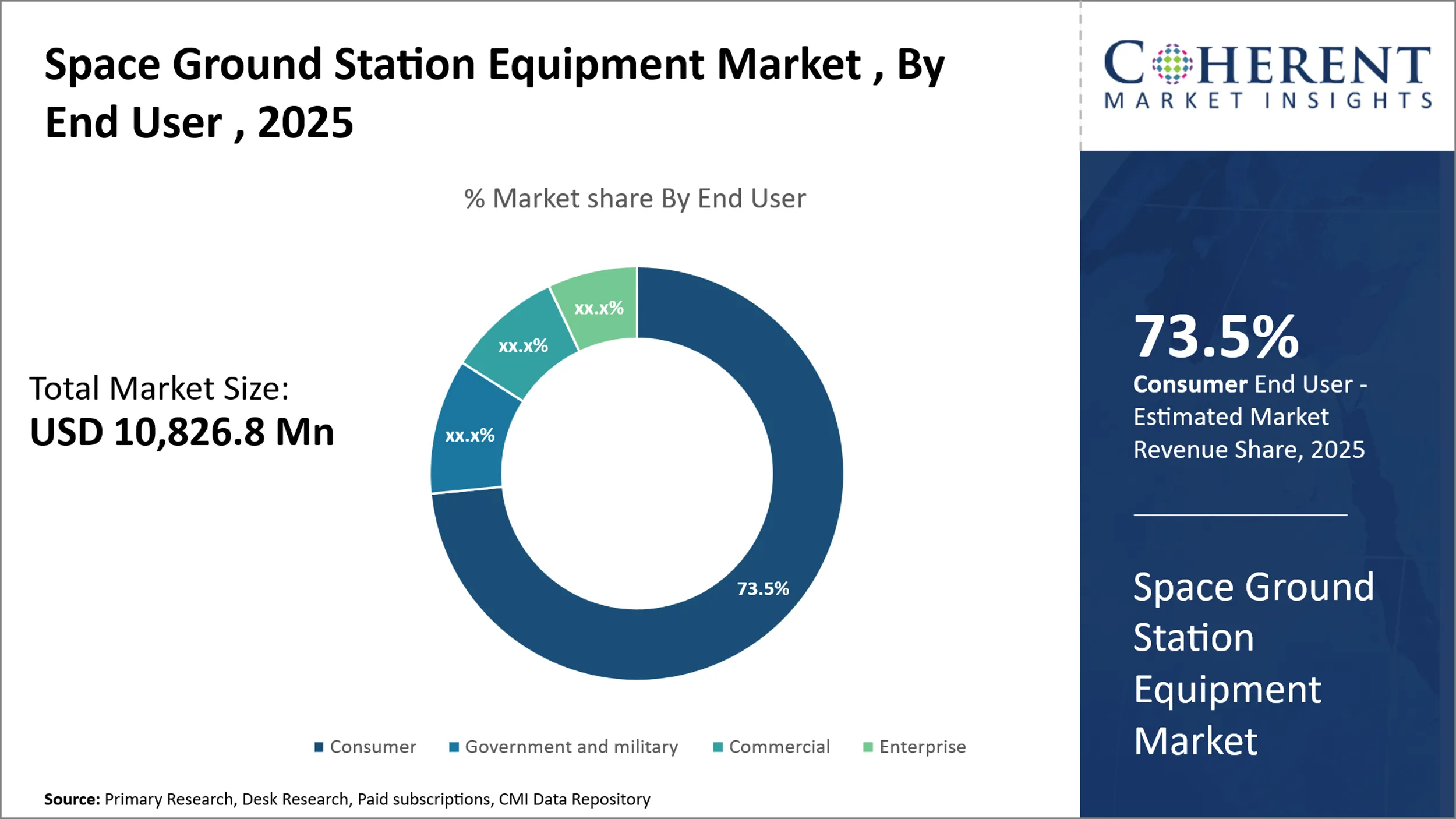
- By End User, Consumer division is projected to dominate the end-user segment with a 74.5% share in 2026.
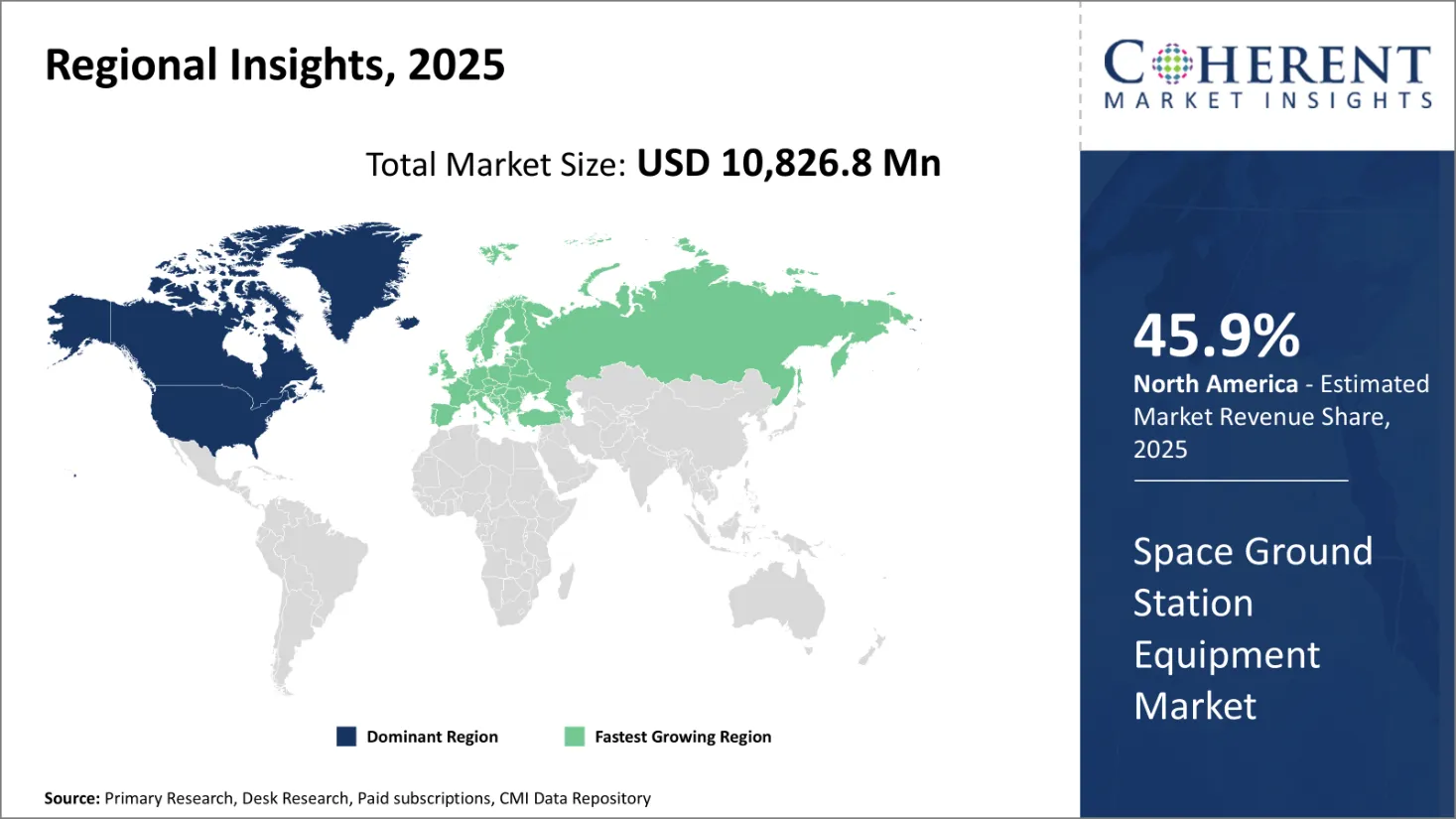
- North America is set to lead the space ground station equipment market with a 45.9% share in 2026.
- Europe is projected to hold a share of 26.7% in the global market during the forecast period.
- Asia Pacific is projected to hold around 19.1% share in the global space ground station market by 2026.
Market Overview
The global space ground station equipment market is experiencing robust growth, driven by the escalating demand for reliable satellite communication and data relay systems. Key growth factors include the rapid expansion of satellite constellations, rising investments in space exploration, and increased reliance on space-based services for communication, navigation, and Earth observation. As governments and private space companies deploy more satellites, the need for advanced ground infrastructure comprising antennas, modems, RF equipment, and software-defined systems is intensifying.
Current Events and its Impact on the Space Ground Station Equipment Market
Current Event | Description and its impact |
Rising Satellite Constellation Deployments by Private Players |
|
Geopolitical Tensions Driving Defense Satellite Expansion |
|
Emergence of Interoperable Ground Networks |
|
Pricing Analysis – Space Ground Station Equipment Market
The pricing of space ground station equipment varies widely depending on the type, technology, and application. Basic components like antennas, modems, and RF systems can range from $10,000 to $500,000, while advanced, integrated systems with software-defined capabilities and optical fiber technologies can exceed $1 million. Pricing is largely influenced by the level of customization, data transfer capacity, frequency bands (S, X, Ka), and the need for real-time communication support.
Government and defense sectors typically demand high-end, secure, and mission-specific systems, driving higher costs. In contrast, commercial operators seek scalable and cost-effective solutions, especially for satellite internet and Earth observation applications. The adoption of software-defined ground stations is helping reduce long-term costs by replacing multiple hardware components with software-based functionalities, though initial setup can be high.
- Current Industry Events of 2026
- Market Size Estimation
- Regional Breakdown
- Competitive Landscape
- Customer Intelligence
- Segmental Analysis
- Pricing Analysis
- Key Market Drivers, Challenges & Future Trends
- Customized Insights Section
Space Ground Station Equipment Market Trends
- Growing adoption of mobile ground stations is a major trend
A ground station is designed for tracking, communicating, and processing data gathered by satellites. However, building a ground station needs high capital investments, due to which, adoption of mobile, portable ground stations having lower costs and high affordability is increasing all over the world. Using mobile ground stations enables easy access to satellite signals to researchers in the absence of conventional ground stations.
For instance, in November 2024, Adelaide-based nanosatellite company Myriota secured a $50 million investment from the Australian federal government and private investors. This funding aims to expand Myriota's Internet of Things (IoT) technology, which connects ground devices to nanosatellites, crucial for industries such as agriculture, defense, and mining.
- Increasing deployment of low earth satellites and satellite constellations is a growing trend
The number of low earth satellites and constellations of satellites deployed is increasing for communication purposes, as demand for these satellites is growing all over the world. The demand for these equipment are high in regions such as Middle East. Several market players are focused on providing innovative and novel products of low earth satellite. This in turn is creating demand for space ground stations.
For instance, In December 2024, French company Cailabs achieved a milestone by facilitating a data transmission rate of 200 gigabits per second from a satellite using optical communication technology. This marked the highest data rate ever for optical communications, significantly surpassing traditional technologies.
Opportunities in the Space Ground Station Equipment Market
Optical Fiber and Software-Defined Ground Stations
The growing adoption of optical fiber technology is driving demand for upgraded satellite access terminals, enabling faster and more efficient data transfer. Fiber-optic systems require advanced components like amplifiers and modems, boosting equipment needs. Simultaneously, the rise of software-defined ground stations—replacing traditional hardware with flexible, cost-effective software solutions—is transforming the market.
Segmental Insights
Space Ground Station Equipment Market Insights, By End User
Consumer equipment is projected to dominate the end-user segment with a commanding 74.5% share in 2026. The surge in satellite-powered broadband services, remote connectivity, and direct-to-home broadcasting is fueling demand for personal user terminals, satellite modems, and compact antennas. Providers like Starlink and OneWeb are accelerating adoption in underserved and rural areas by offering affordable, easy-to-install solutions.
Space Ground Station Equipment Market Insights, By Type
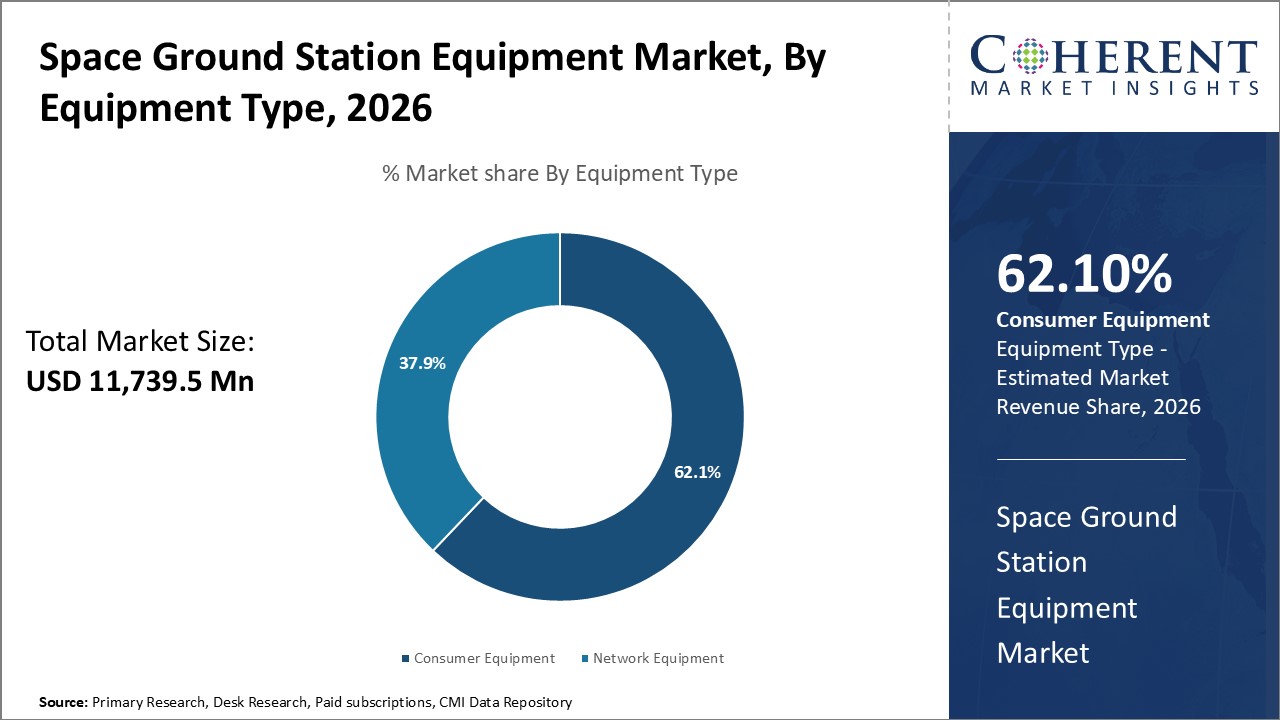
Antenna and radio frequency (RF) equipment segment is anticipated to dominate the space ground station equipment market by 2026. These components are critical for establishing and maintaining reliable communication links between satellites and ground stations. The demand is being driven by increased satellite launches for broadband services, Earth observation, and defense purposes.
Space Ground Station Equipment Market Insights, By Delivery Model
Cloud-based delivery models are rapidly gaining adoption in the space ground station equipment market due to their scalability, real-time accessibility, and cost-effectiveness. As ground operations shift towards virtualized and remotely operated networks, cloud-enabled systems are enabling operators to manage satellite data and ground control functions more efficiently.
Space Ground Station Equipment Market: Regional Insights
North America Space Ground Station Equipment Market Trends and Analysis
North America is projected to dominate the global space ground station equipment market, accounting for 45.9% of the market share in 2026. This leadership is primarily driven by the region’s advancements in commercial satellite operations, expanding defense space programs, and strong presence of key industry players.
The United States, in particular, is at the forefront due to large-scale investments in modernizing ground station infrastructure to accommodate the growing number of low Earth orbit (LEO) satellite constellations. Innovation in cloud-based ground systems, software-defined networking, and optical communication technologies further strengthens North America's market position.
Europe Space Ground Station Equipment Market Trends and Analysis
Europe is expected to hold the second-largest share in the space ground station equipment market, with 26.7% in 2026. The region’s growth is underpinned by robust investments in satellite navigation systems like Galileo, Earth observation programs such as Copernicus, and collaborative space exploration projects. Countries like Germany, France, and the UK are focusing on enhancing ground infrastructure to support both governmental and commercial satellite services. The emphasis on sustainability, cybersecurity, and data privacy is driving demand for advanced, secure ground station solutions across the region.
Space Ground Station Equipment Market Dominating Countries
United States and Canada Space Ground Station Equipment Market Analysis and Trends
The United States and Canada are set to dominate the global space ground station equipment market, with North America projected to capture a 45.9% share in 2026. The U.S. leads due to its strong presence in commercial space operations, defense satellite programs, and rapid deployment of satellite internet services.
Federal initiatives supporting space innovation and investments in next-generation ground systems are driving continued growth. Canada complements with advancements in satellite communication and Earth observation technologies, as well as strategic partnerships with international space agencies and private players.
Market Report Scope
Space Ground Station Equipment Market Report Coverage
| Report Coverage | Details | ||
|---|---|---|---|
| Base Year: | 2025 | Market Size in 2026: | USD 11,739.5 Mn |
| Historical Data for: | 2020 To 2024 | Forecast Period: | 2026 To 2033 |
| Forecast Period 2026 to 2033 CAGR: | 8.4% | 2033 Value Projection: | USD 20,686.9 Mn |
| Geographies covered: |
| ||
| Segments covered: |
| ||
| Companies covered: | EchoStar Corporation, AAC Clyde Space, Comtech Telecommunications Corp., and Analog Devices, Inc. | ||
| Growth Drivers: |
| ||
| Restraints & Challenges: |
| ||
Analyst Viewpoint – Space Ground Station Equipment Market
- The space ground station equipment market is poised for significant growth, driven by rapid advancements in satellite technology and the expanding demand for robust space communication infrastructure. Analysts view the rising adoption of next-generation ground stations, particularly those integrating optical fiber technology and software-defined systems, as key market catalysts.
- The surge in satellite constellations, fueled by initiatives like space-based broadband services and Earth observation programs, is intensifying the demand for scalable and reliable ground station equipment. Regions such as North America and Asia Pacific are expected to lead market expansion due to heavy investments in space infrastructure and government-backed space initiatives.
Space Ground Station Equipment Market: Key Development
- In March 2025, SpaceX announced the deployment of new ground station equipment featuring advanced optical fiber communication technology, aimed at enhancing data transfer speed and reliability for its growing satellite constellation network. This move underscores SpaceX’s commitment to improving satellite-ground connectivity.
- In February 2025, SES introduced software-defined ground station solutions that offer greater operational flexibility and reduced hardware costs, enabling clients to adapt quickly to evolving satellite communication needs.
- In January 2025, Airbus Defense and Space partnered with several national space agencies to upgrade existing ground stations with AI-powered automation systems, improving real-time data processing and reducing manual intervention in satellite operations.
- In September 2024, China Satellite Communications expanded its ground station infrastructure with high-capacity amplifiers and modems optimized for optical fiber systems, boosting data handling capabilities for Earth observation missions.
- In November 2024, Honeywell Aerospace invested heavily in R&D for integrating machine learning algorithms into ground station equipment, enhancing predictive maintenance and optimizing signal tracking for better overall system performance.
Market Segmentation
- Global Space Ground Station Equipment Market, By Equipment (Revenue, USD Mn, 2021 - 2033)
- Consumer Equipment
- Satellite Navigation Equipment
- Dish Antenna
- Satellite Radio
- Broadband Equipment
- Mobile Satellite Terminals
- Network Equipment
- Network Operation Centre (NOCs) Equipment
- VSAT Equipment
- Antennas
- Power Units
- Gateways
- Test and Monitoring Equipment
- Global Space Ground Station Equipment Market, By End User (Revenue, USD Mn, 2021 - 2033)
- Consumer
- Government and Military
- Commercial
- Enterprise
- Global Space Ground Station Equipment Market, By Application (Revenue, USD Mn, 2021 - 2033)
- Communication
- Earth Observation
- Navigation
- Global Space Ground Station Equipment Market, By Satellite Communication Service (Revenue, USD Mn, 2021 - 2033)
- Fixed Satellite Services
- Mobile Satellite Service
- Global Space Ground Station Equipment Market, By Region (Revenue, USD Mn, 2021 - 2033)
- North America
- U.S.
- Canada
- Latin America
- Brazil
- Argentina
- Mexico
- Rest of Latin America
- Europe
- Germany
- U.K.
- Spain
- France
- Italy
- Russia
- Rest of Europe
- Asia Pacific
- China
- India
- Japan
- Australia
- South Korea
- ASEAN
- Rest of Asia Pacific
- Middle East
- GCC Countries
- Israel
- Rest of Middle East
- Africa
- South Africa
- North Africa
- Central Africa
- Key Players Insights
- EchoStar Corporation
- AAC Clyde Space
- Comtech Telecommunications Corp
- Analog Devices, Inc.
Sources
The Stakeholders Consulted
- Satellite communication technology experts and space ground station engineers
- Manufacturers and suppliers of ground station equipment, including antennas, modems, and amplifiers
- Providers of software-defined radio and optical fiber communication solutions
- Space agencies and regulatory authorities overseeing satellite and ground infrastructure
- Research institutions and universities specializing in aerospace and satellite communications
- Government bodies promoting space exploration and satellite technology deployment
- End-users including commercial satellite operators, defense agencies, and telecommunications companies
Databases Opened
- NASA Space Science Data Coordinated Archive
- European Space Agency (ESA) – Satellite Systems and Ground Segment Data
- U.S. Federal Communications Commission (FCC) – Satellite Licensing and Spectrum Data
- International Telecommunication Union (ITU) – Satellite Communication Statistics
- World Bank Open Data – Telecommunications and Infrastructure
Magazines & Trade Publications
- SpaceNews
- Satellite Today
- Via Satellite Magazine
- Space Tech Asia
- Aerospace Manufacturing and Design
- Ground Systems Magazine
Scientific and Industry Journals
- IEEE Transactions on Aerospace and Electronic Systems
- Acta Astronautica
- Journal of Spacecraft and Rockets
- International Journal of Satellite Communications and Networking
- Space Policy
Newspapers & Media Outlets
- The Wall Street Journal – Aerospace & Defense Section
- Bloomberg – Space and Satellite Industry News
- Reuters – Global Aerospace and Technology
- The Economic Times – Technology and Infrastructure
- Space.com – Industry and Technology Updates
Associations and Regulatory Bodies
- International Telecommunication Union (ITU)
- Federal Communications Commission (FCC)
- European Space Agency (ESA)
- National Aeronautics and Space Administration (NASA)
- Space Data Association (SDA)
- Aerospace Industries Association (AIA)
Public Domain Sources
- U.S. Department of Commerce – National Oceanic and Atmospheric Administration (NOAA) Satellite Data
- European Space Agency (ESA) Reports on Ground Segment Infrastructure
- World Bank – Digital Infrastructure Reports
- International Telecommunication Union (ITU) – Spectrum Management Reports
Proprietary Research Elements
- CMI Data Analytics Platform – Space Technology Market Module
- Proprietary CMI Repository of Market Data (covering past 10 years in satellite ground systems)
- CMI Expert Interviews and Insights (focus on satellite ground station technology, market drivers, and adoption trends)
Get access to 250+ pages report
Every segment, forecast, competitor profile and data table behind the analysis above — available for instant download.
- ESOMAR Member
- ISO 9001:2015 Certified
- D-U-N-S Registered
- GDPR & CCPA Compliant
Missing comfort of reading report in your local language? Find your preferred language:
Transform your Strategy with Exclusive Trending Reports
Frequently Asked Questions
The Space Ground Station Equipment Market size is estimated to be valued at USD 11,739.5 Mn in 2026, and is expected to reach USD 20,686.9 Mn by 2033.
The CAGR of the global Market is projected to be 8.4% from 2026 to 2033.
Rise in satellite launches and rise in adoption of High Throughput Satellite (HTS) are fuelling the market.
The Antennas segment is the leading component segment in the market.
High cost of antenna components and unfavorable regulations by government are the major factors restraining the market.
EchoStar Corporation, AAC Clyde Space, Comtech Telecommunications Corp., and Analog Devices, Inc.