

Global Satellite Internet Market Size and Forecast – 2026-2033
The Global Satellite Internet Market is estimated to be valued at USD 13.93 Bn in 2026 and is expected to reach USD 28.03 Bn by 2033, exhibiting a compound annual growth rate (CAGR) of 10.5% from 2026 to 2033.
Key Takeaways of the Satellite Internet Market
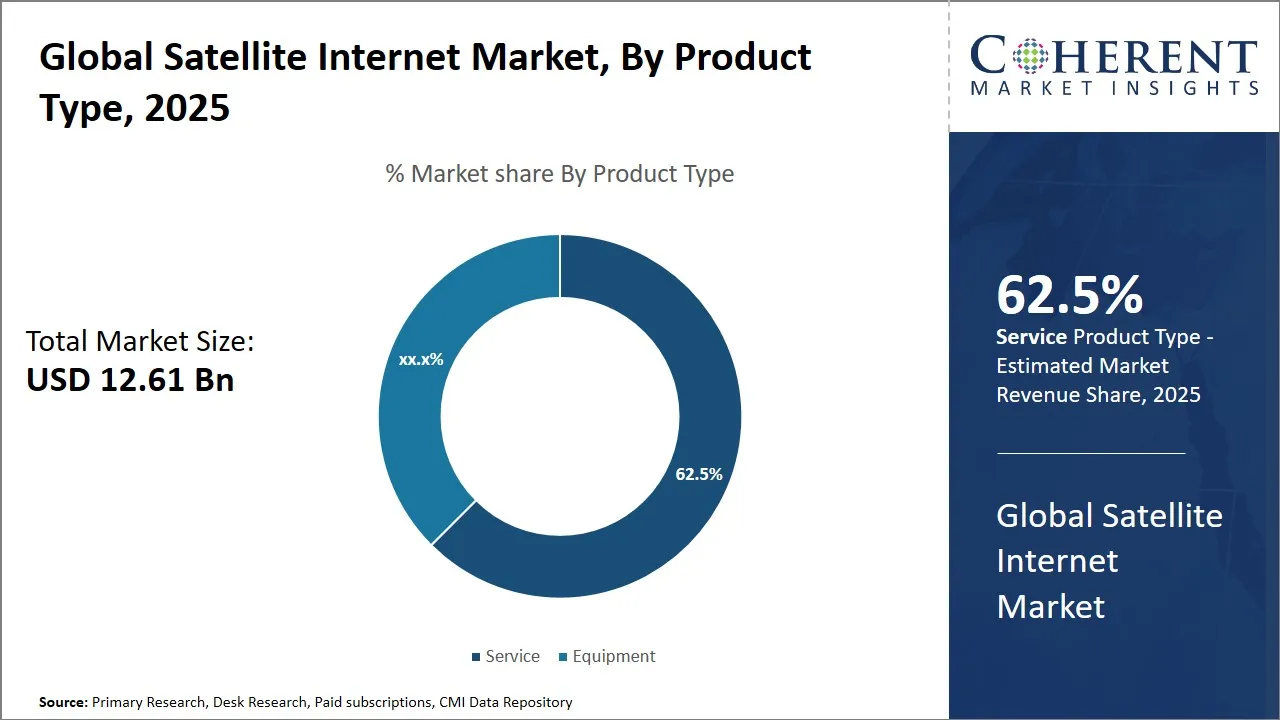
- The Service segment leads the market holding an estimated share of 63.5 % in 2026.
- The Residential segment leads the market holding an estimated share of 38.4 % in 2026.
- Europe is estimated to lead the market with a share of 30.8 % in 2026.
- Asia Pacific, holding a share of 30.7 % in 2026, is projected to be the fastest growing region.
Market Overview
The market is seeing a shift towards Low Earth Orbit (LEO) satellite constellations, which offer lower latency and improved bandwidth compared to traditional geostationary satellites. The deployment of mega-constellations by key players is improving global coverage and service reliability. Also, growing government investments in satellite infrastructure and partnerships between satellite service providers and telecom operators are fostering innovation and expanding market reach.
Current Events and Its Impact
Current Events | Description and its impact |
U.S.-China Tech and Trade Tensions |
|
EU’s IRIS² Satellite Constellation Launch |
|
Middle East Space Programs Acceleration |
|
Global Post-COVID Digital Inclusion Initiatives |
|
Segmental Insights
- Current Industry Events of 2026
- Market Size Estimation
- Regional Breakdown
- Competitive Landscape
- Customer Intelligence
- Segmental Analysis
- Pricing Analysis
- Key Market Drivers, Challenges & Future Trends
- Customized Insights Section
Global Satellite Internet Market Insights, by Product Type – Service Leads Owing to Enhanced Connectivity and Flexibility
The service segment, holding a projected share of 63.5% in 2026, dominates the global satellite internet market. Satellite internet services offer an advantage over traditional terrestrial broadband solutions in remote or rural areas, where laying down physical infrastructure is either cost-prohibitive or logistically challenging.
Also, advancements in satellite technologies such as Low Earth Orbit (LEO) satellite constellations have greatly improved the quality and speed of satellite internet services. Governments and enterprises are using satellite internet services to support remote work, digital learning, telemedicine, and other internet-dependent applications.
Satellite internet services also help a lot in disaster recovery and emergency communications, providing critical support when terrestrial networks are affected. The ability to quickly deploy satellite internet services in disaster-stricken areas improves their indispensability, adding to their market share dominance.
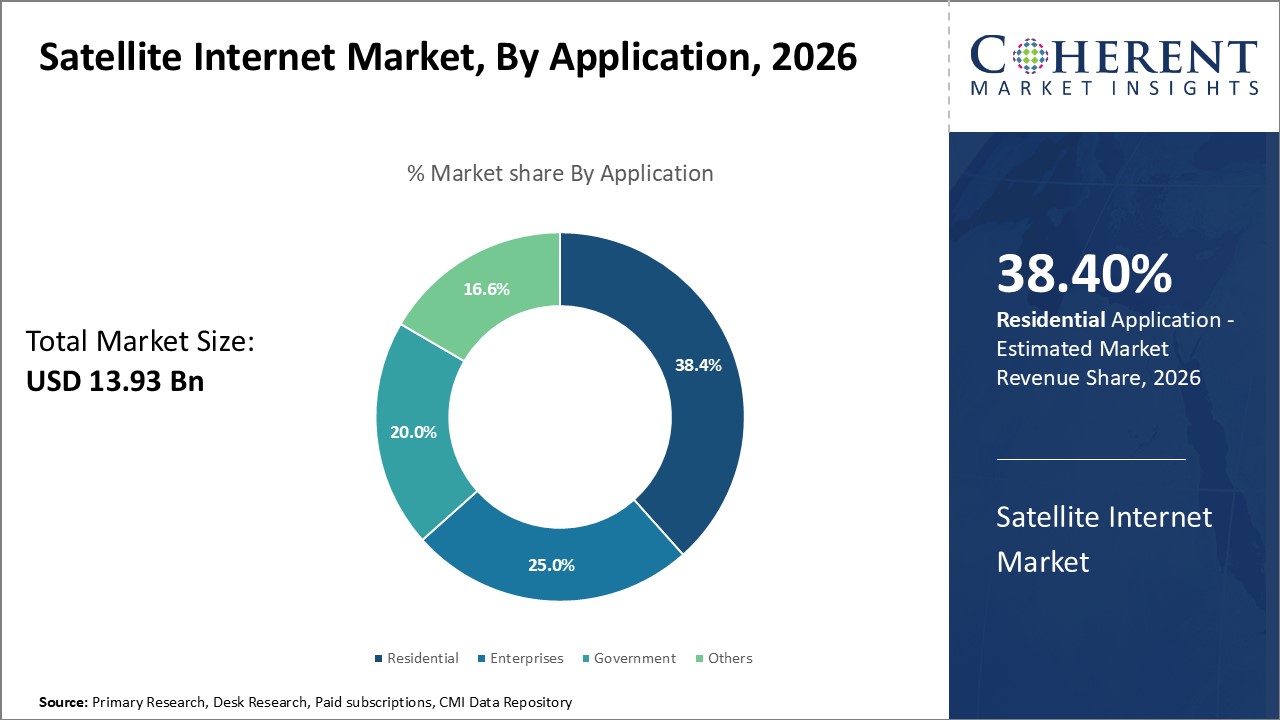
Global Satellite Internet Market Insights, by Application – Residential Leads Due to Increasing Demand for Reliable Home Connectivity
The Residential segment is expected to command a significant share of 38.4% in the global satellite internet market in 2026. A primary driver behind this surge is the growing penetration of digital devices and internet-enabled applications in homes. The proliferation of smart home technologies, streaming services, online gaming, and remote learning platforms has escalated the bandwidth demands of residential consumers.
Additionally, the pandemic-induced shift towards working from home and virtual education has accelerated the adoption of satellite internet in residential settings. With many rural and suburban households unable to access high-quality terrestrial broadband, satellite internet emerges as a practical alternative ensuring continuity of work and education. The flexibility of satellite services to cover expansive geographic areas without the limitations posed by terrestrial cables is a critical factor supporting residential demand.
Moreover, increasing government initiatives aimed at digital inclusion and rural connectivity have positively impacted the residential satellite internet segment. Subsidies and support programs designed to provide affordable internet access in underserved communities incentivize customers to opt for satellite solutions, thereby expanding the residential user base.
The convenience of satellite internet’s quick deployment also appeals to residential consumers who require immediate connectivity without the waiting times or infrastructural developments associated with cable broadband installation. Furthermore, ongoing improvements in satellite technology that reduce latency and increase download speeds bolster the attractiveness of satellite internet for residential users who expect performance comparable to traditional broadband alternatives.
Impact of AI on the Satellite Internet Market
Artificial Intelligence (AI) is significantly transforming the satellite internet market by optimizing network performance, automating satellite operations, and enabling dynamic bandwidth allocation. AI-powered algorithms are increasingly being used in satellite traffic management to predict congestion, reroute data packets, and adjust service levels in real time. For example, SpaceX's Starlink leverages AI to manage its massive constellation of over 6,000 satellites in Low Earth Orbit (LEO), ensuring low-latency, high-throughput service by continuously optimizing inter-satellite links and user-beam assignments. This results in improved service reliability, especially in remote and high-demand areas. AI is also being used in anomaly detection to reduce downtime and anticipate technical issues in satellite systems before they cause service disruptions.
Regional Insights
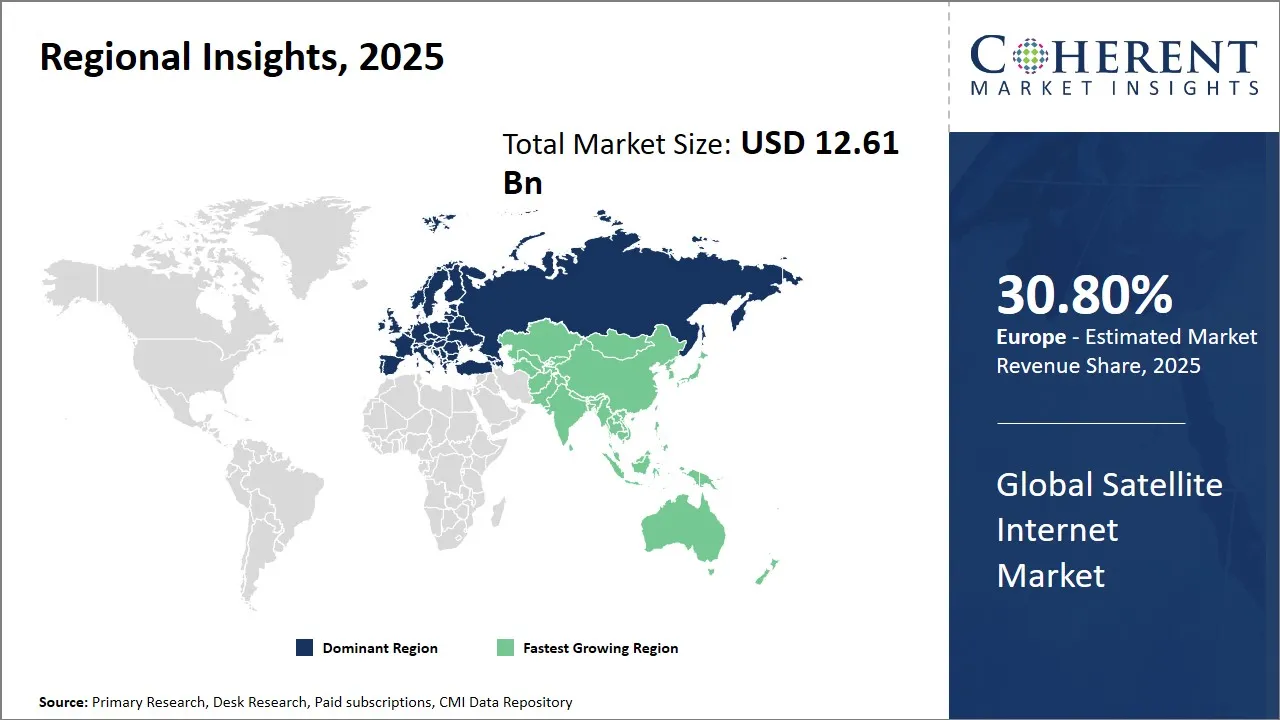
Europe Satellite Internet Market Analysis and Trends
Europe, holding an estimated share of 30.8% in 2026, dominates the satellite internet market. The region is spearheading large-scale projects such as IRIS² (Infrastructure for Resilience, Interconnectivity and Security by Satellite)—a multi-orbit secure satellite internet constellation backed by the European Union, aimed at reducing reliance on non-European providers and ensuring continent-wide secure connectivity. Europe’s robust aerospace and telecom sectors, with key players like Eutelsat, Airbus Defence and Space, and SES, have positioned the region as a center for satellite manufacturing, innovation, and deployment.
The European Commission’s commitment to bridging the digital divide, particularly in remote and rural areas across member states, is driving demand for high-speed satellite Furthermore, the continent benefits from well-established space agencies such as ESA (European Space Agency) and national programs in countries like France, Germany, and Italy, which actively support R&D and public-private collaborations.
Asia Pacific Satellite Internet Market Analysis and Trends
The Asia Pacific, holding a projected share of 30.7% in 2026, exhibits the fastest growth in the global satellite internet market, due to its rapidly increasing internet penetration needs, especially in rural and remote areas of countries like India, Australia, and Southeast Asian nations. The expansive geography combined with diverse terrains makes satellite internet an effective solution for bridging the digital divide. Governments in this region are actively promoting digital infrastructure development through policy reforms and funding initiatives aimed at enhancing connectivity. China is developing a national Low Earth Orbit (LEO) satellite internet constellation under the Guowang project, led by China SatNet, with plans to deploy 13,000+ satellites.
Notable companies such as OneWeb and Starlink are intensifying their focus on the Asia Pacific, partnering with regional telecom operators to expand coverage. Moreover, domestic players and startups in countries like India are contributing to network deployment and local content delivery, which stimulates the market growth. The trade dynamics are also favorable, with increasing foreign investments and collaborations facilitating technology transfer and capacity building.
Global Satellite Internet Market Outlook for Key Countries
U.S. Satellite Internet Market Analysis and Trends
The U.S. remains at the forefront due to its extensive satellite infrastructure and pioneering companies like SpaceX, which through Starlink is revolutionizing consumer satellite internet access globally. Government initiatives aimed at rural broadband expansion and spectrum policy frameworks have paved the way for innovation. Providers like Hughes Network Systems and Viasat also play crucial roles in enterprise and government segments.
India Satellite Internet Market Analysis and Trends
India is rapidly evolving, driven by the vast rural population requiring reliable internet services to support education, agriculture, and e-governance. The government’s Digital India program and emphasis on connectivity have catalyzed policy support and funding for satellite internet projects. Companies such as Bharti Airtel and emerging startups are increasingly collaborating with global satellite operators like OneWeb to improve capacity and reach. India's dynamic regulatory framework and active spectrum management are creating an enabling environment for satellite internet expansion.
Australia Satellite Internet Market Analysis and Trends
Australia’s market leverages its considerable remote and rural population spread across large territories, making satellite internet a vital connectivity solution. The government’s National Broadband Network (NBN) program incorporates satellite technology to reach underserved regions. Providers like Optus and NBN Co work alongside international entities like Starlink to deliver faster and more reliable internet. The high disposable incomes and open regulatory environment encourage technology adoption and infrastructure investments, pushing the sector's growth.
Brazil Satellite Internet Market Analysis and Trends
Brazil’s diverse geography, including the Amazon rainforest, poses challenges for conventional broadband deployment, increasing reliance on satellite services for connectivity. Government efforts to enhance digital inclusion through programs targeting remote communities have contributed to demand growth. Local players, alongside foreign operators, work on deploying satellites tailored to regional needs. Companies like Oi and Embratel are significant contributors, leveraging partnerships with international satellite internet providers to improve coverage and quality.
U.K. Satellite Internet Market Analysis and Trends
The U.K. is characterized by a sophisticated telecommunications infrastructure and proactive government policies supporting satellite communication R&D. The UK benefits from strong collaboration among aerospace manufacturers, satellite operators, and service providers, fostering innovation. Companies such as OneWeb, headquartered in the UK, are key players developing low-earth orbit constellations to provide global high-speed internet access. Furthermore, government initiatives focus on supporting technology startups and fostering export opportunities, enhancing the country’s position in the global satellite internet landscape.
Market Players, Key Development, and Competitive Intelligence
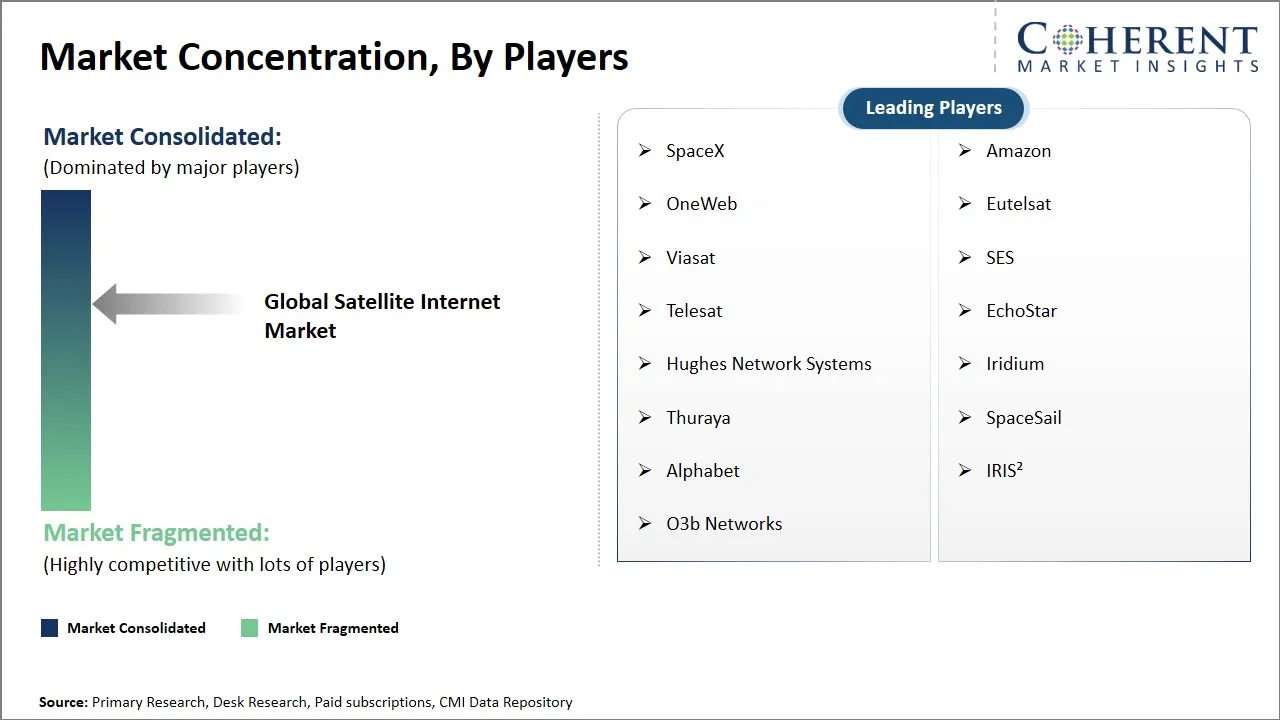
Key Developments
- On July 15, 2025, SpaceX launched the first of three missions for Amazon’s Project Kuiper constellation. The mission, dubbed KF-01 or Kuiper Falcon 1, lifted off at 2:30 a.m. EDT (0630 UTC). The rocket took off from Space Launch Complex 40 at Cape Canaveral Space Force Station and began deploying the 24 Project Kuiper satellites about 56 minutes after liftoff.
- In June 2025, SpaceX's Starlink cleared most of the regulatory and licensing requirements in India, making it closer to launching its satellite internet services in the country. The groundwork is now nearly complete, but several technical and procedural steps remain before the company can launch its service in the country.
- In March 2025, Google’s parent company, Alphabet, officially spun off Taara — a project aiming to provide internet access using laser beams instead of satellites. Developed under Alphabet’s X lab innovation hub, Taara now operates as an independent company.
- In February 2025, Malaysian satellite operator, Measat, signed an MoU with the China-based company operating the Spacesail Low-Earth Orbit (LEO) constellation, Shanghai Spacesail Technologies, formerly known as Shanghai Spacecom Satellite Technology. This MoU opened the door to jointly marketing services and joint R&D. Specifically, the MoU covers potential collaboration in a number of areas including LEO broadband services, direct-to-device communications, satellite IoT, and Earth observation services in Measat’s markets.
Top Strategies Followed by Satellite Internet Market Players
- Established market leaders invest heavily in research and development to innovate high-performance satellite internet products that can deliver enhanced speed, reliability, and coverage.
- SpaceX (Starlink) is investing billions in R&D for innovations like laser-linked satellites, AI-based routing, and direct-to-device (D2D) service.
- Mid-level players in the satellite internet market primarily focus on striking a balance between quality and affordability, aiming to serve price-sensitive customers who seek reliable yet cost-effective internet solutions.
- OneWeb, now merged with Eutelsat, is working with governments in Africa and South Asia to offer affordable low-latency broadband, leveraging fewer satellites and government subsidies to keep pricing competitive.
- Small-scale players in the global satellite internet market differentiate themselves by focusing on niche segments and specialized features that cater to specific customer needs.
- Skylo Technologies focuses on narrowband satellite IoT connectivity for remote industries like agriculture, fishing, and logistics.
Market Report Scope
Satellite Internet Market Report Coverage
| Report Coverage | Details | ||
|---|---|---|---|
| Base Year: | 2025 | Market Size in 2026: | USD 13.93 Bn |
| Historical Data for: | 2020 To 2024 | Forecast Period: | 2026 To 2033 |
| Forecast Period 2026 to 2033 CAGR: | 10.5% | 2033 Value Projection: | USD 28.03 Bn |
| Geographies covered: |
| ||
| Segments covered: |
| ||
| Companies covered: | SpaceX, Amazon, OneWeb, Eutelsat, Viasat, SES, Telesat, EchoStar, Hughes Network Systems, Iridium, Thuraya, SpaceSail, Alphabet, IRIS², and O3b Networks | ||
| Growth Drivers: |
| ||
| Restraints & Challenges: |
| ||
Market Dynamics
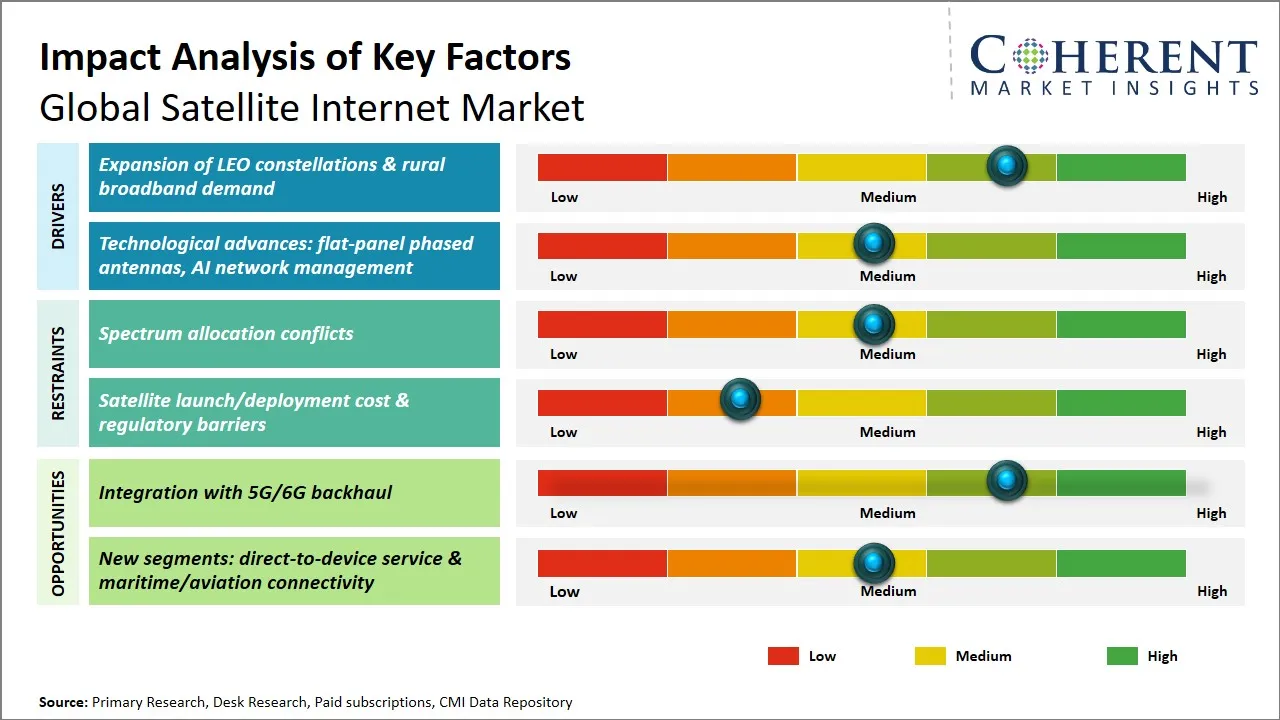
Global Satellite Internet Market Driver – Expansion of LEO Constellations & Rural Broadband Demand
The rapid deployment of low Earth orbit (LEO) satellite constellations is transforming the landscape of global satellite internet services, enabling significantly enhanced coverage, lower latency, and improved bandwidth capabilities compared to traditional geostationary satellites. These advancements are crucial in addressing the persistent connectivity challenges faced by rural and remote regions, where terrestrial internet infrastructure remains limited or economically unviable. Amazon’s Project Kuiper and SpaceX’s Starlink are deploying thousands of LEO satellites to meet rural and underserved connectivity needs globally
The proliferation of LEO satellites facilitates more reliable and affordable broadband access, bridging the digital divide and opening new opportunities for education, healthcare, and economic development in underserved areas. Governments and private players are increasingly focusing on expanding LEO networks to meet escalating demand for continuous, high-speed internet access beyond urban centers, recognizing the critical role satellite internet can play in nationwide digital inclusion strategies.
Global Satellite Internet Market Opportunity – Integration of Satellite Internet with 5G/6G Backhaul Networks
As telecommunications providers strive to enhance network coverage and capacity, especially in remote and underserved regions, satellite technology offers a viable solution to bridge connectivity gaps where traditional fiber optic or microwave backhaul deployments are challenging or economically unfeasible. By leveraging low Earth orbit (LEO) and medium Earth orbit (MEO) satellite constellations, operators can establish high-throughput, low-latency links that complement terrestrial networks, ensuring seamless data transmission essential for 5G and 6G services.
Additionally, satellite-backed 5G/6G backhaul supports critical applications such as smart cities, autonomous vehicles, and Internet of Things (IoT) ecosystems by providing ubiquitous connectivity and real-time data exchange capabilities. NTT and SKY Perfect JSAT (Japan) are collaborating on a space-integrated computing network to support 6G-ready satellite-terrestrial integration by 2030.
Analyst Opinion (Expert Opinion)
- The satellite internet market is undergoing a paradigm shift as innovations redefine global connectivity. A standout transformation is the direct-to-device (D2D) communication, where companies like SpaceX, AST SpaceMobile, and Apple are embedding satellite internet directly into smartphones. This eliminates the need for ground terminals and opens up new possibilities for emergency communications, rural access, and global roaming, fundamentally changing how users connect anywhere, anytime.
- Simultaneously, with the proliferation of thousands of LEO satellites, artificial intelligence (AI) has moved from a luxury to a necessity. AI is now integral to managing complex networks—providing predictive load balancing, anomaly detection, and adaptive beamforming. These capabilities significantly enhance network resilience, efficiency, and latency performance, especially in dynamic, high-demand environments.
- Looking ahead, the industry is moving toward multi-orbit ecosystems. The question is no longer LEO vs. GEO; it’s how to seamlessly integrate across LEO, MEO, and GEO. Pioneers like SES with its O3b mPOWER are enabling intelligent handovers across orbits, optimizing for performance, cost, and use-case—whether it is rural broadband, 5G backhaul, or maritime mobility, signaling the future of truly ubiquitous satellite connectivity.
Speak to the analyst
Want personalized insights?
Take the findings above to one of our principal consultants, or have the report rebuilt around the segments, geographies and competitors you actually track.
Market Segmentation
- Product Type Insights (Revenue, USD Bn, 2021 - 2033)
- Service
- Equipment
- Application Insights (Revenue, USD Bn, 2021 - 2033)
- Residential
- Enterprises
- Government
- Others
- Regional Insights (Revenue, USD Bn, 2021 - 2033)
- North America
- U.S.
- Canada
- Latin America
- Brazil
- Argentina
- Mexico
- Rest of Latin America
- Europe
- Germany
- U.K.
- Spain
- France
- Italy
- Russia
- Rest of Europe
- Asia Pacific
- China
- India
- Japan
- Australia
- South Korea
- ASEAN
- Rest of Asia Pacific
- Middle East
- GCC Countries
- Israel
- Rest of Middle East
- Africa
- South Africa
- North Africa
- Central Africa
- North America
- Key Players Insights
- SpaceX
- Amazon
- OneWeb
- Eutelsat
- Viasat
- SES
- Telesat
- EchoStar
- Hughes Network Systems
- Iridium
- Thuraya
- SpaceSail
- Alphabet
- IRIS²
- O3b Networks
Sources
Primary Research Interviews
Stakeholders
- Satellite Internet Service Providers
- Satellite Manufacturers and Launch Providers
- Telecommunications and Mobile Network Operators
- Government and Defense Procurement Officials
- Remote Infrastructure and Emergency Connectivity Contractors
- 5G/6G Backhaul Integration Engineers
- AI and Network Orchestration Specialists
Databases
- International Telecommunication Union (ITU)
- European GNSS Agency
- Federal Communications Commission (FCC) Filings
- Global Teleconnectivity Database
- National Space Industry Register (NSIR)
Magazines
- Satellite & Space Communications Review
- Global Broadband Today
- Aerospace Connect Magazine
- Satellite Deployment & Innovation Monthly
Journals
- Journal of Satellite & Wireless Communications
- Spaceborne Networks & Systems Journal
- International Journal of Satellite Internet Technology
- Journal of Next-Gen Connectivity
Newspapers
- Orbital Times (Global)
- SpaceTech Daily (USA)
- Asia-Pacific Network Chronicle
- The European Space Journal
Associations
- Global Satellite Operators Association (GSOA)
- LEO Constellation Alliance (LCA)
- Asia-Pacific Satellite Communications Forum (APSCF)
- European Satellite Connectivity Consortium (ESCC)
- International Federation of Satellite Engineers (IFSE)
Public Domain Sources:U.S. Census Bureau
- EUROSTAT
- United Nations Economic Commission for Europe (UNECE)
- World Bank
- ResearchGate
Proprietary Elements:
- CMI Data Analytics Tool, Proprietary CMI Existing Repository of Information for Last 8 Years
Get access to 250+ pages report
Every segment, forecast, competitor profile and data table behind the analysis above — available for instant download.
- ESOMAR Member
- ISO 9001:2015 Certified
- D-U-N-S Registered
- GDPR & CCPA Compliant
Missing comfort of reading report in your local language? Find your preferred language:
Transform your Strategy with Exclusive Trending Reports
Frequently Asked Questions
The global satellite internet market is estimated to be valued at USD 13.93 billion in 2026 and is expected to reach USD 28.03 billion by 2033.
The CAGR of global satellite internet market is projected to be 10.5% from 2026 to 2033.
Expansion of LEO constellations & rural broadband demand and technological advances: flat-panel phased antennas, AI network management are the major factors driving the growth of the global satellite internet market.
Spectrum allocation conflicts and satellite launch/deployment cost & regulatory barriers are the major factors hampering the growth of the global satellite internet market.
In terms of Product Type, Service is estimated to dominate the market revenue share in 2026.
Satellite internet uses orbiting satellites to deliver connectivity, enabling access in remote or underserved areas where fiber or cable networks are unavailable.
AI enhances real-time traffic routing, anomaly detection, and satellite fleet management, enabling more efficient and reliable service delivery.