

Digitally Delivered Services Market Size and Share Analysis - 2026 To 2033
The digitally delivered services market is anticipated to grow at a CAGR of 8.93% with USD 5.47 Tn in 2026 and is expected to reach USD 9.97 Tn in 2033. Adoption of advanced technologies will lead to a growth in demand for digitally delivered services. As a result of these services, end users who regularly use internet-related services receive better quality service. Furthermore, because digital services offer a flexible and safe platform for online communication, the demand for them is rising. Thus, one of the factors driving the expansion of the global digitally delivered services market will be the rise in the usage of internet services (The global internet usage rate is around 73.6%, meaning nearly three out of four people worldwide use the internet. In 2026, there are expected to be more than 6 billion internet users globally.).
Key Takeaways
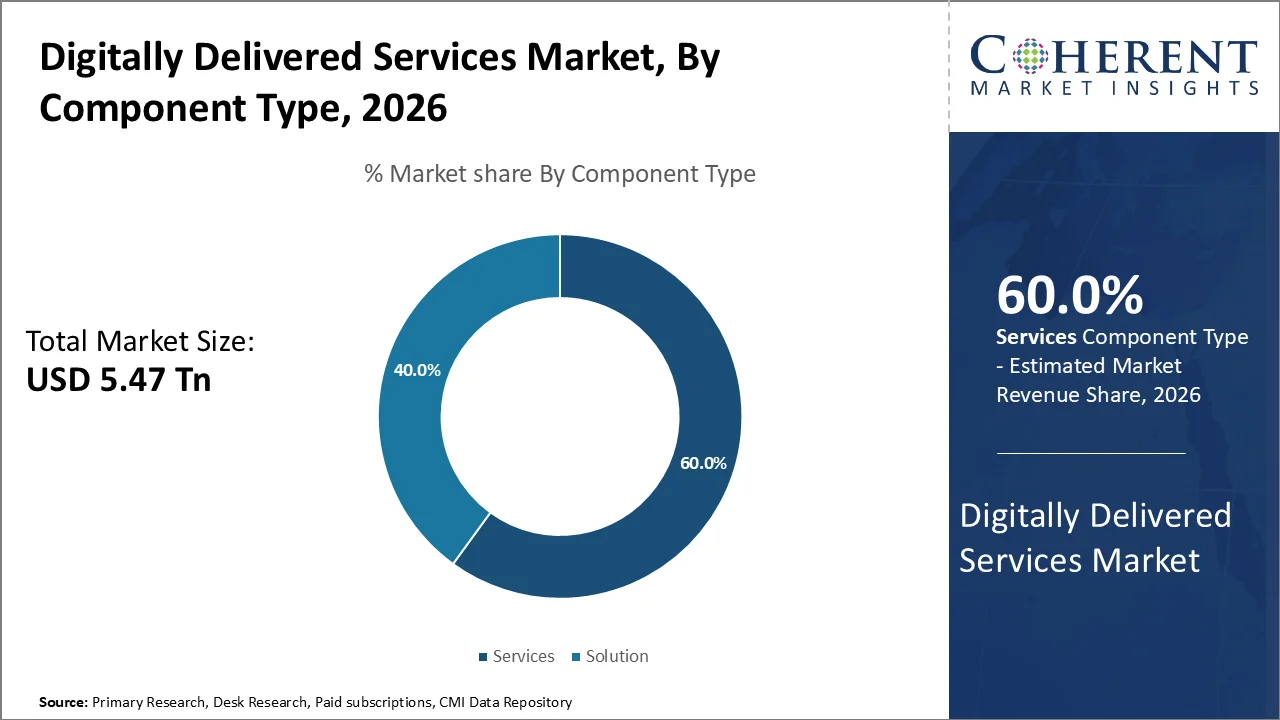
- Services segment is expected to account the largest share of 60% in 2026, services include consulting, outsourcing, support, maintenance, managed services, and implementation. Businesses prefer service-based models because they reduce infrastructure costs and provide access to specialized digital expertise.
- Large enterprises segment will dominate with 65% in 2026, large companies have bigger IT budgets and invest heavily in cloud services, automation, AI, cybersecurity, and digital transformation programs. Companies that focus on digital transformation and improving customer experience can achieve better business results. These efforts can lead to a 20–30% increase in customer satisfaction and 20–50% economic benefits through improved efficiency and cost savings.
- Telecommunication and IT segment will dominate with 25% in 2026, telecom and IT companies are rapidly adopting cloud, SaaS, AI, IoT, and network modernization solutions. More than 80–85% of business applications are expected to use the Software-as-a-Service (SaaS) model.
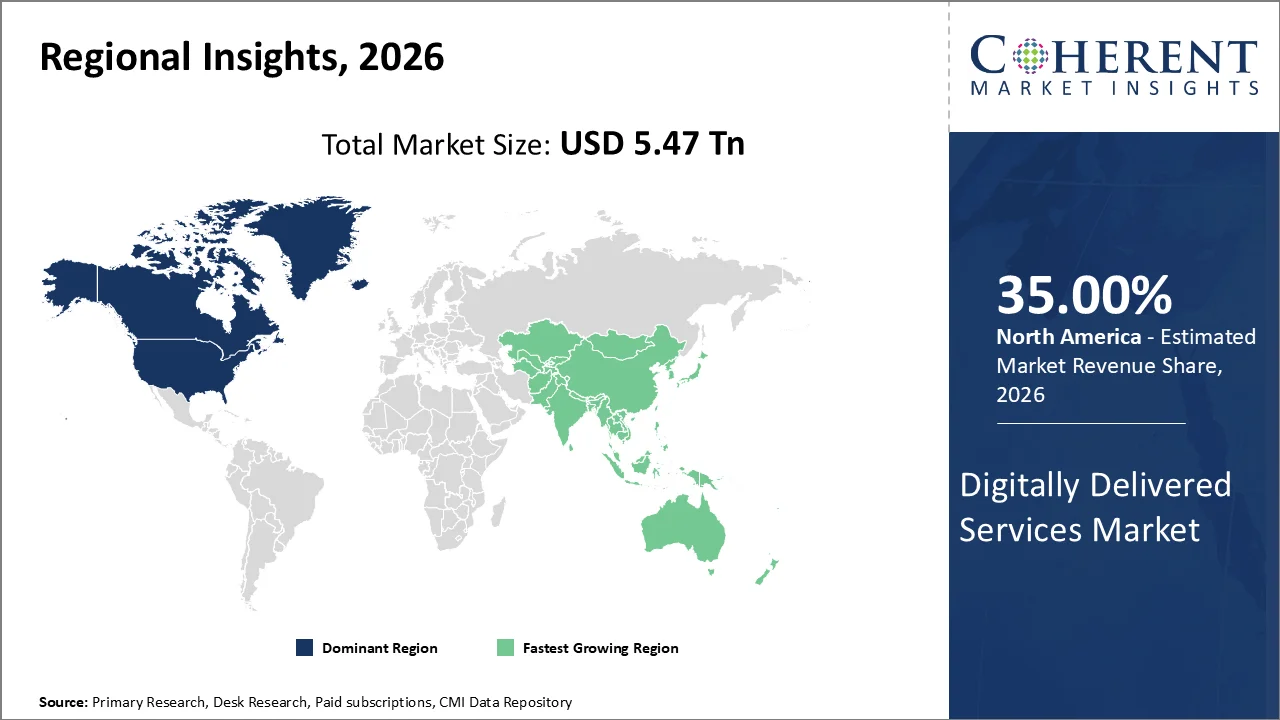
- North America is expected to acquire the dominant share of 35% in 2026, North America leads due to high cloud adoption, strong digital infrastructure, presence of major technology companies, advanced enterprise digitization, and high demand for AI and cybersecurity services. The number of cybersecurity jobs in the U.S. is expected to grow by about 33% by 2033.
Segmental Insights
Why is Services Segment Acquiring the Largest Market Share?
Services is projected to account for the largest share of component type in 2026, representing approximately 60% of the total volume. The consistent support, management, as well as operational continuity that organizations demand is one of the factors responsible for the growth.
Services have a continuous lifecycle of value delivery that has consulting, implementation, integration, managed services, post-deployment maintenance, etc., making them essential to businesses looking for digital transformation at a scale.
Managed services aid businesses lower their IT costs by allowing an external provider to manage as well as support their technology systems. Companies using managed services can lower IT operational costs by up to 40% through lower maintenance costs, fewer IT issues, reduced downtime, as well as better use of resources.
The growing complexity of digital environments that organizations are managing today is one of the growth inducing factors. Enterprises deploying digital tools rarely operate in isolated technological silos rather, they require interconnected systems that must communicate across cloud environments, legacy infrastructure, and third-party applications simultaneously.
- Current Industry Events of 2026
- Market Size Estimation
- Regional Breakdown
- Competitive Landscape
- Customer Intelligence
- Segmental Analysis
- Pricing Analysis
- Key Market Drivers, Challenges & Future Trends
- Customized Insights Section
Large Enterprises Segment holds the Largest Market Share
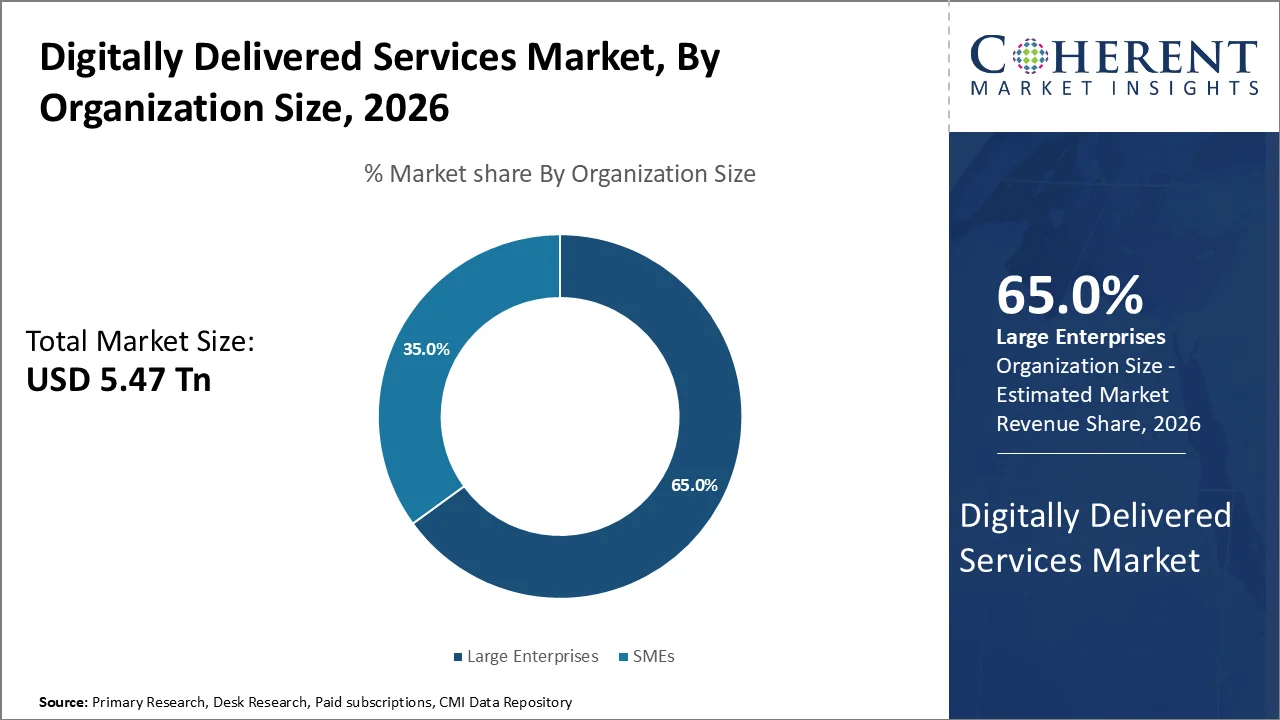
Based on organization size, large enterprises dominates the market, accounting for a significant 65% share in 2026. Their extensive technological infrastructure is propelling the growth of the segment. Moreover, the market is augmented by substantial IT budgets, as well as organizational capacity to integrate complex digital service ecosystems at scale. Businesses are expected to spend USD 4–5 trillion on IT, with a major focus on cloud services, digital infrastructure, and technology upgrades.
Large enterprises across industries including banking, healthcare, manufacturing, retail, telecommunications, etc., have long been at the edge of adopting digitally delivered services, including cloud computing, enterprise resource planning (ERP) solutions, cybersecurity services, digital communication platforms, and data analytics tools.
These organizations operate across different geographies, requiring robust and highly scalable digital delivery frameworks that can support thousands of employees, millions of customer interactions, and massive volumes of transactional data simultaneously.
Their digital transformation agendas, which are usually backed by dedicated innovation units, chief digital officers (CDOs), and multi-year technology roadmaps is another growth inducing factor. For instance, multinational corporations in the financial services sector have highly inclined their core banking infrastructure to cloud-based platforms, adopting digitally delivered services from global technology providers to streamline operations, enhance regulatory compliance, as well as improve customer experience.
Telecommunication and IT Segment holds the Largest Market Share
Based on verticals, Telecommunication and IT segment dominates the market, accounting for a significant 25% share in 2026. The continuous technology evolution, along with the inherent nature of the industry that demands round-the-clock digitally enabled services across every operational function are stimulating the market growth.
For instance, the UMANG platform has become a single digital gateway for government services in India. It has expanded from 166 services in 2017 to 2,572 services by June 2026, showing the strong growth of adoption of digital services.
The fundamental reality that this sector is both a producer as well as a consumer of digitally delivered services simultaneously is further augmenting the growth. Telecom and IT companies are intrinsically dependent on digital platforms for service provisioning, network management, customer engagement, enterprise software delivery, as well as back-end infrastructure operations.
The integration of 5G deployment, edge computing, as well as software-defined networking has exponentially amplified the demand for digitally delivered managed services, platform-as-a-service offerings, and cloud-based operational tools within this vertical.
According to the International Telecommunication Union (ITU), as of recent reporting periods, over 95% of the global population now lives within reach of a mobile broadband network. This shows the sheer scale at which telecom operators must deploy and manage digitally delivered solutions to maintain service integrity.
Market Drivers
Cloud Computing is transforming the Digitally Delivered Services Industry
Cloud computing is the fundamental unit of digitally delivered services. Cloud computing makes sure businesses to use online servers, storage, software, as well as other IT services instead of buying and maintaining their own physical infrastructure. This aid companies lower the costs, improve flexibility, and access technology whenever they need it. Major platforms include AWS, Microsoft Azure, Google Cloud, Salesforce, as well as ServiceNow.
For instance, Amazon Web Services (AWS) was launched in 2006 and has become the largest cloud computing platform globally. AWS holds around 28% of the global cloud infrastructure industry share, making it the prominent cloud service provider ahead of competitors such as Microsoft Azure as well as Google Cloud.
Many global companies use cloud computing to improve performance and growth. Netflix changed its infrastructure to AWS, enabling it to scale globally as well as support millions of users with high availability. Spotify uses Google Cloud technologies such as BigQuery and Dataflow to analyze large amounts of data as well as improve user recommendations, reducing complex data processing tasks from hours to minutes. Cloud adoption helps businesses achieve 20–30% lower IT infrastructure costs, 40–70% faster service deployment, on-demand scalability, and global service availability across 200+ countries. These benefits make cloud computing a key driver of digital transformation worldwide.
Edge Computing & Fog Computing: A major breakthrough in Digitally Delivered Services
Edge and fog computing improve digitally delivered services by processing data closer to where it is made, instead of sending everything to distant cloud servers. This aid bring down delays, save bandwidth, as well as support real-time applications including autonomous vehicles, healthcare monitoring, smart devices, etc. Edge computing uses technologies like edge nodes, 5G Mobile Edge Computing (MEC), fog computing, etc., layers to deliver faster and more reliable services.
Companies are using edge computing to improve performance at a large scale. Cloudflare works as global edge network across hundreds of cities, aid deliver faster online experiences by processing data closer to users. Akamai supports large-scale content delivery for internet services, while companies using AWS Wavelength or rather other edge platforms benefit from low-latency processing for applications like healthcare, automotive, industrial systems, etc. Edge computing can bring down latency from 100–300 milliseconds in conventional cloud systems to around 1–10 milliseconds, lower bandwidth usage by 40–60%, as well as improve service reliability through local data processing.
Current Events and Their Impact on the Digitally Delivered Services Market
Current Event | Description and its Impact |
Government-driven cloud adoption policies and digital infrastructure modernization programs (2025–2026) |
|
Expansion of cybersecurity regulations as well as zero-trust security requirements (2025–2030) |
|
Digitally Delivered Services Market Trends
- The infusion of Generative AI (GenAI) including large language models (LLMs), conversational agents, as well as AI-driven content generation is fundamentally mold how digital services are designed, delivered, and personalized. Contentful customers have reported major improvements in digital content management, including a 10x increase in content production speed and a 78% increase in conversion rates for some customer experiences.
- Enterprises are highly migrating from traditional on-premise infrastructure to cloud-native architectures, with a high demand for multi-cloud and hybrid-cloud strategies. This shift is helping businesses become more flexible, grow faster, and deliver digital services more efficiently. Companies can quickly increase or reduce their IT resources based on their needs, making service delivery faster and more reliable.
- The market is experiencing a combination of digital services within integrated platform ecosystems, commonly referred to as "super-apps." Inspired by models pioneered in Asia (WeChat, Grab, Paytm), Western and emerging market players are bundling financial services, commerce, communication, healthcare, and logistics into unified digital environments, dramatically increasing user stickiness, lifetime value, and cross-sell opportunities.
- Digital payments, lending-as-a-service (LaaS), insurance-as-a-service, and Buy Now Pay Later (BNPL) mechanisms are rapidly being embedded into non-financial digital platforms. By 2026, around 60% of the population in the world is expected to use digital wallets. This means more than 5 billion people will use digital wallets for payments, money transfers, as well as other financial services.
- Blockchain-powered decentralized platforms, tokenized service economies, as well as decentralized autonomous organizations (DAOs) are beginning to reshape ownership as well as monetization frameworks within digital services. By 2026, around 40% of all transactions are expected to use tokenization, a technology that replaces sensitive payment details with secure digital tokens. Visa reports that more than 50% of its e-commerce transactions are already tokenized, helping make online payments safer and easier.
Regional Insights
North America dominates owing to its highly advanced digital infrastructure
North America account 35% market share in 2026, owing to its deeply entrenched digital infrastructure, widespread broadband penetration, and a highly tech-savvy consumer and enterprise base that consistently drives demand for cloud computing, streaming, e-commerce, fintech, and other digitally delivered service verticals.
The U.S. FinTech companies raised USD 11.1 billion across 466 deals in 2026. This was a 16% increase in funding and a 33% surge in the number of deals, showing strong investor interest in financial technology companies.
According to the Federal Communications Commission (FCC), broadband internet access has expanded majorly across American households, making sure easy consumption of digitally delivered services at both consumer as well as enterprise levels.
Furthermore, the U.S. Department of Commerce has targeted the escalating role of the digital economy as a major component of the national GDP, showing how deeply embedded digital service delivery has become across industries including healthcare, education, finance, retail, etc. Canada further supports leading position of North America, with the Canadian Radio-television and Telecommunications Commission (CRTC) actively supporting policies that fuel digital service adoption.
Asia Pacific Digitally Delivered Services Market Trends
The Asia Pacific region is poised to be the fastest-growing region through 2026-2033, expanding at a CAGR of approximately 6.8%. driven by an extraordinary convergence of expanding internet penetration, government-led digital transformation mandates, a rapidly urbanizing population base, and the accelerating formalization of digital economies across both mature and emerging markets within the region. Businesses expect strong growth in Asia’s digital economy in 2026. Around 71% of businesses surveyed expect the digital economy sector to grow, which is 13 percentage points higher than the previous year.
The Asia-Pacific Economic Cooperation (APEC) secretariat has actively documented the increasing policy orientation of the region toward facilitating cross-border digital trade to reduce barriers to digitally delivered services, thereby creating fertile conditions for exponential market expansion.
Countries including India, Indonesia, Vietnam, the Philippines, etc., have witnessed unprecedented growth in digital service consumption, propelled by national programs such as India's Digital India initiative and Indonesia's Making Indonesia 4.0 roadmap, both of which are government-endorsed frameworks encouraging domestic and foreign digital service adoption at scale.
Unparalleled Technological Ecosystem is Accelerating the Digitally Delivered Services Market Demand in U.S.
The U.S. contributes the highest share in the digitally delivered services market in North America, due to its unparalleled technological ecosystem, as well as a regulatory environment that has historically favored the expansion of cross-border digital trade.
The United States remains the global epicenter of digital services innovation, housing the world's most influential technology corporations, cloud service providers, and digital platform operators, all of which generate and distribute services that are consumed domestically and exported internationally through digital channels.
According to the United States International Trade Commission (USITC), the U.S. is a net exporter of digitally delivered services, showing the dominant position of the country in producing as well as transmitting services through digital means. The Bureau of Economic Analysis (BEA) consistently highlights that digitally enabled services spanning financial services, intellectual property licensing, cloud computing, professional services, and telecommunications represent a substantial and expanding portion of U.S. exports.
China Digitally Delivered Services Market Trends
China contributes the highest share in the digitally delivered services market in APAC, owing to its massive digital infrastructure backbone, unprecedented internet penetration levels, and aggressive state-driven digitalization agenda that has systematically transformed how services are conceptualized, delivered, and consumed across sectors.
China's Ministry of Industry and Information Technology (MIIT) has consistently pushed forward policies that mandate digital transformation across public as well as private enterprises, making an expansive ecosystem where cloud computing, e-commerce, fintech, digital healthcare, and AI-enabled platforms, etc., prospering at an extraordinary scale.
With over 1.09 billion internet users as reported by the China Internet Network Information Center (CNNIC) in its latest statistical report, the sheer volume of digitally active consumers gives Chinese digital service providers an unmatched domestic market to operate within and refine their offerings.
Who are the Major Companies in Digitally Delivered Services Industry
Some of the major key players in digitally delivered services market include, IMImobile, Mahindra ComViva, Tech Mahindra, 6d technologies, Infosys, Happiest Minds, Spice Digital Ltd, Analysys Mason, Neudesic, and Acrus Global Ltd.
Key News
- In January 2026, BASF plans to open a Global Digital Hub in Hyderabad, India, in the first quarter of 2026. This new hub will become part of BASF’s global network of Digital Hubs in Germany, Spain, and Malaysia. The Digital Hub will provide digital services and technology support to BASF’s businesses worldwide. It will help BASF improve digital operations, deliver services faster, reduce costs, and strengthen its global digital capabilities.
Market Report Scope
Digitally Delivered Services Market Report Coverage
| Report Coverage | Details | ||
|---|---|---|---|
| Base Year: | 2025 | Market Size in 2026: | USD 5.47 Tn |
| Historical Data for: | 2020 To 2024 | Forecast Period: | 2026 To 2033 |
| Forecast Period 2026 to 2033 CAGR: | 8.93% | 2033 Value Projection: | USD 9.97 Tn |
| Geographies covered: |
| ||
| Segments covered: |
| ||
| Companies covered: | IMImobile, Mahindra ComViva, Tech Mahindra, 6d technologies, Infosys, Happiest Minds, Spice Digital Ltd, Analysys Mason, Neudesic, and Acrus Global Ltd | ||
| Growth Drivers: |
| ||
| Restraints & Challenges: |
| ||
Analyst Opinion
- The digitally delivered services market is experiencing a transformative phase, driven by accelerating technological advancements and shifting consumer preferences toward seamless digital experiences.
- The high adoption of cloud computing, artificial intelligence, as well as high-speed internet infrastructure has fundamentally changed how businesses and consumers access as well as consume services globally. By the end of 2026, more than 200 zettabytes of data are expected to be stored in the cloud.
- Organizations in many industries are making digital-first strategies a top priority. As a result, the demand for Software-as-a-Service (SaaS) platforms, digital consulting, e-learning, telehealth, and online streaming services is growing quickly.
- However, certain restraints temper this growth trajectory, including mounting concerns around data privacy, cybersecurity vulnerabilities, as well as inconsistent regulatory frameworks across different geographies.
- The integration of generative AI and advanced analytics into service delivery models presents unprecedented potential for personalization, automation, and operational efficiency.
Speak to the analyst
Want personalized insights?
Take the findings above to one of our principal consultants, or have the report rebuilt around the segments, geographies and competitors you actually track.
Market Segmentation
- By Component Type (Revenue, USD Tn, 2021-2033)
- Solution
- Services
- By Organization Size (Revenue, USD Tn, 2021-2033)
- SMEs
- Large Enterprises
- By Verticals (Revenue, USD Tn, 2021-2033)
- BFSI
- Telecommunication and IT
- Retail and E-commerce
- Healthcare and Life Science
- Manufacturing
- Government and Defense
- Others
- By Region (Revenue, USD Tn, 2021-2033)
- North America
- U.S.
- Canada
- Latin America
- Brazil
- Mexico
- Argentina
- Rest of Latin America
- Europe
- Germany
- U.K.
- France
- Italy
- Spain
- Russia
- Rest of Europe
- Asia Pacific
- China
- India
- Japan
- Australia
- South Korea
- ASEAN
- Rest of Asia Pacific
- Middle East
- GCC
- Israel
- Rest of Middle East
- Africa
- South Africa
- Central Africa
- North Africa
- North America
Sources
Primary Research Interviews
- Digital Service Providers & Platform Operators
- E-commerce & Digital Content Distribution Executives
- Cloud Service & SaaS Solution Providers
- Regulatory & Compliance Experts in Digital Services
- Others
Databases
- Statista – Digital Economy & Online Services Database
- Bloomberg Terminal – Technology & Digital Services Data
- IBISWorld – Online & Digital Services Industry Database
- S&P Global Market Intelligence
- Others
Magazines
- Wired Magazine
- MIT Technology Review
- Digital Commerce 360
- TechCrunch Magazine
- Others
Journals
- Journal of Digital Economy
- International Journal of Electronic Commerce
- Journal of Information Technology & Digital World
- Others
Newspapers
- The Financial Times
- The Wall Street Journal
- The Economic Times – Technology Section
- Reuters Technology News
- Others
Associations
- Interactive Advertising Bureau (IAB)
- Digital Commerce Alliance
- International Telecommunication Union (ITU)
- Entertainment Software Association (ESA)
- Others
Public Domain Sources
- U.S. Federal Communications Commission (FCC) Reports
- World Trade Organization (WTO) – Digital Trade Data
- OECD Digital Economy Outlook Reports
- European Commission – Digital Single Market Publications
- Others
Proprietary Elements
- CMI Data Analytics Tool
- Proprietary CMI Existing Repository of information for last 10 years
Get access to 250+ pages report
Every segment, forecast, competitor profile and data table behind the analysis above — available for instant download.
- ESOMAR Member
- ISO 9001:2015 Certified
- D-U-N-S Registered
- GDPR & CCPA Compliant
Missing comfort of reading report in your local language? Find your preferred language:
Transform your Strategy with Exclusive Trending Reports
Frequently Asked Questions
The digitally delivered services market is expected to reach USD 9.97 Tn in 2033.
Major players operating in the global digitally delivered services market include IMImobile, Mahindra ComViva, Tech Mahindra, 6d technologies, Infosys, Happiest Minds, Spice Digital Ltd, Analysys Mason, Neudesic, and Acrus Global Ltd.
Resistance to change and lack of digital literacy among certain consumer segments is one of the major factors that is expected to hamper growth of the market over the forecast period.
Increasing smartphone and connected device penetration across emerging economies is driving growth of the global digitally delivered services market.
The digitally delivered services market is anticipated to grow at a CAGR of 8.93% between 2026 and 2033.
Among regions, North America is expected to account for a largest market share in the global digitally delivered services market over the forecast period.
Information and communication services: these are the types of digital services that facilitate interaction between individuals or between individuals and organizations. Examples: email services, instant messaging apps, video conferencing platforms, social media platforms, and voice over IP (VoIP) services.