

Global Managed Services Market Size and Forecast – 2026 To 2033
The global managed services market is expected to grow from USD 405.50 Bn in 2026 to USD 848 Bn by 2033, registering a compound annual growth rate (CAGR) of 10% from 2026 to 2033. The global managed services market is primarily driven by the increasing need for improving operational efficiency.
For instance, on August 18, 2025, TVS Supply Chain Solutions Limited launched Project One, a restructuring initiative to improve efficiency and profitability, which is expected to deliver annualized cost savings of around USD 1 billion. (Source: Business Line)
Key Takeaways of the Global Managed Services Market
- The managed infrastructure services segment is expected to account for 37.0% of the global managed services market share in 2026. Rapid digital transformation across industries is a major factor driving the growth of the segment. On February 17, 2026, Unilever and Google Cloud announced a five-year partnership to accelerate Unilever's business transformation through its use of Google Cloud’s advanced AI, data, platform and next-generation marketing capabilities. (Source: Unilever)
- The cloud segment is estimated to capture 52.0% of the market share in 2026. This segment is boosted by the development of hybrid and remote work models in the modern landscape. On April 22, 2026, Kyndryl announced the expansion of its Distributed Cloud services with Google Cloud, designed to help enterprises transform with AI and modernize applications across private cloud, on-premises data centers, and edge computing environments. (Source: Kyndryl)
- The BFSI segment is projected to hold 29.0% of the global managed services market share in 2026. The growing need to mitigate cyberthreats and ensure data security is a key growth factor. On April 27, 2026, hackers broke into the computer networks of a major critical infrastructure equipment vendor, Itron. (Source: Cyber Security Dive)
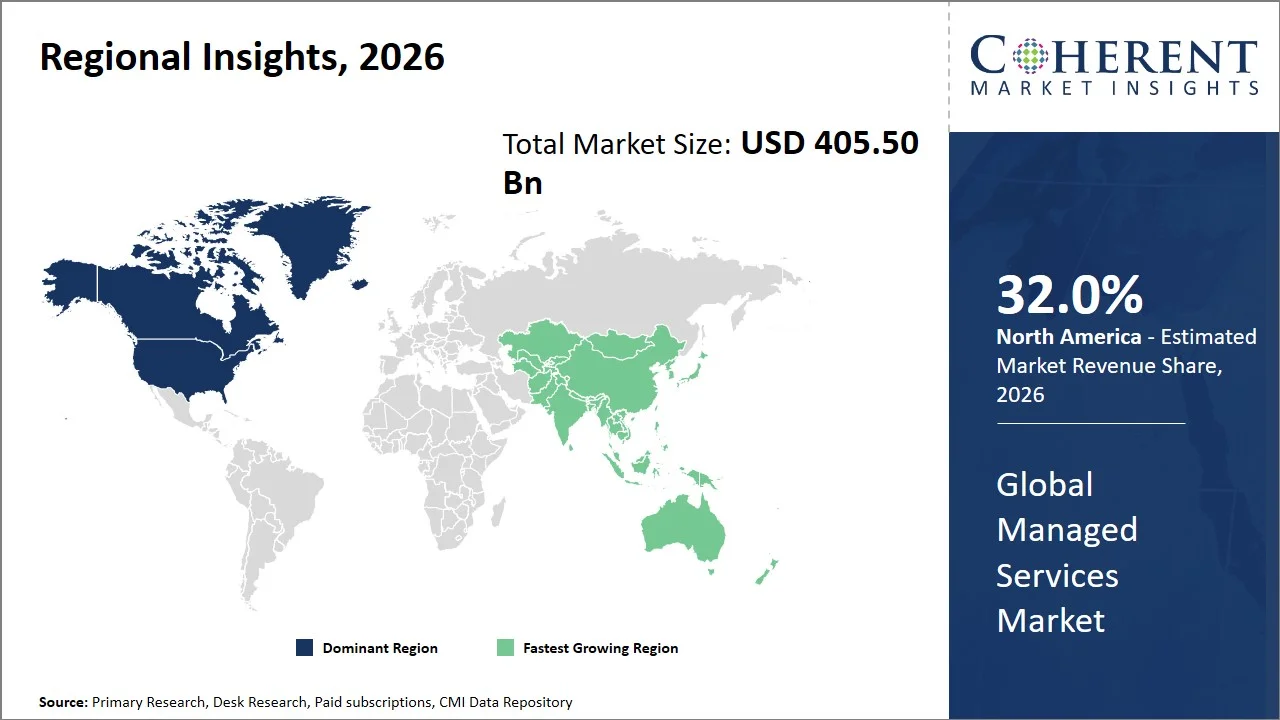
- North America is expected to dominate the global managed services market in 2026 with a market share of 32.0%. Strong growth in managed security services is a major driver for the regional market. On April 15, 2026, IBM announced new security service measures designed to help organizations counter a new generation of cyber threats as attackers begin weaponizing frontier AI models. (Source: IBM)
- Asia Pacific is expected to account for 26.0% share in 2026 and is projected to record the fastest growth over the forecast period. The need for industry specific managed solution is a prime catalyst for the Asia Pacific managed services market. On August 14, 2025, Accenture agreed to acquire CyberCX, a leading privately-owned cybersecurity services provider serving both private and public sector organizations across Australia, New Zealand and internationally. (Source: CyberCX)
- Adoption of managed services in cloud & IT infrastructure management: Cloud-based managed services show strong expansion prospects because businesses increasingly adopt mixed and multiple cloud setups. Growth follows as operations rely more on distributed systems across different cloud services. Demand rises when companies move workloads beyond single providers.
- Growth in cybersecurity & managed security services: Cybersecurity is one of the fastest-growing segments due to rising cyberattacks, ransomware threats, and data breaches. Organizations are adopting managed security services such as Security Operations Centers (SOC), threat detection, endpoint protection, and incident response.
Segmental Insights
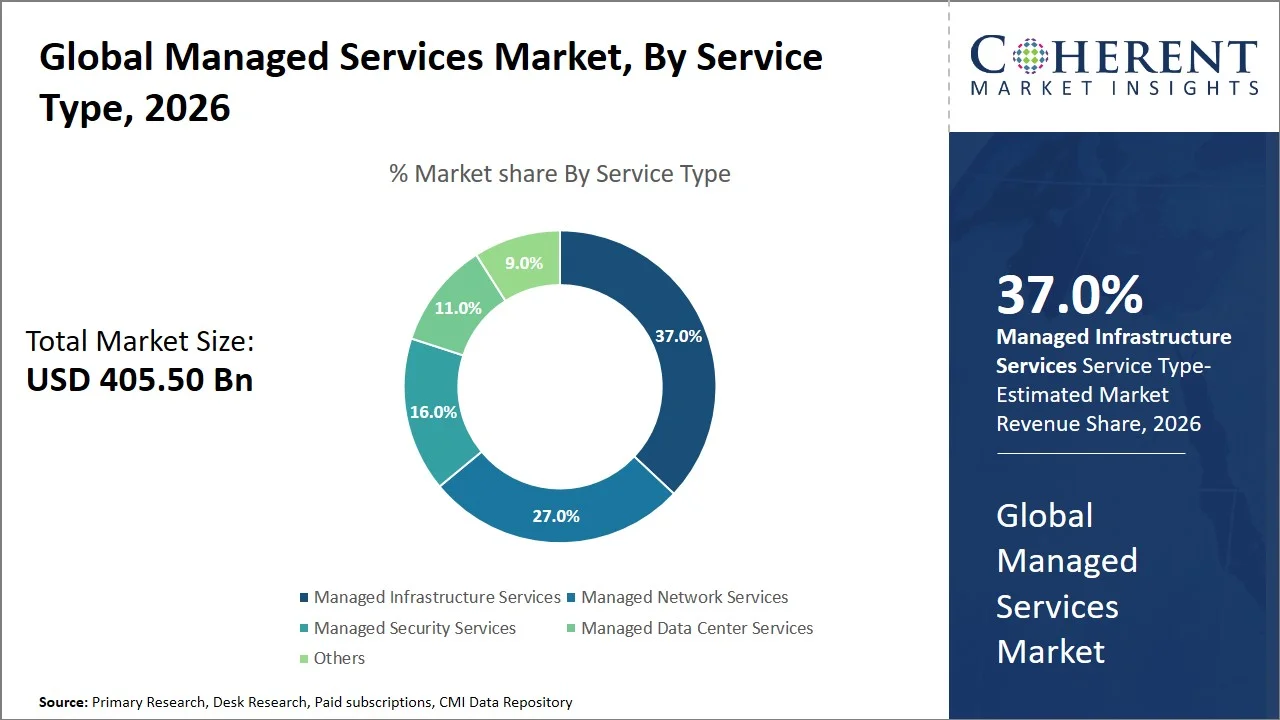
Why Does the Managed Infrastructure Services Segment Dominate the Global Managed Services Market?
The managed infrastructure services segment is expected to account for 37.0% of the global managed services market share in 2026. The trend of digital transformation across industries has boosted the demand for managed infrastructure services. Organizations are increasingly investing in digitalization to improve operational efficiency and infrastructure development. On February 13, 2026, Wesfarmers and Microsoft announced a multi-year strategic partnership to collaborate and co-innovate on a range of digital initiatives to further accelerate and embed AI, support agentic development, and expand cloud innovation across Wesfarmers’ diverse portfolio of businesses that serve millions of customers each year in Australia and New Zealand. (Source: Microsoft)
- Current Industry Events of 2026
- Market Size Estimation
- Regional Breakdown
- Competitive Landscape
- Customer Intelligence
- Segmental Analysis
- Pricing Analysis
- Key Market Drivers, Challenges & Future Trends
- Customized Insights Section
Why is Cloud the Most Preferred Deployment Mode?
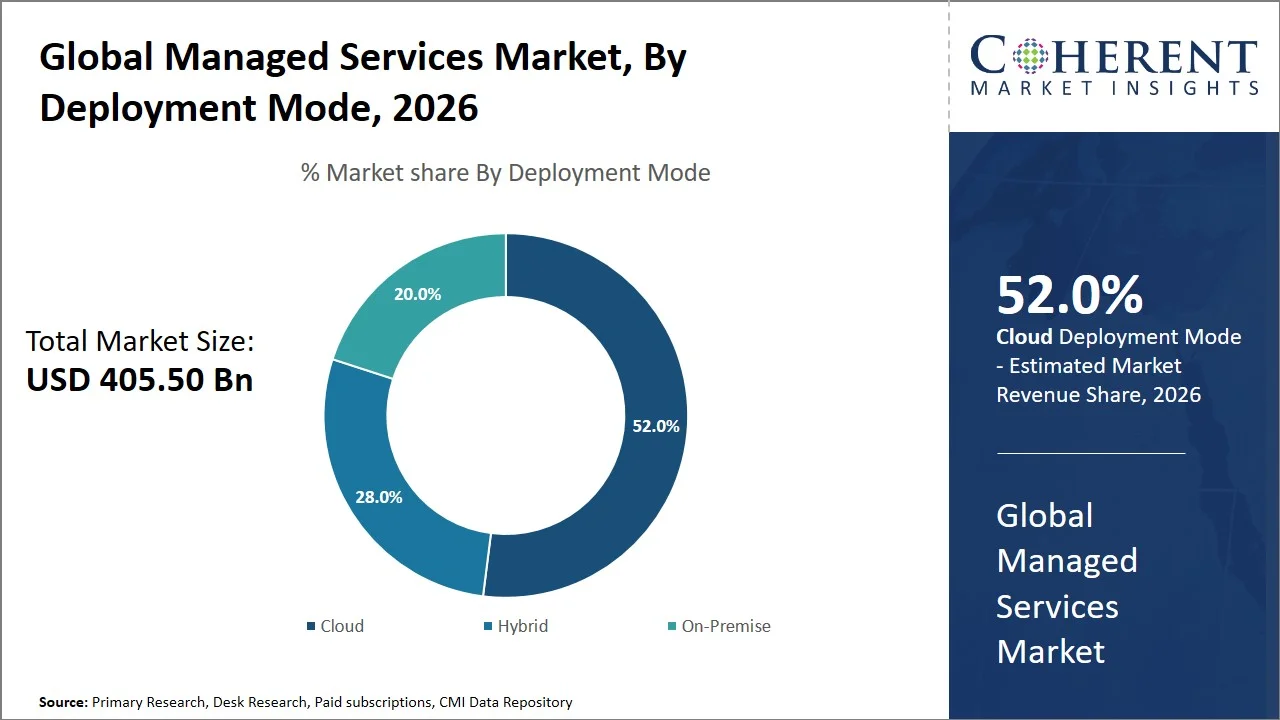
The cloud segment is expected to account for 52.0% of the global managed services market share in 2026. The advantages of cloud development has been growing substantially with increasing improvements in subscription-based models and cloud infrastructure. On April 29, 2026, Cognizant announced that it has entered into a definitive agreement to acquire Astreya, a leading platform-led, global AI-first IT managed services and solutions provider headquartered in San Jose, U.S. The transaction is expected to advance Cognizant's transformation as an AI builder and to meaningfully expand Cognizant's AI infrastructure foundation capabilities by harnessing Astreya's extensive managed services capabilities for enterprise clients at scale. (Source: Cognizant)
BFSI Segment Dominates the Global Managed Services Market
The BFSI segment is expected to account for 29.0% of the global managed services market share in 2026. The rising instances of cyberattacks has increased the demand for security services in the BFSI sector. On April 27, 2026, Vimeo reported a data breach where hackers accessed user and customer data through a third-party analytics vendor, Anodot. (Source: Vimeo)
Currents Events and their Impact
Current Events | Description and its Impact |
EU AI Act (2024-2026) |
|
India Digital Personal Data Protection (DPDP) Act, 2023 |
|
Global Managed Services Market Dynamics
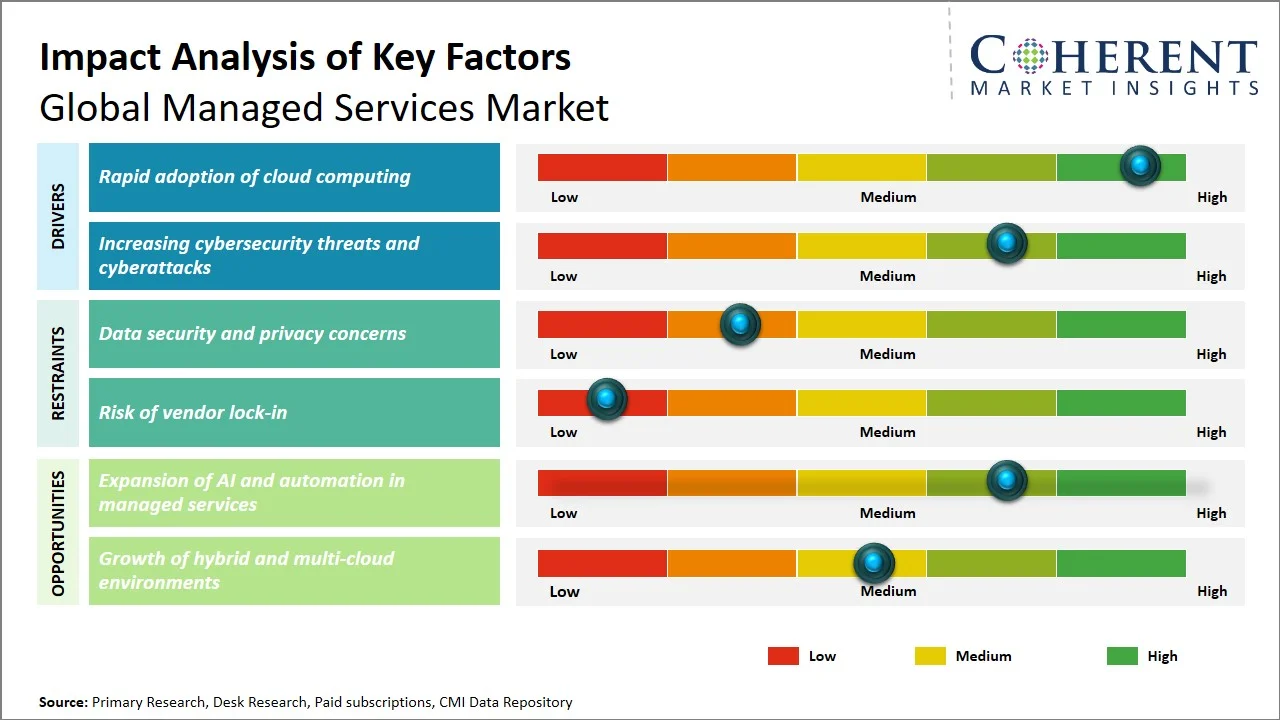
Market Drivers
- Rapid adoption of cloud computing: Cloud computing spreads fast as companies move away from old internal systems toward adaptable, expandable setups that reduce expenses. With more teams working remotely, enterprises in various sectors now rely on public, private, or combined cloud environments and this shift allows smoother access to information while pushing forward technology upgrades across operations. On April 28, 2026, OpenAI and AWS announced an expansion of their strategic partnership to help enterprises build using OpenAI capabilities in AWS environments. This initiative will give AWS customers’ access to the best frontier models, agents, and tools, which will operate within the systems, security protocols, compliance requirements, and workflows they already use. (Source: OpenAI)
- Increasing cybersecurity threats and cyberattacks: Among rising risks in digital environments, greater numbers of complex intrusions appear through ransomware, deception tactics, leaks of confidential details, and compromises within supplier networks. With institutions relying heavily upon internet-based platforms, distant employment setups, and linked infrastructure, weaknesses draw heightened exploitation attempts aimed at capturing private records, interrupting services, or seeking payments under pressure. On April 15, 2026, Signature Healthcare and Signature Healthcare Brockton Hospital reported that they are still recovering from a cyberattack that affected its information systems and forced it to divert ambulances. The incident began on April 6, 2026, when the Massachusetts health system first discovered suspicious activity within certain information systems. It immediately activated downtime procedures as a precaution. (Source: HIPAA)
Emerging Trends
- AI-driven automation and autonomous operations: Managed service providers are increasingly integrating artificial intelligence and machine learning to automate IT operations such as monitoring, threat detection, incident response, and predictive maintenance.
- Shift toward hybrid, multi-cloud, and industry-specific solutions: Organizations are adopting hybrid and multi-cloud strategies to improve flexibility, scalability, and resilience across digital infrastructures.
Regional Insights
Why is North America a Strong Market for Managed Services?
North America is expected to account for a market share of 32.0% in 2026. Across North America, real-time analytics shape managed services adoption in clear ways. Even with obstacles, firms throughout North America now lean more on outside help for complex tech duties. Amid sustained pressure from evolving cyber threats, organizations are shifting focus from in-house teams to specialized third-party providers. For Security Operations Centers (SoC), this shift is particularly significant—enabling enhanced threat detection, continuous monitoring, and cost-efficient access to advanced capabilities without the constraints of building and maintaining internal teams. On March 25, 2026, CrowdStrike and IBM announced an expansion of their strategic collaboration to advance agentic SOC transformation. The expanded collaboration integrates CrowdStrike Charlotte AI with IBM’s Autonomous Threat Operations Machine (ATOM), IBM’s autonomous SOC orchestration engine, for coordinated, machine-speed investigation and containment. (Source: Crowdstrike)
Why Does Asia Pacific Managed Services Market Exhibit High Growth?
Asia Pacific is expected to account for a market share of 26.0% in 2026 and is expected to register the fastest growth rate over the forecast period. The Asia Pacific managed services market is growing rapidly due to the large-scale digitalization of enterprises in countries like India, China, and Southeast Asia, where businesses are shifting directly from legacy systems to cloud-first and mobile-first infrastructures. Strong growth in IT outsourcing hubs, rising adoption of hybrid cloud by SMEs, and aggressive expansion of global MSPs in the region are accelerating demand.
In addition, increasing cybersecurity incidents and cost-sensitive enterprises are driving organizations to rely on managed services for affordable, scalable, and skilled IT operations without heavy in-house investment. On August 14, 2025, Accenture announced that it has agreed to acquire CyberCX, a leading privately-owned cybersecurity services provider serving both private and public sector organizations across Australia, New Zealand and internationally. (Source: Accenture)
Why is the U.S. Emerging as a Major Hub in the Managed Services Market?
In response to escalating cyber threats, managed services are gaining strong traction in the United States, as large enterprises increasingly outsource complex operations, such as cloud infrastructure, artificial intelligence workloads, and cybersecurity, to specialized service providers. As regulatory scrutiny deepens, with requirements from HIPAA alongside updated SEC disclosures, dependence on outside expertise rises gradually. Underlying much of this movement are leading cloud infrastructures operated by Amazon, Microsoft, and Google, forming resilient regional service ecosystems.
Is China the Next Growth Engine for the Managed Services Market?
Among global markets, China stands out through accelerating demand for managed services. Propelled by the widespread adoption of industrial cloud platforms, innovation continues at pace, with 5G enabling intelligent production lines across manufacturing environments. Backed by national policy, the Digital China vision shapes long-term infrastructure paths. Major technology providers including Huawei, Alibaba Cloud, and Tencent now extend dedicated cloud operations and protection layers. At the same time, tightening cybersecurity and data localization laws (Cybersecurity Law (CSL, 2017) and Data Security Law (DSL, 2021)) are forcing organizations to adopt compliant, locally managed IT infrastructure, significantly increasing the demand for managed services within the country.
Germany Managed Services Market Analysis and Trends
The Germany managed services market is shaped by strong industrial demand from its manufacturing and automotive sectors, where companies like Siemens-linked ecosystems and automotive suppliers are rapidly adopting Industry 4.0 solutions requiring managed IoT, OT security, and predictive maintenance services. Strict EU GDPR compliance and Germany’s focus on data sovereignty are pushing enterprises toward locally hosted managed cloud and security services rather than global public cloud-only models. Additionally, rising cyberattacks on industrial systems and the shortage of advanced IT and cybersecurity talent are accelerating outsourcing to specialized MSPs that can support secure, compliance-driven digital transformation.
The India managed services market is expanding rapidly as large IT service providers like TCS, Infosys, and Wipro scale cloud, cybersecurity, and application management services for global clients while domestic enterprises accelerate digital adoption in the BFSI, telecom, and e-commerce sectors. The growth is strongly driven by the country’s role as a global IT outsourcing hub, rising demand for hybrid cloud management, and increasing deployment of AI-driven automation in enterprise operations. Additionally, stricter data protection requirements under the DPDP Act and growing cyber threats are pushing Indian businesses to adopt managed security services and localized cloud solutions for compliance and operational resilience.
Global Managed Services Market - Regulatory Compliance
Metric | Latest Data (2025–2026) |
Global ransomware incidents | ~2,800+ reported cases annually |
Average ransomware attack frequency | Every ~11 seconds globally |
Most targeted sector | Healthcare (25–30% of attacks) |
Data breaches (global annual) | 3,500+ publicly disclosed |
BFSI attack share | ~18–20% of total incidents |
Average cost per data breach | ~USD 4.5 million (global avg) |
AI-driven attack growth | 2–3x increase YoY |
Organizations with security gaps | ~60% report skill shortages |
How is Expansion of AI and Automation in Managed Services Creating New Growth Opportunities in the Global Managed Services Market?
With AI and automation advancing within managed services, fresh paths for growth emerge through quicker, forward-looking, and adaptable IT operations requiring little manual oversight. Tools driven by artificial intelligence enhance capabilities like spotting threats instantly, handling incidents automatically, forecasting system upkeep needs, along with smart management of workloads in both cloud and mixed setups. Such transformation enables managed service providers to step away from old-style problem-after-it-happens approaches toward self-directed, anticipatory support, and cutting expenses while boosting consistency and performance for businesses everywhere.
Nowhere is this change more evident than in how routine tasks evolve under machine-guided precision. On April 22, 2026, Google Cloud, after integrating Wiz technology, launched AI agents for automated cybersecurity operations, including threat detection, vulnerability management, and incident response. (Source: Wiz)
Market Players, Key Development, and Competitive Intelligence
Key Developments
- On October 7, 2025, Newmark Group, Inc. announced the acquisition of RealFoundations, Inc. and its subsidiaries and affiliates, a leading global professional services firm focused solely on the real estate industry through its management consulting and managed services, based in Dallas, U.S.
- On August 26, 2025, Capgemini signed an agreement to acquire Cloud4C, a leading provider of automation-driven managed services for hybrid and sovereign cloud environments. Cloud4C helps enterprises migrate, manage and optimize their technology and data leveraging its low-code, AI-ready platform and vertical specific frameworks, designed for the specific needs of businesses and industries.
Competitive Landscape
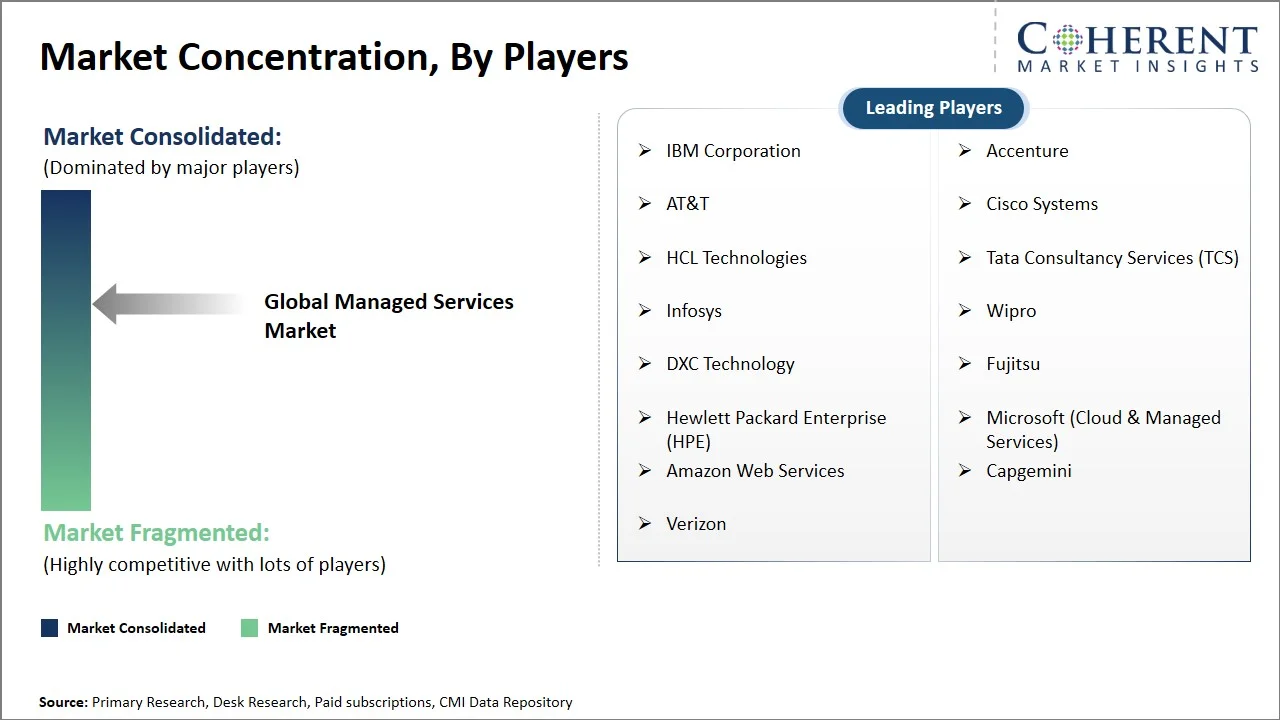
The global managed services market is highly competitive and dominated by global players such as IBM, Accenture, Cisco, AWS, Microsoft, and DXC Technology, which collectively hold a significant share due to their strong cloud, cybersecurity, and enterprise IT capabilities. These companies compete by expanding AI-driven automation, hybrid cloud management, and industry-specific service offerings, while continuously investing in partnerships and acquisitions to strengthen their service portfolios. At the same time, regional and niche providers are increasing competition by offering specialized, cost-effective solutions tailored to sectors like BFSI, healthcare, and manufacturing, making the market both consolidated at the top and fragmented at the lower tiers.
Market Report Scope
Managed Services Market Report Coverage
| Report Coverage | Details | ||
|---|---|---|---|
| Base Year: | 2025 | Market Size in 2026: | USD 405.50 Bn |
| Historical Data for: | 2020 To 2024 | Forecast Period: | 2026 To 2033 |
| Forecast Period 2026 to 2033 CAGR: | 10% | 2033 Value Projection: | USD 848 Bn |
| Geographies covered: |
| ||
| Segments covered: |
| ||
| Companies covered: | IBM Corporation, Accenture, AT&T, Cisco Systems, HCL Technologies, Tata Consultancy Services (TCS), Infosys, Wipro, DXC Technology, Fujitsu, Hewlett Packard Enterprise (HPE), Microsoft (Cloud & Managed Services), Amazon Web Services, Capgemini, and Verizon | ||
| Growth Drivers: |
| ||
| Restraints & Challenges: |
| ||
Analyst Opinion (Expert Opinion)
- The managed services market is a rapidly evolving space shifting from traditional IT outsourcing to AI-driven, cloud-native, and security-centric service models. They highlight that enterprises are increasingly prioritizing outsourcing due to rising cybersecurity risks, hybrid cloud complexity, and persistent IT skill shortages. Experts also note that competition is intensifying as leading providers differentiate themselves through automation, industry-specific solutions, and strategic acquisitions, making innovation and scalability key success factors in the market.
- Looking ahead, the market is expected to evolve toward fully autonomous process monitoring systems where analyzers continuously feed AI-driven control loops with minimal human intervention. Growth will be strongly supported by expansion of green hydrogen projects, carbon capture facilities, and advanced semiconductor manufacturing, all of which require ultra-precise real-time monitoring. Wireless and cloud-connected analyzers are likely to become standard, while miniaturized, multi-parameter devices will replace multiple single-function units, making process analysis more integrated, faster, and cost-efficient across industries.
Speak to the analyst
Want personalized insights?
Take the findings above to one of our principal consultants, or have the report rebuilt around the segments, geographies and competitors you actually track.
Market Segmentation
- Service Type Insights (Revenue, USD Billion, 2021 - 2033)
- Managed Infrastructure Services
- Managed Network Services
- Managed Security Services
- Managed Data Center Services
- Others
- Deployment Mode Insights (Revenue, USD Billion, 2021 - 2033)
- Cloud
- Hybrid
- On-Premise
- End User Insights (Revenue, USD Billion, 2021 - 2033)
- BFSI
- IT & Telecom
- Healthcare
- Retail & E-commerce
- Government & Public Sector
- Manufacturing
- Media & Entertainment
- Regional Insights (Revenue, USD Billion, 2021 – 2033)
- North America
- U.S.
- Canada
- Latin America
- Brazil
- Argentina
- Mexico
- Rest of Latin America
- Europe
- Germany
- U.K.
- Spain
- France
- Italy
- Russia
- Rest of Europe
- Asia Pacific
- China
- India
- Japan
- Australia
- South Korea
- ASEAN
- Rest of Asia Pacific
- Middle East
- GCC Countries
- Israel
- Rest of Middle East
- Africa
- South Africa
- North Africa
- Central Africa
- North America
Sources
Primary Research Interviews
- IT Service Providers and Managed Service Provider (MSP) executives
- Enterprise CIOs and IT Decision Makers
- Cloud Infrastructure Vendors
- Telecommunications Service Providers
Magazines
- CIO Magazine
- Network World
- IT Business Edge
- MSP Business Magazine
Journals
- International Journal of Information Management
- IEEE Transactions on Network and Service Management
- Journal of Network and Computer Applications
Associations
- CompTIA (Computing Technology Industry Association)
- ITSMF (IT Service Management Forum)
- MSPAlliance (Managed Service Provider Alliance)
- Cloud Security Alliance (CSA)
Public Domain Sources
- U.S. Bureau of Labor Statistics IT Industry Reports
- European Commission Digital Economy Reports
- World Bank Digital Development Reports
- OECD Digital Economy Outlook
Proprietary Elements
- CMI Data Analytics Tool
- Proprietary CMI Existing Repository of information for last 10 years
Get access to 250+ pages report
Every segment, forecast, competitor profile and data table behind the analysis above — available for instant download.
- ESOMAR Member
- ISO 9001:2015 Certified
- D-U-N-S Registered
- GDPR & CCPA Compliant
Missing comfort of reading report in your local language? Find your preferred language:
Transform your Strategy with Exclusive Trending Reports
Frequently Asked Questions
The global managed services market is expected to stand at USD 405.50 Bn in 2026 and is expected to reach USD 848 bn by 2033.
The CAGR of the global managed services market is projected to be 10% from 2026 to 2033.
Rapid adoption of cloud computing and increasing cybersecurity threats and cyberattacks are the major factors driving the growth of the global managed services market.
Data security and privacy concerns and risk of vendor lock-in are the major factors hampering the growth of the global managed services market.
In terms of service type, managed infrastructure services are estimated to dominate the market revenue share in 2026.
AI automates monitoring, threat detection, and predictive maintenance in IT operations.
It is a combination of on-premise and cloud-based IT management solutions.