

Microsegmentation Market Analysis & Forecast 2033
The global microsegmentation market is estimated to account for USD 4,560.9 Mn in terms of value by the end of 2026 and is expected to grow till USD 21,748.1 Mn in 2033 at a CAGR of 25% during the forecasted period (2026-2033), because enterprises are rapidly adopting zero trust security to protect dynamic cloud environments and hybrid networks against increasingly sophisticated cyber threats. 63% of organizations worldwide have fully or partially implemented a zero-trust strategy, according to Gartner, Inc.
Key Takeaways of Microsegmentation Market
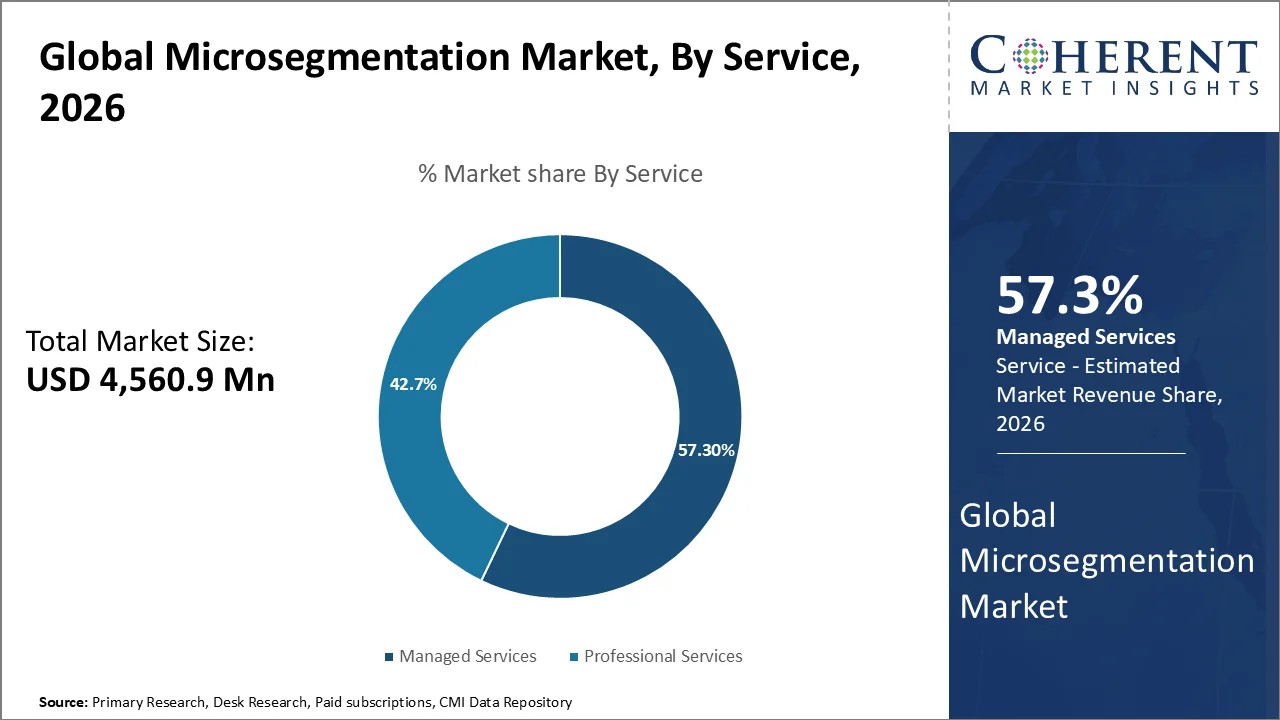
- Based on Service, the Managed services segment is expected to hold 57.3% share of the microsegmentation market in 2026, as outsourcing reduces complexity and addresses cybersecurity skill shortages. 95% of security leaders say microsegmentation is critical to strengthening cyber defenses, but only 5% of organizations are microsegmenting their networks today.
- According to Security, the Network security segment is expected to have the largest share of the microsegmentation market of 46.8% in 2026, as east – west traffic visibility and ransomware defense continue to be top priorities. A global survey of 1,200 security professionals finds microsegmentation is now a vital ingredient in Zero Trust.
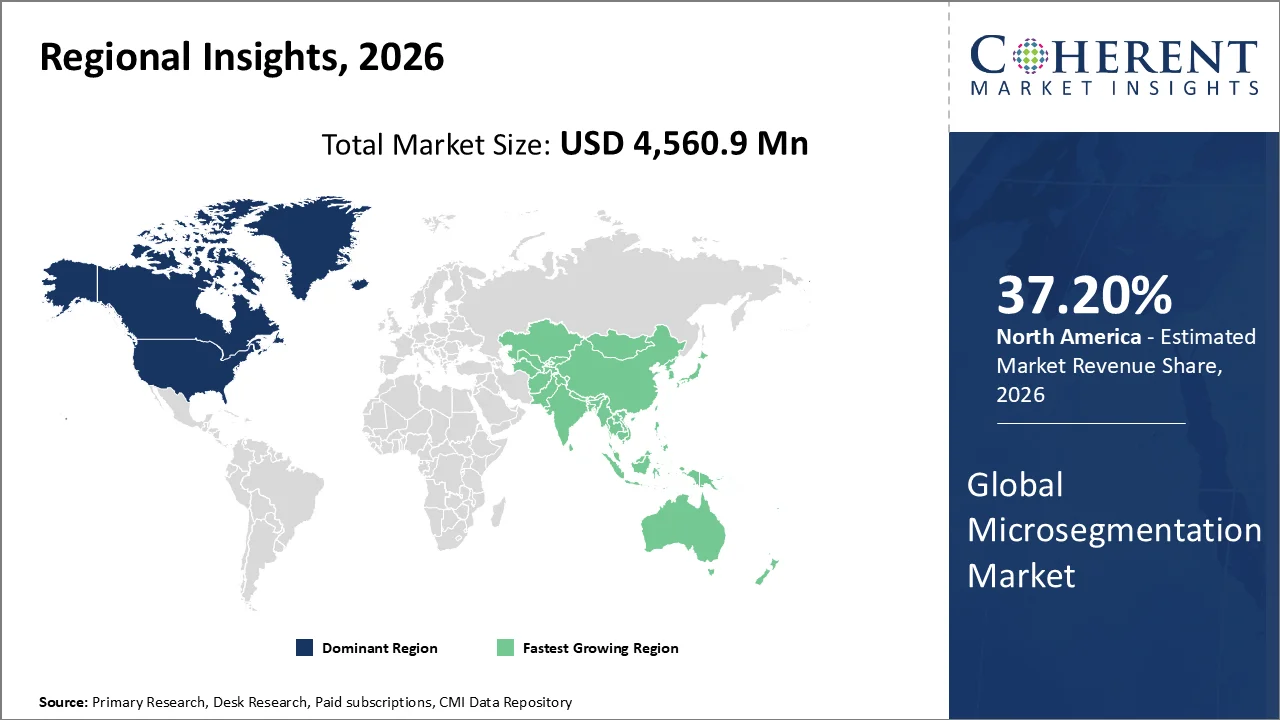
- Regionally, North America is expected to lead the microsegmentation market with a 37.2% share in 2026, driven by Zero Trust mandates, ransomware defense, and cloud-native adoption. With 713 incidents, the United States saw the most manufacturing ransomware incidents, accounting for 21% of worldwide incidents. For the fourth year in a row, manufacturing has been the most attacked industry. Canada came in second with 62 incidents, further highlighting that North America is highly susceptible to ransomware threats, which will boost the need of ransomware defense and microsegmentation adoption
- Based on region, Asia Pacific is expected to be the fastest growing region due to adoption in BFSI, healthcare and government due to rising breaches. This shows that 80% of data breaches were caused by attacks, compared to 38% last year, with 97% resulting from system intrusions, social engineering and web application attacks, highlighting APAC’s concentrated cyber threat landscape.
US Ransomware Losses Usher in Microsegmentation Growth
Rising ransomware attacks are pushing U.S. enterprises to adopt microsegmentation as a key defense, in 2026. By isolating workloads and reducing lateral movement organizations can better contain breaches. The drive for cyber insurance and the federal government’s zero trust mandate are driving adoption, making microsegmentation a mainstream cybersecurity strategy across industries.
The trend highlights the importance of ransomware losses in driving enterprise security priorities with increased investment in zero trust architectures and cloud-native protections for critical infrastructure.
FinCEN’s latest ransomware report: U.S. banks lose $1.3 billion to rising cyberattacks Illumio believes in microsegmentation, a critical security measure that helps prevent lateral movement and limit the damage of breaches. Rising ransomware costs are driving zero trust strategies.
Microsegmentation is the 2026 Zero Trust Pillar
By 2026, microsegmentation is becoming a key pillar of zero trust architectures to address ransomware containment, cloud native security, and AI driven workloads. Segmentation is used by enterprises to isolate workloads, secure east west traffic and prevent lateral movement across hybrid and multicloud environments. Segmentation offers visibility, compliance and resilience as container adoption and AI agents ramp up.
This change brings microsegmentation into the mainstream security practice, helping organizations bolster their security against more sophisticated threats and meet the demands of digital transformation. It marks a move from perimeter to workload-based protection and makes segmentation a must for modern enterprise security in 2026.
In June 2025, Palo Alto Networks revealed its big plans for cloud network security, embedding microsegmentation into its Strata platform. It’s a new innovation that guarantees east-west traffic security, stops lateral movement, and improves zero trust defenses. It addresses ransomware threats and cloud native workloads that will define enterprise cybersecurity strategies in 2026.
- Current Industry Events of 2026
- Market Size Estimation
- Regional Breakdown
- Competitive Landscape
- Customer Intelligence
- Segmental Analysis
- Pricing Analysis
- Key Market Drivers, Challenges & Future Trends
- Customized Insights Section
Data Breaches from April 2026-Microsegmentation Could Have Prevented Lateral Spread
Breach Case | Scale of Breach | Breach Cause |
| Citizens Financial Group & Frost Bank | 3.4M records (Citizens); 250K SSNs/TINs (Frost) | Everest ransomware via shared third-party vendor |
France Titres / ANTS (French Government) | 11.7M accounts confirmed; up to 19M claimed | Cause undisclosed, investigation ongoing |
Medtronic | Up to 9M records claimed | ShinyHunters extortion attack, vector undisclosed |
Adobe | 13M support tickets, 15K employee records, all HackerOne submissions | Supply-chain compromise via BPO; phishing + privilege escalation |
Vercel (via Context.ai) | 580 employee records, access keys, source code, tokens | OAuth supply-chain compromise via Lumma Stealer |
Current Events and their Impacts on the Microsegmentation Market
Current Event | Description and its Impact |
Cloud Infrastructure Evolution and Multi-Cloud Adoption |
|
Regulatory Compliance and Data Privacy Intensification |
|
Segmental Insights
Are Microsegmentation Managed Services Driving Adoption?
In terms of services, the managed services segment dominates with 57.3% share of the market in 2026, because organizations outsource microsegmentation deployment and monitoring to reduce complexity and overcome skill shortages. Providers deliver continuous policy enforcement, compliance support, and threat visibility, enabling enterprises to scale Zero Trust faster. This reliance on external expertise drives steady growth, especially among large enterprises with hybrid cloud infrastructures.
According to the new Omdia survey, commissioned by Elisity Only 22% have hands-on experience with modern microsegmentation, pointing to an awareness gap as much as an execution gap.
Is Microsegmentation Network Security Leading Zero Trust?
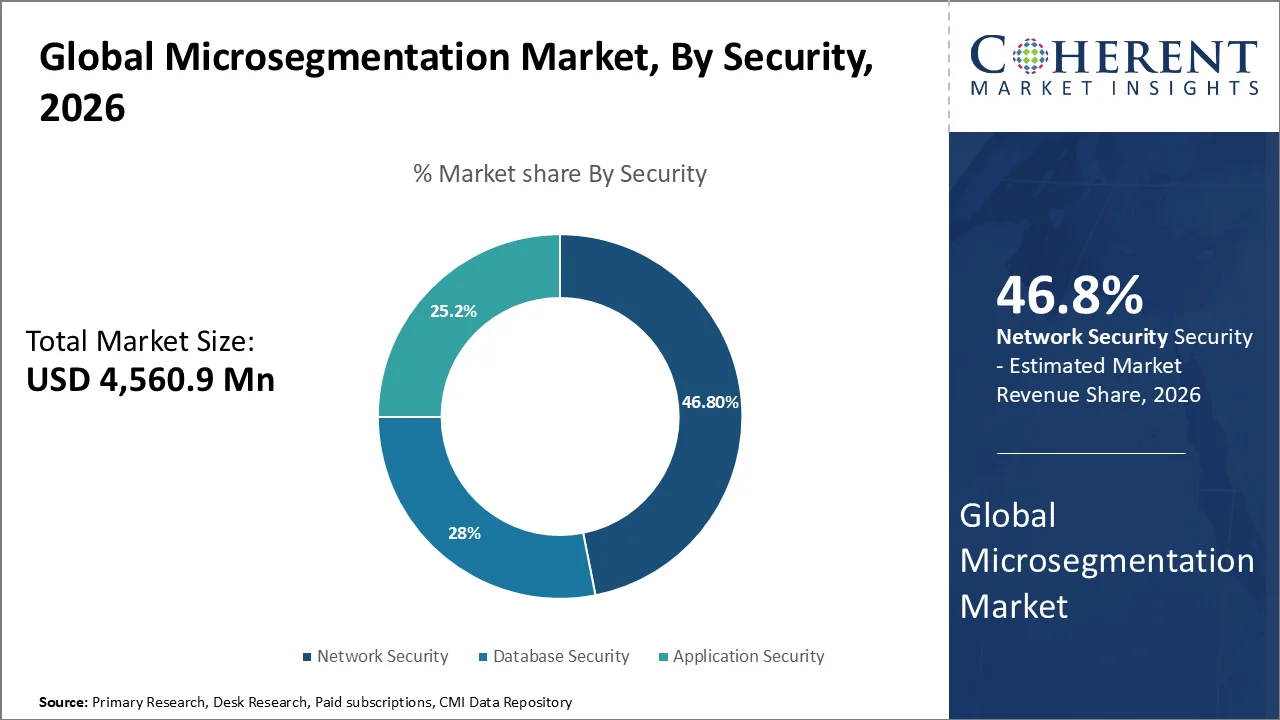
In terms of security, the network security segment leads the market with 46.8% share in 2026, as enterprises prioritize east–west traffic visibility and ransomware defense. Microsegmentation gives you granular control over internal communications, helping to stop threats from moving laterally across data centers and cloud environments. Network security is the largest segment, which is the foundation of Zero Trust, and application security is the fastest growing sub-segment.
Gartner predicts that by 2027, 25% of enterprises that are working toward a Zero Trust architecture will use more than one deployment form of microsegmentation. This is a significant increase from less than 5% in 2025.
Regional Insights
Zero Trust Surge Drives North America’s Microsegmentation Leadership In 2026
North America dominates the microsegmentation market in 2026, holding about 37.2% share. The demand is fueled by strong adoption of Zero Trust, regulatory frameworks such as HIPAA and PCI DSS, and rising ransomware attacks. The region is the largest contributor to global market revenues with enterprises focusing on network security, cloud-native segmentation and managed services.
For instance, in April 2026, The Cybersecurity and Infrastructure Security Agency (CISA) and U.S. government partners released a new guide to help speed up Zero Trust adoption in operational technology. The campaign promotes microsegmentation as an essential security step, bolstering North America’s position as a leader in Zero Trust and network security compliance.
Asia-Pacific Microsegmentation Market to Grow on Rising Cyberattacks By 2026
The Asia-Pacific region is the fastest growing region and is estimated to account for 27.5% share by 2026. Adoption is being driven by increasing cyberattacks and rapid digital transformation in the BFSI, healthcare and government sectors. The Asia-Pacific is the fastest growing region globally as enterprises adopt hybrid deployments and identity-based segmentation. More than 90% of over a thousand global CIOs, surveyed by Bob Bailkoski, CEO at Logicalis have reported Experience at least one cyberattacks in past 12 months in Asia Pacific.
For instance, ViewQwest partnered with Zero Networks to deliver automated microsegmentation solutions in key Asian markets in October 2025. The partnership enhances enterprise adoption of Zero Trust in Asia-Pacific amid increasing cyber threats and makes the region the fastest-growing hub for advanced network security technologies.
Microsegmentation Market Analysis Country-Wise
U.S. Surges Demand Through Zero‑Trust Mandates
In 2026, The U.S. leads the microsegmentation market, thanks to zero trust mandates, larger cybersecurity budgets and widespread enterprise adoption. It is the biggest worldwide market owing to its robust cloud penetration and ransomware defense strategies. The FY2026 U.S. budget includes large investments in advanced cybersecurity, with $9.1 billion for cybersecurity, $5.4 billion for cyberspace operations, and $611.9 million for research and development. These allocations are on zero trust, adoption of microsegmentation and AI driven cyber defense.
For example, ColorTokens showcased an Xshield AI Agent at RSAC San Francisco in March 2026, automating the enforcement of microsegmentation policy. The AI-based tool reduces segmentation cycles from days to minutes, in support of zero trust mandates and strengthening U.S. enterprise defenses against ransomware and lateral movement attacks.
China Growth Boosted by Cloud
Fast growth in the microsegmentation market in China is driven by government cybersecurity initiatives, expanding cloud infrastructure and IoT proliferation. Asia Pacific has the fastest rate of adoption of ransomware threats and digital transformation, driven by China as a key growth engine.
Cloud infrastructure spending in mainland China jumped 26% year over year in Q4 2025 to USD 14.7 billion. Growth was fuelled by enterprise AI adoption, private AI deployments and increased demand for compute, storage and databases. Omdia forecasts another 26% growth in 2026, with agents becoming central to business workflows.
Who are the Major Companies in Microsegmentation Market
Cisco Systems Inc. (US), Akamai Technologies, Inc., Palo Alto Networks, Inc., Symantec Corporation, Okta, Inc., Forcepoint, LLC, Cyxtera Technologies, Sophos Group Plc, Google LLC, Microsoft, Inc., VMware Inc., Trend Micro Incorporated, Cloudflare, IBM Corporation, Fortinet, Check Point Software Technologies Ltd., Unisys, vArmour, Inc., OPAQ Networks, Inc., ExtraHop Networks, ShieldX, Bracket Computing Inc., Nutanix, and Cloudvisory.
Key News
- In April 2026, Zero Networks unveiled AI Segmentation, a breakthrough in cybersecurity designed to control AI agents, enhance visibility, simplify operations, and stop AI‑driven lateral movement. Positioned as an evolution of microsegmentation, the solution integrates zero‑trust principles to address emerging risks in enterprise environments.
- In November 2025, FireMon released new Zero Trust microsegmentation capabilities that integrate with Illumo, VMware NSX and Zscaler. It offers granular segmentation in hybrid and multi cloud environments, reduces complexity of managing policies and improves protection against lateral movement – an important milestone in maturing enterprise cybersecurity strategies.
Market Report Scope
Microsegmentation Market Report Coverage
| Report Coverage | Details | ||
|---|---|---|---|
| Base Year: | 2025 | Market Size in 2026: | USD 4,560.9 Mn |
| Historical Data for: | 2020 To 2024 | Forecast Period: | 2026 To 2033 |
| Forecast Period 2026 to 2033 CAGR: | 25% | 2033 Value Projection: | USD 21,748.1 Mn |
| Geographies covered: |
| ||
| Segments covered: |
| ||
| Companies covered: | Cisco Systems Inc. (US), Akamai Technologies, Inc., Palo Alto Networks, Inc., Symantec Corporation, Okta, Inc., Forcepoint, LLC, Cyxtera Technologies, Sophos Group Plc, Google LLC, Microsoft, Inc., VMware Inc., Trend Micro Incorporated, Cloudflare, IBM Corporation, Fortinet, Check Point Software Technologies Ltd., Unisys, vArmour, Inc., OPAQ Networks, Inc., ExtraHop Networks, ShieldX, Bracket Computing Inc., Nutanix, and Cloudvisory. | ||
| Growth Drivers: |
| ||
| Restraints & Challenges: |
| ||
Microsegmentation Market Trends
- Ransomware containment: Escalating ransomware attacks push U.S use microsegmentation to isolate workloads, contain lateral movement. This mitigates breach impact, meets cyber insurance incentives and compliance mandates. Only 1 in 9 were reported. The BlackFog Q1 2026 Ransomware Report found 2,160 attacks went unreported, average ransom demands were over $1M, 96% of attacks involved data exfiltration, and healthcare was the most targeted industry.
- Zero‑trust enforcement: Federal zero trust mandates accelerate adoption. “Microsegmentation is emerging as an important enforcement mechanism for least privilege access, compliance and workload isolation in government, BFSI and healthcare. Tufin teamed policy automation and Guardicore segmentation for workload-level centralized visibility and enforcement with Akamai. The partnership extends zero trust enforcement to microsegmentation, enhancing ransomware containment and cloud native security for enterprises in 2026.
- Cloud‑native security: As containerized/microservices architectures are gaining popularity, microsegmentation provides workload centric policies. It delivers a secure dynamic environment that safeguards east-west traffic in data centers and hybrid cloud deployments. Cloud Native Application Protection Platforms combine threat detection, compliance automation and vulnerability management. They offer continuous monitoring, automated incident response and up to 95% reduction in alert noise.
- Partner ecosystem growth: Segmentation is being added by vendors into larger platforms that combine networking, identity and cloud security. Partner driven sales are on the rise, making adoption easier and maintaining recurring revenue streams for providers. Firstsource and Typeface partner to offer agentic AI marketing capabilities that drive scalable enterprise revenue growth. The partnership is a reflection of trends in the growth of the microsegmentation partner ecosystem. The article provides numerical estimates, saying AI marketing services will exceed $100 billion by 2026.
Analyst Opinion
- Ransomware containment and regulatory pressure: With over 2,000 ransomware attacks disclosed in the first quarter of 2026, enterprises are adopting microsegmentation to prevent lateral movement. The procurement cycles are shortened with the embedding of segmentation into enterprise security strategies, due to board level scrutiny of east west traffic and tightening compliance frameworks.
- Cloud native and AI-driven workloads: The proliferation of containerized applications, IoT devices, and AI agents demands fine-grained workload isolation. Hybrid environments get visibility and resilience from microsegmentation, and the convergence of platforms with identity and networking vendors creates subscription-based ecosystems that lock in recurring revenue streams and change the competitive landscape.
Speak to the analyst
Want personalized insights?
Take the findings above to one of our principal consultants, or have the report rebuilt around the segments, geographies and competitors you actually track.
Market Segmentation
- By Component (Revenue, USD Mn, 2021-2033)
- Software
- Services
- By Services (Revenue, USD Mn, 2021-2033)
- Managed Services
- Professional Services
- By Security (Revenue, USD Mn, 2021-2033)
- Network Security
- Database Security
- Application Security
- By Deployment Type (Revenue, USD Mn, 2021-2033)
- On-premises
- Cloud
- By Organization Size (Revenue, USD Mn, 2021-2033)
- SMEs
- Large Enterprises
- By Vertical (Revenue, USD Mn, 2021-2033)
- Government & Defense
- BFSI
- IT & Telecom
- Healthcare
- Retail
- Manufacturing
- Energy & Utility
- Others
- By Region (Revenue, USD Mn, 2021-2033)
- North America
- U.S.
- Canada
- Latin America
- Brazil
- Mexico
- Argentina
- Rest of Latin America
- Europe
- Germany
- U.K.
- France
- Italy
- Spain
- Russia
- Rest of Europe
- Asia Pacific
- China
- India
- Japan
- Australia
- South Korea
- ASEAN
- Rest of Asia Pacific
- Middle East
- GCC
- Israel
- Rest of Middle East
- Africa
- South Africa
- Central Africa
- North Africa
- North America
- Key Players
- Cisco Systems Inc. (US)
- Akamai Technologies, Inc.
- Palo Alto Networks, Inc.
- Symantec Corporation
- Okta, Inc.
- Forcepoint, LLC
- Cyxtera Technologies
- Sophos Group Plc
- Google LLC
- Microsoft, Inc.
- VMware Inc.
- Trend Micro Incorporated
- Cloudflare
- IBM Corporation
- Fortinet
- Check Point Software Technologies Ltd.
- Unisys
- vArmour, Inc.
- OPAQ Networks, Inc.
- ExtraHop Networks
- ShieldX
- Bracket Computing Inc.
- Nutanix
- Cloudvisory
Sources
Primary Research Interviews
- Chief Information Security Officers (CISOs)
- Network Security Architects
- Cloud Infrastructure Managers
- Data Center Operations Heads
- Enterprise IT Directors
- Cybersecurity Product Developers
- Firewall and Network Appliance Vendors
- Managed Security Service Providers (MSSPs)
- Cloud Service Providers
- Others
Databases
- Bloomberg Terminal
- Thomson Reuters Eikon
- IEEE Xplore Digital Library
- ACM Digital Library
- U.S. Patent and Trademark Office (USPTO)
- National Institute of Standards and Technology (NIST)
- IETF RFC Repository
- Others
Magazines
- CSO Magazine
- Dark Reading
- SC Media
- Infosecurity Magazine
- Network World
- Cyber Defense Magazine
- TechTarget – SearchSecurity
- Others
Journals
- IEEE Transactions on Network and Service Management
- Journal of Cybersecurity
- Computers & Security
- ACM Transactions on Privacy and Security
- International Journal of Information Security
- Journal of Cloud Computing
- The Lancet Digital Health (for healthcare IT security)
- Others
Newspapers
- Reuters
- Bloomberg News
- The Wall Street Journal – Tech Section
- Financial Times – Technology
- The New York Times – Technology Section
- The Guardian – Technology Section
- CyberScoop
- TechCrunch – Security
- Others
Associations
- Internet Engineering Task Force (IETF)
- National Institute of Standards and Technology (NIST)
- Information Systems Security Association (ISSA)
- ISACA
- Cloud Security Alliance (CSA)
- European Union Agency for Cybersecurity (ENISA)
- Open Web Application Security Project (OWASP)
- Cybersecurity and Infrastructure Security Agency (CISA)
- Others
Public Domain Sources
- NIST Cybersecurity Framework
- U.S. Department of Homeland Security – CISA
- European Union Agency for Cybersecurity (ENISA)
- IETF RFCs
- World Economic Forum – Cybersecurity Reports
- National Cyber Security Centre (UK)
- MITRE ATT&CK Framework
- U.S. Government Accountability Office (GAO) – Cybersecurity Reports
- Others
Proprietary Elements
- CMI Data Analytics Tool
- Proprietary CMI Existing Repository of information for last 8 years
Get access to 250+ pages report
Every segment, forecast, competitor profile and data table behind the analysis above — available for instant download.
- ESOMAR Member
- ISO 9001:2015 Certified
- D-U-N-S Registered
- GDPR & CCPA Compliant
Missing comfort of reading report in your local language? Find your preferred language:
Transform your Strategy with Exclusive Trending Reports
Frequently Asked Questions
The global Microsegmentation Market size was valued at USD 4,560.9 Mn in 2026 and is expected to reach USD 21,748.1 Mn in 2033.
The Global Microsegmentation Market is valued of USD 4,560.9 Mn in 2026.
The Market is expected to witness a CAGR of 25% during the forecast period (2026-2033).
Major factor driving the growth of the Market during the forecast period is the Growing importance of efficient mission-critical operations and the Expansion of the LTE network leading to demand for LTE-integrated LMR devices
The Market is estimated to reach USD 21,748.1 Mn by 2033.
Among regions, the North America region held the largest share in the Markets in 2026.
The Market are Cisco Systems Inc. (US), Akamai Technologies, Inc., Palo Alto Networks, Inc., Symantec Corporation, Okta, Inc., Forcepoint, LLC, Cyxtera Technologies, Sophos Group Plc, Google LLC, Microsoft, Inc., VMware Inc., Trend Micro Incorporated, Cloudflare, IBM Corporation, Fortinet, Check Point Software Technologies Ltd., Unisys, vArmour, Inc., OPAQ Networks, Inc., ExtraHop Networks, ShieldX, Bracket Computing Inc., Nutanix, and Cloudvisory.