

Blockchain Technology Market Analysis & Forecast: 2026-2033
Blockchain Technology Market is estimated to be valued at USD 5,692.1 Mn in 2026 and is expected to reach USD 172,526.7 Mn in 2033, exhibiting a compound annual growth rate (CAGR) of 62.8% from 2026 to 2033.
Key Takeaways
- Based on Type, the Pubic segment is projected to account for 57.6% share of the global blockchain technology market in 2026, due to their open, decentralized structure powering global platforms like Bitcoin and Ethereum.
- Based on Application, the Payment segment is expected to capture the highest share of the market in 2026, as blockchain enables fast, secure, and transparent financial transactions across borders and platforms.
- Based on End-use Industry, BFSI segment is projected to command the highest share of the market in 2026, using blockchain for fraud prevention, smart contracts, and regulatory compliance.
- Based on Region, North America is projected to continue leading the global blockchain technology market in 2026, with a market share of 47.0% in terms of value. While, Europe is anticipated to be the fastest growing region, with 25.7% share in 2026.
Market Overview
Rising need for safe and clear-cut digital dealings is pushing the blockchain technology market growth. With the increasing popularity of cryptocurrencies (Bitcoin and Ethereum, for instance), blockchain is becoming the go-to choice for individuals and businesses looking to have safe, fast, and transparent dealings. For instance, the number of crypto wallet users globally crossed 400 million in 2024, showcasing the dependence on blockchain infrastructure. The surge is not just finance in supply chain, healthcare, and even government are adopting blockchain technology to improve the integrity of data and minimize fraud.
Current Events and Its Impact on the Blockchain Technology Market
Event | Description and Impact |
Global Regulatory Framework Evolution |
|
Central Bank Digital Currency (CBDC) Development Race |
|
Institutional Bitcoin and Crypto Asset Integration |
|
Role of Technologies like AI on the Market
The adoption of artificial intelligence (AI) alongside blockchain technology is transforming an array of industries by improving the effectiveness, security, and creativity of the digital infrastructure. Machine learning technology that improves consensus algorithms addresses blockchain issues like network congestion, energy consumption, and scalability.
For instance, IBM’s AI-driven blockchain platform uses analytics to evaluate transactions and improve network performance. This yields better enterprise solutions. Moreover, AI is used by Chainalysis to ensure compliance with cryptocurrency regulations by identifying atypical transactions with 95% accuracy, thus automating fraud and regulatory investigations. AI improves the execution of smart contracts, automated governance, and secure data sharing.
Ocean Protocol’s decentralized data marketplace leverages AI to empower blockchain-based data transactions, guaranteeing privacy and propriety. They have processed more than $1.5 million in data transactions. AI and blockchain together offer automated trading, predictive maintenance, and advancements in decentralized autonomous organizations (DAOs).
Trust, automation, and value creation are being redefined by these converging technologies that together form the foundation of the world’s transparent, secure, and efficient digital ecosystems
- Current Industry Events of 2026
- Market Size Estimation
- Regional Breakdown
- Competitive Landscape
- Customer Intelligence
- Segmental Analysis
- Pricing Analysis
- Key Market Drivers, Challenges & Future Trends
- Customized Insights Section
Segmental Insights
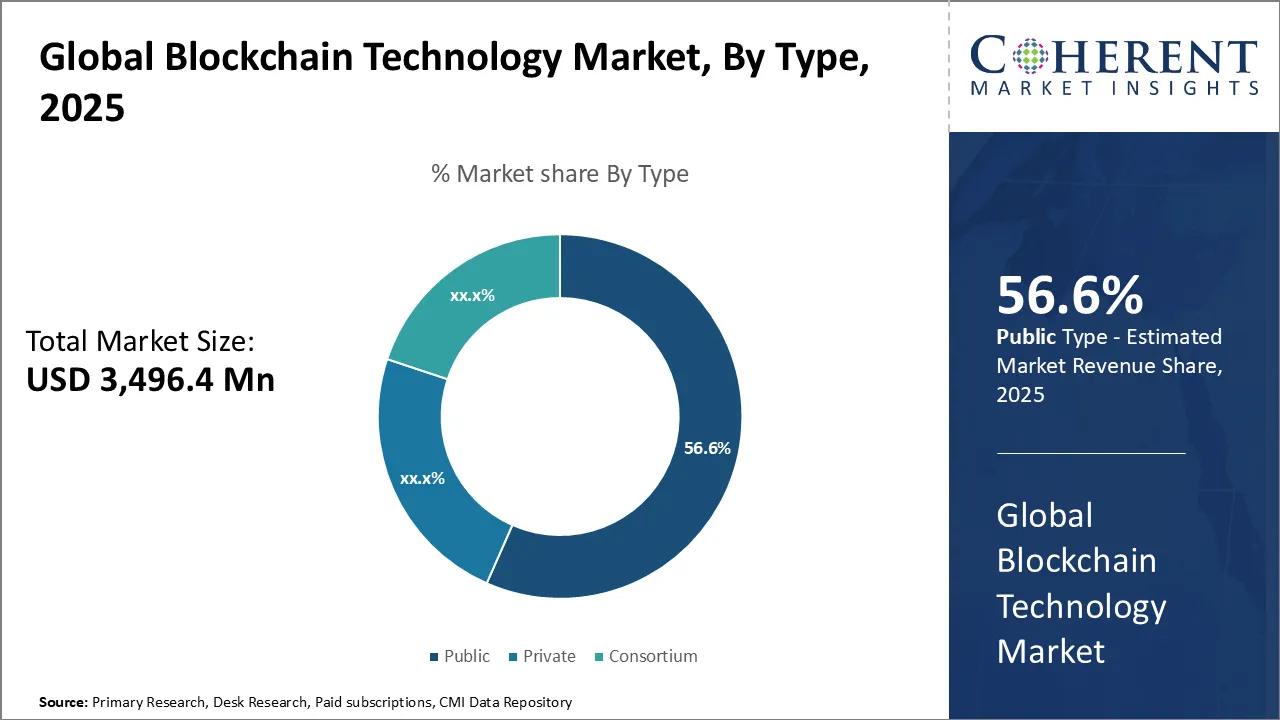
Blockchain Technology Market Insights, By Type: Public Blockchains Lead Due To Their Open, Decentralized Structure Powering Global Platforms Like Bitcoin and Ethereum
In terms of type, the public segment is expected to contribute 57.6% of the blockchain technology market share in 2026, due to their open, decentralized nature that allows anyone to participate without permission. These networks, such as Bitcoin and Ethereum, offer transparency, immutability, and security, making them ideal for applications that require trustless environments. Their widespread adoption in cryptocurrency, decentralized finance (DeFi), and tokenized assets has positioned public blockchains as the backbone of blockchain innovation. Enterprises and developers prefer public blockchains for building scalable and interoperable solutions, contributing to their dominance over private and consortium models.
For instance, in July 2025, Vietnam unveiled NDAChain, its national blockchain platform aimed at accelerating digital data infrastructure by 2026. Spearheaded by the Ministry of Information and Communications, NDAChain is designed to be open, interoperable, and accessible, aligning with public blockchain principles. It will support secure data sharing, digital identity, and smart contracts across multiple sectors.
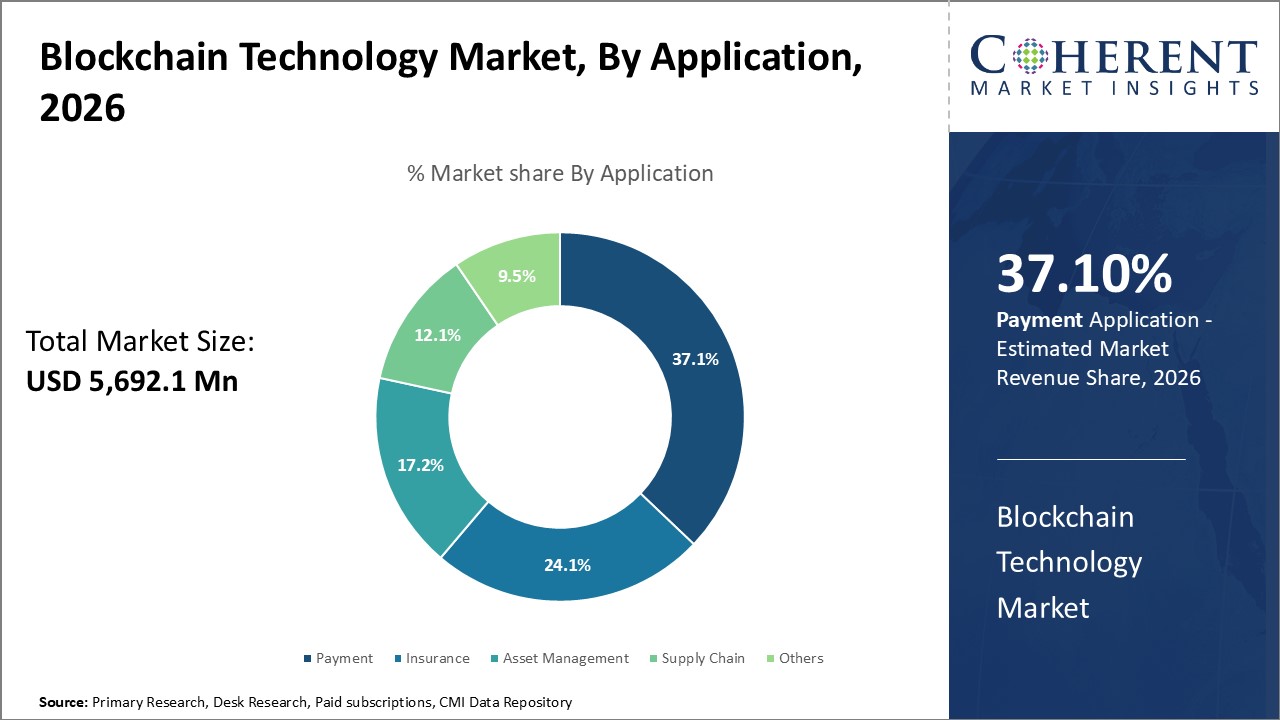
Blockchain Technology Market Insights, By Application: Payment Dominates as Blockchain Enables Fast, Secure, And Transparent Financial Transactions Across Borders and Platforms.
In terms of application, the payment segment is expected to hold the largest share of the market in 2026, driven by the global rise of digital currencies, cross-border transactions, and decentralized financial platforms. Blockchain’s ability to facilitate fast, secure, and low-cost payments without intermediaries has revolutionized financial services. Cryptocurrencies like Bitcoin and stablecoins are increasingly used for remittances, e-commerce, and peer-to-peer transfers. Additionally, blockchain-based payment systems offer enhanced transparency and fraud prevention, making them attractive to both consumers and businesses. This widespread utility ensures payment continues to lead among blockchain applications.
For instance, in October 2025, Citi introduced a blockchain-based payment solution enabling round-the-clock transactions for institutional clients. The system uses smart contracts and tokenized deposits to streamline cross-border payments and liquidity management. This innovation marks a major step in modernizing financial infrastructure, offering real-time settlement and enhanced transparency across global banking operations.
Blockchain Technology Market Insights, By End-Use Industry: BFSI Sector Tops Adoption, Using Blockchain for Fraud Prevention, Smart Contracts, And Regulatory Compliance
In terms of end-use industry, the BFSI segment is projected to capture the highest share of the market in 2026, leveraging it to streamline operations, enhance security, and meet regulatory requirements. Banks use blockchain for real-time settlement, digital identity verification, and smart contracts that automate compliance and reduce operational costs. Insurance companies benefit from blockchain’s ability to validate claims and prevent fraud, while financial institutions use it to improve transparency and auditability. The sector’s high transaction volumes and need for secure, efficient systems make blockchain a critical tool, solidifying BFSI’s position as the leading industry in blockchain adoption.
For instance, in September 2025, SWIFT added a blockchain-based ledger to its infrastructure stack, marking a major leap in digital finance innovation. This integration aims to accelerate transaction speed, enhance transparency, and scale interoperability across financial institutions. The move reflects SWIFT’s commitment to modernizing global payments and embracing decentralized technologies for secure, efficient data exchange.
Regional Insights
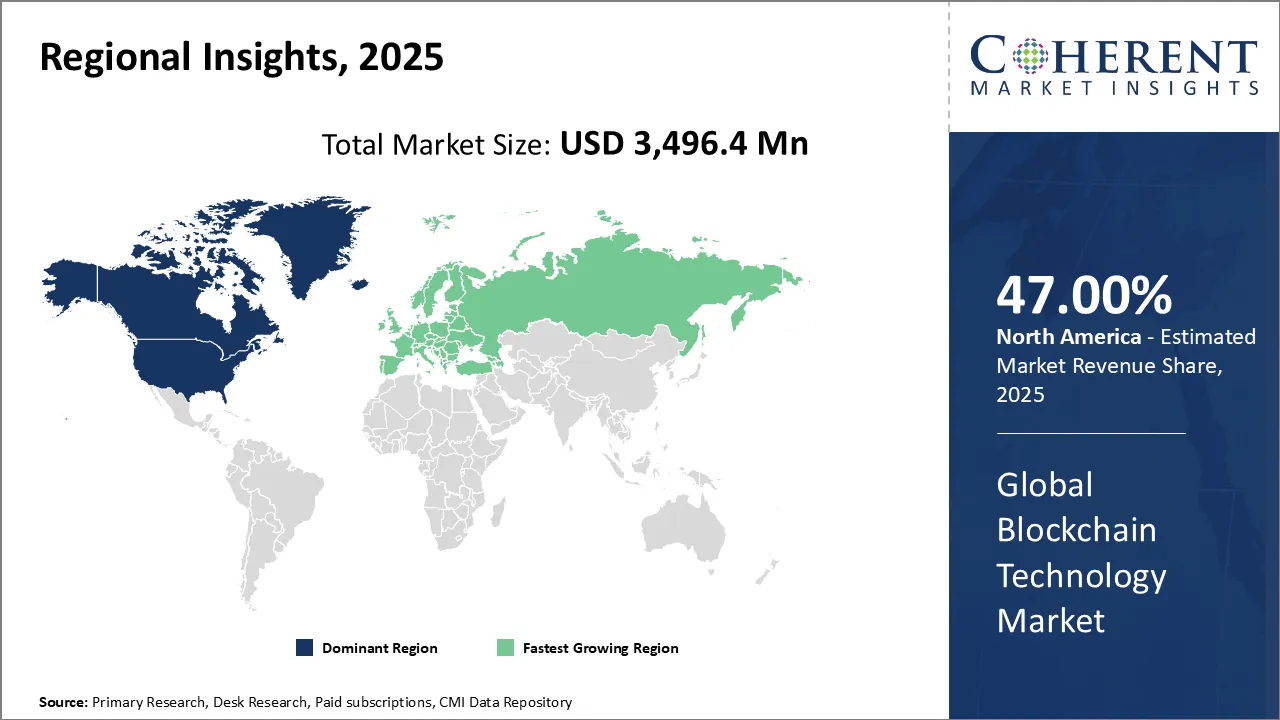
North America Blockchain Technology Market Analysis and Trends
North America is projected to hold a dominant position in the global blockchain technology market with a 47.0% share in 2026. The region’s leadership is driven by a robust technology infrastructure, high levels of digitalization, and strong presence of major blockchain solution providers across industries. The U.S. accounts for the majority of market activity, supported by favorable regulatory developments and increased blockchain adoption in financial services, healthcare, and logistics.
North American enterprises are actively investing in blockchain to enhance transparency, security, and automation in business operations. Government-backed initiatives and rising venture capital funding have further accelerated innovation in blockchain applications, particularly in areas such as identity verification and smart contracts. This combination of mature market conditions and technological innovation solidifies North America’s position at the forefront of global blockchain development.
For instance, in October 2026, Bullish launched its digital asset trading platform in the United States, targeting institutions and advanced traders. The exchange offers deep liquidity, robust security, and innovative trading tools, aiming to set a new standard in crypto markets. This expansion reflects growing demand for regulated, high-performance blockchain-based trading infrastructure.
Europe Blockchain Technology Market Analysis and Trends
The Europe region has been witnessing impeccable growth and is emerging as the fastest expanding region, with 25.7% share in 2026. due to the region’s strong emphasis on digital innovation, regulatory clarity, and cross-industry adoption. European governments and institutions actively support blockchain through initiatives like the European Blockchain Services Infrastructure (EBSI), which promotes secure data exchange and digital identity across borders. The region’s strict data privacy laws, such as GDPR, align well with blockchain’s transparency and immutability, making it a trusted solution for compliance-heavy sectors.
Additionally, industries like finance, healthcare, logistics, and energy are rapidly integrating blockchain to enhance efficiency, traceability, and security. Europe’s commitment to sustainability and ethical sourcing also drives demand for blockchain in supply chain and fashion applications, where provenance and accountability are critical. This combination of policy support, technological readiness, and industry demand positions Europe as a global leader in blockchain adoption.
For instance, in September 2026, ten major European banks launched a regulated Layer 1 blockchain network to support secure tokenization of financial assets. Built on SWIAT infrastructure, the initiative includes Deutsche Bank and Standard Chartered as shareholders. This move aims to modernize capital markets with compliant digital asset solutions across borders and institutions.
Blockchain Technology Market Outlook Country-Wise
The U.S. Blockchain Technology Market Trends
The U.S. leads the blockchain market with a 36.9% share, due to its robust tech ecosystem, heavy investment in crypto startups, and widespread enterprise adoption. Financial institutions, healthcare providers, and supply chain leaders use blockchain for transparency, security, and automation. Regulatory advancements and innovation hubs like Silicon Valley further accelerate demand across industries.
For instance, in October 2026, Grayscale launched the first-ever staking-enabled spot crypto exchange-traded products (ETPs) in the United States. These ETPs offer investors exposure to cryptocurrencies like Solana while earning staking rewards. The move marks a significant milestone in regulated crypto investing, combining asset growth potential with passive income through blockchain staking mechanisms.
The U.K. Blockchain Technology Market Trends
The UK’s blockchain demand with an 8.6% share stems from its strong fintech sector, supportive government policies, and focus on digital identity and smart contracts. London’s financial institutions are integrating blockchain for compliance, fraud prevention, and cross-border payments. The UK also fosters blockchain innovation through academic research and startup incubators, driving steady market growth.
For instance, in September 2026, the London Stock Exchange Group (LSEG) announced to develop a blockchain-based platform to digitize trading and settlement of private assets. Aiming to launch in 2024, the initiative seeks to improve transparency, efficiency, and accessibility in private markets. LSEG emphasizes regulatory compliance and institutional-grade infrastructure to support secure digital asset operations.
China Blockchain Technology Market Trends
China’s blockchain market is scoring 5.5% share, driven by government-backed initiatives, including its national blockchain infrastructure and digital yuan rollout. Despite restrictions on cryptocurrencies, blockchain is widely used in logistics, healthcare, and manufacturing. The country’s emphasis on data security and enterprise blockchain adoption makes it a key player in global blockchain development.
For instance, in May 2026, LaLiga partnered with SF&BT to launch LaLiga Club, a Web3-based community initiative in China. The project aims to deepen fan engagement through blockchain-powered digital experiences, including collectibles and interactive content. This marks LaLiga’s strategic entry into the Chinese tech ecosystem, blending sports culture with decentralized innovation.
Mexico Blockchain Technology Market Trends
Mexico’s blockchain demand of 0.6% share is emerging through fintech innovation, remittance solutions, and agricultural traceability. Startups are using blockchain to improve financial inclusion and secure cross-border payments. Though still nascent, government interest and pilot programs in public services and land registry systems are gradually expanding blockchain’s role in the Mexican economy.
For instance, in September 2026, Binance planned on investing $53 million over four years to launch Medá, a regulated fintech entity in Mexico. Designed as a regional cryptocurrency hub, Meda aims to boost financial inclusion and digital access across Latin America. The move highlights Mexico’s growing role in fintech and Binance’s commitment to expanding crypto adoption.
GCC Countries Blockchain Technology Market Trends
GCC nations like UAE and Saudi Arabia are contributing 3.6% share are investing heavily in blockchain for smart cities, digital governance, and secure financial systems. Government-led initiatives such as Dubai Blockchain Strategy and Vision 2030 promote adoption across sectors. Blockchain is also used in oil logistics, healthcare, and real estate, reflecting regional tech ambitions.
For instance, in October 2026, Bahrain unveiled a blockchain-powered government services portal aimed at streamlining public administration. The platform enhances transparency, speeds up service delivery, and secures digital identity verification. Citizens and businesses can now access tamper-proof records and real-time transaction tracking, marking a major step in Bahrain’s digital transformation and smart governance strategy.
Market Report Scope
Blockchain Technology Market Report Coverage
| Report Coverage | Details | ||
|---|---|---|---|
| Base Year: | 2025 | Market Size in 2026: | USD 5,692.1 Mn |
| Historical Data for: | 2020 To 2024 | Forecast Period: | 2026 To 2033 |
| Forecast Period 2026 to 2033 CAGR: | 62.8% | 2033 Value Projection: | USD 172,526.7 Mn |
| Geographies covered: |
| ||
| Segments covered: |
| ||
| Companies covered: | Accenture, Amazon Web Services, Inc., Advanced Micro Devices, Inc., IBM Corporation, Infosys Ltd, Intel Corporation, Microsoft Corporation, NVIDIA Corporation, Samsung, SAP SE, Siemens AG, Xilinx, Inc. | ||
| Growth Drivers: |
| ||
| Restraints & Challenges: |
| ||
Global Blockchain Technology Market Drivers
- Rising incidents of identity and data theft are fueling the demand for cryptographic ledger solutions
The BFSI (Banking, Finance, Service, Insurance) sector is increasingly embracing digital ledger technology to fortify the security of financial data and safeguard the identities of end-users. This technology is gaining traction in the industry and finding diverse applications, including facilitating cross-border transactions, streamlining clearing and settlements, empowering trade finance platforms, verifying digital identities, and enhancing credit reporting. The extensive adoption of these technologies is anticipated to drive the growth of the market.
- Availability of secured medium to carry out truncations is expected to propel the global blockchain technology market growth over the forecast period
Online payments through blockchain technology are secure since there are no intermediaries and the data is decentralized. The chain of transition is completely automated from beginning to end and requires no documentation, thereby reducing the errors caused by duplication.
Moreover, the availability of real-time tracking of transactions averts fraud caused by errors during online payment. This has enabled online transactions with large-scale payment. Hence, these factors are expected to propel the global blockchain technology market growth in the near future.
In April 2023 Coinflow Labs, a provider of web3 payment solutions, completed its pre-seed round, securing USD 1.45 million in funding. The round was led by Jump Crypto and Reciprocal Ventures and included contributions from CMT Digital, Digital Currency Group, Gumi Cryptos, Builder Capital, Prompt Ventures, Blocktech Ventures, as well as several angel investors. Coinflow's involvement in the Pit, Jump Crypto's innovation hub, garnered interest from these investors.
Global Blockchain Technology Market Opportunities
- Government initiatives are on the rise, contributing to the increased demand for blockchain platforms and services.
In recent years, blockchain technology has garnered significant attention from stakeholders across various industries. As interest in this technology grows, governments worldwide are investing in research endeavors to develop blockchain solutions. Given the high volume of transactions and information exchanges within the government sector, ranging from disbursements and procurements to sales, fees, fines, certifications, and approvals, blockchain solutions are being adopted by government entities to enhance transparency, efficiency, and the overall delivery of public services.
By leveraging distributed ledgers, blockchain technology offers numerous potential applications that can improve transparency, prevent fraud, and enhance operational efficiency for government agencies. Notably, the Estonian government stands as an early adopter of blockchain technology within the European region.
China's notable efforts to establish dominance in blockchain technology are evidenced by the substantial number of blockchain-related patents filed, with approximately 33,000 filed by China and over 10,000 filed by the U.S. China is actively accelerating its applications of blockchain to secure a lasting, first-mover advantage.
In April 2023, in an effort to advance the blockchain technology system, the Indian Union government initiated a research project. The project's main objective is to enhance the blockchain technology stack to facilitate comprehensive end-to-end development of blockchain applications.
According to official sources, the project, titled "Design and Development of Unified Blockchain Framework for Offering National Blockchain Service and Creation of Blockchain Ecosystem," will also enable the integration of Open Application Programming Interfaces (Open APIs) to ensure seamless connectivity and enable the provision of blockchain-as-a-service (BaaS) over distributed infrastructure.
- Automating loans
Smart contracts have the potential to enhance the efficiency of loan servicing and offer customers a smoother experience. One significant benefit is their enhanced capacity to streamline data and payment flows with greater efficiency through automation. For instance, a borrower could electronically submit a utilization request, and a smart contract-based facility agreement could verify the request's compliance with specific terms.
One significant benefit is their enhanced capacity to streamline data and payment flows with greater efficiency through automation. Upon satisfying the conditions, the smart contract could execute instructions. This involves deducting participation from the open credit lines of lenders and initiating the corresponding payments accordingly.
Global Blockchain Technology Market: Key Developments
- In October 2025, Ripple donated $10 million to UC Berkeley to establish the Center for Digital Assets and Blockchain Technology. The initiative aims to advance research, education, and innovation in blockchain and digital finance. It will foster interdisciplinary collaboration and support the development of secure, scalable decentralized systems for real-world applications.
- In September 2025, 21X launched its blockchain-based trading platform by ringing the bell on Deutsche Borse. As a regulated digital securities exchange, 21X leverages Polygon blockchain to enable secure, transparent, and efficient asset trading. The milestone marks a new era in tokenized finance, bridging traditional markets with decentralized infrastructure.
- In April 2025, Under the Future Finance Act, the German intends to implement regulations targeting startups involved in financial innovation. The primary objective of this legislation is to enhance the digitalization of capital markets by enabling the issuance of e-securities on a blockchain platform.
- In April 2023, Ava Labs, the creator of the Avalanche blockchain platform, has recently introduced new institutional deployments aimed at advancing and enriching the blockchain technology ecosystem.
Analyst Viewpoint
- The blockchain technology market is gaining strong traction as enterprises increasingly adopt it across financial services, supply chains, and healthcare. Businesses are using blockchain’s transparency and decentralization to improve operational efficiency and data security.
- Growing demand for secure digital transactions and stronger data integrity is driving widespread blockchain deployment. These features are especially attractive in industries handling sensitive or high-volume data.
- Despite its potential, the market faces challenges such as regulatory uncertainty, concerns about scalability and energy use, and a limited talent pool of skilled blockchain developers, all of which are slowing adoption.
- There is rising optimism around blockchain's integration with AI and IoT. These combinations are opening new use cases in digital identity, smart contracts, and DeFi, offering lucrative opportunities for innovation and growth.
- Regionally, North America leads the market thanks to its strong tech infrastructure and supportive government policies. Meanwhile, Asia-Pacific is the fastest-growing region, driven by heavy investment and digital innovation in countries like China, Japan, and South Korea.
Market Segmentation
- Global Blockchain Technology Market, By Type (Revenue, USD Mn, 2021 - 2033)
- Public
- Private
- Consortium
- Global Blockchain Technology Market, By Application (Revenue, USD Mn, 2021 - 2033)
- Asset Management
- Insurance
- Payment
- Supply Chain
- Others
- Global Blockchain Technology Market, By End-use Industry (Revenue, USD Mn, 2021 - 2033)
- Banking, Financial Services, and Insurance (BFSI)
- Information Technology (IT)
- Healthcare
- Education
- Telecom
- Others
- Global Blockchain Technology Market, By Region (Revenue, USD Mn, 2021 - 2033)
- North America
- U.S.
- Canada
- Latin America
- Brazil
- Argentina
- Mexico
- Rest of Latin America
- Europe
- Germany
- U.K.
- Spain
- France
- Italy
- Russia
- Rest of Europe
- Asia Pacific
- China
- India
- Japan
- Australia
- South Korea
- ASEAN
- Rest of Asia Pacific
- Middle East
- GCC Countries
- Israel
- Rest of Middle East
- Africa
- South Africa
- North Africa
- Central Africa
- North America
- Company Profiles
- Accenture
- Amazon Web Services, Inc.
- Advanced Micro Devices, Inc.
- IBM Corporation
- Infosys Ltd
- Intel Corporation
- Microsoft Corporation
- NVIDIA Corporation
- Samsung
- SAP SE
- Siemens AG
- Xilinx, Inc.
Sources
Primary Research Interviews
- Blockchain technology providers and platform developers
- Enterprise clients implementing blockchain solutions
- System integrators and technology consultants
- Government officials and regulatory bodies
- Others
Databases
- Bloomberg Terminal
- Refinitiv (formerly Thomson Reuters)
- PitchBook Database
- Others
Magazines
- MIT Technology Review
- CoinDesk Magazine
- Blockchain Magazine
- IEEE Computer Magazine
- Others
Journals
- Journal of Network and Computer Applications
- IEEE Transactions on Information Forensics and Security
- Computers & Security Journal
- Others
Newspapers
- Financial Times
- The Wall Street Journal
- Reuters
- CoinTelegraph
- Others
Associations
- Blockchain Association
- Global Blockchain Business Council (GBBC)
- Enterprise Ethereum Alliance (EEA)
- International Association for Cryptologic Research (IACR)
- Others
Public Domain Sources
- U.S. Securities and Exchange Commission (SEC) filings
- European Central Bank publications
- World Bank Group reports
- MIT OpenCourseWare blockchain resources
- Others
Proprietary Elements
- CMI Data Analytics Tool
- Proprietary CMI Existing Repository of information for last 8 years
Definition: Blockchain technology is a decentralized and distributed digital ledger system that records and stores data across multiple computers or nodes.
Get access to 250+ pages report
Every segment, forecast, competitor profile and data table behind the analysis above — available for instant download.
- ESOMAR Member
- ISO 9001:2015 Certified
- D-U-N-S Registered
- GDPR & CCPA Compliant
Missing comfort of reading report in your local language? Find your preferred language:
Transform your Strategy with Exclusive Trending Reports
Frequently Asked Questions
The Blockchain Technology Market size is estimated to be valued at USD 5,692.1 Mn in 2026, and is expected to reach USD 172,526.7 Mn by 2033.
The CAGR of the global Market is projected to be 62.8% from 2026 to 2033.
Major factor driving the growth of the market during the forecast period is the increasing incidents of identity and data theft are projected to accelerate the adoption of cryptographic ledger solutions.
Major factor hampering the growth of the market during the forecast period is expected to be hindered due to a shortage of skilled professionals.
North America market is expected to generate the highest revenue during the forecast period.
Blocks are added through consensus mechanisms like Proof of Work or Proof of Stake, with cryptography ensuring data integrity, transaction verification, and secure linking of blocks.
Blockchain is a decentralized digital ledger that records transactions securely, transparently, and immutably across distributed computer networks.