

Airport Asset Tracking Market Analysis & Forecast: (2026-2033)
Airport asset tracking market size is estimated to be valued at USD 537 Mn in 2026 and is expected to reach USD 1,080 Mn in 2033, exhibiting a compound annual growth rate (CAGR) of 10.5% from 2026 to 2033.
Key Takeaways
- Based on Offering, the Hardware segment is expected to hold 62.7% share in 2026.
- Based on Asset Type, the Mobile Asset segment is expected to lead the market with 47.3% share in 2026.
- Based on Region, North America is set to lead the airport asset tracking market with 37% share in 2026. While, Asia Pacific is projected to be the fastest growing region.
Market Overview
Airport Asset tracking system helps to track the airport sites such as machine shops, workplaces, and storage space. Asset tracking system keeps the record of maintenance history, track location, and gives a clear view of airport operation. The asset tracking system is a software that collects the data based on performance of asset, to check whether the assets are working smoothly. The asset tracking software system works more efficiently as compared to work done by humans working in for the airport.
For asset tracking, there are various technologies which can provide real-time tracking such as RFID (Radio-frequency identification), BLE (Bluetooth low energy), GPS (Global Positioning System), and IoT (Internet of Things). For instance, Radio-frequency identification is used in tracking assets. A tag is attached to the asset, and the reader scans the tag to retrieve all of the asset's information. It utilizes frequency-based technology.
Current Events and Its Impact on the Airport Asset Tracking Market
Current Event | Description and its Impact |
AI and IoT Technology Integration in Airport Operations |
|
Sustainability and Environmental Compliance Pressures |
|
How Fast Are Airports Installing Asset Tracking Systems Worldwide?
- Installed systems grew from 200,000 in 2019 to an expected 500,000 by 2024.
- Growth driven by rising passenger traffic, cargo expansion, and modernization projects.
- Airports deploy IoT, RFID, and GPS solutions for real-time visibility.
- Benefits include reduced delays, enhanced safety, predictive maintenance, and optimized resource use.
- Demonstrates shift from niche adoption to mainstream necessity in airport operations.
- Current Industry Events of 2026
- Market Size Estimation
- Regional Breakdown
- Competitive Landscape
- Customer Intelligence
- Segmental Analysis
- Pricing Analysis
- Key Market Drivers, Challenges & Future Trends
- Customized Insights Section
Segmental Insights
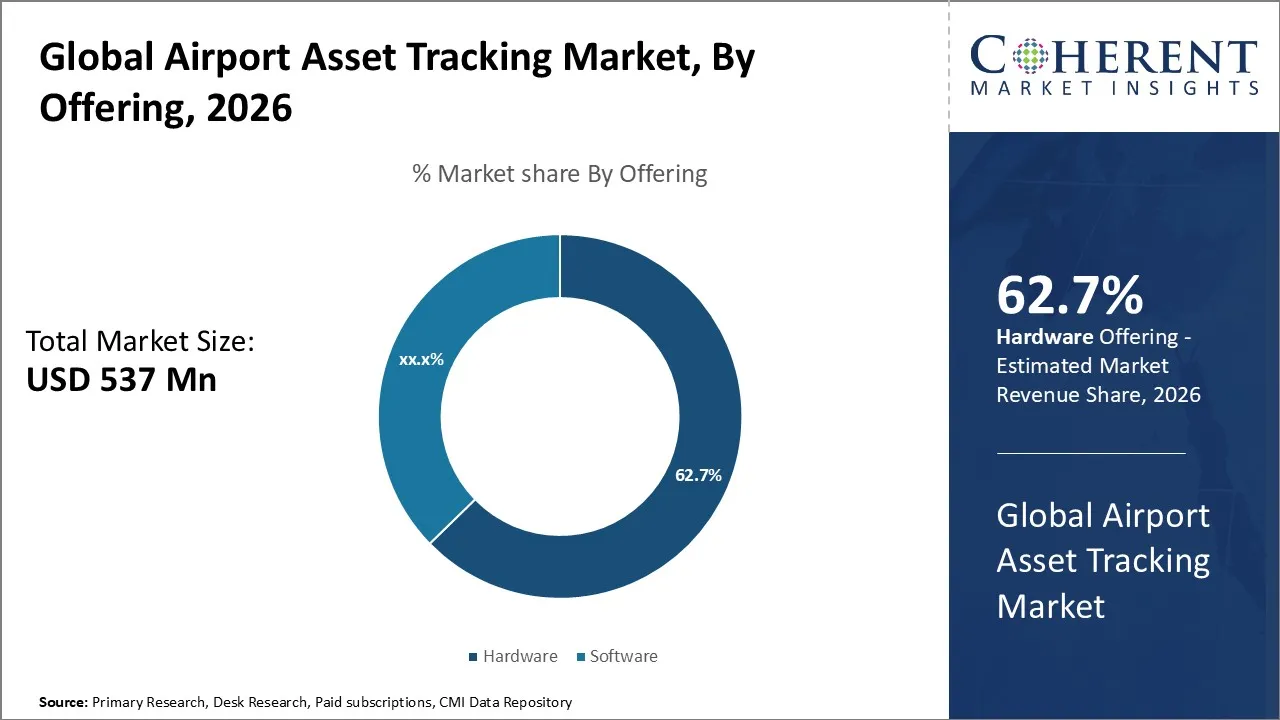
Why Does Hardware Dominates the Airport Asset Tracking Market?
In terms of offering, the hardware segment is expected to lead the market with 62.7% share in 2026. It dominates because RFID tags, GPS trackers, sensors, and IoT devices are essential for real-time monitoring. Airports remain focused on infrastructure development, ensuring hardware continues to account for the majority of overall spending.
For instance, in December 2025, NEC has set up vehicle management tools at Haneda Airport to help self-driving towing tractors. The system has cameras and signal equipment to make it safer by covering blind spots and allowing Level 4 autonomous driving in certain areas. This new idea makes airport operations better by combining cutting-edge hardware with AI-powered traffic management.
Mobile Asset type Leads the Airport Asset Tracking Market
In terms of asset type, the mobile assets segment is expected to hold 47.3% share in 2026. This segment includes ground support equipment such as tugs, fuel trucks, and baggage carts. Rising demand for real-time monitoring drives adoption, helping airports reduce turnaround times, enhance operational efficiency, and improve overall safety standards.
For instance, in June 2025, Ubudu develops real-time location systems that use UWB, BLE, WiFi, and hybrid RTLS to keep track of things. Their solutions make logistics, healthcare, and manufacturing more efficient and safer. The technology can be used to keep an eye on mobile assets like baggage carts, fuel trucks, and ground support vehicles, even though it isn't specific to airports.
Regional Insights
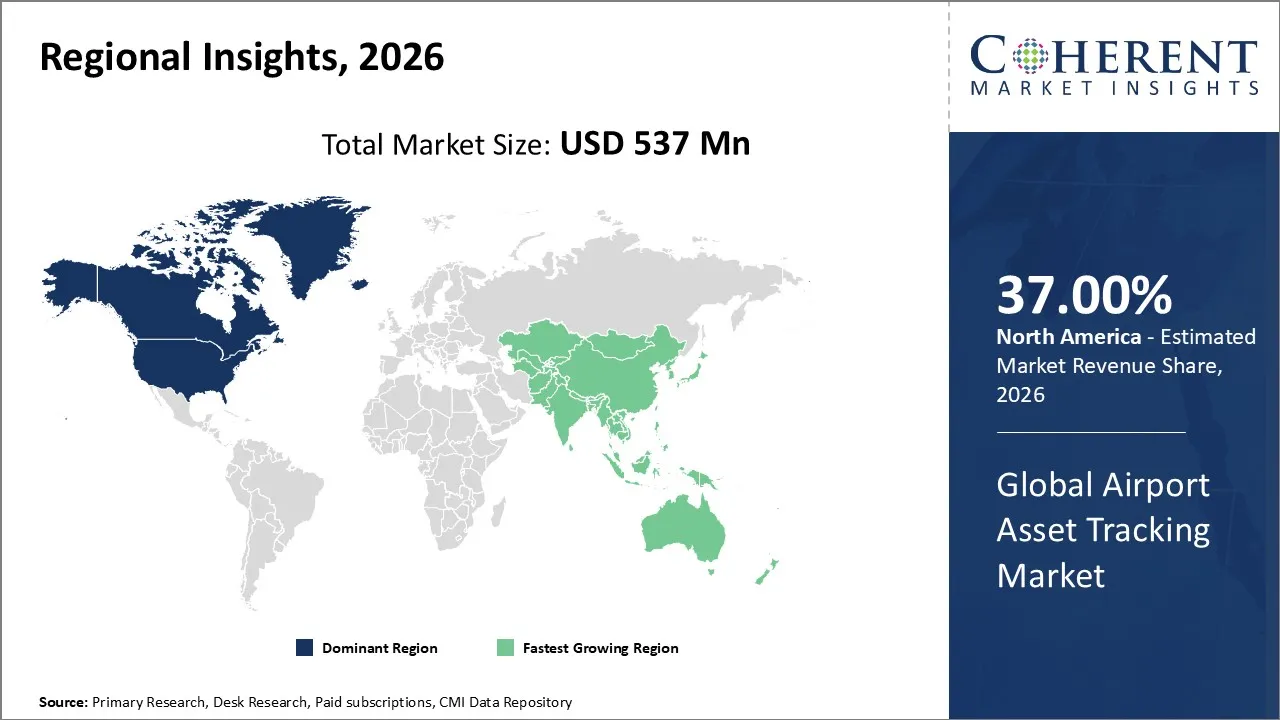
North America Airport Asset Tracking Market Analysis & Trends
North America leads the airport asset tracking market with 37% share in 2026, due to advanced airport infrastructure, high passenger volumes, and strong adoption of IoT, RFID, and AI technologies. Regulatory emphasis on safety, efficiency, and sustainability drives investment, while major hubs like Atlanta and LAX accelerate deployment to optimize operations and reduce costs.
For instance, in December 2025, Samsara, a US-based IoT company, supports Swissport in enhancing aviation operations. Using telematics, GPS, and real-time monitoring, Swissport improves safety, compliance, and efficiency across ground support equipment. The initiative highlights North America’s technology leadership and Europe’s operational adoption, directly linking to airport asset tracking of mobile ground assets.
Asia Pacific Airport Asset Tracking Market Analysis & Trends
Asia Pacific is anticipated to exhibit the fastest growth, due to rapid airport expansions in China, India, and Southeast Asia. Rising passenger traffic, government investments, and modernization programs fuel adoption of IoT, RFID, and AI solutions. Airports seek efficiency, safety, and real-time monitoring, making the region the fastest-growing market.
For instance, in October 2025, SATS, which is based in Singapore, has started a program to change huge airports all over the Asia-Pacific region. The goal of the project is to modernize the way cargo and passengers are handled by focusing on digitalization, automation, and efficiency. SATS wants to improve scalability, sustainability, and operational performance in rapidly growing aviation hubs by using smart technologies.
Airport Asset Tracking Market Outlook Country-Wise
The U.S. Airport Asset Tracking Market Trends
In 2026, the U.S. airport asset tracking market is driven by rising passenger volumes, cargo growth, and modernization of major hubs. Airports adopt IoT, RFID, and GPS to improve efficiency, reduce delays, and enhance security. Federal investments in smart infrastructure further accelerate demand for advanced asset management solutions.
China Airport Asset Tracking Market Trends
In 2026, China’s airport asset tracking market is driven by rapid aviation growth, expanding cargo hubs, and smart airport initiatives. Rising passenger traffic and freight volumes demand IoT, RFID, and GPS solutions to optimize ground support equipment, enhance efficiency, and strengthen safety, aligning with national digital infrastructure investments.
For instance, in July 2025, The AI driver T30A autonomous baggage tractor from UISEE started test runs at Shanghai Pudong International Airport in China. It has Level 4 autonomous driving and cloud-based monitoring, and it works with the Total Airport Management system to improve baggage logistics by tracking it in real time, increasing efficiency and safety. This is an enormous advancement forward in airport asset management.
Market Report Scope
Airport Asset Tracking Market Report Coverage
| Report Coverage | Details | ||
|---|---|---|---|
| Base Year: | 2025 | Market Size in 2026: | USD 537 Mn |
| Historical Data for: | 2020 To 2024 | Forecast Period: | 2025 To 2032 |
| Forecast Period 2026 to 2033 CAGR: | 10.5% | 2033 Value Projection: | USD 1,080 Mn |
| Geographies covered: |
| ||
| Segments covered: |
| ||
| Companies covered: | Litum, Steerpath Ltd., TracLogik, Undagrid B.V, Targa Telematics S.p.A, GeotabInc, indoo.rs GmbH, Tri-Logical Technologies Ltd., Unilode Aviation Solutions, Radiant RFID and LLC. | ||
| Growth Drivers: |
| ||
| Restraints & Challenges: |
| ||
Airport Asset Tracking Market Driver
Passenger & Cargo Growth
Global air traffic continues to surge, with airports managing record passenger volumes and freight demand. This growth intensifies pressure to optimize ground support equipment (GSE) and minimize turnaround times. Advanced IoT, RFID, and GPS solutions drive efficiency, boosting airport asset tracking market share as airports modernize to meet rising operational challenges.
Smart Airport Modernization
Major airports in the U.S., Europe, Middle East, and Asia are accelerating digital transformation through smart airport modernization. Asset tracking technologies provide real-time visibility of baggage carts, fuel trucks, and cargo loaders, enhancing efficiency and safety. These initiatives significantly boost airport asset tracking market demand as hubs prioritize automation and connectivity.
Airport Asset Tracking Market Opportunity
Cargo Growth & Logistics
Rapid expansion of air cargo hubs in China, the U.S., and the Middle East drives demand for efficiency. Asset tracking technologies streamline cargo handling, enable predictive maintenance, and minimize delays. These advancements strengthen logistics networks, positioning smart solutions as vital, with airport asset tracking market forecast showing significant global growth potential.
IoT & AI Integration
Integrating IoT sensors, AI analytics, and cloud platforms empowers predictive asset management in airports. Real-time data insights reduce downtime, optimize equipment utilization, and enhance safety standards. These innovations drive automation and efficiency, fueling airport asset tracking market growth as global hubs embrace digital transformation to meet rising passenger and cargo demands.
Analyst Opinion (Expert Opinion)
- As airports want more control and visibility over important equipment and resources, the airport asset tracking market is becoming more important in the way airports work today. According to installed base data, the number of active tracking systems used in airports around the world has grown exponentially in the last few years. By the middle of the 2020s, there will be almost half a million units in use around the world, covering ground support equipment, non-motorized assets, and on-road vehicles in airport environments. This adoption indicates that the industry as a whole is more focused on real-time location awareness and asset use.
- Different people use solutions like RFID, GPS, Bluetooth Low Energy, and combined IoT platforms in different ways. RFID is still popular as it can be scaled up and used in high-throughput settings like baggage handling and cargo operations. GPS and Bluetooth technologies, on the other hand, make it easier to track mobile assets over large outdoor areas. More and more, cloud-based analytics and AI-enabled platforms are working together. This makes predictive maintenance and automated alerts possible, which helps people make better decisions about how to run their businesses.
- Regional dynamics show that North America and Europe were the first to adopt new technologies. This was due to large airport modernization projects and a focus on safety and security in regulations. At the same time, the Asia-Pacific region is ready to grow quickly because of substantial expenditures in airport infrastructure and digital transformation projects. Emerging markets in the Middle East, Africa, and Latin America are also starting to use asset tracking as part of their larger efforts to make their operations more efficient.
- In general, airport asset tracking is moving from simple identification tools to integrated platforms that help use resources better, cut down on loss and downtime, and support operational excellence based on data.
Speak to the analyst
Want personalized insights?
Take the findings above to one of our principal consultants, or have the report rebuilt around the segments, geographies and competitors you actually track.
Recent Developments
- In December 2025, The Airport Show 2026 in Dubai showcased plans for $183 billion in upgrades to MEASA airports. Investments are made in the Middle East, Africa, and South Asia, with a focus on AI, IoT, sustainability, and smart operations. Asset tracking and real-time equipment monitoring through the Internet of Things (IoT) will make hubs more efficient, safer, and more enjoyable for passengers as they grow.
- In March 2025, Delhi International Airport introduced AI-powered operations to enhance efficiency and passenger experience. The system leverages real-time data, predictive analytics, and automation to optimize resource allocation, reduce delays, and improve safety. This innovation positions Delhi Airport as a smart hub, driving modernization and supporting Airport Asset Tracking Market advancements in India
Market Segmentation
- By Offering
- Hardware
- Software
- By Asset type
- Fixed Assets
- Portable Assets
- Mobile Assets
- By Region
- North America
- U.S.
- Canada
- Latin America
- Brazil
- Argentina
- Mexico
- Rest of Latin America
- Europe
- Germany
- U.K.
- Spain
- France
- Italy
- Benelux
- Denmark
- Norway
- Sweden
- Russia
- Rest of Europe
- Asia Pacific
- China
- Taiwan
- India
- Japan
- South Korea
- Indonesia
- Malaysia
- Philippines
- Singapore
- Australia
- Rest of Asia Pacific
- Middle East & Africa
- Bahrain
- Kuwait
- Oman
- Qatar
- Saudi Arabia
- United Arab Emirates
- Israel
- South Africa
- North Africa
- Central Africa
- Rest of MEA
- North America
- Airport Asset Tracking Market Companies
- Litum
- Steerpath Ltd.
- TracLogik
- Undagrid B.V
- Targa Telematics S.p.A
- GeotabInc
- rs GmbH
- Tri-Logical Technologies Ltd.
- Unilode Aviation Solutions
- Radiant RFID and LLC
Sources
Primary Research Interviews
- Airport Authorities & Operations Managers
- Airport IT & Digital Transformation Heads
- Asset Tracking Solution Providers (RFID, IoT, RTLS)
- Aviation Infrastructure System Integrators
- Ground Handling & Baggage Management Service Providers
- Airport Facility Management Consultants
- Others
Databases
- Bloomberg Terminal
- Thomson Reuters Eikon
- IHS Markit
- Statista
- S&P Global Market Intelligence
- Factiva
- Others
Magazines
- Airport Technology Magazine
- Aviation Week
- International Airport Review
- Airport Business Magazine
- Supply Chain Digital
- Others
Journals
- Journal of Air Transport Management
- IEEE Internet of Things Journal
- International Journal of Aviation Management
- Transportation Research Part E: Logistics and Transportation Review
- Others
Newspapers
- Financial Times
- The Wall Street Journal
- Reuters
- Bloomberg News
- The Economic Times (Aviation Section)
- Others
Associations
- Airports Council International (ACI)
- International Air Transport Association (IATA)
- Civil Air Navigation Services Organisation (CANSO)
- International Civil Aviation Organization (ICAO)
- Airport Operators Association (AOA)
- Others
Public Domain Sources
- International Civil Aviation Organization (ICAO) Publications
- U.S. Federal Aviation Administration (FAA)
- European Union Aviation Safety Agency (EASA)
- U.S. Department of Transportation (DOT)
- World Bank – Transport & Aviation Data
- Others
Proprietary Elements
- CMI Data Analytics Tool
- Proprietary CMI Existing Repository of Information for the Last 8 Years
Get access to 250+ pages report
Every segment, forecast, competitor profile and data table behind the analysis above — available for instant download.
- ESOMAR Member
- ISO 9001:2015 Certified
- D-U-N-S Registered
- GDPR & CCPA Compliant
Missing comfort of reading report in your local language? Find your preferred language:
Transform your Strategy with Exclusive Trending Reports
Frequently Asked Questions
The Airport Asset Tracking Market is estimated to be valued at USD 537 Mn in 2026, and is expected to reach USD 1,080 Mn by 2033.
The CAGR of the Airport Asset Tracking Market is projected to be 10.5% from 2026 to 2033.
Energy Efficiency & Performance and Electric Vehicles (EVs)are expected to drive the market growth.
The hardware is the leading product type segment in the market.
High production cost is expected to hinder the global Airport Asset Tracking Market over the forecast period.
The major players operating in the market include Litum, Steerpath Ltd., TracLogik, Undagrid B.V, Targa Telematics S.p.A, GeotabInc, indoo.rs GmbH, Tri-Logical Technologies Ltd., Unilode Aviation Solutions, Radiant RFID and LLC.