

AVOD Services Market Analysis & Forecast: 2026-2033
AVOD Services Market is estimated to be valued at USD 41.92 Bn in 2026 and is expected to reach USD 107.49 Bn in 2033, exhibiting a compound annual growth rate (CAGR) of 14.4% from 2026 to 2033.
Key Takeaways:
- By Platform Type, the standalone AVOD platform segment is projected to lead the global AVOD services market, capturing approximately 36.0% of the market share in 2026.
- By Region, North America is forecasted to maintain its dominance in the global AVOD services market, holding 35.0% of the market share in 2026.
Market Overview:
The global AVOD Services Market is experiencing robust growth, driven by the rising demand for free, ad-supported digital content, increasing internet penetration, and the shift in consumer viewing habits away from traditional cable TV. The market is gaining significant traction with the expansion of standalone AVOD platforms and hybrid content models that blend live TV, on-demand programming, and targeted advertising.
Current Events and its Impact on the AVOD Services Market
Current Event | Description and its impact |
Surge in Consumer Shift Toward Free Streaming Platforms |
|
Advances in Ad Tech and Personalization |
|
Strategic Partnerships and Content Expansion |
|
Pricing Analysis AVOD Services Market
The AVOD (Advertising-Based Video on Demand) services market operates on a free-to-consumer model, with revenue generated through dynamic ad placements rather than subscriptions. This pricing structure has gained significant traction, especially in cost-sensitive regions, as it removes financial barriers to access premium content.
Advertisers pay platforms based on impressions, clicks, or audience targeting metrics, making AVOD a cost-effective alternative to traditional TV advertising. The rise of programmatic ad buying and AI-driven personalization has further enhanced pricing efficiency by aligning ad spend with viewer behavior and preferences.
Compared to subscription-based models, AVOD platforms offer better scalability in emerging markets and appeal to brands seeking high ROI from diverse, engaged audiences. As competition intensifies, platforms are adopting hybrid models—mixing AVOD with limited paid tiers—to balance monetization with user experience. Overall, AVOD’s ad-supported pricing model is reshaping content economics by democratizing access while maximizing advertiser value.
- Current Industry Events of 2026
- Market Size Estimation
- Regional Breakdown
- Competitive Landscape
- Customer Intelligence
- Segmental Analysis
- Pricing Analysis
- Key Market Drivers, Challenges & Future Trends
- Customized Insights Section
Technological Advancement AVOD Services Market
Technological advancements are playing a pivotal role in shaping the growth of the AVOD (Advertising-Based Video on Demand) services market. Innovations in artificial intelligence (AI) and machine learning (ML) are enhancing content recommendation engines and enabling hyper-personalized ad targeting, significantly boosting viewer engagement and advertiser ROI.
Real-time analytics and big data integration allow platforms to monitor viewer behavior and optimize ad placements with precision. Additionally, cloud-based infrastructure supports seamless content delivery and scalability across multiple devices, including smart TVs, smartphones, and tablets. The rise of server-side ad insertion (SSAI) has improved the viewing experience by enabling buffer-free, non-intrusive advertisements.
Integration with voice assistants, 5G connectivity, and adaptive streaming technology are also improving access and content quality, especially in remote or underserved regions. These technological upgrades not only improve monetization strategies but also foster deeper viewer retention, driving the long-term success of AVOD platforms in an increasingly competitive digital ecosystem.
AVOD Services Market Trends
- Rise of Hybrid Models
AVOD platforms may continue to explore hybrid monetization models, combining ad-supported content with premium, subscription-based offerings. This approach allows platforms to cater to different user preferences while diversifying revenue streams.
- Original Content and Exclusive Licensing
The trend of AVOD platforms investing in original content and securing exclusive licensing deals may have intensified. Producing unique and high-quality content remains a crucial strategy to attract and retain viewers in a competitive market.
Opportunities in the AVOD Services Market
- Global Reach and Localization
AVOD services have the potential to reach a global audience, presenting an opportunity to expand into new regions and tap into diverse markets. By offering localized content and advertising, AVOD platforms can cater to the preferences and cultural sensitivities of viewers in different countries, further enhancing user engagement and retention.
- Mobile and Smart TV Integration
Increasing adoption of smartphones and smart TVs opens up new avenues for AVOD services. Optimizing the user experience for mobile devices and smart TVs can help to attract a broader audience and increase overall watch time. Seamless integration with these devices can also lead to higher ad impressions and revenue generation.
Segmentation Analysis
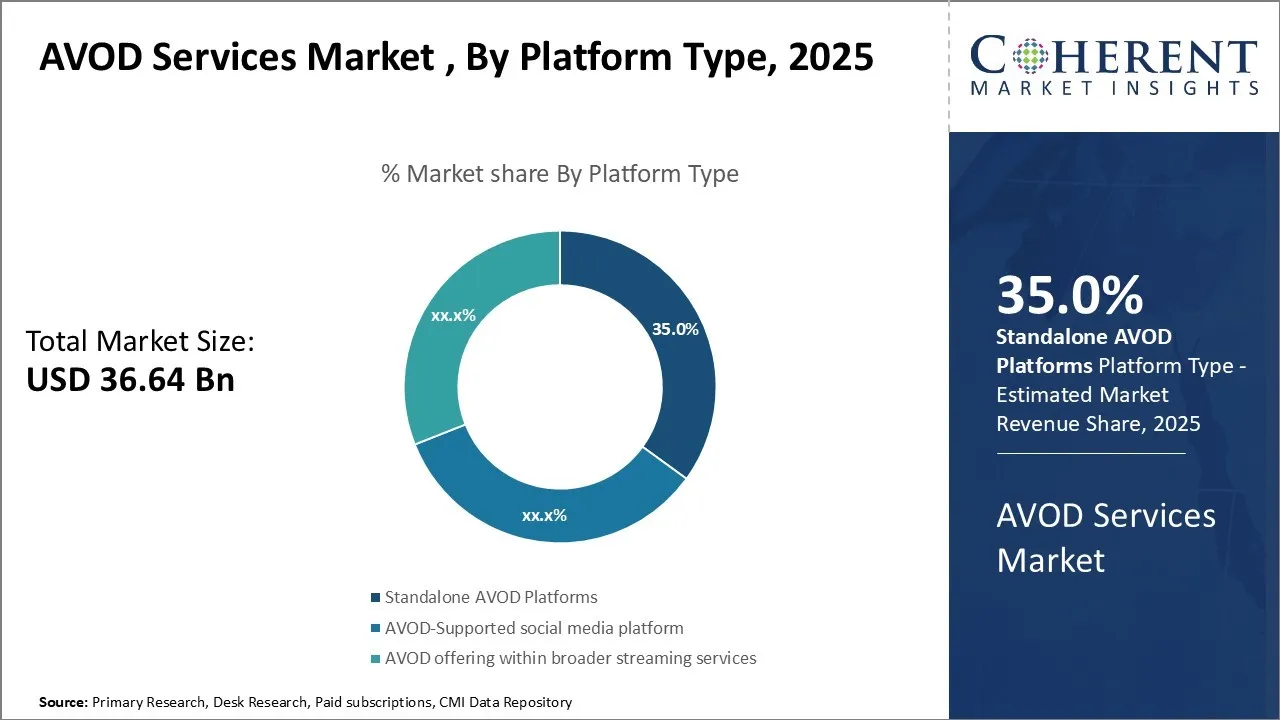
AVOD Service Market Insights, By Platform Type
The standalone AVOD platform segment is projected to lead the global AVOD services market, accounting for approximately 36.0% of the market share in 2026. This leadership is fueled by increasing consumer demand for free, ad-supported streaming content, particularly amid rising subscription fatigue and economic pressures.
Standalone platforms are gaining prominence due to their ability to deliver a wide variety of genres, support hyper-targeted advertising, and cater to underserved demographics. Innovations in user interface design, AI-powered content recommendation engines, and real-time ad performance analytics are further enhancing user experience and advertiser ROI.
AVOD Services Market: Regional Insights
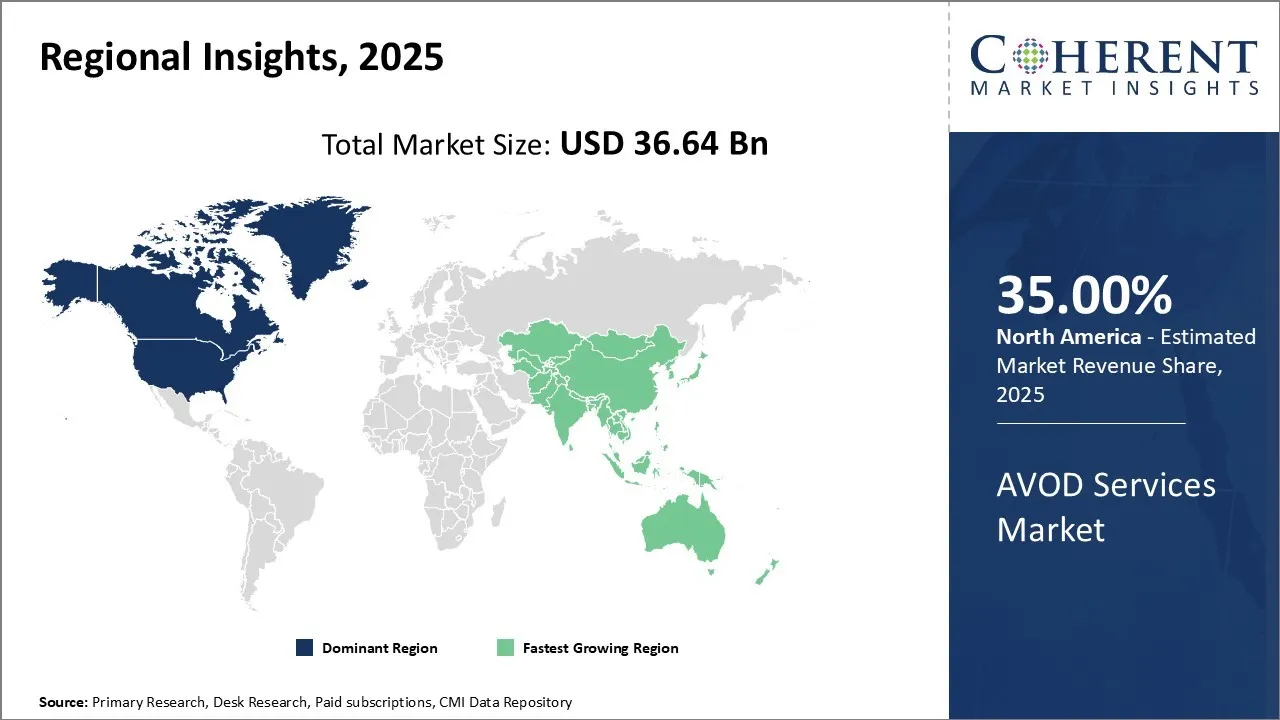
North America AVOD Services Market Trends and Analysis
North America is forecasted to maintain its dominance in the global AVOD services market, holding 35.0% of the market share in 2026. This regional advantage is underpinned by a highly mature digital ecosystem, extensive broadband penetration, and a significant shift in consumer behavior from traditional cable TV to digital streaming platforms.
Europe AVOD Services Market Trends and Analysis
Europe remains a vital region in the AVOD services market, supported by widespread internet accessibility, high smart device usage, and a growing preference for non-subscription-based streaming content. Key markets such as the UK, Germany, and France are witnessing accelerated AVOD adoption, driven by younger audiences and evolving digital content consumption habits.
AVOD Services Market Dominating Countries:
United States and Canada AVOD Service Market Analysis and Trends
The United States and Canada dominate the North American AVOD services market, which is forecasted to account for 35.0% of the global market share in 2026. The U.S. leads the region, driven by a highly developed digital infrastructure, increasing cord-cutting trends, and widespread adoption of ad-supported streaming models by major players such as Pluto TV, Tubi, and Roku. Tech giants and media conglomerates are investing heavily in original ad-supported content and AI-driven ad targeting, further fueling market expansion.
Canada contributes with a growing demand for free-to-access streaming platforms, supported by high internet penetration, government incentives for digital content production, and increasing collaboration between broadcasters and AVOD platforms to monetize digital audiences.
Market Report Scope
AVOD Services Market Report Coverage
| Report Coverage | Details | ||
|---|---|---|---|
| Base Year: | 2025 | Market Size in 2026: | USD 41.92 Bn |
| Historical Data for: | 2020 To 2024 | Forecast Period: | 2026 To 2033 |
| Forecast Period 2026 to 2033 CAGR: | 14.4% | 2033 Value Projection: | USD 107.49 Bn |
| Geographies covered: |
| ||
| Segments covered: |
| ||
| Companies covered: | YouTube (Google), Hulu (Disney), Peacock (NBCUniversal), Tubi (Fox Corporation), Pluto TV (ViacomCBS), IMDb TV (Amazon), Roku Channel (Roku), Crackle (Chicken Soup for the Soul Entertainment), Xumo (Comcast), Vudu (Walmart), The Roku Channel (Roku), Popcornflix (Screen Media Ventures), MX Player (Times Internet), Voot (ViacomCBS) | ||
| Growth Drivers: |
| ||
| Restraints & Challenges: |
| ||
Analyst Viewpoint – AVOD Services Market
- Analysts view the AVOD (Advertising-Based Video on Demand) services market as a high-growth sector driven by the global shift in consumer behavior toward free, ad-supported digital content. The increasing demand for cost-effective entertainment, particularly in price-sensitive and emerging markets, is accelerating AVOD platform adoption.
- Analysts highlight that advancements in AI-driven ad targeting, real-time data analytics, and programmatic advertising are enhancing monetization strategies and viewer engagement. The standalone AVOD platform segment is expected to lead due to its diverse content libraries and personalized viewing experiences.
- North America remains the dominant region, benefiting from a mature digital infrastructure and evolving partnerships between media companies and advertisers. However, analysts also point out challenges such as ad fatigue, content licensing costs, and data privacy concerns that could hinder market growth. Despite these, the overall outlook is optimistic, with continued investment in content quality, mobile optimization, and technological integration expected to cement AVOD's role as a mainstream digital entertainment model.
AVOD Services Market: Key Development
- In March 2025, Roku launched its enhanced AVOD platform interface with AI-powered ad targeting and personalized content recommendations, aiming to increase user engagement and advertising efficiency across its growing viewer base.
- In April 2025, YouTube expanded its ad-supported movie and TV show catalog globally, partnering with top studios to offer premium content for free with ads, strengthening its competitive position in the global AVOD market.
- In February 2025, Amazon Freevee introduced interactive ad formats using viewer behavior data and machine learning, enabling advertisers to deliver more dynamic and measurable campaigns within its AVOD ecosystem.
- In January 2025, Pluto TV partnered with several telecom providers in Latin America and Asia-Pacific to expand its AVOD service footprint, tapping into new user bases in underserved markets.
- In May 2025, Tubi unveiled a cloud-based analytics dashboard for content creators and advertisers, allowing real-time insights into ad performance and audience engagement metrics to enhance ROI.
Market Segmentation
- By Content Type:
- Movies
- TV Shows
- Original Series
- News
- Sports
- User-Generated Content (UGC)
- By Platform Type:
- Standalone AVOD platforms
- AVOD offerings within broader streaming services
- AVOD-supported social media platforms
- By Genre:
- Drama
- Comedy
- Action/Adventure
- Horror/Thriller
- Romance
- Sci-Fi/Fantasy
- Documentary
- Animation
- By Device:
- Mobile devices (smartphones, tablets)
- Desktop and laptops
- Smart TVs
- Streaming devices (e.g., Roku, Amazon Fire TV, Apple TV)
- By Advertising Format:
- Pre-roll ads
- Mid-roll ads
- Post-roll ads
- Banner ads
- Interactive ads
- Native ads
- By Region:
- North America
- Europe
- Asia Pacific
- Latin America
- Middle East & Africa
- Key Players Insights
- YouTube (Google)
- Hulu (Disney)
- Peacock (NBCUniversal)
- Tubi (Fox Corporation)
- Pluto TV (ViacomCBS)
- IMDb TV (Amazon)
- Roku Channel (Roku)
- Crackle (Chicken Soup for the Soul Entertainment)
- Xumo (Comcast)
- Vudu (Walmart)
- The Roku Channel (Roku)
- Popcornflix (Screen Media Ventures)
- MX Player (Times Internet)
- Voot (ViacomCBS)
Sources
The Stakeholders Consulted:
- AVOD platform developers and content providers
- Digital advertising agencies and marketing strategists
- Media buyers and programmatic advertising experts
- Telecom and broadband service providers
- Regulatory authorities overseeing digital media and advertising standards
- Research institutions and think tanks specializing in digital media consumption and advertising trends
- End-users and consumer panels across diverse demographics and regions
Databases Opened:
- Interactive Advertising Bureau (IAB) – Digital Video Advertising Reports
- Statista – AVOD and Streaming Media Data
- Nielsen – Streaming and Audience Measurement Data
- Digital TV Research – OTT & AVOD Market Analytics
Magazines & Trade Publications:
- Variety – Digital Media and Advertising
- Adweek – Streaming & AVOD Insights
- Streaming Media Magazine
- FierceVideo – OTT and Streaming News
- MediaPost – Digital Advertising News
Scientific and Industry Journals:
- Journal of Advertising Research
- Journal of Interactive Advertising
- International Journal on Media Management
- Telecommunications Policy Journal
Newspapers & Media Outlets:
- The Wall Street Journal – Media & Advertising
- Bloomberg – Digital Media & Technology
- Reuters – Technology and Entertainment News
- Financial Times – Media and Advertising Sector
- The Economic Times – Telecom and Digital Services
Associations and Regulatory Bodies:
- Interactive Advertising Bureau (IAB)
- Federal Communications Commission (FCC) – U.S.
- European Audiovisual Observatory
- Advertising Standards Authority (ASA), UK
- Telecom Regulatory Authority of India (TRAI)
Public Domain Sources:
- U.S. Federal Communications Commission (FCC) – Digital Media Reports
- European Commission – Digital Economy and Society Index (DESI)
- World Bank – Digital Development Reports
- International Telecommunication Union (ITU) – Broadband and Media Access Data
Proprietary Research Elements:
- Internal Data Analytics Platform for Consumer Viewing Behavior
- Proprietary Repository of AVOD Market Trends and Historical Data (covering last 7 years)
- Expert Interviews and Stakeholder Consultations (covering AVOD platform technology, user engagement, and advertising monetization)
Get access to 250+ pages report
Every segment, forecast, competitor profile and data table behind the analysis above — available for instant download.
- ESOMAR Member
- ISO 9001:2015 Certified
- D-U-N-S Registered
- GDPR & CCPA Compliant
Missing comfort of reading report in your local language? Find your preferred language:
Transform your Strategy with Exclusive Trending Reports
Frequently Asked Questions
The AVOD Services Market size is estimated to be valued at USD 41.92 Bn in 2026, and is expected to reach USD 107.49 Bn by 2033.
Ad-blocking, content piracy, and competition from SVOD platforms are expected to hamper the market growth.
Increasing internet penetration, growing demand for free content, and rising digital advertising expenditure are expected to hamper the market growth.
YouTube (Google), Hulu (Disney), Peacock (NBCUniversal), Tubi (Fox Corporation), Pluto TV (ViacomCBS), IMDb TV (Amazon), Roku Channel (Roku), Crackle (Chicken Soup for the Soul Entertainment), Xumo (Comcast), Vudu (Walmart), The Roku Channel (Roku), Popcornflix (Screen Media Ventures), MX Player (Times Internet), Voot (ViacomCBS)
North America will lead the market.
The CAGR of the global Market is projected to be 14.4% from 2026 to 2033.