

Smart Tv Market Size and Trends - 2026 to 2033
Global smart TV market is estimated to be valued at USD 521.61 Bn in 2026 and is expected to reach USD 1110.56 Bn by 2033, exhibiting a compound annual growth rate (CAGR) of 11.4% from 2026 to 2033.
Key Takeaways
- Based on Screen Size, 40 to 50 inches division will hold around 35% shares in the global market in 2026.
- By Display Technology, LED segment is likely to hold 48% shares in the global smart TV market in 2026.
- On the basis of Operating System, Android TV division is likely to hold around 35.8% shares in 2026.
- North America will hold dominating position with 42.4% of market shares during the forecast period.
Market Overview
Smart TVs provide advanced features like internet connectivity, access to streaming apps and content, and voice assistants. Rising preference for connected devices and increasing internet penetration can boost demand for smart TVs globally.
Current Events and their Impact on the Smart TV Market
Current Event | Description and its Impact |
Streaming Wars and Content Platform Evolution |
|
5G Network Rollout and Connectivity Infrastructure |
|
Role of Artificial Intelligence in the Global Smart TV Market
The smart TV market is experiencing a paradigm shift as artificial intelligence becomes deeply embedded in entertainment technology. AI is no longer just a buzzword but a fundamental driver reshaping how consumers interact with their televisions, making viewing experiences more personalized, intuitive, and engaging than ever before.
For instance, Samsung introduced Vision AI Companion, a platform that brought conversational AI to household televisions. It enabled users to ask questions, receive customized recommendations, and manage tasks using natural voice commands and two-way dialogue.
- Current Industry Events of 2026
- Market Size Estimation
- Regional Breakdown
- Competitive Landscape
- Customer Intelligence
- Segmental Analysis
- Pricing Analysis
- Key Market Drivers, Challenges & Future Trends
- Customized Insights Section
Smart TV Market Driver
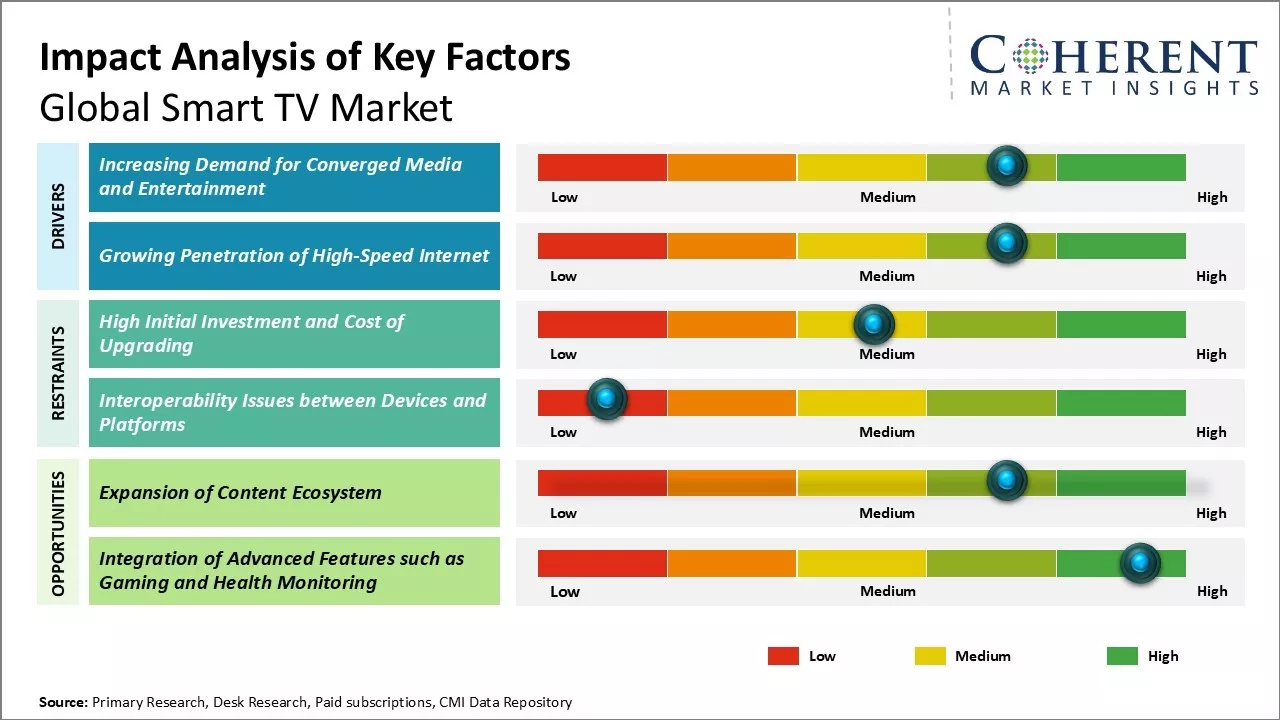
Increasing Demand for Converged Media and Entertainment
Evolving entertainment needs and preferences of consumers can drive the smart TV market growth. Traditional television is no longer enough to satiate the appetite of modern audiences who seek an immersive and engaging experience. These people want to access all forms of media through a single screen and smart TVs have emerged as the ideal platform to provide a converged experience.
The proliferation of premium over-the-top (OTT) streaming platforms during pandemic has widened entertainment options. Many people shift to online streaming altogether to cut cord from expensive cable packages. Smart TV emerges as a single gateway to access increasingly popular streaming giants Netflix, Amazon Prime Video, Disney Hotstar and more on large television screens. Seamless content discovery and integrated payment platforms boosts demand for such connected devices.
Growing Penetration of High-Speed Internet
Ubiquitous high-speed connectivity across regions can drive the smart TV market growth. Fast and reliable internet penetration delivers on the promise of television experience beyond traditional broadcasts. It empowers smart features and unlocks true potential of online content viewing.
Globally, fiber and 5G networks are extending high bandwidth coverage to both urban and remote areas. Majority of developed economies now have access to speeds well above basic requirements for HD video streaming. Even developing regions are making rapid progress towards universal 4G/LTE coverage and rural fiberization.
Segmental Insights
Global Smart TV Market Insights, By Screen Size
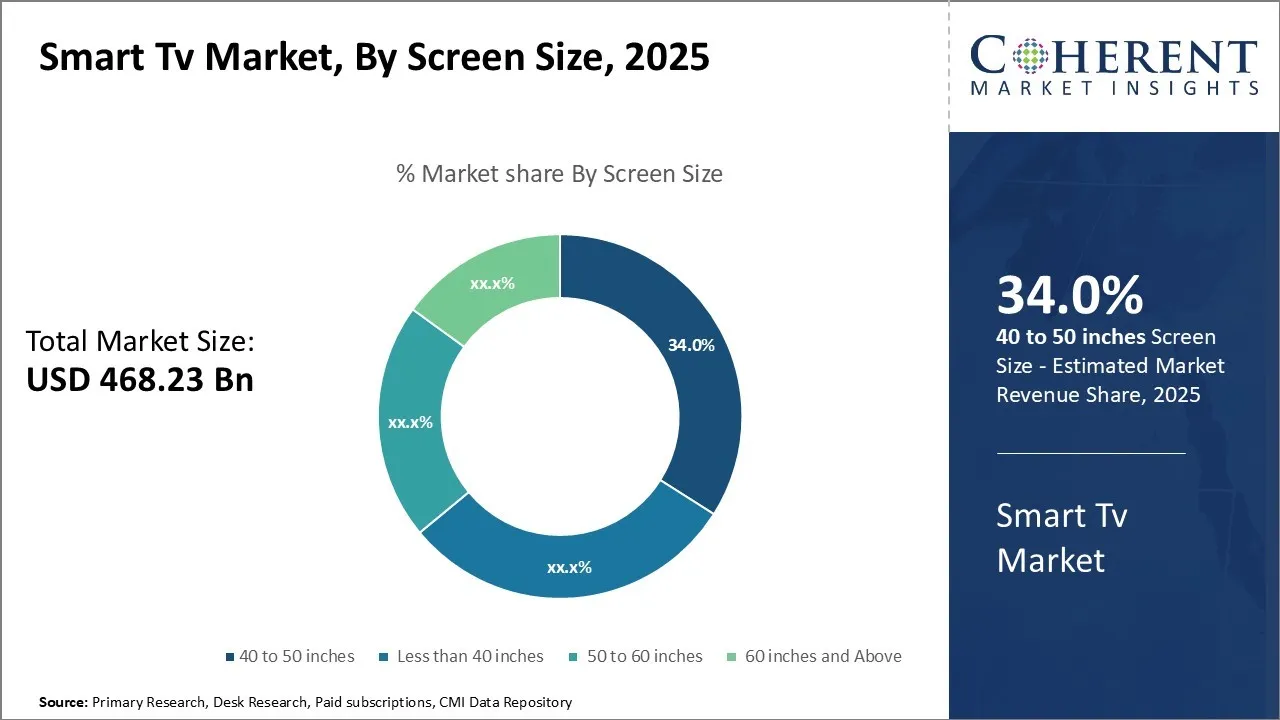
In terms of screen size, 40 to 50 inches segment is estimated to contribute the highest market share of 35% in 2026, owing to its optimal balance of size and affordability. This screen size category appeals to a wide range of consumers thanks to several key advantages.
From a cost perspective, 40 to 50-inch TVs strike a practical sweet spot. Their screens are large enough to deliver an immersive viewing experience but come at mid-range prices that are within financial reach for most households. As affordability is a top priority for budget-conscious buyers, the relatively low prices of these TVs help maximize their appeal.
For instance, German-based audio-video brand Blaupunkt expanded its range of smart TVs in the country with the launch of a 50-inch 4K HDR 10+ TV.
Global Smart TV Market Insights, By Display Technology
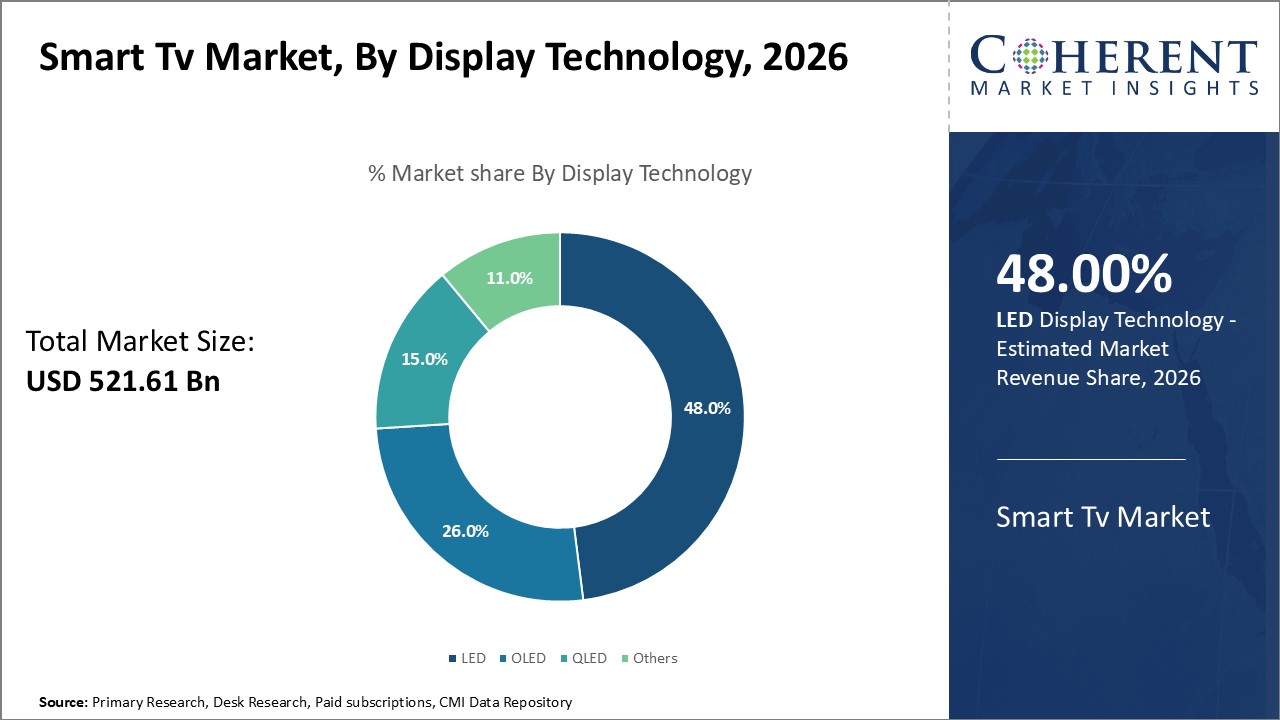
In terms of display technology, LED segment is expected to contribute the highest market share of 48% in 2026 due to its advantages for delivering high-quality images. As screen quality is a leading purchase factor, LED has cemented its status at the forefront of the display technology segment.
Relative to competing technologies, LED televisions provide superior color accuracy, brightness, and black level performance straight out of the box. Their pictures exhibit vibrant, lifelike colors and inky dark scenes without the need for extensive calibration or adjustments.
For instance, in August 2025, Blaupunkt entered the premium smart TV category in India with the launch of its new Google-powered Mini LED televisions.
Global Smart TV Market Insights, By Operating System
In terms of operating system, android TV segment is expected to contribute the highest market share of 35.8% in 2026, owing to its extensive app ecosystem. Access to thousands of apps tailored for big-screen enjoyment has made Android OS the system of choice for smart TV fans and cord cutters.
Running Google's popular Android software, Android TV delivers seamless access to the widest selection of apps available for any TV operating system. Viewers can install practically any app these use on mobile, from Netflix and YouTube to games and fitness apps. The immense app library pairs perfectly with large TV screens.
For instance, Global Top-2 TV brand TCL unveiled its P-series 4K HDR TV in India, which came with Android 11.
Regional Insights
North America Smart TV Market Analysis & Trends
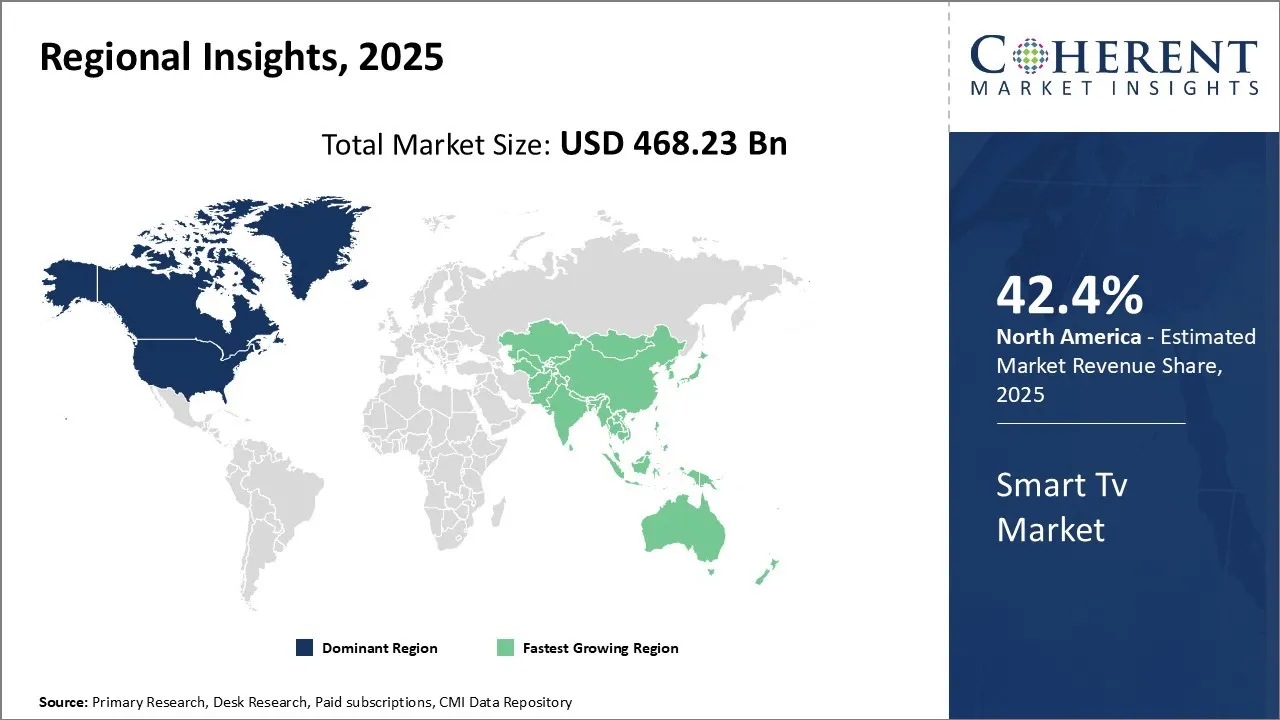
North America has established itself as the dominant region in the global smart TV market with an estimated market share of 42.4% in 2026. The U.S. boasts high disposable income of consumers who are early adopters of new technologies. These are constantly switching to the latest TV models featuring enhanced internet and streaming capabilities. This has provided a fillip to smart TV sales.
For instance, in October 2026, FloSports introduced Connected TV app on Samsung and VIZIO smart TVs. Starting that day, the FloSports app became available on Samsung smart TV models from 2018 and later, as well as on all VIZIO Smart TVs. The launch brought more than 50,000 live events and access to more than 25 sports to millions of fans with the simple click of a button. FloSports announced plans to launch on LG smart TVs later in the year, making the sports streamer available on the majority of smart TVs sold in North America.
Asia Pacific Smart TV Market Analysis & Trends
Asia Pacific region has emerged as the fastest growing market globally led by China and India. Massive manufacturing capabilities of TV brands in these countries coupled with competitive pricing makes smart TVs highly accessible to people. China, with its enormous consumer base, is a lucrative market already accounting for over a third of the APAC market. Government initiatives to improve connectivity in India have bolstered the demand for smart TVs among its youthful population inclined towards OTT media consumption.
For instance, in May 2023, TCL, the world's TOP 2 TV brand and TOP 1 98-inch TV brand, unveiled its latest multi-category products for the Asia Pacific market at an exclusive launch event in Bangkok.
Global Smart TV Market – Dominating Countries
China Smart TV Market Analysis and Trends
China is likely to hold highest shares in the global smart TV market in 2026. This is owing to the high adoption of advanced home entertainment technologies, strong consumer purchasing power, widespread availability of high-speed internet, and the growing integration of AI-driven features and streaming services in smart TVs.
For instance, in October 2026, Xiaomi expanded its high-end Mini LED TV lineup with the launch of the Xiaomi TV S Pro Mini LED 2026 edition TV in a new 98-inch model in China.
Japan Smart TV Market Analysis and Trends
Japan is likely to hold highest shares in the global smart TV market in 2026. This is owing to the strong presence of leading electronics manufacturers such as Sony, Panasonic, and Sharp; continuous advancements in display technologies like OLED and 8K; high consumer demand for premium home entertainment systems; and the country’s rapid adoption of IoT and AI-integrated devices.
For instance, in August 2026, AKAI introduced its new PowerView Series in India, featuring Google TV powered by Android 14. The Japanese consumer electronics brand positioned the lineup as a step forward in home entertainment, combining QLED and 4K displays with advanced gaming features and accessibility-focused options.
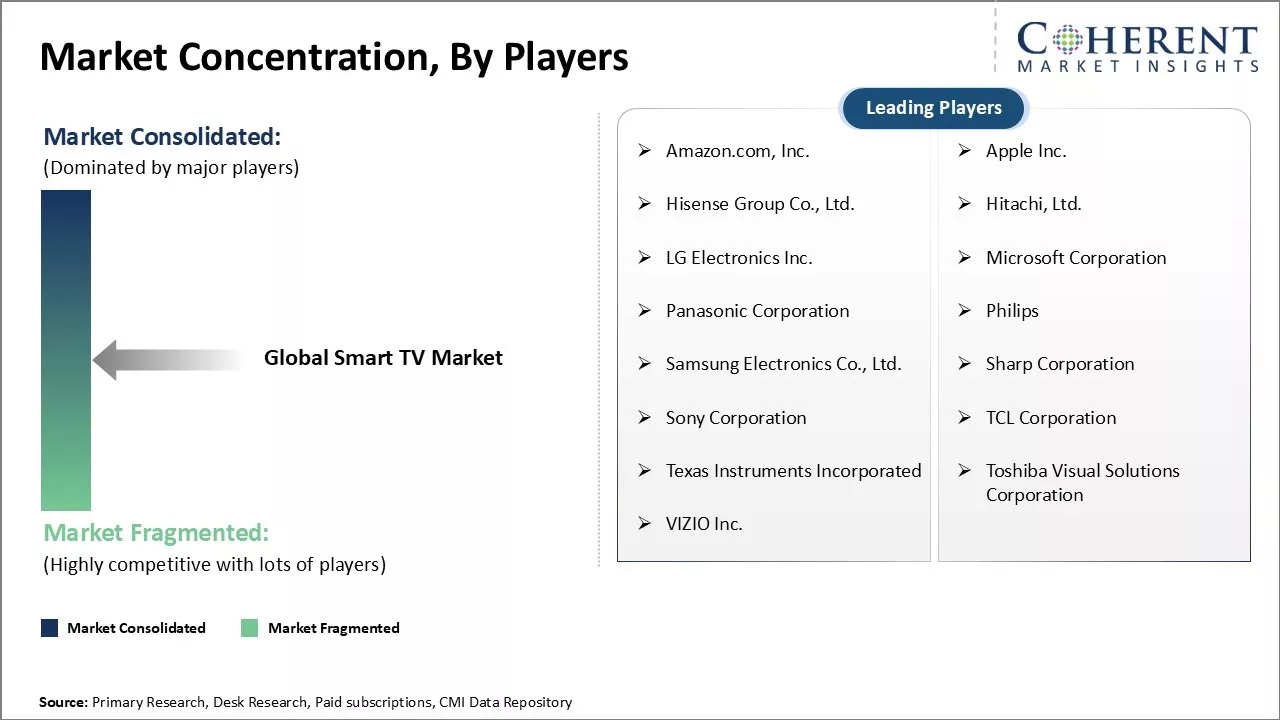
Market Concentration and Competitive Landscape
Key Takeaways from Analyst
Global smart TV market growth is driven by factors like rising disposable incomes in developing countries, lower prices of smart TVs as compared to previous years, and innovative features offered by brands. Many households, especially young consumers, prefer smart TVs due to its connectivity features and content options. North America is likely to dominate the global market in 2025, owing to high disposable income of early adopters of new technologies.
Smart Tv Industry News
- In October 2022, Samsung Electronics Co., Ltd., a leading global technology company, introduced updated models of The Frame TV in India. This QLED TV range features the company’s Quantum Processor 4K, which provides advanced 4K AI upscaling capabilities for enhanced picture quality.
- In September 2022, Sony Corporation, a leading global technology and entertainment company, launched the Bravia XR Master Series A95K OLED TV in India. This new model is powered by the innovative cognitive XR processor, which enhances the viewing experience by delivering immersive visuals.
- In April 2022, Samsung Electronics Co., Ltd., a leading global technology company, launched its Neo QLED 8K smart TV range, which includes 65-inch and 85-inch models. To further stimulate demand for its products, Samsung also introduced promotional offers that allow consumers to purchase these TVs at reduced prices.
- In 2021, TCL, one of the world’s best-selling consumer electronics brands, collaborated with Roku to launch a 4K HDR Roku TV. This partnership aimed to enhance the viewing experience by integrating Roku's streaming platform with TCL's advanced television technology.
Market Report Scope
Smart TV Market Report Coverage
| Report Coverage | Details | ||
|---|---|---|---|
| Base Year: | 2025 | Market Size in 2026: | USD 521.61 Bn |
| Historical Data for: | 2020 To 2024 | Forecast Period: | 2026 To 2033 |
| Forecast Period 2026 to 2033 CAGR: | 11.4% | 2033 Value Projection: | USD 1110.56 Bn |
| Geographies covered: |
| ||
| Segments covered: |
| ||
| Companies covered: | Amazon.com, Inc., Apple Inc., Hisense Group Co., Ltd., Hitachi, Ltd., LG Electronics Inc., Microsoft Corporation, Panasonic Corporation, Philips, Samsung Electronics Co., Ltd., Sharp Corporation, Sony Corporation, TCL Corporation, Texas Instruments Incorporated, Toshiba Visual Solutions Corporation, and VIZIO Inc. | ||
| Growth Drivers: |
| ||
| Restraints & Challenges: |
| ||
Opportunity- Expansion of Content Ecosystem
Expansion of the content ecosystem available for viewers can offer market growth opportunities. As broadband and cellular connectivity expands across the world, there is a growing market for over-the-top media services delivering video and audio content. Major players like Netflix, Amazon Prime Video, YouTube and many regional providers have started offering their vast libraries of TV shows, movies, news and podcasts that can be seamlessly played on smart TVs.
Market Segmentation
- By Screen Size Insights (Revenue, USD Bn, 2021 - 2033)
- 40 to 50 inches
- Less than 40 inches
- 50 to 60 inches
- 60 inches and above
- By Display Technology Insights (Revenue, USD Bn, 2021 - 2033)
- LED
- OLED
- QLED
- Others (LCD, Plasma, etc.)
- By Operating System Insights (Revenue, USD Bn, 2021 - 2033)
- Android TV
- Roku TV
- webOS
- Tizen
- Others (FireTV, Smart TV, etc.)
- By Regional Insights (Revenue, USD Bn, 2021 - 2033)
- North America
- U.S.
- Canada
- Latin America
- Brazil
- Argentina
- Mexico
- Rest of Latin America
- Europe
- Germany
- U.K.
- Spain
- France
- Italy
- Russia
- Rest of Europe
- Asia Pacific
- China
- India
- Japan
- Australia
- South Korea
- ASEAN
- Rest of Asia Pacific
- Middle East
- GCC Countries
- Israel
- Rest of Middle East
- Africa
- South Africa
- North Africa
- Central Africa
- Key Players Insights
- Amazon.com, Inc.
- Apple Inc.
- Hisense Group Co., Ltd.
- Hitachi, Ltd.
- LG Electronics Inc.
- Microsoft Corporation
- Panasonic Corporation
- Philips
- Samsung Electronics Co., Ltd.
- Sharp Corporation
- Sony Corporation
- TCL Corporation
- Texas Instruments Incorporated
- Toshiba Visual Solutions Corporation
- VIZIO Inc.
Sources
Primary Research Interviews
- Smart TV Manufacturers
- Content Streaming Service Providers
- Consumer Electronics Retailers and Distributors
- Technology Component Suppliers
- Others
Databases
- IBISWorld Industry Research Database
- Euromonitor International Consumer Electronics Database
- Others
Magazines
- Consumer Electronics Magazine
- Smart Home Technology Magazine
- Digital TV Magazine
- Home Theater Review Magazine
- Others
Journals
- IEEE Consumer Electronics Magazine
- International Journal of Consumer Electronics
- Journal of Broadcasting & Electronic Media
- Others
Newspapers
- The Wall Street Journal (Technology Section)
- Financial Times (Consumer Electronics Coverage)
- Reuters Technology News
- Bloomberg Technology Reports
- Others
Associations
- Consumer Technology Association (CTA)
- International Association of Consumer Electronics (IACE)
- Smart TV Alliance
- Digital Entertainment Group (DEG)
- Others
Public Domain Sources
- Federal Communications Commission (FCC) Reports
- International Telecommunication Union (ITU) Statistics
- World Intellectual Property Organization (WIPO) Patent Database
- Government Consumer Electronics Trade Statistics
- Others
Proprietary Elements
- CMI Data Analytics Tool
- Proprietary CMI Existing Repository of information for last 8 years
*Definition: Global smart TV market consists of manufacturers, distributors, and retailers involved in the production, distribution, and sales of internet-connected televisions with integrated apps and services. Smart TVs allow users to access over-the-top content from various streaming services, browse the internet, download third-party applications, and control smart home devices through voice commands.
Get access to 250+ pages report
Every segment, forecast, competitor profile and data table behind the analysis above — available for instant download.
- ESOMAR Member
- ISO 9001:2015 Certified
- D-U-N-S Registered
- GDPR & CCPA Compliant
Missing comfort of reading report in your local language? Find your preferred language:
Transform your Strategy with Exclusive Trending Reports
Frequently Asked Questions
The Smart Tv Market is estimated to be valued at USD 521.61 Bn in 2026, and is expected to reach USD 1110.56 Bn by 2033.
The CAGR of the Smart Tv Market is projected to be 11.4% from 2026 to 2033.
Increasing demand for converged media and entertainment and growing penetration of high-speed internet are the major factors driving the growth of global smart TV market.
High initial investment and cost of upgrading and interoperability issues between devices and platforms are the major factors hampering the growth of global smart TV market.
In terms of screen size, 40 to 50 inches segment is estimated to dominate the market in 2026.
Amazon.com, Inc., Apple Inc., Hisense Group Co., Ltd., Hitachi, Ltd., LG Electronics Inc., Microsoft Corporation, Panasonic Corporation, Philips, Samsung Electronics Co., Ltd., Sharp Corporation, Sony Corporation, TCL Corporation, Texas Instruments Incorporated, Toshiba Visual Solutions Corporation, and VIZIO Inc. are the major players.
North America is expected to lead the global smart TV market in 2026.