

MENA And CIS Buy Now Pay Later Platform Market Size and Share Analysis: 2026 - 2033
The MENA And CIS buy now pay later platform market size is expected to reach approximately USD 1,727.4 Mn in 2026 and USD 3,051.6 Mn by 2033, growing at a CAGR of 8.4% throughout the forecast period (2026-2033).
Key Takeaways from the MENA And CIS Buy Now Pay Later Platform Market Report
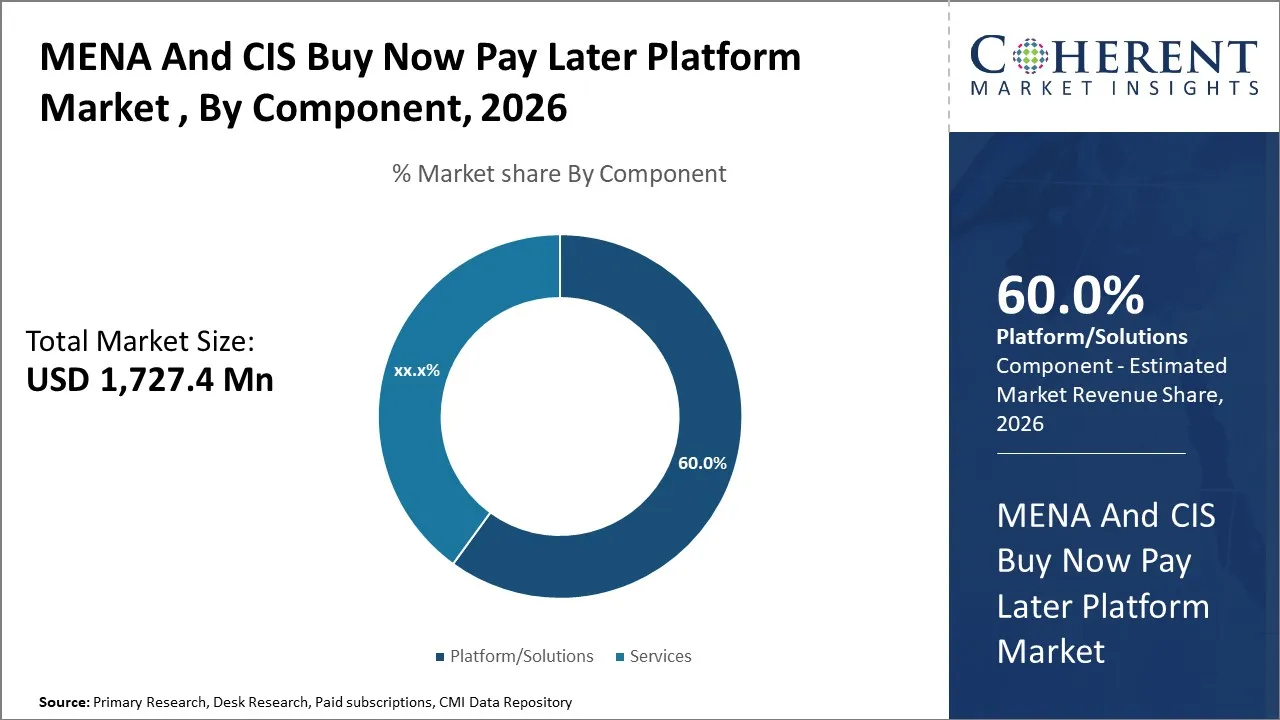
- Platform/Solutions segment holds the dominant position in the market, accounting for about 60% of the market share in 2026.
- Customer-Driven are expected to remain leading end users of buy now pay later platform s, accounting for 50% of market revenue in 2026, driven by high device volumes and adoption in comprehensive care.
- The online segment registered its dominance over the MENA and CIS buy now pay later platform market with share of 70% in 2026.
- MENA is projected to dominate the MENA And CIS buy now pay later platform market in 2026, with a share of over 60% due to strong adoption of alternative therapies.
MENA And CIS Buy Now Pay Later Platform Market Overview
The buy now pay later platform allows customers to purchase goods and services without having to commit to paying the entire amount up front. By using this option, consumers can finance purchases right away and repay them over time in installments. For instance, a customer purchasing a USD 1000 item could pay for it in four 250 interest-free installments. The Buy Now Pay Later platform is a fintech based payment solution. The MENA and CIS buy now pay later platform market is gaining significant traction as a result of the rapid expansion of ecommerce, increasing adoption of smartphones, and rising demand for flexible digital payment methods. GenZ and Millennials consumers encourage to adopt credit cards owing to increased financial inclusion and limited credit card penetration. Increasing technology advancement and adoption of inorganic growth strategies between merchants and fintech companies are improving accessibility and establishing BNPL platforms as a strategically notable part of the local digital payments ecosystem.
Current Events and Their Impact on the MENA And CIS Buy Now Pay Later Platform Market
Current Event | Description and its Impact |
Adoption of Inorganic Growth Strategies like Partnerships Between BNPL Providers and Retailers |
|
Rising Implementation of Regulatory Framework for BNPL Services |
|
Segmental Insights
- Current Industry Events of 2026
- Market Size Estimation
- Regional Breakdown
- Competitive Landscape
- Customer Intelligence
- Segmental Analysis
- Pricing Analysis
- Key Market Drivers, Challenges & Future Trends
- Customized Insights Section
MENA And CIS Buy Now Pay Later Platform Market Insights, By Component - Platform/Solutions Remain Leading Component in the Market
Based on component, platform/solutions segment is expected to lead the market, accounting for a revenue share of 60% in 2026. Increasing demand for the seamless digital payment option has estimated to drive the growth of the platform/solutions segment over the forecast period. The platform/solution segment leads because BNPL providers primarily provide integrated digital platform that can be easily integrated into online retail checkout systems. These payment option allows merchants to rapidly adopt BNPL services without intricate infrastructure changes, thereby rising demand for platform-based solutions across e-commerce ecosystems. For instance, in February 2026, Shahbandr, Saudi-Arabia based e-commerce enabler unveiled a strategic partnership with the Tabby, BNPL fintech company to integrate Buy Now, Pay Later payment solutions across its e-commerce platform in Egypt and Saudi Arabia. Initiation of this integration, more than 20,000 online stores operating on the Shahbandr platform can integrate Tabby’s installment payment option directly into their online checkout systems. This strategic alliance allows consumers to split their purchases into multiple installments during the checkout process. Improving payment flexibility and enhancing conversion rates for merchants.
MENA And CIS Buy Now Pay Later Platform Market Insights, By Business Model - Customer Driven to Remain Leading Business Models of MENA and CIS Buy Now Pay Later Platform
Based on business model, customer driven segment held dominant position in the market with a share of 50% in 2026. Due to inflammation in cities the consumers are increasingly preferring installment based payment models instead of paying the full amount upfront. Increasing preference for flexible payment options has driven the growth of the segment over the forecast period. Moreover, in various MENA and CIS economies, credit card utilization and formal credit access are relatively low. Buy now pay later option fill this gap by providing quick approval and short-term financing without traditional banking requirements. Minimal service charges and interest free models has increased its popularity among Gen Z and Millennials. Furthermore, increasing financial inclusion across the region has driven the growth of the customer driven segment over the forecast period.
For instance, in July 2025, Tamara, software company providing a payment solution that makes shopping simpler and based in the wider GCC & Saudi Arabia signed partnership with Amazon Payment Services, a significant online payment processing service in the Middle East and North Africa. The partnership significantly highlights how e-commerce platforms and payment providers are incorporating BNPL options to enhance the shopping experience and grow conversion rates. Customers are more comfortable to complete purchases when installment models are available.
MENA And CIS Buy Now Pay Later Platform Market Insights, By Mode
Based on Mode, online mode segment led the MENA and CIS buy now pay later platform market with share of 70% in 2026. Rising online shopping trends and rising smartphone & internet penetration has driven the growth of the segment over the forecast period. Growing seamless incorporation of buy now pay later with digital payment gateways has estimated to drive the growth of the market over the forecast period. Online buy now pay later services offer faster and more convenient checkout experience compared to traditional credit systems. Hence faster and convenience transaction has estimated to drive the growth of the market over the forecast period.
Regional Insights
MENA Remains the Market Leader in Buy Now Pay Later Platform
MENA is expected to dominate the MENA And CIS buy now pay later platform market, accounting for a share of 60% in 2026. MENA leads the market due to various technological and structural factors that support the rapid adoption of installment-based digital payment options. The primary factor influencing the dominance of the MENA region is the rapid expansion of digital retail platform and e-commerce platforms, which has notably increased online transactions across countries such as Saudi Arabia, United Arab Emirates, and Qatar. Moreover, the MENA region has a youth, techsavvy population with high smartphone penetration, encouraging the adoption of mobile-based fintech solutions. Expanding fintech ecosystem and rapid development in fintech innovation, with various startups and payment technology providers launching BNPL solutions. Furthermore, the rising support by the government of the MENA for digital transformation has influenced the dominance of the MENA region in the market.
For instance, in January 2026, PayLater, BNPL fintech startup based in Qatar secured around USD 10 million in seed funding to expand its installment payment platform and scale BNPL adoption across e-commerce and merchants platforms in the country. This investment encourages the development of digital credit solutions and strengthens the BNPL startup ecosystem in the region.
CIS Buy Now Pay Later Platform Market Trends
CIS region is considered to be a significantly growing area, due to several technological, economic, and demographic factors. Many CIS countries still have limited access to traditional bank loans and credit cards. The CIS region is experiencing rapid development of fintech ecosystems and digital lending platforms. Innovations such as open banking technologies, AI-based credit assessment, and mobile payment apps are making BNPL services easier to access and more reliable. The CIS region is expanding rapidly in the buy now pay later market due to limited traditional credit access, expanding e-commerce, increasing young digital consumers, fintech innovation, and increasing merchants partnerships.
MENA And CIS Buy Now Pay Later Platform Market Outlook – Country-wise
UAE Buy Now Pay Later Platform Market Trends
The UAE country hold dominant position in the MENA and CIS buy now pay later platform market owing to its strong adoption of digital solutions and rapidly developing fintech ecosystem. The country benefits from high-tech smartphone and internet penetration, e-commerce sector. Moreover, favourable regulatory support and increasing adoption of inorganic strategic partnership between fintech companies, banks, and retail platforms are accelerating the expansion and adoption of buy now pay later platform model across the UAE.
Russia Buy Now Pay Later Platform Market Forecast
Russia is experiencing growth in the adoption of the Buy Now Pay Later platform ecosystem through financial inclusion programs, regulatory reforms, digital payment infrastructure development and fintech innovation policies. These initiatives focus to strengthen consumer protection while growing access to substitute financing options for households and small businesses. The Bank of Russia and government are actively shaping the regulatory and technological environment to assure that installment-based digital payment models function transparently and securely.
For instance, in February 2026, the Russian State Duma revealed the approval of new rules under Federal Law No. 283-FZ to regulate installment-based payment platforms functioning in the Russia. This legislation established a clear legal framework for Buy Now Pay Later operators, defining their responsibilities toward consumers, financial institutions and merchants. The law focus to develop a structured environment for the rapidly growing installment payment sector and assure that companies providing BNPL services follow standardized operational practices.
MENA And CIS Buy Now Pay Later Platform Industry News
- In February 2026, Madfu, a Saudi fintech startup based in Riyadh developing Buy Now, Pay Later (BNPL) models, secured USD 25.5 million in a pre-Series A funding round led by Afaq Capital. This financing will support product innovation and platform expansion across Saudi Arabia’s digital commerce sector. The financing reflects growing investor trust in Buy Now, Pay Later fintech startups and highlights the rising demand for installment-based payment solutions in the region.
- In October 2025, Bynow, a Saudi Arabia fintech startup, which offers buy now, pay later funding for merchants and businesses, raised USD 1.2 million in seed funding from Merak Capital, private funding venture based in Riyadh, Saudi Arabia. The startup plans to utilize the capital to grow its platform capabilities and accelerate the adoption of installment-based payment solutions for small and medium sized business owners.
Market Report Scope
MENA And CIS Buy Now Pay Later Platform Market Report Coverage
| Report Coverage | Details | ||
|---|---|---|---|
| Base Year: | 2025 | Market Size in 2026: | USD 1,727.4 Mn |
| Historical Data for: | 2020 To 2024 | Forecast Period: | 2026 To 2033 |
| Forecast Period 2026 to 2033 CAGR: | 8.4% | 2033 Value Projection: | USD 3,051.6 Mn |
| Geographies covered: |
| ||
| Segments covered: |
| ||
| Companies covered: | Klarna Bank AB, Afterpay Holdings Inc., Laybuy Group Holdings Limited, PayI8r (Social Money Ltd.), PayPal Holdings Inc., Perpay, Quadpay, Sezzl, Splitit. | ||
| Growth Drivers: |
| ||
| Restraints & Challenges: |
| ||
MENA And CIS Buy Now Pay Later Platform Market Drivers
Growth of Youth, Digitally Savvy Population & Smartphone-Internet Penetration
As the large number of populations in MENA & CIS regions consists young consumers who are highly addicted to buying stuff online which has increased the demand for the buy now, pay later platform. The young consumers are highly comfortable with smartphones, digital technologies, and mobile applications. These young consumers prefer convenient and flexible payment solutions rather than traditional credit systems. Rising growth of mobile internet connectivity and smartphone usage in the MENA and CIS regions has developed a strong foundation for digital payment services such as Buy Now, Pay Later. This rapidly spreading connectivity enables seamless integration of Buy Now, Pay Later services with online stores and payment gateways, thereby encouraging adoption among both consumers and merchants.
For instance, in March 2025, according to the data published by the UNICEF and international demographics, MENA region has one of the largest young populations globally, with approximately 140 million individuals aged 10-24 representing nearly one quarter of the population. According the same source, the youth population is estimated to increase from around 140 million in 2024 to over 143 million by 2026, creating a huge digitally active consumer base that is encouraging the incorporation of e-commerce and buy now, pay later platform.
MENA And CIS Buy Now Pay Later Platform Market Drivers
Rising Government Funding for Fintech and Digital Payments
Increasing government in several countries within the CIS and MENA regions are actively promoting digital financial services and fintech innovation through regulatory support, fintech sandboxes, and national digital transformation initiatives. Policies focus at promoting cashless economies and financial inclusion support the adoption of substitute payment solutions such as Buy Now, Pay Later. This supportive regulatory environment allows payment technology providers and fintech startups to evolve and expand Buy Now, Pay Later service models rapidly.
MENA And CIS Buy Now Pay Later Platform Market Trends
Emergence of Buy Now, Pay Later into Essential Services Beyond Retail
The expansion of installment based payment solutions beyond traditional retail sectors into fundamental services such as education, healthcare, travel and insurance are shaping the MENA and CIS Buy Now Pay Later market significantly. Increasing adoption of inorganic strategies in between financial platform and service providers to provide installment plans for tuition fees, medical bills, and insurance premiums. This trend is gaining traction due to increasing living costs and consumer demand for flexible payment solutions. The BNPL platforms in GCC countries allow school fee financing through edtech platforms and travel bookings through digital travel marketplaces. This development is strategically positioning BNPL platforms as broader consumer finance solutions rather than just retail checkout tools.
MENA And CIS Buy Now Pay Later Platform Market Opportunities
Financial Inclusion and Low Credit Card Penetration
Several countries in the Middle East and CIS, credit card penetration remains relatively low compared with western economies. Hence, a large segment of consumers lacks access to traditional credit facilities. Buy Now, Pay Later platforms fill this gap by providing short-term installment plans with minimal documentation and fast rapid approval processes. This encourages previously underbanked or underserved consumers to access digital credit, significantly growing the potential customer base and creating strong growth opportunities for Buy Now Pay Later providers in the region.
Increasing Advancement in Technology such as AI integration, Open Banking, and Embedded Finance
Evolving financial technologies such as open banking, artificial intelligence, and embedded finance are allowing Buy Now, Pay Later providers to improve fraud detection, risk assessment, and personalized customer experience. AI-driven analytics give permission to platforms to evaluate consumer creditworthiness quickly and approve loans in minutes. Moreover, embedded finance allows Buy Now, Pay Later (BNPL) solutions to be integrated directly into e-commerce platforms, mobile wallets, and digital marketplaces, making installment payments more accessible and fuelling further market growth.
Analyst Opinion (Expert Opinion)
- MENA and CIS buy now pay later platform market is experiencing strong momentum owing to the rapid growth of mobile payments and digital commerce. Analysts recorded that retailer integrating buy now pay later platform are witnessing 20-30% higher cart conversion rates and increased average order values, demonstrating that installment-based payment models are becoming a strategic tool for merchants seeking to improve consumer purchasing power and drive online retail expansion.
- The MENA and CIS regions consists of large young, digitally savvy population which has anticipated to significantly drive the growth of the buy now pay later platform market in the region. A large number of consumers under the age of 35 prefer flexible payment solutions over traditional credit cards. Market experts highlight that this demographic shift is optimizing consumer finance behaviour, as Gen Z and millennials highly rely on short-term installment payments for electronics, fashion, and lifestyle purchases, positioning BNPL platforms as central component of the region’s evolving digital payment ecosystem.
- Fintech companies and adoption of inorganic growth strategies like partnerships between banks, payment providers, and e-commerce platforms are fortifying the Buy Now, Pay Later infrastructure across the region. Analyst note that the incorporation of advanced technologies such as AI-based credit assessment and real-time transactions within seconds while managing credit risks. Increasing technology advancement has developed trust within the consumers allowing buy now pay later platforms providers to scale operations in MENA and CIS region
- Regulatory bodies and government funding for digital financial services are also shaping the long-term outlook of the BNPL market. Several countries in the MENA are launching fintech-friendly policies, digital banking frameworks, regulatory sandboxes to encourage innovation while ensuring consumer protection. Analysts emphasize that this balanced regulatory approach is likely to attract new market entrants, increase foreign investment, and strengthen the overall sustainability of the Buy Now, Pay Later ecosystem in the region.
Speak to the analyst
Want personalized insights?
Take the findings above to one of our principal consultants, or have the report rebuilt around the segments, geographies and competitors you actually track.
MENA And CIS Buy Now Pay Later Platform Market Segmentation
- By Component Insights ( Revenue, USD Mn, 2020 - 2033)
- Platform/ Solutions
- Services
- By Purchase Ticket Size Insights ( Revenue, USD Mn, 2020 - 2033)
- Small Ticket Item (Upto USD 300)
- Mid Ticket Item (USD 300 – USD 1000)
- Higher Prime Segments (Above USD 10,000)
- By Business Model Insights ( Revenue, USD Mn, 2020 - 2033)
- Customer Driven
- Business Driven
- By Mode Insights ( Revenue, USD Mn, 2020 - 2033)
- Online
- Offline
- By Vertical ( Revenue, USD Mn, 2020 - 2033)
- Fitness & Gear
- Travel
- Electronics
- Home & Furniture
- Fashion
- Electronics
- Fashion
- Sports & Outdoors
- By Region Insights ( Revenue, USD Mn, 2020 - 2033)
- Middle East & North Africa
- Saudi Arabia
- GCC Countries
- Israel
- Rest of Middle East & Africa
- Commonwealth of Independent States (CIS)
- Russia
- Kazakhstan
- Turkmenistan
- Belarus
- Uzbekistan
- Rest of CIS Azerbaijan, Armenia, etc.)
- Middle East & North Africa
- Key Players
- Klarna Bank AB
- Afterpay Holdings Inc.
- Laybuy Group Holdings Limited
- PayI8r (Social Money Ltd.)
- PayPal Holdings Inc.
- Perpay
- Quadpay
- Sezzl, Splitit
Sources
Primary Research interviews
- Interviews with fintech experts, BNPL platform executives, and digital payment specialists in MENA and CIS region.
- Insights from e-commerce merchants, bank, and payment gateway providers utilizing BNPL services.
- Discussions with regulatory experts and fintech experts on digital credit policies and BNPL adoption.
Databases
- IMF Financial Statistics – financial indicators and macroeconomics
- World Bank Data Base – financial inclusion and digital payment data
- CB Insights – fintech investments and startup insights
Magazines
- The Paypers
- FinTech Magazine
- Finextra
- Global Finance Magazine
Journals
- Journal of Financial Technology
- International Journal of Finance & Banking Studies
- Journal of Digital Banking
- Journal of Medical Devices
Newspapers
- Khaleej Times
- Gulf News
- The National (UAE)
- The Wall Street Journal
- Financial Times
Associations
- Association of Banks of Russia
- Fintech Association of Georgia (FIA)
- Association of Banks of the Republic of Kazakhstan
- Fintech Association of Uzbekistan
- Association of Banks in Jordan (ABJ)
- Arab Regional Fintech Working Group (Arab Monetary Fund)
- Arab Federation for Digital Economy (AFDE)
- MENA FinTech Association (MFTA)
- Egyptian FinTech Association (EFA)
- UAE Banks Federation (UBF)
Public Domain sources
- Arab Monetary Fund (AMF) – Arab Regional Fintech Working Group
- Buna (Arab Monetary Fund)
- Saudi Central Bank (SAMA) Open Data Portal
- Saudi Central Bank Permitted Fintechs / Sandbox
- Central Bank of the UAE – Retail Payment Services and Card Schemes Regulation
- Central Bank of the UAE – Payments and Settlements
- Official / Regulatory Sources – CIS
- Bank of Russia – National Payment System
- Bank of Russia – Payment Statistics
- National Bank of the Republic of Kazakhstan – Payment Systems
- National Bank of Georgia – Payment Service Providers
- National Bank of Georgia – Payment Systems
- Central Bank of Uzbekistan – Payment Systems
Proprietary Elements
- CMI Data Analytics Tool
- Proprietary CMI Existing Repository of information for last 8 years
Get access to 250+ pages report
Every segment, forecast, competitor profile and data table behind the analysis above — available for instant download.
- ESOMAR Member
- ISO 9001:2015 Certified
- D-U-N-S Registered
- GDPR & CCPA Compliant
Missing comfort of reading report in your local language? Find your preferred language:
Transform your Strategy with Exclusive Trending Reports
Frequently Asked Questions
The market is estimated to be valued at USD 1,727.4 Mn in 2026.
The MENA And CIS Buy Now Pay Later Platform Market value is expected to reach USD 3,051.6 Mn by 2033.
The market is poised to exhibit a CAGR of 8.4% from 2026 to 2033.
Major growth factors include growth of youth, digital savvy population & smartphone-internet penetration and rising government funding for fintech and digital payments
Compliance challenges & regulatory uncertainty and data privacy and cybersecurity concerns
Some major companies in the MENA And CIS Buy Now Pay Later Platform Market include Klarna Bank AB, Afterpay Holdings Inc., Laybuy Group Holdings Limited, PayI8r (Social Money Ltd.), PayPal Holdings Inc., Perpay, Quadpay, Sezzl, Splitit.
MENA, with 60% share in 2026, is expected to lead the market during the forecast period.