

Hid Ballast Market Size and Forecast — 2026-2033
The Global HID Ballast Market size is estimated to be valued at USD 5.11 billion in 2026 and is expected to reach USD 7.88 billion by 2033, exhibiting a compound annual growth rate (CAGR) of 6.4% from 2026 to 2033.
Overview
HID (High-Intensity Discharge) ballasts are essential electrical control devices that regulate current and voltage supplied to HID lamps, ensuring stable illumination and extended lamp life. These products are widely used in street lighting, automotive headlights, stadiums, and industrial applications. A typical HID ballast includes ignition circuits, current control modules, and thermal protection systems to optimize lamp performance. Electronic ballasts have increasingly replaced magnetic variants, offering benefits such as reduced flicker, faster startup, lower energy consumption, and compact design. Advancements in digital control and dimming capabilities allow seamless integration with smart lighting systems.
Key Takeaways
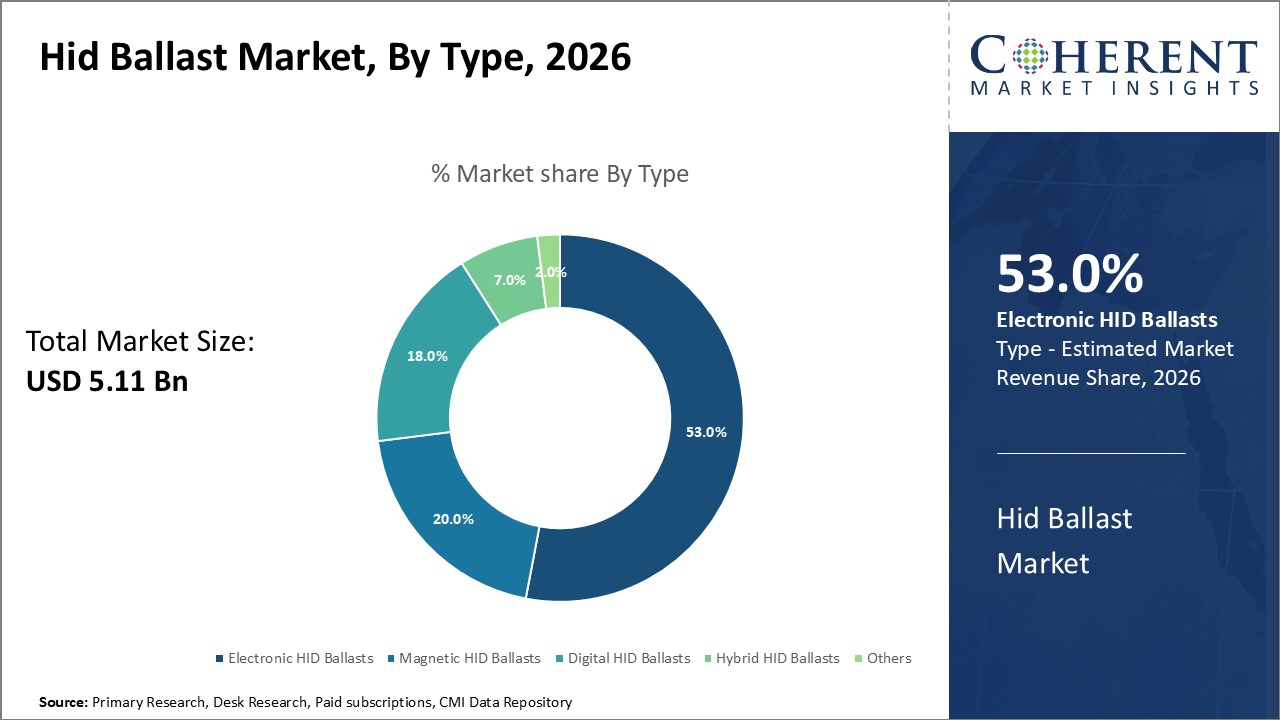
The Electronic HID Ballasts segment dominates with over 53% market share, driven by superior energy efficiency and compatibility with modern lighting systems.
Automotive Lighting application commands the largest market revenue, capitalizing on rapid vehicle production and aftermarket upgrades globally.
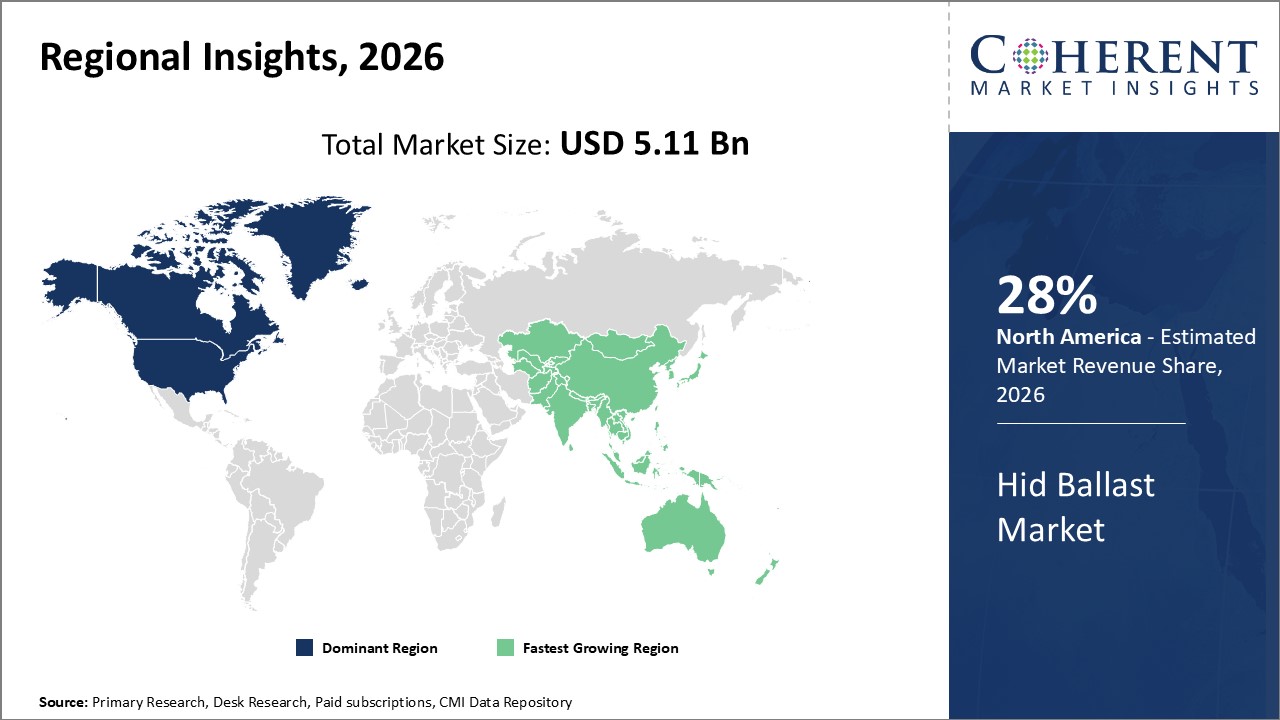
North America leads regional market share with approximately 28%, bolstered by strong automotive and smart lighting infrastructure industries.
Asia Pacific presents the fastest-growing region with a CAGR surpassing 7%, supported by government initiatives and expanding urbanization fueling HID ballast usage.
Hid Ballast Market Segmentation Analysis
Hid Ballast Market Insights, By Type
Electronic HID Ballasts dominate the market share with a commanding 53%, primarily due to their enhanced energy efficiency, compact design, and compatibility with contemporary lighting systems. Their capability to reduce power consumption and provide stable current outputs is a key factor driving their adoption across automotive and industrial lighting sectors. Digital HID Ballasts are the fastest-growing segment, benefiting from the integration of intelligent control features, adaptability to IoT platforms, and superior performance stability. This subsegment is gaining traction, particularly in smart city projects and architectural lighting, where precision control is essential. Magnetic HID Ballasts, while older technology, maintain niche applications due to cost advantages but face declining demand.
Hid Ballast Market Insights, By Application
Automotive Lighting remains the dominant application segment, credited with the largest market revenue share due to rising vehicle production and demand for improved lighting safety and aesthetics. Innovations such as adaptive HID headlights and hybrid vehicle lighting systems have increased ballast demand in this segment. Horticulture Lighting represents the fastest-growing application, fueled by the increasing prevalence of controlled-environment agriculture and commercial indoor farming. HID ballasts provide essential high-intensity lighting crucial for plant growth cycles. Industrial Lighting caters to large facilities requiring robust and reliable illumination, often favoring digital and electronic ballasts for maximized efficiency
Hid Ballast Market Insights, By End-User
OEMs dominate the segment due to their role in integrating HID ballast technology directly into new vehicles and lighting systems, accounting for the majority market share. The rise of electric vehicle production further cements OEM dominance as manufacturers prioritize advanced lighting efficiency. Aftermarket represents the fastest-growing subsegment owing to increasing vehicle refurbishment and upgrade activities, particularly in mature markets like North America and Europe. Commercial end-users, such as retail chains and stadium authorities, demand sophisticated lighting for enhanced ambiance and functionality, supporting steady market growth.
Hid Ballast Market Trends
The HID ballast market trends highlight a significant shift towards intelligent ballasts capable of remote control, which increased adoption in smart city projects by 19% in 2025.
Moreover, eco-conscious designs and regulatory-driven sustainable product offerings have become pivotal, particularly in the EU and North America.
Another trend revolves around market diversification into horticulture lighting, reflecting innovative applications that augment the market scope beyond traditional sectors.
Hid Ballast Market Insights, By Geography
North America Hid Ballast Market Analysis and Trends
In North America, the HID ballast market dominance stems from its robust automotive manufacturing ecosystem and aggressive smart infrastructure development. With approximately 28% of the market share, strong investments in upgrading urban lighting and stringent environmental standards have stimulated demand for energy-efficient ballasts. The presence of key industry players and innovation hubs propels continuous offerings in technologically advanced HID ballasts.
Asia Pacific Hid Ballast Market Analysis and Trends
Meanwhile, Asia Pacific exhibits the fastest growth with a CAGR exceeding 7%. Rapid urbanization, expansion of automotive industries in China and India, and government initiatives for energy conservation are primary growth catalysts. The burgeoning industrial sector and large-scale infrastructure projects likewise accelerate the adoption of advanced HID ballast systems, marking this region as a critical market growth front.
Hid Ballast Market Outlook for Key Countries
USA Hid Ballast Market Analysis and Trends
The USA's HID ballast market benefits from strong automotive manufacturing, government energy policies, and advanced R&D infrastructure. Leading companies such as Philips Lighting and OSRAM have partnered with automotive OEMs to enhance ballast integration in vehicle lighting systems. Smart city projects in metropolitan hubs like New York and Los Angeles increasingly deploy digital ballasts for street and architectural lighting, contributing to market revenue growth. Furthermore, demand from industrial and commercial sectors is also on the rise, fostering overall market expansion.
India Hid Ballast Market Analysis and Trends
China's HID ballast market is characterized by vigorous urban infrastructure development and rising automotive production. The government's emphasis on energy-efficient lighting in smart cities and industrial zones has accelerated ballast adoption. Domestic companies alongside multinationals actively manufacture and distribute innovative ballast technologies to meet the growing need. Initiatives focusing on electrical mobility also generate demand for automotive lighting ballasts, consolidating China’s position as a crucial market player.
Analyst Opinion
The surge in automotive LED hybrid lighting systems has intensified demand for advanced HID ballasts capable of seamless integration, significantly impacting market size. In 2025, automotive lighting upgrades increased HID ballast demand by approximately 9%, reflecting enhanced imports and OEM collaborations.
Production capacity across Asia-Pacific manufacturers scaled up by 12% in early 2026 due to escalating orders from urban infrastructure projects, reinforcing supply-side growth drivers. This expansion aligns with an uptick in demand for reliable ballast units in street and industrial lighting.
Pricing dynamics saw a moderate increase, with average HID ballast unit prices rising by 5.3% in 2025, driven by raw material cost fluctuations, particularly electronic components and rare metals, subsequently influencing market revenue and growth strategies.
Use case diversification remains pivotal, as HID ballasts are increasingly employed across stadium, commercial, and specialized horticulture applications. By 2026, horticultural lighting installations utilizing HID technology accounted for a 16% rise in market share, emphasizing evolving market dynamics.
- Current Industry Events of 2026
- Market Size Estimation
- Regional Breakdown
- Competitive Landscape
- Customer Intelligence
- Segmental Analysis
- Pricing Analysis
- Key Market Drivers, Challenges & Future Trends
- Customized Insights Section
Market Scope
| Report Coverage | Details | ||
|---|---|---|---|
| Base Year: | 2025 | Market Size in 2026: | USD 5.11 billion |
| Historical Data for: | 2020 To 2024 | Forecast Period: | 2026 To 2033 |
| Forecast Period 2026 to 2033 CAGR: | 6.4% | 2033 Value Projection: | USD 7.88 billion |
| Geographies covered: |
| ||
| Segments covered: |
| ||
| Companies covered: | Philips Lighting, OSRAM Licht AG, GE Lighting, Shenzhen Feilo Acoustics Co., Ltd., Seoul Semiconductor, Zurich Instruments, Havells India Ltd., Koninklijke Philips N.V., Eaton Corporation, Signify NV. | ||
| Growth Drivers: |
| ||
Hid Ballast Market Growth Factors
The increasing adoption of energy-efficient and long-lasting lighting solutions forms the primary growth driver for the HID ballast market, supported by tightening emissions regulations and sustainability directives in North America and Europe. Growing urban infrastructure development in the Asia-Pacific is further catalyzing demand for reliable outdoor lighting systems powered by advanced ballasts. Additionally, expanding automotive production and aftermarket refurbishment boost demand for automotive lighting ballasts, with electric vehicle proliferation offering added momentum. Rising smart city initiatives globally are simultaneously driving the incorporation of sophisticated lighting control technologies, which depend heavily on compatible HID ballasts optimized for connectivity and energy savings.
Hid Ballast Market Development
In October 2025, Philips Lighting introduced a new line of high-efficiency HID ballasts with advanced dimming capabilities. These ballasts offer improved energy efficiency and enhanced controllability, enabling lighting systems using high-intensity discharge (HID) lamps to operate with more precise dimming, lower operating costs, and better compatibility with modern control infrastructures.
In April 2022, OSRAM launched a new generation of HID ballasts designed with an improved power factor and lower harmonic distortion. The updated ballasts were engineered to meet stricter system performance and regulatory requirements, delivering cleaner electrical characteristics and better compatibility with utility grids in industrial and commercial lighting applications.
Key Players
Leading Companies of the Market
Philips Lighting
OSRAM Licht AG
GE Lighting
Shenzhen Feilo Acoustics Co., Ltd.
Seoul Semiconductor
Zurich Instruments
Havells India Ltd.
Koninklijke Philips N.V.
Eaton Corporation
Signify NV
Several prominent market players have adopted aggressive market growth strategies, including technological collaborations and strategic mergers. For example, Philips Lighting’s integration with automotive giants enhanced their customized HID ballast portfolio, resulting in a market share increase above 11% in the automotive segment by 2026. Meanwhile, OSRAM's R&D investment in digital ballast platforms expanded product offerings and drove adoption in industrial lighting, contributing to a 8% growth in overall revenue. Eaton Corporation’s expansion into emerging economies via joint ventures accelerated regional penetration, reflecting strategic geographic diversification.
Hid Ballast Market Future Outlook
HID ballast development is expected to focus on enhancing digital control, energy optimization, and system compatibility as the lighting industry continues transitioning toward LEDs. Intelligent electronic ballasts with dimming, wireless connectivity, and integrated sensors will support adaptive lighting systems for industrial and automotive applications. Eco-friendly designs using recyclable materials and compliance with global energy standards will drive innovation. While HID technology will gradually lose share to LEDs, specialized uses—such as horticultural, marine, and projection lighting—will sustain demand for advanced, high-frequency electronic ballasts that balance performance with cost efficiency.
Hid Ballast Market Historical Analysis
- HID ballasts have long been a critical component of high-intensity discharge lighting systems, providing the necessary voltage regulation and current stabilization for lamps such as metal halide, high-pressure sodium, and mercury vapor. Initially dominated by magnetic designs, HID ballasts evolved toward electronic types that offered faster ignition, reduced energy loss, and lower noise levels. As urban lighting and automotive headlamp applications expanded, the demand for compact and efficient ballast systems surged. Manufacturers introduced digital control circuitry, thermal protection, and automatic power adjustment to enhance reliability. The introduction of hybrid ballasts allowed compatibility with both HID and emerging LED lighting systems, maintaining relevance amid rapid technological shifts.
Sources
Primary Research Interviews:
Lighting Engineers
Electrical Component Manufacturers
Automotive Lighting Specialists
Industrial Equipment Technicians
Databases:
IEA Energy Efficiency Data
GlobalData Lighting Reports
U.S. DOE Solid-State Lighting Program
Statista Electrical Components
- Magazines:
Lighting Design + Application
LEDs Magazine
Electrical Contractor
Industrial Lighting Journal
Journals:
IEEE Transactions on Industrial Electronics
Journal of Light & Visual Environment
Lighting Research & Technology
Electrical Power Systems Research
Newspapers:
The Economic Times (Energy)
The Guardian (Sustainability)
The Wall Street Journal (Industry)
Nikkei Asia (Technology)
Associations:
Illuminating Engineering Society (IES)
National Electrical Manufacturers Association (NEMA)
International Commission on Illumination (CIE)
Energy Star Program
Get access to 250+ pages report
Every segment, forecast, competitor profile and data table behind the analysis above — available for instant download.
- ESOMAR Member
- ISO 9001:2015 Certified
- D-U-N-S Registered
- GDPR & CCPA Compliant
Missing comfort of reading report in your local language? Find your preferred language:
Transform your Strategy with Exclusive Trending Reports
Frequently Asked Questions
Industry frontrunners include Philips Lighting, OSRAM Licht AG, GE Lighting, and Eaton Corporation, all of whom command significant market shares through innovation and strategic partnerships.
The market size is projected to grow from USD 5.11 billion in 2026 to approximately USD 7.88 billion by 2033, underlining sustained market expansion and business growth.
Automotive lighting represents the largest and fastest-growing end-user segment owing to increasing vehicle production and aftermarket lighting upgrades globally.
Trends will increasingly focus on intelligent, digital ballast solutions with IoT integration and sustainable materials, expanding the market’s technology-driven growth trajectory.
The landscape is characterized by consolidation, technological innovation, and regional expansion, with challenges including raw material price volatility and stringent regulatory compliance.
Market players pursue strategies like R&D investments, joint ventures, and regional partnerships to enhance product portfolios and penetrate emerging markets effectively.