

Pretrained AI Models Market Size and Forecast — 2026-2033
The Global Pretrained AI Models Market is estimated to be valued at US$ 608.0 Mn in 2026 and is expected to reach US$ 1,286.1 Mn by 2033, exhibiting a compound annual growth rate (CAGR) of 13.3% from 2026 to 2033.
Key Takeaways of the Global Pretrained AI Models Market:
- The Large Language Models (LLMs) segment is expected to lead the market holding a share of 49.6% in 2026, owing to their ability to generate human-like text at scale.
- Among application, the enterprise productivity segment is projected to dominate with a share of 37.8% in 2026, owing to widespread automation needs.
- North America is estimated to lead the market with a share of 45.1% in 2026, owing to the presence of major tech companies.
- Asia Pacific, holding a share of 28.7% in 2026, is projected to be the fastest growing region, supported by national AI strategies.
Market Overview:
The market for pretrained AI models is experiencing considerable growth trends backed by increasing investments made by technology giants in artificial intelligence and machine learning technologies. Various enterprises such as Siemens and Walmart, across industries are recognizing the capabilities of pretrained models for their applications such as computer vision, natural language processing, and others. Additionally, continuous advancements in deep learning techniques, such as self-supervised learning, have enabled the development of highly efficient pretrained models, driving their adoption rates. Wide availability of pretrained models having different capabilities as per the requirements is also supporting the growth of this market.
Current Events and Their Impact
Current Events | Description and its impact |
Intensified Regulatory Landscape on AI and Data Protection |
|
Accelerated Adoption of AI Technologies Across Sectors Globally |
|
Insights, by Model Type
Global Pretrained AI Models Market Insights, by Model Type – Large Language Models (LLMs) Lead Owing to their Ability to Generate Human-Like Text at Scale
Large Language Models (LLMs) segment is expected to hold a share of 49.6% in 2026 and has seen widespread adoption owing to their ability to generate human-like text at scale. LLMs have revolutionized content creation workflows by enabling companies to automate routine writing tasks like drafting marketing emails, product descriptions, and creating initial drafts of longer-form documents. LLMs save businesses time and money by reducing reliance on human writers for standard template-based content.
LLMs are also finding increased usage in customer support chatbots and virtual assistants. Models such as Anthropic's Claude can understand complex customer questions and respond empathetically in a conversational manner. They allow businesses to improve customer experiences through 24/7 on-demand assistance. The humanizing effect of LLMs has increased consumer acceptance of AI-powered support compared to earlier rule-based systems.
The flexible capabilities of LLMs continue attracting developers who apply the models in new innovative applications on an ongoing basis. Large tech firms actively invest in expanding the frontiers of what LLMs can do through continued model development, extending their competitive edge in this segment. As LLMs become smarter and more helpful, their prevalence in content generation and customer support domains will keep growing steadily in the foreseeable future.
Insights, by Application
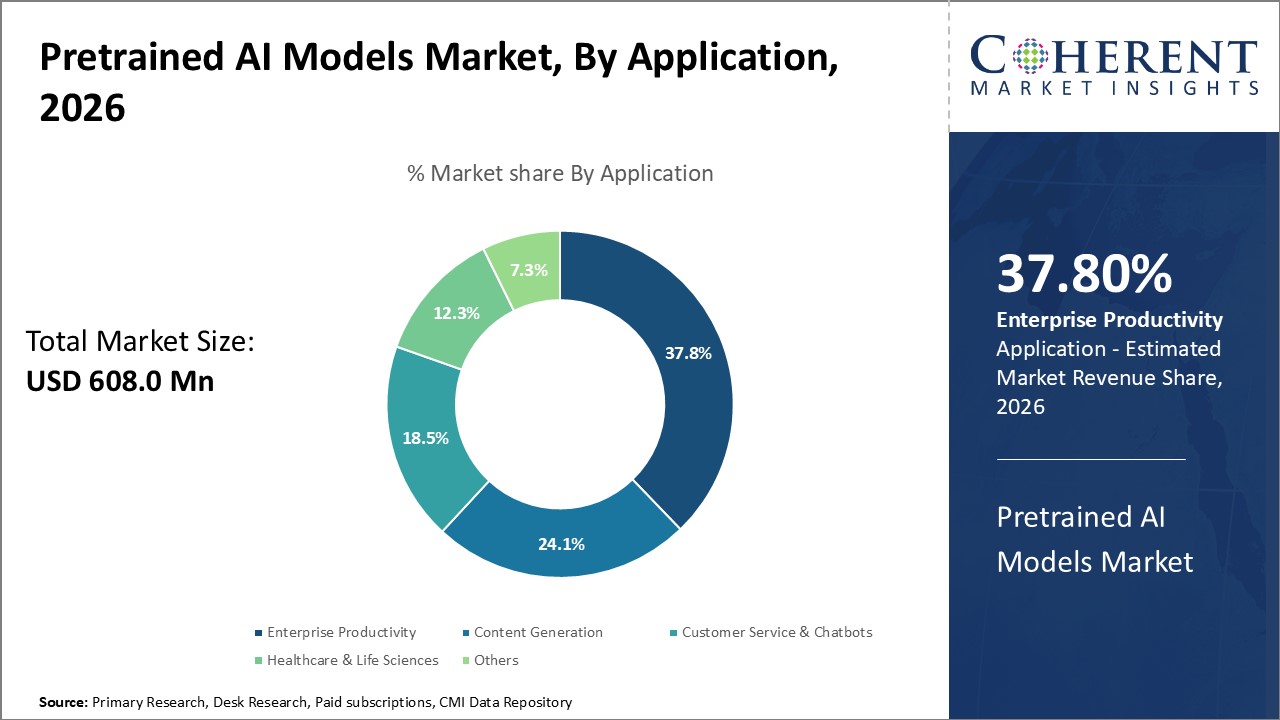
Global Pretrained AI Models Market Insights, by Application - Enterprise Productivity Leads Due to Widespread Automation Needs
Enterprise productivity applications, holding a share of 37.8% in 2026, have emerged as the biggest adopters of pretrained AI models owing to the widespread automation needs across business functions. Pretrained models help businesses minimize human effort spent on repetitive desk jobs through intelligent document automation, workflow management, and process optimization.
Within enterprises, pretrained models are most actively used to automate knowledge work like creating reports from structured data, compiling meeting minutes from audio transcripts, generating personalized emails and letters at scale. They reduce labor costs significantly by minimizing the time employees previously set aside for mechanical data processing and formatting tasks.
AI assistants powered by pretrained models are also deployed across functions to improve individual productivity. Models like Anthropic's Claude or Anthropic's PBC extend the capability of individual employees by enabling on-demand access to deep subject matter expertise. They augment human capabilities rather than replacing jobs.
Given the presence of massive automation opportunities within routine back-office tasks throughout companies, enterprise productivity will likely remain the biggest driver of the pretrained AI models market. As models advance to handle more complex operational workflows, their return on investment for businesses remains highly attractive.
Role of Artificial Intelligence (AI)
AI is redefining how pretrained models are built, deployed, and scaled—creating a kind of recursive innovation loop that’s propelling the market forward.
At the core, AI is enabling automation within the development lifecycle of AI models. Meta, for instance, uses reinforcement learning and neural architecture search (NAS) techniques—AI methods—to automatically refine the structure of its Large Language Model (LLMs). These AI-driven optimizations reduce training time and compute costs while improving model performance. It’s a self-improving system, and it’s already starting to outpace traditional hand-tuned architectures.
On the deployment side, AI is driving intelligent orchestration of model performance across platforms. Startups like OctoML and Modular AI are using machine learning to automatically optimize pretrained models for different hardware environments—whether it's an edge device, GPU cloud cluster, or mobile chipset. This adaptability is crucial as more enterprises seek to embed pretrained models across varied and sometimes resource-constrained environments.
Regional Insights
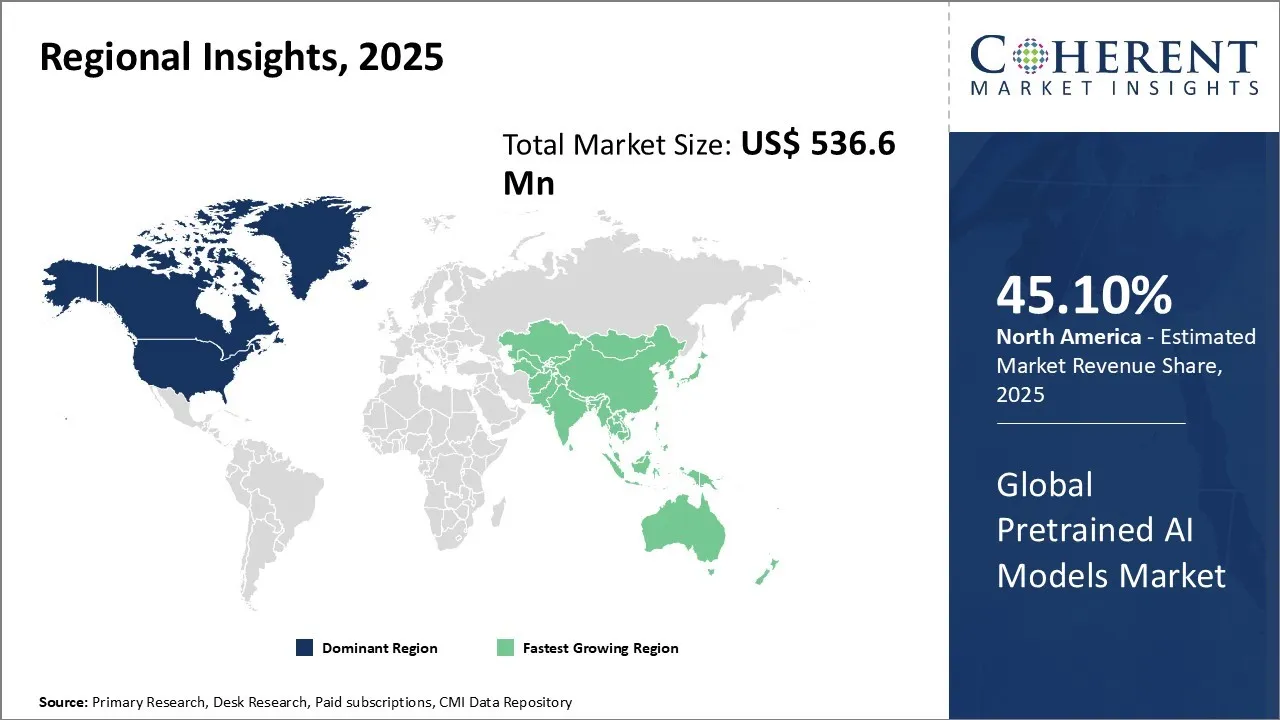
North America Pretrained AI Models Market Analysis and Trends
North America, holding a share of 45.1% in 2026, is expected to dominate the pretrained AI models market. This dominance can be attributed to strong government support for AI research and the presence of major tech companies. The region is at the forefront of innovating and adopting new technologies. The U.S. leads globally with heavy investments from the private sector, high availability of data, and vibrant startup ecosystem focusing on AI applications across industries. Companies like Google, Microsoft, IBM, and Anthropic focus on developing advanced models for applications in healthcare, education, cybersecurity and more.
Asia Pacific Pretrained AI Models Market Analysis and Trends
The Asia Pacific region, holding a share of 28.7% in 2026, is expected to exhibit the fastest growth in the pretrained AI models market. Countries like China, India, and Japan are aggressively promoting national AI strategies and heavily investing in fundamental research and emerging technologies. China's 2021-2026 development plan allocates significant funding to build AI innovation centers and 1,000 AI companies. India launched a national AI strategy and program in 2021 to encourage both tech adoption and local model development. The region also has a large talent pool and low-cost opportunities attracting global tech giants to set up offices and labs.
Global Pretrained AI Models Market Outlook for Key Countries
U.S. Pretrained AI Models Market Analysis and Trends
The U.S. pretrained AI models market continues to see strong demand from enterprises across sectors looking to gain competitive advantage through AI-powered solutions. Companies like Anthropic, Hugging Face, and AI21 focus on safety-critical domains to address ethical concerns and trust factors around model development.
China Pretrained AI Models Market Analysis and Trends
China's pretrained AI models market is driven by support from government agencies and large tech firms. Entities like the Chinese Academy of Sciences invest in fundamental research while Alibaba, Tencent, and Baidu offer AI capabilities through their cloud platforms. The country is making large strides in developing explainable and adaptable models.
India Pretrained AI Models Market Analysis and Trends
India has emerged as a hub for AI startups with growing interest in developing multilingual models. Firms like InfiniaML, Anthropic, and Straton are specifically working on models addressing inclusive education and healthcare needs of the local population through regional languages.
Japan Pretrained AI Models Market Analysis and Trends
Japanese companies lead in industrial and manufacturing applications of AI with a focus on robotics, automation, and computer vision. Partnerships between players like Fujitsu, Toyota, and Mitsubishi aim at enhancing productivity while ensuring job security. The country is investing in fundamental AI research through institutions to realize a “smart society.”
Market Players, Key Development, and Competitive Intelligence
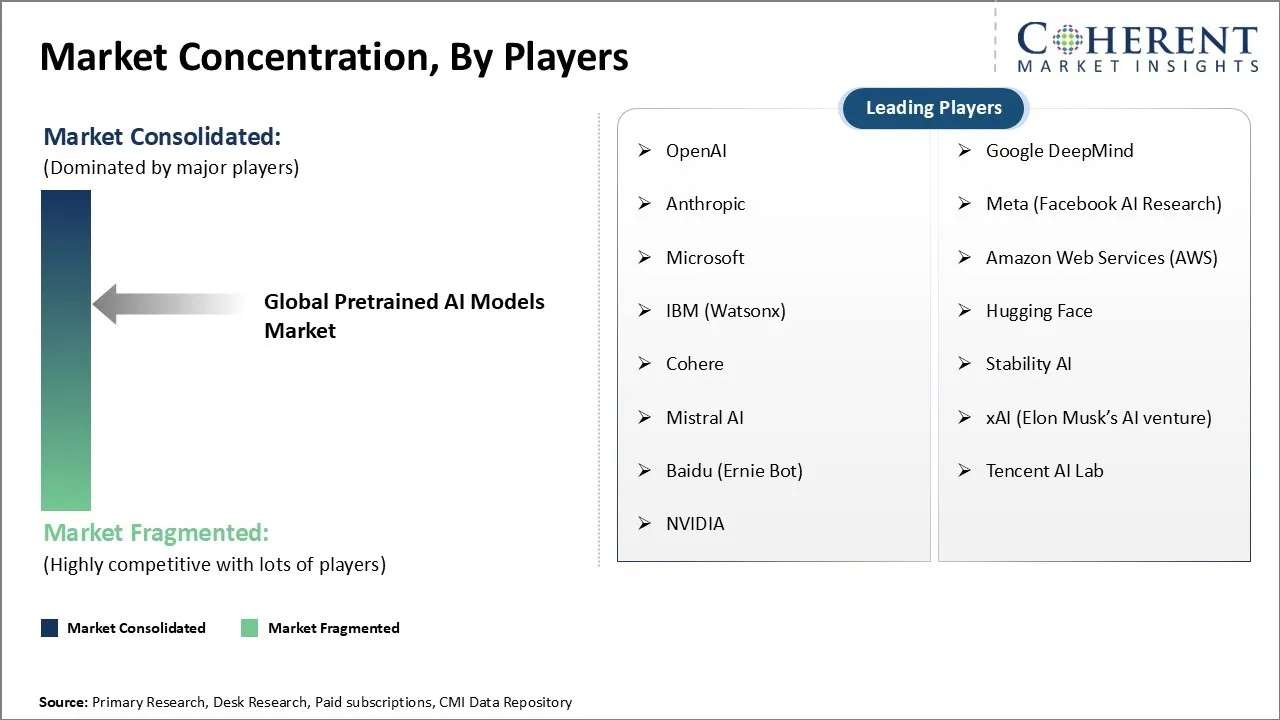
Key Developments:
- In April 2025, Google, a U.S.-based technology company, rolled out an early version of Gemini 2.5 Flash in preview in the Gemini API via Google AI Studio and Vertex AI. Building upon the foundation of 2.0 Flash, this version delivers a major upgrade in reasoning capabilities, while still prioritizing speed and cost.
- In November 2024, Amazon, a tech giant, and Anthropic, an AI company, deepened their strategic collaboration. Anthropic named AWS its primary training partner, using AWS Trainium to train and deploy its largest foundation models. Amazon announced an investment of US$ 4 billion in Anthropic.
- In June 2024, Anthropic launched Claude 3.5 Sonnet—the company's first release in the forthcoming Claude 3.5 model family
- In December 2021, Hugging Face, a platform used for sharing, building, and deploying AI models and datasets, acquired Gradio, an open-source library for developing machine learning applications.
Top Strategies Followed by Global Pretrained AI Models Market Players
- Established Players: Established players in the global pretrained AI models market focus heavily on research and development to maintain an edge over competitors. Companies like Google, Microsoft and Anthropic invest tens of millions annually to refine architectures, scale models, and push the boundaries of what's possible. This level of R&D expenditure allows them to innovate cutting-edge solutions like GPT-3, BERT and Constitutional AI that reinforce their market leadership. Strategic partnerships are also a major priority, especially for extending reach into new industries and domains.
- Google partners with automakers on AI-powered vehicle systems, while Anthropic collaborates with startups applying its models to healthcare, education and more. These alliances help established players tap new revenue streams and solidify their presence across multiple verticals.
- Mid-level Players: Mid-level pretrained AI models providers frequently adopt cost-effective strategies to compete. Just AI promotes its affordable multilingual chatbots as a competitor to high-priced solutions. They target price-conscious SMBs and individual consumers who may not need the very largest models. Collaborations also play a key role for mid-tier players.
- For example, Hugging Face works closely with AI safety non-profits like Anthropic to ensure responsible model development. Synced focuses on partnerships that strengthen its 3D computer vision capabilities. These alliances help mid-level providers make technological leaps and better serve different markets.
- Small-Scale Players: Smaller players in the pretrained AI models market often rely on agility, specialization, and community-driven innovation to carve out a space for themselves. Without the deep pockets of the tech giants, these firms focus on niche applications, rapid iteration, and building strong developer ecosystems.
- Take Aleph Alpha, for instance. This Germany-based startup zeroes in on language sovereignty in the EU, offering models that natively support multiple European languages—something that even larger models often overlook. Instead of chasing scale, they pursue linguistic relevance and regional compliance, which gives them a unique edge in government and public sector deals.
- Current Industry Events of 2026
- Market Size Estimation
- Regional Breakdown
- Competitive Landscape
- Customer Intelligence
- Segmental Analysis
- Pricing Analysis
- Key Market Drivers, Challenges & Future Trends
- Customized Insights Section
Market Report Scope
Pretrained AI Models Market Report Coverage
| Report Coverage | Details | ||
|---|---|---|---|
| Base Year: | 2025 | Market Size in 2026: | USD 608.0 Mn |
| Historical Data for: | 2020 To 2024 | Forecast Period: | 2026 To 2033 |
| Forecast Period 2026 to 2033 CAGR: | 13.3% | 2033 Value Projection: | USD 1,286.1 Mn |
| Geographies covered: |
| ||
| Segments covered: |
| ||
| Companies covered: | OpenAI, Google DeepMind, Anthropic, Meta (Facebook AI Research), Microsoft, Amazon Web Services (AWS), IBM (Watsonx), Hugging Face, Cohere, Stability AI, Mistral AI, xAI (Elon Musk’s AI venture), Baidu (Ernie Bot), Tencent AI Lab, and NVIDIA | ||
| Growth Drivers: |
| ||
| Restraints & Challenges: |
| ||
Market Dynamics
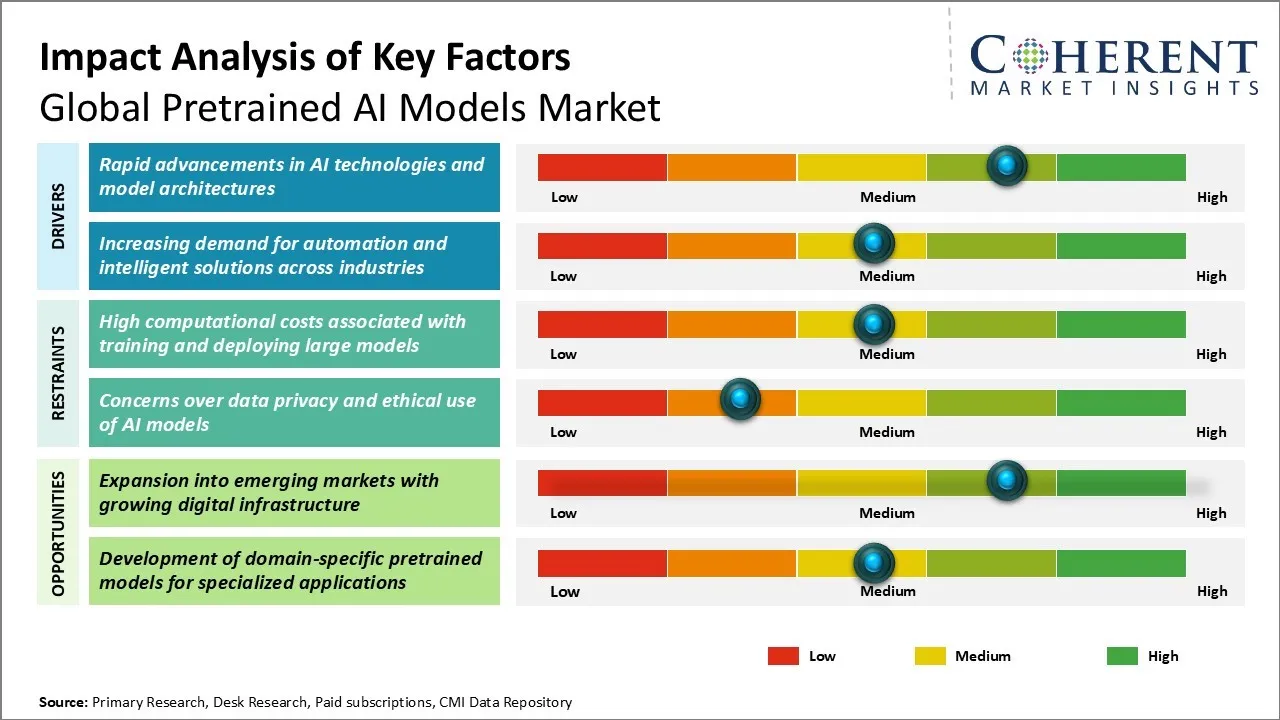
Global Pretrained AI Models Market Driver - Rapid advancements in AI technologies and model architectures
The global pretrained AI models market has been witnessing significant growth owing to rapid advancements happening in the field of artificial intelligence technologies and model architectures. With continuous improvements in computing power, vast amounts of data, and newer algorithms, AI researchers and companies are constantly developing more advanced and sophisticated AI models every year.
The introduction of transformer models and self-supervised learning techniques have revolutionized the capabilities of language models. Newer architectures such as GPT-3, BERT, ALBERT etc. have demonstrated superhuman performance on various natural language processing tasks. Advancements are also being made in the fields of computer vision and reinforcement learning. This constant innovation in AI technologies and thirst for developing more powerful models is driving organizations globally to invest in pretrained AI models to gain competitive advantages.
Global Pretrained AI Models Market Opportunity – Expansion into emerging markets with growing digital infrastructure
One major opportunity for the global pretrained AI models market is expansion into emerging markets that are developing strong digital economies and infrastructure. While many developing regions still face connectivity and hardware limitations, investment in 5G networks, cloud computing and data centers is growing rapidly across Asia Pacific, Latin America, Africa, and other areas. This improved digital backbone will enable more organizations and governments in these markets to take advantage of off-the-shelf pretrained AI models that have already been optimized for performance. By effectively tapping into these emerging markets, AI companies have a significant chance to scale their user bases and drive further revenue growth over the coming years. Those who understand the needs and contexts of developing regions best will be in strongest position to succeed.
Analyst Opinion (Expert Opinion)
- The global pretrained AI models market is evolving at a breakneck pace, and it is not just about big tech flexing muscle anymore. As of early 2025, large language models accounted for the highest market value, underscoring how much weight is now being placed on natural language capabilities across industries.
- One particularly telling sign of market maturity is the rising demand for domain-specific models. General-purpose models are powerful but companies are increasingly recognizing the value of pretrained models fine-tuned for sectors like healthcare or finance. IBM’s integration of domain-adapted models into its Watsonx platform or AWS’s industry-specific Bedrock services is a significant example.
- While North America continues to lead the market with a 45.10% share, largely due to the dominance of OpenAI, Anthropic, and Google DeepMind, it is the Asia Pacific region that is truly turning heads. From Baidu’s ERNIE bot to India’s national AI stack initiatives, the pace of innovation and policy support in this region could see it rival North America within the next 5 to 7 years.
Speak to the analyst
Want personalized insights?
Take the findings above to one of our principal consultants, or have the report rebuilt around the segments, geographies and competitors you actually track.
Market Segmentation
- Model Type Insights (Revenue, US$ Mn, 2021 - 2033)
- Large Language Models (LLMs)
- Multimodal Models
- Vision Models
- Speech & Audio Models
- Other Specialized Models
- Application Insights (Revenue, US$ Mn, 2021 - 2033)
- Enterprise Productivity
- Content Generation
- Customer Service & Chatbots
- Healthcare & Life Sciences
- Others
- Regional Insights (Revenue, US$ Mn, 2021 - 2033)
- North America
- U.S.
- Canada
- Latin America
- Brazil
- Argentina
- Mexico
- Rest of Latin America
- Europe
- Germany
- U.K.
- Spain
- France
- Italy
- Russia
- Rest of Europe
- Asia Pacific
- China
- India
- Japan
- Australia
- South Korea
- ASEAN
- Rest of Asia Pacific
- Middle East
- GCC Countries
- Israel
- Rest of Middle East
- Africa
- South Africa
- North Africa
- Central Africa
- North America
- Key Players Insights
- OpenAI
- Google DeepMind
- Anthropic
- Meta (Facebook AI Research)
- Microsoft
- Amazon Web Services (AWS)
- IBM (Watsonx)
- Hugging Face
- Cohere
- Stability AI
- Mistral AI
- xAI (Elon Musk’s AI venture)
- Baidu (Ernie Bot)
- Tencent AI Lab
- NVIDIA
Sources
Primary Research Interviews:
Stakeholders:
- AI Research Scientists and Model Engineers (e.g., Lead Developers at AI Labs)
- Product Managers from AI Startups and Enterprise SaaS Providers
- Data Scientists at Fortune 500 Companies (Healthcare, Finance, Retail)
- Cloud Platform Architects and Infrastructure Heads (e.g., AWS, Azure, GCP)
- Open-Source Community Contributors and Maintainers (e.g., Hugging Face, PyTorch)
- AI Policy Advisors and Regulatory Experts
Databases:
- Global Tech Analytics Portal (GTAP)
- AI Systems Intelligence Repository (AISIR)
- Digital Transformation Index (DTI)
- Advanced Computing & AI Metrics Bureau (ACAMB)
Magazines:
- AI Business Weekly
- Machine Learning Digest
- Neural Networks & Beyond
- Tech Intellect Magazine
Journals:
- Journal of Applied Artificial Intelligence
- AI Model Deployment & Systems Journal
- Neural Computation and Cognitive Systems Journal
- Global AI Policy & Governance Review
Newspapers:
- The Global Tech Observer
- AI Today News
- Digital Horizons Daily
- TechFront Times
Associations:
- Global Artificial Intelligence Foundation (GAIF)
- International Society for AI Model Development (ISAMOD)
- AI Ethics and Compliance Consortium (AECC)
- Association for Machine Learning & Model Deployment (AMLMD)
- Federation of AI-Enabled Enterprises (FAIEE)
Public Domain Sources:
- U.S. Census Bureau
- EUROSTAT
- United Nations Economic Commission for Europe (UNECE)
- World Bank
- ResearchGate
Proprietary Elements:
- CMI Data Analytics Tool, Proprietary CMI Existing Repository of information for last 8 years
Get access to 250+ pages report
Every segment, forecast, competitor profile and data table behind the analysis above — available for instant download.
- ESOMAR Member
- ISO 9001:2015 Certified
- D-U-N-S Registered
- GDPR & CCPA Compliant
Missing comfort of reading report in your local language? Find your preferred language:
Transform your Strategy with Exclusive Trending Reports
Frequently Asked Questions
The global pretrained AI models market is estimated to be valued at US$ 608.0 Mn in 2026 and is expected to reach US$ 1,286.1 Mn by 2033.
The CAGR of the global pretrained AI models market is projected to be 13.3% from 2026 to 2033.
Rapid advancements in AI technologies and model architectures and increasing demand for automation and intelligent solutions across industries are the major factors driving the growth of the global pretrained AI models market.
High computational costs associated with training and deploying large models and concerns over data privacy and ethical use of AI models are the major factors hampering the growth of the global pretrained AI models market.
In terms of model type, the Large Language Models (LLMs) segment is estimated to dominate the market revenue share in 2026.
OpenAI, Google DeepMind, Anthropic, Meta (Facebook AI Research), Microsoft, Amazon Web Services (AWS), IBM (Watsonx), Hugging Face, Cohere, Stability AI, Mistral AI, xAI (Elon Musk’s AI venture), Baidu (Ernie Bot), Tencent AI Lab, and NVIDIA are the major players.
North America is expected to lead the global pretrained AI models market in 2026, holding a share of 45.1%.