

Small Satellite Market Size and Share Analysis - Growth Trends and Forecasts (2026-2033)
Small Satellite Market is estimated to be valued at USD 7,000.7 Mn in 2026 and is expected to reach USD 19,666.5 Mn in 2033, exhibiting a compound annual growth rate (CAGR) of 15.9% from 2026 to 2033.
Key Takeaways
- Based on Satellite Size, the Nanosatellites segment s expected to lead the market holing a share of 46.3% in 2026, due to their affordability and scalability.
- Based on Application Type, the Earth Observation segment is projected to dominate with the largest share in 2026, driven by demand for real-time imaging and environmental monitoring.
- Based on End User, the Commercial segment leads the market holding the highest share of the market in 2026, fueled by private sector investments in satellite-based services.
- Based on Region, North America, holding an estimated share of 33% in 2026, dominates the global small satellite market. While, Asia Pacific market is anticipated to be the fastest growing region.
Market Overview
The small satellite market is growing quickly as there is a lot of demand for small, cheap satellites that weigh less than 500 kg. These satellites make it cheaper to launch and build, which is good for new businesses and developing economies. Advanced missions like ISRO's Microsat, NASA's Asteria, and HawkEye 360's SmallSat Express show how their communication, earth observation, and security capabilities are growing. As technology gets better, the small satellite market demand keeps going up in all industries that need scalable, real-time space-based solutions.
Current Events and their Impact on the Global Small Satellite Market
Current Event | Description and its Impact |
US-China Space Competition and Technology Export Controls |
|
European Space Sovereignty and Regulatory Harmonization |
|
Role of Artificial Intelligence (AI) in Global Small Satellite Market
Artificial Intelligence (AI) is changing the global small satellite market by making them more independent, efficient, and able to process data faster. AI lets satellites do analytics on board, which means they don't have to rely on ground stations as much and can make decisions faster in real time. This is very useful for defense, disaster response, and observing the Earth, where getting information quickly is very important. Many parts of satellite operations are better because of machine learning algorithms. They can help with things like planning routes, avoiding crashes, using energy wisely, and recognizing pictures. AI helps with traffic management and predictive maintenance as satellite constellations get bigger. These new technologies are making small satellite missions around the world more innovative, cheaper to run, and more useful.
For instance, in June 2025, TakeMe2Space, a startup based in Hyderabad, launched India's first AI-powered "thinking" satellite aboard ISRO's SSLV. The small satellite has AI inference capabilities built in, so it can analyze data in space on its own, which means it doesn't need as many ground stations. This is a big step forward in bringing artificial intelligence into India's commercial space and small satellite industry.
- Current Industry Events of 2026
- Market Size Estimation
- Regional Breakdown
- Competitive Landscape
- Customer Intelligence
- Segmental Analysis
- Pricing Analysis
- Key Market Drivers, Challenges & Future Trends
- Customized Insights Section
Segmental Insights
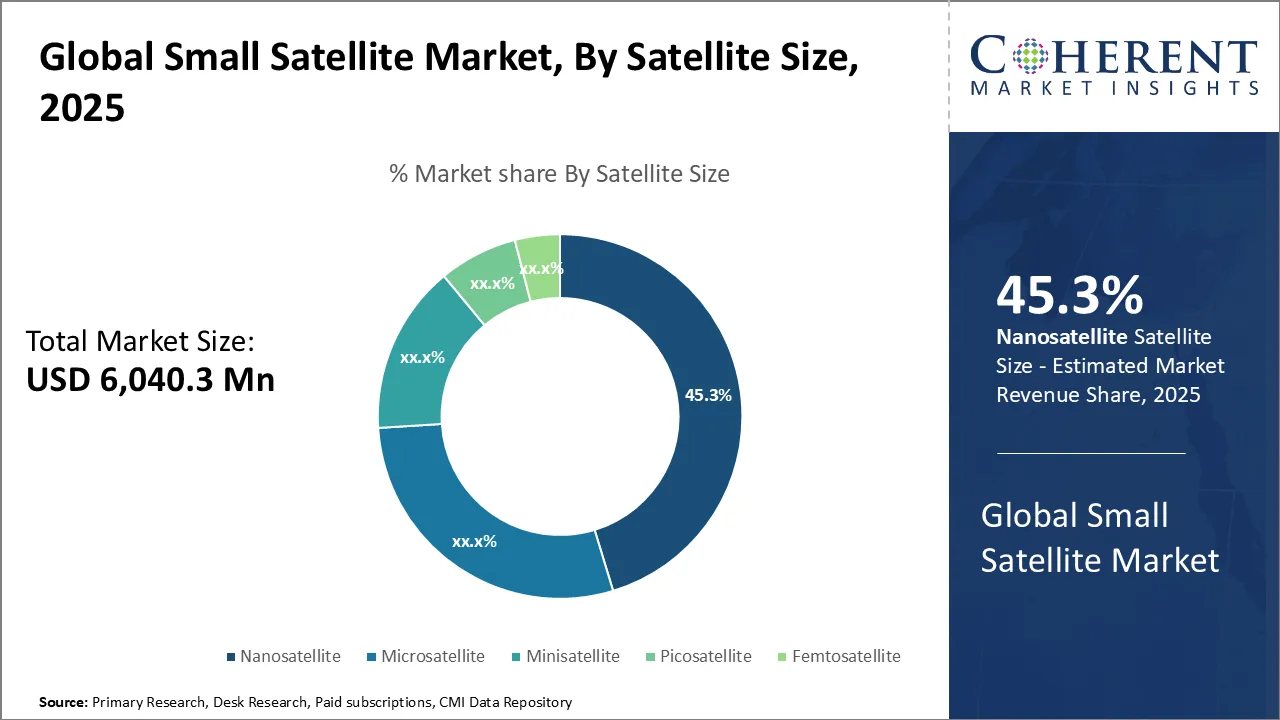
Global Small Satellite Market Insights, By Satellite Size: Nanosatellites Leads Due To Their Affordability and Scalability
In terms of satellite size, the nanosatellites segment is expected to hold the 46.3% share in 2026. They are extremely useful for business and research since they are small, inexpensive to make and launch, and can be used in large groups. People are using these satellites more and more in groups to cover large areas of land with real-time data. This is especially useful for things like communication and earth observation. Nanosatellites are the best choice for both new and old space agencies as they are easy to scale up and cheap.
For example, in September 2026, Australia's SPIRIT nanosatellite completed the first phase of its mission. This was a big step forward for the country's space capabilities. Developed to support scientific research and earth observation, SPIRIT showcases the growing role of nanosatellites in global space innovation. The mission highlights Australia’s commitment to advancing compact satellite technologies.
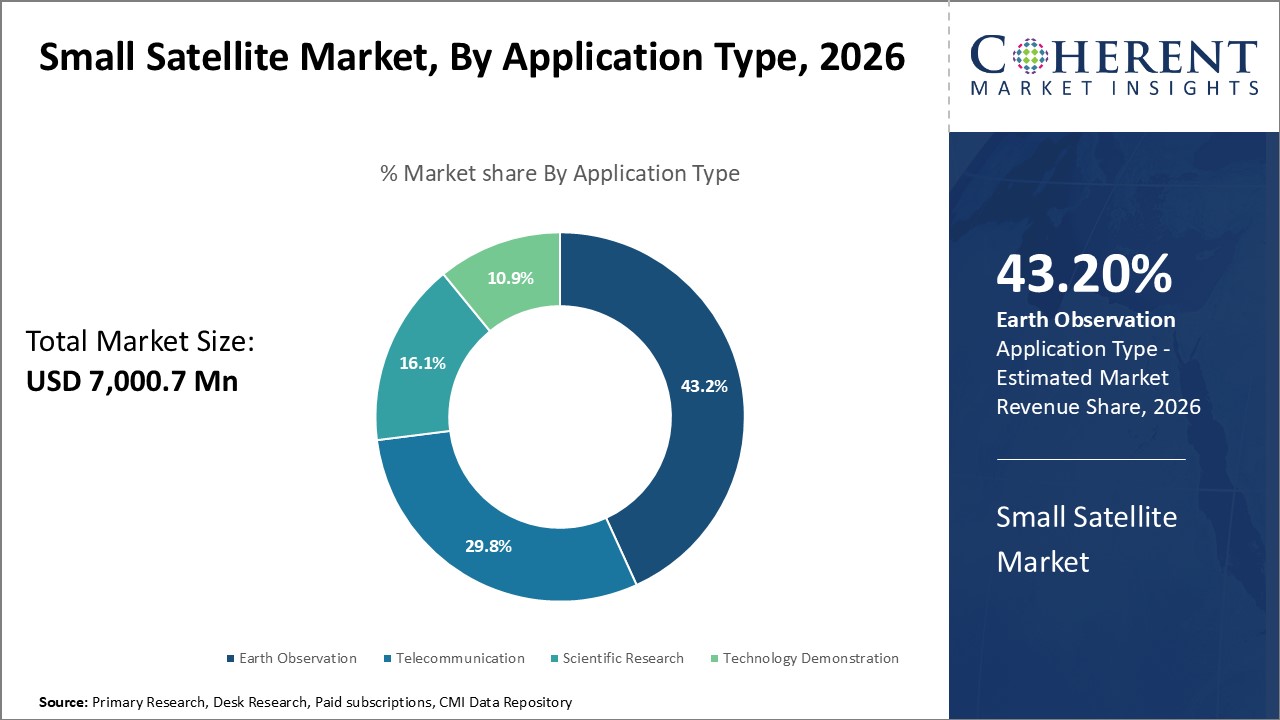
Global Small Satellite Market Insights, By Application Type: Earth Observation Dominance Is Driven by Demand for Real-Time Imaging and Environmental Monitoring
In terms of application type, the earth observation segment is expected to contribute the largest share of the market in 2026. This dominance is driven by the growing demand for high-resolution imagery and data analytics across sectors such as agriculture, environmental monitoring, urban planning, and disaster management. Small satellites equipped with advanced sensors and imaging technologies offer frequent revisit rates and cost-effective solutions for tracking changes on the planet’s surface. As governments and private enterprises increasingly rely on satellite data for decision-making, the earth observation segment continues to expand its market share.
For instance, in August 2025, India’s EOS-08 microsatellite successfully launched aboard the SSLV-D3, marking a key milestone in ISRO’s small satellite program. Designed for Earth observation, EOS-08 supports applications in agriculture, forestry, and disaster management. The mission highlights India’s growing capabilities in deploying compact, cost-effective satellites for real-time environmental monitoring and national development.
Global Small Satellite Market Insights, By End User: Commercial is Fueled by Private Sector Investments in Satellite-Based Services
In terms of end user, the commercial segment is projected to account for the highest share of the market in 2026. This growth is due to more private companies putting money into satellite-based services like broadband internet, Internet of Things (IoT) networks, and remote sensing. The commercialization of space has given satellite operators, data analytics companies, and service providers new ways to use small satellites for business intelligence, logistics, and infrastructure monitoring. Commercial companies are leading the way in deploying small satellites because there is a growing need for real-time, global coverage and data-driven solutions.
For instance, in August 2025, NASA’s DiskSat platform is nearing flight readiness, marking a breakthrough in commercial small satellite technology. Designed for very low Earth orbit, the compact, disk-shaped satellite supports commercial applications such as Earth observation and space situational awareness. The upcoming demonstration will validate its maneuverability and efficiency, paving the way for scalable, low-cost satellite services.
Regional Insights
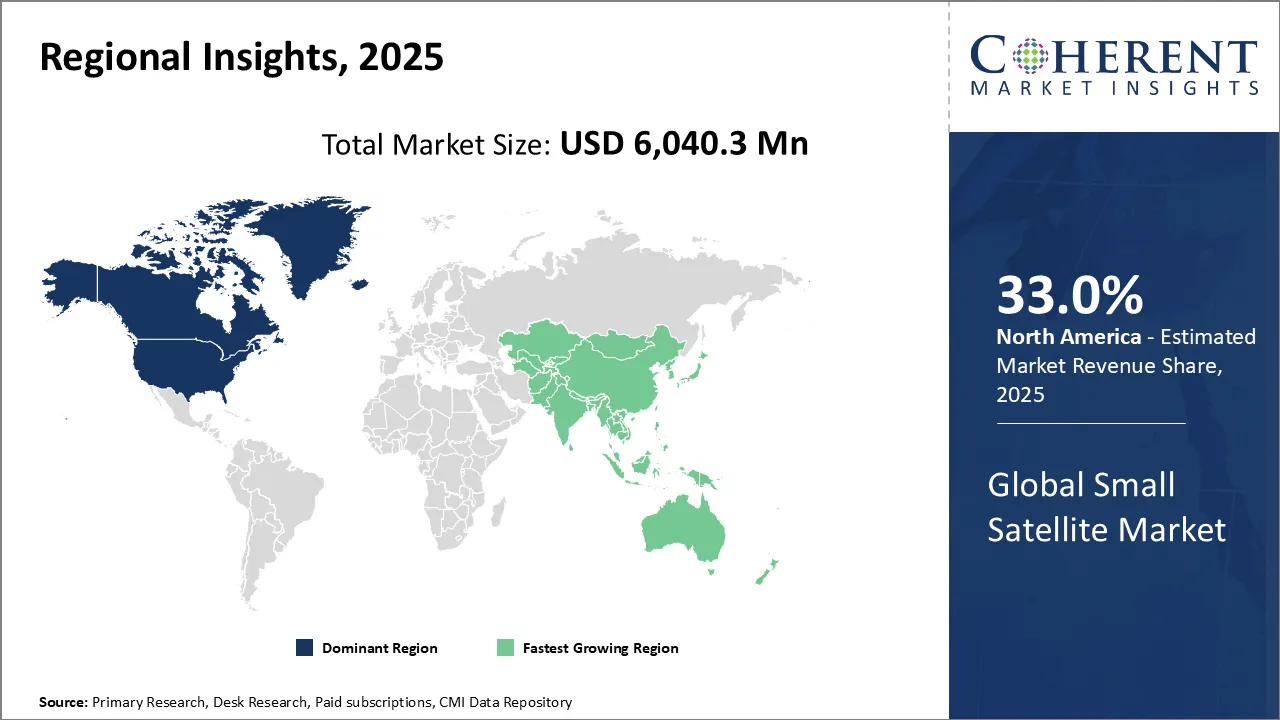
North America Small Satellite Market Analysis & Trends
North America held a dominant position in the global small satellite market in 2026 and is expected to maintain its dominance during the forecast period owing to the significant growth in the communication and telecom sector. Satellite communication technology offers data, voice, and video services in remote locations. It helps to track and monitor vehicles and vessels to offer efficient logistics support. Hence, the demand for small satellites in the communication and telecom sector in North America is driving the growth of the small satellite market.
For instance, in October 2026, SpaceX successfully launched 28 new Starlink satellites into low Earth orbit, expanding its global broadband network. Each satellite, classified as a small satellite, contributes to the growing constellation aimed at delivering high-speed internet worldwide. The launch underscores SpaceX’s continued leadership in commercial satellite deployment and space-based connectivity.
Asia Pacific Small Satellite Market Analysis & Trends
Asia Pacific is expected to emerge as the fastest-growing region for the small satellite market in the forecast period. The countries like India, China, Japan, Australia and others are investing significantly in small satellite projects owing to the diverse applications supported by the small satellites such as military surveillance, tracking assets, weather predictions, monitoring natural disasters, and others.
For instance, in October 2026, Malaysia’s UiTMSAT-2 nanosatellite, developed by Universiti Teknologi MARA, was successfully launched to the International Space Station via Japan’s HTV-X1 mission. As part of the ASEANSAT initiative, the 1U CubeSat supports earth observation, smart agriculture, and disaster management. Its deployment into low Earth orbit in early 2026 marks a milestone in ASEAN space collaboration.
Small Satellite Market Outlook Country-Wise
The U.S. Small Satellite Market Trends
The U.S. small satellite market is thriving due to rapid technological advancements, increased demand for real-time data, and growing interest in satellite-based services like Earth observation, communication, and IoT. Government initiatives and private sector innovation are accelerating deployment, making small satellites a key driver of space-based solutions across industries.
For instance, in June 2026, UC Davis and Proteus Space launched the first-ever dynamic digital twin in space using a small satellite platform. The Digital Twin Orbiter (DTO) will simulate real-time space conditions, enabling predictive modeling and diagnostics. This U.S.-based initiative marks a breakthrough in aerospace innovation, combining compact satellite technology with advanced digital simulation.
China Small Satellite Market Trends
China’s small satellite market is booming due to strong government support, rapid commercial space growth, and rising demand for Earth observation, IoT, and communication services. Local firms like Galactic Energy and Space Pioneer are driving innovation with cost-effective launch solutions, while national strategies emphasize satellite constellations for data, defense, and global connectivity.
For instance, in October 2026, Chinese launched firms Space Pioneer and Galactic Energy which are advancing toward IPOs, signaling strong momentum in the country’s commercial space sector. Both companies specialize in launching small satellites, with Galactic Energy’s Ceres-1 rocket and Space Pioneer’s Tianlong-2 supporting low Earth orbit missions. Their public listings aim to boost innovation and expand satellite deployment capabilities.
Market Report Scope
Small Satellite Market Report Coverage
| Report Coverage | Details | ||
|---|---|---|---|
| Base Year: | 2025 | Market Size in 2026: | USD 7,000.7 Mn |
| Historical Data for: | 2020 To 2024 | Forecast Period: | 2026 To 2033 |
| Forecast Period 2026 to 2033 CAGR: | 15.9% | 2033 Value Projection: | USD 19,666.5 Mn |
| Geographies covered: |
| ||
| Segments covered: |
| ||
| Companies covered: | Harris Corporation Airbus Defense and Space, Boeing, GeoOptics Inc., Lockheed Martin Corporation, Millennium Space Systems Inc., Northrop Grumman Corporation, OHB AG, OneWeb Ltd, Planet Labs Inc., Sierra Nevada Corporation, Singapore Technologies Engineering Limited, Space Exploration Technologies Corp. (Space X), Surrey Satellite Technology Ltd., and Thales Alenia Space. | ||
| Growth Drivers: |
| ||
| Restraints & Challenges: |
| ||
Global Small Satellite Market Drivers
Cost Efficiency of the Small Satellites
The cost efficiency of small satellites is a major driver behind small satellite market growth. Compared to traditional large satellites, these small platforms need a lot less money to be developed, launched, and run. Their light weight makes rideshare launches possible, which lowers deployment costs. Faster innovation and scalability are possible because of short manufacturing cycles and standardized parts. Small satellites can do a lot of different things, from watching the Earth to sending messages. This makes them great for startups, universities, and governments. As more people want real-time data and global connectivity, the low cost and flexibility of small satellites keep the market growing. This makes space access a more open and flexible frontier.
Technological Advancements
Technological advancements are significantly boosting small satellite market by enabling more powerful, compact, and cost-effective satellite systems. Innovations in miniaturized sensors, propulsion, and onboard computing have expanded mission capabilities, allowing small satellites to perform tasks once reserved for larger spacecraft. Enhanced launch technologies, such as reusable rockets and rideshare options, further reduce deployment costs. AI-driven data processing and real-time communication systems improve operational efficiency and responsiveness. These breakthroughs make small satellites ideal for Earth observation, climate monitoring, and global connectivity. As technology continues to evolve, the small satellite market value is expected to rise, transforming space access for governments and enterprises alike.
Global Small Satellite Market Opportunities
Earth Observation and Remote Sensing
Earth observation and remote sensing are key drivers of the small satellite market forecast, offering cost-effective, high-resolution data for agriculture, disaster management, urban planning, and climate monitoring. Small satellites enable frequent revisits and real-time imaging, making them ideal for dynamic Earth monitoring. Their compact size and lower launch costs allow for deployment in constellations, enhancing global coverage and data continuity. Governments, research institutions, and private firms increasingly rely on these satellites for actionable insights. As demand for geospatial intelligence grows across sectors, the Small Satellite Market is anticipated to show robust expansion, fueled by innovation in imaging technologies and data analytics capabilities.
Remote Sensing and Weather Forecasting
Small satellites equipped with remote sensing instruments can collect data on weather patterns, atmospheric conditions, and climate variables. This information is vital for accurate weather forecasting, climate modeling, and disaster management. Private companies and government agencies can use the small satellites for these purposes.
Global Small Satellite Market Trends
Increasing Launch Capacity
The availability of dedicated small satellite launch services and rideshare options has expanded significantly. Several companies are developing small satellite launchers, and established launch providers are offering rideshare opportunities on larger rockets. This increased launch capacity enables more frequent and cost-effective access to space for small satellite operators. For Instance, In February 2023, the Small Satellite Launch Vehicle (SSLV) designed and developed by the ISRO has successfully launched their second developmental launch these SSLV has launch capacity up to 500Kg satellites which can result into low cost access to space and flexibility in carrying multiple small satellites at once.
Miniaturization and Advanced Technology
There is a strong emphasis on miniaturization in the small satellite industry. Advances in miniaturized components, including sensors, cameras, communication systems, and propulsion systems, have allowed for the development of highly capable small satellites. Smaller satellites also benefit from reduced manufacturing and launch costs.
Analyst Opinion (Expert Opinion)
The small satellite market is entering a period of controlled growth, where service differentiation and operational resilience are more important than hardware proliferation. In 2024, there will be almost 2,800 small satellites launched, each weighing an average of 223 kg. The industry is moving from expanding based on volume to deploying based on performance. Customers want high-resolution imaging, real-time connectivity, and secure data services, so the shift to heavier, more powerful payloads is a response to that.
Launch costs are still very important. Rideshare programs, especially those from SpaceX, are the main way to get to orbit, but they also make the system more dependent on them. At the same time, business is moving toward multi-year, customized contracts. Planet Labs' US$230 million satellite order shows that there is a growing need for guaranteed data capacity and mission control.
However, orbital congestion and the growth of space debris have become major problems for businesses and the government. As sustainability becomes a key part of licensing and insurance, companies that invest in deorbiting technologies and systems that help avoid collisions are likely to have an edge over their competitors.
Hardware is becoming less valuable, and the only way to stand out in the long term is through analytics, reliability, and following through on contracts. The most resilient operators will find a balance between vertical integration and partnerships, offer a variety of ways for clients to launch, and put intelligence directly into client operations. In this changing world, success will depend on turning orbital capability into lasting, data-driven value instead of just trying to get more satellites.
Speak to the analyst
Want personalized insights?
Take the findings above to one of our principal consultants, or have the report rebuilt around the segments, geographies and competitors you actually track.
Global Small Satellite Market: Key Developments
- In October 2025,SpaceX successfully launched 28 Starlink satellites aboard a Falcon 9 rocket from California, expanding its global broadband internet constellation. The small satellites, each weighing around 260 kg, were deployed into low Earth orbit. This mission underscores the growing role of small satellites in delivering affordable, high-speed connectivity worldwide.
- In September 2025, ISRO signed a technology transfer agreement with Hindustan Aeronautics Limited (HAL) for its Small Satellite Launch Vehicle (SSLV). The pact aims to boost India’s commercial space capabilities by enabling HAL to manufacture and deploy SSLVs, which are designed to launch small satellites into low Earth orbit efficiently and cost-effectively.
- In February 2025, An Adani-backed firm is among three finalists selected by the Indian government to develop small satellite launch vehicles. This initiative aims to boost India’s private space sector by enabling cost-effective deployment of small satellites. The move reflects growing demand for indigenous launch capabilities and aligns with India’s broader strategy to expand its commercial space footprint.
Market Segmentation
- Global Small Satellite Market, By Satellite Size (Revenue, USD Mn, 2021 - 2033)
- Minisatellite
- Microsatellite
- Nanosatellite
- Picosatellite
- Femtosatellite
- Global Small Satellite Market, By Application Type (Revenue, USD Mn, 2021 - 2033)
- Earth Observation
- Telecommunication
- Scientific Research
- Technology Demonstration
- Global Small Satellite Market, By End User (Revenue, USD Mn, 2021 - 2033)
- Civil
- Defense
- Commercial
- Government
- Global Small Satellite Market, By Region (Revenue, USD Mn, 2021 - 2033)
- North America
- U.S.
- Canada
- Latin America
- Brazil
- Argentina
- Mexico
- Rest of Latin America
- Europe
- Germany
- U.K.
- Spain
- France
- Italy
- Russia
- Rest of Europe
- Asia Pacific
- China
- India
- Japan
- Australia
- South Korea
- ASEAN
- Rest of Asia Pacific
- Middle East & Africa
- GCC Countries
- Israel
- Rest of Middle East & Africa
- North America
- Global Small Satellite Market Companies Insights (Revenue, USD Mn, 2021 - 2033)
- Harris Corporation Airbus Defense and Space
- Boeing
- Geooptics Inc.
- Lockheed Martin Corporation
- Millennium Space Systems Inc.
- Northrop Grumman Corporation
- OHB AG
- OneWeb Ltd, Planet Labs Inc.
- Sierra Nevada Corporation
- Singapore Technologies Engineering Limited
- Space Exploration Technologies Corp. (Space X)
- Surrey Satellite Technology Ltd.
- Thales Alenia Space.
Sources
Primary Research Interviews from the following stakeholders
Stakeholders
- Interviews with satellite manufacturers, launch service providers, satellite operators, subsystem suppliers, ground station operators, and government space agencies across key global markets.
Specific stakeholders
- Program directors and mission planners at national space agencies (e.g., NASA, ISRO, ESA, JAXA)
- Chief engineers and R&D heads at small satellite OEMs (e.g., CubeSat and microsatellite developers)
- Commercial satellite operators and NewSpace startups (e.g., Planet Labs, Spire, Satellogic)
- System integration leads and payload developers in Earth observation, communication, and IoT sectors
- Launch vehicle manufacturers and service coordinators (e.g., SpaceX, Rocket Lab, Arianespace)
- Ground station network managers and satellite communication service providers
- Component suppliers for propulsion systems, power subsystems, onboard computers, and ADCS (Attitude Determination and Control Systems)
- Academic and research institutions involved in nanosatellite and university satellite programs
- Defense and intelligence community representatives involved in reconnaissance and ISR missions
Databases
- Union of Concerned Scientists (UCS) Satellite Database
- International Telecommunication Union (ITU) Space Services Database
- Euroconsult Satellite Industry Database
- United Nations Office for Outer Space Affairs (UNOOSA) Registry of Objects Launched into Outer Space
- World Bank Open Data – Space and Technology Statistics
- European Space Policy Institute (ESPI) Space Data Portal
- Federal Aviation Administration (FAA) Commercial Space Transportation Reports
- OECD Space Forum Data
- European Space Agency (ESA) Annual Reports and Space Environment Data
- Space-Track.org (U.S. Department of Defense database for satellite catalog)
Magazines
- SpaceNews
- Satellite Evolution Group
- Aerospace America
- Orbit Magazine
- Launchspace Magazine
- Astronomy Technology Today
- SpaceTech Asia
- NewSpace International
- Aerospace & Defense Review
Journals
- Acta Astronautica (Elsevier)
- Journal of Small Satellites (JoSS)
- Aerospace Science and Technology (Elsevier)
- Journal of Spacecraft and Rockets (AIAA)
- IEEE Transactions on Aerospace and Electronic Systems
- Advances in Space Research
- Space Policy Journal (Elsevier)
- International Journal of Satellite Communications and Networking
- Remote Sensing (MDPI)
Newspapers
- The Wall Street Journal – Space & Aerospace Section
- Financial Times – Aerospace & Defence Reports
- The Economic Times – Space and Technology
- Nikkei Asia – Space Business and Satellite Manufacturing
- The Hindu Business Line – Aerospace & Defence
- South China Morning Post – Space Industry Developments
- The Guardian – Science and Technology
- The Washington Post – Space Exploration and Defense
Associations and Organizations
- International Astronautical Federation (IAF)
- Space Foundation
- American Institute of Aeronautics and Astronautics (AIAA)
- International Telecommunication Union (ITU)
- United Nations Office for Outer Space Affairs (UNOOSA)
- Space Data Association (SDA)
- Asia-Pacific Regional Space Agency Forum (APRSAF)
- National Space Society (NSS)
- Secure World Foundation (SWF)
- International Space University (ISU)
- Confederation of Indian Industry (CII) – Aerospace and Defence Forum
Public Domain Sources
- National Aeronautics and Space Administration (NASA) – Small Satellite Missions Database
- European Space Agency (ESA) – Small Satellite Programs
- Indian Space Research Organisation (ISRO) – Launch Records and Satellite Missions
- Japan Aerospace Exploration Agency (JAXA) – Small Satellite Initiatives
- Department of Space (Government of India)
- Ministry of Defence (UK) – Space Directorate Reports
- Federal Aviation Administration (FAA) – Space Transportation Data
- Office of Space Commerce (U.S. Department of Commerce)
- National Oceanic and Atmospheric Administration (NOAA) – Satellite Operations Data
- Space Development Agency (U.S. Department of Defense)
- European Commission – Space Industry Policy Reports
- OECD – The Space Economy Reports
Proprietary Elements
- CMI Data Analytics Tool
- Proprietary CMI Existing Repository of information for last 8 years
Get access to 250+ pages report
Every segment, forecast, competitor profile and data table behind the analysis above — available for instant download.
- ESOMAR Member
- ISO 9001:2015 Certified
- D-U-N-S Registered
- GDPR & CCPA Compliant
Missing comfort of reading report in your local language? Find your preferred language:
Transform your Strategy with Exclusive Trending Reports
Frequently Asked Questions
The Small Satellite Market is estimated to be valued at USD 7,000.7 Mn in 2026, and is expected to reach USD 19,666.5 Mn by 2033.
The CAGR of the Small Satellite Market is projected to be 15.9% from 2026 to 2033.
Major factor driving the growth of market during the forecast period is Cost Efficiency of the Small Satellites.
Major factors hampering the growth of the market during the forecast period is Limited Payload Capacity and Capabilities
North America market is expected to generate the highest revenue during the forecast period.