

Telecom API Market Analysis & Forecast: 2026-2033
The Telecom API Market is anticipated to grow at a CAGR of 23.7% with USD 905.5 Bn in 2026 and is expected to reach USD 3,523.3 Bn in 2033. The Telecom API market is driven by 5G expansion, IoT integration, and enterprise demand for programmable communications such as messaging and payments. For instance, in December 2025, Twilio supports over 402,000 active customer accounts globally with its communications APIs, including SMS, voice, and verification services, demonstrating broad business adoption in 2025; meanwhile, Verizon’s API platform enables enterprises to integrate programmable voice, video, and data communication capabilities into business applications, enhancing customer engagement and digital workflows. North America dominates the Telecom API market due to rapid 5G adoption and smartphone penetration, driving significant demand for messaging and communication services.
Source: TWILIO INC.; Verizon
Key Takeaways
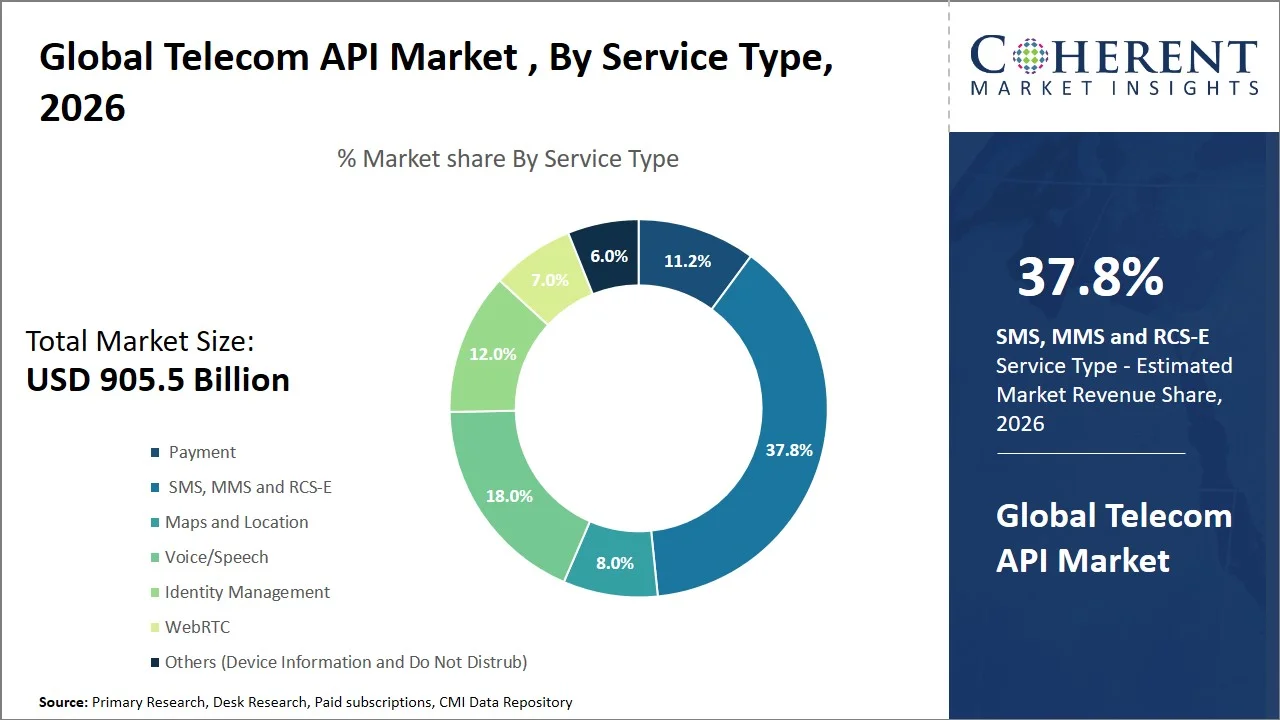
- SMS, MMS and RCS-E is expected to account the largest share of 37.8% in 2026. Messaging APIs remain the largest revenue pool because enterprises still rely on them for OTPs, alerts, transactional notifications, and customer engagement. One market source project global A2P traffic at 2.2 trillion messages in 2024, while Twilio reports 39% of consumers prefer SMS/MMS for business communication and 62% want to message businesses through messaging channels.
- Enterprise developer will dominate with 43.0% in 2026, because enterprises typically drive the majority of API purchases, integrations, and long‑term telecom digital transformation projects. The GSMA Open Gateway initiative unites 85+ mobile operator groups representing over 300 mobile networks and about 80% of global mobile connections around a common API framework that exposes network capabilities to developers at scale. This global participation shows the strong ecosystem backing for telecom APIs that enterprises leverage for large‑scale services.
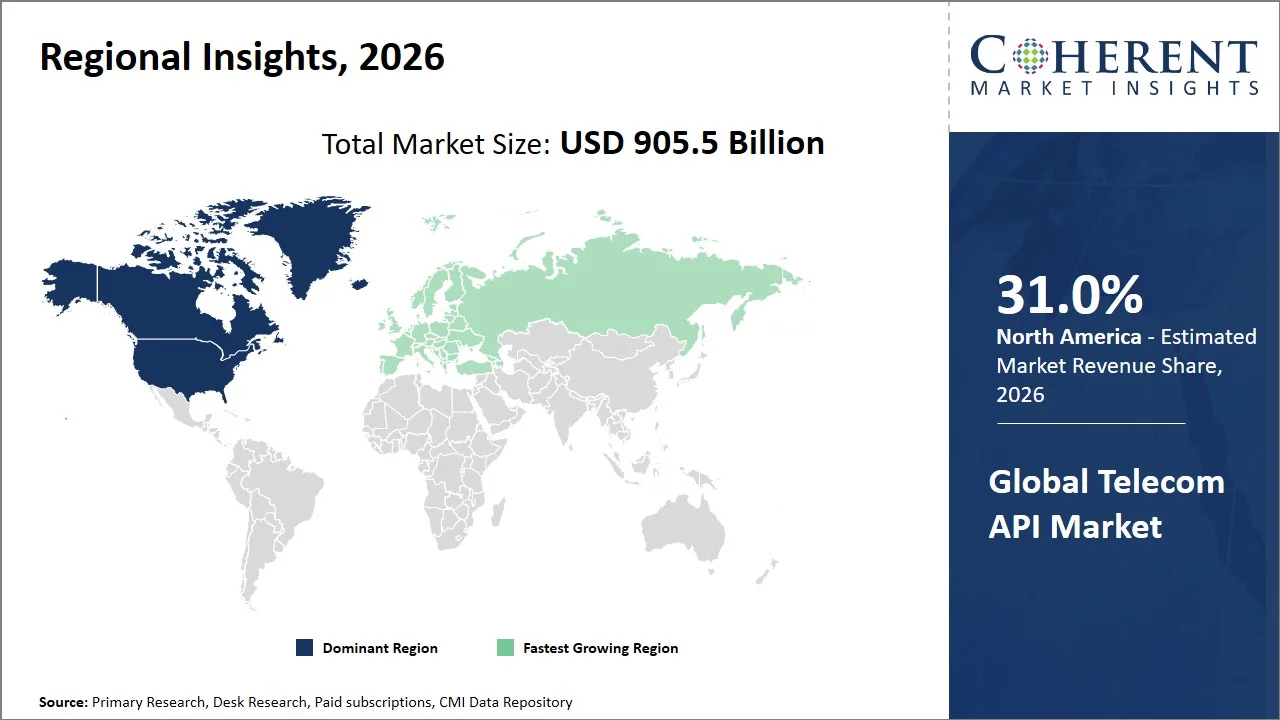
- North America is expected to acquire the dominant share of 31.0% in 2026, attributed to rapid mobile adoption, broad digital transformation across industries, and growing API usage for messaging, location, payment, and other telecom services. North America’s leadership is driven by Twilio’s growth of 200,000+ developers, Verizon’s 5G IoT APIs, and AT&T’s collaborations with Google Cloud to advance edge computing and 5G APIs.
Segmental Insights
Why is SMS, MMS and RCS-E Acquiring the Largest Market Share?
SMS, MMS and RCS-E is projected to account for the largest share of cognitive systems spending in 2026, representing approximately 37.8% of the total volume. A major reason for dominance is ubiquity and reliability. SMS works across virtually all types of mobile users reachable through operator networks, while API providers emphasize broad carrier connectivity, delivery tracking, routing optimization, and production-ready compliance support. That makes messaging APIs highly practical for mission-critical communication where businesses value immediacy and dependable delivery more than feature richness alone. For instance, in august 2025, Twilio Inc., cloud communications platform-as-a-service (CPaaS) company announced the general availability of Rich Communication Services (RCS) messaging with branded, interactive features marking a major evolution beyond traditional SMS and MMS for enterprise engagement. Furthermore, in March 2026, Twilio Inc., cloud communications platform-as-a-service (CPaaS) company powered an expanded deployment of RCS messaging with Televox, enabling secure, branded, interactive customer communication at scale a major indicator that enterprises are migrating from simple SMS/MMS to rich messaging via APIs. Also in 2026, Twilio updated its Programmable Messaging stack to unify opt‑out handling across SMS, MMS, and RCS, simplifying compliance and improving cross‑channel management for enterprises. Meanwhile, by early 2026, Indian API provider Kaleyra was highlighted as delivering enterprise‑grade RCS APIs with high uptime and multi‑channel support, driving uptake among banks and large brands.
Additionally, in March 2026, Bharti Airtel teamed with Google to enhance RCS spam protection, supporting broader adoption of enhanced messaging services. These 2026 instances show the SMS/MMS/RCS‑E API segment’s commercial momentum and enterprise adoption in real deployments.
Source: Twilio Inc.
- Current Industry Events of 2026
- Market Size Estimation
- Regional Breakdown
- Competitive Landscape
- Customer Intelligence
- Segmental Analysis
- Pricing Analysis
- Key Market Drivers, Challenges & Future Trends
- Customized Insights Section
Enterprise Developer holds the Largest Market Share
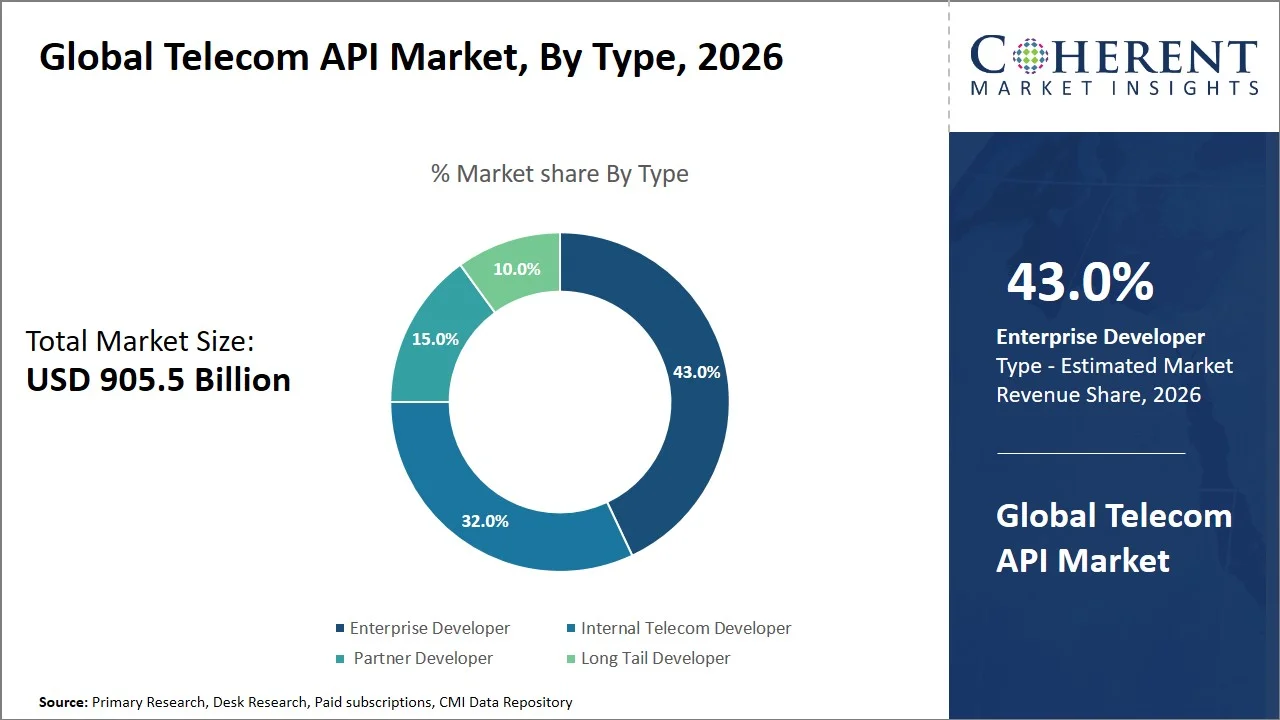
Based on type, enterprise developer dominates the market, accounting for a significant 43.0% share in 2026, reflecting they use APIs at much larger scale and higher business criticality than internal, partner, or long-tail developers. Large enterprises embed messaging, voice, video, authentication, and customer-engagement APIs directly into core systems such as CRM, contact centers, apps, banking flows, logistics platforms, and customer support journeys. That scale is visible in Twilio’s enterprise footprint: it reported more than 402,000 active customer accounts as of December 31, 2025, while its enterprise platform highlights 4,800 global carrier connections and 29.7 billion voice calls annually.
Another major factor enterprise developers lead is that they are the earliest buyers for high-value security, identity, and fraud-prevention APIs, where the ROI is immediate. Vonage positions its network APIs around KYC, onboarding, SIM-swap detection, and identity checks, while Ericsson specifically highlights banks and financial companies as target users for fraud-prevention network APIs and even lists enterprise pay-per-use monetization as a model. These are enterprise-grade use cases, not hobbyist or small-developer workloads. The growth of enterprise developers in this market is being driven by standardization and easier multi-operator access. In December 2025, GSMA’s Open Gateway framework and related initiatives are reducing fragmentation by giving enterprises and developers more common, interoperable ways to access network capabilities. GSMA notes that 73 operator groups representing about 285 networks and nearly 80% of global mobile subscribers are now committed to Open Gateway, while GSMA Fusion is explicitly designed to connect enterprises and operators through programmable APIs and real-world industry collaboration.
A further growth driver is the move toward 5G-era network APIs. For instance, in February 2025, AT&T, T-Mobile, and Verizon announced the first standardized 5G network APIs in the U.S. through Aduna, including Number Verification and SIM Swap APIs. AT&T said this gives developers a single, trusted interface for building advanced applications at scale. That kind of interoperability strongly favors enterprise developers, because they need secure deployment across markets, compliance-ready authentication, and carrier-grade performance for banking, commerce, mobility, and other large-scale applications.
Market Driver
Rising Proliferation of Mobile Internet and Cloud Technologies
Increasing proliferation of mobile internet and cloud technologies has driven the telecom API market growth over the forecast period. As mobile internet adoption surges, enterprises are increasingly developing mobile-first applications that rely heavily on telecom APIs for messaging, authentication, real-time communication, and mobile data services. APIs like SMS, MMS, RCS, and voice are integral to supporting these mobile applications, particularly for customer engagement, mobile payments, and security solutions. For instance, according to the data published by the GSM Associations in 2026, the mobile internet user base is expected to reach 5.7 billion by 2025, providing a vast opportunity for telecom API providers to cater to mobile‑enabled applications.
The proliferation of cloud technologies allows telecom operators to provide scalable, flexible, and cost-effective APIs that enterprises can integrate into their digital infrastructure without heavy upfront investments. The rise of cloud‑native services helps businesses to quickly adopt and deploy programmable telecom services like voice, messaging, and data analytics, resulting in faster time-to-market for applications. Cloud adoption is growing rapidly the global cloud services market is projected to reach USD 832.1 billion by 2025, which correlates with the increasing need for telecom APIs to support cloud-based communication and infrastructure.
Furthermore, with 5G networks rolling out globally, there is a growing need for advanced telecom APIs that can handle higher data throughput, lower latency, and support the Internet of Things (IoT), enabling smart cities, automated industries, and real-time applications. Telecom APIs enable seamless integration of services in 5G environments by providing tools for mobile operators to enhance network capabilities and connectivity. For instance, in 2026, according to the data published by the GSMA association, 5G adoption will fuel exponential growth in IoT devices, pushing demand for telecom APIs that connect, manage, and optimize networked devices. According to GSMA, 5G will connect 1.4 billion users by 2025, creating an immense need for APIs.
Increasing access to 4G LTE network
Increasing access to 4G LTE networks significantly fuels the market growth of the Telecom API market by enabling high‑speed mobile broadband and seamless data transmission prerequisites for modern For instance, in September 2025, according to the SAMENA Council’s “4G/5G Outlook Report (2025)”, about 7.6 billion people worldwide (≈93 % of the global population) were within the reach of 4G mobile broadband coverage in 2025, providing a strong foundation for APIs that depend on mobile data connectivity. Additionally, according to the International Telecommunication Union (ITU) estimates published via Our World in Data (2025), roughly 6 billion people (≈74 % of the global population) were using the Internet, enabled primarily by widespread 4G access. Greater 4G access enhances mobile application performance and API responsiveness, broadening use cases across industries and increasing adoption of Telecom APIs for digital communication and enterprise integration.
Source: SAMENA Council
Unlocking New Possibilities: The Impact of Innovation on Telecom API Expansion
Rising innovation and telecom API expansion has created significant opportunity for the growth of the telecom API market in the near future. Telecom APIs have transformed traditional network capabilities into programmable, enterprise‑friendly services, enabling developers to integrate messaging, voice, location, payment, and data functions into software applications. This shift from legacy monolithic systems toward API‑centric architectures is powered by innovation in cloud platforms, standardized API frameworks, and telecom operator openness to third‑party developers. Such innovations reduce development time and costs, creating a dynamic ecosystem where telcos become digital service enablers rather than mere connectivity providers. Standardization efforts like GSMA’s Open Gateway initiative also facilitate interoperable APIs across carriers, simplifying global development and accelerating new service delivery.
Innovation has rapidly transformed telecom APIs from basic connectivity tools into strategic enablers of digital services. Leading operators such as AT&T now expose programmable APIs for messaging, voice, and location services, enabling enterprises to integrate communication workflows into apps and systems AT&T’s API Marketplace has been active and updated as of March 2026 and is widely used by developers. Vonage’s Nexmo APIs (now Vonage Communications APIs) power enterprise SMS and voice globally, supporting real‑time engagement at scale; Vonage documentation was last updated in February 2026. Historically, Comverse’s messaging platforms deployed in over 450 service providers across 125+ countries laid early foundations for modern API‑centric messaging services (data verified as of April 2026). These innovations help carriers unlock new revenue streams and support rapid creation of customer‑centric digital services worldwide. For instance, in February 2025, a major industry collaboration between AT&T, T‑Mobile, and Verizon (via Aduna) announced the first standardized 5G network APIs in the United States, including Number Verification and SIM Swap APIs. This effort aims to give developers access to core carrier capabilities for secure authentication, fraud prevention, and trust‑based services marking a significant push toward interoperable carrier‑grade network APIs. Moreover, in July 2025, the GSMA Open Gateway portal and CAMARA project were heavily promoting the standardization and commercialization of network APIs, enabling developers to integrate multi‑carrier network capabilities easily.
Furthermore, for instance, in October 2024, Strava, a fitness tracking app with millions of active users, integrated Infobip’s omnichannel SMS API to improve communication for real‑time location updates and notifications to athletes during events. With Infobip, Strava achieved 95% SMS delivery across 190+ countries, ensuring uninterrupted communication during global sporting events. This boosted Strava’s real‑time engagement and helped Infobip’s SMS API reach a wider audience, highlighting the growing demand for reliable communication solutions in fitness and real‑time data services. It also paved the way for future integrations of APIs that support high‑volume SMS services in the sports and fitness industry.
Current Events and Their Impact on the Telecom API Market
Current Event | Description and its Impact |
Ecosystem Expansion, Regulatory Facilitation & Standardization |
|
Regulatory evolution leading to diversification of services |
|
Regulatory and compliance-driven growth boosts security & trust in messaging APIs |
|
Telecom API Market Trends
AI integration and AI ‑ Enabled Telecom APIs
Telecom operators and industry bodies like the GSMA launched initiatives such as Open Telco AI in 2026 aiming to accelerate telco‑specific AI models that can optimize network operations and support advanced API services. This trend links AI with API automation for network management, anomaly detection, and personalized services.
5G and 5G ‑ Enabled Programmable Networks & Network APIs
The rollout of standalone 5G networks and edge computing infrastructure increases demand for APIs that can expose network slicing, edge services, and real‑time data processing enabling developers to build responsive, localized applications. With 5G adoption expanding rapidly, operators are exposing network capabilities (like slicing, low latency paths, location services) through network‑level APIs that enable real‑time enterprise use cases such as AR/VR, autonomous systems, and industrial IoT unlocking Network‑as‑a‑Service. For instance, on February 27, 2025, AT&T, T-Mobile, and Verizon announced the first standardized 5G Network APIs in the U.S., starting with 2 launch APIs: Number Verification and SIM Swap. This is important because once 3 major U.S. operators expose the same standardized APIs, developers can build one service and scale it across multiple carrier networks more easily. Aduna’s 2026 platform also shows support across 6 API segments and a community of 12 telecom operator partners, which strengthens the case for multi-operator programmable networks.
IoT and Device ‑ Driven Services
As IoT ecosystems expand, APIs are increasingly used for device management, location services, and M2M communication, especially in smart cities, automotive telematics, and industrial applications. APIs act as the integration layer between devices and backend networks. For instance, in 2026, Fortumo’s Connectivity API enables IoT devices to use mobile billing and subscription services directly from mobile networks. As of January 2026, Fortumo claimed that 3 million new IoT devices connected through their API, specifically in smart metering and wearable tech. The API’s focus on low-cost, high-efficiency connectivity is driving its adoption in IoT industries that need scalable and cost-effective solutions. Furthermore, Nexmo’s IoT APIs allow enterprises to deploy millions of IoT devices quickly on mobile networks. As of February 2026, Nexmo reported a 500% increase in usage by IoT-centric companies for mobile data routing services, especially in sectors like healthcare and logistics. The advanced mobile connectivity API ensures high availability and secure communication for real-time monitoring and decision-making.
Regional Insights
North America Dominates the Telecom API Market Owing to Strong Enterprise Demand
The North America region hold the dominant position in the global market accounting 31.0% market share in 2026, because it combines high 5G readiness, early carrier API commercialization, strong enterprise demand, and supportive spectrum policy. GSMA says 60% of North America’s mobile internet users already connect through 5G, and it specifically points to effective spectrum policy, deregulation, and sustained mobile investment as key growth enablers.
A second major factor is faster API standardization across leading operators. In February 2025, AT&T, T-Mobile, and Verizon moved to launch standardized Number Verification and SIM Swap APIs in the U.S. through Aduna, which reduces fragmentation and makes it easier for developers and enterprises to scale use cases nationally.
Canada adds further momentum. In 2025, the Canadian government announced new mmWave spectrum measures for innovative 5G services, and EnStream’s partnership with Aduna expanded authentication and fraud-prevention APIs with broad national coverage.
Asia Pacific Grow at Fastest Rate in the Telecom API Market
Asia Pacific is the fastest growing region in the market as the region combines huge mobile-user scale, fast network modernization, and very high digital-service usage. GSMA indicates that around 40% of new mobile internet subscribers added globally between 2025 and 2030 will come from Asia-Pacific, led by markets such as India, Pakistan, and Indonesia, which creates massive demand for messaging, authentication, voice, and location APIs. The region is also moving quickly on 5G, with GSMA noting that 5G is projected to account for 50% of Asia-Pacific mobile connections by 2030, expanding the addressable market for higher-value network APIs. Another major factor is the region’s mobile-first digital economy. India’s DPI push links identity, payments, and secure data exchange into everyday services, while UPI processed 22.64 billion transactions in March 2026, showing the scale of API-heavy use cases such as OTPs, notifications, fraud checks, and customer engagement.
Asia-Pacific also has a strong operator-led API commercialization ecosystem. Recent examples include Bharti Airtel opening 5G network APIs with Nokia in December 2025, Globe expanding its network API collaboration with Nokia in January 2026, and Philippine operators PLDT, Globe, and DITO collaborating through GSMA Open Gateway in March 2025. These moves accelerate standardization and make APIs easier for enterprises and developers to deploy at scale.
China’s Telecom API Market Dominance: Key Drivers of Innovation and Expansion in the Asia-Pacific Region
China holds a dominant position in the Asia-Pacific telecom API market due to several compelling factors. Firstly, China’s massive mobile subscriber base, which exceeds 1.6 billion connections, provides a vast market for telecom APIs like messaging, payments, and authentication. The country's 5G network expansion, driven by both state-owned and private companies, is accelerating the deployment of advanced telecom APIs to support next-gen services like IoT, edge computing, and autonomous vehicles. For instance, in 2025, China Mobile’s 5G rollout drove the adoption of cloud-based APIs for enhanced connectivity. Additionally, China’s strong government-backed infrastructure projects and innovative smart city initiatives like Hangzhou’s AI-driven urban services are fueling demand for telecom APIs. With continuous regulatory support and investment in digital infrastructure, China remains the dominant player in shaping the region’s telecom API ecosystem.
Rising technology advancement and infrastructure expansion in China has driven the growth of the telecom API market in the China country. For instance, In January 2026, China’s three major telecom operators China Mobile, China Telecom, and China Unicom joined the GSMA Open Gateway initiative. This move enhances the interoperability of telecom APIs and promotes third-party developers to access standardized telecom services, advancing the region's API ecosystem. Furthermore, In March 2026, China Telecom and Huawei won multiple industry awards at the Mobile World Congress (MWC) 2026 for their groundbreaking work in AI-powered mobile networks, satellite NTN connectivity, and the deployment of UWB AAU base stations. These awards reflect China’s leadership in telecom infrastructure innovation and the ability to deliver advanced telecom solutions globally. At the Mobile World Congress (MWC) 2026, China Telecom presented its AI-driven transformation strategy, focusing on cloud‑network integration and advanced AI services. The company’s vision shifts China Telecom from a traditional telecom provider to a technology-oriented enterprise, demonstrating how AI and cloud solutions are redefining telecom infrastructure and services for next-generation needs.
U.S. Telecom API Market Trends
U.S. has become the biggest player in the North America telecom API market in 2026. The U.S. stands out as the dominant country in the North American telecom API market due to several key factors, including its advanced technological infrastructure, robust telecom ecosystem, and early adoption of 5G technologies. The U.S. is home to leading telecom operators like AT&T, Verizon, and T-Mobile, who have been instrumental in commercializing telecom APIs, making them a foundational part of the country's digital transformation. Moreover, because U.S. country combines a very large carrier base, mature enterprise API infrastructure, and a dense concentration of telecom-API platform leaders. On the carrier side, AT&T states that it serves more than 100 million U.S. families, friends and neighbors, plus nearly 2.5 million businesses, giving API-based services a massive domestic commercialization base. AT&T also announced in 2026 the launch of the first standardized 5G Network APIs in the U.S., enabling developers to access verification capabilities across all three major U.S. carriers through one interface, which lowers integration friction and speeds enterprise adoption.
The U.S. is also home to leading API-enablement platforms. Twilio says its authentication stack handles 4.5B+ verifications each year, 130B messages annually, delivers 99.95%+ monthly API uptime, and works with 1,500+ global carrier partners; its messaging API can reach 7B+ devices with SMS, MMS, RCS, and WhatsApp through one integration. Google Cloud Apigee adds enterprise-scale API management with support for up to 75B standard API proxy calls and up to 99.99% SLA on Enterprise Plus. Vonage (formerly Nexmo) expands the ecosystem further with APIs spanning SMS/MMS, RCS, voice, video, and identity, and says its Silent Authentication can make 2FA up to 2x faster while its platform scales to nearly 200 countries and 2,000+ networks.
Who are the Major Companies in Telecom API Market
Some of the major key players in Global Telecom API Market are AT&T, Inc., Comverse, Inc., Apigee Corp., Nexmo, Inc., LocationSmart, Fortumo OU, Alcatel-Lucent, Aepona Ltd., Orange S.A., Tropo, Inc., Twilio, Inc., and Huawei
Key News
- In April 2026, Twilio Inc., San Francisco-based cloud communications platform (CPaaS) launched its Consent Management API (Public Beta). This API lets developers programmatically sync, store, update, and manage end‑user consent for messaging channels including RCS, SMS, and MMS centralizing consent data and enforcing compliance without code changes.
- In March 2026, Nokia, telecommunications company expanded its Network as Code ecosystem at MWC26, advancing API‑based agentic AI with Google Cloud. This makes programmable network APIs usable by enterprise agents (i.e., AI workflows can call network APIs automatically). The partner ecosystem includes operators like Orange, Telefónica, Tata Communications, Deutsche Telekom, Globe, Rakuten, TELUS, Vodafone, and more, boosting network API adoption. This illustrates a major 2026 API initiative for programmable connectivity and monetization.
- In March 2026, Google Cloud, a company that provides a suite of modular cloud computing services announced integration of Nokia’s Network as Code (NaC) platform with its agentic AI stack (using Gemini‑based AI agents), enabling AI agents to interact with programmable network APIs (e.g., QoS, slicing, identity) and manage network lifecycle tasks automatically via intent‑driven workflows. This bridges core network APIs and AI development environments.
Market Report Scope
Telecom API Market Report Coverage
| Report Coverage | Details | ||
|---|---|---|---|
| Base Year: | 2025 | Market Size in 2026: | USD 905.5 Bn |
| Historical Data for: | 2020 To 2024 | Forecast Period: | 2026 To 2033 |
| Forecast Period 2026 to 2033 CAGR: | 23.7% | 2033 Value Projection: | USD 3,523.3 Bn |
| Geographies covered: |
| ||
| Segments covered: |
| ||
| Companies covered: | AT&T, Inc., Comverse, Inc., Apigee Corp., Nexmo, Inc., LocationSmart, Fortumo OU, Alcatel-Lucent, Aepona Ltd., Orange S.A., Tropo, Inc., Twilio, Inc., and Huawei | ||
Analyst Opinion
- Telecom API market growth is driven by the increasing demand for network automation, messaging, and fraud prevention services. Telecom operators are increasingly adopting APIs for real-time data and secure customer interactions. For instance, in March 2026, AT&T, Inc. launched its 5G Network APIs that enable secure services like Number Verification and SIM Swap, streamlining fraud prevention.
- Key segments driving telecom API adoption include messaging, identity management, and fraud prevention. In 2026, Twilio and Nexmo captured significant market share by enabling enterprises to integrate voice, SMS, and authentication services. Additionally, specialized APIs for fraud detection are growing, with Huawei and Nexmo (Vonage) enhancing fraud workflows.
- Innovations in network APIs are pushing the telecom market forward, with companies like Orange S.A. embracing GSMA Open Gateway. In February 2026 Orange S.A., telecommunications corporation expand its telecom API ecosystem, enabling services such as location tracking and fraud prevention across multiple operators. This opens up new revenue streams and enhances customer engagement.
- North America remains the dominant region in the telecom API market, driven by leading companies like Twilio, which serves over 200,000 active developers, offering messaging, voice, and video APIs. Verizon and AT&T are pioneering 5G and edge computing APIs, with AT&T partnering with Google Cloud and Microsoft Azure. T-Mobile US is a key player in network-as-a-service (NaaS), enhancing security and identity management APIs across industries.
Speak to the analyst
Want personalized insights?
Take the findings above to one of our principal consultants, or have the report rebuilt around the segments, geographies and competitors you actually track.
Telecom API Market Segmentation
- By Service Type (Revenue, USD Bn, 2021-2033)
- Payment
- SMS, MMS and RCS-E
- Maps and Location
- Voice/Speech
- Identity Management
- WebRTC
- Others (Device Information and Do Not Distrub)
- By Type (Revenue, USD Bn, 2021-2033)
- Enterprise Developer
- Internal Telecom Developer
- Partner Developer
- Long Tail Developer
- Global Telecom API Market, By Region (Revenue, USD Bn, 2021-2033)
- North America
- U.S.
- Canada
- Latin America
- Brazil
- Mexico
- Argentina
- Rest of Latin America
- Europe
- Germany
- U.K.
- France
- Italy
- Spain
- Russia
- Rest of Europe
- Asia Pacific
- China
- India
- Japan
- Australia
- South Korea
- ASEAN
- Rest of Asia Pacific
- Middle East
- GCC
- Israel
- Rest of Middle East
- Africa
- South Africa
- Central Africa
- North Africa
- North America
Sources
Primary Research Interviews
- Telecom operators, API platform providers, and network engineers: Discuss adoption challenges, integration issues, and the impact of 5G and IoT APIs on operations.
- API developers, software architects, and system integrators: Share insights on advancements in 5G network APIs, RCS, MMS/SMS messaging, and cross-network interoperability.
- Market analysts, telecom consultants, and industry advisors: Evaluate market trends, competitive landscape, and API-driven connectivity in sectors like automotive, healthcare, and smart cities.
- Enterprise decision-makers, IT heads, and digital transformation managers: Assess investment drivers, implementation challenges, and data privacy concerns related to API adoption.
Databases
- Orbis
- TeleGeography
- GSMA Intelligence
- TM Forum Open API Directory
- ITU DataHub
- Apigee API Management Database
- Statista
Magazines
- Light Reading
- Fierce Wireless
- RCR Wireless
- Telecoms.com
- Wireless Week
- Mobile World Live
- Connected World Magazine
Journals
- Journal of Telecommunications and Information Technology (WIT Press)
- IEEE Transactions on Network and Service Management
- Journal of Wireless Communications and Networking (Springer)
- Journal of Communication and Networks (Springer)
- International Journal of Network Management (Wiley)
- Telecommunications Policy (Elsevier)
Newspapers
- China Daily (Telecom Section)
- The Times of India (Telecom Section)
- The Australian (Telecom Section)
- Financial Times (Telecom Section)
- The New York Times (Technology Section)
- The Guardian (Technology Section)
- The Wall Street Journal (Telecom Section)
Associations
- GSMA
- TM Forum
- 5G Americas
- Internet Society
- Open Networking Foundation (ONF)
- Wi-Fi Alliance
- Mobile Marketing Association (MMA)
- The Linux Foundation (CAMARA Project)
- International Telecommunication Union (ITU)
- Broadband Forum
Public Domain Sources
- International Telecommunication Union (ITU) Public Reports
- GSMA Public Reports
- TM Forum Open API Case Studies
- U.S. Federal Communications Commission (FCC) Reports
- U.S. Department of Commerce (NTIA)
- World Bank ICT Reports
- OpenStreetMap Telecom Data
- European Commission Telecom Policy and Regulations Reports
Proprietary Elements
- CMI Data Analytics Tool
- Proprietary CMI Existing Repository of information for last 10 years
Get access to 250+ pages report
Every segment, forecast, competitor profile and data table behind the analysis above — available for instant download.
- ESOMAR Member
- ISO 9001:2015 Certified
- D-U-N-S Registered
- GDPR & CCPA Compliant
Missing comfort of reading report in your local language? Find your preferred language:
Transform your Strategy with Exclusive Trending Reports
Frequently Asked Questions
The Telecom API Market is expected to reach USD 3,523.3 Bn in 2033.
Major players operating in the global Telecom API Market include AT&T, Inc., Comverse, Inc., Apigee Corp., Nexmo, Inc., LocationSmart, Fortumo OU, Alcatel-Lucent, Aepona Ltd., Orange S.A., Tropo, Inc., Twilio, Inc., and Huawei
Over the top (OTT) service providers cutting revenue and margin of telecom operators is the major factors hampering the growth of the telecom API market.
Rising proliferation of mobile internet and cloud technologies and increasing access to 4G LTE network are the factors driving the growth of the Telecom API market.
The Telecom API Market is anticipated to grow at a CAGR of 23.7% between 2026 and 2033.
Among regions, North America is expected to account for a largest market share in the global Telecom API Market over the forecast period.