

Global Home Security Solution Market Size and Share Analysis – Growth Trends and Forecasts (2026-2033)
Global home security solution market is estimated to be valued at USD 71.36 Bn in 2026 and is expected to reach USD 132.99 Bn by 2033, exhibiting a compound annual growth rate (CAGR) of 9.3% from 2026 to 2033.
Key Takeaways
- In terms of Component, Hardware Segment is expected to contribute the highest market share of 38.6% in 2026. This is due to its indispensability in forming the core infrastructure for any home security solution.
- In terms of Distribution Channel, Offline Segment is expected to contribute the highest market share of 53.8% in 2026. This is due to consumers' entrenched preferences for hands-on research and relationships.
- In terms of Type of System, Access Control System segment is expected to contribute the highest market share of 39.7% in 2026. This is due to the unparalleled convenience and control it provides to homeowners.
- North America dominates the global home security solution market, with an estimated market share of 41.1% in 2026. This is due to presence of major industry players and technology innovators in the U.S. and Canada.
Market Overview
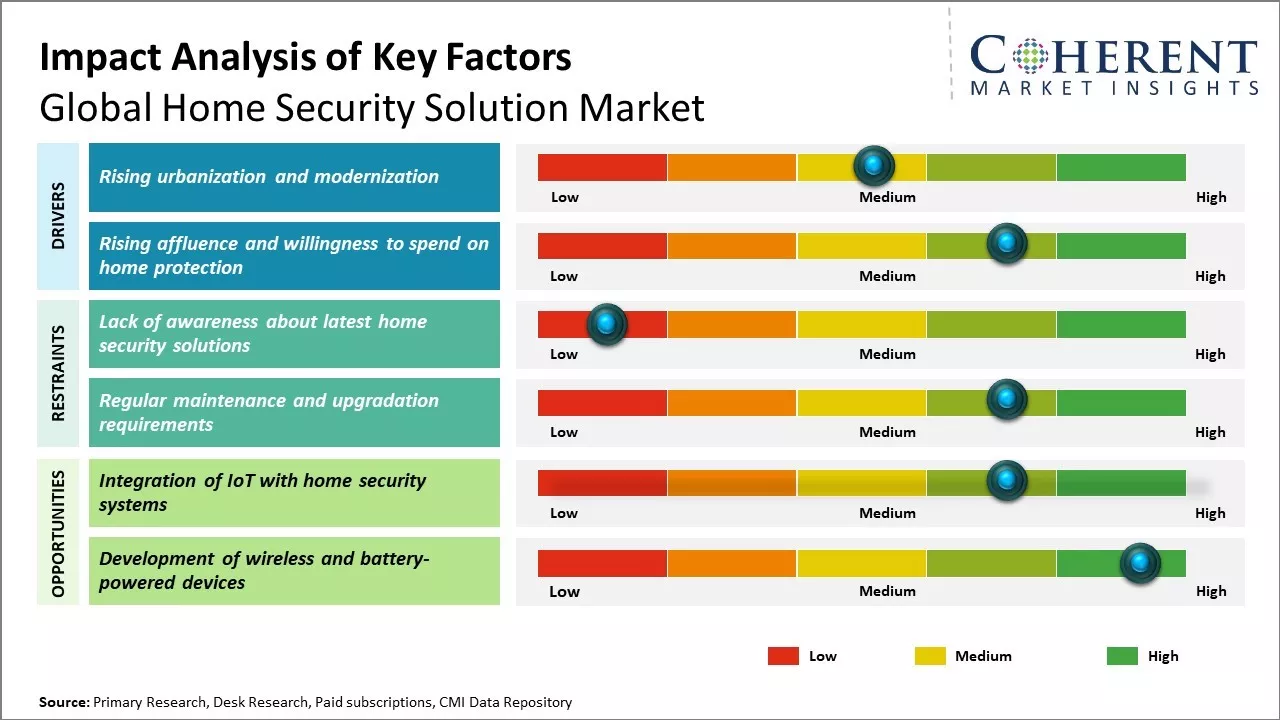
Rising safety concerns among individuals, increasing disposable income, growing digitalization and improved living standards can boosts adoption of smart home security devices. Furthermore, market players are investing heavily in research and development to introduce innovative products with advanced technologies such as IoT and AI. The ongoing trend towards development of wireless and battery-powered home security devices can drive the market growth during the forecast period. However, high initial installation cost and technology limitations in certain regions can hamper the market growth.
Current Events and Its Impact on Home Security Solution market
Current Events | Description and its impact |
Expansion of AI-Powered Surveillance and Threat Detection |
|
Smart Home Integration Fuels Bundled Security Adoption |
|
Role of Emerging Technologies in the Home Security Solution Market
New technology is transforming the home security solution market, driving innovation, cost savings, and smarter protection systems. The most groundbreaking disruption comes in the form of artificial intelligence (AI) and machine learning, which allows security cameras and sensors to learn to differentiate between threats and non-threats, like recognizing a family member versus an intruder or eliminating false alarms caused by pets or weather conditions.
IoT connectivity is yet another cornerstone, enabling seamless interconnectivity between devices such as smart doorbells, locks, cameras, lights, and alarms. This interconnected environment provides instant notifications, remote viewing, and control via mobile apps. 5G and Wi-Fi 6 technology are also enhancing speed and reliability, which is enhancing live streaming from security cameras to be quicker and more responsive.
Cloud storage and edge computing are also gaining traction. Cloud solutions deliver elastic video archiving and analytics, while edge computing delivers real-time device-level decision-making to reduce latency and bandwidth usage. It is particularly beneficial for AI-enabled motion detection and facial recognition.
Biometric authentication, whether through fingerprint or face scanning, is becoming more and more prevalent in smart locks and access systems to offer an added layer of personalized security. Meanwhile, blockchain technology is now also beginning to play a role in data transmission security and preventing unauthorized entry into devices.
- Current Industry Events of 2026
- Market Size Estimation
- Regional Breakdown
- Competitive Landscape
- Customer Intelligence
- Segmental Analysis
- Pricing Analysis
- Key Market Drivers, Challenges & Future Trends
- Customized Insights Section
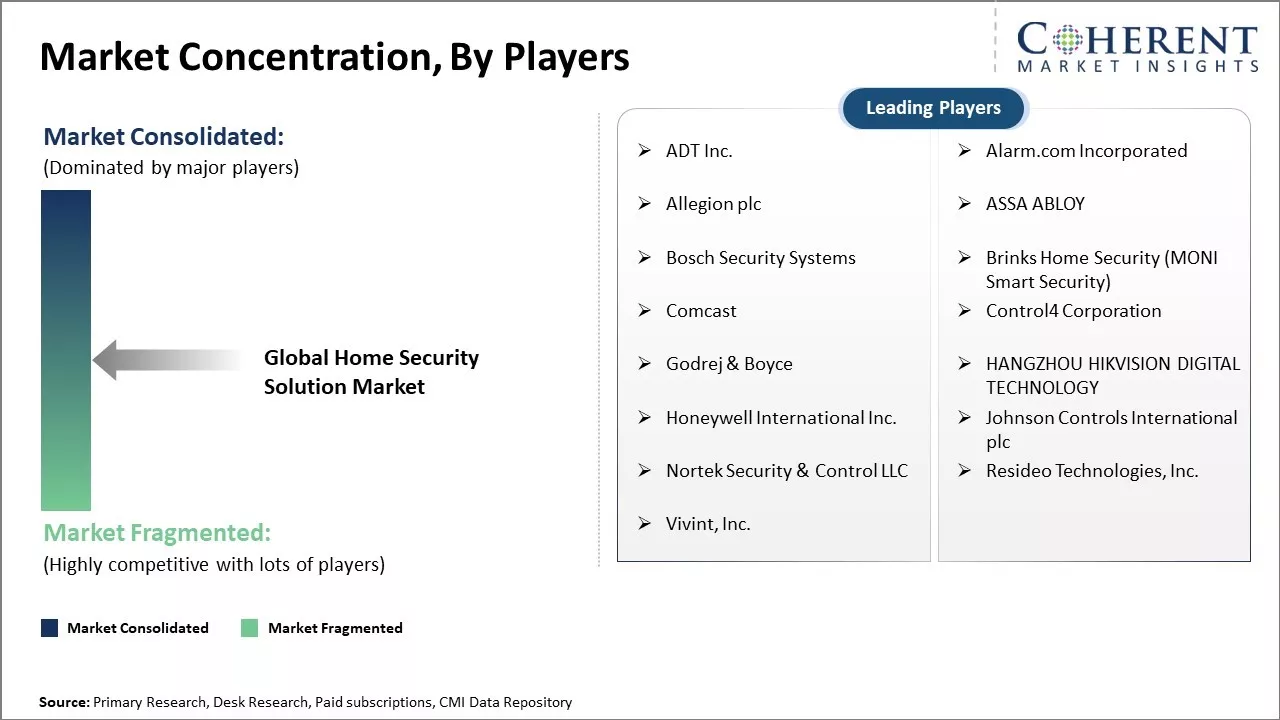
Market Concentration and Competitive Landscape
Segmental Insights
Home Security Solution Market Insights, By Component
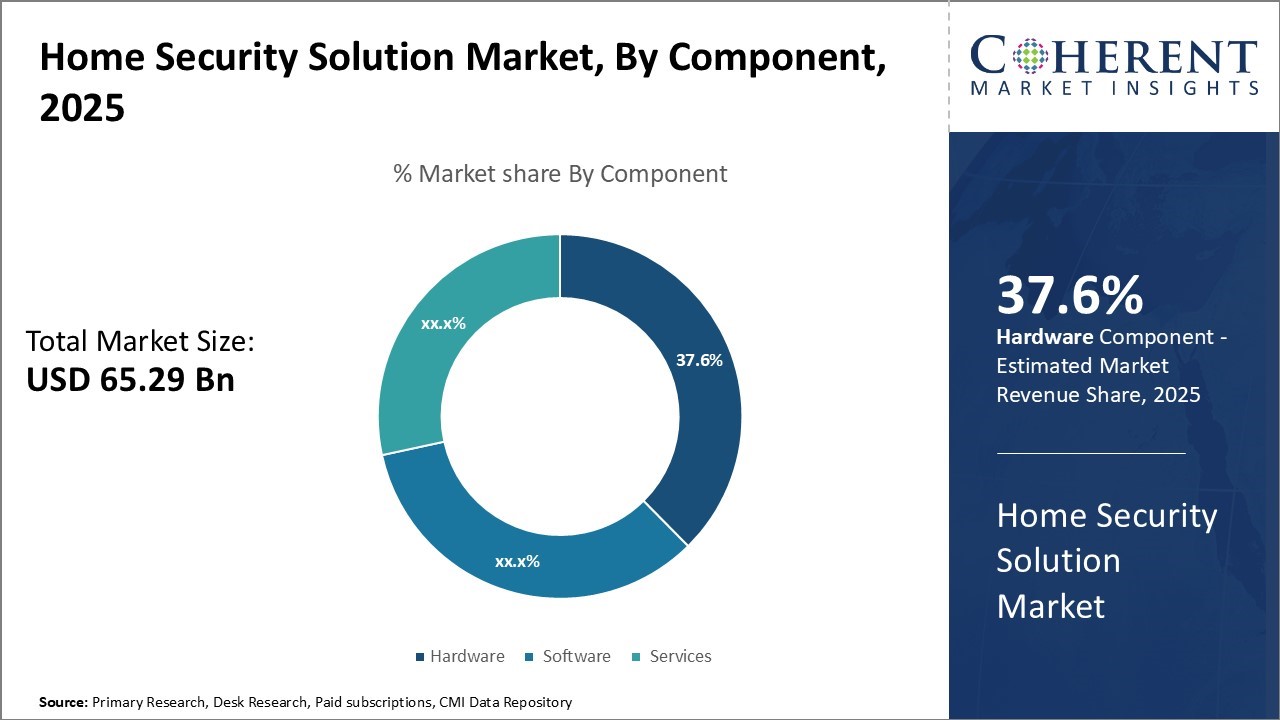
In terms of component, hardware segment is expected to contribute the highest market share of 38.6% in 2026, due to its indispensability in forming the core infrastructure for any home security solution. Hardware equipment such as alarms, cameras, motion sensors, entry/exit sensors, and other detection devices are fundamental building blocks that enable the functionality of any security system.
Consumer demand for added layers of physical protection boosts substantial uptake of hardware products across residential installations. Video surveillance cameras have become enormously popular due to their ability to monitor premises remotely through mobile or web access. Rising smart home technologies has integrated security hardware seamlessly with other networked devices in the home.
Home Security Solution Market Insights, By Type of System
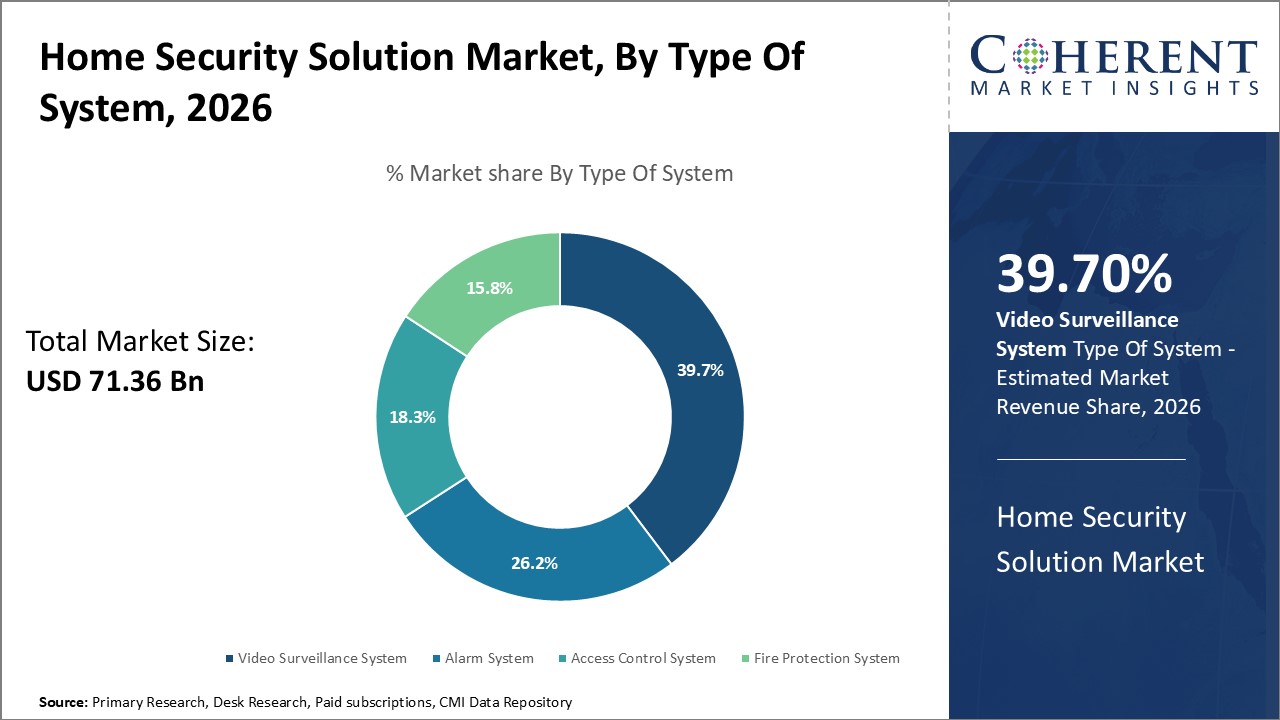
In terms of type of system, access control system segment is expected to contribute the highest market share of 39.7% in 2026 due to the unparalleled convenience and control it provides to homeowners. Being able to securely lock/unlock doors, detect unauthorized entries, and monitor approved access from any location delivers immense peace of mind. The ability to manage who can access the property through smart locks, keypads and related equipment empowers users with tailored access rights.
This customizable access management addresses unique needs around guest privileges, delivery/service entries or child/pet safety. Through seamless integration with other systems like alarms or cameras, access control elevates the entire security experience. Its rising sophistication through technologies like biometrics, mobile credentials and automated updates is boosting popularity and drives the segment growth.
Home Security Solution Market Insights, By Distribution Channel
In terms of distribution channel, offline segment is expected to contribute the highest market share of 53.8% in 2026 due to consumers' entrenched preferences for hands-on research and relationships. While online shopping is increasingly adopted across many sectors, for such large investments homeowners appreciate the personal touchpoints offered through retail stores, security consultants and installation experts.
Offline avenues aid complex solution selection by providing live product demos, detailed needs analysis and post-purchase support. Established brick-and-mortar chains coupled with local security specialists have established deep expertise that engenders consumer confidence. Furthermore, a significant portion of the target audience for home security systems include older demographics who remain more comfortable with physical shopping experiences. Thus, offline channel maintains its edge despite the rising prominence of online research and purchases in other industries.
Regional Insights
North America Home Security Solution Market Analysis and Trends
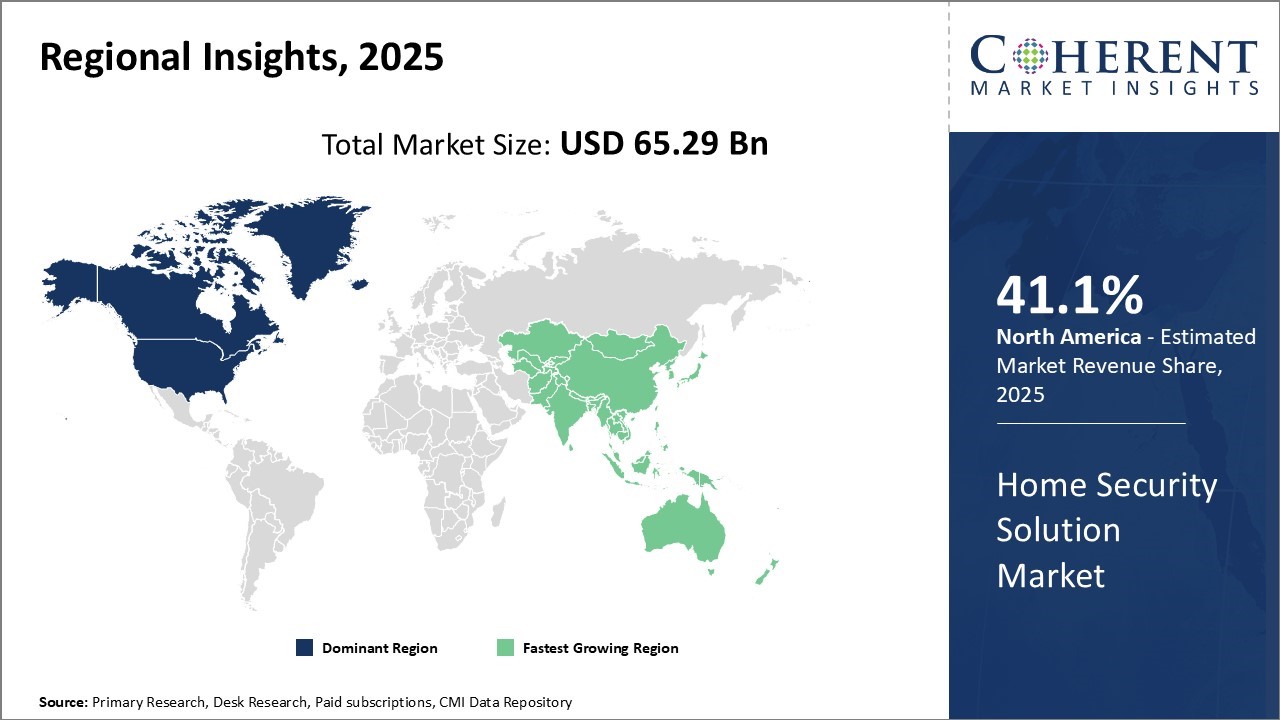
North America dominates the global home security solution market, with an estimated market share of 41.1% in 2026, due to presence of major industry players and technology innovators in the U.S. and Canada. The strong presence of leading security equipment manufacturers along with rapid adoption of smart home technologies have enabled North America to continue outpacing other regions. Growing concerns around security and safety among homeowners combined with high consumer spending power drives the market growth.
Asia Pacific Home Security Solution Market Analysis and Trends
Asia Pacific has emerged as the fastest growing regional market for home security solution. Countries like China, India, Japan and South Korea boosts market expansion due to rising disposable incomes, increasing urbanization and growth of middle-class population. Improving standards of living have encouraged Asian consumers to invest more in home security devices for protection.
Furthermore, penetration of internet and proliferation of smartphones have made smart security systems more affordable and accessible in Asia. This has motivated both individual users and small businesses to incorporate advanced security measures.
Europe Home Security Solution Market Analysis and Trends
Europe holds the second largest market share globally, led by developed nations such as the U.K., Germany, France and Italy. Stringent government regulations surrounding safety and security compliance of residential and commercial buildings have boosted product adoption. European companies are also actively collaborating with emerging startup firms to bring innovative solutions.
However, pricing pressures due to high tariffs and taxes on imported equipment affect the profit margins in Europe. Meanwhile, Latin America and Middle East & Africa remain highly lucrative yet untapped markets for home security solution providers to explore opportunities. Demand is steadily increasing across both regions mainly driven by growing urban populations and real estate developments.
Home Security Solution Market Dominating Countries
United States Home Security Solution Market Analysis and Trend
The United States leads the world home security solution market due to extensive adoption of smart home technologies, strong consumer awareness, and presence of key players like ADT, SimpliSafe, and Ring. Growing burglary fear, presence of DIY products, and compatibility with insurance incentives continue to drive market growth.
China Home Security Solution Market Analysis and Trend
China leads the Asia-Pacific market, boosted by rapid urbanization, smart city initiatives, and widespread adoption of AI-powered surveillance. Domestic tech champions like Hikvision and Dahua are leading cost-efficient high-tech solutions, propelling strong residential security growth within the urban environment.
Germany Home Security Solution Market Analysis and Trend
Germany is a top European home security market with robust household spending, advanced infrastructure, and high standards of home safety legislation. With emphasis on energy conservation and smart home compatibility, Germany is a suitable adopter of smart security devices and IoT-enabled devices.
United Kingdom Home Security Solution Market Analysis and Trend
The U.K. shows robust growth in the uptake of home security, particularly wireless and cloud-based options. Increased crime sensitivity and insurance discount-based incentives for security system installations have driven higher penetration of technologies like smart locks, video doorbells, and motion sensors.
Market Report Scope
Home Security Solution Market Report Coverage
| Report Coverage | Details | ||
|---|---|---|---|
| Base Year: | 2025 | Market Size in 2026: | USD 71.36 Bn |
| Historical Data for: | 2020 To 2024 | Forecast Period: | 2026 To 2033 |
| Forecast Period 2026 to 2033 CAGR: | 9.3% | 2033 Value Projection: | USD 132.99 Bn |
| Geographies covered: |
| ||
| Segments covered: |
| ||
| Companies covered: | ADT Inc., Alarm.com Incorporated, Allegionplc, ASSA ABLOY, Bosch Security Systems, Brinks Home Security (MONI Smart Security), Comcast, Control4 Corporation, Godrej & Boyce, HANGZHOU HIKVISION DIGITAL TECHNOLOGY, Honeywell International Inc., Johnson Controls International plc, Nortek Security & Control LLC, Resideo Technologies, Inc., and Vivint, Inc. | ||
| Growth Drivers: |
| ||
| Restraints & Challenges: |
| ||
Home Security Solution Market Driver
- Rising urbanization and modernization
Rising urbanization as many people move to urban areas in search of better employment and livelihood opportunities can drive the market growth. People living in cities are more concerned about safety and security of their homes and properties due to rising crime rates, terrorism threats and civil unrest in many metropolitan areas.
For example, in 2024, ADT announced a partnership with tech firms to roll out AI-enabled cameras and facial recognition systems specifically targeted at urban residents concerned about theft, break-ins, and vandalism.
With rising incomes and modern lifestyles, homeowners demand advanced security measures to protect themselves and their families. The penetration of internet and proliferation of smart home devices have boosted demand for technologically advanced smart security solutions.
Homeowners are increasingly adopting sophisticated video surveillance systems, motion sensors, smart locks, home alarms and other intelligent security solutions. These solutions provide round-the-clock protection and make it possible to monitor and control the security of homes from any location via mobile apps and web interfaces.
- Rising affluence and willingness to spend on home protection
Global home security solution market growth is driven by increasing affluence of consumers and their rising willingness to spend on protecting their homes and families. Emerging economies like India, China, Brazil and others have witnessed substantial growth in per capita incomes.
This burgeoning middle class is now able to afford best-in-class security hardware and subscription-based security services. With westernization and exposure to modern lifestyles, people across the world attach greater importance to home safety and security. These people do not hesitate to invest in sophisticated yet user-friendly security automation for seamless protection.
The ongoing work-from-home culture also boosts demand for technologically superior security monitoring from anywhere, anytime. Homeowners recognize security systems as valuable long-term investments that elevate overall living standards, lifestyle comforts and property values in the long-run. Advanced home automation integrated with security has become a necessity rather than luxury for urban populations worldwide.
Home Security Solution Market Opportunities
Integration of IoT with home security systems
The integration of IoT with home security systems provides a huge opportunity for global home security solution market growth. IoT enabled security systems allow for round-the-clock remote monitoring and control of the home from any location.
Homeowners can stay connected to their homes and receive instant notifications through their smart devices in case of intruder alarms, smoke/fire detection or unauthorized entry. This provides greater peace of mind and convenience compared to traditional stand-alone security systems.
With IoT, security systems can also be integrated with other smart home technologies like cameras, locks, lighting, thermostats and appliances. This enables automated actions and enhanced protection. For example, lights and alarms can automatically trigger if motion is detected by cameras when the residents are away. Smart locks can remotely lock/unlock based on the home occupancy.
Such tightly-integrated solutions deliver improved safety, convenience and energy savings for homeowners. Furthermore, the IoT-based home security market enables automatic alerting of emergency services in events such as fires or break-ins, while real-time footage and location data capture help accelerate response times.
Home Security Solution Industry News
- In 2025, TP-Link introduced its new Tapo 4K cameras and HybridCams, boosting home security with higher-quality images and intelligent features. The new devices further develop TP-Link's smart home platform to provide greater device integration. The release is driven by increasing urban consumption for innovative security products with the escalation of safety issues.
- In June 2025, Honeywell launched its first-ever Indian-designed and manufactured CCTV camera portfolio under the 'Make in India' initiative by the government. The 50 Series cameras, engineered at Honeywell's Bengaluru R&D facility, come loaded with features like intelligent video analytics, gyro sensor-based image stabilization, and high-grade cybersecurity.
Key Takeaways from Analyst
- Global home security solution market growth is driven by increasing crime rates and the need for safety and security among homeowners. Advancements in home automation technology along with falling prices of security cameras and alarms can boost adoption of smart home security systems. Rising awareness about various benefits of remote access and monitoring can also demand for these systems. However, data privacy and security concerns associated with networked devices can hamper the market growth.
- North America currently dominates the market, owing to high consumer awareness levels and presence of global players. However, Asia Pacific is emerging as the fastest growing region due to double income households, rapid urbanization and improving economic conditions in major countries such as China and India.
- The development of smart cities and increased focus on infrastructure development offer significant opportunities for home security providers, while the integration of artificial intelligence capabilities, including advanced video analytics and biometric sensors is driving growth in the biometric home security market by enhancing security and surveillance solutions. Leading players are investing in R&D to differentiate their offerings and expand into complementary smart home applications. Collaborations with networking giants to develop IoT-based platforms can provide new revenue streams.
Market Segmentation
- Component Insights (Revenue, USD Bn, 2026 - 2033)
- Hardware
- Software
- Services
- Type of System Insights (Revenue, USD Bn, 2026 - 2033)
- Video Surveillance System
- Alarm System
- Access Control System
- Fire Protection System
- Distribution Channel Insights (Revenue, USD Bn, 2026 - 2033)
- Online
- Offline
- Regional Insights (Revenue, USD Bn, 2026 - 2033)
- North America
- U.S.
- Canada
- Latin America
- Brazil
- Argentina
- Mexico
- Rest of Latin America
- Europe
- Germany
- U.K.
- Spain
- France
- Italy
- Russia
- Rest of Europe
- Asia Pacific
- China
- India
- Japan
- Australia
- South Korea
- ASEAN
- Rest of Asia Pacific
- Middle East & Africa
- GCC Countries
- Israel
- South Africa
- Rest of Middle East & Africa
- Key Players Insights (Revenue, USD Bn, 2021 - 2033)
- ADT Inc.
- Alarm.com Incorporated
- Allegionplc
- ASSA ABLOY
- Bosch Security Systems
- Brinks Home Security (MONI Smart Security)
- Comcast
- Control4 Corporation
- Godrej & Boyce
- HANGZHOU HIKVISION DIGITAL TECHNOLOGY
- Honeywell International Inc.
- Johnson Controls International plc
- Nortek Security & Control LLC
- Resideo Technologies, Inc.
- Vivint, Inc.
Sources
Primary Research Interviews
- Home Security System Manufacturers
- Smart Home Technology Providers
- Security Service Providers
- End-User Consumers (Residential & Commercial)
- Others
Databases
- IBISWorld Industry Research Database
- Euromonitor International Database
- Others
Magazines
- Security Today Magazine
- SDM (Security Distributing & Marketing) Magazine
- Smart Homes Magazine
- Home Security Magazine
- Others
Journals
- Journal of Security Technology
- International Journal of Smart Home Technology
- IEEE Security & Privacy Journal
- Others
Newspapers
- The Wall Street Journal
- Financial Times
- USA Today
- The Guardian (Technology Section)
- Others
Associations
- Security Industry Association (SIA)
- Electronic Security Association (ESA)
- Smart Home Association
- International Association of Security & Investigative Regulators (IASIR)
- Others
Public Domain Sources
- U.S. Census Bureau Reports
- Federal Trade Commission (FTC) Publications
- Department of Homeland Security Reports
- International Trade Administration Data
- Others
Proprietary Elements
- CMI Data Analytics Tool
- Proprietary CMI Existing Repository of information for last 8 years
Get access to 250+ pages report
Every segment, forecast, competitor profile and data table behind the analysis above — available for instant download.
- ESOMAR Member
- ISO 9001:2015 Certified
- D-U-N-S Registered
- GDPR & CCPA Compliant
Missing comfort of reading report in your local language? Find your preferred language:
Transform your Strategy with Exclusive Trending Reports
Frequently Asked Questions
The Home Security Solution Market size is estimated to be valued at USD 71.36 Bn in 2026, and is expected to reach USD 132.99 Bn by 2033.
The CAGR of the global Market is projected to be 9.3% from 2026 to 2033.
Rising urbanization and modernization and rising affluence and willingness to spend on home protection are the major factors driving the growth of global home security solution industry.
Lack of awareness about latest home security solutions and regular maintenance and upgradation requirements are the major factors hampering the growth of global home security solution industry.
Home security solutions prevent theft by using motion sensors, cameras, alarms, and smart locks to detect and deter intruders in real time, often alerting homeowners and authorities instantly.
Yes, mobile apps are important for home security solutions as they allow users to remotely monitor, control, and receive alerts from their security systems anywhere, enhancing responsiveness and peace of mind.
2-way audio helps in home security solutions by enabling homeowners to communicate with visitors or potential intruders through security cameras, which can deter suspicious activity and improve emergency response.