

Online Gambling and Betting Market Size and Forecast – 2026 to 2033
The global online gambling and betting market is estimated to be valued at USD 116.66 Bn in 2026 and is expected to exhibit a compound annual growth rate (CAGR) of 11.3% during the forecast period, reaching USD 246.83 Bn by 2033. The legalization of online gambling in many jurisdictions across the world and rising internet and smartphone penetration are fueling growth of this market.
Key Takeaways from the Online Gambling and Betting Market Report
- Sports betting remains highly popular worldwide, with this segment projected to account for 31.6% of the global online gambling and betting market share in 2026.
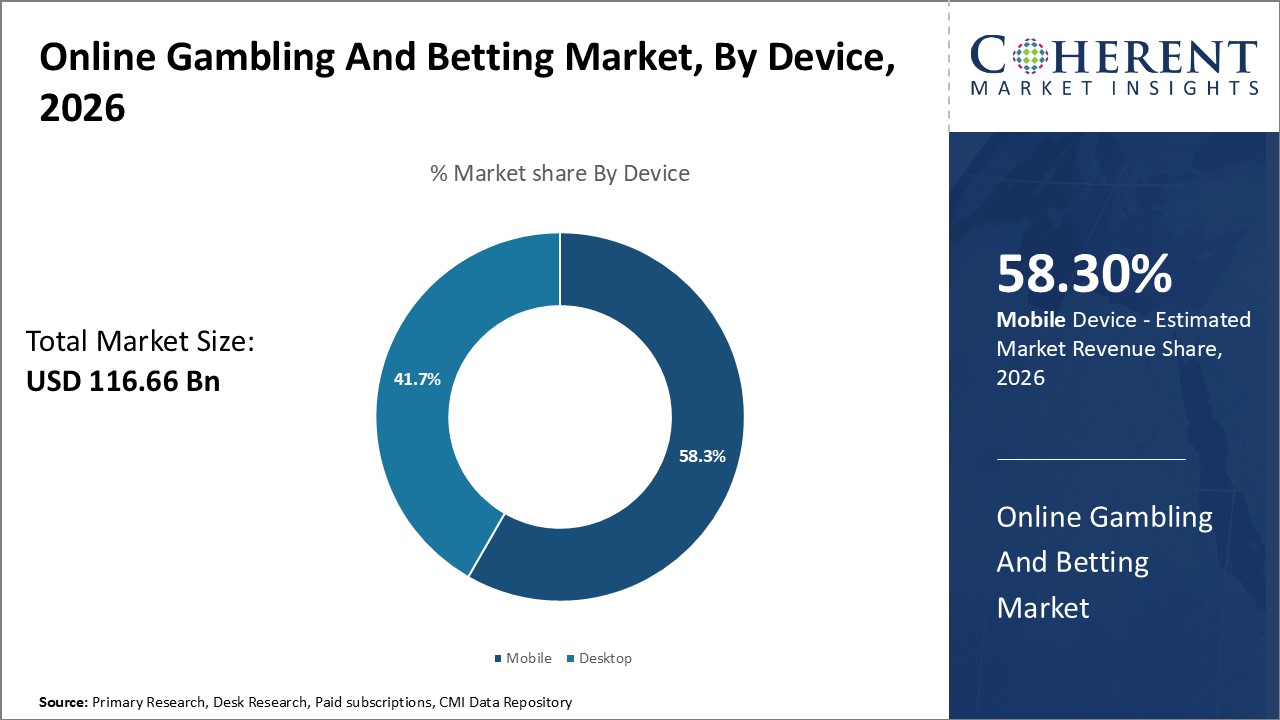
- Based on device, mobile segment is expected to hold a prominent market share of 58.3% in 2026.
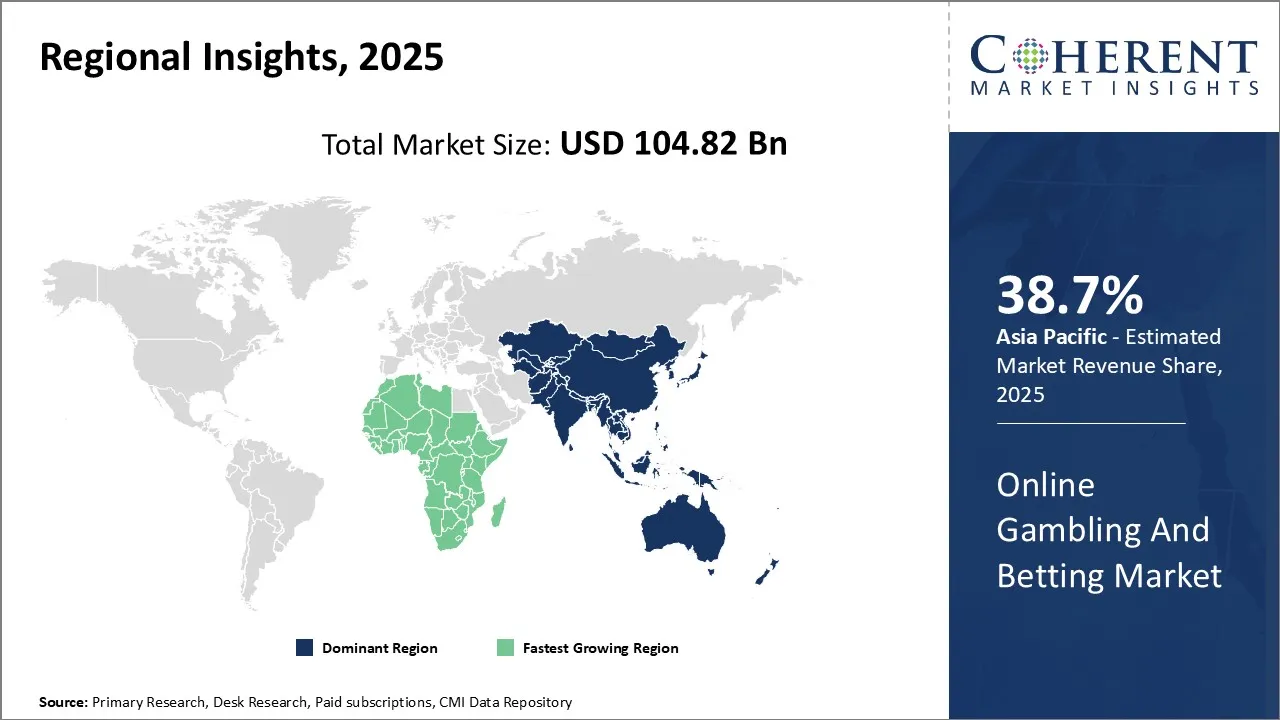
- North America remains the leading hub for online gambling and betting, capturing 38.7% of the global market share in 2026.
- Africa is emerging as a highly lucrative pocket for online gambling and betting companies.
Online Gambling and Betting Market Overview
The global online gambling and betting market value is expected to increase rapidly during the forecast period. This is attributable to increasing internet and smartphone penetration, legalization of gambling and betting in various regions, and rising popularity of online sports betting.
Many nations are relaxing gambling laws and legalizing online betting to generate tax revenue. For instance, Netherlands collected a record €1 Bn ($1.07 Bn) in gambling taxes in 2024, according to Statistics Netherlands (CBS).
Similarly, in January 2025, Thailand's cabinet approved a draft law to legalize gambling and casinos. The law aims to increase tourism, create jobs, and attract investment. The new law would allow gambling in big entertainment centers and is now being discussed in parliament.
The market is witnessing a continued shift towards online/mobile platforms from traditional in-person channels. Strong consumer preference for the convenience and variety offered through online gambling is evidenced in growing digital traffic and engagement.
Current Events and Their Impact on the Online Gambling and Betting Market
Current Event | Description and its Impact |
U.S. Sports Betting Regulatory Expansion |
|
Artificial Intelligence and Machine Learning Integration |
|
Cryptocurrency and Blockchain Adoption in Gaming |
|
Segmental Insights
- Current Industry Events of 2026
- Market Size Estimation
- Regional Breakdown
- Competitive Landscape
- Customer Intelligence
- Segmental Analysis
- Pricing Analysis
- Key Market Drivers, Challenges & Future Trends
- Customized Insights Section
Online Gambling and Betting Market Insights, By Gaming Type: Sports Betting Dominates the Market as Audience Interest Grows
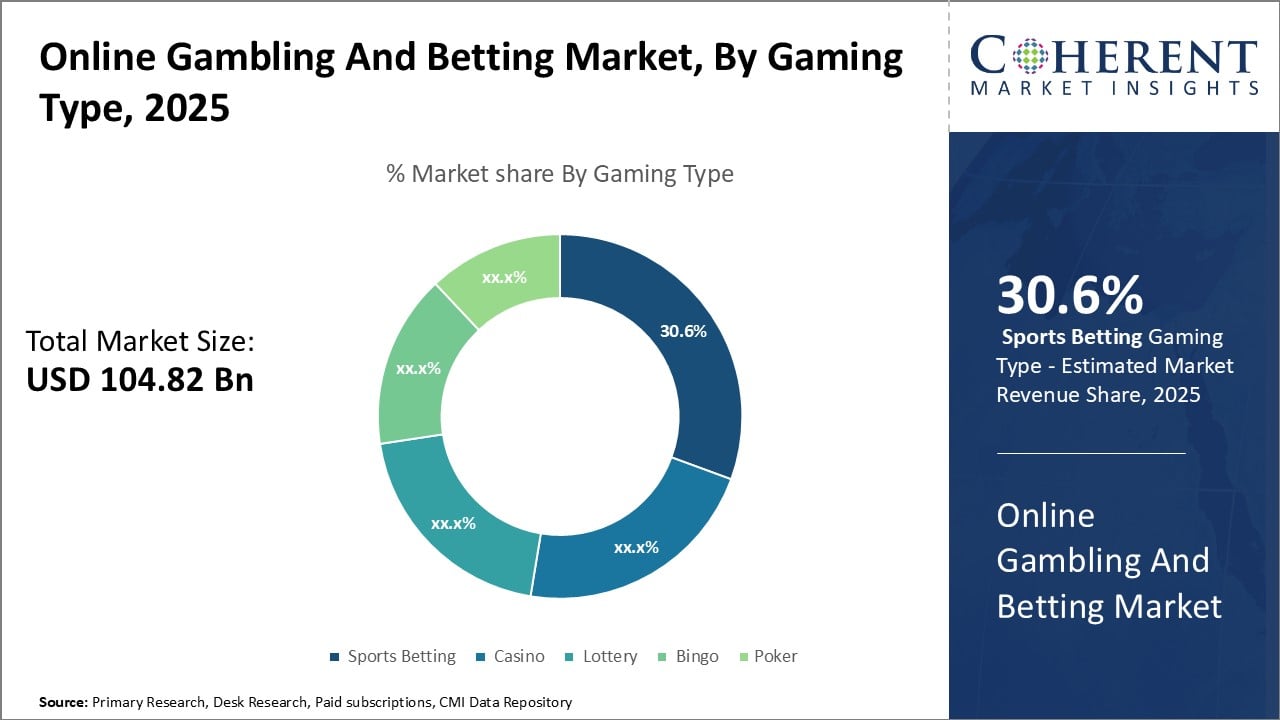
Sports betting continues to be a major contributor to the global online gambling and betting industry, with the segment expected to capture 31.6% of the total market share in 2026. This is mostly due to increasing enthusiasm among sports fans and audiences.
The rising digital and online connectivity has made it convenient for sports enthusiasts to place bets on their favorite games from anywhere and anytime using their mobile phones or computers. This has boosted the reach and uptake of various online sports betting platforms.
For instance, DraftKings reported a significant milestone in the second quarter of 2025, posting a record $1.51 billion in revenue, marking a 37% year-over-year increase. This growth was primarily driven by its sportsbook segment, which saw a 45.3% rise in revenue to $997.9 million.
Also, sports betting makes watching games more exciting because fans can bet on who will win or how players will perform, which makes them more involved in the action. Gamers are also able to earn money by correctly predicting scores, taking the experience beyond passive viewing.
Major sports leagues and franchises have also adopted effective strategies to promote sports betting among fan communities. Aggressive marketing campaigns that run across online platforms help create awareness as well as drive traffic towards authorized betting sites and apps, which is further accelerating the online gambling market share.
Online Gambling and Betting Market Insights, By Device: High Smartphone Adoption Boosts Mobile Segment’s Market Dominance
As per Coherent Market Insights latest online gambling and betting market analysis, mobile segment is slated to hold 58.3% of the market share in 2026. This is attributable to rising smartphone penetration across both developed and developing regions.
According to the GSMA, more than 4.3 billion people worldwide own a smartphone. Demand for online gaming and betting is expected to grow rapidly during the forthcoming period, thanks to increasing access to mobile devices and high-speed internet.
Mobile gaming offers unmatched flexibility and portability for gamers to place bets anytime as per their convenience. Today's smartphone users spend a considerable time browsing the internet as well as interacting on various applications on the go. Top online betting websites and apps are taking advantage of this trend by making their services easy to use on small screens, which keeps users more engaged.
Mobile gaming caters well to the on-the-go lifestyles of modern consumers who seek to spend their idle waiting periods engaging in quick betting sessions. Attractive app designs facilitating one-tap functionality have made betting transactions extremely convenient and fast on smartphones.
Progressive web applications (PWAs) like responsive design and push notifications further enrich the overall user experience. Platforms provide extensive personalized promotions that auto-sync with player profiles for seamless access across devices.
As people increasingly conduct their online lives through portable devices, the shift towards mobiles has been a defining step forward for the online gambling segment. With internet access now pervasive, mobile betting is expected to register continued gains owing to its reach as well as to its increasing preference over other mediums.
Regional Insights
North America Remains Undisputed Market Leader in Online Gambling and Betting
North America has established itself as the dominant region in the global online gambling and betting market. The region is expected to account for 38.7% of the global online gambling and betting industry market share in 2026.
Legalization of online betting across the U.S. is a prominent factor driving the online gambling and betting market growth in North America. Many states are legalizing gambling and betting to boost revenues. For example, in November 2024, Missouri became the 39th U.S. state to legalize sports betting following a narrow voter approval.
With countries like the U.S. slowly removing restrictions at state level, more and more consumers now have access to legal and regulated online betting platforms. This growing liberalization of laws has attracted major industry players to invest heavily in expanding and customizing their offerings for the North American audience.
Large population bases, especially in the U.S., present a highly lucrative customer segment for operators. Further, the region has a highly developed digital payment infrastructure, which facilitates easy deposit and withdrawal options, thus providing consumers a seamless experience contributing to their rising participation rates.
A key factor for the dominance of North America has been legal certainty offered to businesses. Major operators, confident about long term prospects, have set up regional headquarters and created many local jobs. This, in turn, is strengthening the domestic supply chains in service capabilities and technology supporting the industry.
North American companies are also actively investing in innovation to develop new products. The increased commercialization is boosting ancillary industries such as data analytics, web hosting, and software development in the region.
Africa Becoming Hotbed for Online Gambling and Betting Companies
Africa is emerging as the fastest-growing market for online gambling and betting globally. The region’s land-based gambling is still underdeveloped, and more people are using smartphones and the internet, making it a great place to attract new online customers.
Countries across East, West, and South Africa are seeing a surge in new real-money gambling platforms targeting their populations. While regulations still need improving, many governments are supporting job creation and investments from established operators.
The youthful demographics and growing digitalization of payment solutions are aiding the regional online volumes. Some nations have implemented taxation frameworks specifically aimed at benefiting from the budding internet gambling space. With several African markets still in initial growth phases, stronger regulations could further spur industry scale and formalization.
Online Gambling and Betting Market Outlook – Country-wise
U.S. Online Gambling and Betting Market Trends
The United States is expected to dominate the global online gambling and betting industry during the forecast period. This is attributable to increasing legalization of online sports betting in multiple states and rising popularity of mobile and online casino platforms. Also, new technology like live betting and safe digital payments is bringing more people to online gambling.
Consumers’ growing interest in virtual gaming experiences and the convenience of betting from home are also boosting market expansion. Partnerships between traditional casinos and online operators, along with strong marketing campaigns targeting millennials and Gen Z, are expected to support market expansion during the forthcoming period.
In May 2026, Fanatics Casino debuted its standalone real-money online casino app and website, launching simultaneously in New Jersey, Pennsylvania, Michigan, and West Virginia. This represented one of the largest multi-state rollouts by a U.S. online casino operator in recent years.
Denmark Online Gambling and Betting Market Forecast
Denmark is becoming a highly lucrative pocket for online gambling and betting service operators. This is mostly due to high mobile penetration, rising tech-savvy population, and supportive regulatory framework.
Another key growth driver is the increasing popularity of live dealer games and interactive casino experiences. Players enjoy the thrill of real-time gaming from home, which makes online casinos more engaging. Likewise, loyalty programs and personalized promotions by operators are encouraging more frequent play and attracting new users.
In July 2026, LeoVegas Group introduced its proprietary sportsbook platform in Denmark, rolling it out under both the LeoVegas and Expekt brands. The launch represents an important milestone in the company’s transition toward using its own in-house technology.
Market Concentration and Competitive Landscape
Online Gambling and Betting Industry News
- In September 2025, Entain introduced new sportsbook features and enhancements across the U.S., Brazil, and other markets. These include app performance upgrades, live same-game parlays, and localized features for specific markets.
- In August 2025, Bet365 launched its online sportsbook in Kansas. This expansion made Kansas the 14th state in the U.S. where Bet365 operates.
- In February 2024, betFIRST, in partnership with Middelkerke Casino, launched a new online casino in Belgium. The new online casino can be accessed at www.betfirstcasino.be.
Market Report Scope
Online Gambling and Betting Market Report Coverage
| Report Coverage | Details | ||
|---|---|---|---|
| Base Year: | 2025 | Market Size in 2026: | USD 116.66 Bn |
| Historical Data for: | 2020 To 2024 | Forecast Period: | 2026 To 2033 |
| Forecast Period 2026 to 2033 CAGR: | 11.3% | 2033 Value Projection: | USD 246.83 Bn |
| Geographies covered: |
| ||
| Segments covered: |
| ||
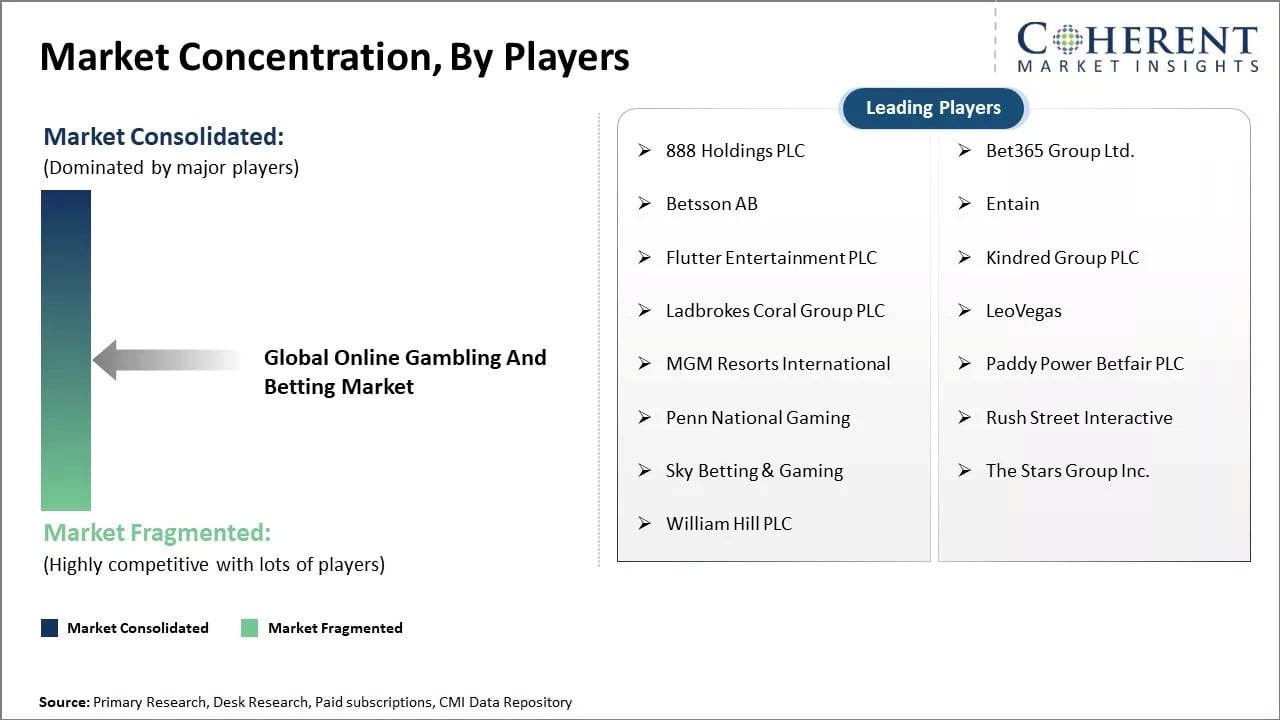
| Companies covered: | 888 Holdings PLC, Bet365 Group Ltd., Betsson AB, Entain, Flutter Entertainment PLC, Kindred Group PLC, Ladbrokes Coral Group PLC, LeoVegas, MGM Resorts International, Paddy Power Betfair PLC, Penn National Gaming, Rush Street Interactive, Sky Betting & Gaming, The Stars Group Inc., and William Hill PLC | ||
| Growth Drivers: |
| ||
| Restraints & Challenges: |
| ||
Online Gambling and Betting Market Drivers
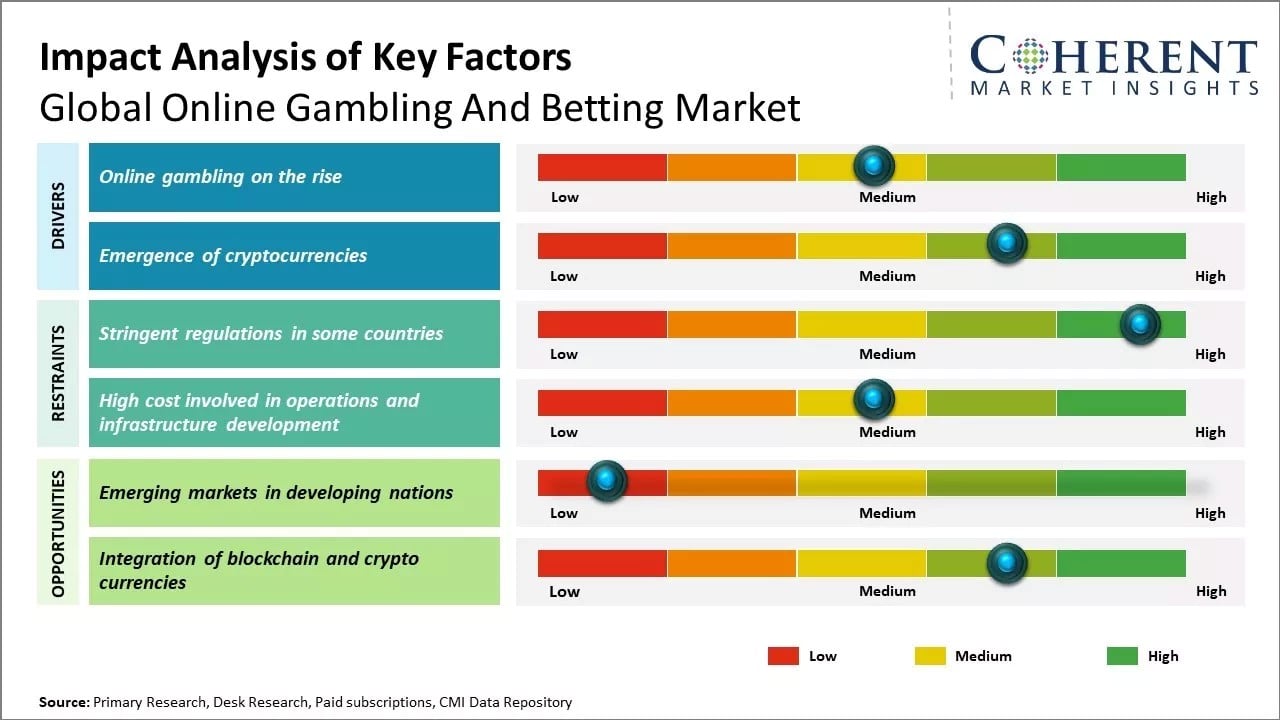
Rapid Rise of Online Gambling
The online gambling and betting market has witnessed a huge rise over the past decade mainly due to the increase in smartphone and internet penetration globally. The ease and convenience of being able to place bets from anywhere using just a mobile device is a huge draw for users.
No longer do people have to visit land-based casinos or betting shops to try their luck. Websites and apps have transitioned the entire experience online with features like live streaming of games and tournaments that allow users to feel immersed in the action from the comfort of their homes.
Social Interaction, Accessibility, and Technological Advancements
Many online platforms have become popular because they let people interact and socialize. Users can chat, form betting groups, or create leagues, which makes the experience more fun and engaging than traditional offline systems.
Online platforms are also seen as cheaper and give access to a much larger variety of games and bets from around the world. With just a few clicks or taps, users can try different games and betting options from anywhere.
Such accessibility and exposure have played a big role in driving up participation levels in online gambling activities. The industry is using latest technological capabilities like AR/VR, AI, and immersive experiences to continually innovate and improve user experience to attract new converts.
Increasing Strategic Partnership
The target market is witnesing a surge in partnerships and collaborations. For instance, bet365 recently partnered with Gaming Realms. As part of the agreement, Gaming Realms will supply bet365 with a selection of its popular online gaming titles, including the hit Slingo games Slingo Rainbow Riches and Slingo Lobstermania.
This partnership is an important step for Gaming Realms as it grows worldwide by working with well-known brands like bet365. Through this collaboration, bet365 will be able to offer its players a wider variety of fun and exciting games, making the experience on its platform even better.
Online Gambling and Betting Market Opportunity
Expansion in Developing Nations
With rising internet penetration and increasing smartphone adoption, more consumers in developing countries now have access to online platforms for the first time. Online gambling platforms can remove many of the accessibility barriers associated with traditional casinos, allowing consumers to gamble from anywhere on any device. This convenience may attract new internet users, although adoption depends on local regulations as well as cultural attitudes toward gambling.
Social gaming habits in these regions may gradually transition to real-money betting as online gambling becomes more familiar. Compared to mature Western markets, the online gambling market remains largely untapped in many developing regions
Analyst Opinion (Expert Opinion)
- The online gambling and betting industry is undergoing a profound transformation. This is mostly due to technological advancements, regulatory shifts, and evolving consumer behaviors. Technologies like mobile platforms, live streaming, and artificial intelligence are reshaping user experiences. Furthermore, the expansion of legal sports betting in the U.S. and other regions is influencing market dynamics.
- Mobile platforms have become the cornerstone of online gambling. In 2025, mobile segment accounted for over 57% of the online gambling market revenue. This shift is not merely a trend but a fundamental change in how consumers engage with gambling services. The convenience of placing bets anytime and anywhere has attracted a broader demographic, including younger and more diverse audiences. Operators must prioritize mobile-first strategies, ensuring seamless user experiences across devices. The success of platforms like FanDuel, which reported significant revenue growth in 2024, underscores the importance of mobile optimization in capturing market share.
- Strategic partnerships with gaming platforms and sponsorships of esports events can enhance visibility and attract a dedicated user base. However, operators must navigate the complexities of esports regulations and ensure responsible gambling practices to maintain credibility and trust.
Speak to the analyst
Want personalized insights?
Take the findings above to one of our principal consultants, or have the report rebuilt around the segments, geographies and competitors you actually track.
Market Segmentation
- Gaming Type Insights (Revenue, USD Bn, 2021 - 2033)
- Poker
- Casino
- Lottery
- Bingo
- Sports Betting
- Device Insights (Revenue, USD Bn, 2021 - 2033)
- Desktop
- Mobile
- Regional Insights (Revenue, USD Bn, 2021 - 2033)
- North America
- U.S.
- Canada
- Latin America
- Brazil
- Argentina
- Mexico
- Rest of Latin America
- Europe
- Germany
- U.K.
- Spain
- France
- Italy
- Russia
- Rest of Europe
- Asia Pacific
- China
- India
- Japan
- Australia
- South Korea
- ASEAN
- Rest of Asia Pacific
- Middle East
- GCC Countries
- Israel
- Rest of Middle East
- Africa
- South Africa
- North Africa
- Central Africa
- Key Players Insights
- 888 Holdings PLC
- Bet365 Group Ltd.
- Betsson AB
- Entain
- Flutter Entertainment PLC
- Kindred Group PLC
- Ladbrokes Coral Group PLC
- LeoVegas
- MGM Resorts International
- Paddy Power Betfair PLC
- Penn National Gaming
- Rush Street Interactive
- Sky Betting & Gaming
- The Stars Group Inc.
- William Hill PLC
Sources
Primary Research Interviews
- In-depth interviews were conducted with Key Opinion Leaders (KOLs), including top-level executives (CXO/VPs, Sales Head, Marketing Head, Operational Head, Regional Head, Country Head, etc.) across major regions. These insights were consolidated with secondary findings to provide actionable insights.
Databases
- H2 Gambling Capital: Provides detailed coverage of over 150 national/state gambling markets and 100 listed operators and suppliers, with market share analysis in over 100 markets.
Magazines
- Gambling Insider: A business-to-business publication for the iGaming industry, offering insights into the latest trends and developments.
- GGB Magazine: Focuses on the international casino industry, providing updated news and analysis on gaming operations and regulations.
Journals
- The Dependence of Online Gambling Businesses on High-Risk Players: A study analyzing the concentration of revenue within the online gambling sector, highlighting regulatory challenges.
- The Impact of Gambling Advertising and Marketing on Consumer Behavior: An exploration of how marketing expenditures influence online gambling activities.
Newspapers
- Reuters: Reported on Flutter's projection of a 34% increase in core profit in 2025, driven by its U.S. brand FanDuel.
- The Guardian: Covered the AFL's admission of losing control over online gambling oversight amid a rise in integrity risks.
Associations
- European Gaming and Betting Association (EGBA): Represents leading online gaming and betting operators in Europe, providing industry data and policy advocacy.
Public Domain Sources
- American Gaming Association (AGA): Offers insights into the U.S. commercial gaming industry's financial performance through its Commercial Gaming Revenue Tracker.
- U.S. Sports Betting Data: Provides market share statistics by brand, revenue, and taxes generated in the U.S. online sports betting market.
Proprietary Elements
- CMI Data Analytics Tool
- Proprietary CMI Existing Repository of Information for the Last 8 Years
Get access to 250+ pages report
Every segment, forecast, competitor profile and data table behind the analysis above — available for instant download.
- ESOMAR Member
- ISO 9001:2015 Certified
- D-U-N-S Registered
- GDPR & CCPA Compliant
Missing comfort of reading report in your local language? Find your preferred language:
Transform your Strategy with Exclusive Trending Reports
Frequently Asked Questions
The global market is estimated to be valued at USD 116.66 Bn in 2026.
The global online gambling and betting market size is expected to reach USD 246.83 Bn by 2033.
The global market is projected to register a CAGR of 11.3% from 2026 to 2033.
Major growth drivers include rising popularity of online gambling platforms, increased adoption of cryptocurrencies, and growing interest in sports betting worldwide.
Stringent regulations in some countries and high costs involved in operations and infrastructure development are the major factors hampering market growth.
Sports betting segment dominates the market with a share of 30.6% in 2026.
888 Holdings PLC, Bet365 Group Ltd., Betsson AB, Entain, Flutter Entertainment PLC, Kindred Group PLC, Ladbrokes Coral Group PLC, LeoVegas, MGM Resorts International, Paddy Power Betfair PLC, Penn National Gaming, Rush Street Interactive, Sky Betting & Gaming, The Stars Group Inc., and William Hill PLC are major players.