

Real Estate Software Market Size and Trends
Global Real Estate Software Market is estimated to be valued at USD 15.60 Bn in 2026 and is expected to reach USD 39.49 Bn by 2033, exhibiting a compound annual growth rate (CAGR) of 14.2% from 2026 to 2033.
Key Takeaways
- Based on Software Type, the Real Estate PMS segment is expected to lead the global real estate software market with the largest share in 2026, due to its ability to streamline operations such as lease management, rent collection, maintenance scheduling, tenant communications, and financial reporting.
- Based on Application, the Commercial Sector segment is projected to account for the 64% share of the market in 2026, due to its complex operational requirements and scale.
- Based on Region, North America is expected to lead the market, holding a share of 33.4% in 2026. While, Asia Pacific is anticipated to be the fastest growing region, with 22.9% share in 2026.
Market Overview
Global real estate software market is expected to witness positive trends during the forecast period. With growing digitalization and rising adoption of cloud-based solutions, more real estate companies are investing in innovative software to improve operational efficiency and enhance customer experience. Key players are focusing on strategic partnerships and mergers & acquisitions to strengthen their product offerings and expand their customer reach. In addition, increasing demand for property management systems and customer relationship management solutions from small and medium size real estate firms will provide lucrative opportunities for market players. However, data privacy and security concerns may hamper the growth of real estate software market during the forecast period.
Current Events and their Impact on the Real Estate Software Market
Current Event | Description and its Impact |
AI Revolution and Technological Integration in PropTech |
|
ESG Regulatory Compliance and Sustainability Requirements |
|
Role of Artificial Intelligence (AI) in the Real Estate Software Market
Artificial Intelligence (AI) is playing a transformative role in the Real Estate Software Market, reshaping property management, customer engagement, and investment strategies. AI-powered tools are being widely used to automate routine tasks such as document verification, lease abstraction, and contract analysis, saving time and reducing human error. Predictive analytics helps real estate firms forecast market trends, property valuations, and tenant behavior, enabling smarter investment and leasing decisions. AI-driven chatbots and virtual assistants are enhancing customer support by providing instant responses to queries and improving tenant experience. In addition, AI-enabled recommendation engines are personalizing property searches, increasing lead conversions for brokers and developers. The integration of computer vision and natural language processing further supports fraud detection, property inspection, and smart contract management. Overall, AI adoption is significantly boosting operational efficiency, transparency, and profitability, thereby fueling the real estate software market growth globally.
For instance, in January 2025, RSoft Technologies unveiled RealtorsRobot, an AI-powered real estate CRM tailored for builders, developers, brokers, promoters, channel partners and marketers. The platform is designed to streamline client relationship management, optimize lead prioritization and enhance operational workflows. Its capabilities include an AI-based lead management system, SIM-based Android auto-dialer with a 73% boost in call efficiency, real-time call tracking, automated follow-ups, WhatsApp marketing automation, analytics dashboards, mobile accessibility, customizable interfaces, robust security and integrations with over 1,500 external tools.
- Current Industry Events of 2026
- Market Size Estimation
- Regional Breakdown
- Competitive Landscape
- Customer Intelligence
- Segmental Analysis
- Pricing Analysis
- Key Market Drivers, Challenges & Future Trends
- Customized Insights Section
Segmental Insights
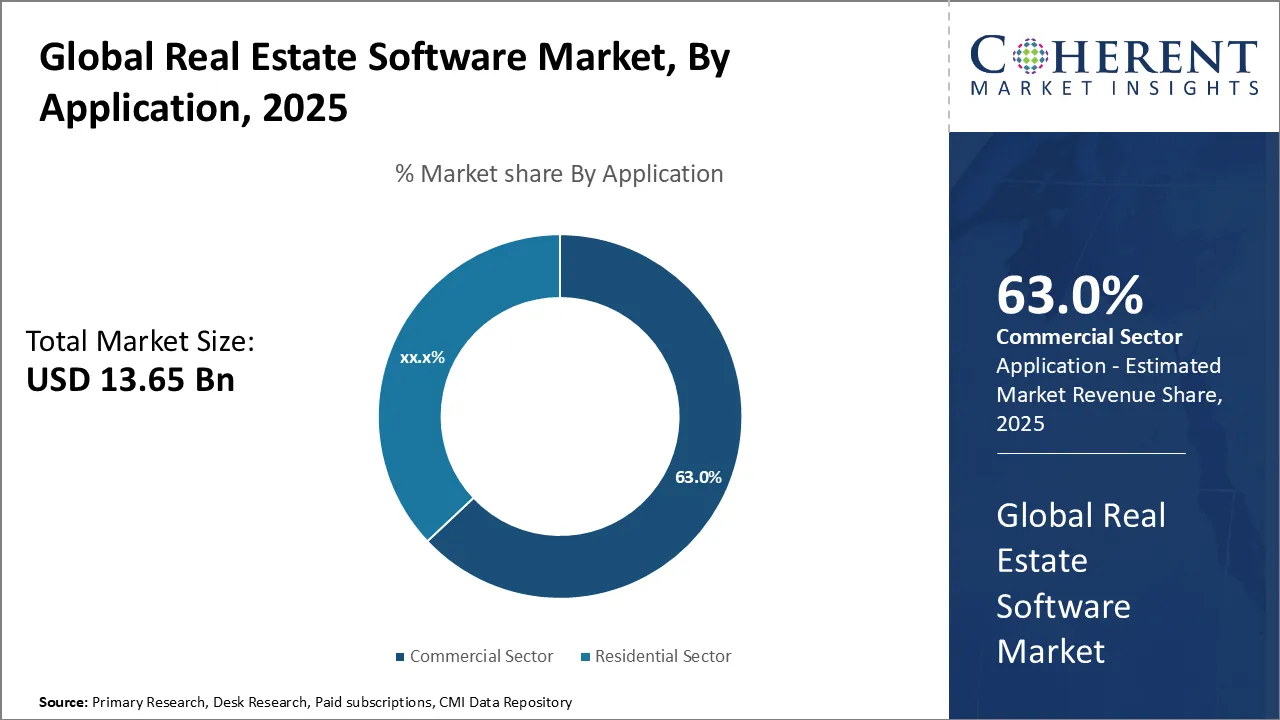
Real Estate Software Market Insights, By Application: The Leading Growth of Commercial Sector is Driven by its Complex Operational Requirements and Scale
In terms of application, the commercial sector segment is expected to capture the 64.0% share of the market in 2026, due to its complex operational requirements and scale. Commercial properties, including office spaces, retail centers, warehouses, and co-working hubs, require advanced solutions for lease management, tenant tracking, space optimization, financial reporting, and predictive maintenance. The rising trend of smart buildings, integrated IoT systems, and sustainability compliance has further pushed property managers and developers to adopt robust real estate software. Additionally, growing investments in commercial infrastructure and the shift toward digitalized property management in response to hybrid work and e-commerce expansion are amplifying demand from the commercial sector.
For instance, in July 2025, Measurabl, a sustainability data platform for real estate, launched a perpetual, free software solution enabling property stakeholders to measure, manage, and report sustainability performance across portfolios at no cost. The product arrives amid growing uncertainty over environmental disclosure and ENERGY STAR’s future, aiming to lower barriers and promote data-driven decision-making in real estate.
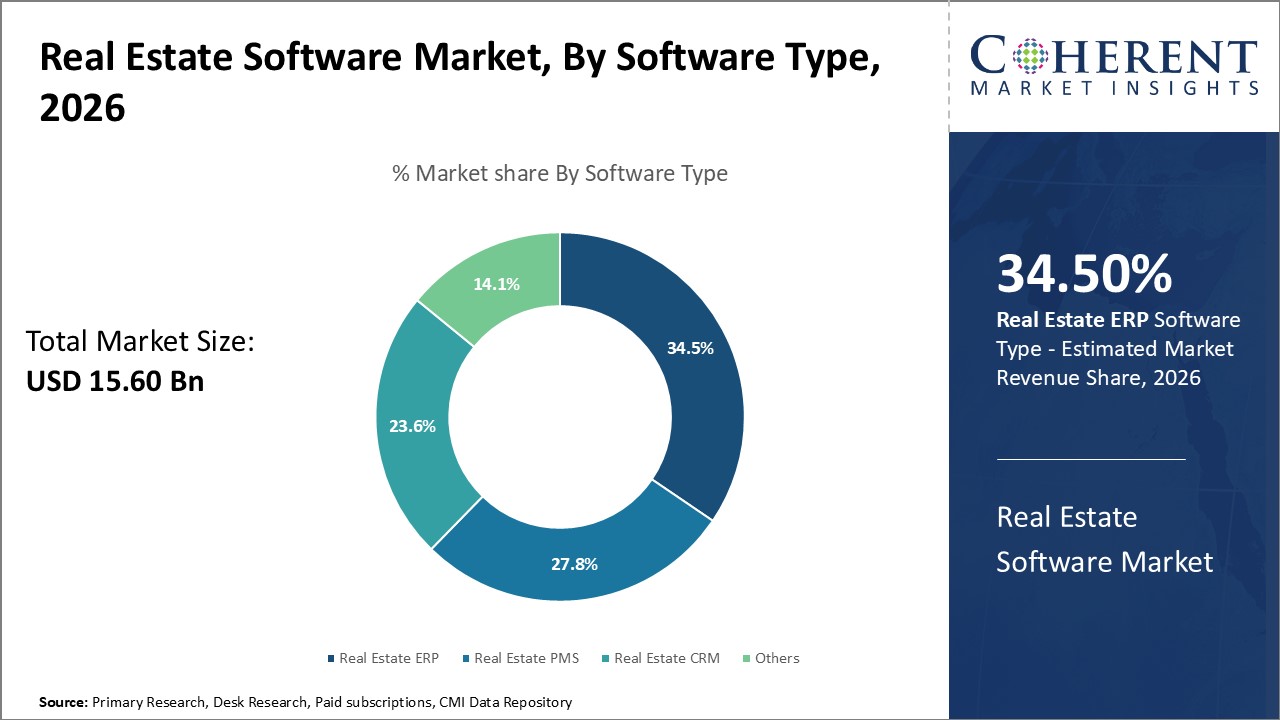
Real Estate Software Market Insights, By Software Type: The Real Estate PMS segment is Driven by Its Ability to Streamline Operations
In terms of software type, the real estate PMS segment is projected to hold the largest share of the market in 2026, due to its ability to streamline operations such as lease management, rent collection, maintenance scheduling, tenant communications, and financial reporting. With increasing complexity in managing large residential and commercial properties, PMS ensures higher efficiency, cost savings, and transparency. Additionally, the integration of AI, cloud platforms, and mobile-based access allows property managers and landlords to monitor real-time data, automate tasks, and enhance tenant experience. The growing number of rental properties, co-living spaces, and commercial assets globally further accelerates the adoption of PMS, making it one of the most in-demand software types in the real estate sector.
For instance, in August 2025, Alt, a leading platform in India’s alternative investment space, introduced ARIPS, India’s first Portfolio Management Service (PMS) focused solely on listed Real Estate Investment Trusts (REITs) and Infrastructure Investment Trusts (InvITs). The initiative gives investors access to institutional-grade real estate and infrastructure assets via a regulated, liquid, and professionally managed vehicle.
Regional Insights
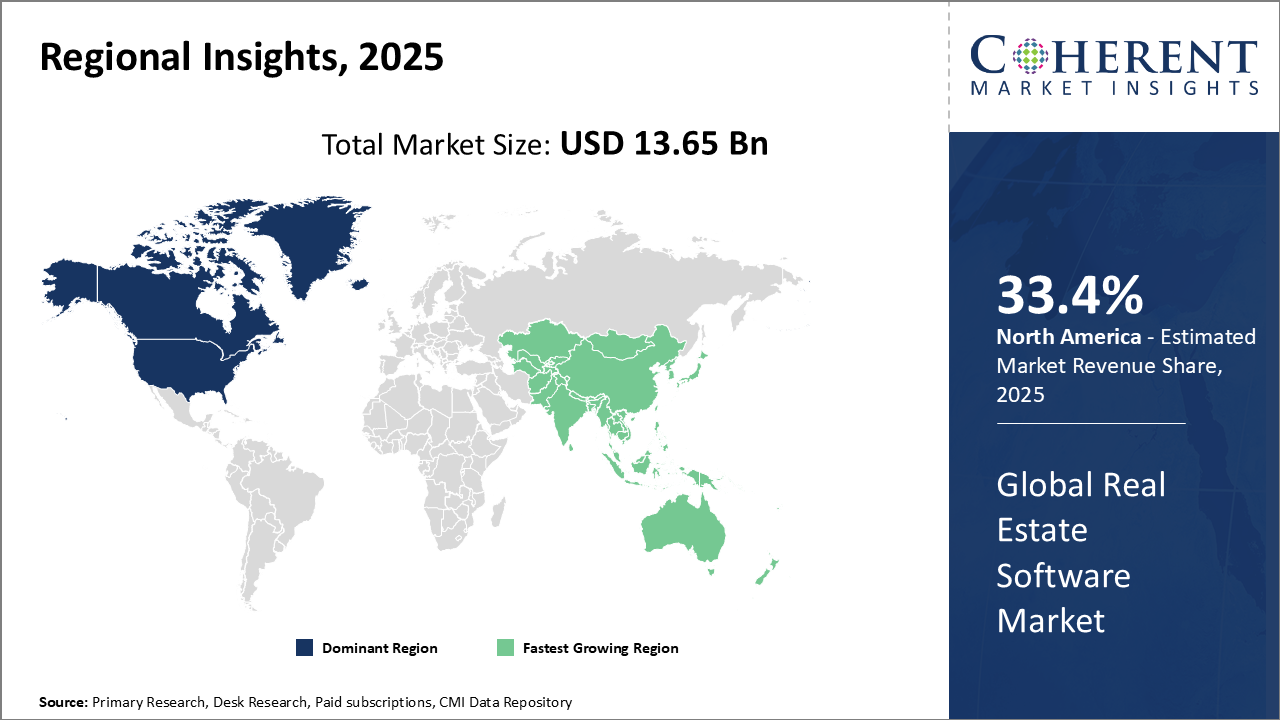
North America Real Estate Software Market Analysis & Trends
North America remains the dominant region in the global real estate software market with 33.4% share in 2026. The large-scale development and adoption of advanced technologies across industries has created considerable opportunities for real estate software providers in the region. Major real estate companies have digitally transformed their operations by deploying software platforms to streamline project management, customer relationship management and transactions. Furthermore, the presence of leading real estate software vendors and their heavy investments in product innovation are catering to the dynamic needs of customers.
For instance, June 2026, Lone Wolf Technologies, a residential real estate software in North America, unveiled Deal Tracker, a new visual pipeline dashboard now live as the default homepage in its Transact platform. Designed to give real estate professionals full visibility into every transaction stage. This tool integrates seamlessly across Lone Wolf’s ecosystem, including Relationships, Transact, and Back Office, under its Foundation cloud platform.
Asia Pacific Real Estate Software Market Analysis & Trends
Asia Pacific region is poised to be the fastest growing market with 22.9% share in 2026 for real estate software. Due to rapid urbanization and rise in middle-class population they are fuelling new construction projects and property developments. At the same time, technology adoption across workplaces is increasing in the region. Real estate firms recognize the potential of digital tools and cloud-based platforms to boost productivity, optimize business processes, and enhance customer experiences. Several large property developers and brokers have expressed intentions to digitize their operations in order to compete effectively and garner a bigger market share. The growth also stems from the regional expansion strategies adopted by global companies to tap into new opportunities. While pricing may vary across countries, overall software costs remain competitive.
For instance, in June 2026, OutSystems, a global leader in AI-powered low-code development, is empowering Hong Kong’s real estate sector to modernize and optimize application development. Deploying its platform, real estate firms such as Sino Group have rapidly launched digital solutions for workflows like buyer intent registration, balloting, and sales-event attendance tracking. The AI-infused low-code environment reduces technical barriers, accelerates time-to-market, and ensures seamless teamwork between internal and external teams, all while embedding robust security controls.
Real Estate Software Market Outlook Country-wise
The U.S. Real Estate Software Market Trends
The real estate software market demand in the U.S. with 24.1% share is rising due to the country’s large and highly competitive real estate sector, where efficiency, automation, and data-driven decision-making are critical. High adoption of property management systems (PMS), customer relationship management (CRM) tools, and ERP solutions is driven by the need to streamline leasing, tenant engagement, financial reporting, and compliance with regulatory requirements. Additionally, the growing trend of smart buildings, co-working spaces, and digital property listings has accelerated the demand for cloud-based and AI-enabled real estate software. The U.S. market also benefits from strong investments in proptech startups and increasing integration of virtual tours, predictive analytics, and mobile-first platforms, making real estate transactions faster, more transparent, and customer-centric.
For instance, in August 2026, Islamic fintech Wahed unveiled its Shariah-compliant private real-estate investment platform in the U.S., enabling fractional ownership in residential properties starting at just USD 100. The fully managed platform, accessible via Wahed’s mobile app, offers investors quarterly rental income and potential capital gains from debt-free properties. The offering addresses barriers faced by faith-based and values-oriented investors, with Wahed overseeing regulatory compliance, property maintenance, and tenant relations.
The U.K. Real Estate Software Market Trends
The U.K. real estate software market is growing with a 5.9% share, driven by digital property transactions, government-backed transparency initiatives, and expansion of the build-to-rent sector. PropTech adoption and rising demand for cloud-based solutions further fuel software integration across residential and commercial portfolios.
For instance, in June 2026, PEXA, the digital property-exchange platform, confirmed it has successfully executed the UK’s first fully digital property purchase. The pilot transaction, part of a test of PEXA’s upcoming Sale & Purchase service, was conducted with Hinckley & Rugby Building Society and conveyancing firm Muve using PEXA Pay, now the seventh net settlement payment system cleared through the Bank of England.
China Real Estate Software Market Trends
China leads with a 6.7% share, supported by rapid urbanization, smart city investments, and government-driven digitization of property registries. Expanding residential demand, e-commerce-linked real estate, and strong PropTech innovation push adoption of AI and cloud-powered real estate software solutions, making China the most dominant regional market.
For instance, in May 2026, China’s rapid urban transformation is now underpinned by smart-city innovations and sustainable design to meet surging urbanization from just 11% to 66% by 2023, with projections nearing 68% globally by 2050. The article highlights widespread deployment of traffic-monitoring infrastructure and surveillance systems as urban planners seek efficiency. Showcasing Sino-Swiss collaboration, the piece features expert Yin Li’s dual training in architecture and energy engineering, and his leadership in the Zero-Emission-Building initiative.
Brazil Real Estate Software Market Trends
Brazil holds a 3.5% share, with demand propelled by urban housing needs, fintech integration in property transactions, and rising adoption of digital platforms for leasing and property management. Growing investments in commercial real estate and online property marketplaces are further driving the country’s real estate software market expansion.
For instance, in September 2026, PipeImob, a Brazil-based proptech platform digitizing the entire real estate transaction process, has secured R$15 million in a seed funding round led by venture capital firm Headline. The fresh capital will support the company’s planned entry into the rental market and enhance its financial services offering.
GCC Countries Real Estate Software Market Trends
The GCC market accounts for 2.5% share, driven by mega infrastructure projects, luxury residential developments, and government smart city initiatives. Growing foreign investments, regulatory transparency, and digitization of property dealings encourage adoption of advanced real estate software for efficient management, leasing, and investor engagement in the region.
For instance, in May 2026, Abu Dhabi-based AI firm G42 will spearhead the construction of a 10-square-mile AI campus in Abu Dhabi under the US–UAE AI Acceleration Partnership, the White House announced. The first phase includes a 1-gigawatt AI data center, in a project eventually reaching 5 GW—the largest AI facility outside the United States.
Market Report Scope
Real Estate Software Market Report Coverage
| Report Coverage | Details | ||
|---|---|---|---|
| Base Year: | 2025 | Market Size in 2026: | USD 15.60 Bn |
| Historical Data for: | 2020 To 2024 | Forecast Period: | 2026 To 2033 |
| Forecast Period 2026 to 2033 CAGR: | 14.2% | 2033 Value Projection: | USD 39.49 Bn |
| Geographies covered: |
| ||
| Segments covered: |
| ||
| Companies covered: | Accruent, Altus Group Ltd., AppFolio, Inc., Aareon, Autodesk Inc., CoStar Group, Entrata, IBM Corporation, Intuit Inc., MRI Software LLC, Microsoft, Oracle Corporation, RealPage, Trimble Inc., Yardi Systems | ||
| Growth Drivers: |
| ||
| Restraints & Challenges: |
| ||
Real Estate Software Market Driver
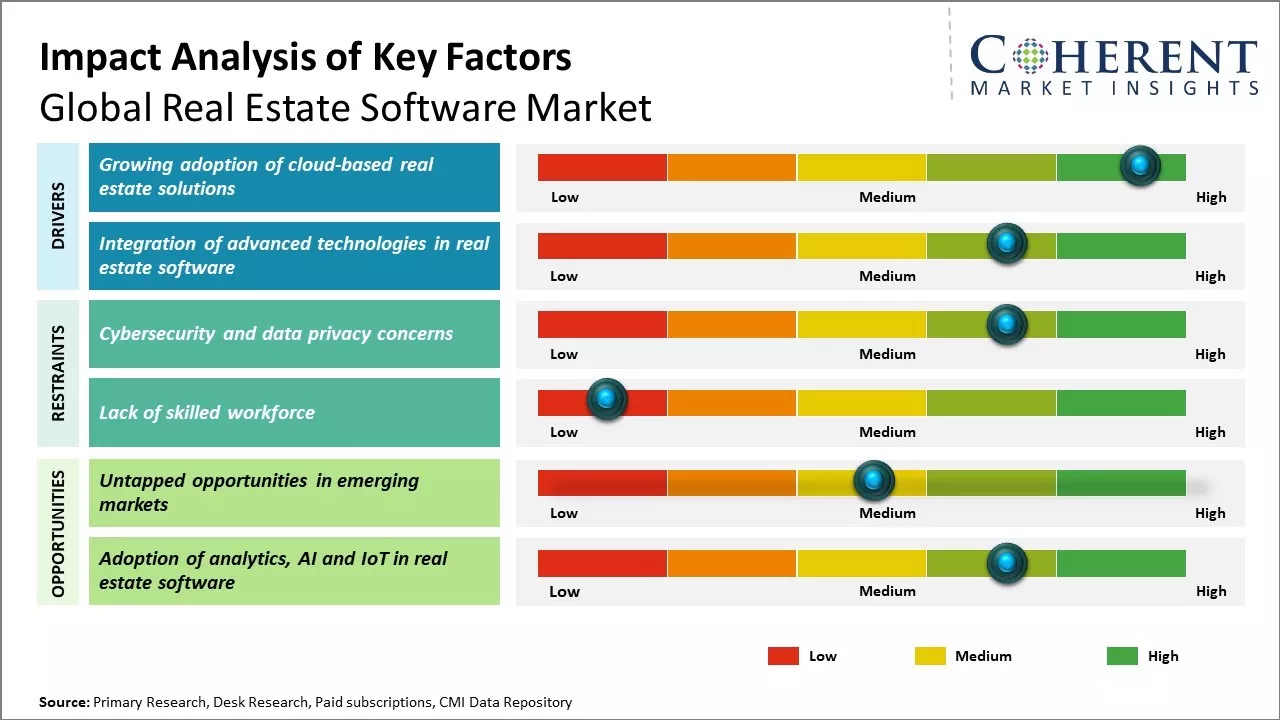
- Growing adoption of cloud-based real estate solutions
With rising internet and smartphone penetration, cloud-based solutions are rapidly transforming the real estate sector. Developers, brokers, and managers are adopting cloud-based property management and transaction systems for centralized data access, mobility, and scalability. These platforms streamline lease management, billing, and maintenance while improving collaboration and efficiency. Consumers’ growing comfort with online property transactions further boosts adoption. Major firms are integrating legacy systems with cloud platforms to enhance transparency and mobility. This increasing shift toward cloud-based models is a key driver of growth, strengthening the real estate software market share globally.
- Integration of advanced technologies in real estate software
The global real estate industry is increasingly adopting advanced technologies to enhance efficiency, transparency, and consumer experience. Artificial intelligence automates tasks like document verification and predictive maintenance, while big data analytics improves decision-making. Blockchain ensures secure, transparent transactions, and VR/AR enhance property visualization and planning. IoT enables remote monitoring for optimized property management. These innovations are reducing costs, boosting productivity, and improving services, driving strong adoption of next-generation platforms. Such advancements are a key focus of real estate software market research, highlighting how technology integration is reshaping industry growth worldwide.
Real Estate Software Market Opportunities
- Untapped opportunities in emerging markets
Global real estate software market has tremendously untapped the potential in emerging markets. Many developing nations are witnessing rapid urbanization as more people migrate to cities for education and employment opportunities.
Several emerging nations like India, Indonesia, and Nigeria already have large metropolitan areas with over 10 million residents each. With growing affluence and middle class in these cities, the real estate sector is poised to take off. However, most real estate firms in developing markets still rely on outdated systems like physical files and spreadsheets instead of specialized property management or CRM software. This presents a major business opportunity for global real estate software providers to introduce customized, multilingual and cloud-based solutions. Their tools addressing needs of property developers, brokers, agents and valuers can dramatically improve operations, compliance and customer experience.
Analyst opinion (Expert Opinion)
The Real Estate Software Market is undergoing a decisive shift from administrative automation toward intelligence-led operations; mere digital replication of legacy processes is no longer sufficient to command leadership. Vendors that treat the product as a compliance-and-operations utility will be outcompeted by platforms that deliver measurable operational leverage: time returned to managers, measurable rent-recovery improvements, risk reduction in underwriting, and demonstrable cost-to-serve compression. Evidence of this re-ranking is visible in adoption patterns: a large share of property operators now run core functions (leasing, screening, rent collection) inside integrated platforms rather than spreadsheets.
AI and workflow automation are moving from pilot projects into production workflows that materially change unit economics, automating tenant screening, raising the speed of lease processing from hours to minutes in reported deployments, and cutting routine manager hours per property. Case examples from leading SaaS incumbents show leasing automation and integrated screening materially reduce manual touchpoints and accelerate time-to-occupancy, which translates directly into improved recovery and lower vacancy-servicing cost.
Moreover, commercial buyers are increasingly procurement-sensitive about real estate software market value and real estate software market price as separate evaluation axes. The purchaser’s calculus now separates (a) software value, defined as measurable delta in NOI, cycle time, tenant retention, and compliance risk reduction, from (b) headline price and license model. Procurement teams routinely bifurcate vendor evaluation: a higher headline price is acceptable when the vendor proves a 6–12-month payback via lower operating expense or higher realized rents; conversely, rock-bottom pricing with limited integration and sparse analytics is being rejected even by mid-tier operators. Vendor messages that conflate low price with high value will lose tenders.
Speak to the analyst
Want personalized insights?
Take the findings above to one of our principal consultants, or have the report rebuilt around the segments, geographies and competitors you actually track.
Recent Developments
- In August 2025, DRA Group and the Philippines’ Balajadia family launched a USD 100 million real-estate platform (approx. ₹876 crore) targeting yield-generating office and retail assets across South India. This 50:50 joint venture marks the Filipino family’s debut in India’s real estate market. Phase one includes a 60,000 sq ft retail centre underway in Chennai’s OMR corridor and a planned 1.6-acre commercial centre.
- In April 2025, Housp unveiled a cutting-edge real estate platform powered by machine learning to transform secondary property transactions. The ML-enabled system predicts pricing trends, enables smarter searches, and offers tools like EMI and ROI calculators, title verification, and e-mandate digital signing, aimed at eliminating spam, false promises, and opacity in resale deals.
- In November 2024, HostBooks Ltd, a prominent business-automation solutions provider, introduced its new Real-Estate ERP Software tailored for the complex needs of the real-estate industry. The all-in-one platform integrates property management, financial operations, CRM, legal compliance, and project management tools to unify previously fragmented processes.
Market Segmentation
- By Software Type (Revenue, USD Bn, 2026 - 2033)
- Real Estate ERP
- Real Estate PMS
- Real Estate CRM
- Others
- By Application (Revenue, USD Bn, 2026 - 2033)
- Residential Sector
- Commercial Sector
- Regional Insights (Revenue, USD Bn, 2026 - 2033)
- North America
- U.S.
- Canada
- Latin America
- Brazil
- Argentina
- Mexico
- Rest of Latin America
- Europe
- Germany
- U.K.
- Spain
- France
- Italy
- Russia
- Rest of Europe
- Asia Pacific
- China
- India
- Japan
- Australia
- South Korea
- ASEAN
- Rest of Asia Pacific
- Middle East & Africa
- GCC Countries
- Israel
- South Africa
- Rest of Middle East & Africa
- Key Players Insights (Revenue, USD Bn, 2021 - 2033)
- Accruent
- Altus Group Ltd.
- AppFolio, Inc.
- Aareon
- Autodesk Inc.
- CoStar Group
- Entrata
- IBM Corporation
- Intuit Inc.
- MRI Software LLC
- Microsoft
- Oracle Corporation
- RealPage
- Trimble Inc.
- Yardi Systems
Sources
Primary Research Interviews — Stakeholders
- Interviews with property managers, facility managers, asset managers, leasing managers, corporate real estate (CRE) heads, procurement heads, IT heads, and digital transformation leads across leading global markets.
Specific Stakeholders (examples)
- PropTech / Digital transformation leads at large retail chains and mall operators (e.g., major national retail chains, multinational mall owners).
- Asset managers and portfolio managers at REITs and institutional real estate investors.
- Facility and operations managers at transport hubs and large mixed-use developments (e.g., major international airports, transit hubs, flagship malls).
- Head of Corporate Real Estate / Workplace Experience at large corporates and tech companies.
- IT infrastructure and applications heads at hospitality and hotel groups (e.g., global and regional chains).
- Lease administration and portfolio analytics teams at commercial landlords and portfolio servicers.
- Property managers and operations teams at multi-family and residential management companies.
- Brokerage heads and transaction technology leads at major commercial brokerage firms (role-based interviews rather than company-name focus).
- Procurement heads for enterprise real estate and facilities technology.
- Product managers and solution architects at real estate software vendors (property management, CAFM, IWMS, lease administration, CRE analytics, tenant experience apps).
- Systems integrators and implementation partners (ERP integrators, SIs specializing in real estate technology).
- Independent consultants and academic experts in property technology and urban informatics (for triangulation).
- End users: building engineers, front-desk/property operations staff, tenant experience managers, and facility service vendors.
Databases
- World Bank — World Development Indicators (urban, construction, investment).
- UN-Habitat / UN Statistics Division (urbanization, housing stock).
- Eurostat (housing, construction, ICT in real estate).
- U.S. Bureau of Economic Analysis (BEA) and U.S. Census Bureau (housing starts, building permits).
- Japan Statistics Bureau / METI statistics (building permits, construction output).
- National statistical offices (ONS UK, INSTAT, Statistics Korea, Statistics Canada) for national property/activity data.
- Land registries and property transaction portals (e.g., HM Land Registry — UK; state land registries — India; municipal property registries where public).
- National Real Estate Regulatory Authority / RERA databases (where available) for registrations and project data.
- Open data portals for major cities (building footprints, zoning, permits).
- Central banks’ housing market reports (e.g., Reserve Bank of India housing/credit notes, Federal Reserve housing indicators).
- Commercial property transaction feeds and public filings (REIT filings, listed landlords’ disclosures) — use company filings rather than third-party paid services when possible.
Trade & Industry Magazines / Online Media
- PropTech Magazine / PropTech-focused trade outlets.
- Commercial Property Executive.
- Property Week.
- The Real Deal (commercial & residential markets).
- Inman (residential real estate tech & trends).
- GlobeSt (commercial real estate news).
- Real Estate Weekly.
- Construction & Property sections of TechRadar Pro (enterprise property tech coverage).
- Facility Management Journal / FM World.
Academic Journals & Technical Journals
- Journal of Real Estate Research.
- Real Estate Economics.
- Journal of Property Investment & Finance.
- Journal of Real Estate Finance and Economics.
- Building Research & Information.
- Automation in Construction (for smart-building / IoT integrations).
- IEEE Internet of Things Journal (for smart building/IoT topic intersections).
- Journal of Urban Technology.
Newspapers & Business Press (for market trends / deals)
- The Wall Street Journal — Real Estate & Technology.
- Financial Times — Property & PropTech coverage.
- The Economic Times — Real Estate & Technology (India).
- The Hindu Business Line — Real Estate & Infrastructure (India).
- Nikkei Asia — Property, construction and electronics supply chain.
- South China Morning Post — Property & urban tech in Asia.
- Local major business dailies for country-level deal coverage.
Associations & Industry Bodies
- Royal Institution of Chartered Surveyors (RICS).
- Urban Land Institute (ULI).
- National Association of Realtors (NAR) / equivalent national realtor associations.
- Building Owners & Managers Association (BOMA).
- Institute of Real Estate Management (IREM).
- International Real Estate Federation (FIABCI).
- Local PropTech associations and industry clusters (country/regional PropTech groups).
- Facilities management associations (IFMA chapters, national FM bodies).
Public-domain and Government Sources
- Ministry of Housing and Urban Affairs (Government of India) / national housing ministries.
- Department of Housing and Urban Development (HUD), U.S. — housing & community data.
- Ministry of Commerce/Industry statistical releases for construction & ICT adoption.
- Municipal open data portals (building permits, zoning, planning applications).
- Central bank reports and macroprudential/housing market bulletins.
- National land registries and public property transaction disclosure portals.
- NITI Aayog / national policy thinks tanks’ reports on urban development where relevant.
Proprietary Elements (internal / client)
- CMI Data Analytics Tool, and Proprietary CMI Existing Repository of information for last 8 years
Get access to 250+ pages report
Every segment, forecast, competitor profile and data table behind the analysis above — available for instant download.
- ESOMAR Member
- ISO 9001:2015 Certified
- D-U-N-S Registered
- GDPR & CCPA Compliant
Missing comfort of reading report in your local language? Find your preferred language:
Transform your Strategy with Exclusive Trending Reports
Frequently Asked Questions
The Real Estate Software Market is estimated to be valued at USD 15.60 Bn in 2026, and is expected to reach USD 39.49 Bn by 2033.
The CAGR of the Real Estate Software Market is projected to be 12.8% from 2026 to 2033.
Growing adoption of cloud-based real estate solutions and integration of advanced technologies in real estate software are the major factors driving the growth of global real estate software market.
Cybersecurity and data privacy concerns and lack of skilled workforce are the major factors hampering the growth of global real estate software market.
In terms of type, Customer Relationship Management Software is expected to dominate the market revenue share in 2026.
Accruent, Altus Group Ltd., AppFolio, Inc., Aareon, Autodesk Inc., CoStar Group, Entrata, IBM Corporation, Intuit Inc., MRI Software LLC, Microsoft, Oracle Corporation, RealPage, Trimble Inc., Yardi Systems are the major players.
North America is expected to lead the global real estate software market in 2026.