

Algorithmic Trading Market Size and Trends Forecast: 2026 - 2033
The algorithmic trading market is estimated to be valued at USD 3.59 Bn in 2026 and is expected to reach USD 6.68 Bn by 2033, exhibiting a compound annual growth rate (CAGR) of 9.3% from 2026 to 2033.
Key Takeaways of the Algorithmic Trading Market
- Based on type, the retail investors segment is projected to dominate holding a share of 38.5% in 2026.
- Based on deployment, the cloud-based segment is estimated to hold 59.8% of the market share in 2026.
- In terms of organization size, the large enterprises segment is expected to hold 57.7% share in 2026.
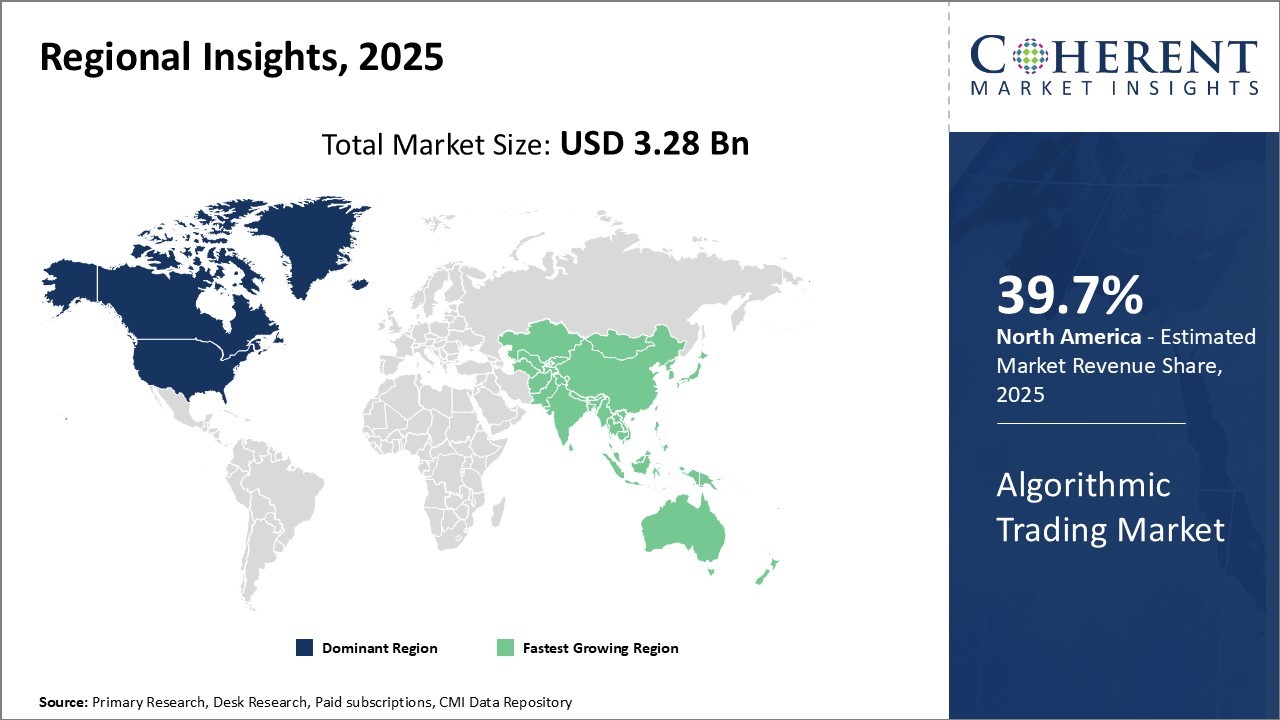
- North America is estimated to dominate the algorithmic trading market with 39. 7% market share in 2026.
Market Overview
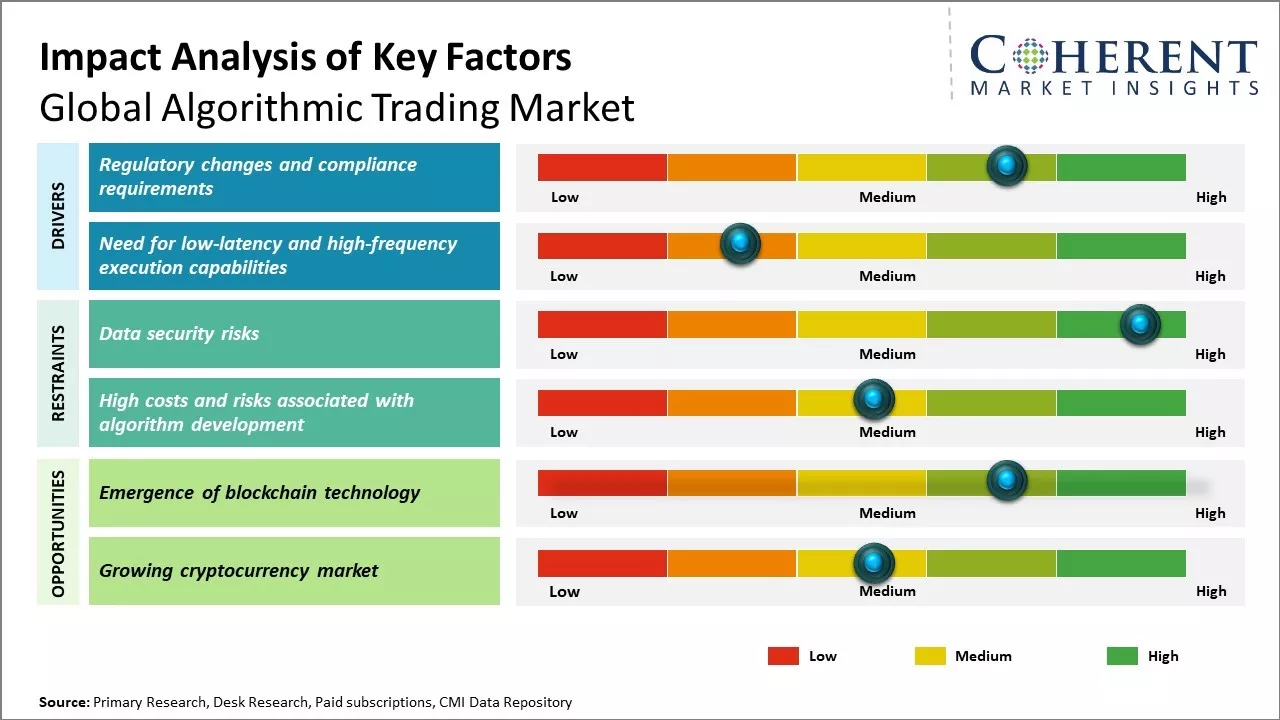
Global algorithmic trading market growth is driven by rising need for superior order execution, low latency trading, and liquidity provision. Advancements in technologies such as artificial intelligence, machine learning, and natural language processing have also boosted the development of innovative algorithmic trading solutions. Furthermore, increasing capital markets’ digitization, growing adoption of cloud-based solutions, and regulators accepting algorithmic trading can offer growth opportunities for the market players.
However, data security risks pose a significant challenge that can hamper the growth of the global algorithmic trading market.
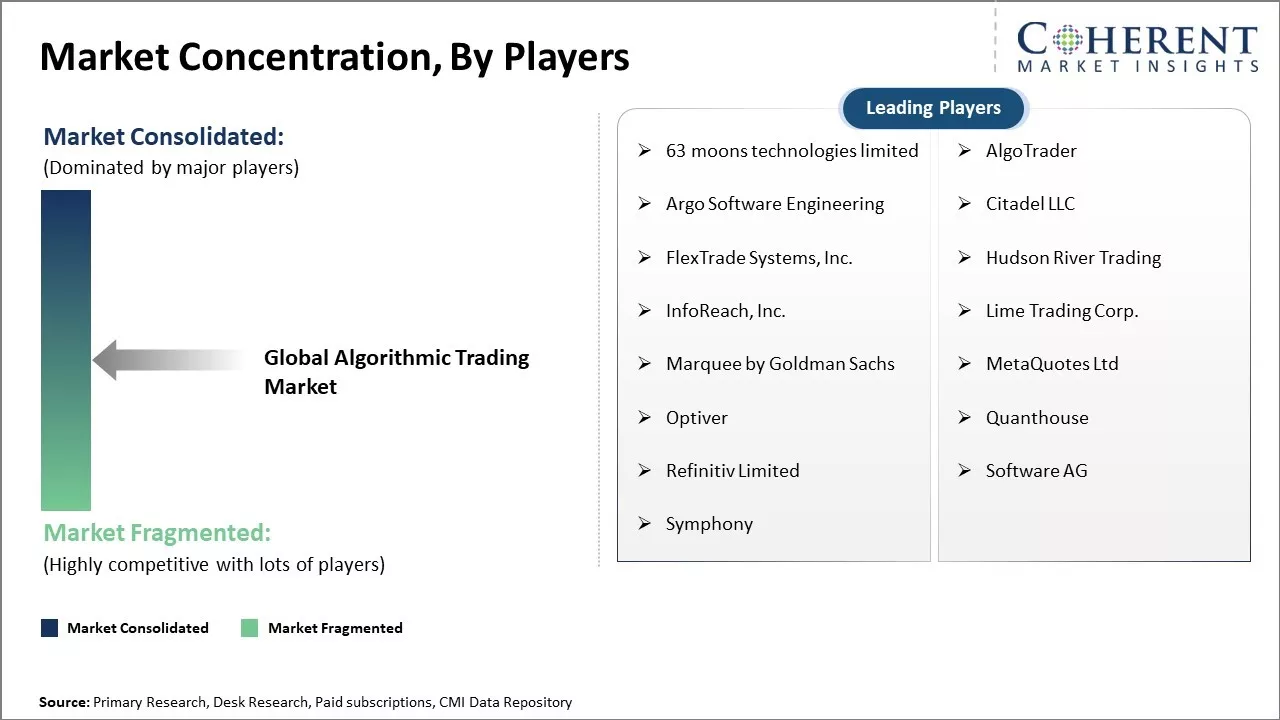
Market Concentration and Competitive Landscape
Current Events and Their Impact on the Algorithmic Trading Market
Current Events | Description and its impact |
Macro-Level Economic and Regulatory Developments |
|
Geopolitical and Regional Market Dynamics |
|
- Current Industry Events of 2026
- Market Size Estimation
- Regional Breakdown
- Competitive Landscape
- Customer Intelligence
- Segmental Analysis
- Pricing Analysis
- Key Market Drivers, Challenges & Future Trends
- Customized Insights Section
Market Trends
Expansion of High-Frequency Trading (HFT) Strategies
The expansion of high-frequency trading (HFT) strategies significantly propels the growth of the algorithmic trading market by leveraging advanced computational power and sophisticated algorithms to execute thousands of trades within fractions of a second. HFT facilitates the exploitation of minute price discrepancies and market inefficiencies across global financial markets, demanding highly efficient and automated trading systems.
Segmental Insights
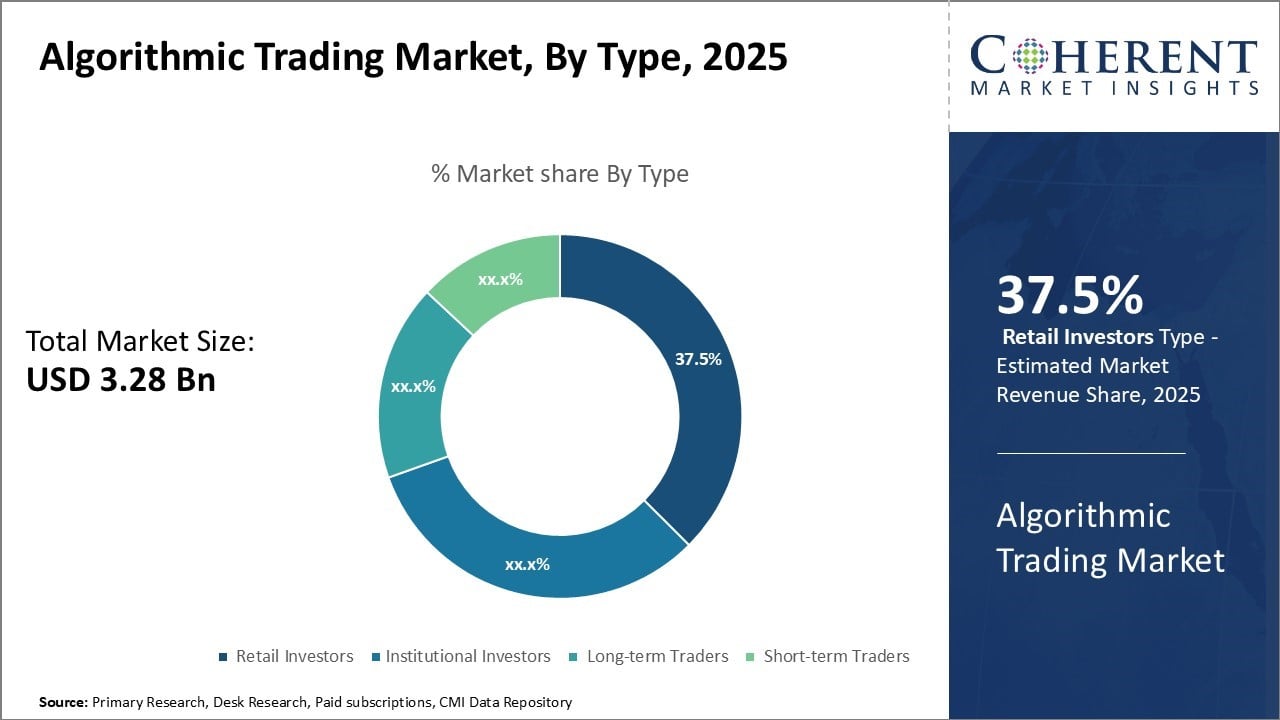
Algorithmic Trading Market Insights, By Type: Increased Accessibility Boosts Retail Investors Segment
In terms of type, retail investors segment is estimated to contribute the highest market share of 38.5% in 2026, owing to the increased accessibility of algorithmic trading platforms.
Retail investors are increasingly looking for new ways to generate returns in low interest environment and algorithmic trading offers a way to trade more frequently and diversify their portfolios more cost effectively. The proliferation of fintech companies offering user-friendly algorithmic trading apps at low or no commission has lowered the barriers to entry for individual investors. Advanced modelling and cloud technologies have streamlined the development and deployment of trading strategies, allowing retail traders to execute algorithms from any device.
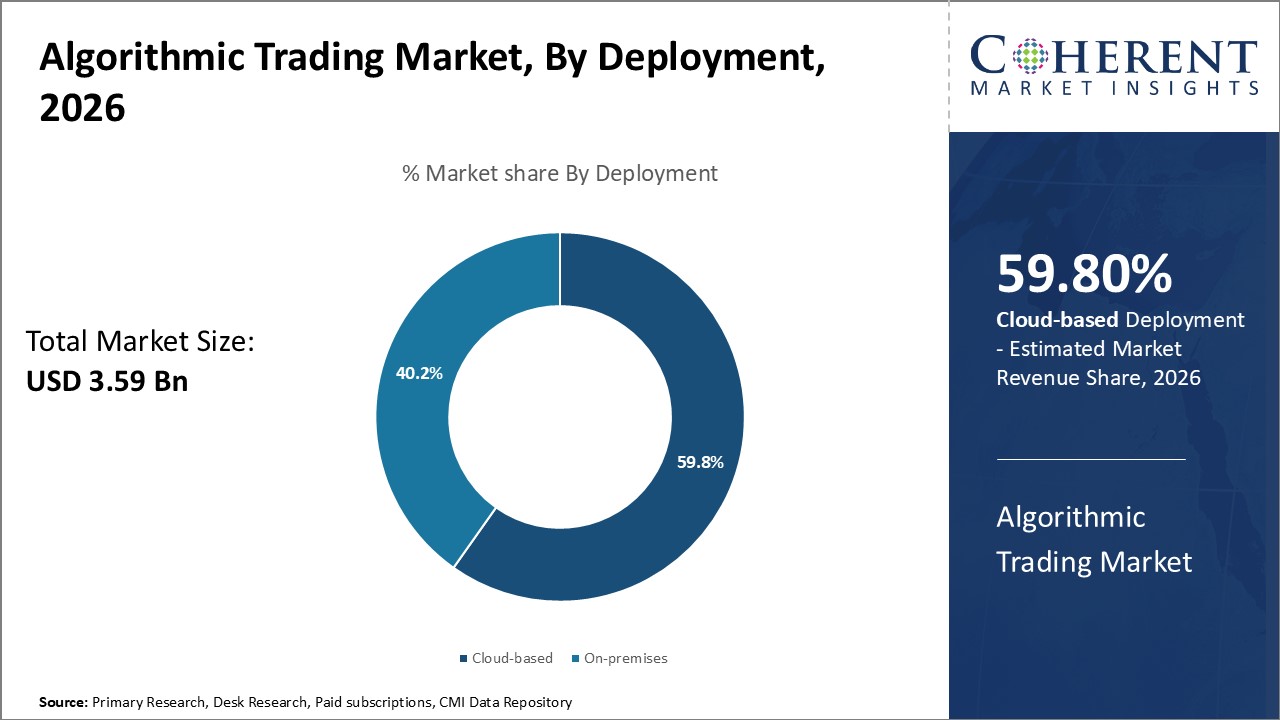
Algorithmic Trading Market Insights, By Deployment: Superior Scalability Boosts Cloud-Based Segment
In terms of deployment, cloud-based segment is estimated to contribute the highest market share of 59.8% in 2026, due to its superior scalability.
As algorithmic trading strategies become more sophisticated, requiring massive amounts of market and alternative data flows to be processed in real-time, the on-premises deployment model is limiting. Cloud infrastructure allows trading firms to instantly scale up computing power and storage capacity based on trading volumes and workload demands. This eliminates over-provisioning of on-premises servers and data centers, which are costly to maintain regardless of utilization rates.
Algorithmic Trading Market Insights, By Organization Size: Resource Leveraging Drives Large Enterprises Segment
In terms of organization size, large enterprises segment is estimated to contribute the highest market share of 57.7% in 2026, owing to their ability to leverage scale and resources.
Large brokerage firms, investment banks and hedge funds have significant capital to invest in hiring top quantitative talent, acquiring data vendors and developing in-house trading platforms. Their quantitative research teams can obtain bleeding-edge market insights by training sophisticated AI/ML algorithms on massive datasets. Dedicated teams of developers, quants and traders allow continuous refinement of strategies over several years.
Emerging Innovations in the Algorithmic Trading Market
- The Rise of Cloud Computing
- The rise of cloud computing is reshaping the algorithmic trading landscape by providing scalable and cost-efficient computational resources. Traditionally, the infrastructure necessary for running complex algorithms was prohibitively expensive and resource-intensive. Cloud platforms now enable smaller firms and individual traders to access the same computational power previously reserved for large financial institutions. The flexibility offered by cloud services allows rapid backtesting of new algorithms, real-time data processing, and the deployment of trading strategies in various geographic regions with minimal delay.
- Blockchain and Distributed Ledger Technologies (DLT)
- Blockchain and distributed ledger technologies (DLT) have also begun to influence algorithmic trading, particularly in cryptocurrency markets. Smart contracts and decentralized exchanges provide new venues and trading mechanisms, allowing algorithmic strategies to be executed in trustless environments. While still in early stages compared to traditional asset classes, these technological foundations promise to enhance transparency, reduce counterparty risk, and open up innovative algorithmic approaches tailored to digital assets.
Impacts of Artificial Intelligence (AI) on the Algorithmic Trading Market
By harnessing AI’s computational power and advanced analytics, market participants can navigate complex financial landscapes with greater speed and precision.
- Goldman Sachs has incorporated AI into its trading desks to optimize decision-making. Goldman Sachs uses AI to process unstructured data—including news, social media, and earnings reports—alongside traditional market data. This fusion of information feeds into their trading algorithms, allowing the firm to execute more informed trades at an unprecedented scale and speed.
- JP Morgan Chase has developed an AI-based execution algorithm called LOXM that intelligently routes orders to multiple exchanges by analyzing real-time market conditions. LOXM’s machine learning capabilities help minimize market impact and slippage, leading to improved trade efficiency and cost savings. This application exemplifies AI’s role in delivering tangible operational improvements by adapting dynamically to market volatility.
Regional Insights
North America Algorithmic Trading Market Analysis and Trends
North America has established itself as the dominant region in the global algorithmic trading market, with an estimated market share of 39.7% in 2026. Major financial centers such as New York and Chicago host a strong presence of algorithmic trading firms. Leading stock exchanges in the region have also invested heavily in developing technical infrastructure to support high-frequency and automated trading.
For instance, according to the Robust Trader in the U.S. stock market and many other developed financial markets, about 60-75% of overall trading volume is generated through algorithmic trading according to Select USA.
Asia Pacific Algorithmic Trading Market Analysis and Trends
Asia Pacific has emerged as the fastest growing market for algorithmic trading. Countries like China and India have witnessed increase in algorithmic trading activities due to growing institutional investments and maturing financial markets in these nations. Economic development in Asia has increased households' investable surplus that is making its way to stock exchanges.
For instance, as of November 2024, the Shanghai Stock Exchange (SSE) had a market capitalization of approximately USD 7.17 trillion, making it one of the largest stock exchanges globally. This growth underscores the expanding role of algorithmic trading in Asia Pacific's financial markets.
Algorithmic Trading Market Outlook for Key Countries
U.S Algorithmic Trading Market Analysis and Trends
The U.S. continues to lead the global algorithmic trading market, driven by the presence of major financial hubs like New York and Chicago, which host some of the world's most influential hedge funds, proprietary trading firms, and high-frequency trading (HFT) companies. The New York Stock Exchange (NYSE) and NASDAQ provide advanced trading infrastructure, including co-location services and low-latency data feeds, facilitating the growth of algorithmic and HFT strategies. U.S. regulations such as Reg NMS have also played a role in shaping the competitive, fragmented landscape that benefits algorithmic execution.
U.K. Algorithmic Trading Market Analysis and Trends
The U.K., particularly London, is a major center for algorithmic trading in Europe. The London Stock Exchange (LSE) has adopted technologies that support high-speed, automated trading, and many global investment banks and asset managers have established algorithmic trading desks in the region. Post-Brexit regulatory developments have sought to maintain London’s competitiveness as a financial hub, with support for innovation in fintech and electronic trading platforms.
India Algorithmic Trading Market Analysis and Trends
India has emerged as a rapidly growing player in the algorithmic trading market, particularly in the equity derivatives segment. Exchanges like the National Stock Exchange (NSE) and Bombay Stock Exchange (BSE) have embraced automation, and both provide APIs and co-location services to support low-latency trading.
Japan Algorithmic Trading Market Analysis and Trends
Japan plays a prominent role in the algorithmic trading landscape in the Asia Pacific region. The Tokyo Stock Exchange (TSE) supports high-frequency and algorithmic trading through its arrowhead trading system, which offers sub-millisecond latency. Many Japanese financial institutions, along with international trading firms operating in Tokyo, leverage sophisticated algorithms for market making, arbitrage, and statistical strategies.
Pricing Analysis of the Algorithmic Trading Market
Category | Price Range (USD) |
Basic License | Free for retail traders |
Professional License | 1,500- 3,000 annually |
Enterprise Solutions | 10,000- 50,000+ annually |
Custom Development | 50- 150 per hour |
Market Report Scope
Algorithmic Trading Market Report Coverage
| Report Coverage | Details | ||
|---|---|---|---|
| Base Year: | 2025 | Market Size in 2026: | USD 3.59 Bn |
| Historical Data for: | 2020 To 2024 | Forecast Period: | 2026 To 2033 |
| Forecast Period 2026 to 2033 CAGR: | 9.3% | 2033 Value Projection: | USD 6.68 Bn |
| Geographies covered: |
| ||
| Segments covered: |
| ||
| Companies covered: | 63 moons technologies limited, AlgoTrader, Argo Software Engineering, Citadel LLC, FlexTrade Systems, Inc., Hudson River Trading, InfoReach, Inc., Lime Trading Corp., Marquee by Goldman Sachs, MetaQuotes Ltd, Optiver, Quanthouse, Refinitiv Limited, Software AG, and Symphony | ||
| Growth Drivers: |
| ||
| Restraints & Challenges: |
| ||
Algorithmic Trading Industry News
- In July 2025, the National Stock Exchange of India (NSE) announced the implementation of a comprehensive framework for retail algorithmic trading, which will come into effect on August 1, 2025. The new framework mandates the registration of all trading strategies and introduces enhanced Application Programming Interface (API) security measures to ensure greater transparency and safeguard investor interests.
- In July 2025, MetaQuotes expanded access to algorithmic trading with Spanish and Chinese Editions of “MQL5 Programming for Traders”. This expansion allows more users to explore algorithmic trading in their native language and in a format that suits them best.
- In January 2024, FlexTrade Systems, a global leader in multi-asset execution and order management systems announced a new offering for traders of public equity to plan, manage, and execute equity offerings via their new issue management system, FlexNIMS.
Analyst View
- The algorithmic trading market is poised for significant transformation, driven by advancements in technology and increasing adoption of automated systems by institutional and retail investors. Key drivers include the growing need for efficient trade execution, reduced transaction costs, and the ability to process vast amounts of data to identify profitable opportunities in real-time.
- Additionally, the rising complexity of financial markets and the demand for speed and accuracy in trading have further accelerated adoption. However, regulatory scrutiny and concerns around market manipulation and system failures remain notable restraints, potentially slowing down widespread implementation in certain regions.
- Opportunities abound in integrating artificial intelligence and machine learning with algorithmic strategies, which can enhance predictive analytics and optimize trade decisions. Furthermore, the expansion of emerging markets offers new avenues for growth as these regions increasingly adopt electronic trading platforms.
- Overall, the algorithmic trading market is evolving towards greater sophistication with a focus on leveraging cutting-edge technologies to enhance market efficiency. Stakeholders must navigate regulatory challenges while capitalizing on AI-driven innovations and expanding geographic footprints.
Market Segmentation
- Type Insights (Revenue, USD Bn, 2021 - 2033)
- Institutional Investors
- Retail Investors
- Long-term Traders
- Short-term Traders
- Deployment Insights (Revenue, USD Bn, 2021 - 2033)
- Cloud-based
- On-premises
- Organization Size Insights (Revenue, USD Bn, 2021 - 2033)
- Small and Medium Enterprises
- Large Enterprises
- Regional Insights (Revenue, USD Bn, 2021 - 2033)
- North America
- U.S.
- Canada
- Latin America
- Brazil
- Argentina
- Mexico
- Rest of Latin America
- Europe
- Germany
- U.K.
- France
- Russia
- Rest of Europe
- Asia Pacific
- China
- India
- Japan
- Australia
- South Korea
- ASEAN
- Rest of Asia Pacific
- Middle East & Africa
- GCC Countries
- Israel
- South Africa
- Rest of Middle East & Africa
- Key Players Insights
- 63 moons technologies limited
- AlgoTrader
- Argo Software Engineering
- Citadel LLC
- FlexTrade Systems, Inc.
- Hudson River Trading
- InfoReach, Inc.
- Lime Trading Corp.
- Marquee by Goldman Sachs
- MetaQuotes Ltd.
- Optiver
- Quanthouse
- Refinitiv Limited
- Software AG
- Symphony
Sources
Primary Research Interviews
- Algorithmic Trading Platform Providers
- Hedge Funds & Asset Managers
- Proprietary Trading Firms
- Brokerage Firms
- Others
Magazines
- Algorithmic Trading Magazine
- Institutional Investor
- Traders Magazine
- Others
Journals
- Journal of Financial Markets
- Quantitative Finance
- Algorithmic Finance
- Others
Newspapers
- Financial Times
- The Wall Street Journal
- Economic Times
- Others
Associations
- Futures Industry Association (FIA)
- Algorithmic Traders Association
- International Swaps and Derivatives Association (ISDA)
- Others
Public Domain Sources
- SEC Filings (e.g. EDGAR)
- World Bank Data
- International Monetary Fund (IMF) Reports
- Commodity Futures Trading Commission (CFTC) Reports
- Others
Proprietary Elements
- CMI Data Analytics Tool – Algorithmic Trading Market
- CMI Existing Repository of Information for the Last 8 Years
*Definition: Global Algorithmic Trading Market involves the development and use of computer programs that follow a defined set of instructions or mathematical models to place a large number of orders and trades automatically. These allow institutional investors and investment banks to define automated trading strategies and electronically execute trades based on pre-programmed proprietary models. Algorithmic trading helps in reducing costs while increasing the speed, accuracy and consistency of different trading decisions in global financial markets.
Get access to 250+ pages report
Every segment, forecast, competitor profile and data table behind the analysis above — available for instant download.
- ESOMAR Member
- ISO 9001:2015 Certified
- D-U-N-S Registered
- GDPR & CCPA Compliant
Missing comfort of reading report in your local language? Find your preferred language:
Transform your Strategy with Exclusive Trending Reports
Frequently Asked Questions
The algorithmic trading market is estimated to be valued at USD 3.59 Bn in 2026, and is expected to reach USD 6.68 Bn by 2033.
The CAGR of the algorithmic trading market is projected to be 9.3% from 2026 to 2033.
Regulatory changes and compliance requirements and need for low-latency and high-frequency execution capabilities are the major factors driving the growth of global algorithmic trading market.
Data security risks and high costs and risks associated with algorithm development are the major factors hampering the growth of global algorithmic trading market.
In terms of type, retail investors segment is estimated to dominate the market in 2026.
63 moons technologies limited, AlgoTrader, Argo Software Engineering, Citadel LLC, FlexTrade Systems, Inc., Hudson River Trading, InfoReach, Inc., Lime Trading Corp., Marquee by Goldman Sachs, MetaQuotes Ltd, Optiver, Quanthouse, Refinitiv Limited, Software AG, and Symphony are the major players in the global algorithmic trading market.
North America is expected to lead the algorithmic trading market in 2026.