

Telecom Order Management Market Size and Forecast — 2026-2033
The Global Telecom Order Management Market size is estimated to be valued at USD 2.76 billion in 2026 and is expected to reach USD 6.38 billion by 2033, exhibiting a compound annual growth rate (CAGR) of 12.7% from 2026 to 2033.
Overview
Telecom order management solutions are designed to automate and streamline the end-to-end order lifecycle for telecom services, including provisioning, billing, and fulfillment. These systems integrate customer relationship management (CRM) and network management platforms to reduce order errors, improve operational efficiency, and enhance customer experience. Modern telecom order management platforms leverage AI, automation, and analytics to handle complex service orders, manage service dependencies, and ensure real-time order tracking for telecom operators.
Key Takeaways
The Cloud deployment segment dominates the market given its scalability and cost efficiencies, holding over 63% share, reflecting rapid industry-wide migration from on-premise systems.
Mobile Order Management is leading the application segment with multi-million USD revenues attributed to the explosive growth of mobile subscribers globally.
In telecom operators’ end-user segment, there is the highest industry share due to their expansive service portfolios necessitating advanced order management capabilities.
Regionally, North America commands the largest market share, driven by strong telecom infrastructure and early technology adoption.
Asia Pacific emerges as the fastest-growing region, propelled by expanding telecom networks in India and China, exhibiting a CAGR exceeding 14%, thanks to supportive government initiatives and private sector investments enhancing market scope.
Telecom Order Management Market Segmentation Analysis
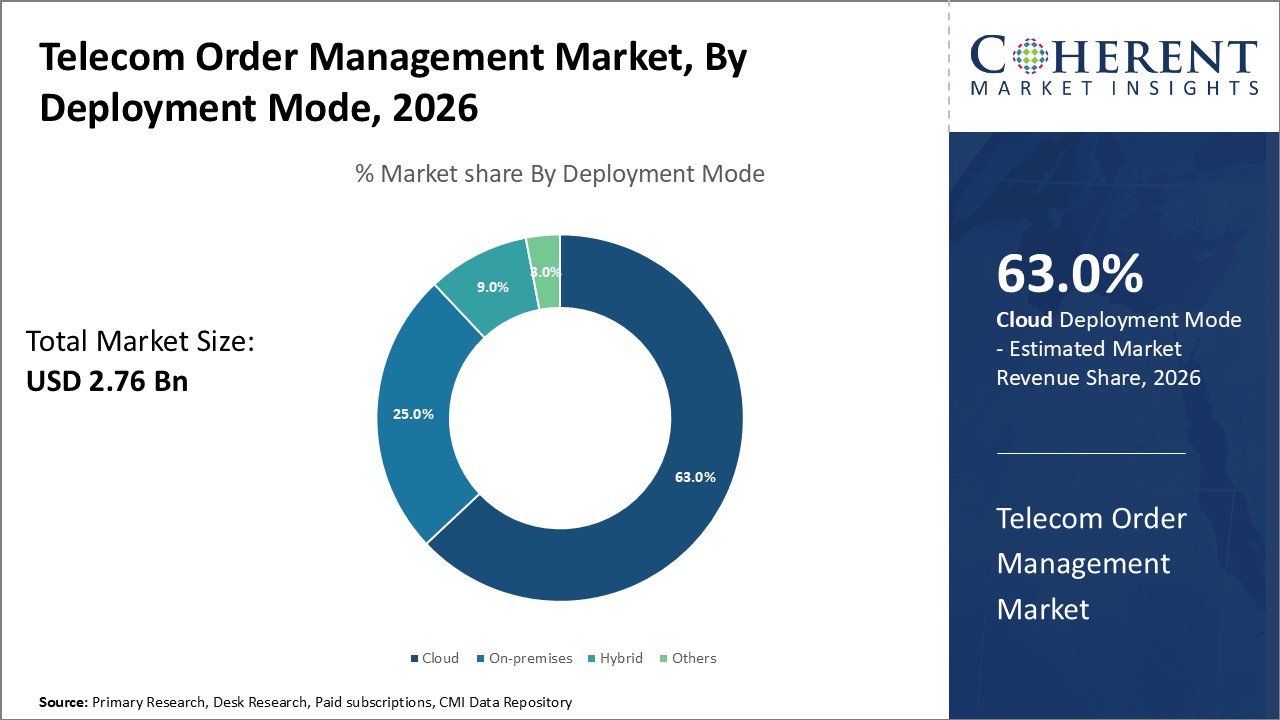
Telecom Order Management Market Insights, By Deployment Mode
In terms of deployment type, Cloud dominates the market share due to its scalability, cost-effectiveness, and flexibility, accounting for 63% of the overall deployments. This preference is driven by telecom operators seeking agile platforms that facilitate rapid service rollouts and seamless upgrades. The Cloud segment’s ability to integrate AI and machine learning models for predictive order management further accelerates its adoption.
Telecom Order Management Market Insights, By Application
Mobile Order Management holds the largest industry share, driven by the explosive growth of mobile subscribers and the increased complexity of mobile service bundles such as data, voice, and value-added services. Telecom providers prioritize mobile OMS to reduce churn and improve customer satisfaction. Wholesale Order Management is the fastest-growing subsegment, spurred by the expansion of multi-operator network sharing agreements and IoT connectivity business models.
Telecom Order Management Market Insights, By End-User
Telecom Operators dominate the market share owing to their extensive subscriber bases and intricate order ecosystems requiring advanced OMS platforms. Their investment in digital transformation and 5G services drives continued demand. Enterprises represent the fastest-growing subsegment as businesses increasingly adopt telecom order management solutions for private networks and cloud connectivity facilitation, particularly in Industry 4.0 frameworks. Managed Service Providers maintain moderate growth, acting as intermediaries offering outsourced services, whereas ‘Others’ include niche verticals that are progressively integrating OMS solutions for optimized communication needs.
Telecom Order Management Market Trends
Major trends include the accelerated adoption of cloud-based solutions, the integration of artificial intelligence for process automation, and regulatory compliance mandates.
Cloud adoption facilitates the scaling of order management platforms, enabling support for complex multi-service product bundles, which have recorded a 63% market share in deployment models.
AI-powered solutions optimize workflows; for example, in 2025, AI integration reduced order processing errors by 19%, demonstrating direct impacts on operational efficiency.
Regulatory frameworks, particularly in Europe and North America, necessitate enhanced data privacy and SLA enforcement, embedding compliance as a core market driver.
Telecom Order Management Market Insights, By Geography
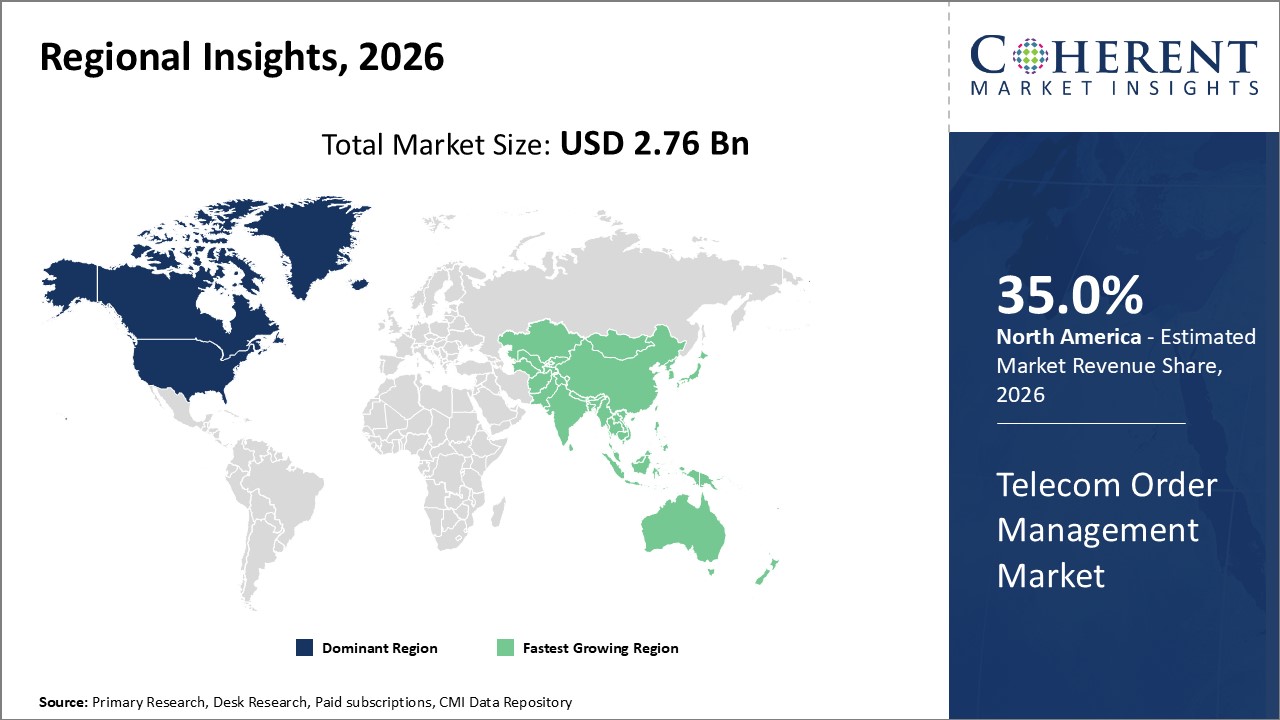
North America Telecom Order Management Market Analysis and Trends
In North America, the Telecom Order Management Market leads globally, driven by advanced infrastructure, early 5G rollouts, and significant government and industry collaboration. The high adoption rate of cloud OMS platforms and AI-driven automation by top telecom companies contributes to North America’s commanding market share, estimated at over 35% as of 2026.
Asia Pacific Telecom Order Management Market Analysis and Trends
Meanwhile, Asia Pacific exhibits the fastest growth in telecom order management, driven by expanding telecom subscriber bases in India and China, increasing investments in 5G, and progressive digital infrastructure development. The region’s CAGR exceeds 14%, supported by government policies incentivizing telecom digitization and regional players’ market growth strategies.
Telecom Order Management Market Outlook for Key Countries
USA Telecom Order Management Market Analysis and Trends
The USA market stands as the largest contributor to Telecom Order Management revenues, underpinned by early adoption of 5G and cloud transformation initiatives. Key market players such as Oracle and Cisco have deployed AI-enabled OMS solutions within major telecom operators, achieving order processing efficiency gains of over 25% in 2025. The presence of established service providers and technology vendors fosters a competitive ecosystem promoting rapid innovation and high market revenue realization.
India Telecom Order Management Market Analysis and Trends
India’s Telecom Order Management Market reflects robust expansion fueled by a surge in mobile and broadband users, government-led digitalization programs, and growing 5G deployments. Indian telecom companies are investing heavily in automated and cloud-based order management systems to handle the complexities of a vast subscriber base, driving market growth with a 15-20% annual increase in service order volumes. Local and multinational solution providers are collaboratively expanding market reach through partnerships and innovative offerings adapted to regional needs.
Analyst Opinion
The increasing adoption of cloud-native order management solutions significantly influences market size and growth prospects. Enterprises are shifting from traditional legacy systems to agile cloud-based platforms, enhancing scalability and reducing time-to-revenue. For instance, leading telecom operators deploying cloud OMS platforms recorded a 21% reduction in order processing times in 2025, according to industry reports.
Demand-side indicators emphasize the surge in multi-service bundle offerings across telecom players, fostering growth in order management revenues. Bundling services such as broadband, IP telephony, and OTT media streaming has raised the complexity of order orchestration, urging market players to innovate. In 2026, operators offering triple-play services witnessed a 16% increase in average revenue per user (ARPU), reinforcing the market forecast for higher order management investments.
On the supply side, pricing dynamics are favorable due to competitive vendor strategies leveraging AI-based automation and real-time analytics in order management workflows. The entry of AI-driven solutions helped reduce order fallouts by 19% in 2025, pointing to increasing acceptance of such technologies fueling industry growth.
Micro-indicators such as regulatory mandates around data security and service transparency are propelling adoption rates. For example, Europe’s GDPR enforcement in 2025 resulted in enhanced compliance integration within order management platforms, leading to a 25% higher demand for upgraded systems in telecom enterprises.
- Current Industry Events of 2026
- Market Size Estimation
- Regional Breakdown
- Competitive Landscape
- Customer Intelligence
- Segmental Analysis
- Pricing Analysis
- Key Market Drivers, Challenges & Future Trends
- Customized Insights Section
Market Scope
| Report Coverage | Details | ||
|---|---|---|---|
| Base Year: | 2025 | Market Size in 2026: | USD 2.76 billion |
| Historical Data for: | 2020 To 2024 | Forecast Period: | 2026 To 2033 |
| Forecast Period 2026 to 2033 CAGR: | 12.7% | 2033 Value Projection: | USD 6.38 billion |
| Geographies covered: |
| ||
| Segments covered: |
| ||
| Companies covered: | Amdocs Limited, Ericsson, IBM Corporation, Huawei Technologies, Nokia Corporation, Oracle Corporation, NetCracker Technology, Cisco Systems Inc., CSG International, Comarch SA, Optiva Inc., ZTE Corporation, Tech Mahindra. | ||
| Growth Drivers: |
| ||
Telecom Order Management Market Growth Factors
The telecom industry's relentless push towards 5G adoption is a pivotal market driver, necessitating order management systems that can handle increased order volumes and complex service orchestration. Reports from 2026 indicate that 5G-related order management solutions accounted for a 31% higher deployment rate compared to legacy systems. Secondly, the surge in digital transformation initiatives among telecom operators to enhance customer experience is spurring growth; for example, in 2025, operator-led AMP initiatives helped reduce order fall-throughs by 23%.
Furthermore, the growing importance of automation and real-time analytics in order validation and inventory management accelerates demand for sophisticated OMS platforms, with automation-driven deployments growing 27% in the last two years. Lastly, regional regulatory frameworks mandating strict SLA adherence and data privacy are forcing telecom companies to upgrade order management processes, evident from the 2025 uptick in compliance-based OMS modernization projects across Europe and North America.
Telecom Order Management Market Development
In October 2026, AT&T partnered with Ericsson to launch a cloud-based IoT Marketplace that includes an integrated order management system, enabling seamless provisioning, fulfillment, and billing of IoT services. The platform leverages TMF (TeleManagement Forum) APIs for standardized workflows and supports automated orchestration across network domains. The launch aims to help telecom operators accelerate time-to-market for IoT services, reduce manual order processing, and provide end-to-end visibility across the customer lifecycle.
In May 2025, Itential introduced its Orchestrated Telecom Fulfillment solution, designed to integrate ServiceNow’s Sales & Order Management with Itential’s network orchestration platform. This solution allows telecom operators to automate complex order flows, from order capture to provisioning across multiple OSS/BSS systems. It includes intelligent workflow automation, rollback and compensation features for failed orders, and real-time status tracking.
Key Players
Leading companies of the market:
Amdocs Limited
Ericsson
IBM Corporation
Huawei Technologies
Oracle Corporation
NetCracker Technology
Cisco Systems Inc.
CSG International
Comarch SA
Optiva Inc.
ZTE Corporation
Tech Mahindra
Several market players have embraced strategic partnerships and acquisitions to expand their product portfolios, exemplified by company Amdocs’ collaboration with cloud providers, which accelerated their order management cloud-based offerings, increasing market penetration by 15% in 2025. Similarly, Oracle’s integration of AI and ML into its OMS suite resulted in notable enhancements in predictive order failures, cutting down operational costs by 10% in major telecom clients.
Telecom Order Management Market Future Outlook
In the coming years, the market is expected to grow significantly with the rollout of 5G networks, increasing IoT connectivity, and the expansion of digital services. Telecom operators will increasingly adopt AI-driven automation and robotic process automation (RPA) to handle complex order workflows, enhance predictive maintenance, and ensure real-time tracking. Cloud-based and SaaS platforms are likely to dominate due to their scalability, flexibility, and reduced infrastructure costs. Additionally, telecom companies will focus on delivering hyper-personalized services, real-time customer updates, and efficient multi-service fulfillment, driving both operational efficiency and enhanced customer satisfaction.
Telecom Order Management Market Historical Analysis
The telecom order management market has undergone substantial transformation over the past decade, shifting from manual and semi-automated processes to fully integrated digital platforms. Initially, telecom operators relied on basic order entry and tracking systems, which often resulted in delayed service delivery, billing errors, and customer dissatisfaction. The rapid expansion of mobile, broadband, and value-added services required more sophisticated solutions capable of managing complex service bundles, multi-technology provisioning, and interdependent network elements.
Integration with CRM and billing systems became essential to ensure seamless customer experiences and operational efficiency. Over time, the adoption of AI, predictive analytics, and automation in telecom order management has allowed operators to reduce errors, improve order fulfillment speed, and enhance service personalization, solidifying its importance in modern telecom operations.
Sources
Primary Research interviews:
Telecom Operations Managers
Network Engineers
IT System Integrators
Product Development Heads
Databases:
Gartner Telecommunications Reports
International Telecommunication Union (ITU)
Statista Telecom Infrastructure Database
GSMA Intelligence
Magazines:
Telecom Review
Light Reading
Communications Today
Telecompetitor
Journals:
IEEE Communications Magazine
Journal of Telecommunications Management
International Journal of Network Management
Journal of Communication Engineering
Newspapers:
The Economic Times (Telecom)
Financial Times (Technology)
The Hindu Business Line (Telecom)
The Wall Street Journal (Tech & Media)
Associations:
Telecommunications Industry Association (TIA)
GSM Association (GSMA)
International Telecommunication Union (ITU)
Broadband Forum
Get access to 250+ pages report
Every segment, forecast, competitor profile and data table behind the analysis above — available for instant download.
- ESOMAR Member
- ISO 9001:2015 Certified
- D-U-N-S Registered
- GDPR & CCPA Compliant
Missing comfort of reading report in your local language? Find your preferred language:
Transform your Strategy with Exclusive Trending Reports
Frequently Asked Questions
Dominant players include Amdocs Limited, Ericsson, Huawei Technologies, Oracle Corporation, and Nokia Corporation, known for their comprehensive product suites and technology integrations, influencing market share.
The market size is projected to grow from USD 2.76 billion in 2026 to an estimated USD 6.38 billion by 2033, reflecting a CAGR of 12.7%.
Telecom operators represent the largest end-user segment due to their increasing service complexity and expansive subscriber bases, driving telecom order management market growth.
Trends indicate a move towards cloud-native platforms, AI-driven automation, API integrations, and increased regulatory compliance, shaping market revenue and growth strategies.
The market exhibits intense competition marked by technological innovation, strategic partnerships, and challenges, including integration complexity and regulatory compliance requirements.
Common strategies include forming alliances with cloud service providers, investing in AI-enhanced product development, and focusing on customized solutions for emerging 5G and IoT use cases.