

Telecom Operations Management Market Size and Forecast – 2026 to 2033
The Telecom Operations Management Market is estimated to be valued at USD 79.7 Bn in 2026 and is expected to reach USD 121.8 Bn by 2033, exhibiting a compound annual growth rate (CAGR) of 6.2% from 2026 to 2033.
Key Takeaways
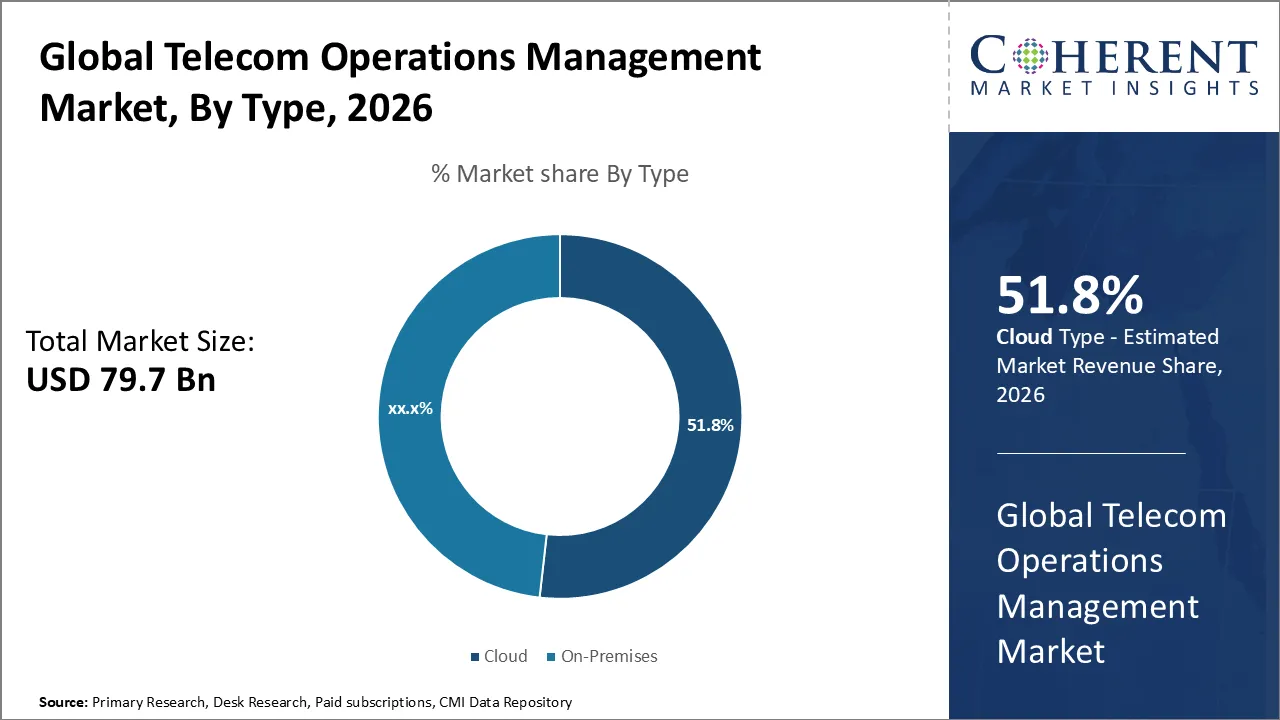
- By Type, Cloud holds the largest market share of 51.8% in 2026 owing to the transformation toward scalable, flexible infrastructure.
- By Deployment, Software expected to hold largest market share of 53.8% in 2026 owing to its complexity of modern telecom networks.
- By Software, Network Management acquired the prominent market share of 36.8% in 2026 owing to the 5G rollout and ultra‑high bandwidth networks.
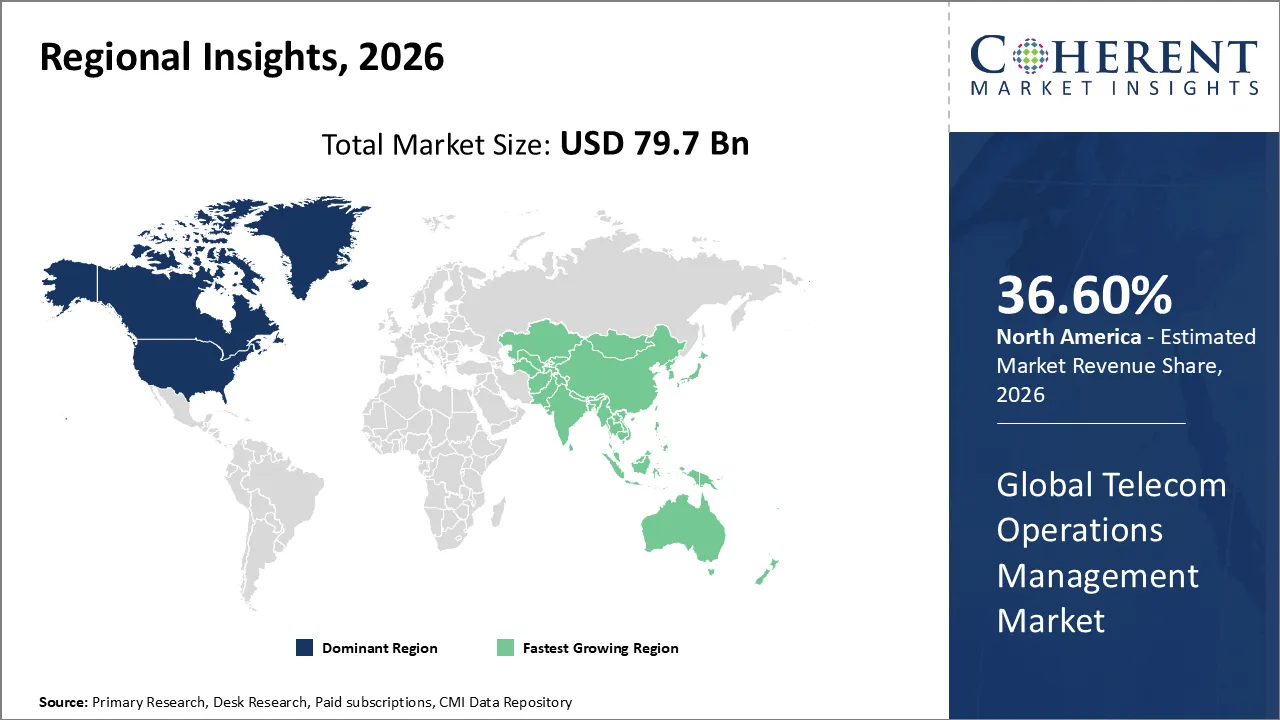
- By Region, North America dominates the overall market with an estimated share of 36.6% in 2026 owing to the advanced telecommunications infrastructure.
Market Overview
Telecom operators worldwide are rapidly transforming the Telecom Operations Management (TOM) market by adopting advanced solutions to optimize network performance, cut operational costs, and improve customer experience. They are deploying 5G, cloud technologies, and IoT while integrating AI-driven analytics and automation to modernize traditional operations. Operators actively implement software-defined networks, service assurance, and network management platforms to manage increasing data traffic and complex infrastructures, ensuring efficient, scalable, and real-time monitoring across multi-vendor environments.
Current Events and their Impact
Current Events | Description and its impact |
Geopolitical Tensions and Regulatory Changes |
|
Technological Advancements and Network Upgrades |
|
Security Threat Landscape and Compliance Demands |
|
Segmental Insights
- Current Industry Events of 2026
- Market Size Estimation
- Regional Breakdown
- Competitive Landscape
- Customer Intelligence
- Segmental Analysis
- Pricing Analysis
- Key Market Drivers, Challenges & Future Trends
- Customized Insights Section
Telecom Operations Management Market Insights, By Type - Cloud contributes the highest share of the market owing to its operational efficiency & cost savings
Cloud holds the largest market share of 51.8% in 2026. Telecom operators are increasingly adopting cloud in the Telecom Operations Management market to achieve flexibility, scalability, and cost-efficient management of complex networks. They use cloud platforms to support 5G deployment, edge computing, and IoT services while accelerating service rollout and fostering innovation. Cloud-based solutions enable automation, real-time analytics, and AI-powered operations, reducing manual effort and boosting network performance. By embracing hybrid and multi-cloud environments, operators strengthen resilience, enhance operational agility, and streamline management across diverse telecom infrastructures. For instance, in December 2025, Larsen & Toubro-Vyoma partnered with SRIT India Ltd to launch SRIT Cloud, a sovereign India-localized cloud platform built on MeitY-compliant infrastructure to support secure and reliable services for government, healthcare, telecom, and other critical sectors.
Telecom Operations Management Market Insights, By Deployment - Software contributes the highest share of the market owing to its digital transformation & zero‑touch operations
Software expected to hold largest market share of 53.8% in 2026. Telecom operators are actively adopting software solutions to streamline operations, increase network visibility, and enhance service delivery. They use advanced software to automate processes, monitor networks in real time, and apply predictive analytics to detect faults, optimize resources, and minimize downtime. By integrating AI, cloud platforms, and digital transformation initiatives, they deploy new services faster and manage complex, multi-vendor networks more efficiently. Leveraging software-driven operations, operators improve efficiency, elevate customer experience, and quickly respond to changing market demands. For instance, in February 2026, Amdocs launched aOS, an agentic operating system designed for telecommunications to help service providers accelerate generative AI adoption, enhance operations, and improve customer and employee experiences.
Telecom Operations Management Market Insights, By Software - Network Management contribute the highest share of the market owing to its rapid growth of data traffic & IoT proliferation
Network Management acquired the prominent market share of 36.8% in 2026. Telecom operators are actively implementing advanced network management solutions to maintain seamless connectivity and deliver high service quality across complex infrastructures. They monitor performance in real time, optimize traffic flows, and rapidly detect and resolve faults. The expansion of 5G, IoT, and multi-vendor networks pushes operators to deploy automated, AI-driven management tools that minimize manual effort and boost operational efficiency. By strengthening network management, they enhance reliability, enable new services, and elevate the overall customer experience.
Regional Insights
North America Telecom Operations Management Market Trends
North America dominates the overall market with an estimated share of 36.60% in 2026. In North America, telecom operators are driving the Telecom Operations Management market by adopting advanced technologies early and investing heavily in network modernization. They integrate AI, cloud-native architectures, and automation to manage increasing data traffic and support emerging services such as 5G and IoT. The region’s mature digital infrastructure and strong demand for reliable, secure connectivity push operators to continuously upgrade their operations platforms. Leading service providers and innovation hubs in the U.S. and Canada actively promote competition and the adoption of sophisticated management tools. For instance, in July 2025, IQSTEL Inc. launched IQ2Call, an AI-powered call center service developed by its subsidiary Reality Border, combining telecom infrastructure with advanced AI to deliver scalable and efficient customer engagement.
Asia Pacific Telecom Operations Management Market Trends
In the Asia Pacific region, telecom operators are driving the Telecom Operations Management market through rapid 5G rollout, increasing mobile and internet usage, and significant investments in digital infrastructure across major economies like China, India, and Japan. They are actively adopting AI and automation tools to manage growing network complexities and meet evolving service demands. The region’s expanding subscriber base and government-led digitalization initiatives push operators to deploy advanced operations platforms, improving real-time monitoring and boosting overall operational efficiency. For instance, in March 2026, Tech Mahindra partnered with Microsoft to launch an ontology-driven agentic AI platform that accelerates data modernization for telecom and enterprise sectors.
United States Telecom Operations Management Market Trends
In the United States, telecom operators are transforming the Telecom Operations Management market by adopting advanced technologies to handle increasingly complex networks and growing data demands. They leverage AI, automation, and cloud-native solutions to monitor performance in real time, resolve faults quickly, and improve operational efficiency. By expanding 5G infrastructure and integrating predictive analytics, operators streamline network operations and enhance service quality. Competitive pressures and ongoing innovation drive them to invest continuously in smarter, scalable operations platforms that support modern connectivity requirements. For instance, in April 2025, Vodafone Business and ServiceNow formed a five-year strategic partnership to deliver AI-powered service management, enabling faster query resolution, improved anomaly detection, and enhanced service tools for business customers.
India Telecom Operations Management Market Trends
In India, telecom operators are driving the Telecom Operations Management market by rapidly expanding networks and managing increasing data traffic and service complexity. They are actively adopting AI, automation, and cloud-native platforms to enhance real-time monitoring, streamline routine tasks, and improve service quality. The fast rollout of 5G infrastructure and growing demand for advanced analytics are prompting companies to modernize OSS/BSS and operations systems. Government digitalization programs and a large subscriber base further motivate operators to deploy sophisticated management tools.
End-user Feedback and Unmet Needs
Artificial intelligence (AI) is transforming the telecom operations management market by enabling automated, data-driven network management and service optimization. AI algorithms analyze massive volumes of network and customer data in real time to predict traffic demand, optimize bandwidth allocation, and enhance overall network performance. It also supports predictive maintenance by identifying early signs of equipment failure, reducing downtime and operational costs. In addition, AI automates OSS/BSS processes, improves fault detection, and accelerates incident resolution.
In February 2026, Anthropic and Infosys formed a strategic partnership to develop advanced enterprise AI solutions for telecommunications companies. The collaboration integrates Anthropic’s Claude models with Infosys’s AI platform, Infosys Topaz, enabling AI systems to perform complex, multi-step business processes with minimal human intervention.
Telecom Operations Management Market Trend
Cloud-Native Transformation
Telecom operators are increasingly shifting from traditional on-premises systems to cloud-native platforms. This trend enables flexible scaling, centralized control, and faster deployment of new services. Cloud adoption supports automation, real-time analytics, and AI-driven decision-making, allowing operators to manage complex multi-vendor networks efficiently. The migration also reduces infrastructure costs while enhancing disaster recovery, operational resilience, and seamless integration with emerging technologies like 5G and edge computing, making cloud a cornerstone of modern operations management.
Market Report Scope
Telecom Operations Management Market Report Coverage
| Report Coverage | Details | ||
|---|---|---|---|
| Base Year: | 2025 | Market Size in 2026: | USD 79.7 Bn |
| Historical Data for: | 2020 To 2024 | Forecast Period: | 2026 To 2033 |
| Forecast Period 2026 to 2033 CAGR: | 6.2% | 2033 Value Projection: | USD 121.8 Bn |
| Geographies covered: |
| ||
| Segments covered: |
| ||
| Companies covered: | IBM Corporation, Hewlett Packard Enterprise Development LP, Telefonaktiebolaget LM Ericsson, Netcracker Technology Corp, Accenture PLC, Oracle Corporation., TATA Consultancy Services Limited, Amdocs Inc., NEC Corporation, ZTE Corporation, Nokia Corporation, Comarch SA, SAP SE, ServiceNow Inc. and Cisco Systems Inc. | ||
| Growth Drivers: |
| ||
| Restraints & Challenges: |
| ||
Telecom Operations Management Market News
- In September 2025, Tata Elxsi and Evergent have launched Subscription Hub, a unified platform that helps media and telecom operators offer, manage, and monetize subscription services more effectively.
Analyst Opinion (Expert Opinion)
- Leading operators are prioritizing AI‑enabled automation and cloud-native orchestration, evidenced by technology vendors like Cisco expanding AI‑assisted network orchestration suites and Ericsson partnering with major carriers to cut fault resolution times through analytics‑driven operations.
- Operators that aggressively integrate real‑time analytics into service management report measurable improvements in operational responsiveness, yet the market’s complexity — particularly in reconciling heterogeneous OSS/BSS stacks — remains a visible constraint on deployment scale. Industry research highlights those cloud‑based deployments captured nearly 67% of TOM implementation share, driven by elasticity and pay‑as‑you‑grow economics, even as hybrid and on‑premises solutions persist where regulatory or sovereignty requirements dictate.
- There is a palpable shift in competitive dynamics: hyperscale cloud providers are reshaping TOM value chains by offering managed 5G core and observability capabilities that bypass legacy system constraints, forcing traditional infrastructure vendors to evolve or lose relevance. Challenges such as talent shortages in AI/ML and end‑to‑end data integration persist, but operators that invest in zero‑touch automation and predictive operations stand to differentiate on service quality and cost efficiency in the next phase of network evolution.
Speak to the analyst
Want personalized insights?
Take the findings above to one of our principal consultants, or have the report rebuilt around the segments, geographies and competitors you actually track.
Market Segmentation
- By Type
- On-Premise
- Cloud
- By Deployment
- Software
- Services
- By Software
- Network Management
- Customer and Product Management
- Revenue Management
- Inventory Management
- Others
- By Regional Insights
- North America
- U.S.
- Canada
- Latin America
- Brazil
- Argentina
- Mexico
- Rest of Latin America
- Europe
- Germany
- U.K.
- Spain
- France
- Italy
- Russia
- Rest of Europe
- Asia Pacific
- China
- India
- Japan
- Australia
- South Korea
- ASEAN
- Rest of Asia Pacific
- Middle East
- GCC Countries
- Israel
- Rest of Middle East
- Africa
- South Africa
- North Africa
- Central Africa
- North America
- Key Players Insights
- IBM Corporation
- Hewlett Packard Enterprise Development LP
- Telefonaktiebolaget LM Ericsson
- Netcracker Technology Corp
- Accenture PLC
- Oracle Corporation.
- TATA Consultancy Services Limited
- Amdocs Inc.
- NEC Corporation
- ZTE Corporation
- Nokia Corporation
- Comarch SA
- SAP SE
- ServiceNow Inc.
- Cisco Systems Inc.
Sources
Primary Research interviews
- Senior executives from leading telecom operators in North America, Asia Pacific, and Europe
- Network operations managers and OSS/BSS heads from Tier-1 and Tier-2 carriers
- Technology architects and solution engineers involved in AI, cloud, and automation deployments
- Regulatory and compliance officers overseeing telecom operations and digital transformation initiatives
Databases
- ITU (International Telecommunication Union) databases on network deployment and performance
- GSMA Intelligence database for mobile and IoT penetration
- FCC and TRAI official network and spectrum reports
- Open-source network performance monitoring datasets from major telecom operators
Magazines
- Telecom Review
- Light Reading
- Telecommunication Magazine
- Network World
Journals
- IEEE Communications Magazine
- Journal of Network and Systems Management
- International Journal of Communication Systems
- Journal of Telecommunications and Information Technology
Newspapers
- The Economic Times – Telecom Section
- The Wall Street Journal – Technology & Telecom
- Financial Times – Telecom Industry Coverage
- The Hindu Business Line – Telecom Updates
Associations
- GSMA (GSM Association)
- IEEE Communications Society
- ITU Telecommunication Standardization Sector
- National Association of Telecom Operators in respective countries
Public Domain sources
- Annual reports and investor presentations of telecom operators
- Regulatory filings and public notices from government telecom authorities
- Press releases on network expansions, 5G rollouts, and new technology deployments
- Open datasets from regional telecom authorities on subscriber growth and traffic
Proprietary Elements
- CMI Data Analytics Tool, and Proprietary CMI Existing Repository of information for last 8 years
Get access to 250+ pages report
Every segment, forecast, competitor profile and data table behind the analysis above — available for instant download.
- ESOMAR Member
- ISO 9001:2015 Certified
- D-U-N-S Registered
- GDPR & CCPA Compliant
Missing comfort of reading report in your local language? Find your preferred language:
Transform your Strategy with Exclusive Trending Reports
Frequently Asked Questions
The Telecom Operations Management Market is estimated to be valued at USD 79.7 Bn in 2026 and is expected to reach USD 121.8 Bn by 2033.
Rising operational costs and complexity is anticipated to drive the growth of the market.
Network Management segment is the leading software segment in the market.
System integration process is highly costly and time-consuming which is the key factor hampering the growth of the market
Major key players operating the market are IBM Corporation, Hewlett Packard Enterprise Development LP, Telefonaktiebolaget LM Ericsson, Netcracker Technology Corp, Accenture PLC, Oracle Corporation., TATA Consultancy Services Limited, Amdocs Inc., NEC Corporation, ZTE Corporation, Nokia Corporation, Comarch SA, SAP SE, ServiceNow Inc. and Cisco Systems Inc.