

Managed Security Service Provider Market Size and Forecast – 2026 to 2033
The Managed Security Service Provider Market is anticipated to grow at a CAGR of 12.4% with USD 43.1 Bn share in 2026 and is expected to reach USD 81.7 Bn in 2033. Rising cyberattacks, widespread cloud adoption, stricter data privacy regulations, and the shortage of skilled cybersecurity professionals are driving demand for Managed Security Service Provider (MSSP) solutions. In 2025, 71% of organizations reported an increase in the frequency of cyberattacks.
Key Takeaways
- Firewall Management hold the largest market share of 36.6% in 2026 owing to the increasing cyber threats. Firewalls play a critical role in protecting networks by blocking cyber threats such as malware, ransomware, phishing and spoofing attempts, and distributed denial-of-service (DDoS) attacks.
- Cloud-based expected to hold largest market share of 42.8% in 2026 owing to its accelerating cloud adoption. More than 90% of organizations have adopted cloud computing.
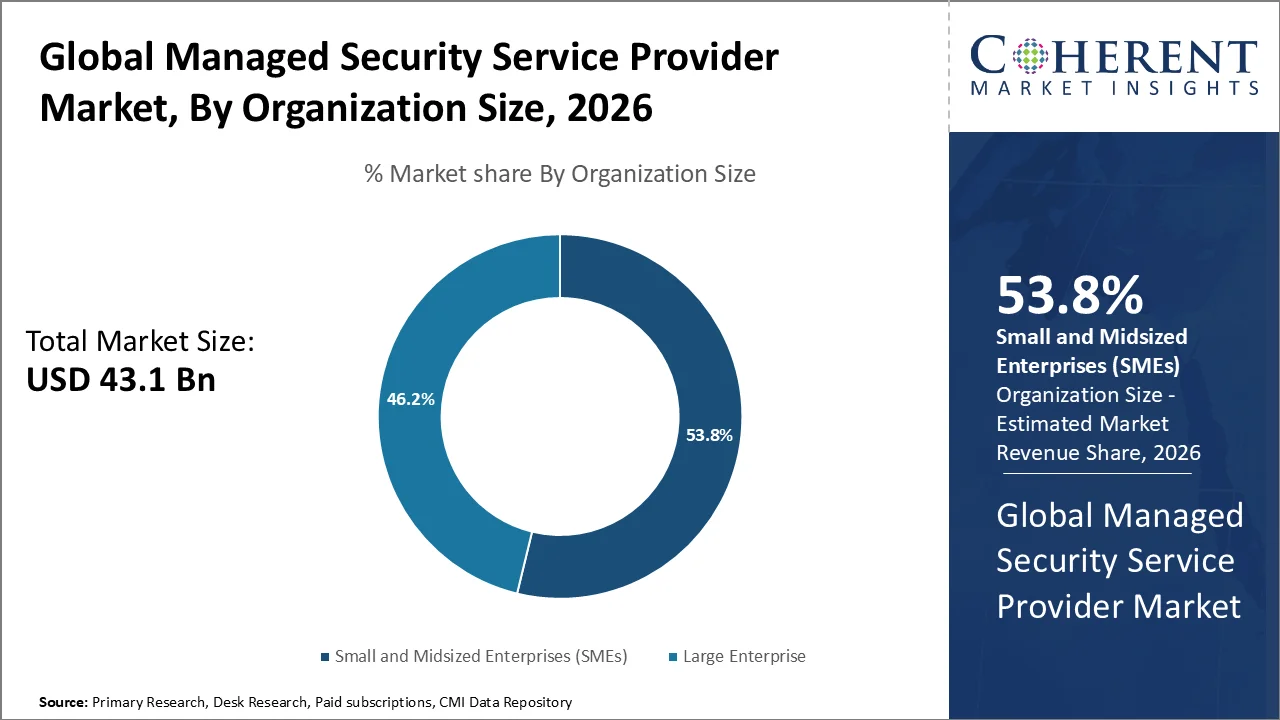
- Small and Midsized Enterprises (SMEs) acquired the prominent market share of 53.8% in 2026 owing to its increasing cyberattacks on SMEs. In 2026, 49% of small businesses experienced cyberattacks, with an incident occurring approximately every seven seconds.
- Healthcare captures the largest market share of 37.7% in 2026 owing to its rising cyberattacks on healthcare organizations. In 2024, the healthcare sector recorded 739 data breaches affecting more than 276 million records, the highest annual total on record.
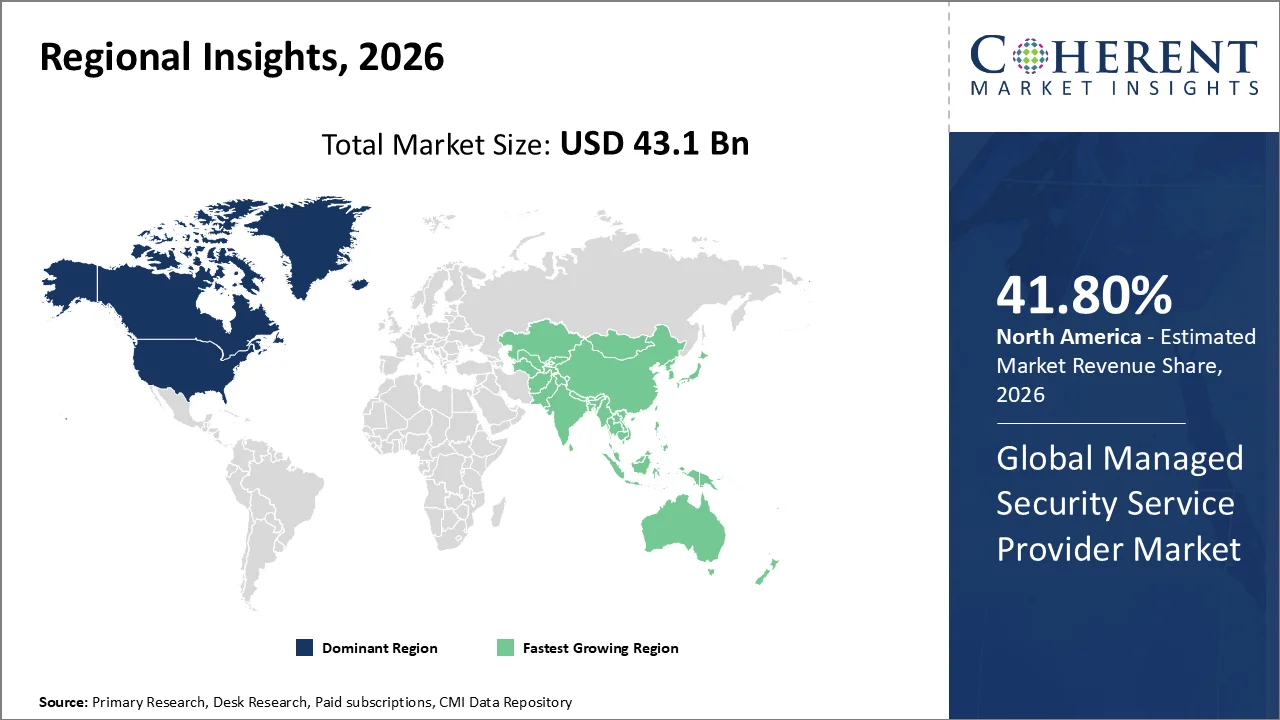
- North America is expected to acquire the dominant share of 41.8% in 2026 owing to the stringent regulatory and data privacy requirements.
Current Events and Their Impact on the Managed Security Service Provider Market
Current Event | Description and its Impact |
Implementation of the EU NIS2 Directive |
|
United States CIRCIA Rulemaking |
|
Segmental Insights
- Current Industry Events of 2026
- Market Size Estimation
- Regional Breakdown
- Competitive Landscape
- Customer Intelligence
- Segmental Analysis
- Pricing Analysis
- Key Market Drivers, Challenges & Future Trends
- Customized Insights Section
Why is Firewall Management Acquiring the Largest Market Share?
Firewall Management hold the largest market share of 36.6% in 2026. Organizations are driving demand for firewall management services in the Managed Security Service Provider (MSSP) market by prioritizing continuous protection against increasingly sophisticated cyber threats. As businesses expand across hybrid cloud environments, support remote work, and manage distributed networks, they face greater complexity in firewall administration and increasingly rely on specialized MSSPs. These providers actively monitor firewalls around the clock, configure security policies, detect threats, deploy software updates, and support compliance efforts, enabling organizations to strengthen network security, improve incident response, reduce operational workloads, and maintain consistent protection across evolving IT environments. For instance, Fortinet introduced the FortiGate 3500G and 400G next-generation firewalls to support data center-scale operations and enterprise edge environments handling high-performance, AI-driven workloads. The new solutions help organizations manage encrypted traffic and hybrid networks by combining advanced ASIC acceleration with AI-powered threat intelligence capabilities.
Cloud-based expected to hold largest market share
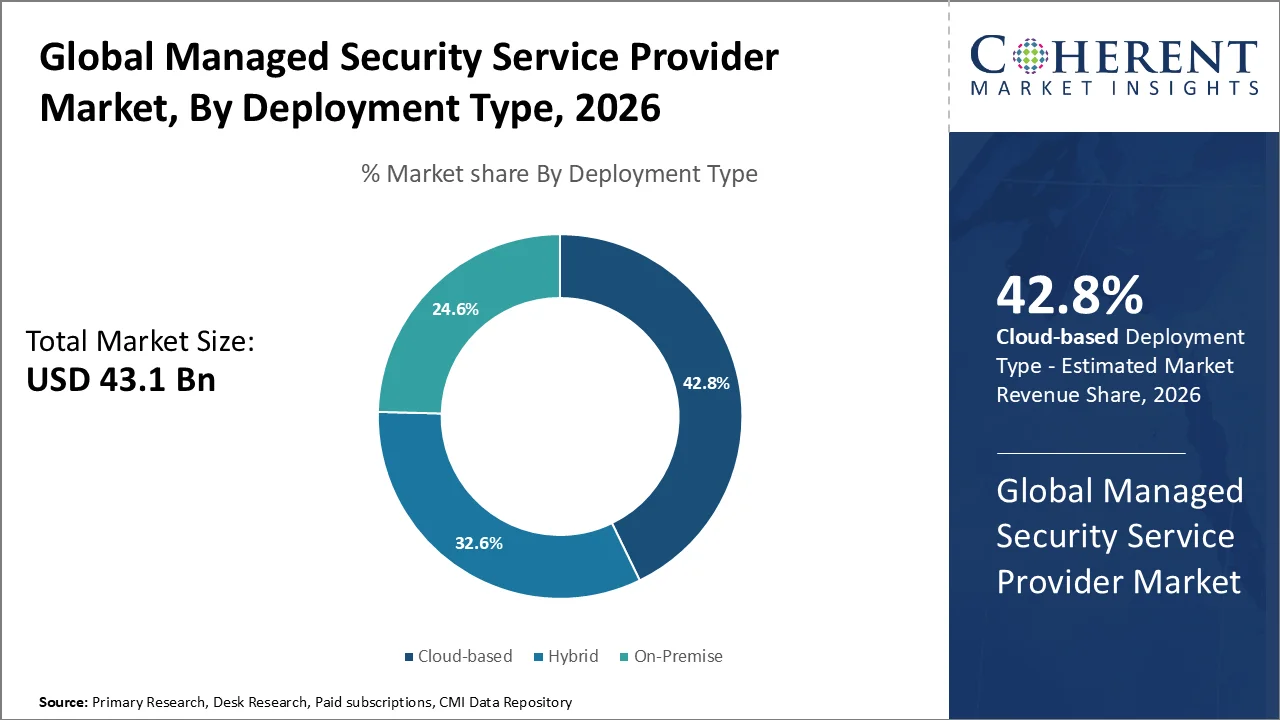
Cloud-based expected to hold largest market share of 42.8% in 2026 owing to its remote and hybrid work models. Organizations are increasing their adoption of cloud-based Managed Security Service Provider (MSSP) solutions as they move applications, data, and workloads to public, private, and hybrid cloud platforms. Businesses face greater challenges in securing multi-cloud environments due to rising cyber threats and expanding remote workforces, driving them to seek continuous security monitoring and specialized expertise. Cloud-based MSSPs provide scalable security services, centralized visibility, threat detection, compliance assistance, and faster incident response, helping organizations enhance protection, simplify security operations, and manage evolving digital environments effectively. For instance, Swimlane Inc., an agentic artificial intelligence cybersecurity automation company, launched an AI-powered security operations center designed for managed security service providers. The solution enables MSSPs to enhance cybersecurity automation and improve security operations efficiency while supporting broader industry discussions across AI, cloud, cybersecurity, and emerging technologies.
Small and Midsized Enterprises (SMEs) acquired the prominent market share
Small and Midsized Enterprises (SMEs) acquired the prominent market share of 53.8% in 2026 owing to its digital transformation. Small and midsized enterprises (SMEs) are driving the adoption of Managed Security Service Provider (MSSP) solutions as they seek to combat rising cyber threats and overcome limited internal cybersecurity resources. SMEs increasingly outsource security operations to specialized providers due to budget limitations and challenges in hiring skilled professionals. MSSPs deliver cost-effective access to advanced security technologies, continuous monitoring, threat detection, compliance assistance, and incident response capabilities. These services enable SMEs to enhance cybersecurity, safeguard sensitive information, streamline operations, and maintain secure digital environments while concentrating on business expansion.
Which End Users segment dominates the market?
Healthcare captures the largest market share of 37.7% in 2026. Healthcare organizations are increasingly choosing Managed Security Service Provider (MSSP) solutions to secure sensitive patient information and counter rising cyber threats against healthcare systems. The adoption of electronic health records, telemedicine services, cloud platforms, and connected medical devices creates complex security requirements, encouraging providers to seek specialized cybersecurity support. As of 2024, 91% of office-based physicians and more than 99% of non-federal acute care hospitals had adopted certified electronic health record (EHR) systems. MSSPs deliver continuous monitoring, threat detection, compliance management, and incident response capabilities that enable healthcare organizations to protect data, meet regulatory requirements, minimize security risks, and maintain reliable healthcare operations.
Managed Security Service Provider Market Trends
- Rising cyber threats and sophisticated attacks such as ransomware, phishing, malware, and data breaches are increasing demand for Managed Security Service Providers (MSSPs) that offer continuous monitoring, threat detection, and incident response capabilities. According to the World Economic Forum's Global Cybersecurity Outlook 2025, 71% of organizations reported an increase in cyberattack frequency over the past year, underscoring the growing need for managed cybersecurity services.
- Growing adoption of cloud computing, hybrid IT environments, and remote work models is driving organizations to seek managed security solutions that provide centralized protection, secure access management, and visibility across complex digital infrastructures. According to the Flexera 2025 State of the Cloud Report, more than 90% of organizations have adopted cloud computing, increasing the complexity of securing hybrid and multi-cloud environments.
- Increasing shortage of skilled cybersecurity professionals encourages enterprises, especially small and midsized businesses, to outsource security operations to MSSPs for access to specialized expertise, advanced technologies, and 24/7 security monitoring. According to the ISC2 2024 Cybersecurity Workforce Study, the global cybersecurity workforce gap reached approximately 4.8 million professionals.
- Growing cybersecurity investments across critical sectors such as healthcare, banking, government, manufacturing, and telecommunications are supporting MSSP market growth as organizations prioritize business continuity, data protection, and operational resilience. According to the U.S. Department of Health and Human Services (HHS) Office for Civil Rights, the healthcare sector recorded 739 data breaches affecting more than 276 million records in 2024, the highest annual total on record, highlighting the need for managed security services across critical industries.
Regional Insights
North America dominates owing to increasing investment in AI and security automation
North America is expected to acquire the dominant share of 41.80% in 2026. North American organizations are accelerating the adoption of Managed Security Service Provider (MSSP) solutions as they address increasing cyber threats, pursue digital transformation, and require continuous security monitoring. Businesses across various industries are implementing cloud platforms, hybrid infrastructures, and remote work models, which create complex cybersecurity challenges. The shortage of skilled security professionals drives organizations to partner with MSSPs for outsourced security operations. MSSPs deliver advanced threat detection, compliance support, faster incident response, and enhanced cybersecurity resilience to help businesses protect their digital environments. For instance, Accenture and ServiceNow launched a joint offering that combines AI-powered managed security services on the ServiceNow AI Platform with an automated solution for migrating legacy systems to ServiceNow.
Asia Pacific Managed Security Service Provider Market Trends
Companies across Asia Pacific are driving the Managed Security Service Provider market as they seek advanced cybersecurity solutions, accelerate digital transformation, and adopt cloud-based services. Organizations are partnering with external security experts to address complex cyber threats, enhance data protection, and meet regulatory requirements. The growth of connected devices, remote work models, and evolving cyber risks is prompting businesses to implement managed security services for continuous monitoring, proactive threat detection, and effective security operations management. As of 2024, 12.7% of full-time employees in India work remotely, while 28.2% follow a hybrid work model.
United States Managed Security Service Provider Market Trends
The United States managed security service provider (MSSP) market grows as organizations demand advanced cybersecurity solutions to address evolving cyber threats and secure digital infrastructure. Businesses increasingly partner with MSSPs to handle complex security operations, monitor networks, and maintain regulatory compliance. The limited availability of skilled cybersecurity professionals, widespread adoption of remote work models, and the need for continuous threat detection and rapid incident response drive companies to choose MSSPs for efficient, reliable, and cost-effective security management.
Japan Managed Security Service Provider Market Trends
Japan’s Managed Security Service Provider (MSSP) market is growing as businesses face rising cyber threats, accelerate digital transformation, and adopt cloud technologies. Organizations rely on MSSPs to access specialized security expertise, manage complex IT infrastructures, strengthen threat detection, and meet regulatory requirements. A shortage of skilled cybersecurity professionals and the need for continuous security monitoring drive enterprises to implement MSSP solutions. According to CyberS2, citing multiple Japanese government surveys, Japan faces a shortage of approximately 170,000–190,000 cybersecurity professionals. Furthermore, companies are leveraging artificial intelligence and automation to improve cybersecurity operations and enhance protection capabilities.
Who are the Major Companies in Managed Security Service Provider Industry
Some of the major key players in Managed Security Service Provider are IBM Corporation, Hewlett Packard Enterprise Company, Verizon Communications, Inc., AT&T, Inc., Symantec Corporation, Fortinet, Inc., Solutionary, Inc., SecureWorks, Inc., Computer Services Corporation, CenturyLink, Inc., Trustwave Holdings, Inc., and Rapid7, Inc.
Key News
- In July 2026, ENISA launched a public consultation on the draft European Union Managed Security Services (EUMSS) cybersecurity certification scheme. The initiative responds to growing demand for outsourced cybersecurity services as organizations increasingly rely on external providers instead of expanding internal security teams.
Market Report Scope
Managed Security Service Provider Market Report Coverage
| Report Coverage | Details | ||
|---|---|---|---|
| Base Year: | 2025 | Market Size in 2026: | USD 43.1 Bn |
| Historical Data for: | 2020 To 2024 | Forecast Period: | 2026 To 2033 |
| Forecast Period 2026 to 2033 CAGR: | 12.4% | 2033 Value Projection: | USD 81.7 Bn |
| Geographies covered: |
| ||
| Segments covered: |
| ||
| Companies covered: | IBM Corporation, Hewlett Packard Enterprise Company, Verizon Communications, Inc., AT&T, Inc., Symantec Corporation, Fortinet, Inc., Solutionary, Inc., SecureWorks, Inc., Computer Services Corporation, CenturyLink, Inc., Trustwave Holdings, Inc., and Rapid7, Inc. | ||
Analyst Opinion
- Managed Security Service Provider (MSSP) adoption is being shaped by the reality that cyber threats have become a persistent operational risk rather than an occasional IT challenge. According to industry reports, organizations worldwide continue to face millions of cyber incidents annually, while ransomware, phishing, and supply-chain attacks increasingly target businesses of all sizes. In Japan, where highly digitized industries such as manufacturing, finance, and healthcare depend on connected systems, enterprises are prioritizing continuous threat monitoring and outsourced cybersecurity expertise. In my view, MSSPs are becoming a strategic necessity for companies that cannot build and maintain a full-scale security operations capability internally.
- The shortage of cybersecurity talent is one of the strongest structural drivers for MSSP demand in Japan. Industry assessments indicate that Japan faces a significant gap in cybersecurity professionals, with organizations struggling to recruit specialists capable of managing advanced security tools, incident response, and threat intelligence operations. This talent shortage is pushing enterprises toward managed security providers that can deliver 24/7 monitoring, skilled analysts, and automated security responses. I believe this shift is moving MSSPs from a cost-saving outsourcing option to a critical partner for maintaining cyber resilience.
- The increasing complexity of cloud environments and digital infrastructure is accelerating demand for managed security services. Japan’s enterprises are rapidly adopting cloud platforms, IoT systems, and hybrid IT architectures, creating larger attack surfaces that traditional security teams often find difficult to manage. For example, major Japanese corporations in sectors such as automotive and financial services are strengthening partnerships with cybersecurity providers to protect interconnected operations and sensitive data. The future of MSSPs will be defined by their ability to integrate artificial intelligence, threat intelligence, and automated response capabilities to handle increasingly sophisticated attacks.
Speak to the analyst
Want personalized insights?
Take the findings above to one of our principal consultants, or have the report rebuilt around the segments, geographies and competitors you actually track.
Market Segmentation
- By Application (Revenue, USD Bn, 2021-2033)
- Firewall Management
- End-point Security
- Distributed Denial of Service
- Unified Threat Management
- Antivirus/Antimalware
- Others
- By Deployment Type (Revenue, USD Bn, 2021-2033)
- Cloud-based
- Hybrid
- On-Premise
- By Organization Size (Revenue, USD Bn, 2021-2033)
- Small and Midsized Enterprises (SMEs)
- Large Enterprise
- By End Users (Revenue, USD Bn, 2021-2033)
- BFSI
- Government & Defense
- Telecom & IT
- Education
- Retail
- Healthcare
- Others
- By Region (Revenue, USD Bn, 2021-2033)
- North America
- U.S.
- Canada
- Latin America
- Brazil
- Mexico
- Argentina
- Rest of Latin America
- Europe
- Germany
- U.K.
- France
- Italy
- Spain
- Russia
- Rest of Europe
- Asia Pacific
- China
- India
- Japan
- Australia
- South Korea
- ASEAN
- Rest of Asia Pacific
- Middle East
- GCC
- Israel
- Rest of Middle East
- Africa
- South Africa
- Central Africa
- North Africa
- North America
Sources
Primary Research Interviews
- Chief Information Security Officers (CISOs) and cybersecurity leaders from enterprises
- IT infrastructure managers and security operations professionals
- Managed security service providers and cybersecurity solution vendors
- Cloud security specialists and technology consultants
- Industry experts involved in cyber risk management and compliance
Databases
- Government cybersecurity databases and threat intelligence repositories
- Cyber incident and vulnerability databases
- Enterprise technology adoption databases
- Open-source cybersecurity intelligence platforms
- Publicly available security advisories and regulatory databases
Magazines
- Cybersecurity and information technology magazines
- Enterprise technology and digital transformation publications
- Cloud computing and infrastructure security magazines
- Information security industry newsletters
Journals
- Cybersecurity research journals
- Information systems and technology management journals
- Network security and cloud computing research publications
- Academic journals focused on data protection and risk management
Newspapers
- Business and technology newspapers
- Cybersecurity incident coverage publications
- Digital economy and enterprise technology news sources
- Publications covering data breaches, regulations, and technology trends
Associations
- Cybersecurity professional associations
- Information technology industry associations
- Data protection and privacy organizations
- Cloud computing and digital security communities
Public Domain Sources
- Government cybersecurity frameworks and guidelines
- Regulatory authority publications on data protection and cyber risk
- Public security advisories and vulnerability disclosures
- Industry white papers and technical reports
- Open-source threat intelligence resources
Proprietary Elements
- CMI Data Analytics Tool
- Proprietary CMI Existing Repository of information for last 10 years
Get access to 250+ pages report
Every segment, forecast, competitor profile and data table behind the analysis above — available for instant download.
- ESOMAR Member
- ISO 9001:2015 Certified
- D-U-N-S Registered
- GDPR & CCPA Compliant
Missing comfort of reading report in your local language? Find your preferred language:
Transform your Strategy with Exclusive Trending Reports
Frequently Asked Questions
The MSSP market is driven by increasing cyber threats, rising complexity of IT environments, cloud adoption, and the shortage of skilled cybersecurity professionals.
Businesses are adopting MSSPs to strengthen cybersecurity defenses, achieve continuous security monitoring, reduce operational challenges, and gain access to specialized expertise.
The global shortage of cybersecurity talent is encouraging organizations to partner with MSSPs that provide experienced security analysts, and security operations center capabilities.
The rapid adoption of cloud platforms, hybrid infrastructures, and connected devices is expanding organizational attack surfaces.
Artificial intelligence is enhancing MSSP capabilities by enabling faster threat detection, automated response, behavioral analysis, and predictive security monitoring.