

North America Public Safety Wireless Communication Market Size Analysis - 2026 To 2033
The North America public safety wireless communication market is estimated to be valued at USD 19,600 Mn in 2026 and is projected to grow at a CAGR of 7.6% during the forecast period, reaching approximately USD 32,600 Mn by 2033. This steady growth is attributable to increasing government investments in modernizing emergency response infrastructure and rising adoption of broadband-based mission-critical communication systems such as LTE/5G networks and FirstNet-type platforms.
Key Takeaways from the North America Public Safety Wireless Communication Market Report
- Local segment is expected to lead the market with a share of around 42.0 in 2026 due to large number of agencies (police, fire, EMS), high day-to-day operational usage, and ongoing upgrades from LMR to LTE hybrid communication systems. For example, FirstNet reports over 18,500 public safety agencies and organizations, mainly municipal and county police, fire, and EMS, supporting mission-critical communications.
- The police segment is expected to account for the largest market share of 45.0% in 2026 due to continuous operational communication needs. A large-scale NIST nationwide survey (7,000+ first responders) shows that police officers rely on communication systems more continuously than other departments because of real-time dispatch, coordination, and incident response needs.
- The U.S. is expected to dominate North America public safety wireless communication market with a share of around 75.0% in 2026, owing to its large public safety infrastructure, higher adoption of advanced communication technologies, and significant government investments in emergency communication systems. For example, FirstNet covers more than 2.97 Mn square miles and serves over 28,500 public safety organizations across the United States.
North America Public Safety Wireless Communication Market Overview
The North America public safety wireless communication market is expected to grow steadily during the forecast period. This is mostly due to increasing investments in modernizing emergency communication infrastructure, rising demand for reliable and interoperable broadband networks, and rapid adoption of advanced technologies such as LTE and 5G for mission-critical communications.
Government initiatives, especially the expansion of nationwide platforms such as FirstNet, are playing a key role in strengthening connectivity for first responders. These efforts are enhancing communication reliability and enabling faster, more coordinated emergency response capabilities across the region.
Public safety networks are wireless communication systems used by emergency service organizations such as police, fire departments, and medical emergency services to prevent as well as respond to incidents that may threaten people or property. The speed and reliability of data transmission over these wireless networks are continuously improving, enhancing public safety and municipal communication systems. As a result, governments in the contemporary world are increasingly adopting high-speed communication technologies to support the growing demands of modern public safety operations.
Rising need for reliable emergency communication is boosting market growth across North America. Police, fire departments, and EMS agencies need real-time voice, video, and data sharing during emergencies. This is pushing strong demand for mission-critical wireless systems that work even in disasters and network failures.
For example, AT&T’s FirstNet public safety network helps connect first responders by using devices like body cameras, drones, and trackers to send live data in real time. This highlights the growing need for strong, reliable networks that can support critical emergency communication.
Segmental Insights
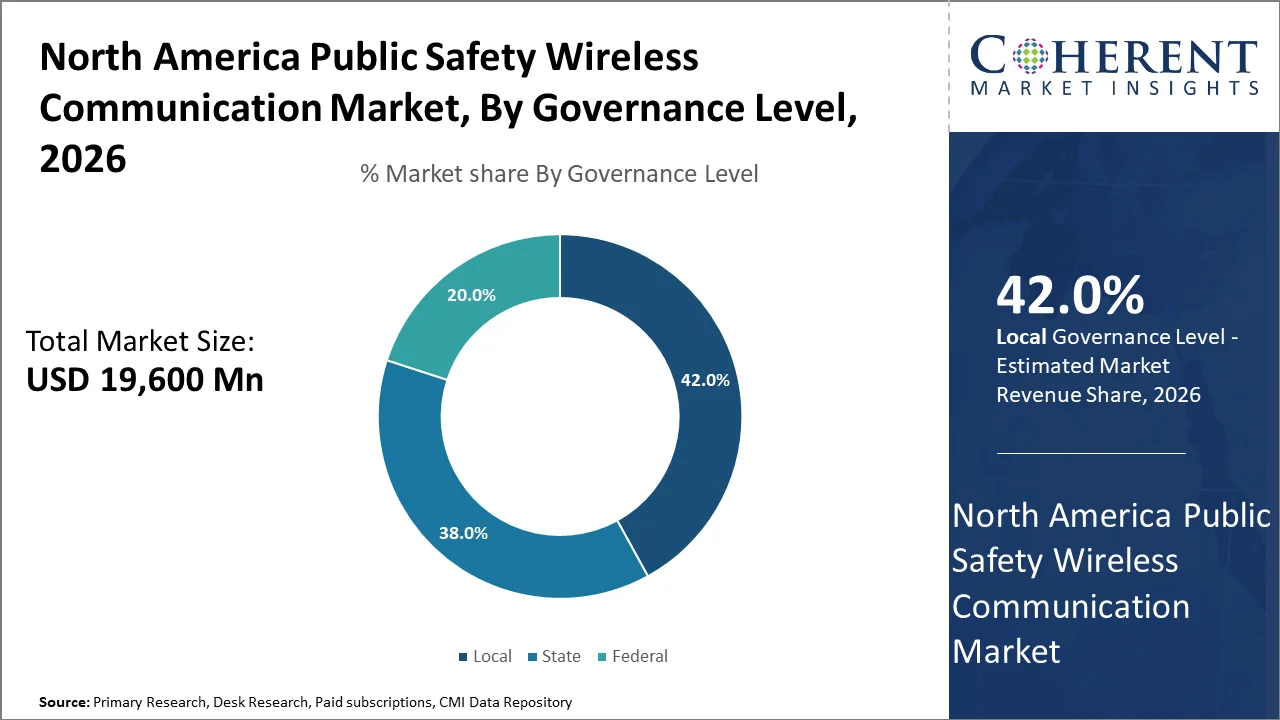
Which Governance Level Holds the Largest Share in the North America Market?
Local Level Set to Account for More Than Two-Fifths of Market Share in 2026
According to Coherent Market Insights’ latest North America public safety wireless communication market analysis, local governance segment is set to hold the largest market share of 42.0% in 2026. This dominance is attributable to high volume of day-to-day emergency response activities managed at the municipal and county levels, where police, fire, and emergency medical services primarily operate.
According to the U.S. Bureau of Justice Statistics, there are approximately 17,541 state and local law enforcement agencies in the United States. This highlights the highly decentralized structure of public safety operations.
Local agencies are also the first point of contact during critical incidents, driving stronger reliance on dedicated and interoperable wireless communication systems. In addition, increasing investments in upgrading legacy communication infrastructure and deployment of advanced broadband-enabled public safety networks are also fueling segment growth.
- Current Industry Events of 2026
- Market Size Estimation
- Regional Breakdown
- Competitive Landscape
- Customer Intelligence
- Segmental Analysis
- Pricing Analysis
- Key Market Drivers, Challenges & Future Trends
- Customized Insights Section
Which Department Dominates North America Public Safety Wireless Communication Market?
Police Department to Lead the North American Market
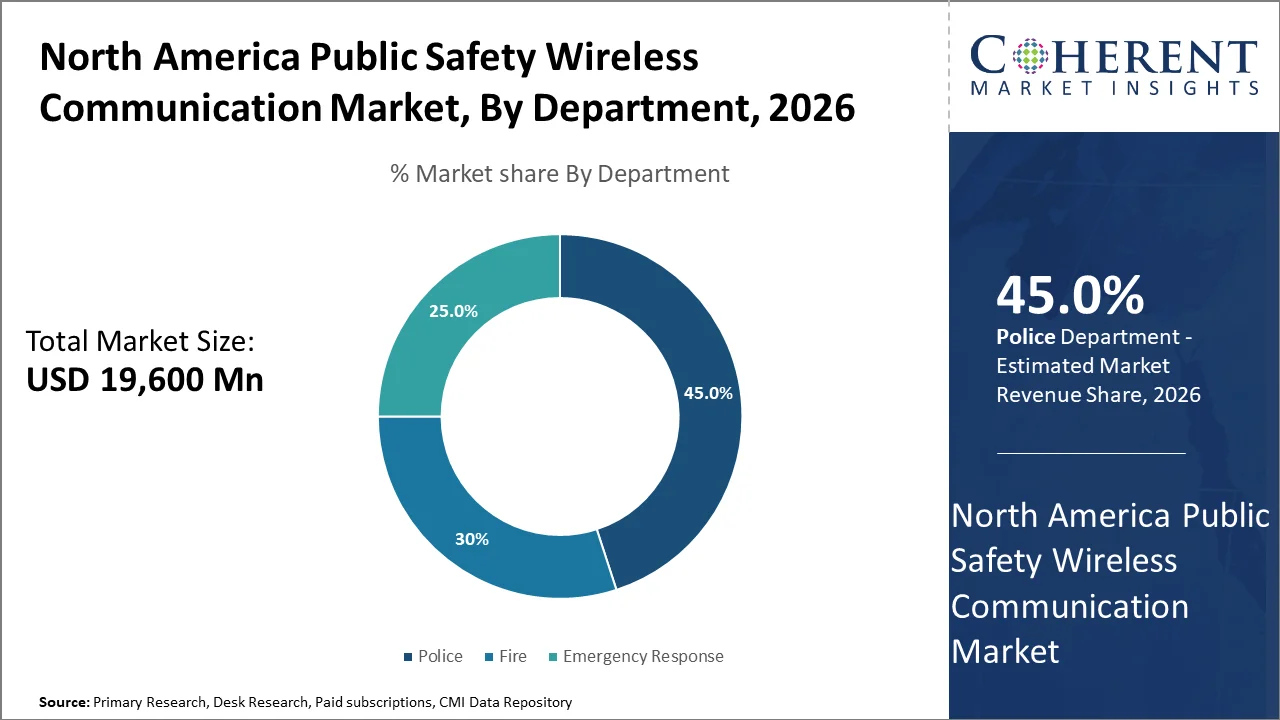
Police department is expected to lead the public safety wireless communication market in North America, capturing a share of 45.0% in 2026. This is mostly due to its extensive operational footprint, continuous need for real-time coordination, and high dependence on secure and reliable communication systems for routine patrols, emergency response, crime investigation, and public order management.
According to the U.S. Bureau of Justice Statistics (2018), local police departments make up about 67% of all law enforcement agencies in the U.S. and employ nearly 59% of sworn personnel. This shows their large share of workforce and explains their high level of daily mission-critical communication.
Growing adoption of advanced technologies such as broadband push-to-talk, LTE/5G-based communication networks, and integrated dispatch systems is also strengthening police communication capabilities. In addition, increasing government investments in modernizing law enforcement infrastructure and improving interoperability across agencies are driving the segment’s dominance in the market.
North America Public Safety Wireless Communication Market Growth Drivers
Rising Frequency of Natural Disasters and Emergencies
Rising incidence of natural disasters and emergencies is providing a strong impetus for the growth of North America public safety wireless communication market. Events such as wildfires, hurricanes, floods, and large-scale accidents are prompting governments to invest in reliable, real-time communication systems for first responders. According to the National Interagency Fire Center, 77,850 wildfires were recorded in 2025, burning approximately 5.13 million acres. The number of fires exceeded both the five-year and ten-year historical averages. These situations require seamless coordination among police, fire, and medical teams, thereby boosting demand for advanced and resilient wireless communication networks.
North America Public Safety Wireless Communication Market Opportunities
Government Push for Interoperable Communication Networks
Governments in nations like the U.S. and Canada are increasingly prioritizing interoperability between agencies to address communication failures experienced during past emergencies, including the 9/11 incident. Programs such as FirstNet in the U.S. are enabling emergency responders to communicate over a unified broadband network. This is expected to create lucrative growth opportunities for the public safety wireless communication market across North America during the forecast period.
For instance, in May 2026, This platform is designed to test and develop next-generation wireless technologies to support public safety, security, and defence capabilities.
North America Public Safety Wireless Communication Market Trends
Rising Adoption of LTE and 5G Technologies
Increasing use of LTE and 5G-based broadband public safety networks is a key growth-shaping trend in the North America public safety wireless communication market. There is a growing transition from legacy Land Mobile Radio (LMR) systems to LTE and 5G-based broadband networks across the region. These technologies enable real-time video, location tracking, and data sharing, which are essential for modern emergency response operations.
Current Events and Their Impact on the North America Public Safety Wireless Communication Market
Current Event | Description and its Impact |
FirstNet Expansion Reaching 6+ Million Connections (U.S.) |
|
FCC Push for Public Safety Spectrum Modernization (4.9 GHz Band Reform) |
|
North America Public Safety Wireless Communication Market Outlook – Country-wise
United States to Retain its Dominance in the North America Market
The United States is expected to lead the North America public safety wireless communication market, accounting for around 75% share in 2026. This dominance is attributable to strong adoption of dedicated public safety broadband networks, especially LTE and 5G-based mission-critical communication systems such as FirstNet, along with continuous federal investment in emergency communication reliability and interoperability.
Expanding usage of FirstNet by emergency responders for real-time voice, video, and data sharing is playing a key role in boosting U.S. public safety wireless communication market. For example, the FirstNet network now supports more than 5.5 million connections across public safety agencies in the U.S., showing strong nationwide adoption of dedicated emergency communication infrastructure.
Canada Set to Emerge as a Highly Lucrative Market for Industry Players
Canada is expected to emerge as a highly lucrative market for public safety wireless communication system providers during the forthcoming period. This is mainly due to the modernization of emergency communication systems and the increasing deployment of interoperable digital radio and broadband-based public safety networks. Upgrading legacy systems to broadband-enabled platforms, improving cross-agency communication, and expanding coverage in remote and Arctic regions where reliable connectivity is critical for emergency response are also supporting market growth in the nation.
Who are the Major Companies in the North America Public Safety Wireless Communication Market?
Some of the major players in North America public safety wireless communication market are Holding AG, Hytera Communication Corporation Ltd., Motorola Solutions, Telefonaktiebolaget LM Ericsson, Nokia Corporation, ZTE Corporation, Huawei Technologies Co., Mentura Group, Hariss Corporation, AT&T, Inmarsat plc, and Telestra Corporation Ltd.
Key Strategies Adopted by Industry Players
Top public safety wireless communication companies across North America are adopting various organic and inorganic strategies to boost their revenue as well as gain a competitive edge over the industry. These include new product launches, investments in R&D activities, partnerships, mergers, acquisitions, collaborations, and distribution agreements.
- In May 2026, L3Harris introduced the XL Converge 300P portable radio for public safety and critical communication users. The device is designed to support mission-critical communications by combining multiple networks, including public safety broadband and other connectivity options.
- In May 2026, Nokia secured FCC approval for its in-home broadband devices in the United States. This approval allows Nokia to continue deploying its residential broadband equipment without interruptions in the U.S. market.
- In June 2025, AT&T introduced new features for its ESInet platform used in Next Generation 9-1-1 services. The update includes support for sending photos, videos, and vehicle crash data to emergency call centers to improve response times.
Market Report Scope
North America Public Safety Wireless Communication Market Report Coverage
| Report Coverage | Details | ||
|---|---|---|---|
| Base Year: | 2025 | Market Size in 2026: | USD 19,600 Mn |
| Historical Data for: | 2020 To 2024 | Forecast Period: | 2026 To 2033 |
| Forecast Period 2026 to 2033 CAGR: | 7.6% | 2033 Value Projection: | USD 32,600 Mn |
| Geographies covered: |
| ||
| Segments covered: |
| ||
| Companies covered: | Holding AG, Hytera Communication Corporation Ltd., Motorola Solutions, Telefonaktiebolaget LM Ericsson, Nokia Corporation, ZTE Corporation, Huawei Technologies Co., Mentura Group, Hariss Corporation, AT&T, Inmarsat plc, and Telestra Corporation Ltd. | ||
| Growth Drivers: |
| ||
| Restraints & Challenges: |
| ||
Analyst Opinion (Expert Opinion)
- Rising need for mission-critical connectivity is driving demand in the North America public safety wireless communication market. Police, fire, and emergency medical services increasingly depend on real-time voice, video, and data sharing during emergencies. This is pushing governments to invest more in reliable LTE and 5G-based public safety networks.
- Strong adoption of nationwide public safety broadband is expanding usage. The FirstNet ecosystem in the U.S. has reached over 5 million public safety connections, reflecting large-scale adoption of dedicated emergency communication infrastructure. It strengthens long-term demand for secure, interoperable wireless networks and supports similar initiatives across North America.
- Aging Land Mobile Radio (LMR) systems are still widely used but are being gradually upgraded. Many agencies continue to rely on traditional LMR systems, which are now being integrated with broadband solutions such as LTE and P25 hybrid systems. This is creating steady upgrade and replacement demand rather than sudden full system replacement, supporting continuous market growth.
- Increasing natural disasters and emergency events are reinforcing the need for network resilience. Events such as wildfires, hurricanes, and large-scale emergencies are increasing the demand for resilient and backup communication systems for first responders. This is driving investment in redundant, fail-safe, and portable communication infrastructure across public safety agencies.
Speak to the analyst
Want personalized insights?
Take the findings above to one of our principal consultants, or have the report rebuilt around the segments, geographies and competitors you actually track.
Market Segmentation
- By Governance Level Insights ( Revenue, USD Mn, 2021 - 2033)
- Federal
- State
- Local
- By Department Insights ( Revenue, USD Mn, 2021 - 2033)
- Police
- Fire
- Emergency Response
- By Technology Insights ( Revenue, USD Mn, 2021 - 2033)
- Network Infrastructure
- Communication Networks Technology
- TETRA/TEDS
- APCO25 (P25)
- Others
- Communication Networks Technology
- Data Networks Technology
- Satellite
- Terrestrial
- Wireless Equipment
- Communication Devices
- Services
- Network Infrastructure
- By Region Insights ( Revenue, USD Mn, 2021 - 2033)
- North America
- U.S.
- Canada
- North America
Sources
Primary Research interviews
- Interviews with industry experts, public safety communication officers, emergency response agencies, and network infrastructure providers
Databases
- Government statistical databases
- Telecom regulatory databases
- Spectrum allocation databases
- Public safety communications datasets
Magazines
- Telecom industry magazines
- Public safety technology magazines
- Wireless communication trade publications
Journals
- Peer-reviewed journals in telecommunications, wireless networking, emergency communication systems, and information technology
Newspapers
- National and regional newspapers covering public safety infrastructure, government communication initiatives, and telecom developments
Associations
- Public safety communications associations
- Telecom standards organizations
- Emergency response coordination bodies
- Government advisory groups
Public Domain sources
- Government reports
- Regulatory authority publications
- Defense and homeland security communications reports
- Official policy documents
Proprietary Elements
- CMI Data Analytics Tool
- Proprietary CMI Existing Repository of information for last 10 years.
Get access to 250+ pages report
Every segment, forecast, competitor profile and data table behind the analysis above — available for instant download.
- ESOMAR Member
- ISO 9001:2015 Certified
- D-U-N-S Registered
- GDPR & CCPA Compliant
Missing comfort of reading report in your local language? Find your preferred language:
Transform your Strategy with Exclusive Trending Reports
Frequently Asked Questions
The North America Public Safety Wireless Communication Market is estimated to be valued at USD 19,600 Mn in 2026.
The North America Public Safety Wireless Communication Market value is expected to reach USD 32,600 Mn by 2033.
The North America Public Safety Wireless Communication Market is poised to exhibit a CAGR of 7.6% from 2026 to 2033.
Major growth factors include proactive initiatives for public safety application and improved coordination among emergency organizations.
Police department is set to lead the market with a share of 45% in 2026.
Some major companies in the North America Public Safety Wireless Communication Market include Holding AG, Hytera Communication Corporation Ltd., Motorola Solutions, Telefonaktiebolaget LM Ericsson, Nokia Corporation, ZTE Corporation, Huawei Technologies Co., Mentura Group, Hariss Corporation, AT&T, Inmarsat plc, and Telestra Corporation Ltd.
The United States is set to lead the North America public safety wireless communication industry with a share of 75% in 2026.