

Global Personal Emergency Response Systems Market Size and Share Analysis
Personal Emergency Response Systems Market is estimated to be valued at USD 7.90 Bn in 2026 and is expected to reach USD 12.68 Bn in 2033, exhibiting a compound annual growth rate (CAGR) of 7.0% from 2026 to 2033.
Key Takeaways
- Based on Product Type, Mobile Devices Segment is expected to dominate the personal emergency response systems market with 40.4% shares during the forecast period. This is due to the increase in the adoption of mobile devices by the geriatric population.
- North America is estimated to hold 41.50% of the market share in 2026. This is due to factors including the rising prevalence of chronic diseases like Alzheimer's disease and the rising prevalence of falls among the elderly.
Market Overview
The Enterprise Collaboration Service industry is motivated by the growing need for unified communication solutions, increased use of remote and hybrid work paradigms, and the requirement for real-time collaboration across geographically distributed workforces. Companies are investing in cloud collaboration platforms that provide messaging, video conferencing, file sharing, and project management to enhance productivity and optimize operations. The advent of AI-powered features like intelligent meeting reports, automated task management, and contextual language translation is also contributing towards increasing the efficiency of the platform and user experience.
Current Events and Its Impact on Personal Emergency Response Systems Market
Current Events | Description and its impact |
LogicMark Introduces Guardian Alert 911 Plus featuring Fall Detection and 4G LTE
|
|
Pipeline Analysis – Enterprise Collaboration Service Market
The market for enterprise collaboration services enjoys a robust innovation pipeline of AI integration, increased security, and cross-platform compatibility. Industry leaders like Microsoft, Google, Cisco, and Zoom are committing significant investment in R&D to create more intelligent collaboration capabilities such as AI-driven meeting assistants, real-time translation, and intelligent content suggestions. These technologies aim to enhance productivity, reduce communication barriers, and enable hybrid workforces.
Upcoming pipeline innovations also encompass virtual reality (VR) collaboration spaces, especially for areas such as engineering, healthcare, and design, where immersive meetings can improve visualization and collaboration. Moreover, developers are also focusing on integrating collaboration tools more deeply into ERP, CRM, and project management systems to improve workflows and access to data.
Security and compliance are key focus areas in the pipeline, with future solutions focused on zero-trust architecture, end-to-end encryption, and region-by-region data governance (e.g., HIPAA and GDPR compliance). Furthermore, industry-specific-use-case tools such as healthcare collaboration platforms or legal document-sharing solutions are being piloted to address specialized regulatory and business requirements.
In general, the pipeline is headed towards smarter, more secure, and highly integrated collaboration platforms with a focus on scalability, user experience, and cost-efficiency to serve the changing demands of global enterprises.
- Current Industry Events of 2026
- Market Size Estimation
- Regional Breakdown
- Competitive Landscape
- Customer Intelligence
- Segmental Analysis
- Pricing Analysis
- Key Market Drivers, Challenges & Future Trends
- Customized Insights Section
Patent Landscape
The patent scenario of the Enterprise Collaboration Service market indicates fast-paced innovation in communication technologies, integration with AI, and data protection. Industry giants like Microsoft, Cisco, Google, IBM, and Zoom together dominate a majority of patents regarding real-time messaging, video conferencing, screen sharing, and cloud service collaboration infrastructure. These patents aim at boosting performance, minimizing latency, and facilitating cross-device interoperability.
Increasingly, patents revolve around AI-powered capabilities, including automatic meeting transcription, intelligent scheduling, sentiment analysis, and contextual task suggestions. Microsoft, for instance, has submitted many patents for intelligent meeting assistants and productivity analytics based on AI using its Teams platform.
Another field that is in the spotlight is security and encryption, particularly end-to-end encrypted file exchange and secure access control systems. As companies focus on data privacy and regulatory compliance, innovation in secure collaboration protocols is heating up.
Interoperability and integration patents are also on the rise, including techniques for smooth syncing between third-party applications (e.g., CRM, ERP, and project management software).
Startups and smaller companies are pitching in with specialty patents in specialized collaboration fields such as VR meetings, decentralized communications, and multilingual interfaces. Overall, the patent trend points to a very competitive and innovation-based market around AI, security, and frictionless digital experiences.
Global Personal Emergency Response Systems Market – Driver
- Increasing healthcare expenditure and increasing chronic diseases
Increase in the adoption of healthcare advancement with the increasing geriatric population can tend to drive the personal emergency response systems market. In 2024, ADT Health, a leading provider of medical alert systems, launched an upgraded AI-enabled PERS platform featuring real-time fall detection, voice recognition, and health trend monitoring. The system was designed to meet the growing needs of elderly individuals managing chronic conditions such as cardiovascular disease, diabetes, and arthritis. Personal Emergency Response Systems with caregivers and emergency services.
Segmental Insights
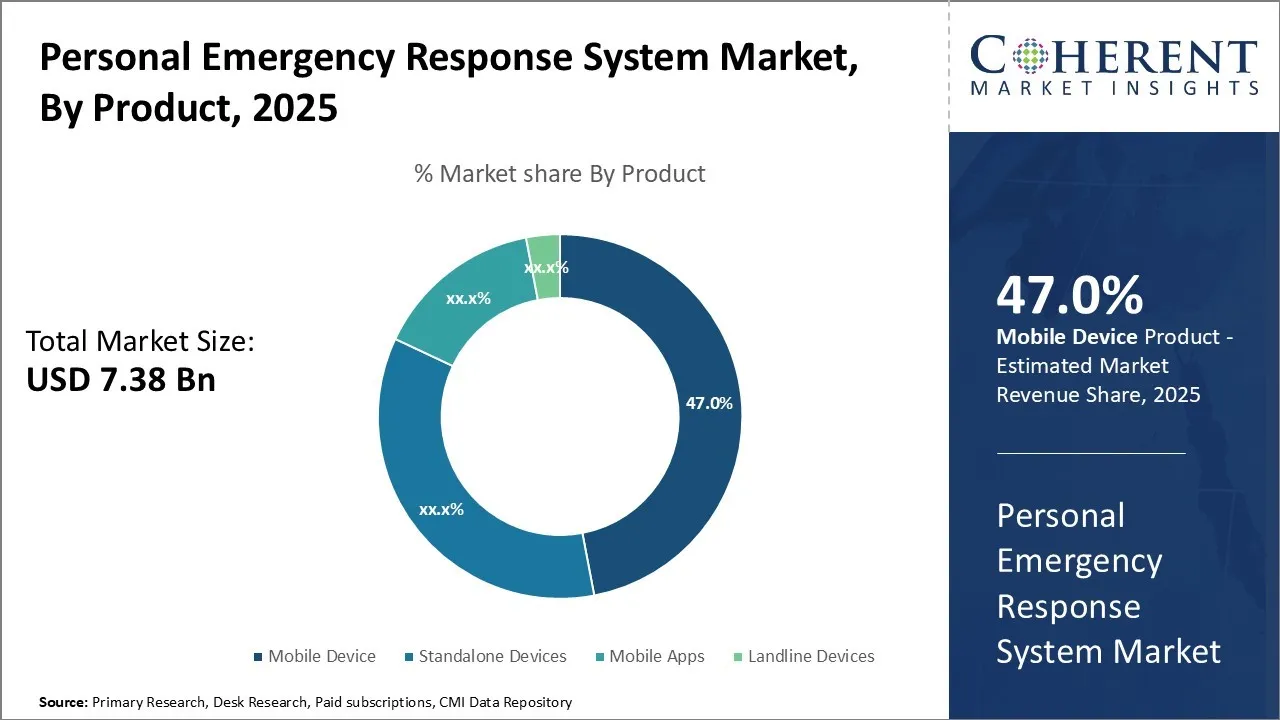
Personal Emergency Response Systems Market Insights By product, mobile devices segment lead the market
By Product, the market is segmented into landline devices, mobile devices, standalone devices, and mobile apps. Out of which, the mobile devices segment is expected to dominate the personal emergency response systems market during the forecast period and this is due to the increase in the adoption of mobile devices by the geriatric population.
Although they acquire technology at a somewhat slower rate than younger generations, older individuals are today more online than they were five years ago. Different smartphone technologies and e-health platforms are used by a chosen group of older folks who are more prosperous and well-educated.
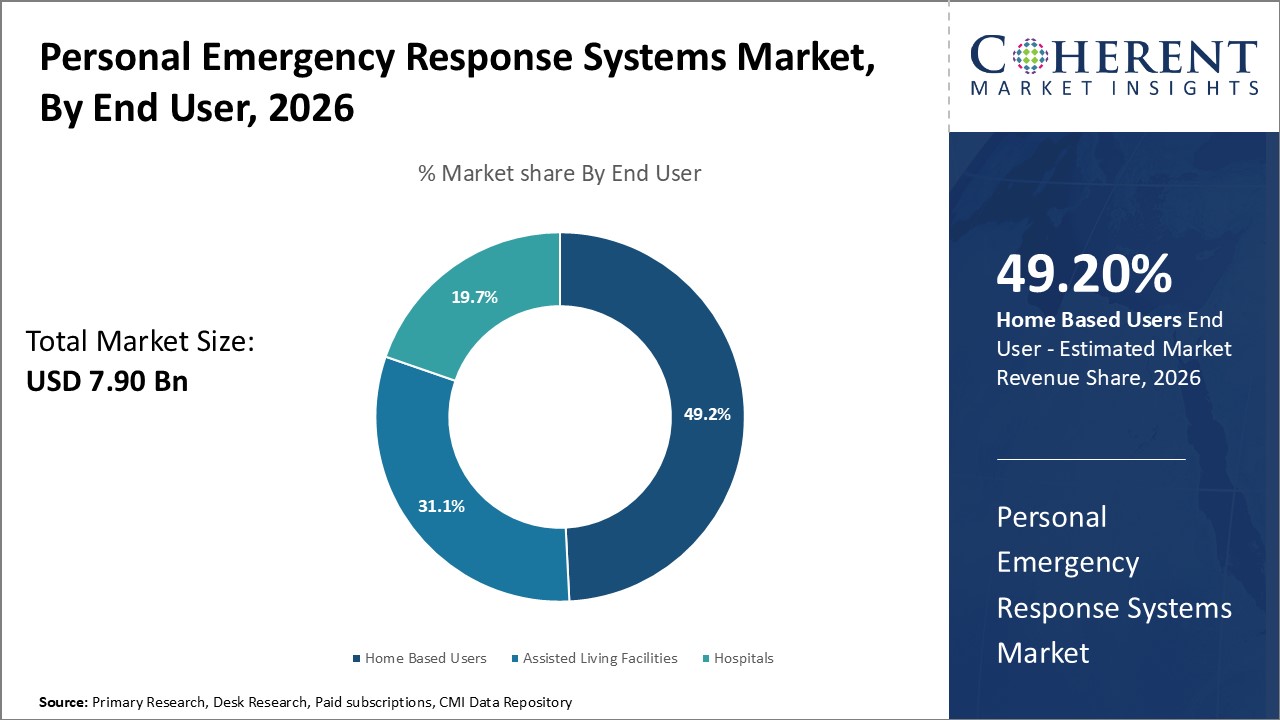
Personal Emergency Response Systems Market Insights, By end user
By End User, the market is segmented into home-based users, assisted living facilities and hospitals. Out of which, the home-based user’s segment is expected to dominate the market over the forecast period and this is due to the increasing needs of the geriatric population having chronic diseases.
Global Personal Emergency Response Systems Market Cross Sectional Analysis
Rising incidence of falls of older patients due to chronic diseases in emerging economies is also expected to boost demand for personal emergency response systems in North America region. For instance, in March 2020, according to The Administration for Community Living, between 2009 and 2019, the number of Americans age 45-64 increased by 4% from 80.3 million to 83.3 million. The number of Americans age 60 and older increased by 34% from 55.7 million to 74.6 million.
Global Personal Emergency Response Systems Market – Regional Insights
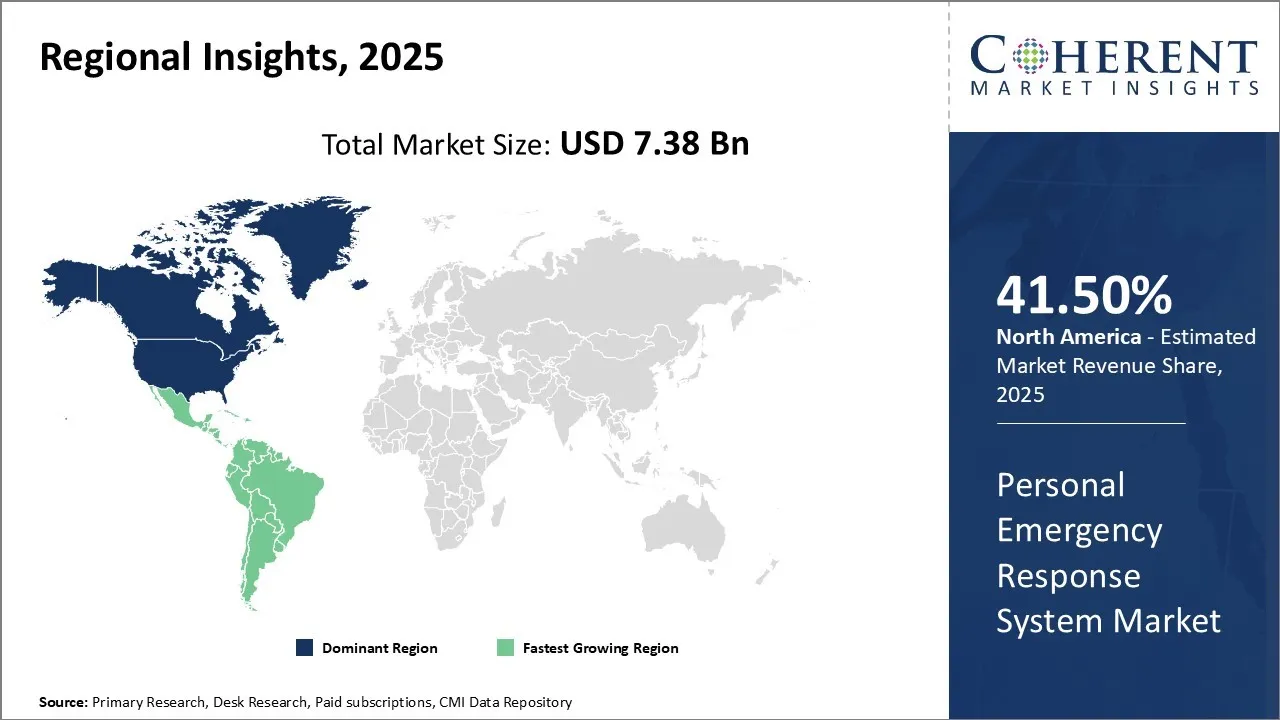
North America Personal Emergency Response Systems Market Analysis and Trends
Among regions, North America is estimated to hold a dominant position in the global personal emergency response systems market over the forecast period. North America is estimated to hold 41.50% of the market share in 2026. In the upcoming years, the demand for personal emergency response systems in the North American market is anticipated to rise sharply due to factors including the rising prevalence of chronic diseases like Alzheimer's disease and the rising prevalence of falls among the elderly. Thus, the rise in global personal emergency response systems market growth over the forecast period.
Personal Emergency Response Systems Market Dominating Countries
United States Personal Emergency Response Systems Market Analysis and Trend
The U.S. dominates the global PERS market with its aging population, sophisticated healthcare infrastructure, and extensive use of medical alert technologies. Government encouragement of elderly care and extensive utilization of home healthcare services translate into robust demand for mobile and landline-based PERS solutions.
Germany Personal Emergency Response Systems Market Analysis and Trend
Germany is a leader in the European PERS market, led by an established care system for the elderly and growing investment in assistive technology. The emphasis of the country on independent living among the elderly, as well as reimbursement backing for medical devices, supports stable market growth.
Japan Personal Emergency Response Systems Market Analysis and Trend
Japan's high percentage of seniors and focus on elder security position it as a key market for personal emergency response systems. Advanced wearables and wireless PERS devices are ubiquitous, buttressed by smart city and telehealth programs that promote senior mobility and surveillance.
United Kingdom Personal Emergency Response Systems Market Analysis and Trend
UK PERS market is expanding as a result of government schemes favoring elderly care at home and the uptake of digital health. Both private payers and public healthcare payers are encouraging the utilization of emergency response systems to cut down on hospitalization and enable independent living.
Market Report Scope
Personal Emergency Response Systems Market Report Coverage
| Report Coverage | Details | ||
|---|---|---|---|
| Base Year: | 2025 | Market Size in 2026: | USD 7.90 Bn |
| Historical Data for: | 2020 To 2024 | Forecast Period: | 2026 To 2033 |
| Forecast Period 2026 to 2033 CAGR: | 7.0% | 2033 Value Projection: | USD 12.68 Bn |
| Geographies covered: |
| ||
| Segments covered: |
| ||
| Companies covered: | Major players operating in the global personal emergency response systems include Koninklijke Philips N.V., LifeWatch Services, Inc., Tunstall Healthcare, ADT LLC, Medical Guardian LLC, MobileHelp, Bay Alarm Company, AlertOne Services, LLC., Robert Bosch GmbH and GreatCall. | ||
| Growth Drivers: |
| ||
| Restraints & Challenges: |
| ||
Global Personal Emergency Response Systems Market: Key Developments
- In 2025, LogicMark, an American maker of personal emergency communication devices, introduced Guardian Alert 911 Plus, a next-generation wearable that features 4G LTE connectivity and automated fall detection. The focus of this innovation is enhancing response times and reliability for seniors and vulnerable populations, particularly in mobile and home environments.
- In 2024, Medical Guardian, a top firm in the personal emergency response industry, bought MobileHelp, its B2B division, Clear Arch Health. The acquisition was set to grow the customer base of Medical Guardian in remote patient monitoring and mobile PERS technology. The acquisition bolstered its platform, MGEngage360, as it added its advanced location tracking and real-time monitoring features.
Analyst View
- The personal emergency response systems (PERS) industry is experiencing high interest fueled by the growing aging population and rising incidence of chronic illnesses around the world. With the elderly wanting to preserve independence and receive medical help in a timely manner, the need for trust-worthy emergency alert systems has grown. Innovative solutions like GPS tracker, fall detection, and interface with smart home technology have improved the efficacy and popularity of PERS services. Yet, high upfront expenses as well as data privacy and device reliability issues are still significant constraints potentially hampering adoption rates.
- Potential exists for expanded PERS capabilities through AI and IoT, which can facilitate predictive analytics and individualized health monitoring. Furthermore, increasing awareness in developing economies offers unlimited opportunities for market growth.
- North America remains the leading market, supported by an established healthcare system and increased disposable income within the elderly population. The Asia-Pacific market, by contrast, is poised as the most rapidly developing market due to an expanding geriatric population, enhanced healthcare awareness, and government support for caring for the elderly.
- In summary, the PERS market is well positioned for sustained growth with technological innovation complementing demographic patterns and healthcare requirements. Stakeholders prioritizing affordability, upgraded features, and data security will benefit from this growing market, particularly by targeting underserved areas. In total, the development of the sector will be determined by the equilibrium between technological developments and consumer confidence.
Market Segmentation
- Global Personal Emergency Response Systems Market, By Product (Revenue, USD Bn, 2021 - 2033)
- Landline Devices
- Mobile Devices
- Standalone Devices
- Mobile Apps
- Global Personal Emergency Response Systems Market, By End User (Revenue, USD Bn, 2021 - 2033)
- Home Based Users
- Assisted Living Facilities
- Hospitals
- Global Personal Emergency Response Systems Market, By Region (Revenue, USD Bn, 2021 - 2033)
- North America
- U.S.
- Canada
- Latin America
- Brazil
- Mexico
- Argentina
- Rest of Latin America
- Europe
- Germany
- U.K.
- France
- Italy
- Spain
- Russia
- Rest of Europe
- Asia Pacific
- China
- India
- Japan
- Australia
- South Korea
- ASEAN
- Rest of Asia Pacific
- Middle East
- GCC
- Israel
- Rest of Middle East
- Africa
- South Africa
- Central Africa
- North Africa
- North America
Sources
Primary Research Interviews
- Healthcare Providers
- Medical Device Manufacturers
- Emergency Response Service Providers
- Technology Solution Vendors
- Others
Databases
- IBISWorld
- Frost & Sullivan
- Others
Magazines
- Healthcare IT News
- Medical Device and Diagnostic Industry (MD+DI)
- mHealth Intelligence
- Others
Journals’
- Journal of Telemedicine and Telecare
- Journal of Medical Internet Research
- International Journal of Medical Informatics
- Others
Newspapers
- The Wall Street Journal
- The New York Times Health Section
- Financial Times Healthcare
- Others
Associations
- Personal Emergency Response Association (PERA)
- American Telemedicine Association (ATA)
- Medical Device Manufacturers Association (MDMA)
- Others
Public Domain sources
- World Health Organization (WHO)
- U.S. Food and Drug Administration (FDA)
- Centers for Disease Control and Prevention (CDC)
- Others
Proprietary Elements
- CMI Data Analytics Tool
- Proprietary CMI Existing Repository of information for last 8 years
Get access to 250+ pages report
Every segment, forecast, competitor profile and data table behind the analysis above — available for instant download.
- ESOMAR Member
- ISO 9001:2015 Certified
- D-U-N-S Registered
- GDPR & CCPA Compliant
Missing comfort of reading report in your local language? Find your preferred language:
Transform your Strategy with Exclusive Trending Reports
Frequently Asked Questions
The Personal Emergency Response Systems Market size is estimated to be valued at USD 7.90 Bn in 2026, and is expected to reach USD 12.68 Bn by 2033.
The CAGR of the global Market is projected to be 7.0% from 2026 to 2033.
Increasing healthcare expenditure and increasing geriatric population is expected to drive global personal emergency response systems growth.
Mobile devices is the leading segment in global personal emergency response systems market.
Low awareness of services and low adoption of personal emergency response systems expected to hinder the global personal emergency response systems over the forecast period.
Major players operating in the global personal emergency response systems include Koninklijke Philips N.V., LifeWatch Services, Inc., Tunstall Healthcare, ADT LLC, Medical Guardian LLC, MobileHelp, Bay Alarm Company, AlertOne Services, LLC., Robert Bosch GmbH and GreatCall.